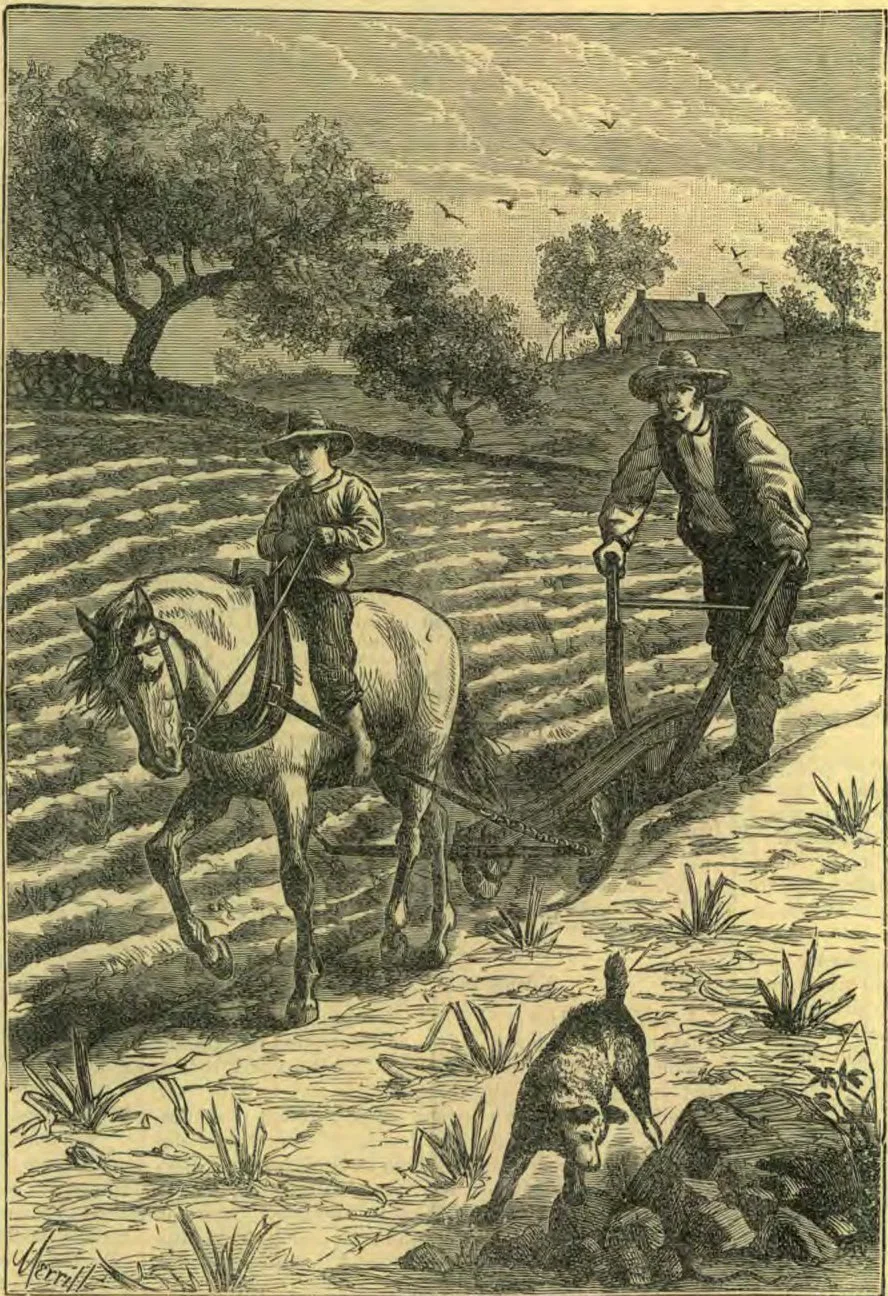
NORMAN DEANE had at last found a place to work. He had inquired at almost every farm-house within five miles; and though nearly everybody wished to hire a boy, Norman, who was only twelve years old, and small and puny-looking at that, was always told that he wasn’t “big enough” or “tough enough.” But he was not discouraged. He knew that on his success depended his going to school that winter, for he must earn some new books; his old ones he already knew by heart.
His mother was a poor widow. In the summer time she could support them nicely by sewing; but when the cold New England winter set in, her cough was so bad that she could do but little, and their scanty store was soon exhausted.
Norman had been kept steadily at school, and now it seemed more important than ever; for though he was hardly strong enough to do farm work, he thought he could get a place in a store if he could keep in school another term, and get through his arithmetic; but how could he get the new books?
“I can earn them; I know I can, if they’ll only give me a chance,” said he; and after he had looked three days for the “chance,” it came at last, for a man finally concluded that he might do to ride horse and pick up stones. He offered him fifty cents a week and his board, and Norman gladly accepted it.
This New England farm was so hilly that it seemed necessary, when plowing, to have a small boy ride the horse, because the ground was so uneven, and so stony, that it was impossible to guide both the horse and the plow at the same time. At first this was quite a novelty to Norman; but he soon got tired of riding up and down the long furrows all day, and often he wished he might run away to the woods, and stretch his weary limbs in their cool shade. He even envied the dog, as it ran barking from one stone-pile to another, scaring out a stray toad or a little green snake; but the thought of the new books that were to be his made it easier for him.
Then, while they were using the horse to drag or roll the newly plowed ground, he would pick up all the small stones scattered around, and pile them with the larger ones for the men to carry off and build a wall. Every week when he went home, he would tell his mother all about his work and how much he hoped to earn; but he never told her that sometimes he was too tired to eat the nice bowl of fresh bread and milk the farmer’s wife gave him for supper, nor how the stones bruised his feet till he could scarcely walk.
At last the plowing was all done, and he proudly trudged home the week before school commenced, with two bright, shining dollars. The doctor was just leaving, as he reached home; but he heard him say, “You’ll never get better of that cough, ma’am, unless you dress warmer than you do. Take my advice, and get some good, warm flannel to wear this winter, or I’ll not answer for the consequences.”
Norman didn’t say much, but he thought a great deal; and that afternoon, when he went to the village store, instead of walking to the counter where the books were temptingly placed, he resolutely turned to the other side, and called for two dollars’ worth of their very best flannel. As the kind-hearted store-keeper measured it off, he turned to Norman, and said pleasantly, “You’ve been at work this fall, I hear, and now I suppose you will go to school this winter?”
“No, I guess not,” answered Norman; “I’ve changed my mind, and I won’t be able to get any books, now, anyway.”
“Why, what’s the matter? Your mother was telling me just the other day how well you were doing. You haven’t been spending your money foolishly, I hope?”
“Oh no, sir,” said Norman, “but—but—”
“But what?” questioned the man; and so Norman had to tell him all about it; and though he said nothing but “Well, well,” Norman thought, as he went out, that he saw him wipe his eyes.
To say that Mrs. Deane was surprised at the appearance of Norman with a bundle of red flannel instead of books, would scarcely express it; but a greater surprise lay in store for Norman when Mr. Adams, the store-keeper, came there the next day, and said that he had been thinking of getting a boy to run on errands and go to school; and that if Norman thought he would like it, he might come, and he would give him his books and clothes, and if he got along well, and was pretty good at figures, he would take him into the store next summer.
Norman did get along well, and he is in the store yet, but not as errand boy or clerk. He owns it now, and his mother has all the red flannel she wants to wear. He says his success began with “one unselfish act.”
S. ISADORE MINER.
How Jamie Hated Order
“When you have played outdoors until the last minute, and you get into the house just as the clock strikes one, then do you mind if dinner is all in order?”
Jamie smiled, and then looked a little sober.
“Yesterday, when Uncle Charles came to take you to ride with him, if you could be ready in five minutes, were you sorry to find a clean collar, neck-tie, handkerchief, gloves, and hat all ready to lay your hand on them?”
“Mamma!”
“Would you like to find yourself at school with holes in your jacket? Do you hate, when you go up stairs at night tired, to find a bed nicely made up?”
“Mamma, what do you mean?”
“It is not order that you hate, but the trouble necessary to gain it. No one of us likes that; but ought not each one to do his part? Or should papa or mamma do all the tiresome picking up and ‘fixing up,’ while Jamie only enjoys it?”
Jamie put two warm arms around his mother’s neck.
“O mamma!” said he, “you have such a way of telling things. I’ll try not to be selfish any more.”—Little Sower.
HOW JAMIE HATED ORDER.
WHEN Jamie came rushing in from play to supper, his mother was obliged to speak to him about hanging up his hat. When his hunger was satisfied, and he started from the table, she had to say: “Jamie, don’t leave your napkin like that! Fold it, and put it in the ring. Have you no sense of order?”
“No, mamma!” cried Jamie, rushing back to do as his mother told him; “I hate order! It’s always hindering.”
“Some people might say that disorder is always hindering. If you had folded your napkin at the proper time, you would not have had to come back to do it,” said Mrs. Wright. “I think you love order as well as any of us.”
“No, I don’t! I just hate it! I love to fly my kite, or to make a boat, and sail it on the pond; and when it is dark, I love to come in and see you, and eat supper; but I just despise to be always folding or hanging up something.” And Jamie jerked the table-cloth so that the baby’s tray and spoon went clattering to the floor. Then there were two more things to pick up.
“Still,” said Mrs. Wright, “I think there are some kinds of order which you like.”
“I am afraid not, mamma; not one.”
Letter Budget.
CECIL C. BRANSTETTER, of Metcalfe Co., Ky., says: “I seldom see a letter from Kentucky, and so I write. Pa is away canvassing most of the time. My little brother and I cut and haul wood, make fires, feed the stock, and go to mill. We have been plowing some, but my brother is too small to plow much, as he is not seven years old yet. I am eleven years old. Pa rewards us by giving us fifty cents a week when we are good, and don’t get angry; but if we fail, we miss our reward. I send you some poetry, ‘Think of the Poor,’ which I hope you will print. We have Sabbath-school at our house, as we have no church house. We send love to all.”
Boys and girls can be very helpful in their homes if they try; and it is the business boys and girls that generally make the most useful men and women. The poor we should always remember; and we can always find those who need our help. The poetry you send, Cecil, will be pasted in the INSTRUCTOR scrap-book, to be used some time in the winter season, when the poor are to be especially remembered.
MAL. E. FOOT, of Clare Co., Mich., says: “I am eleven years old, and never saw the weekly INSTRUCTOR until last Saturday; but I think it is splendid. I should like always to take it. Ma says if I will keep them clean, she will get them bound for me. I should like to get acquainted with the little letter-writers of my paper. If you think this worth printing, I will write and tell you all about the country.”
Dear little friend, we are glad to number you with our letter-writers, and hope you may think even more of your paper than you do now. When you tell us about the country where you live, won’t you please tell us where you first saw the INSTRUCTOR?
MILES A. CONNOR, of Longlade Co., Wis., says: “I wrote you last May for the first time. We were then the only family here who kept the Sabbath; now there are two families and part of another with us. We organized a Sabbath-school, which registers twenty-six scholars at present. In October, Eld. Decker baptized eight persons. Papa, mamma, and I were three of the eight. I desire to live a Christian, and be accounted worthy to obtain eternal life.”
Miles, you truly have cause for thankfulness.
FAITHFUL IN LITTLE.
I CANNOT do great things for Him
Who did so much for me,
But I should like to show my love,
Dear Jesus, unto thee,
Faithful in very little things,
O Saviour, may I be!
There are small things in daily life
In which I may obey;
And thus may show my love to thee;
And always—every day—
There are some little loving words
Which I for thee may say.
There are small crosses I may take,
Small burdens I may bear;
Small acts of faith and deeds of love;
Small sorrows I may share;
And little bits of work for thee
I may do everywhere.