In watering house plants, give them a heavy soaking and let that suffice for several days.
“The best disinfectant known to science, boric acid, does not seem to be appreciated by people generally.”
Immersing oranges in hot water for a few minutes before peeling will make the peel come off easily, removing all of the inner white skin with it.
When you wish to set dishes on ice in the refrigerator, put a rubber ring, such as are used on fruit jars, under the dish to prevent slipping as the ice melts.
Marshmallows lend themselves to various ways of serving; but placed on little square white wafers (one marshmallow to each square), set in the oven until soft enough to put English walnuts in the center, browned, and then cooled, they make a delicious dainty.
To make a rich brown crust on biscuits, pies, and tarts when baked, brush the top with cold milk or cream.
Thin slices of white soap added to the water before putting flowers into it will preserve their freshness. Some will keep fresh for two weeks, when so treated.
Sole linings of white shoes often discolor fine white stockings, and the stain is hard to remove. To obviate this, cut inner soles of good, white paper, thin, but strong and smooth. New inner soles may be made of this material as often as needed.
According to a statement of the Department of Agriculture, most of the rice on the market is polished and coated; that is, it first has its natural coat removed and with it a considerable portion of the protein, fat, and inorganic salts, as well as the flavor of the grain, and then it is provided with a new coat of talc, glucose, or other material. According to the rules of the Department, rice which has been put through such a finishing process should bear a statement to this effect.8
For the Finding-Out Club
[Every one who sends in a correct list of answers to any set of questions will be entered as a member of the Finding-Out Club, if the list is received within three weeks after the date of the paper containing the list. Membership lists of answers to be accepted must follow the rules given below:—
The list must be written neatly.
Pen and ink must be used.
Writing must appear upon only one side of the sheet of paper.
The answers must reach the editor’s desk within three weeks after the date of the paper containing the questions answered.
All lists must be folded and not rolled.
The questions must not be repeated in the list of answers.
Each answer must bear the same number as the question it is intended to answer.
Every list must give the date of the Instructor containing the list of questions being answered; for example, “Answers to questions in Instructor of December 8.”
Every list must bear at the bottom the name of the one sending in the list.
The number of lists that one has successfully answered is indicated by the small figure at the upper right-hand corner of the name. Failure to heed any one of these rules is sufficient to bar one from membership in the Finding-Out Club. Let us watch the membership grow.—Ed.]
INDICATE the pronunciation of the following names:—
Iowa
Golgotha
Diana
Hemans
Guyot
Eiffel
Genoa
Chopin
Buddha
Faneuil
Cyrene
Beethoven
Erasmus
Doré
Barbados
Answers to Questions in “Instructor” of October 10
1. CHARLES G. FINNEY, an American theologian and popular preacher. He was born in Connecticut in 1792 and died in 1875. He was nearly twenty years old before he had the privilege of attending Sunday school, or indeed a real church service. Up to that time he had lived in what was then the wilderness of western New York. When nearly twenty-five years old he began the study of law, and he found so many references to the Bible in his law books that he felt he must own a copy, and bought his first Bible. He soon discovered that the study of the Bible was far more interesting than the study of law. He gave up his plan to become a lawyer, and instead pleaded the cause of his Master, Jesus Christ. He became one of the best-known preachers in America.
When Oberlin College was founded at Oberlin, Ohio, Mr. Finney was chosen president. The college grounds were then just a clearing in the forest, and the students slept in barracks. President Finney helped thousands of college students to become noble Christian men.
2. Humbert Nicholas Thomas Jean Marie is heir apparent to the Italian throne. He is but twelve years of age, yet he has had some remarkable adventures. He is head of the Young Explorers of Italy, a body that corresponds to the Boy Scouts in America, and he has done many things that most boys would like to do. He has gone up in aeroplanes, down in submarines, steered warships, sailed boats, shot at wild boars, and ridden cavalry horses. But the things he is proudest of are his visits to the front, for he has been there not once but many times. His first visit was a matter of considerable family discussion.
While the first prince of his line destined to a naval career, young Humbert likes the army as much as the navy. His fondness for soldiers comes from his associations with his aged grandfather, King Nicholas of Montenegro, who has been a soldier all his life, and involved in wars with both Austria and Turkey. Humbert loves his grandfather very much, and has always insisted on hearing tales of the latter’s exploits in war.
3. Carmen Sylva was the nom de plume of the late Queen Elizabeth of Roumania. She chose this name to be used in her writings as an expression of her love for all nature, for her people, for birds and flowers and for the world. Her writings include poems, plays, novels, and short essays. Translations of her works have appeared in all the principal languages of Europe. Two of her works she wrote in English, “Sweet Hours,” and “Edeleen Vaughan; or, Paths of Peril.” Her “Thoughts of a Queen” and “Shadows of Love’s Dial” are of especial worth.
Queen Elizabeth spoke of herself as the queen who was born far from the throne. “She had early shown a most positive dislike to the thought of being married, and whenever the subject was discussed she would say, ‘I do not want to marry unless I can become queen of Roumania.’ There was nothing to the speech at the time, except that it was her way of saying that she would never marry, as the principality of Roumania was just then being founded, and the idea of any one’s being its queen was a dim and hazy one. But sometimes strange destinies are dealt us. Prince Charles, of Hohenzollern-Sigmaringen, had met the obscure young princess in Berlin in 1861, when she was just blooming into womanhood, and he straightway fell in love with her. She refused his suit, however, on the same pretext, that she would marry no one unless she could become queen of Roumania. In this way she thought to defer indefinitely the momentous question. Later, however, when Prince Charles had been selected to rule over Roumania, he again sought the wilful young lady, and reminded her that she could now rule over Roumania by becoming his wife.
“So she accepted the fortune which fate seemed to have planned for her, and in the autumn of 1869 she and the prince were married.”
Queen Elizabeth was a beautiful woman, physically as well as in character. She was greatly beloved by her subjects, and “the fragrance of her personality will linger in the hearts and memories of people of all ranks in other countries as well as her own.”
Members of the Finding-Out Club
T. D. Sanford⁵
Mrs. Minnie Norman
Milton K. Dymot
Lois A. Christian
Helen Salisbury
Inez Mortenson⁵
Harold E. Beasley
Irene Mac Donald
George F. Webb³
Ruby E. Lea³
Frances C. Rosenkrans
Bessie Mount⁷
Earle Stiles
Mrs. Grace Hoover⁶
W. C. Van Gorder
Mrs. L. A. Jacobs⁸
Mrs. Blanch Spriggs
Mary H. Moore⁶
Norman Lee Marsh
Charles S. Channing³
Harold W. Clark
Lolita Leadsworth³
Edwin Montgomery
Stella Teft Shryock
Louise Quick
Oscar Nystel
Almeda Laing
Agnes Nystel
Ity Ruth Thompson
Mary B. Long²
Loretta Heacock
E. Harold Shryock
Ross A. Curtis
Helen M. Gould
Mae C. Laing
Mrs. Robert Wallace³
Rose M. Brown
Mrs. H. C. Lyle
Harold N. Williams
Mrs. Hattie Robinson³
Cora Felker
Eva B. Taylor
Grace M. Steves
Mrs. Anna Osborn
May Willhelm
Athalie Moseley
Frank Steuenberg
Laura Sharp
Alfred Shryock³
Mrs. Belle Schrank
Milton Dillon, Jr.
Katherine Coleman
J. D. Mac Ginn
Pauline Sanford
Eva B. Santee²
Lou Smith
Reuben Coquillette
Myrtle E. Cooper
Virgil Jackson
Orie A. Johnson
Evelyn Karr
Lillian Beatty
G. Nystel
Mary F. Beatty
Laurence Mac Lafferty
Bernice Mac Lafferty²
R. R. Sweany
Herbert Hansen
W. M. Andress
H. O. Kaneko
William S. Thomson
Mrs. Josephine Paden²
Hattie M. Shoals²
Mrs. Mary Finn²
Lillian Burrows-Parker
Vera Mott
C. J. Dart
Mrs. E. M. Glass
(Concluded on page fifteen)9
Members of the Finding-Out Club
(Concluded from page eight)
Lavina Burkhalter²
Mabel Otey Kelso
Engracia Hansen
Leota G. Spicer
Gussie Field-Colburn
William E. Whitmore²
Mrs. C. M. Babcock
Perry G. Hills²
Thelma Aletha Fretz
Helen Dykstra Beguelin
Hazel Brooks
Stanley R. Altman
Mrs. W. T. Lewis
F. E. Cary
John Newton
Mrs. Ruth Mount
Clara H. Curtis
Curtis F. Myers
Faye F. Felter
Lulu Morehead³
Mrs. Grace C. White
David E. Fay²
Mildred Meleen
Mrs. F. D. Emmons
The City of Salt
MORE than a thousand feet down in the bowels of the earth, Polish miners at Wieliczka, eight miles from Cracow, Poland, have been blasting and working rock salt. Twelve hundred men work day and night in the mines, for which they receive a bare twenty-five cents a day. They work, too, under hazardous conditions,—dangers from gas, fire, collapsing salt columns, and from the salt itself, which has a very disastrous effect upon the health.
Once “a fire broke out while fodder for the horses was being lowered. It raged for seven months, consuming even the boats upon the subterranean lakes, and the little railroad stations, cafés, restaurants, and other buildings in this strangest of cities.
“There are hundreds of horses employed in the underground city, hauling little steel wagons full of rock salt. Many of these animals are entirely blind, having been born in the mines and having lived for years without seeing the light of day.”
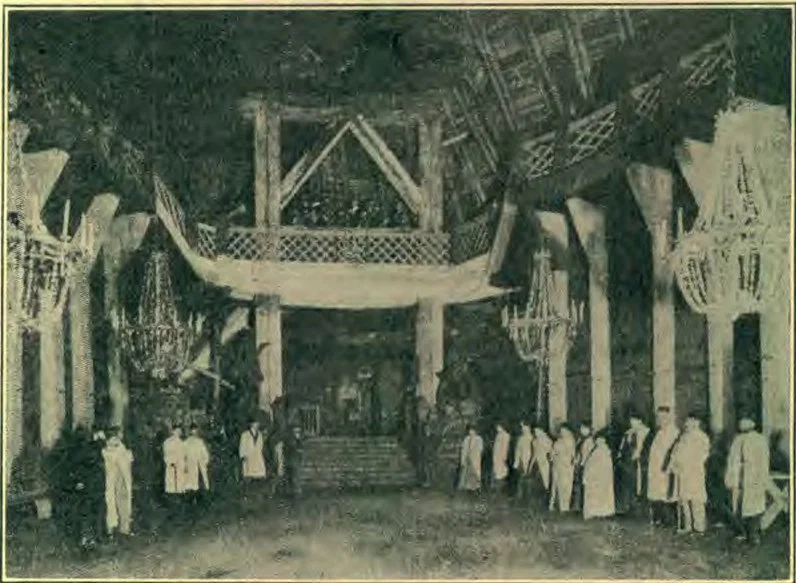
“THE ENORMOUS CHAMBER KNOWN AS THE LETOW BALLROOM”
The salt is mined according to plans made by some master mind, so that the visitor sees ballrooms, chapels, railroad stations, massive chandeliers, throne chairs, and many other things of interest.
The enormous chamber known as the Letow Ballroom is doubtless the product of centuries of human toil. This chamber lies 230 feet below the surface of the ground, and was first used as a ballroom in 1809. There is surely no “more remarkable hall in the world than this ballroom, with its ancient twisted pillars, elaborate galleries, gigantic chandeliers, and statues carved out of the glittering crystals.”
“A thousand and one candles and electric lights scattered in all parts of the mine when all are allowed to do their part in the illumination, make the place seem like an enchanted fairyland.
“At one end are high reliefs hewn in the salt walls symbolizing Knowledge and Labor. There are weird-looking statues, too, of Vulcan and Neptune also cut in salt; and a triumphal archway surmounted by the figure of a miner saluting. A Polish inscription is carved beneath. These Galician miners maintain an excellent orchestra among themselves, and on festival days the salt-cut ballroom is a strange and merry scene with wild Slav music and dancing couples all in native costume.
“On the second level of the mine is another magnificent apartment known as the Michatovice Chamber. This is nearly 100 feet long, 60 feet wide, and no less than 121 feet high. It supplied salt for forty-four years; and in parts the sides and roof are made secure by means of lofty tree stems placed one above the other and strutted together. Depending from the center is a huge cluster of salt crystals, which is eight feet in diameter and twenty feet high. This unique chandelier takes 200 candles, which, when fully lighted, make the great chamber a spectacle of weird grandeur.
“The Kaiser Francis Chamber, which is nearly 200 feet long and 104 feet high, contains memorials of a visit from an early emperor and empress, as is recorded on two rock-salt pyramids.
“The Archduke Frederick Chamber slopes down between the second and third levels; and a strange effect is produced on the visitor as he walks down the spacious floor by the light of red Bengal flares, and hears in the distance the wild strain of the miners’ band below.
“Some 250 yards away and about 500 feet below the surface of the earth, one reaches the Count Goluchowski Station, excavated three centuries ago, and in 1854 turned into the main railroad station of the underground city, since it is the point of convergence for so many of the galleries, with their little trolley lines and horse cars.
“On great holidays friends of the miners and visitors generally assemble on the station platform, where is a café seating 400 persons. In a gallery above—of course cut in the salt—an orchestra of miners plays selections to the passengers who are about to make a trip altogether unique. Just westward of the station are two beautiful grottoes, respectively the Rudolph and Stephanie, connected by a tunnel filled with salt water sixteen feet deep.
“Farther along, this broadens out into a lake, and rising out of the water is a colossal statue of St. John, with lovely shining salt stalactites all around him. Immediately beyond, one enters the marvelous cathedral of St. Anthony, with altars, statues, columns, and so on, all hewn from the sixteenth century onward out of ruby-red rock salt.
“You can imagine no experience more impressive than to enter this crystal-hewn church behind a party of men provided with flaming pine torches and bunches of magnesium ribbon. Its reputation for sanctity is so great that the church is resorted to by thousands of pilgrims annually. The miners have their own chaplain, with special prayers adapted to their perilous calling, and never a shift is changed but prayer is offered in the subterranean cathedral which grew so slowly under the ax and chisel of these devout Galicians.
“Of the many marvels to be seen in the mine, the most wonderful, perhaps, is a second large subterranean lake, lying 700 feet below the surface of the earth. The waters are dark, thick, and heavy, and as the boat in which visitors are carried glides over10its surface, the spreading ripples roll up against the sides of the grotto with a ghostlike swish. The little waves splash against the greenish and ruby sides of the grottoes, making weird echoes and giving the visitor an overwhelming sense of remoteness from the world. The boat is substantial, and accommodates many people. It is guided through the grottoes in a curious fashion, by ropes running on pulleys along the sides of the boat. The trip across and back takes fifteen or twenty minutes, as the boat moves slowly through the sluggish brine. A gun fired in the middle of the lake makes a long and lingering echo, and the voice of the boatman, as he calls out that all is ready, seems like the voice of a giant from the depth of chaos. There are sixteen of these lakes in the mine, but visitors are allowed upon only two of them.
“The laborers produce 65,000 tons of salt per annum. As might be supposed, their implements are of the most primitive kind, but still these simple men continue patiently cutting their way through the solid crystals, leaving behind them strange pillared streets with statues, signposts, obelisks, queer animals, and a hundred other fantasies.”
Wireless Telegraphy
By Walter H. Hamel
WIRELESS telegraphy as it is today is one of the foremost wonders of the world, yet there are to be found scores of youths among the most skilled of the craft, amateurs to be sure, but some of whom have discovered new wonders in the art and many of whom have shown great scientists points of heretofore unknown interest.
Scanning the pages of Uncle Sam’s official list of radio operators, one finds many boys still in their teens who have built admirable wireless apparatus, and have installed complete outfits in their homes, capable of sending and receiving messages a great many miles, sometimes from points all along the Pacific and Atlantic coasts, and from vessels plying therefrom.
Many boys of twelve, fourteen, and sixteen years have passed the federal examination as wireless experts, and the way they manipulate the delicate instruments and decipher the mysterious code that flies through the air, brings admiration to their parents and the older ones of the family.
To a boy who accomplishes these feats of skill and efficiency, our government presents a beautiful diploma in the form of a license which can be kept for reference after the holder becomes grown, just as a school graduation diploma or a medal for bravery and honor is kept, and shown in after years to old acquaintances, a form of guaranty that is always appreciated.
Frequently a patent is granted on wireless inventions to some American youth, and as the field is large, the wide-awake boy is always repaid in some form for his exerted energy. The wireless experimenter in the United States is given more privileges than in any other country.
WALTER H. HAMEL.
Autumn
By Bliss Carman
WHEN the leaves are flying
Across the azure sky,
Autumn on the hilltop
Turns to say good-by;
In her gold-red tunic,
Like an Eastern queen,
With untarnished courage
In her wilding mien.
All the earth below her
Answers to her gaze,
And her eyes are pensive
With remembered days.
Yet, with cheek ensanguined,
Gay at heart she goes
On the great adventure
Where the north wind blows.
— Bliss Carman.
Dietary Idiosyncrasies
IDIOSYNCRASIES in general are natural antipathies toward some object, as animals, articles of food, plants, or water. It is said that Napoleon’s hatred of cats was so great that the sight of one was sufficient to cause him to fall into a nervous convulsion. One man faints at sight of a pig; another on hearing the splash of water, while another pales at the sight of water cress, and still another shivers at sight or touch of a peach, or turns violently ill when lobster or crab is brought before him.
But dietetic idiosyncrasies are perhaps the most common and of the most concern. So many and so marked are these that physicians in general are awakening to the importance of making them a subject of special study, as it is thought by eminent French physiologists that such idiosyncrasies are symptoms of graver troubles; possibly of deep-rooted nervous disorders. At the present time there is no doubt that “one man’s meat is another man’s poison.”
Strawberries are known to act as a poison to some persons, though they relish the taste of the berry. The naturalist John Burroughs found late in life that eggs acted as a toxin to him. One physician discovered to his own consternation and regret that in his case potatoes and neuralgia were closely enough related to be twins, his neuralgia disappearing on the disappearance of potatoes from his dietary and returning when he digressed from the abstinence regimen.
Clams, shad, and salmon cause a severe skin irritation to some persons. The advice given to such is “to scratch these foods from the menu, and the itch will vanish.” Clean, pure, fresh milk, a perfect food for the ordinary baby, is altogether inadequate to nourish some babies. Hives invariably follow the drinking of milk by some persons; as they do the eating of grapes or cabbage and some other vegetables by other persons. One child, though very fond of both almonds and oatmeal, was made ill many times from their use. Tomatoes frequently cause ulcers in the mouth, irritation of the skin, or even rheumatic pains in joints and muscles. So well known is this peculiarity that a certain form of swollen joints is known to physicians as “tomato joints.”
To some persons dietary idiosyncrasies seem mere mental disturbances which could be overcome by an effort of the will. Physicians declare this to be untrue. To force children manifesting such natural disabilities to eat food or take medicine against which their system rebels, is both unwise and unjust. A physician may be able to destroy the idiosyncrasies by giving a course of treatment that will bring the metabolic processes of the patient to the normal standard.
In this scientific age, the one possessed of dietetic idiosyncrasies is to be regarded as a subject for a wise physician’s care, instead of one to be laughed at for his peculiarities or forced to ignore them by unwise parents or guardians.
Two Decisions
By Hazel Kane
MARIAN and Elizabeth lived on adjoining farms in Kansas. Marian’s father had accumulated much wealth, and since his wife’s death he and his daughter had been constant companions. Elizabeth’s father was a man of moderate circumstances. There were only two children, Elizabeth and her brother Ralph. The two children had been taught to assist in bearing the family burdens, and an atmosphere of happiness filled the home. Marian, as can easily be imagined, was a selfish, spoiled girl, for her father had sought to gratify her every wish. The two girls had finished high school together the spring before, and strange as it may seem, Marian had developed a special fondness for Elizabeth.
It had been decided that both girls should attend college the next year. So all summer they were busy making their preparations. Elizabeth was sensible, and in her wardrobe she had all she needed, and her clothes were made neatly, but were plain, while Marian’s wardrobe was filled with elaborately made gowns.
At last the day dawned when they must say good-by to the home folks, and start on their eastward journey. Elizabeth found a lump coming up in her throat as the train whistled in the distance, but bravely she choked it back, for she felt it would be hard enough for her loved ones to bid her good-by. So she cheerfully stepped onto the train, saying, “I will send you a card from Kansas City.”
As the train began to move and the forms of the loved ones faded from view, the girls settled themselves in their seats and began talking. “My, I am glad I can get away from the farm for a few months, for I get so tired of it,” confided Marian.
“Yes, I am glad for the privilege of attending college, but I know I shall miss home,” said Elizabeth. “Ralph said this morning at the breakfast table, that he did not know what he would do without me. He isn’t very well, and I really did hate to leave him.”
“Well, I do not believe father will mind it very much,” said Marian. “He has the work to oversee, then he reads most of the time, and if he really wants to talk to some one, he can talk to the housekeeper.”
Thus the girls were talking when the porter called out, “Kansas City, change for Chicago and all eastern points.” A little redcoat took their luggage and put them on the Chicago train, which was already on the track. From Kansas City the girls took a sleeper, and as the last days had been strenuous ones, they retired early.
Seven o’clock the next morning found each with hat and coat on, for the train was due in Chicago in twenty minutes. Chicago was their destination, and they were anxious to see how everything would be. They were met at the train and taken immediately to the college grounds, where the preceptress showed them to their room. Many of the other girls were already there, and had such cozy-looking rooms that Marian and Elizabeth were anxious to see how theirs would look when in order.
The next two weeks were spent in being classified, getting acquainted with their neighbors, and becoming accustomed to their surroundings. Elizabeth was specializing in English and Marian was taking art. Both girls were so buried in their work that they avoided the worst of those awful homesick days. The teacher in the English department had already noticed that she had a talented student in Elizabeth Gardner. And during the winter term she took occasion to tell Elizabeth what bright prospects lay before her; for she knew this knowledge would only tend to make her more diligent.
One Saturday night a group of merry girls had just returned from a shopping trip, and were in one room looking over their purchases, when Carrie stepped to the door and called, “Marian and Elizabeth, come and see my new gown.”
The girls both ran across the hall. Upon returning, Elizabeth found a letter from home lying on the dresser. Eagerly she tore it open and began reading, but as she read a grave look came over her face, and now and then a tear trickled down her cheek. After she had finished reading, she folded her hands and sat thinking for a long time. It was thus that Marian found her.
“Why, Elizabeth, what is the matter?”
“Marian, I am going home Monday.”
“Why, Elizabeth Gardner, you are not going to do anything of the kind! Give up all your cherished hopes? Well, I guess not.”
“Yes, dear, I am. Ralph is very sick with typhoid fever, and what is more serious still, the doctor fears tuberculosis, but he says that if he had a congenial companion to be with him and keep his mind off himself, and see that he lived out of doors, he might get well. Mother cannot do all this, so I shall go home. I care more for my brother’s life than for all the literary degrees you could give me.”
Monday morning found Elizabeth on the train, speeding toward home. During two hours after reading the letter from home, Elizabeth had sat with folded hands, but it was all over now, and the train could not go fast enough, so anxious was she to be at home. She reached her destination at noon the next day, and finding a neighbor in town, she rode home with him.
Upon her arrival, there was surely a glad reunion in the Gardner home. The days that followed were busy ones, for Elizabeth gave herself entirely to her brother. After long months of watching he began to get a little better, and at the end of two years was quite like himself again.
One day as the doctor was leaving, he looked at the boy and said, “Ralph, you are a well boy again, thanks to your sister’s careful nursing.”
“Yes, Doctor,” said the boy, “I owe my life to her. I tell you she is a jewel.”
Now let us take a peep at Marian. During these two years she has worked hard, and this spring was12graduated with honors. Next year she will be assistant instructor in the art school from which she was graduated. At graduation time her father wrote her a letter, telling her how proud he was of her, and begged her to come home and spend the summer with him, but she wrote back that she could not do it this summer, but that she would try to do it next summer. Oh, could she have seen the look of despair on his face as he read the letter, I believe she would have recalled it all. He realized now that his daughter cared more for her profession than for her father. And from that time on he began to fail rapidly, and the neighbors often said that Mr. Andrews would not live long.
One morning in September Marian received a telegram saying: “Come immediately, your father can live only a few days.” She arrived just two days before his death, and as she knelt by his bedside and listened to his story of loneliness, the hot tears of remorse flowed freely down her cheeks. O, how she longed for a chance to show her love for him, but it was too late, for he was breathing his last.
After her father’s death there was nothing for Marian to do but go back to her profession, but it was with a heavy heart that she did so. She had learned by dear experience that there are some things in this world of more value than a career. As Marian bade Elizabeth good-by at the station, she said, “Elizabeth, I have my profession and a bleeding heart; you have your brother and a heart filled with joy, because you did your duty. How I wish I had followed your example!” HAZEL KANE.
Relation of Students to Their Parents
By S. H. Carnahan
THE foregoing is a subject of grave importance. We are living in a period when many schools and colleges exist, and never before were there so many children and youth sent from their homes to receive their schooling.
A tendency of the times is for young people to fail in proper respect for their parents. When out from their direct control, children often do not sense their duty toward their parents, and show little appreciation and gratitude for the service rendered by them.
Many parents, especially widowed mothers, sacrifice comforts and suffer need in order to furnish means to keep their sons and daughters in college, or spend earnings of former years to educate them.
The pupils, on the other hand, instead of living as economically as possible, use the money extravagantly in pleasures and in what would be luxuries to their fathers and mothers.
Then afterward when these young persons have finished their school and entered some line of work (earning, perhaps, more money than their fathers did when young), they fail to give financial aid to their aged parents who did so much for them, and who are not so able to earn their living in their declining years.
The Lord in well-chosen words shows such students, or other young persons, what he expects of them. The first commandment with promise, the fifth precept of the decalogue, is, “Honor thy father and thy mother.”
Paul, in 1 Tim. 5:8, says, “If any provide not for his own, and specially for those of his own house, he hath denied the faith, and is worse than an infidel.”
We learned in our Sabbath school lessons, as found in Matthew 15, that some might try to evade the duty of assisting their parents by saying, “I have consecrated my time and means to the work of God,” or “It is a gift to the cause, or church.” Christ says of such that they have made the commandment of God of none effect by their tradition, and that even their worship is in vain.
Let us all remember that if we wish to do something for Christ, we can best do it by ministering unto one of his saints, or creatures. Read Matt. 25:40. If we have espoused the cause of Christ, who knows but that our parents will be led to know God only as we show them due honor, respect, sympathy, and gratitude? If we fail in this, they may not be led to him, and we, too, may be lost.
S. H. CARNAHAN.
Jesus is Coming Again
By Myrtle L. Judd
JESUS is coming again! Yes, he surely is coming again! He promised his disciples before he ascended to heaven, that he would return to earth. He said, “I go to prepare a place for you. And . . . I will come again, and receive you unto myself; that where I am, there ye may be also.” That promise, which so stirred and thrilled the hearts of the disciples of old, has been the blessed hope of many other followers of Christ in all ages down to our day.
Enoch said: “The Lord cometh with ten thousands of his saints, to execute judgment.”
Job rejoiced in this hope: “I know that my Redeemer liveth, and that he shall stand at the latter day upon the earth.”
The psalmist tells us that God shall come, and gather his saints, who have made a covenant with him by sacrifice.
Isaiah paints for us a beautiful picture of Christ’s second coming, when death shall be swallowed up in victory, and “the Lord God will wipe away tears from off all faces.”
This hope was also dear to Luther, Melanchthon, Calvin, Knox, Ridley, Baxter, and others, whose names we recognize as men who counted it joy to suffer for Christ. If men of all ages have rejoiced in the promise that Christ would come to redeem his people from the bondage of sin, how much more should we rejoice who live in the time when his coming is “even at the doors”!
By reading God’s Word we know that Jesus will soon return to this earth, and we can see the prophecies which point to his coming being rapidly fulfilled on every hand. Just as we know that summer is near when the trees are tender and put forth their leaves, so we know that Jesus’ coming is near, because we see the signs that point to that event fulfilling all about us.
There are events occurring every day that point unmistakably to the coming of Jesus. The heathen, who have been sleeping in darkness and superstition for centuries, are being awakened and are seeking for gospel light. The day has come when the truth can be proclaimed in many lands where heretofore the doors have been closed to the message of salvation. The nations are angry. Very nearly the whole world13is involved in the great slaughter of humanity which is bringing untold suffering and distress to millions. People everywhere, stirred by the terrible things that are taking place in the world, are asking for an explanation from the Word of God as to what these things mean. Men’s hearts are “failing them for fear.” The love of riches is so possessing the hearts of men today that they will do almost anything to get wealth. But James tells them: “Ye have heaped treasure together for the last days.” The oppression of the poor results in want and privation; strife and commotion and unrest are everywhere; sickness and death walk abroad in the land.
This world is full of sorrow and trouble, and how often we long for a different condition! But, if we will, we may read from these things, as from an open book, that the day of the Lord draws near. Jesus is coming again! coming as the Prince of Peace, to put an end to sin and suffering, and to usher in a condition so different from the present that we can but dimly comprehend it.
But, dear friends, we cannot meet Jesus with joy unless we are ready for him. If we greet him then as a loving Saviour and Friend, we must now look upon him as such, and prepare to meet him. If you have ever looked forward to the coming of a dear friend from a distance, you know how happy it made you feel to have your home set in order, all marks of neglect or carelessness effaced, and yourself dressed in a clean garment before the arrival of your friend. But think how bad you would have felt, and how disappointed, had he arrived and found you unready to receive him. So when Jesus comes, how happy will be the Christian who has been careful to put his spiritual house in order, to remove all marks of carelessness or neglect in character, and to put on the pure garment of Christ’s righteousness.
Let us make the thought of Jesus’ coming a very practical thing in our daily lives. He has told us that he is coming again, and if we are not ready to meet him, he will not meet us as a Friend and Saviour, but as an “executor of just and righteous judgment on account of sin.” We can help others to get ready, too, so that they may meet him with great joy in that glad day.
“The blessed hope of Christ’s return
To this dark world of woe,
Should give us hope and joy and peace
To labor here below,
That souls may hear and ready be
For that momentous day,
When earth shall yield God’s chosen few
Whose sins are washed away.
“The autumn days of earthly life
Cannot mistaken be;
The time is short for you to work,
And short it is for me.
So we should work as ne’er before,
While it is called today;
O labor now for souls in sin,
And garner sheaves away!”
MEDITATION.— Father, I am so glad that Jesus is coming again! But while the thought fills me with joy and hope and courage, it also makes me feel the great responsibility which rests upon those who know that his coming is near. “More diligence give me; swift fleeth the day.” O, help me to get ready to meet my Saviour, that I may be among the number who shall say: “Lo, this is our God; we have waited for him, and he will save us: . . . we will be glad and rejoice in his salvation.”
SPECIAL PRAYER.— Surely those who are in prison or persecuted for Christ’s sake need our prayers. Let us pray especially for them this week. The Lord is just as willing today to answer the prayer of faith in behalf of those imprisoned or persecuted for the truth’s sake as he was when he answered the prayers offered for Peter, and released him from prison.
BLESSED are the undefiled in the way, who walk in the law of the Lord.
Blessed are they that keep his testimonies, and that seek him with the whole heart.
Thou hast commanded us to keep thy precepts diligently.
O that my ways were directed to keep thy statutes!
Then shall I not be ashamed, when I have respect unto all thy commandments.
I will praise thee with uprightness of heart, when I shall have learned thy righteous judgments.
Wherewithal shall a young man cleanse his way? by taking heed thereto according to thy word.
Blessed art thou, O Lord: teach me thy statutes.
I will meditate in thy precepts, and have respect unto thy ways.
Deal bountifully with thy servant, that I may live, and keep thy word.
Open thou mine eyes, that I may behold wondrous things out of thy law.
Incline my heart unto thy testimonies, and not to covetousness.
Turn away mine eyes from beholding vanity; and quicken thou me in thy way.
Teach me good judgment and knowledge: for I have believed thy commandments.
Before I was afflicted I went astray: but now have I kept thy word.
Thou art good, and doest good; teach me thy statutes.
It is good for me that I have been afflicted; that I might learn thy statutes.
Thy hands have made and fashioned me: give me understanding, that I may learn thy commandments.
The entrance of thy words giveth light; it giveth understanding unto the simple.
Great peace have they which love thy law: and nothing shall offend them.
Missionary Volunteer Society Programs for Week Ending November 18
THE programs for the Missionary Volunteer Societies, Senior and Junior, for this date, with notes, illustrations, and other helpful material, will be found in the Church Officers' Gazette for November.