If Christ can save us from past sin, can not he save us from committing sin?
MORAL FIRMNESS IS POWER.
COMMENTING on the exposure of the political corruptions evidently practised for years with impunity in New York City, the Youth’s Companion says:—
“No political event of this century has excited more universal satisfaction among good men of all parties than the overthrow of the corrupt ‘machine’ in New York City. How came it about?
“Now that the great work has been accomplished, every one acknowledges the agency of one man; not in effecting the magnificent revolution, but in shaming the rest of the city into activity, and in forcing his fellows to help him rid the metropolis of its disgrace.
“Why should we not name him?— Rev. Dr. Parkhurst. Not a politician in the usual sense of the word; not even what is commonly known as a ‘man of the world’—at the beginning of his work deemed a harmless, quixotic ‘crank,’ by some who really wished he could succeed; laughed at as one more clerical meddler with what did not concern him, by the mighty saloon-keepers who ruled New York.
“Then it was actually the voice of one crying in the wilderness.
“He was not afraid to lift up his voice; obloquy and ridicule had no effect upon him. He knew he was right, and he compelled men to listen. He laid bare the iniquities of the city ring until it became disgraceful for men to uphold those who were even remotely connected with the ring.
“The lesson of it all is obvious. It applies to many cities beside New York. It concerns many men who are indifferent to municipal corruption. It is to be remembered when the leeches again fasten themselves to the New York City treasury—as they will. If the lesson does not teach itself, no words of ours can.”
THE POWER OF LOVE.
A BEAUTIFUL illustration of the power of love is furnished by the following observation which the writer made some time ago. One day, near a barn, several men were busied in the yard at trying to loose a wagon, the wheels of which had been frozen fast into a puddle of ice. One of them went to work with hammer and axe, and after a great deal of labor, succeeded in setting one of the wheels free, at least sufficiently to revolve it, yet not without damaging it quite a little. But after awhile a woman came from the house with a lot of hot water which she poured on the spokes. Quickly the wheels were completely thawed out by the heated water, whereupon the bystanders loudly praised the woman for her wisdom, and she deserved it. But there was a deeper lesson in that little experience which we all can profit by; it is this: the warming, winning influence of genuine Christian love, and a godly walk and conversation, are far better to melt a hardened and sinful heart to repentance than any carnal or violent weapons of man's invention, or any self-righteous chiding or upbraiding. Let us then be so filled with the love of God ourselves; and by virtue of his love and Spirit within us, be a savor of life unto life to all with whom we come in contact, that by all means we may win some to Christ.
A MANLY YOUTH.
It was a crowded railway station and a raw December day. Every few minutes the street-cars emptied their loads at the door, and gusts of cold wind came in with the crowd. All hurried as they entered. All were laden with bag, basket, box, bundle. Shivering groups stood about the great round stove in the center of the room. A small boy called, “Tillygram and Broken Needle,” which last meant the Brooklyn Eagle. Another boy shouted, “Cough candy and lozenges, five cents a paper.”
“BY-LOW, SWING LOW.”
Every few minutes a stream of people flowed out through the door, near which a young man stood and yelled, “Rapid transit for East New York.”
The gate was kept open but a moment, and closed again when enough persons had passed through to fill the two cars upon each train. Those so unfortunate as to be farthest from the door must wait until next time. Among those unfortunate ones was an old Swedish woman, in the heavy shoes and short frock of her native northland. She had heavy bundles, and, though she had a place so near the door that many pushed against her, could not seem to get out. Her burden was too heavy for her to hold as she stood, and when the rush came, and she seized one package from the floor by her side, she dropped the other, and in trying to get it, some one crowded, and pushed her aside. The bundle was in the way; an impatient foot kicked it beyond her reach, and before she could recover it again, the door was shut. The kind old face looked pitifully troubled.
Suddenly, as she bowed her old gray head to lift the abused bundle from the floor, a bright, boyish face came between her and her treasure, and a pair of strong young hands lifted it to her arms. Surprise and delight struggled in the old wrinkled countenance, and a loud laugh came from two boys whose faces were pressed against the window outside the gate.
“See there, Harry; see Fred; that’s what he dashed back for!”
“No! you don’t say so! I thought he went for peanuts.”
“No, not for peanuts or pop-corn, but to pick up an old woman’s bundle. Isn’t he a goose?”
“Yes. What business has she to be right in the way with her bundles? I gave one a good kick.”
“Here comes the train. Shall we wait for him, Harry?” And they pounded on the window, and motioned Fred to come out.
But he shook his head, and nodded toward the little old woman at his side. He had her bundles, and her face had lost its anxious look, and was as placid as the round face of a holiday Dutch doll.
“Come along, Fred! come along! You’ll be left again.”
“Never mind, boys; off with you. I’m going to see her through.”
And they went. And Harry repeated to Dick, as they seated themselves in the train:—
“Isn’t he a goose?”
“No!” was the indignant answer, “he’s a man, and I know another fellow who’s a goose, and that’s I; and Fred makes me ashamed of myself.”
“Pooh, you didn’t mean anything. You only gave it a push.”
“I know it; but I feel as mean as if Fred had caught me picking her pocket.”
The train whirled away. The next one came: “Rapid transit for East New York; all aboard!” shouted the man at the door.
The gate was opened. There was another rush. In the crowd was an old Swedish woman, but by her side was Fred Monroe. He carried the heavy burden; he put his lithe young figure between her and the press. With the same air he would have shown toward his own mother, he “saw her through.” And when the gate shut, I turned to my book with a grateful warmth at my heart that, amid much that is rude, chivalry still lives as the crowning charm of a manly youth.—Silver Cross.
THE LITTLE BOOTBLACK.
A HUNDRED years ago there lived a little boy in Oxford whose business it was to clean the boots of the students of the famous university there. He was poor, but bright and smart.
Well, this lad, whose name was George, grew rapidly in favor with the students. His prompt and hearty way of doing things, and his industrious habits and faithful deeds, won their admiration. They saw in him the promise of a noble man, and they proposed to teach him a little every day. Eager to learn, George accepted their proposal, and he soon surpassed his teachers by his rapid progress. “A boy who can blacken boots well can study well,” said one of the students. “Keen as a briar,” said another; “and pluck enough to make a hero.”
But we cannot stop to tell of his patience and perseverance. He went on, as the song goes:— “One step and then another,” until he became a man—a learned and eloquent man, who preached the gospel to admiring thousands. The little bootblack became the renowned George Whitefield.—Selected.
BABY'S SWINGING SONG.
By Myrta B. Castle
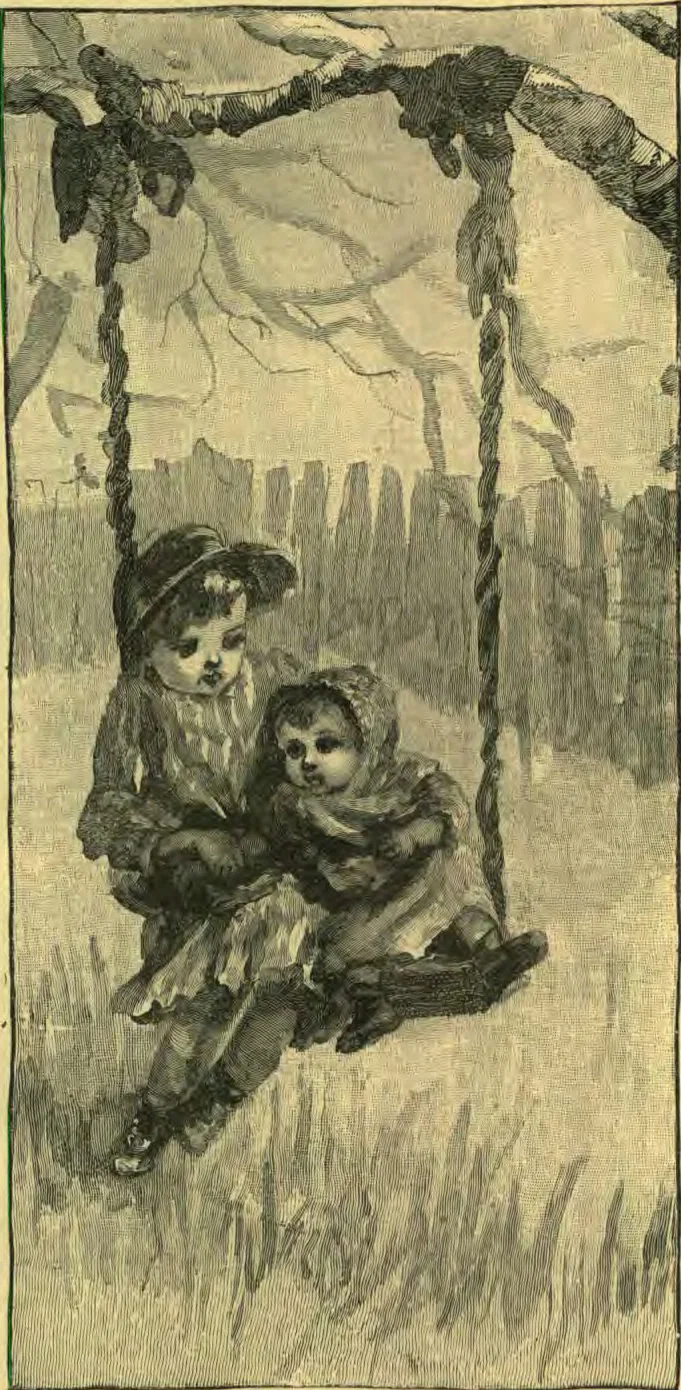
BY-LOW, swing low,
In sunny Babyland; —
The spider swings and spins and swings
His web in Wonderland;
The birdie swings and prunes his wings
In leafy Fairyland;
The dainty baby softly swings —
By-low, swing low,
In sunny Babyland!
By-low, swing low,
O babes in Babyland; —
The spider's spinning, swinging day
Is short in Wonderland;
The swaying bird, with joyous lay,
Swift flits through Fairyland;
And dainty babes, a-swinging too —
By-low — soon go
Afar from Babyland.
MYRTA B. CASTLE.
A WISE CONCLUSION.
By Sydney Dayre
SAID Peter Paul Augustus: “When I am grown a man, I'll help my dearest mother the very best I can. I'll wait upon her kindly. She'll lean upon my arm; I'll lead her very gently, and keep her safe from harm.
“But when I think upon it, the time will be so long.” Said Peter Paul Augustus, “before I'm tall and strong, I think it would be wiser to be her pride and joy By helping her my very best while I'm a little boy.”
— Sydney Dayre.
AN ORIENTAL JUDGMENT.
A YOUNG man going on a journey intrusted a hundred dinars to an old man. When he came back, the old man denied having had any money deposited with him, and he was brought before the cadi (judge).
“Where were you, young man, when you delivered this money?”
“Under a tree.”
“Take my seal, and summon the tree,” said the judge, “and the tree will obey when you show it my seal.”
The young man went in wonder. After he had been gone some time, the cadi said to the old man: “He is long. Do you think he has got there yet?”
“No,” said the old man; “it is some distance. He has not got there yet.”
“How knowest thou, old man,” cried the cadi, “where that tree is?”
The young man returned, and said the tree would not come.
“It has been here, young man, and given its evidence. The money is thine.”
PHYSIOGNOMY
By W. E. Perrin
Physiognomy, as defined by Webster, is (1) the art or science of discerning the character of the mind from the features of the face; (2) particular expression of countenance. There are, then, two kinds of physiognomy, which may be termed active and passive—active physiognomy being the art, itself; while the passive is the particular expression of countenance by which the real character is discerned.
Everything that is visible is stamped with its own peculiar physiognomy. But perhaps the term “physiognomy” should not be applied scientifically to anything that has not a medium degree of intelligent or instinctive life. Inanimate things may have form and color, but they lack expression, which is the distinguishing feature of physiognomy. It is necessary to have both form and expression. Form reveals the general character, quality, or condition; and expression, the mind or disposition.
Physiognomy is a descriptive sign, as it were, which the divine Being has written, in plain characters, upon the face of every living thing, for the benefit of others. It might be termed a window in the outer man, through which we look, and see the character of the inner one. By it we also determine the nature of inanimate objects. Thus, for instance, when we look at a piece of iron or any other mineral, we do not take it to be wood; we distinguish the one from the other by its appearance. But this is physiognomy only in a low degree. The term, as generally used, in its strictest sense, is applied to the study of human nature. The science is used with regard to animals but very little. However, it would be a great help to all who are engaged in the handling of stock, if they were better acquainted with it. The spirit, activity, and strength of a horse can be determined by its facial expression and physical development, just as easily as we discover similar conditions in a human being.
The study of the art is a very deep one; so much so that some think it quite impossible to ascertain, with any degree of accuracy, the nature or character of a person by means of it. The reason given for this belief is that human nature is so varied, each person being the possessor of a distinct character, and differing from every other, just as in looks, that no general rule can be given that will apply to all men alike. But we may lessen the difficulty very much if, in our study of the matter, we take into consideration the fact that there are certain types of character, and that every one belongs to one or the other of these types. Or, at least he partakes more of the qualities of one than of another; so when we understand any certain type, we have the key which will unlock the door to the general character of every person who belongs to that cast, or type. Then there are certain other principles that lie at the foundation of human nature, whose existence or manifestation will be apparent to a greater or less extent in individual character. Thus size and quality usually measure the power of a person. Again: coarseness or fineness, or, in other words, the texture of the body, indicates the condition of the mind; also certain forms or shapes accompany special conditions of character. These principles and manifestations are the same throughout the human race; so if we once understand them, and learn just how to apply them, our conclusions will seldom be incorrect.
The study of physiognomy is very interesting; and all the benefits to be derived from a thorough understanding of it, can hardly be estimated. Many a person has been ruined, homes have been destroyed, families broken up, and lives forever blighted or lost, all because of a lack of knowledge of this science. Men have been unable to understand the dark and mysterious movements of the shrewd schemer, who was working for their financial destruction, until too late; people have not known the real character of pretended friends, until their work was done, and their own downfall was complete. And all of this because they never studied human nature, and therefore could not read it. W. E. PERRIN.
The Corean and His Hat
THE Corean is ranked as a man by his hat.
HE CURES DIPHTHERIA.
The eyes of all the world are upon Dr. Roux, the physician who has met with such success with his new method for curing diphtheria, and Paris, the city of his labors, is accordingly proud of him. It was not until the recent Congress of Hygiene, held at Budapest, that Dr. Roux gave to the world the results of his experiments in treating that dread disease, and it speaks well for his theories and discoveries that the two thousand five hundred physicians assembled in Budapest from all parts of the world seem to put faith in him.
Dr. Roux is a young man not yet forty years old, but he has long been known for his valuable work in the Pasteur Institute. He has been the assistant of Pasteur for fifteen years. Pasteur himself is only a chemist. When he came to study human diseases with his peculiar methods, it was necessary that he should have some trained physician with him. He applied to Vulpian, who was then at the height of his fame and at the head of the faculty of medicine in Paris. That eminent physician chose for him young Dr. Roux, who was but an unknown student.
Fortunately the student was of the stamp of Pasteur himself. He is capable of working twelve or thirteen hours a day, week after week, and he is as curious to know as he is keen in understanding the results of his observations. The discovery of the special poison of the microbe of diphtheria and croup was made by a German professor of Berlin, but he was unable to reduce it to a method of practical vaccination. It is this which has occupied Dr. Roux for the last two years. Out of many hundreds of sick children, he has lost only one fifth, while the old methods scarcely cured one half of the cases, and often two thirds and more died. Considering how many children are brought to the hospital only when the disease is far advanced, he feels warranted in saying that not more than two out of one hundred need die under ordinary circumstances, if properly treated.
All last winter his daily visits to the children's hospital were enough to exhaust the strength of one man. But he was often seen in the remote quarters of Paris at the bedside of little ones down with the terrible disease. Sometimes he has passed the whole night watching them. When the poor parents in the morning asked what they could give him, the famous physician darted out of the door, and disappeared, as if afraid even of their thanks. This disinterestedness, which he carries to an extraordinary degree, is known to all his associates of the Institute.
He is now at the head of the service, but as the Institute is always in want of funds, he does not even draw the small salary which is allotted him. His friends say that he belongs to another age, that he knows nothing of money, and cares less, and that he has given up his whole existence to serve science and humanity.—Exchange.
OUR LANGUAGE.
By A. R. Wilcox
IN SEVEN PARTS.—PART V.
The Norman Conquest and Subsequent Periods.
In the year 1041 Edward the Confessor, whose mother was of Norman parentage, became king of England, and introduced many Norman customs he had learned in the courts of Normandy, where he had been educated. When Edward died, William the Conqueror, Duke of Normandy, laid claim to the English throne, and the question was decided in his favor in a decisive battle on the field of Hastings in 1066. The language of Normandy then predominated in England in the courts of justice, in schools, and in refined circles. The Saxon language was considered to be a vulgar tongue.
The common people hated their conquerors as well as their language, and held to their own tongue for many years. But time heals the deepest wound; so, after a period of one hundred and fifty years, the Saxons became more favorable to the Normans. The Norman-French, as compared to the Saxon tongue, was much better adapted to the ballads and songs which pleased the people of that time so much; and the Saxons, perceiving its advantages, were led to enrich their vocabulary by the addition of words from that language. Five thousand words from the Norman-French were added during the Transition period.
In the thirteenth and fourteenth centuries a revolution in public sentiment occurred, which turned in favor of the English tongue, and it became the official language of the country. Not long after the Conquest, Saxon literature was suppressed; but in the fourteenth century it was again revived, and the first English work of this period,—the “Travels of Sir John Mandeville,”—was published in 1356.
Wicliffe’s translation of the Bible followed in 1380. Chaucer also used his native tongue in his poetical works; but the form of the language in which these authors wrote could hardly be identified with the English of to-day. In the Middle English period, from 1362 to 1550, conservatism was the rule, and but few grammatical changes were effected. The plural form you, as applied to a single person, was first used in the place of thou and thee, during this period.
The Modern English period reaches from 1550 to our own time. Among the most important changes that may be noticed are extensive additions to the vocabulary; establishing and simplifying the forms of spelling; also a few grammatical changes have been made. Some of the changes which have been effected during this period are the substitution of are for be (we are for we be), and of s for th; as loves, instead of the old form loveth for the present indicative. Also its as the possessive of it was quite early in the period introduced in the place of the old form his. According to the old form of declension, the nominative was hit, possessive his. The authorized version of the Bible does not contain the form its; Milton used it only three times, and Shakespeare ten times.
A. R. Wilcox.
Kindness Daily and Guarded Speech
Do a kind deed every day; guard well your words in all you say.
The Cheerful Giver
THE man who does not give cheerfully may give all he has, and yet not give much of anything.
Religion on the Street Versus Religion at Church
Do you practise the same kind of religion on the street that you are supposed to have at church?
Loving the Right Under All Circumstances
No man truly loves the right who is not willing to do right under all circumstances and at all hazards.
The Highest Felicity: Knowing Him Who Is Perfect
To know Him who is the sum of all perfectness is the highest felicity any mortal in this world is capable of.
Praying Without Ceasing to Do God's Will
EVERY Christian should pray without ceasing that he may do the will of God as perfectly as do the angels in heaven.
Faithful Work Is Never Wholly Fruitless
IN this world much that is done faithfully and with the very best of intentions may seem to be useless; but honest work is never wholly fruitless.
Guarding One's Reputation in the Service of God
It is every man’s duty so to guard his reputation at all times that he can fall back on it confidently when it has to be exposed in the service of his Master.
Morality Versus Genuine Religion: The Tree and Its Fruit
MERE morality is not unlike a Christmas-tree,—its fruit is tied to the branches. Genuine religion is a tree whose fruit is the organic product and vital expression of hidden roots anchored in a soil of spiritual fertility. Self-righteousness is a worm-eaten morality.
WHICH?
By Parish Visitor
READER, there are two ways of beginning the day—with prayer and without it. You begin the day in one of these two ways. Which?
There are two ways of spending the Sabbath—idly and devotionally. You spend the Sabbath in one of these ways. Which?
There are two classes of people in the world—the righteous and the wicked. You belong to one of these two classes. Which?
There are two great rulers in the universe—God and Satan. You are serving under one of these two great rulers. Which?
There are two roads which lead through time to eternity—the broad and the narrow road. You are walking in one of these two roads. Which?
There are two deaths which people die—some “die in the Lord,” others “die in their sins.” You will die one of these deaths. Which?
There are two places to which people go—heaven and hell. You will go to one of these two places. Which?
Ponder these questions; pray over them; and may the issue be your salvation from “the wrath to come.”—Parish Visitor.
HOW TO SEEK SALVATION.
By Mackey
An old man once lost a bank-note in his barn. He looked for it several times, but could not discover it. At last he said to himself, “That note certainly is in the barn somewhere, and I will search for it until I find it.” Accordingly he went to work, and carefully moved straw and hay, hour after hour, till he at last found the note. A few weeks after, the old man sat by his fire, musing over his spiritual state, for he felt he was not right with God. Turning to his wife he asked, “What must I do to become a Christian?” “You must seek for it,” she replied, “as you sought for the bank-note.” The words made a deep impression on him. He followed her advice, and ere long was rich in spiritual joy and blessing.—Mackey.
A BOY’S RELIGION.
If a boy is a lover of the Lord Jesus Christ, though he can’t be a church officer, or a preacher, he can be a godly boy,—in a boy’s way and in a boy’s place. He need not cease to be a boy because he is a Christian. He may run, jump, climb, and make himself heard, like a real boy. But in it all he ought to be free from vulgarity and profanity. He ought to eschew tobacco in every form, and have a horror of intoxicating drinks. He ought to be peaceable, gentle, merciful, generous. He ought to take the part of small boys against the larger ones. He ought to discourage fighting. He ought to refuse to be a party to mischief, to persecution, or deceit. And above all things, he ought to show his colors. He need not always be interrupting a game to say he is a Christian, but he ought not to be ashamed to say that he refuses to do something because he fears God. He ought to take no part in the ridicule of sacred things, but meet the ridicule of others with a bold statement, because he feels the deepest reverence for the things of God.—Great Thoughts.
WON BY PERSEVERANCE.
Professor Morris, who is at the head of the mechanical department of Cornell University, has a romantic history. When Hon. Chauncey M. Depew visited Cornell recently, he was claimed by Professor Morris as a superior officer, giving as the reason that he had formerly been an employee of the New York Central Railway.
“How did you get here?” asked Depew.
“I fired on the New York Central. I stood on the footboard as an engineer on the Central. While a locomotive engineer, I made up my mind to get an education. I studied at night, and fitted myself for Union College, running all the time with my locomotive. I procured books, and attended as far as possible the lectures and recitations. I kept up with my class, and on the day of graduation I left my locomotive, washed up, put on the gown and cap, delivered my thesis, and received my diploma. I then put away my diploma, put the gown and cap in the closet, put on my working shirt, got on my engine, and made my usual run that day.”
“Then,” says Depew, “I knew how he became Professor Morris.”
Professor Morris has shown the world the secret of success, which is free to all. Hard work toward a noble end, making the most of each passing day, hour and moment,—this is the sure road to success.—Exchange.
Trustful Toward Friends, Believing Toward God
A GOOD rule to follow is this: “Be toward friends trustful; toward God, believing.”
ARE THEY PLANETS?
This question is asked in a recent number of a leading weekly paper and answered something like this:—
In the constellation Cygnus, which is plainly marked out to the eye by the figure called the Northern Cross, is a faint star, numbered 61, which was the first star whose distance from the earth was measured; and which, notwithstanding its insignificant appearance, is one of the nearest stars in all the heavens.
Examined with the telescope, it is found to be composed of two nearly equal stars, which seem to be connected by their mutual attraction, so that they revolve slowly about their common center of gravity. They are, then, two suns, each considerably smaller than our sun, linked together by gravitation.
Recently Professor Wilsing, at Potsdam, has discovered something very peculiar about this starry pair. He finds that there are periodical variations in the distance between the two stars which are not accounted for by their known relations one to the other, and which, he thinks, could be explained by supposing that there are one or more invisible bodies connected with them.
The thought that these invisible bodies may be planets is a natural one. The belief that there are planets revolving around some, at least, of the stars, is widespread. But the telescope has not yet been able to reveal any to our eyes.
Their attraction, however, must have some effect upon the motion of the stars to which they belong, and in case they are very large and massive, such an effect might be perceptible to us.
If the suspected invisible bodies connected with the double sun, 61 Cygni, are planets, they must be enormously larger and heavier than the earth. The possibility that a star which is comparatively so near us actually possesses planets, cannot but stir the most sluggish imagination.
“REDEEMING THE TIME.”
If you are going to build a boat or a fort, or make a doll’s dress, or a birthday present, you will have to make a definite beginning, will you not? and keep on working at it, if it is ever to be finished. And if you are going to recite a history lesson in school to-morrow, it won’t do to keep putting off looking at it till ten minutes before you go into class; because then names and dates will be one confused jumble in your head, and you will make a failure of the recitation. Simply intending to do a thing won’t bring it about.
Now it is just the same way about serving Christ. Probably not one of you boys and girls would say that you never intend to be a Christian. When you stop to think of it at all, you expect some day to give yourself, heart and soul, to Christ; but now you simply drift along without doing anything.
But drifting will not bring you to Him. You must make a definite beginning, just as you would with any other matter which is important, and which you expect to make any progress in. Don’t drift. Redeem the time, for it is precious. Start now, in this fresh year that God has given you, to serve him, and fill the years with loyal love and living; and then what a record they will bear to God for you! — Child’s Paper.