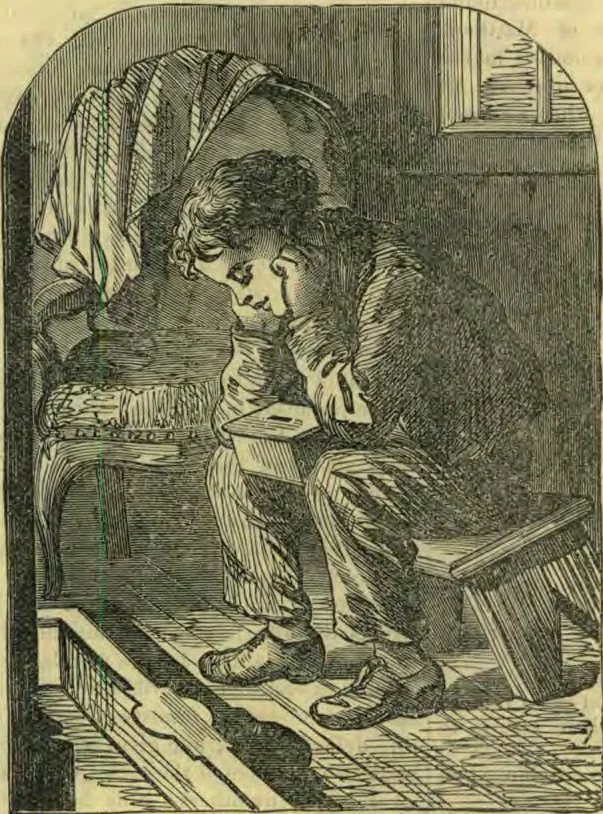
LAST Christmas Albert Reade’s grandfather sent him a savings bank. It was painted a bright red, and was really a very pretty present. Albert had never had one before, and thought he had never seen one any where near as nice as his. He was very proud of his “bank,” and at once began to think about getting some pennies to put into it; for who ever heard of a bank without money? Every penny that was given him by his friends now went into his bank instead of being spent for candy or fish-hooks, as he had been in the habit of doing. His father and mother, seeing how anxious he was, often gave him a chance to earn a little by hiring him to do jobs of work besides the chores which commonly fell to his lot. Then, too, when spring came, neighbor Brown, who had no boys of his own, wanted some one to bring up his cows at night, and so Albert drove them up when he did his father’s cows; and for this he got ten cents a week. This seemed a good deal to a boy like Albert, who has always lived in the country, and so has not had so much spending money as city boys do. And every cent went into the bright bank; and week by week it grew heavier, and Albert’s heart grew happy in thinking how rich he was getting.
Now just back of Mr. Reade’s farm lies a pretty little lake, and two or three summers ago a party of young men and boys from the city camped there. They brought their tents and boats with them; and they often gave Albert and his brothers a ride. Since then it has been Albert’s greatest ambition to have a pretty sail-boat like one of theirs. So when his bank began to fill up, he thought within himself, “Now I will save my money till I can get a boat.” But when the boys questioned him about what he was going to do with his money, he gave no answer, only that they should see by-and-by.
And so the summer passed away, and September came. One evening Albert’s father came home from the post-office, and as the family gathered around the supper-table, he said, “I hear bad news to-night. They say down at the burg that the woods in northern Michigan are afire, and everything is burning up. Here is the paper telling all about it, in my coat pocket.”
All were eager to hear the news; and as soon as supper was over, Mr. Reade handed the paper to Albert’s older brother, Walter, saying, “Here, boy, your eyes are better than mine; can’t you read for us?” And so Walter read of the terrible fire and the ruin it was working,—how that houses, barns, and crops, and even whole villages were burned; and men, women, and children, with cattle and horses, fled before the fire, until the cruel flames overtook and destroyed them, leaving nothing behind but desolate fields and blackened corpses. Others ran until they came to lakes or rivers, where they stayed in the water for many hours. Sometimes the water along the shore grew so hot from the fire that the people were almost scalded. Those who escaped from the fire had no home to go to, and nothing left but the tattered clothes upon their backs; and of course everybody would be glad to send money, provisions, and clothes to the poor sufferers.
After the reading was finished, all began to talk about what they could do to help; and even grandma and little Robbie were anxious to do their part. Money was never very plenty in the little brown house where Albert lives, and it seemed as if it was unusually scarce this fall; but Mr. Reade said to his wife, “Well, mother, we’ll divide with them, won’t we? We’ve never come to want yet, and I guess we shall not now.” So while they were planning what should be done, the boys crept off to bed.
Albert had said nothing, but all the while his father and mother were talking, he had someway been thinking about his bank and the money in it. He wondered how much there was, anyway; but then he could not think of sending that off, for he must save it toward getting that boat which he so much wanted.
Finally Albert dropped to sleep, but the first thing in the morning he thought of the poor people, and then his bank. He went about his chores with such a sober face that his mother asked him if he was sick, for Albert was usually a very cheerful boy. After awhile he came into the house, and going into the little parlor, got his bank off the mantel, and crept softly up stairs to his room under the roof. He sat down there with his head in his hands and his bank on his knees for a long time; and then getting up, he marched down stairs very fast, as if afraid his courage would fail him. His mother was at work in the kitchen, and he went up to her, and handing her the bank, said, “Here, mother, send this to them,” and turned away without another word.
The mother saw what a struggle it was for her little boy, but she thought it was a good thing for him to learn to deny himself for others, and so she wisely said nothing. That evening Mr. Reade opened the bank, and counted out five dollars and sixty cents,—Albert’s donation to the fire sufferers. The father said nothing, but something that looked like tears glistened in his eyes; and as Albert went to bid grandma good-night, she put her hand on his head, and said softly, “God bless you, my son.” E. B.
ONLY A TUFT OF GRASS.
Rambling along the coast of the Isle of Man some years ago, a young man came to a spot where the ground sloped at a steep angle, and then terminated abruptly in a series of perpendicular rocks rising more than three hundred feet above the sea. The ground was covered with short fine grass, rendering it exceedingly slippery for walking.
The young man carelessly rambled along, scarcely conscious of his perilous position, when, suddenly losing his presence of mind, he sat down to recover himself. He had not done so for more than a minute or two, when, to his horror, he found himself gradually slipping down the incline. Every effort to stop himself was fruitless. Each moment brought him nearer to the awful brink. Destruction seemed inevitable. Words can not describe the agony that filled his mind. His whole soul was now engaged in most earnest supplications to God; and He who is always ready to hear, and ever ready to save, even to the uttermost, was not deaf to the momentary cry that rose from this poor young man's lips; for exactly in his path, and within a foot of the terrible brink, there grew a little solitary tuft of grass. Against this he placed his trembling foot. It arrested him in his descent. In this position he remained for a few minutes, fervently engaged in prayer. On becoming more calm, he gently unloosed his boots, and, with the utmost caution, he was enabled to take first one boot off, and then the other, and secure them to his neck. He was now enabled to obtain a firmer footing, and, turning round, he slowly ascended till he safely reached the top, there to adore the Grace that had so miraculously snatched him from an awful death.
Dear young reader, in this illustration, which is a real fact, you have a picture of the careless sinner's position. He is even at this moment sliding down the incline of life; each fleeting second brings him nearer and nearer to eternity's awful brink; beneath him lies the abyss of eternal ruin. This may be your position. If you are not a Christian, it is. But listen. It may be that God has put before you this simple incident—a short but solemn and true story, like “the little tuft of grass”—to arrest you in your downward course. Oh! despise it not. That young man could not afford to neglect even so mean a thing as a little tuft of grass; and can you afford to refuse God's offer of mercy? Many a soul has been saved by reading a single text of Scripture. This may be your time. “To-day, if ye will hear his voice, harden not your hearts.” “As I live, saith the Lord God, I have no pleasure in the death of the wicked.”—London Children's Treasury.
Choosing Worthy Work and Living True to Purpose
It is well in life to care greatly for something worthy of our care; choose worthy work, believe in it with all our souls, and labor to live, through inevitable checks and hindrances, true to our best sense of the highest life we can attain.
CALL THEM TO ME.
By L. C. N.
CALL to Me the little children,
And forbid them not to come;
For of such as these my kingdom,
They are with me in my home.
I would bless them ere my Father
Calls me to his realms above;
Teach you by this act to trust me,
E'en with childhood's perfect love.
These my lambs, Oh gently lead them
Safe into my Father's fold;
They to me are richer treasure,
Than the silver or the gold.
Teach their little hearts to love me!
Guide their tender feet aright!
By their faith, your own shall prove me,
Lead you upward to the light.
They are pure and sweet and holy,
Keep them ever by your side;
So shall you grow like unto them,
Like the Saviour, crucified.
Hand in hand and close together,
Over life's tempestuous sea—
Till at last my pearls I gather—
They and you are safe with me.
L. C. N.
LETTER BUDGET.
Nina Loomis has kept the Sabbath with her parents for about one year. They have meeting and Sabbath-school at their house every Sabbath, and prayer-meeting every Wednesday night. She is trying to be a good girl, and hopes to meet the INSTRUCTOR family in Heaven.
Ollie M. Stevens writes from Corsica, Ohio. She says they have a Sabbath-school of about twenty-five members, and they all have pretty good lessons. Her grandma, who is nearly seventy years old, lives with them, and goes to Sabbath-school almost every Sabbath. Ollie is nine years old, and has three brothers. One is eleven, another five, and the youngest is two. We think they must have a very happy family, and it is so nice to have grandma to live with them.