The Youth’s Instructor, Vol. 29, No. 43.

BAALBEC

The Youth’s Instructor

Oct 26, 1881

S. D. A. Publishing Association · Battle Creek, Mich. · Oct 26, 1881

BAALBEC
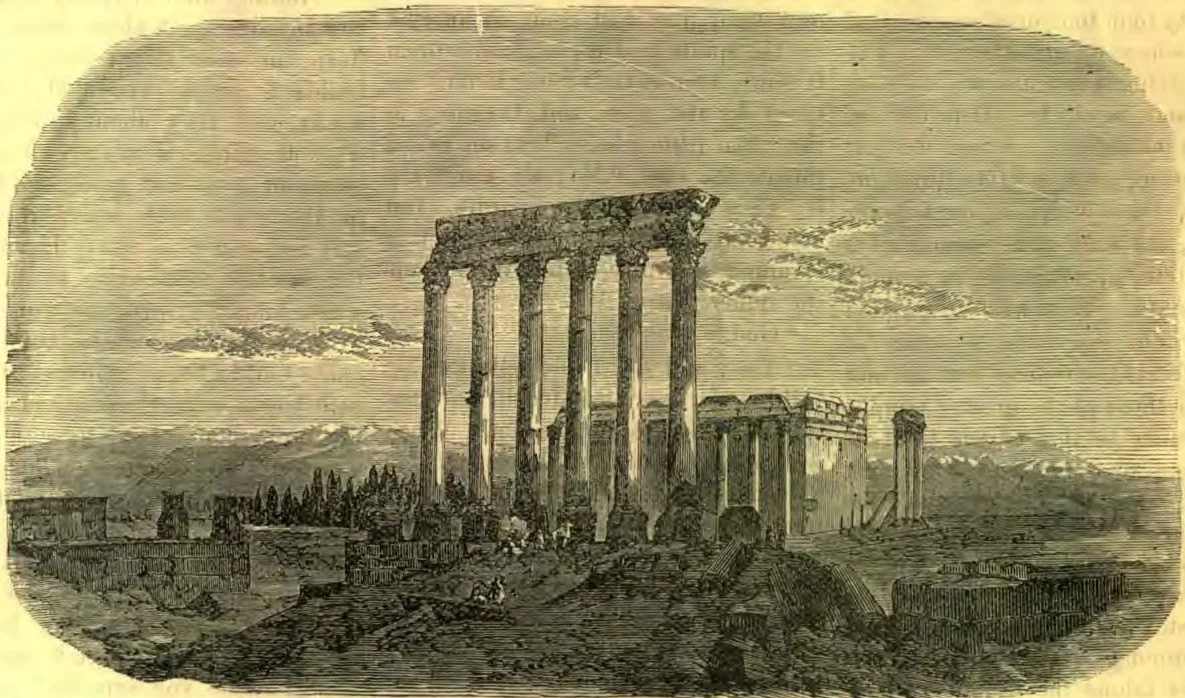
NORTH of Palestine is a hilly range, known as the Mountains of Lebanon. This range extends from a point about fifteen miles east of Sidon, in a north-easterly direction, nearly parallel with the shore of the Mediterranean Sea. Farther to the east, and parallel with Lebanon, runs the chain of Anti-Lebanon. Between these two ranges there lies a beautiful valley, about seven miles wide and seventy miles in length, which was anciently called Cœle-(Sēe-le) Syria, which means Hollow Syria, or Syrian Hollow. Down this valley flows the River Litany, sometimes called Leontes, whose waters empty into the Great Sea just north of Tyre. Tracing this river back until it becomes quite a small stream, and turning the eyes to the east, toward the heights of Anti-Lebanon, one sees in the far distance six huge columns, standing in a line, apparently surmounted by a large timber. If accompanied by a guide, you will learn that these are a part of the ruins of the ancient city of Baalbec (Bäl'bec). You will hardly believe it, when the guide tells you they are five miles away; but after you have walked a mile or two in their direction, and seem to come no nearer to them, you conclude that he is right, and listen to his recital of the city's history.
RUINS OF BAALBEC.
RUINS OF BAALBEC.
A great many hundred years ago, large companies of men traveled on camels, bringing silks, spices, and much other merchandise from India to the sea-ports of Tyre and Sidon, whence they would be sent in ships to all parts of the world. These companies would wend their way down this valley, and when they came to the cool springs and beautiful shade trees that we see around us, they would unload their camels, and pitch their tents for a day's rest from their journey. When the people living in this part of the valley found that the merchantmen stopped very often, and would give their wares in exchange for fruits, vegetables, and grains, they began to build stores and houses on the spot. In this way a large and wealthy city soon sprang up, and because the people worshiped the sun for their principal god, their city came to bear the name Baalbec, which means the “city of the sun.”
The inhabitants finally became so wealthy that they built magnificent palaces for themselves, and two vast temples in honor of their heathen gods. These, with sparkling fountains, stately monuments, delightful shade trees, and the fresh mountain breezes blowing over all, made the city so attractive that a great many traveled long distances to visit it, and the Grecians hearing of it, came over and captured it, and changed its name to the Greek word, Heliopolis, which means the same as the Syrian word, Baalbec. It afterward passed into the hands of the Romans. By this time the idolatrous inhabitants had become very wicked, and even the Roman emperor put a stop to some of their sinful practices. From this time the prosperity of the city declined, until in the year 1400 A. D. it was wholly overthrown.
All that now remains of this once magnificent city are the ruins of its temples and city walls; and the inhabitants, instead of living in palaces of hewn stone, make their homes in huts built of mud, and only number about two thousand. Though now lying in ruins, travelers love still to visit the spot; and as they stand among its fallen columns, and heaps of finely chiseled blocks, lying so useless at their feet, and see what wars, earthquakes, and the lapse of time, have done to these stupendous work of man, they acknowledge that the confused mass gives evidence of the “wrath of God against all ungodliness and unrighteousness of men.” Some have thought that Baalbec was the “house of the forest of Lebanon,” which Solomon built (1 Kings 7:2), but there is no proof that they are right.
But we have now come within full view of the ruins. Before us appears a vast platform, which seems to be built of stones. It rises thirty feet above the surrounding plain, is eight hundred feet from east to west, and four hundred feet in width, and covers seven acres of ground. Around the outside of this structure are seen, here and there, remnants of the city walls, which were three or four miles in circuit. As we look more carefully, we notice three huge stones which help to form the wall of the platform. They are each over sixty-three feet long. Our guide tells us that in a quarry not far away, where these were obtained, there lies another huge block, partly hewn out, but for some reason not used, which is sixty-nine feet long, fourteen feet wide, and seventeen feet high, and weighs eleven hundred tons! How these huge blocks were carried from the quarry and lifted to their places in the wall, no one can tell. Some of the superstitious nations tell travelers that it was done by fallen angels; and surely it would seem less difficult to think so, than to believe that it was the work of puny man.
These stones are in the west side of the wall; our guide has now led us to the north side, and we are entering a dark vaulted chamber, which we are told is six hundred feet long, and will bring us out upon the platform we have been viewing. As we emerge into the sunlight, what a scene meets our view! It looks as though whole temples had been struck by lightning, and had tumbled together in one heap. We now learn the use of this immense platform. We are standing in a six-sided court, at the eastern end of the platform. In front, to the east, are the remains of a mammoth portico, which was once supported by twelve large stone pillars, and was reached by an immense flight of stairs, now wholly in ruins. Turning around to the west, and passing through the remains of an arched doorway of vast size, we enter another court, larger than the first, having four sides. This court, like the first, is filled with the remains of fountains, monuments, and altars, some standing, and some lying upon the ground. Around its sides are numberless little rooms, fronted with pillars.
Climbing up a heap of rubbish, which was once a grand stairway, you stand upon the western half of the platform, which is twenty feet higher than the floor of the courts. Here, at a height of fifty feet above the surrounding plain, once stood the largest temple in the city, said to be one of the wonders of the world. Passing to the farther end of the platform, your eyes fall upon the view presented by the accompanying engraving. There, on the left, stand the six huge columns, which we saw five miles away. What we thought was a timber, we now see is the remains of the cornice by which they are surmounted. These columns, though seventy-five feet in height, and over seven feet through at their base, are composed of only three blocks of stone, placed one above the other. The cornice, which they support, comprises only five blocks, each one reaching from one column to another, and are fourteen feet in thickness. These six columns are all that remain erect of the fifty-four that once surrounded the spot where we are standing. The rest are lying prostrate at our feet, broken and severed. Beneath us, vaulted tunnels, like the one we just passed through, run in every direction.
Beyond these columns, on a lower platform, are seen the remains of a smaller temple, which is in a more perfect state. This was surrounded by forty-four columns, nineteen of which are still standing, but are not so high as those of the greater temple. The entrance to this edifice is at its eastern end, by a portal forty-two feet in height. During an earthquake the keystone of this portal, weighing sixty tons, sank a distance of two feet, in which position it still remains. On this keystone is sculptured an eagle, soaring among the stars, and grasping in his talons the thunderbolts of Jove. This gateway is said to be one of the most beautiful in the world. The interior of this building is completely covered with beautiful sculpture, representing flowers, vines, fruits, busts, etc., in great profusion. The stairway leading to the top is so choked with rubbish that only by crawling through a tunnel one foot high and two feet in width, can one gain a look from the roof of the building; but the view obtained repays your labor, especially if it be by moonlight.
So graceful and beautiful do these remains appear to the eye, owing to their good proportion and arrangement, that it seems impossible to believe that the standing pillars are as large as those lying upon the ground, until measurement shows them to be so. On this account, and because they have stood so long and well, these ruins are considered the most wonderful in the world. A certain renowned poet, inspired by the grandeur of the ruins, and the mystery connected with them, penned the following lines:—
“O say, who built thee up, thou queen! Did Solomon the Great? Did Sheba’s lovely mistress lean On yonder parapet, And listen to the tinkling sound Of Judah’s daughters dancing round? But, ah! thy walls, thy giant walls, Who laid them in the sand? Belief turns pale, and fancy falls Before a work so grand; And well might heathen seers declare That fallen angels labored there. No, not in Egypt’s ruined land, Nor ’mid the Grecian isles, Tower monuments so vast, so grand, As Baalbec’s early piles! Baalbec, thou city of the Sun, Why art thou silent, mighty one!” C. H. GILES.

Fourth Certificate

OCTOBER

ANOTHER year has gone its round, The summer’s growing old; October days their wealth have found In autumn’s brown and gold.
The chill winds whistle through the trees, And tell of winter’s blast; And now a shower of gorgeous leaves Is falling, falling fast.
The wheat is safely garnered in, The apples all are stored; And merry voices they that ring Around the festal board.
Their work is done, the labor o’er, The harvest too is past; The workman’s worthy of his hire, And he may rest at last.
Then welcome, sweet October days, Though summer flee with thee; She dons her brightest robe and ways To say good-by to me.
MARY A. STEWARD.

A TALK ABOUT SPIDERS.

“Oh, Bertie, here’s a great big, horrible spider right in our corner! Get Sis to kill it.”
“Oh!” screamed little Katie, “I’m afraid.”
“Pshaw!” said Albert, “I’m not afraid; I’ll kill it.”
It was a rainy day, and their mother had let the children play in the attic. It was such a nice play-room, with its clean, bare floor, its queer little high windows, and the fine places for hiding behind old chests and boxes! But now their play had come to an end, for the spider had given them a great fright. Jennie, their “big sister,” entered by the door, and, laughing at the “dear little goosies” (as she called them), she said, “No; we won’t kill it; it is a harmless little creature. But come, sit down and let us watch it spinning its pretty web. Who made the spider, Mary?”
“God.”
“Yes; and the Bible tells us that ‘all his works are wonderful,’ and that ‘all his works shall praise him.’ When we go down stairs, Sis will show you a dead spider that she has, through a microscope, and you will see how wonderfully God has made it, and how it praises him by showing us his great power and goodness. In the middle of the spider’s body there is a strange little spinning-machine that spins the web. Every thread of that web you see is formed of hundreds of smaller ones finer than the finest silk. As the web runs out, the spider takes hold of it with its hands and fastens it where he wants it to go.”
“You mean feet, Sis?” said Albert.
“No; I mean hands,” said Sis; “for it really has hands, with two fingers and a thumb. When we look at the spider through the microscope, you will see that he wears a beautiful velvet coat, much better than your little dress, Katie, for it does not hurt his coat to get wet, and it never wears out either.”
“I don’t see his eyes, Sis,” said Mary, who had crept close to the web, and was watching him.
But he sees yours, Mary, for he has four times as many as you have; and he can do more than you can, for he can see on three sides of his head at once. He has eight beautiful eyes— two on the top of his head, two in front, and two on each side.”
“My!” said Albert, “wouldn’t it be jolly to have eight eyes when we go with papa to the ‘Zoo’? We can’t see half enough with two eyes. But look, Sis! he’s standing still. I wonder if he hears us talking about him?”
“Yes, Bertie, he hears us, although he has no ears. That sounds strange, doesn’t it? You know that sound is made by little waves in the air striking against your ear. Well, in the spider these little waves strike against the hairs on its legs, and it hears in this way. So that instead of giving the spider ears, God has made this wonderful arrangement by which it hears with the hairs on its legs. It can hear the slightest noise, and I suppose it is just as well satisfied as if it had a pair of ears. There are several hundred kinds of spiders. There is the ‘house-spider’ and the ‘garden-spider’; the ‘water-spider,’ that makes a little diving-bell and lives in it under the water; and a very curious kind called the ‘tiger-spider,’ because it is striped like the tiger. It digs a little cave in the earth to live in, and festoons it with fine curtains of web, and at the entrance makes a door that has hinges to it and shuts with a spring, so that when its enemy, the digger-wasp, comes, he can shut himself in and be safe.”
“Another kind of spider digs a burrow into the earth about seven inches deep, and then above the ground he builds a pretty five-sided tower of sticks, each stick about an inch long. Then he fringes it on the outside with pieces of moss and grass, and lines it on the inside with beautiful web as soft and smooth as silk. If you, Bertie, wanted to become an architect when you are grown, you would have to study a long while before you could build a beautiful house; but this little tower-builder never had to learn his profession. God gave him this wonderful knowledge by which he can build this pretty house without being taught.”
“Then there is another kind called the ‘gossamer-spider,’ and it is quite a traveler, for it takes long journeys through the air, although it cannot fly. Now, how do you suppose it does it?”
“Well, it spins a long web that is so light that the wind takes it high up into the air. The spider holds on to one end of it and lets go of what it stood on, and so it goes floating along just as if it were in a balloon. In the fall you will see a great many of these webs in the air. Then these gossamer-spiders start on a long journey over the houses and fields and rivers until they reach a warmer climate, where they spend the winter. When the wind blows them against a tree, and the web breaks, they spin another and start again.”
“Now, God made the spider for something else than just to look at and talk about. The Bible says, ‘Ask now the beasts, and they shall teach thee.’ So even the little spider can set us an example and tell us how to please God. If we should break that spider’s web in the corner, he would spin it right over again, and do it as often as we would break it. The spider works hard, and doesn’t give up because it fails sometimes. And so in our lives we must never give up working for God and fighting against sin.”
“Sometimes when we do what is wrong, we feel like giving up and not trying any more. But we must never stop loving and working for Jesus. He tells us in the Bible that ‘even a child is known by his doings, whether his work be pure and whether it be right.’ Jesus knows when children love him and try hard to please him; and he will make them very happy in this world, and afterward take them to live with him in Heaven, and give them real palaces to live in a thousand times more beautiful than any king’s palaces in the world.”
“And now, suppose we go down stairs, and sister will show you some of the strange things we have been talking about, through the microscope.”—Flora L. Palmer.

THE HUMMING-BIRD.

The smallest humming-birds are about the size of bumble-bees; they derive their name from the sound they produce by the rapid motion of their wings. The plumage is composed of the most brilliant colors. The wings are very strong, so they can fly both long and swiftly; the breast-bone is large, and the feathers are as close as fishes’ scales. The legs and feet are small and feeble, for they only settle on a twig to dress their plumage and to arrange the moss and down of their nests.
Although blossoms of every kind attract the humming-bird, yet tubular flowers are its greatest favorites, because of the insects which crowd the recesses of the blossom to feed upon its sweets. Arriving at a thicket of them, the little creature suspends its body on the wing so steadily that its pinions become almost invisible. Its only note is a single chirp not louder than that of a cricket or grasshopper.
The nest of the humming-bird is composed of an outer layer of moss glued on with the saliva of the bird, thus making it firm and keeping out the damp. Within this are matted layers of the wings of certain flying seeds; and, lastly, it is lined with down from the stalks of ferns, etc. When viewed from below, the nest appears to be a mere mossy knot upon the branch of the tree. The eggs are two in number, and are of equal thickness at both ends.

The Habit of Doing Small Things Well

The slighting of a task because it is apparently unimportant leads to habitual neglect, so that men and women degenerate insensibly into bad workers. Training the hand and eye to do work well, leads persons to form correct habits in other respects; and a good workman is, in most cases, a good citizen. No one need hope to rise above his present position who suffers small things to pass unimproved, or who neglects (metaphorically speaking) to pick up a half-penny because it is not a florin. “Seest thou a man diligent in his business? he shall stand before kings.”

SCENES IN THE LIFE OF CHRIST.

LESSON 40.—THE PARABLE OF THE TARES.

After explaining the parable of the sower, Jesus gives one about a man who sowed good seed in his field; “But while men slept, his enemy came, and sowed tares among the wheat, and went his way.”
But when the wheat had grown up, and began to form heads, it was seen that there were tares among the wheat. “So the servants of the householder came, and said unto him, Sir, didst not thou sow good seed in thy field? from whence, then, hath it tares? He said unto them, An enemy hath done this. The servants said unto him, Wilt thou, then, that we go and gather them up? But he said, Nay; lest while ye gather up the tares, ye root up also the wheat with them. Let both grow together until the harvest; and in time of the harvest I will say to the reapers, Gather ye together first the tares, and bind them in bundles to burn them, but gather the wheat into my barn.”
At last, when the people had become weary, Jesus sent them away, and went into a house. Then his disciples asked him to tell them the meaning of the parable about the tares. Then, “He answered and said unto them, He that soweth the good seed is the Son of man; the field is the world; the good seed are the children of the kingdom; but the tares are the children of the wicked one; the enemy that sowed them is the devil; the harvest is the end of the world; and the reapers are the angels. As therefore the tares are gathered, and burned in the fire, so shall it be in the end of the world. The Son of man shall send forth his angels, and they shall gather out of his kingdom all things that offend, and them which do iniquity; and shall cast them into a furnace of fire: there shall be wailing and gnashing of teeth. Then shall the righteous shine forth as the sun in the kingdom of their Father.”
Among other parables spoken that day were two that were meant to teach that the kingdom of heaven is worth more than all things else, and that if we would gain it, we must be willing to give up everything else for it. They are as follows:—
“Again: the kingdom of heaven is like unto treasure hid in a field; the which when a man hath found, he hideth, and for joy thereof goeth and selleth all that he hath, and buyeth that field.”
“Again: the kingdom of heaven is like unto a merchantman, seeking goodly pearls; who, when he hath found one pearl of great price, went and sold all that he had and bought it.”

QUESTIONS.

  1. What parable did Jesus next give, after explaining the one about the sower? Matt. 13:24.
  2. What did this man’s enemy do in the night while men were sleeping?
  3. What was noticed when the grain began to form heads?
  4. What did the man’s servants say to him?
  5. How did he say this had come about?
  6. What did he say when the servants asked if they should pull up the tares?
  7. How long were they to let the wheat and the tares grow together?
  8. What was then to be done with the tares?
  9. What was to be done with the wheat?
  10. When the multitudes had been sent away, where did Jesus go? Verse 36.
  11. What did his disciples then ask him to do?
  12. What did he say about the one who sows the seed?
  13. What is the field in which the seed is sown?
  14. What does the good seed represent?
  1. Who are represented by the tares?
  2. Who is the enemy that sowed them?
  3. What is the harvest?
  4. Who are the reapers?
  5. When the end of the world shall come, what will the angels do?
  6. What will then become of the wicked?
  7. What will be the condition of the righteous?
  8. Did Jesus speak any other parables that day?
  9. Tell the one about the treasure found in a field.
  10. Tell the one about the merchantman and his pearls.
  11. What are these two parables meant to teach us about the worth of the kingdom of heaven?
  12. What do they show that we must do if we would enter that kingdom?

NEW-TESTAMENT HISTORY.

LESSON 53.—REVIEW.

1. Tell how the five thousand were miraculously fed.
2. Why was it necessary to perform this miracle?
3. Where did this scene occur?
4. Tell how Jesus walked upon the sea as they were crossing on their return to the west side.
5. How did the people receive him when he landed?
6. Describe the work of mercy that followed.
7. What caused the people where Jesus fed the five thousand to follow him across the sea? John 6:24-26.
8. How did Jesus reprove them? Verse 27.
9. What did he say about the bread of Heaven?
10. What did such strong language cause some to do?
11. What reply did Peter make when Jesus asked the twelve if they would also go away?
12. Of what did the scribes and Pharisees accuse the disciples? Matt. 15:1, 2.
13. How did Jesus refute the charge?
14. Tell how the daughter of the Syro-phoenician woman was healed.
15. Where did Jesus go on leaving the coasts of Tyre and Sidon? Mark 7:31.
16. Tell how the dumb man was healed.
17. Describe the miracle of feeding the four thousand with a few loaves and fishes.
18. How did Jesus warn his disciples against the doctrines and influence of the Pharisees and the Sadducees? Matt. 16:4-12.
19. Where were they journeying when this happened?
20. Describe the healing of the blind man at Bethsaida. Mark 8:22-26.
21. What conversation took place as they were on their way to Cæsarea Philippi? Matt. 16:13-23.
22. What solemn warning was given at the close of this conversation? Mark 8:34-38.
23. Describe the transfiguration of our Lord. Matt. 17; Mark 9; Luke 9.
24. Describe the reception which Jesus met on coming down from the mount of transfiguration.
25. Tell how the tribute money was miraculously obtained.
26. How did Jesus teach his disciples meekness? Matt. 18:1-5; Luke 9:46-48.
27. What did he teach about avoiding offences? Matt. 18:6-9.

GLIMPSE AT THE LIFE OF JESUS.

After presenting a cluster of scenes relating to the birth of our Saviour, and giving us a single incident of his youth, the sacred narrative enters at once upon his public life, beginning with his baptism and subsequent temptation.
The baptism of our Lord took place in the autumn; and the temptation, the calling of some of his disciples, the visit to Cana and Nazareth, the tarrying at Capernaum, and the going up to Jerusalem, occupied the remainder of the year, up to the time of the passover.
At that passover he purified the temple, and had an interview with Nicodemus. After this, he spends some months in preaching throughout Judea, journeys northward; talks with the woman at Jacob's well, converts many Samaritans; teaches in Galilee; at Cana heals the nobleman's son; is rejected from Nazareth and takes up his abode at Capernaum. There, or near by, occurred the miraculous draught of fishes, the healing of the demoniac in the synagogue, the healing of Peter's mother-in-law, and other miracles. Again he preaches and heals throughout Galilee, and after his return to Capernaum heals a paralytic; calls Matthew Levi; answers questions about fasting, etc., thus completing the year.
Coming again to Jerusalem to the feast of the passover, he heals an infirm man at the pool at Bethesda. Afterward he corrects abuses of the Sabbath, chooses the twelve, gives the Sermon on the Mount, heals the centurion's servant, raises the son of the widow of Nain, testifies concerning John, is anointed by a poor woman in the house of Simon, and reproves and instructs the Pharisee; makes another circuit through Galilee; heals a demoniac, is accused of casting out devils through Beelzebub; reproves the Pharisees, exposes error, defends truth, and gives instruction; relates the parable of the sower, that of the tares, and many others; stills the tempest on the Sea of Galilee; restores reason to the demoniacs of Gadara; heals the woman with a bloody flux, and raises the daughter of Jairus; heals two blind men and a dumb man; is again rejected from Nazareth; makes a third circuit in Galilee, during which he sends forth the twelve, Herod takes Jesus to be John, whom he has beheaded; the twelve return, and Jesus crossing the lake with them, feeds the five thousand on its northeastern border; walks upon the sea, performs cures, and discourses concerning the bread of life, and thus completes another year's work.
This passover, the third after the beginning of his ministry, our Lord did not attend, but remained in Capernaum, where the Pharisees upbraid his disciples for eating with unwashed hands; going thence to the region of Tyre and Sidon, he heals the daughter of the Syro-phoenician woman; returning to the region of Decapolis, south-east of the Sea of Galilee, he there heals a man who is deaf and dumb, and miraculously feeds the four thousand; passing over to the west side of the sea he there reproves the Pharisees, who again demand a sign. Then commences the journey to Cæsarea Philippi. On crossing the sea to its northeastern side, Jesus warns his disciples against the leaven of the Pharisees and the Sadducees; at Bethsaida he heals a blind man, and on the journey northward questions his disciples, receives Peter's confession, foretells his own death and resurrection, and the sufferings of his followers. A few days after this, he was transfigured, and on coming down from the mountain healed the demoniac whom the disciples could not heal. After this he again foretells his death and resurrection, and has several discourses with his disciples. In these he teaches humility by the example of a little child, allows others to heal in his name, teaches to avoid offences, gives the parable of the lost sheep, shows how difficulties should be settled, teaches forgiveness, and gives the parable of the cruel servant, who, when he had been freely forgiven, refused to forgive another.
Then our Lord departs from Galilee, as noticed in our last advance lesson. We have now passed over about three years of the Saviour's public ministry,—from his baptism to his first passover, about half a year; from his first to his second passover, one year; from his second to his third passover, one year; and from his third passover to his departure from Galilee, about half a year. Half a year more brings us to his crucifixion; but although the remaining part of his life is so short, it is remarkably full of events, and will furnish themes for many lessons. God grant that we may so learn those lessons that they may affect our hearts and lives!
G. R. S.

Earlier English Bible Translations and Revisions Before King James

A REVISION of an English Bible is not a new thing. Although 250 years have passed since the King James translation was made, yet previous to that time a large number of other translations and revisions were made; and the dates of issue were as follows: Wycliffe's version, about 1380; Tyndale's New Testament, 1525—revised in 1534; Coverdale's version, 1535; Matthew's Bible, 1537 (this translation was probably the work of John Rogers, under the assumed name of Matthew. It was sent to Cromwell, Earl of Essex, and through his influence sanctioned by royal authority); The Great Bible, by Coverdale, and printed in Paris, 1539; Taverner's Bible, 1539; Cramner's, 1539-40; Geneva New Testament, 1557 (this was divided into verses like the Greek text of Stephens of 1551); Geneva Bible, 1560; Bishop's Bible, 1568—revised edition, 1572; Rheims New Testament, 1582; King James' Version, 1611.

Humility, Prayer, and Preparation for Service

A SENSE of our own unsupported weakness will keep us humble, and impel us to the exercise of prayer, that knowledge, strength, and wisdom may be dispensed to us by Him who is enthroned on the mercy-seat. And thus, divine efficacy being imparted to our humble yet faithful efforts to qualify ourselves for service in His cause, we shall be made wise to win souls to Him, and become the instruments of promoting that “godliness” which, whether in the child or in the man, is “profitable for the life that now is, as well as for that which is to come.”

A Teacher's Power Lies in Character

It is a truth that cannot be too often repeated, that a teacher's power is rather in what he is, than in what he does or says; that his life six days in the week has more weight than his mere words on the seventh day. One of the early monks is reported as saying of the Christian Church: “If she were but for one day that which she ought to be, the world would be converted before nightfall!” On whom, then, rests the responsibility for the conversion of the world? for the conversion of your scholars?—S. S. Times.

Why Many Neglect Prayer

THE reason that many do not pray much is, that they do not keenly desire anything; they do not seem to know or realize that there is anything better for them.

NOTE

The kingdom of God.—God's throne is in heaven, and that is the center of his kingdom; but he has promised to set up a kingdom upon this earth, where our Lord Jesus Christ shall reign over his saints forever and ever. This kingdom is the one commonly meant by the “kingdom of God,” or kingdom of heaven; but sometimes Jesus speaks of the kingdom of heaven, when he means merely some of the ways and means used for bringing people into the kingdom. This is the case in some of the parables found in the thirteenth chapter of Matthew. Such a use of language is common in the Bible and elsewhere. For instance, we say a man loves the bottle, when we mean that he loves what is in the bottle; we speak of reading Milton, when the meaning is that we read what Milton wrote; and we read that all Jerusalem, etc., went out to be baptized of John in Jordan, when it was really the people who dwelt in the city, and not the city itself, that went out to be baptized. All we have to do is to understand the language of the Bible just as we would the language of conversation, or of any other book, and all will be as plain as it needs to be.
Continue reading: ALBERT’S VICTORY