THE chisel was employed for inscribing on stone, wood, and metal. It was so sharpened as to suit the material operated on, and was dextrously handled by all early artists. The style, a sharp-pointed instrument of metal, ivory, or bone, was used for writing on wax tablets. The style was unsuitable for holding a fluid; hence a species of reed was employed for writing on parchment. These styles and reeds were carefully kept in cases, and the writers had a sponge, knife, and pumice stone, compasses for measuring, scissors for cutting, a puncheon to point out the beginning and end of each line, a rule to draw and divide the lines into columns, a glass containing sand, and another with writing fluid. These were the chief implements used for centuries to register facts and events. Reeds continued to be used until the eighth century, though quills were known in the middle of the seventh. The earliest author who used the word “penna” for a writing pen is Isadorus, who lived in that century; and towards the end of it a Latin sonnet “To a Pen,” was written by an Anglo-Saxon. But though quills were known at this period, they came into general use very slowly: for in 1433 a present of a bundle of quills was sent from Venice by a monk with a letter, in which he says, “Show this bundle to Brother Nicholas that he may choose a quill.” The only other material to which we would refer is ink, the composition and colors of which were various. The black was made of burnt ivory and the liquor of the cuttle-fish. We are not prepared to say what other ingredients were used, or how it was manufactured, but these ancient manuscripts prove that the ink was of a superior description. Red, purple, silver, and gold inks were also used. The red was made from vermillion and carmine, the purple from the murex, and the manufacture of these, especially the gold and silver varieties, was an extensive and lucrative business.—N. Y. Evangelist.
FAST RAILROAD SPEED.
The average railroad speed in this country is not surpassed in England or any other section of the world. There are special trains in America that average 53 miles per hour; and instances are on record of others which have made the astonishing rate of a mile a minute. On the 3d of September, 1885, a train on the Delaware, Lackawanna, and Western Railroad covered the distance between Binghamton and East Buffalo—197 miles—in an equal number of minutes.—Golden Days.
Letter Budget.
CLARENCE N. OLSEN, now of Battle Creek, Mich., writes: “Thinking that some of my friends in other States where I used to live would like to hear from me, I send a letter to the editors of the INSTRUCTOR that they may print it in the paper. I like it in Battle Creek very much. We have a real good, interesting Sabbath-school. I go every Sabbath. All the children get an INSTRUCTOR every Sabbath. I think that is so nice, to have such a good paper of my own to read. I will let some others have them to read also. Next spring, if it be the Lord’s will, papa, mamma, my brothers, Alfred and Mahlon, and myself will sail across the Atlantic Ocean. We shall go to Norway. I have a grandpa and grandma living there that I have never seen. I am a little boy eight years old. I shall try hard to be a good boy, that I may be prepared to meet the Lord when he shall come to save his people and all the children that have loved and obeyed him. Much love to all the INSTRUCTOR family.”
We hope Clarence is going across the great waters to act as a little missionary among his friends and others who have not yet had the light of truth. A letter from his new home will be quite acceptable to the Budget. May we all remember him both then and now.
CORA and BERTIE PARISH write from Van Buren Co., Mich. Cora says: “I have never written for a paper before. I am thirteen years of age. There are six in our family. I have two little sisters and one brother. A tent was pitched here a year ago last August, and we have kept the Sabbath since that time. Pa works away from home this winter, and comes home Friday nights. It is lonesome for us to stay here alone. I like to read the INSTRUCTOR, and those pieces written by Eld. Canright, I like to read. He came here and preached not long ago. We all like to hear him. I have begun to read the Bible through. Have got as far as Numbers. I am trying to keep the commandments of God, so I can have a home in the earth made new. I hope all my friends will be there.”
BERTIE writes: “I have never seen a letter in the Budget from this place, so I will try to write one. I am nine years old. I go to Sabbath-school, and to day school. We have a mile and a half to go to Sabbath-school. I study in Book No. 1. I have a good teacher, and I like the school. We have a cow and a horse, and I have a little dog. His name is Skip. Sister Cora has two birds. We have good sleighing now. I help ma do the chores when pa is away. I go on horseback after the mail sometimes. I am trying to be a good boy, so I may go to heaven when the Lord comes.”
It is a great comfort to a mother to have a helpful girl and boy, like Cora and Bertie, when father is away. May these children prove true every time.
CHARLEY BLAKE, of Jackson Co., Wis., says: “I thought I would write a few lines, to let you know what I have been doing. I have been helping Uncle Charles plow and drag. I have also been doing some missionary work. I was eight years old the 6th of November. I go to Sabbath-school nearly every Sabbath, and learn lessons in Book No. 2. I am trying so to live that I may be saved when Jesus comes.”
Plowing is pretty hard work for little boys; but probably Uncle Charles makes it easy for you. While you are learning how to plow, you will be growing stronger, ready to do good work by and by. You are large enough to do some kinds of missionary work; and we like to know you are a worker in the Master’s harvest field.
HENRIETTA M. LAUCK writes from Jackson Co., Kansas. She says: “As I have never written for the INSTRUCTOR before, I thought I would write and tell you that I have taken it ever since I can remember; and that I like it better than anything else I have to read. I am nine years old. I go to day school every day, and read in the fourth reader. We speak pieces every Friday, and I learn mine in the INSTRUCTOR. We have no Sabbath-school, as we are the only Sabbath-keepers about here. We study our lessons and have Sabbath-school at home. I am trying to be a good girl, and hope to meet you all in the new earth.”
Do you ever try, Henrietta, to get your mates interested in the INSTRUCTOR, which you like so well? If you had our “Special Instructions” to canvassers, it may be you would like to do so. We think there are a great many boys and girls who would work real hard for what we now offer to canvassers.
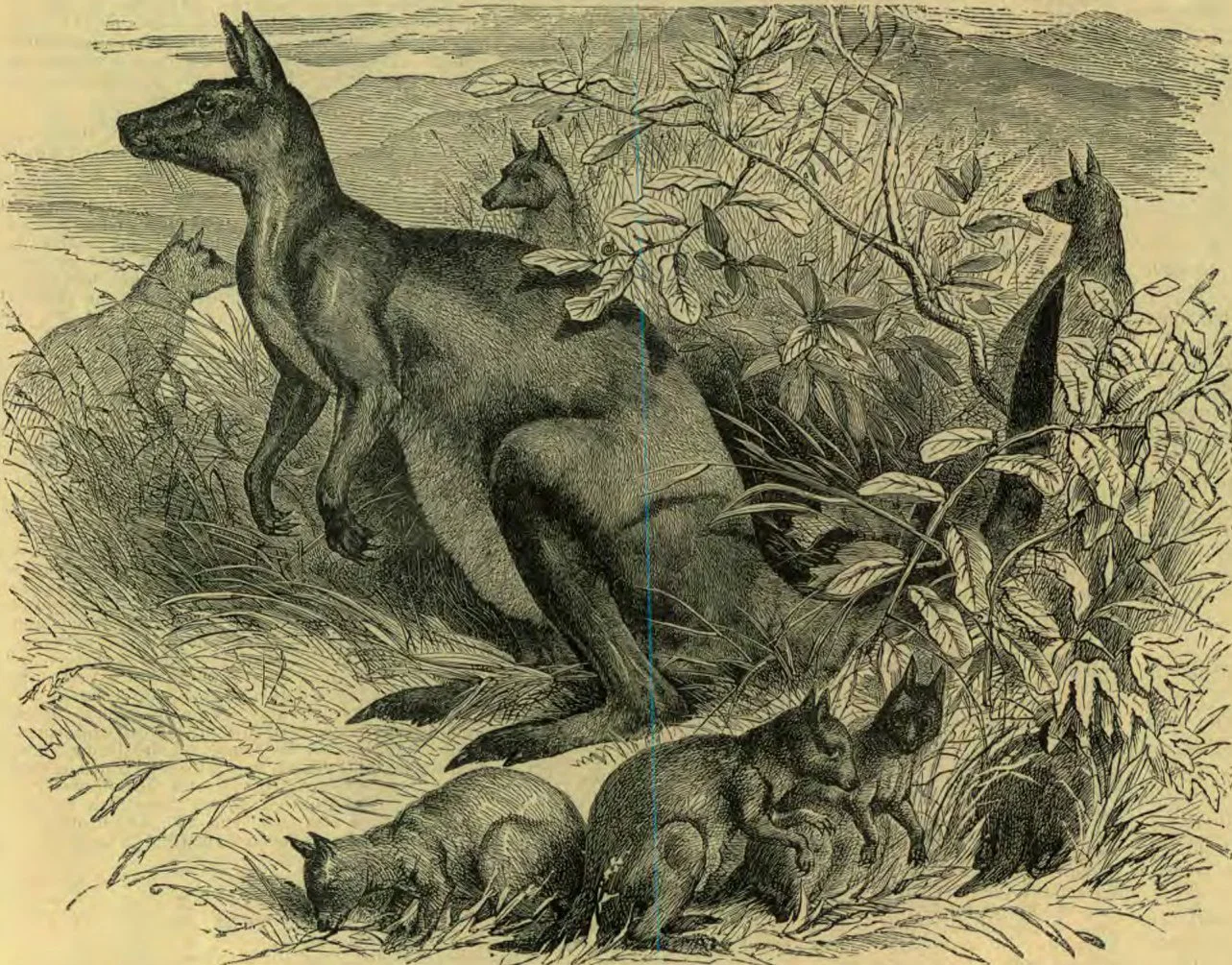
THE KANGAROO.
SHOULD we visit the wilds of Australia or some of the adjoining islands, we might in our rambles come suddenly upon a large, long-legged kangaroo sitting upon his haunches, and eating perhaps berries or fruits from his forepaws, as the squirrels do; or if he heard our footsteps, he might be standing on his hind toes, with his head six feet high in the air, listening and looking for us. I think we should be quite willing by that time to take ourselves away in a hurry; but as the kangaroo will not trouble people if they let him alone, we may stop and examine the creature at leisure.
His whole body is covered with a short, brown hair mingled with gray, and his forepaws and the end of his tail are black. From his nose to the tip of his tail he measures more than seven feet; the tail itself is three feet long, and quite large and heavy. The hind legs are exceedingly long, and were given him more for jumping than for walking; and they often send him, when frightened, fifteen feet at each leap. The front legs, as you see, are short, and resemble arms, and as arms he uses them; still they answer a very good purpose when he jumps. His nose is sharp and long, his ears erect, and his eyes large, soft, and quite beautiful.
The young of the kangaroo, when first born, are soft and helpless, and not larger than a young mouse; and were they exposed like other animals, they would soon perish. But the mother has a pouch under her stomach, into which she puts her little one to board; and there, living on warm milk and not having any change in the atmosphere, it thrives and grows. After about eight months, when it has sufficient strength, and its curiosity is developed, it crawls up and pokes its head out to take a peep at the world, and get a breath of fresh air. Presently it ventures out upon the ground, and takes a few nips at the tender herbage which grows at its feet. But if it becomes weary, or is frightened at the strange objects it sees around, it hurries back into the mother's warm pocket, and is quite contented and safe. When it weighs about ten pounds, she considers it too large for her to carry any longer, and ever after it depends upon itself.
The natives of Australia call the male kangaroo “boomer,” perhaps on account of his size, for he weighs, when full grown, one hundred and sixty pounds or more.
These animals do not go in droves, like the buffalo, yet a few generally keep in the neighborhood of each other, where each takes care of himself in his own way. They are hunted for their skins, which are valuable for many purposes. The flesh is also prized by the hunter, and is roasted and eaten in the field with great satisfaction.
A kangaroo hunt is entered into with zeal; a party go forth with dogs and spears, and scour the country to start up their prey, which is surrounded, and speared by the one who first gets a chance at the affrighted animal.
If they can manage to come upon a kangaroo without being heard, the spear is thrust into him, when a long and exciting fight follows; for the creature will not give up the life his Maker has given him, without a hard struggle.
It is said that when the kangaroo is closely pressed by the dogs, he makes his way, if possible, to the water, and wading in a short way, waits for his tormentors to come up. The first that reaches him, he seizes with his paws, and plunging him into the water, holds him under to drown him. If another dog arrives before he thinks it safe to let go the one he has, he puts one of his large hind feet upon the first, while he reaches out to catch and drown another.
When no water can be reached, and the kangaroo finds that he must be overpowered, he places his back against a tree, that the dogs may not reach him from behind, and then waits for them to come up. The first dog which comes near, is sure to feel the long claws of the kangaroo's great hind foot, and it is often the last thing the dog ever does feel, for it kills him at once. Sometimes in his desperation, the kangaroo rushes through the dogs, and makes a bold attack upon the hunter. If the kangaroo, when running, did not have the habit of looking behind him occasionally, he would escape more frequently than he does, as he is likely to run against trees or other obstacles, and cause his own death.
The female kangaroo is very much smaller than the male, and unless young, displays none of the swiftness and daring courage of the male. Indeed it is said that if she is fiercely attacked by men and dogs, and sees no possible way of escape, she is often terrified to such a degree that she lies down at once and dies of fear.
Sometimes she plunges into brushwood out of sight, and then, with a powerful effort, leaps to one side, where she lies perfectly still, while the dogs rush past her. When they are far ahead, she crawls cautiously out, and hurries off in another direction.
Thus God has given these poor creatures an instinct for their own preservation, which, if exercised by us, would be called thought and reason. All animals were made to enjoy their lives, and it is a pity and a sin that they should be killed out of mere sport, and wanton cruelty.—Beasts and Birds.
ONE LITTLE RHYME IN A WORLD OF RHYME.
ONE little grain in the sandy bars;
One little flower in a field of flowers;
One little star in a heaven of stars;
One little hour in a year of hours,—
What if it makes or what if it mars?
But the bar is built of the little grains;
And the little flowers make the meadows gay;
And the little stars light the heavenly plains;
And the little hours of each little day
Give to us all that life contains.
—St. Nicholas.
Little Beams of Sunshine in Daily Life
The sunshine of life is made up of very little beams that are bright all the time. To give up something, when giving up will prevent unhappiness; to yield, when persisting will chafe and fret others; to go a little around rather than come against another; to take an ill look or a cross word quietly rather than resent or return it,—these are the ways in which clouds and storms are kept off, and a pleasant and steady sunshine secured.