The Youth’s Instructor, Vol. 34, No. 6.

THE LIFE-SAVING SERVICE

The Youth’s Instructor

Feb 10, 1886

S. D. A. Publishing Association · Battle Creek, Mich. · Feb 10, 1886

THE LIFE-SAVING SERVICE.
ONE of the most humane and worthy institutions supported by the governments of the world, is the life-saving service of the ocean. Along the coasts are many dangerous, rocky reefs and shoals, on which the storm-driven vessels are ever liable to be wrecked. And notwithstanding the utmost endeavors put forth to prevent it, many lives and vessels are annually lost by shipwreck upon these dangerous rocks and shoals.
Various methods are employed to give warning of danger to the mariner, and thus prevent the fatal accidents that are ever liable to occur when overtaken and driven by the fierce, blinding storm. The most noteworthy of these methods of warning and prevention, are the lighthouses, light vessels, fog signals, buoys, and beacons. According to the statistics of the treasury department of the U. S. government for 1873, there were upon the different sea and lake coasts of our country six hundred and forty-one light stations; of these, six hundred and twenty were light-houses, and twenty-one, light vessels. The government expended for the maintenance of these in one year, $1,889,017.50. The number of buoys and beacons in the United States, is nearly five thousand. In all governments except that of the United States, commerce is directly or indirectly made to pay the cost of maintaining these light-house establishments. In Great Britain a tax is levied upon every vessel, domestic or foreign, that uses any particular light that is to be supported. France has a similar tax, or harbor due, from the proceeds of which the expenses are paid.
Notwithstanding all these grand and expensive means for the prevention of shipwreck, vessels are frequently driven by the storms upon the rocks and wrecked. And thus it becomes necessary that some means should be maintained close by these dangerous points, by which the poor sailors can be saved from a watery grave, and property on board the vessel can be rescued from destruction by the dashing waves.
For this purpose the government has erected at certain intervals all along our sea and lake coasts, life-saving stations. These are neat, substantial frame buildings, one and a half stories high, forty feet long, and twenty wide. They afford ample room for the boats, wagons for carrying the boats, lines, and all the other necessary apparatus. They are also provided with comfortable apartments for those who have the care of them, and also for those who may at any time be rescued from a wreck. At each of these stations six experienced surfmen are kept constantly on duty during the winter months; and these are in charge of a competent keeper, who is regularly appointed by the secretary of the treasury. From the first of December to the first of April, these men are required to patrol the beach day and night, watching for any wreck that may occur. If a wreck is discovered, information is immediately sent from one station to another by a system of signals, consisting of flags by day, and colored lights at night. When the signal is raised, all haste is made to the scene of disaster, and every means employed to rescue the poor unfortunates. If possible to do so, the life-boats are launched and manned by the daring surfmen, who dash out upon the boiling, tumbling waves, and pull with might and main for the ship, where the people are taken on board, and conveyed in safety to the shore. This is very often an extremely hazardous undertaking, but these noble men, thinking only of saving the lives of their fellow men, fearlessly risk their own in the performance of duty. It would certainly be an ungrateful people and government that failed to recognize and show their appreciation of these labors by a liberal reward.
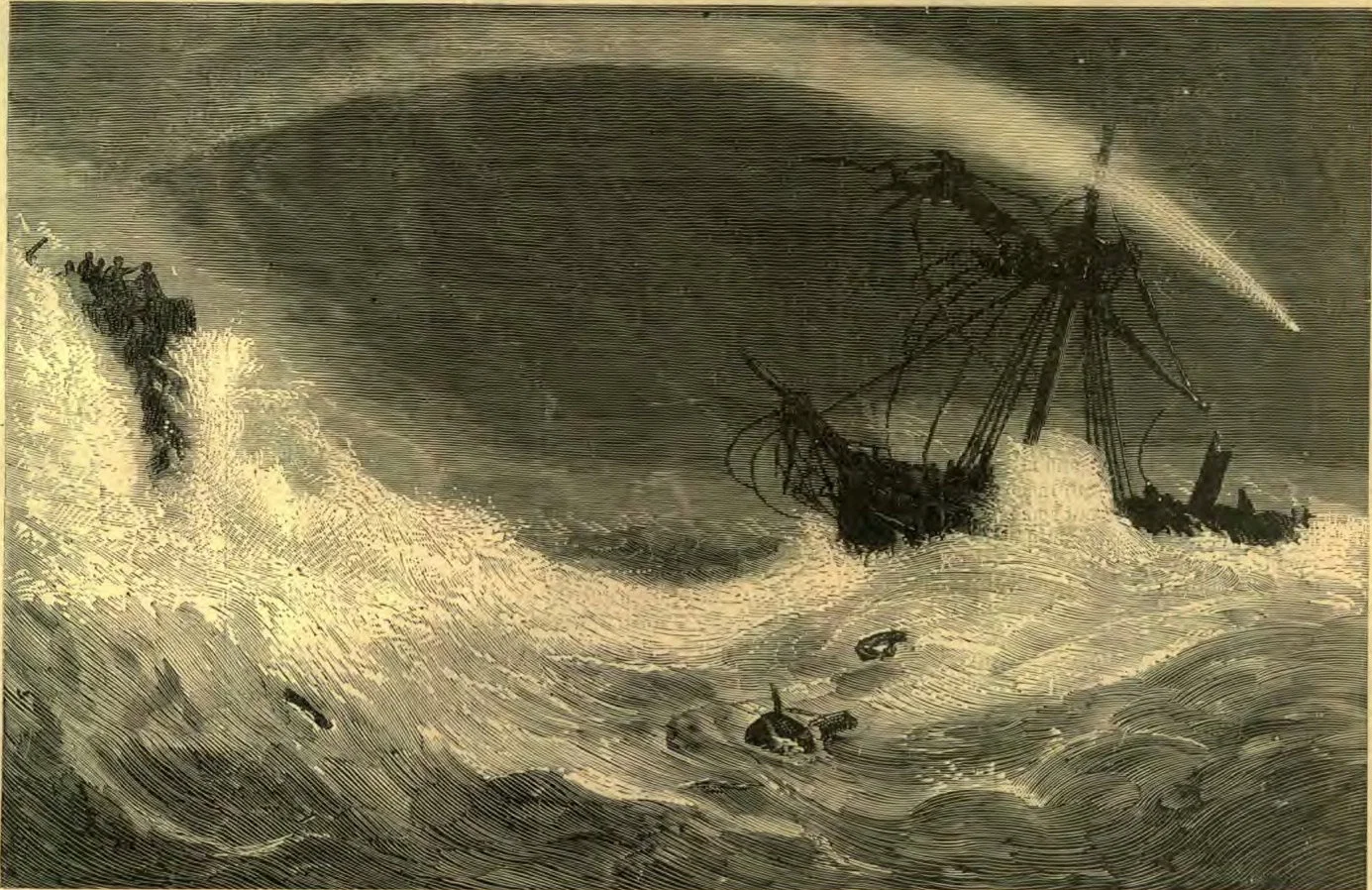
Frequently it is impossible for the men to reach the ship with the boats, and then some other means must be employed. One of these methods is shown in our engraving. Here we see a vessel driven upon the jagged rocks, where it is impossible to reach it with the life-boats. For such emergencies these stations are provided with a small cannon, or mortar, of five and one-half inches calibre, from which is thrown an iron ball weighing about twenty pounds. To this ball is attached a line, one inch in diameter, by means of a spiral spring to take up the jerk. The line is coiled in a peculiar manner in a box or on the ground, and when the shot has been successfully thrown over the wreck, a larger line, two inches in diameter, is then attached to the shore end of the smaller line, and is hauled off by the people on the wreck; and by means of this line a four-inch hawser is then hauled on board and made fast. This is then made taut by the men on shore, and fastened by means of tackles, anchors, etc. By means of the second, or hauling line, various appliances are hauled back and forth, until the people are saved.
The life-car is often attached to the large hawser. This is a covered, metallic boat, capable of holding four grown persons or eight small children. It is so constructed as to be water-tight, and by means of it persons are frequently transferred from the ship to the shore without being wet. So rapidly is all this done, that it is said the time usually occupied in arranging the lines and sending off the car after firing the mortar, is about thirty minutes. The life-car was introduced into the United States service in 1849, and in the following year two hundred and one lives were saved by it from the British emigrant ship, Ayrshire, which was wrecked on Squam Beach, N. J., during a fearful snowstorm.
The history of this noble enterprise is an exceedingly interesting one, and worth the study of every individual. Our space admits of but a brief mention of a few interesting points concerning it. It had its origin in the Old World, and was at first supported by voluntary contributions. Humane societies, having similar objects in view, afterward became interested in it, and it was by them supported and enlarged. The first step in this direction in our country, was in the beginning of the present century, when the Humane Society of Massachusetts was established. Its huts of refuge and its volunteer life boat-men were of almost incalculable service to the unfortunate mariners who were stranded upon that rocky coast. This first effort received the aid of Congress, which on March 3, 1847, initiated the establishment of the present life-saving service. An examination of the records shows that on that date Congress appropriated $5,000 for providing lighthouses “on the Atlantic coast, with means of rendering assistance to shipwrecked mariners.” The following year the sum of $10,000 was appropriated for providing the necessary apparatus for the service, such as boats, lines, rockets, cannonades, etc.
In December of the same year, Congress authorized the regular organization of the life-saving service, and fifty-four stations were established on the coast of Long Island and New Jersey. In 1871 the liberal appropriation of $200,000 was granted for increasing and improving the stations on the above coasts; and by the aid of subsequent appropriations, these stations have been established on all our dangerous coasts.
Although the returns are incomplete, the records of the treasury department of our government show that during the twenty-five years preceding 1872, 5,604 lives have been saved, and property rescued to the amount of $1,116,000; and according to a recent report of the royal national life-boat institution of Great Britain, 22,153 lives were saved from 1824 to 1873, or during the forty-nine years of its existence.
Every year appropriations are granted, and every effort made, to make this service still more effective. The government has long ago come to see its great value, and with a noble liberality it bestows its money for its extension and maintenance. J. W. B.

WINTER

THE hills a robe of ermine wear, “Like wool,” the mantle of the valleys; And icy lances pierce the air, With sharp and gusty sallies.
But we forget the wintry day; For, though it has but just been snowing, Behind the somber cloud of gray, The sunset hues are glowing.
Although the summer bloom has fled, Of crocus, buttercup, and clover, We smile to know they are not dead, But only covered over.
We laugh in Nature's days of storm, At rain, and wind, and sleet together, Because we know her heart is warm In spite of wintry weather.
— Wolstan Dixey.

STORIES ABOUT ABRAHAM LINCOLN.

Every reader of the INSTRUCTOR knows who Abraham Lincoln was; for he lived only a few years ago. From a poor, humble boy, he came to be the greatest man in our nation. He not only became a noted man, but many things in his life and character were truly great, and worthy of being followed by every boy. I will tell you of some of the hard things he had to bear; and I do this that you need not be discouraged if you have to meet some of the same things. I will also tell you about some of the good things which he did, that you may be stimulated to follow his good example.
Children are apt to think that if they are poor, they do not have a fair chance in the world. But this is not true. Poor boys and girls often make the greatest men and women. Mr. Lincoln was one of these very poor boys. He lived in a log house in a new, rough country, and had no chance to go to school or get books to read. “Abe,” as everybody called him, had to live on corn bread and coarse fare, wear the poorest clothing, and work hard at anything he could get to do. He had a good mother, but he met with a great misfortune in losing her when he was only ten years old. Poor little Abe used to sit by her grave and sob out his sorrow. God took this way to soften his heart, so that he would pity others in sorrow; and this he did as long as he lived.
When Abe was only a little boy, he often had to take a bag of wheat upon the back of his father’s horse, and ride fifty miles to mill. That did not look as if he would ever be a president, did it? Yet the faithful performance of these hard duties fitted him to fill well the high office that he afterwards held. Idle, disobedient boys seldom become great men.
Lincoln was noted for his honesty, even when a boy, so that he earned the title of “honest Abe.” Once he borrowed a book, the “Life of Washington.” By accident it got wet and nearly spoiled. Abe felt very bad. He had no money to pay for it. What could he do? Like an honest boy, he went to the owner, told him all about it, and offered to work to pay for the book. So he pulled corn for two days to settle the debt, and got the book. The books he had to read, when he was young, were the Bible, much of which he could repeat, Esop’s Fables, Pilgrim’s Progress, and the Life of Washington,—a good list for other children to read. It was fortunate for him that his mind was not poisoned by bad books.
Lincoln was a very awkward, homely looking man, tall, thin, and ungainly. When a young man at work on the farm, he wore trousers made of flax and tow, and all out at the knees. He was the roughest looking person in the country. But you would not have been afraid of the bad looks or poor clothes, for he was good at heart. Young Lincoln was a favorite with everybody. He was good natured, full of fun, ready to tell a story or take a joke; and he was always ready to help the weak or to settle quarrels.
In the days of his poverty he was appointed postmaster of a very small office. As he could not afford to stay in his office, and away from his business, he carried all the mail in the top of his hat. When any one asked for mail, all he had to do was to look in his hat. At the close of his office, he owed the government about seventeen dollars. Many years afterward, when this was called for, he went to a trunk and took out an old bag, where he had the exact amount due. Though poor, and in need of money, he would never touch what was not his. It was this habit of strict honesty that made him such a great man.
How did Abe get an education? In just the way that a lazy, good-for-nothing boy would never try. All day he worked hard at cutting wood or splitting rails. When evening came, he studied hard and late to learn what others got at school. He did not waste his evenings “up town,” nor in reading foolish books. Boys of this character will always amount to something when they become men. D. M. CANRIGHT.

THE CATHOLIC RELIGION IN DENMARK.

The humble, self-denying life taught by Christ harmonized but little with the proud, independent, and unbending disposition of the Scandinavians. A peaceful, spiritual life in God was directly opposed to their warlike character and ideas of future bliss. And the Catholic doctrine of much fasting and mortification of the body was also contrary to their habits; for they greatly valued a strong body and loved daring exploits. Consequently it was a long time—about two hundred years—before Christianity was fully introduced among them.
In the beginning of the ninth century, Charlemagne reigned over the Franks. He was zealous to propagate Catholicism among the Northern tribes. His son, Louis the meek, sought an opportunity to send missionaries into Denmark. He first sent Ebbe, the archbishop of Rheims, but he accomplished nothing and soon returned.
Church-historians state that Louis introduced Christianity among the Northern tribes; but if we say Catholicism, I think we get nearer the truth. Mosheim states of Louis the meek, that he inherited the defects of his father without his virtues, and was his equal in vice and cruelty.” But men who exulted in violence and cruelty could certainly not be Christians, whatever virtues they might otherwise possess. Their object in spreading the modern religion was only to subdue the Barbarian tribes, and thus confirm and extend their own power.
The religious belief spread by such means is certainly unworthy of the name of Christianity, although there were some pious men who took part in the work. It was a gross corruption of the religion of Christ—a little Christianity mixed with a great deal of heathen philosophy and political policy.
Ansgar became the apostle of the North. His pious mother taught him early to seek the Lord. Afterward he became very zealous for the Catholic religion. Ansgar was in Germany, when king Harald Klack from Jutland was driven from his kingdom, and with his family and many other Danes sought refuge at the court of the German emperor. Harald was one of the many petty kings who then reigned in Denmark. He, with many of his followers, was persuaded to receive baptism in Ingelheim by Maintz. Most of them consented on account of the pretty, white robes which they received from the emperor or from their sponsors at the baptism. One of them, when he was about to be baptized, was displeased because he thought the robe was too poor, and said to the emperor: “I have already been baptized twenty times in this place, and every time I have received very pretty white clothes; but such a bag as this is more fitting for a shepherd than a soldier. If I did not feel ashamed to stand here naked, I would immediately return unto you your robe and your Christ.”
The emperor entertained, and not without reason, serious apprehensions for his royal god-son, wherefore he sent with him Ansgar and Authbert, two pious monks. But king Harald cared nothing for them. He became friendly for a short time, because, on account of the missionaries, he made the voyage to Denmark in a more comfortable ship; but this friendship ended when he reached his own country.
The labors of Ansgar and Authbert brought them into many dangers, yet they succeeded in establishing a school in Hadeby (Schleswig), where some native boys, who were serfs, were instructed in order to become teachers. For two years they continued their work with great patience and self-denial, when Authbert was taken sick, returned, and soon died, while Ansgar went into Sweden.
After having labored awhile in Sweden, Ansgar returned to Denmark. But the most he could do was to buy the liberty of some boys, who were serfs, and instruct them. The emperor had meanwhile made Ansgar archbishop of Hamburg, but the Danish king attacked this city with his wild hordes, and pillaged it. Then Ansgar lost all his possessions, and for several years he lived in poverty, forsaken by all.
When Louis the German became emperor, Ansgar obtained help from him, and once more commenced his school in Schleswig. He found favor with the Danish king Erik, and was permitted to build a church in the same place. This was the first church in Denmark.
When Ansgar returned from his second trip in Sweden, he found the church destroyed, and the Christians persecuted by the new king Erik Child. But Ansgar persuaded the young king to change his mind, and the work was again resumed. The church in Schleswig was rebuilt and a new church was built in Ribe.
These events show clearly that the new faith depended very much on the favor of kings and on church-buildings. But the success of the mission of our Saviour did not depend on these. Neither Christ nor his apostles courted the favor of kings to establish their work; nor was the success of the apostles marked by the building of a grand church edifice in Ephesus or Rome. They built churches of living stones, gained solely by the preaching of the gospel. Yet we are thankful that a few among the Catholics were true Christians and feared God. They believed in the merits of Christ and his atoning sacrifice, and lived a pious life according to the light they had.
Gorm the old reigned now over all of Denmark. His son Harald was the first Danish king who was baptized, A. D. 972. The chief cause for this step was a war between him and the German emperor Otto II., in which the emperor was victorious. Harald was compelled to make peace, and one of the conditions was that he and his son should be baptized.
In his time, Adeldag was archbishop in Hamburg. He was very active. A third church was built in Aarhus, in the northern part of Jutland. There were now three bishop-ricks—Schleswig, Ribe, and Aarhus. Then the king himself built a church in Roskilde on Salland, where a new bishopric was formed, besides one in Odense on the island Fün.
Kanut the Great was the first king who succeeded in making Catholicism the predominating religion in Denmark. He made a pilgrimage to Rome to obtain from the pope the remission of his sins. He brought many English prelates over to Denmark, and in his time most of the bishops were English.
How powerful the clergy had now become is seen by the manner in which they treated Kanut’s successor, Svend Estridson. The king had caused several great men, who had spoken disrespectfully of him, to be murdered during church service. When the king again came to the church, Bishop Wilhelm placed his staff before the king’s breast, and put him under the interdict of the church. The king went home, put on an old mantle, returned to the church barefooted, and threw himself on the ground by the entrance. Then he found favor with the bishop, and was again received into the church.
King Svend was very learned, and corresponded in Latin with pope Gregory VII. His son Kanut the holy, who began to reign in 1080, exalted the clergy to the highest rank, and made them equal with princes and dukes.
The Danes took no part in the crusades of the thirteenth century; but in the place of this, they entered the countries around the Botnic bay, with an army under the command of Bishop Suneson.
The Esthlanders defended themselves with great valor, and in the battle by Reval it was for some time doubtful who would win; but then “Dannebrog,” a new standard, was lifted up, and the Danes gained a great victory. This banner, a flag with a white cross on red ground, which was said to fall down from heaven, but was really sent by the pope of Rome to Bishop Suneson, became afterward the Danish flag. Then the Esthlanders were made Catholics, and acknowledged the sovereign pontiff.
JOHN G. MATTESON.
Copenhagen, Denmark.

SNOW-BIRDS

How changed the fields since when the summer skies Bent over them—a shield of tenderest blue; When from the grass, with bright, wide-open eyes, Sweet violets looked through tears of sparkling dew!
Then golden buttercup and silvery head Of dandelion nodded on the leas, As down and petal felt the soft, light tread Of feet unsandaled, of the summer breeze.
Then on the morning silence rich did pour And plash and dimple showers of liquid sound; A bobolink's mad fancy bubbled o'er, As if a shattered rainbow fell around.
Through orchard trees a flash of orange flame Showed where the oriole hastened to his mate; The ruby-throated humming-bird grew tame, And came to rest him on the garden gate.
But now the fields are blanketed with snow; Smooth, white, and soft as fleece of wool it lies, Or drifts before the biting winds that blow From cold, gray cloud-tents of the northern skies.
From wood and orchard, leaf and bloom are gone; To garden shrubs few seeds and berries cling; The nests are empty—all their tenants flown Until the coming of another spring.
Through blinding snows, that fill the wintry air, A merry flock of piping birds appear; From colder regions of the north they fare, To bring a hearty greeting of “Good cheer.”
Who will not bless the rank, uncomely weeds That fill the untilled corners of the fence, To furnish forth a banquet of dry seeds,— For such a greeting but scant recompense?
—Youth's Companion.

“WAIT A MINUTE.”

THERE is an old proverb, and a very good one, that “Time and tide wait for no man.”
That means that if a man has a chance of bettering his condition, and lets it go by, the chance may never come again.
Perhaps a vessel can only be launched at the turn of the tide; and if the captain does not seize that precious moment, the tide turns, and the vessel has to be left behind. For the tide will not wait, nor the time either. Still there are seasons when our motto would prove a wholesome one, when it would be a good thing to wait a minute.
When you are about to make an angry reply. Your blood is up; and you could say a cutting thing. But don't do it. The irritation will go off if you have a little patience. Grievous words stir up anger. It is better to wait a minute.
When you are tempted to do a wrong—it may be to lie or steal. Satan is hurrying you on, because he does not wish you to reflect. He knows that if you reflect, you will not do it. But do not be driven into sin blind-folded. Wait a minute.
When you are going to spread a report about your neighbor. It will do him harm, and you do not know whether it is true. You have not had time to search into the matter. And yet the tale is on your tongue. But you had better not. Wait a minute.
That minute waited will often save you from evil. It may give your passions time to cool. You may be able to put up a secret prayer, “Lead me not into temptation.” You may call to mind the commandment, “Thou shalt not bear false witness against thy neighbor.”
Stop then, on the brink of wrong doing, if you have been foolish enough to get so far.

IMPORTANT BIBLE SUBJECTS.

LESSON 8.—THE GREAT PROPHETIC PERIOD.

1. In the vision of Daniel 8, what symbols were presented to the prophet?
2. What interest did Daniel manifest in this vision? Verse 15.
3. Who was sent to make him understand the meaning of the vision? Verse 16.
4. What verses record the angel’s explanation of the first symbol?
5. What verses record his explanation of the second symbol? The third?
6. Why did he not explain the application of the symbolic time spoken of in the fourteenth verse? Verse 27, first clause.
7. When the prophet had recovered from his sickness, how did he regard the vision? Verse 27, last part.
8. Is there any intimation that he did not understand the part that had been explained to him?
9. How long was it before Gabriel returned to complete the work of making Daniel understand the vision?—About 15 years. (See margin.)
10. How was Daniel employed when the angel thus returned to him? Dan. 9:20, 21.
11. What did Gabriel say he had now come to do? Verse 22.
12. What did he tell Daniel to consider? Verse 23, last part.
13. What vision must this have been?
14. Why was he to consider the vision?—That he might “understand the matter” that the angel was about to explain. Verse 23.
15. What part of the former vision had been left unexplained? Dan. 8:14.
16. In explanation of this point, what does Gabriel first introduce? Dan. 9:24.
17. How much literal time is denoted by the seventy weeks?—All agree that a prophetic day stands for a literal year. See also Eze. 4:5, 6; and Num. 14:34.
18. What important things were to be accomplished during the period thus allotted to the Jews? Dan. 9:24.
19. What do we understand by the finishing of the transgression? (See note.)
20. What is meant by making an end of sin, and by making reconciliation for iniquity?
21. What is the everlasting righteousness that was to be brought in?
22. In what sense were the vision and the prophecy to be sealed up?
23. What do we understand by the anointing of the most Holy?

NOTES.

To finish the transgression.—The Jews were to fill up the measure of their iniquity by rejecting and crucifying the Messiah; they would then no longer be his peculiar people, or host. Read Matt. 21:38–43; 23:32–38; 27:25.
Making an end of sin.—This probably means to make an end of sin-offerings, which were to be abolished by the death of Christ. See Dan. 9:27 (cause the sacrifice and oblation to cease); read also Heb. 9:10. The sacrifice of Christ, in making an end of sin-offering, would also make reconciliation for iniquity, since it would satisfy the demands of the broken law, for all who would seek pardon through it.
Everlasting righteousness.—This must mean the righteousness of Christ,—that righteousness by which he was enabled to make an atonement for sin, and which, through faith, may be imputed to the penitent believer.
To seal up the vision.—To seal sometimes means to fulfill; to establish. See Webster. During the seventy weeks a part of the vision was exactly fulfilled, and this establishes and makes sure the fulfillment of the whole.
To anoint the most Holy.—This is supposed to refer to the anointing of the heavenly sanctuary, preparatory to opening the services there.
Summary.—The angel assured Daniel that 490 years of the 2300 should be given to the Jews; and that during that period they would fill up the measure of their iniquity; Christ would put an end to sin-offering by offering himself, thus making reconciliation for iniquity, and bringing in everlasting righteousness; the events of this period would so strikingly fulfill the first part of the prophecy as to make its complete fulfillment a certainty, and the way would be prepared for Christ, the crucified, to enter upon his ministry in the heavenly sanctuary,—the true tabernacle, which the Lord pitched, and not man.

A STRIKE IN ANCIENT EGYPT.

LABOR strikes are of frequent occurrence now-a-days. They take their rise something like this: A number of laborers refuse to work unless their employer will increase their wages, or else because he contemplates making a reduction in the price he has been paying them. In either case, they pledge together that they will not work, or allow any one to take their places until their demands are met. The result of these strikes is sometimes quite serious, as you may know. But that they are no new thing is “proven by the deciphering of a papyrus in the Turin Museum, giving the particulars of a successful riot or strike under a King Rameses, probably the third of the line.” As interpreted, it reads:—
“The workmen’s quarter sent a deputation on the 28th of December to Hatnekin, the keeper of books, and to several priests of the necropolis. The speaker of the deputation spoke as follows: ‘Behold, we are face to face with famine. We have neither nourishment, nor oil, nor vestments. We have no fish; we have no vegetables. We have already sent a petition to our sovereign lord, the Pharaoh, praying him to give us these things, and we now address the governor, in order that he may give us wherewithal to live.’ The general distribution of wheat was then evidently due to the workmen, but why it did not take place is not known. Perhaps the individual who should have distributed the food was absent. Whatever was the cause of the delay, the need was urgent, and Hatnekin, with the priests present, either touched with compassion or to prevent the affair from reaching the ear of the governor of the necropolis, accorded one day’s rations. How the workmen lived in the days following is not recorded on the papyrus; but some weeks afterward they were in full revolt. Three times they forcibly emerged from their quarters, notwithstanding the walls which surrounded them and the gates which closed them in. ‘We will not return,’ cried a kneftu to the police sent in pursuit of them. ‘Go tell your chief what we tell you; it is famine which speaks by our mouths.’ To argue with them was useless. ‘There was great agitation,’ writes the superintendent in his day-book: ‘I gave them the strongest answer I could imagine, but their words were true and came from their hearts.’ They were quieted by a distribution of half-rations, but ten days later they were up again. Khons, the leader of the band, pressed his companions to provide for themselves. ‘Let us fall,’ said he, ‘upon the stores of provisions, and let the governor’s men go and tell him what we have done.’
‘This counsel was followed as soon as given. They entered forcibly into the inclosure, but not into the fortress where the provisions were kept. The keeper of the stores, Amen-Nextu, gave them something, and contrived to induce them to return to their quarter. Eleven days later the movement began again. The commander of Thebes, passing by, found the men seated on the ground behind the temple of Seti, at the northern end of the necropolis. Immediately they began to cry: ‘Famine! famine!’ The commander then gave them an order for fifty measures of wheat in the name of Pharaoh, ‘who has sworn,’ said he, ‘an oath that you will have food again.’”

Warmth of Personal Sympathy in Sabbath School Teaching

Avoid mere professionalism; it always involves a loss of power. When the warmth of personal sympathy dies out of the Sabbath-school teacher, and he becomes simply a portion of the Sabbath-school machinery, the most valuable part of his influence is gone. No one cares for machine-made counsel; no one wants machine-made comfort. Be a part of the world's machinery, as is your duty to be; but never let the manly or womanly die out beneath the mechanical. When you suffer that to happen, it is time for you to write the epitaph over the grave of your slain influence.

THE TRUE STEEL.

ON metals my house-builder often would prate, And this truth from experience cull: “Poor tools are bad cutters,—yes, even when sharp,— But a good tool will cut when ’tis dull.”
The matter I never had pondered till then, And revolving a saying so new, I wondered, though spoken of chisel and plane, If of metals alone it were true. —(Companion.)

THE MAELSTROM.

Many of the school boys and girls, even of the present time, have been told of a terrible whirlpool off the west coast of Norway; and if any have had access to an old-fashioned school atlas, they may have seen a representation of it. But during the last few years, it has been hinted that no such whirlpool exists. A writer in Harper’s Young People explains the disturbance in those waters which gave rise to the existence of a destructive whirlpool there. He says:—
“When I was a boy, twenty-five or thirty years ago, I used to read in my geography, with a kind of shudder, of an awful whirlpool, called the Maelstrom, off the coast of Norway, which sucked in vessels that came anywhere in its neighborhood, and out of whose mysterious center nothing could escape alive. What is the reality on which this story was founded? Dr. C. C. Tiffany takes pains to tell us in a recent account of a trip to Tromso. This: ‘It is the one humbug of Norway. It is simply a dangerous current at the south end of the Lofoden Islands, between the islets of Moskenes and Værøe. When the wind blows from certain quarters, particularly from the north-west, and meets the returning tide in the strait, the whole sea between Moskenes and Værøe is thrown into such agitation that no ship could live in it. In calm weather, however, it is crossed in safety three-quarters of an hour before flood-tide. What gives it the name and appearance of a whirlpool is that the set of the tide is changed at its different stages by the narrow limits within which it acts. Its movements are at first toward the south-east; then, after flood-tide, it turns from the south toward the south-west, and finally toward the north-west; so that it takes twelve hours to complete the circle of its movement. Rather slow motion for such a fast character as a whirlpool.’”

SOME PEOPLE'S QUEER NOTIONS.

HERE is what Jack in the Pulpit, in the July St. Nicholas, has to say about people's queer customs:—
“The wearing of jewels of gold and silver began with savages, who could think of no more secure way of keeping their valuables than by hanging them in their ears, noses, lips, cheeks, or around their necks or arms. After awhile they seemed to forget that security had been the object in thus disfiguring themselves; and from being pleased at seeing their treasures so conspicuously and safely displayed, they actually began to fancy that the effect not only pleased every one else, but that they themselves presented a very attractive appearance. Think of a person being attractive with a hole in the end of the nose and a gold ring hanging there! Or with the cheek pierced with a large pin! And it is true that not only savages, but persons who call themselves civilized, actually pierce holes in their own ears, and hang gold and jewels through them!”
“Very odd things are done by mortals to aid or improve upon nature; some of them are as horrid as they are odd. Japanese maidens, who are pretty enough naturally, daub their faces liberally with red and white paint, and put a dab of bronze on the lips. Chinamen sometimes allow their finger-nails to grow as long as six inches. Chinese girls glory in deformed feet. A tribe of South American Indians bore a hole in the lower lip, and force in there a wooden plug larger than a silver dollar, making the lip look like a shelf! And thus it seems that all over the world men and women are busy disfiguring themselves in the hope of becoming handsome.”

A NOBLE AMERICAN APPLE-TREE.

THE following account of a fine specimen of apple-tree was printed in the February (1885) issue of Young England:—
“On the land of an old gentleman named Hotchkiss, living at Cheshire, Connecticut, is an apple-tree supposed to be, at the present time, no less than 186 years old. It is said to be the last of an orchard planted by the first settlers in that neighborhood. Mr. Hotchkiss is over eighty years of age, and he has known and owned this tree for nearly half a century. Some time ago, he informed a gentleman that, when he was a boy, he heard his grandmother say that she used to play in her early childhood under its then broad and sheltering branches. The body of the tree is four feet in diameter up to the point where the limbs branch out. There are five main branches, each of which is nearly two feet in diameter. Its height is sixty feet, and from its outermost branches, apples falling perpendicularly lie upon the ground thirty-three yards apart! Mr. Hotchkiss said that he had picked up and measured one hundred and twenty-five bushels of good, sound apples out of one year’s product of this tree, and he estimates that it has borne from ten to twelve thousand bushels from the date of its being planted up to the present time.”

THE BOATS OF GOLD.

The museum of northern antiquities in Copenhagen has just been enriched by a remarkable discovery made at a small place near Thisted, on the west coast of Jutland, Denmark. Two men digging in a gravel-pit in the neighborhood of an old burial mound, called Thor’s Mound, struck an earthen vessel with their picks, disclosing a number of gold pieces. On examination it was found that an earthen vessel about seven inches diameter at the rim, and covered with a flat stone, had been buried about a foot and a half below the surface, and this contained about a hundred little golden boats, curiously worked, varying in size from three to four and a half inches. A gunwale and frames of thin strips of bronze had first been formed, and these had been covered with gold plates, some of which were further ornamented with impressions of concentric rings. The boats, of which only a few are in a fair state of preservation, are tapered at both ends, and resemble the Danish craft of the present day. This discovery, which may be regarded as a deposited treasure of votive offerings, and belongs doubtless to the close of the bronze age, proves that frame built vessels were already known at that time, and that man was not satisfied with the hollowed-out trunks of trees. The gold of which these little fishing models are composed was valued at $26, which amount, together with a gratuity, has been forwarded to the finders, who are both poor men.—Sel.
Continue reading: BEFORE PENS