Your ShelfYour Projects

Signs of the Times, Vol. 23, No. 22.

Editorial
Earlier text: Editorial

GETHSEMANE.

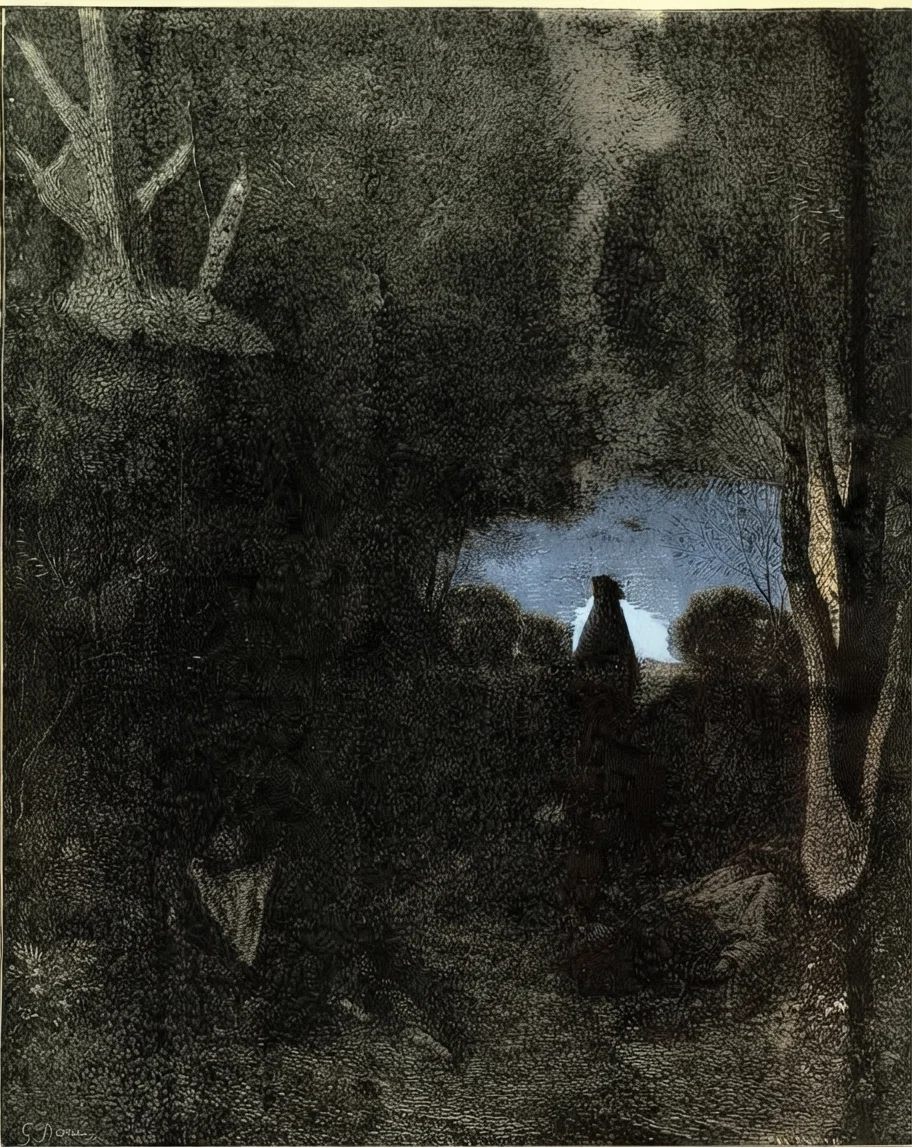
“THEN cometh Jesus with them unto a place called Gethsemane, and saith unto the disciples, Sit ye here, while I go and pray yonder. And he took with him Peter and the two sons of Zebedee, and began to be sorrowful and very heavy. Then saith he unto them, My soul is exceeding sorrowful, even unto death; tarry ye here, and watch with me. And he went a little farther, and fell on his face, and prayed, saying, O my Father, if it be possible, let this cup pass from me; nevertheless not as I will, but as thou wilt.” It was here that the mysterious cup trembled in Christ’s hand. Here the destiny of a lost world hung in the balance. Should he refuse to stand as man’s surety? Satan encircled his humanity with a horror of great darkness, tempting him to think that God had forsaken him.
In this hour of trial Christ’s human nature longed for sympathy. In the supreme agony of his soul, he came to his disciples with a yearning desire to hear some words of relief from those whom he had oft blessed and comforted and shielded in sorrow and distress; for the law of kindness was ever on his lips. The One who had always had words of comfort for them was now suffering superhuman agony, and he craved sympathy; he longed to know that they were praying for him and for themselves. How dark seemed the malignity of sin! No earthly potentate can show himself more keenly observant of his subjects than was Jesus. He was jealous for his law as no earthly king can be, for he was the king, eternal, invisible, immortal. If he could only know that his disciples understood and appreciated the terrible temptation to let the human race bear the consequences of its own guilt, while he stood innocent before God, he would be strengthened.
“And he cometh unto the disciples, and findeth them asleep.” Had he found them praying, he would have been relieved. Had they been seeking refuge in God, that Satanic agencies might not prevail over them, he would have been comforted by their steadfast faith. But, unheeding the repeated warning, “Watch and pray,” they had fallen asleep. They knew not the necessity of watchfulness and earnest prayer in order to withstand the temptations of Satan.
As one surprised, Christ addressed them, saying, “What, could ye not watch with me one hour?” They roused themselves, and looked sorrowfully at their Lord. “Watch and pray,” he said, “that ye enter not into temptation.” Then the divine Sufferer excused the disciples, saying, “The spirit indeed is willing, but the flesh is weak.”
Christ went away the second time, and prayed earnestly, “O my Father, if this cup may not pass away from me, except I drink it, thy will be done.” Again darkness pressed upon his soul with almost unbearable agony, and again he felt a longing for companionship, for some words which would bring relief, and break the spell of darkness that well-nigh overpowered him. “And he came and found them asleep again; for their eyes were heavy;” “neither wist they what to answer him.” They saw his face marked with the bloody sweat of agony, and they were filled with sorrow; for “his visage was so marred, more than any man.”
Again Christ went away, and prayed that if it were possible this cup might pass from him. His soul was filled with an overpowering fear of separation from God in consequence of sin. Satan told him that if he became the substitute and surety for a sinful world, he would never more be one with God, but would be under his control.
Three times the prayer ascended to God, “O my Father, if it be possible, let this cup pass from me,” always followed by the words, “Not my will, but thine, be done.” Shall the cup pass from the Suffering One? Shall the sacrifice of Christ, ordained before the foundation of the world, and symbolized in every sacrifice offered since Adam’s transgression, be given up? Shall the glorious purpose of God the Father, and Jesus Christ his Son, entered upon to save a perishing world, be of no account? Shall that which angels eagerly desired to look into and understand, that which had been the burden of prophecy, that which lay at the foundation of types and shadows, fail after all, leaving Satan and his apostate forces and confederacy of evil to come off triumphant?
O, how much Christ had already suffered as the Son of man, in order to redeem and save men! How much he had borne as their substitute! Now the time had come when all the types and symbols pointing to his suffering and death were to be fulfilled. Shall he fail, and come short in his work of redemption? Shall the prince of darkness triumph? Shall his proud boast become truth? Shall the prey be left helpless in the hands of the mighty, or shall the captives be delivered, Satan overcome, and it be demonstrated that obedience to the law is possible; for all have been made more than conquerors through Christ?
It was the will of God that none should perish, but that all should have eternal life through faith in the sacrifice of Christ. Him God the Father sealed to become man’s Restorer. The worlds unfallen and the heavenly angels watched with intense interest as the conflict drew to its close. Satan and his confederacy of evil, the legions of apostasy, watched intently this great crisis in the work of redemption. The powers of good and evil waited to see what answer would come to Christ’s thrice-repeated prayer. In this awful crisis, when everything was at stake, when the mysterious cup trembled in the hand of the Sufferer, the heavens opened, a light shone forth amid the stormy darkness of the crisis hour, and an angel who stands in the presence of God, occupying the position from which Satan fell, came to the side of Christ. What message did he bring? Had he come to tell Christ that the price to be paid was too great, that it would cost too much to save the world, and that man must be left to his doom, to be destroyed by the wrath of an offended God? Did he tell him that he need not drink the bitter cup, that he need not bear the guilt of man?
The angel did not come to take the cup from Christ’s hand, but to strengthen him to drink it, with the assurance of the Father’s love. He came to give power to the divine-human Suppliant. He pointed him to the open heavens, telling him of the souls that would be saved as the result of his sufferings. He assured him that his Father is greater and more powerful than Satan, that his death would result in the utter discomfiture of Satan, and that the kingdom of this world would be given to the saints of the Most High. He told him that he would see of the travail of his soul, and be satisfied, for he would see a multitude of the redeemed, saved, eternally saved.
Christ’s agony did not cease, but his depression and discouragement left him. He still carried the load of guilt, and he fulfilled the demands of the divine law, and glorified the Father by drinking the bitter cup.
“Then cometh he to his disciples, and saith unto them, Sleep on now, and take your rest; behold, the hour is at hand, and the Son of man is betrayed into the hands of sinners.” The storm of the hellish host had in nowise abated, but he who was its subject was strengthened to meet its fury. He came forth calm and serene. He had borne that which no human being can ever bear; for he had tasted the sufferings of death for every man. “Who is this that cometh from Edom, with dyed garments from Bozrah? this that is glorious in his apparel, traveling in the greatness of his strength? I that speak in righteousness, mighty to save. Wherefore art thou red in thine apparel, and thy garments like him that treadeth in the wine fat? I have trodden the winepress alone; and of the people there was none with me.”

The Temptation of Christians.

As Satan tempted Christ, so he will tempt Christ’s followers. The Son of man was betrayed into the hands of sinners. Many, for Christ’s sake, will undergo a similar experience. Priests and rulers will instigate men to testify falsely against them. Christ has told us of the persecution that will come upon those that love and fear God through men who are working in copartnership with Satan. Under the teaching of the Holy Spirit, God’s people will learn more of the terrible character of sin as they feel the cruelty of those who are controlled by it. But all the cruelty manifested toward them is charged against the doers as done to Christ, who has redeemed human souls with his own blood, and has called them by his name.
The strength given to Christ in the hour of bodily suffering and mental anguish in the Garden of Gethsemane, has been and will be given to those who suffer for his dear name’s sake. The same grace given to Jesus, the same comfort, the more than mortal steadfastness, will be given to every believing child of God, who is brought into perplexity and suffering, and threatened with imprisonment and death, by Satan’s agents. Never has a soul that trusts in Christ been left to perish. The rack, the stake, the many inventions of cruelty, may kill the body, but they can not touch the life that is hid with Christ in God.
“Nation shall rise against nation,” said Christ, “and kingdom against kingdom; and great earthquakes shall be in divers places, and famines, and pestilences; and fearful sights and great signs shall there be from heaven. But before all these, they shall lay their hands on you, and persecute you, delivering you up to the synagogues, and into prisons, being brought before kings and rulers for my name’s sake. And it shall turn to you for a testimony. Settle it therefore in your hearts, not to meditate before what ye shall answer; for I will give you a mouth and wisdom, which all your adversaries shall not be able to gainsay nor resist. And ye shall be betrayed both by parents, and brethren, and kinsfolks, and friends; and some of you shall they cause to be put to death. And ye shall be hated of all men for my name’s sake. But there shall not an hair of your head perish.” “In the world ye shall have tribulation; but be of good cheer; I have overcome the world.” MRS. E. G. WHITE.

JEWISH CUSTOMS AND TRADITIONS.

(By an Israelite.)

The Passover.

It was noted in article 6 that not one word which Christ ever spoke was devoid of meaning. What was true of Christ's life while on earth is equally true of those objects which were typical of him, and which by faith represented him. "Thus in the ministration of the tabernacle, and of the temple that afterward took its place, the people were taught each day the great truths relative to Christ's death and ministration."—Patriarchs and Prophets, page 358.
Among the many ceremonies and feasts given to Israel, in addition to the one mentioned in the preceding article, there were three other feasts to which the Lord attached great importance, and emphasized the necessity of their observance. The account of them is as follows: "Three times thou shalt keep a feast unto me in the year." "Three times in a year shall all thy males appear before the Lord thy God in the place which he shall choose; in the feast of unleavened bread, and in the feast of weeks, and in the feast of tabernacles; and they shall not appear before the Lord empty." Ex. 23 : 14-17; Lev. 23; Deut. 16 : 16.
The first in the catalog is the feast of unleavened bread, or, as it is generally known, "the Passover." Its observance was instituted at the time of the exode, as a memorial of their deliverance from Egyptian bondage. Thus were they to observe it: On the tenth day of the first month each family was to take a lamb without blemish, and keep it till the fourteenth day of the same month. Then between the two evenings, from three till six P.M., all the people were to kill their lambs simultaneously, and take of the blood and sprinkle it upon the door posts, and upon the two side posts of the house in which the animal was to be eaten. It was to be roasted with fire, and the whole of it eaten that selfsame night, none of it to be left till morning. When the animal was slain, they were to be very particular that none of its bones were broken.
The reason the blood was sprinkled upon the door posts was because that night the Lord was to pass over Egypt and smite every first-born in the land, from the first-born of Pharaoh to the first-born of the least of the cattle. And when the Lord observed the blood upon the houses, it was to be a token of their obedience, and the children of Israel were to be passed by, and not to be destroyed. It was the blood of the lamb that saved the house of Israel from destruction with the Egyptians.This feast was to last seven days, during which time no manner of leaven was found in their houses, and no servile work performed. It was to be a statute forever throughout their generations, as a memorial of deliverance from Egyptian servitude. The passover thus ordained and thus observed is called "the Lord's Passover." It was not man's, it was not Jewish, it was God's only. The first and the last days of the feast were holy days, and to be so regarded. See Ex. 12 : 13.
The true meaning of the Passover is very clearly noted in the Scriptures, and perhaps it may be well to adduce a few texts, and then contrast them with the way this ordinance has been perverted by tradition. "Cleanse out the old leaven, that you may be a new mass, as you are unleavened; for even our Paschal Lamb Christ, was sacrificed." 1 Cor. 5 : 7, Emphatic Diaglott. Thus we see that the lamb slain by the Israelites in Egypt represented the "Lamb of God, which taketh away the sin of the world." John 1 : 29. The lamb was to be without spot and without blemish. Pilate's testimony concerning Christ was, "I find no ['not one,' Greek] fault in him." John 18 : 38. The Jews were commanded to take the lamb on the tenth day, and keep it till the fourteenth, when it was to be slain. Four days before the Passover, Messiah came to Jerusalem, and after being examined before the tribunals, was declared to be without sin. "Ye have brought this man unto me, as one that perverted the people; and, behold, I, having examined him before you, have found no fault in this man touching those things whereof ye accuse him; no, nor yet Herod; for I sent you to him; and, lo, nothing worthy of death is done unto him." Luke 23 : 14, 15.
While Jesus was on the cross, the soldiers came to break his legs, as they broke the legs of the thieves who were crucified with him. But when they saw he was dead, they broke them not. But one of the soldiers pierced his side with a spear, and instantly blood and water flowed from the place. "For these things were done, that the scripture should be fulfilled, A bone of him shall not be broken." John 19 : 32-37. It was in the acceptance of the command of God to sprinkle the blood that Israel were saved. So it is written, "The blood of Jesus the Messiah cleanseth us from all sin." 1 John 1 : 7. And as we read the fifty-third chapter of Isaiah, and many other scriptures, how accurately do we see fulfilled in Jesus of Nazareth all that was done to the lamb!
Is it not then surprising that the Jews did not know Jesus when he was on earth, because the meaning of the Passover to them was so different from what it was originally meant to be, that they lost sight of the truth taught by it. And as the years have rolled by, and the temple gone, it means still less. In the place of the lamb at the present time, they use a shank-bone of an animal, the very part of the animal that was not to be broken. Instead of having the simple ordinance the evening of the Passover, a great display is made, when many things have been added, and many prayers, stories, fables, and allegories are repeated, most of them meaningless and without foundation. One of the additions is that on the Passover night each person must drink four cups of wine. The law on that point is as follows: "All persons, whether men or women, are obligated on this night to drink four cups (or glasses) of wine, and this number is not to be diminished."—Hilchoth Chometz, Laws of Leaven, chap. 8.
This law is purely a creation of the rabbis, and carries with it great hardships if obeyed. "Whosoever has not got wine, transgresseth a command of the rabbis, for they have said that there is to be no diminution from the four cups. And it is necessary to sell what he has in order to keep the command of the wise men. He is not to depend upon the bread, for if he fulfil the command concerning one cup, he has not fulfilled that respecting the three. Therefore let him sell what he has, and furnish the expense, until he procure wine or raisins."—Arbah Turim Orach Chaim, Ways of Life. We wonder not at the denunciations of Christ against the rabbis, scribes, Pharisees making void the law of God by their tradition, and placing heavy burdens upon the people.
The Lord told the people anciently to leave nothing of the lamb remaining overnight, but all to be eaten at one time. With the shank-bone previously mentioned, an egg is also used; and these, instead of being eaten the first night, are left for the second evening. The Lord's command was that the first and last days were holy; the rabbis have added a day at each end, compelling all to observe them. "These are the six days on which the Scripture has forbidden the doing of work. The first and seventh day of Passover, the first and eighth day of the Feast of Tabernacles, the day of the feast of weeks, and the first day of the seventh month; and these days are called holy days. The sabbatism of all is alike; it is unlawful on any of them to do any manner of work, excepting that which is necessary for the preparation of food, as it is said, Save that which every man must eat. Ex. 12 : 16."—Hilchoth Youm Tov, Laws of the Holy Days, chap. 1, 1. And then is added the following:—
To us who observe two days, everything that is forbidden on the first day is also forbidden on the second day; and whosoever makes light of it is to be excommunicated. But if he be an acute Talmudist, the excommunication is not to be severe, only he is to be beaten.—Orach Chaim, Ways of Life, 496.
Altho the second holy day is only of the words of the scribes, everything that is forbidden on the first day is forbidden on it also. And every one who professes the second holy day, even that of the New Year, whether it be in a matter relating to the sabbatism, or by work, or by going beyond the sabbath limit, is to receive the beating denounced against rebellion, or to be excommunicated, unless he be a learned man.—Hilchoth Jom Tov, Laws of the Holidays, chap. 1, 24.
The beating here referred to is called "the law of rebellion," the substance of which is that whoever transgresseth an affirmative commandment, he is to be beaten until his soul go out of him, without any consideration of his strength, or without dividing the flogging into three parts. And also whoever transgresses a law of the wise men, he is to be beaten with stripes without number and without consideration. And the reason this is called "the flogging of rebellion" is because the individual has rebelled against the words of the scribes. (Baal Aruch, "Lord of the Ways or Manners.")
In addition to these additions and changes many more have been made to resemble the ordinance as given by the Lord, but which are contradictory in themselves, and opposed to the Word of God. Space forbids mentioning more. Thus we see to some extent how the commandments of God have been made of none effect by their tradition, how Christ has been hidden from the people, and man exalted in his place.

THE "AMERICAN SABBATH."

As NO person, and therefore no people, can be said to keep the Sabbath who do violence to the rest of the law (James 2:10), it follows that the "American sabbath" is the lowest grade of Sabbath observance to be found in the world. For proof we submit the following points from the Union Signal, which are amply verified by official statistics and other authorities:—
The United States has a standing army of twenty-five thousand men, and so far as we have learned, they killed nobody last year. But in our peaceful (?) hamlets, towns, and villages, on our quiet farms, and in the cities that are the centers of our great philanthropies, there were slaughtered last year seventeen thousand one hundred and seventy-two persons, of whom ten thousand six hundred and fifty-two were murdered, and the rest committed suicide. This is probably the bloodiest record ever made in any country except Turkey and among cannibals.
Side by side with this sickening statement put another: The proportion of murders to population steadily increases, and has done so for many years. Dr. W. F. Crafts assures us that in the last thirty years (since 1867), murders, divorces, and liquor sales have increased ten times as fast as the population. Lynchings, labor riots, and municipal corruption have developed to a greater extent than in any other country. Social impurity, by the testimony of a recent convention of physicians, has increased apace, and the sabbath is more attacked and less defended than ever before.
Now add the declaration of judges, grand juries, statisticians, chaplains, and wardens of prisons that ninety per cent. of the crimes committed in this country have their origin in strong drink, and is it conceivable that with such a situation confronting, surrounding, pressing in upon us at every inch of space, a vast majority of our people can go on with their regular routine and make no effort to try to meet the cause of the calamity with well-considered, systematic, and unrelenting opposition? To be so constructed mentally that one can "go on his way rejoicing" when he lives in a land where nobody's life is safe because of beer and brandy, is to confess a lapse of mental power, to say nothing of paralysis of conscience and ossification of heart The very fact that this is done proves that as a nation we are drugged.
Many professed Christian people seem to think that the remedy for all this lies in stringent Sunday laws enforced by the State. Leading Sunday-law advocates argue that "the moral thermometer of any community is its sabbath observance." Now the States that have no Sunday laws are not guilty of any greater proportion of the foregoing crimes than many States where they have such laws. For instance, staid old Pennsylvania, with its eighteenth-century statute, has had three deaths from prize-fights in the last two months; and Nevada, which passed a special act to authorize the great world's championship fight, has its Sunday law. Then if the morality of a country is to be judged by its Sunday observance, it is fair to judge the Sunday observance by the morality, as shown by statistics and other well-established facts. Logically, then, the "American sabbath," for which we hear so much clamor, is worse than the "continental Sunday," of which we hear so much dread expressed.
The proof has yet to be adduced that Sunday laws are in any way a check upon the lengthening criminal record of the last days, in this or any other country. Too many people are deluded with the idea that Sunday laws are an evidence of a Sabbath-keeping people. Too many are deceived by the theory that a civil law on the statute books insures the writing of the law of God in the heart—without which no man can keep the Sabbath, or any other commandment, in a manner acceptable to God. Appeals to secular authority to uphold or enforce religious tenets by civil law are simply appeals to the arm of flesh, ignoring the power of God, on which alone the commission to proclaim the Gospel is based. "Put not your trust in princes, nor in the son of man, in whom there is no help." Ps. 146:3. "It is better to trust in the Lord than to put confidence in man." Ps. 118:8. Yes, the scripture puts it stronger still: "Thus saith the Lord, Cursed be the man that trusteth in man, and maketh flesh his arm." Jer. 17:5.
W. N. G.

Peace Without God

THERE is no peace, no settled, solid peace, for them that know not God. There is no true nor lasting content for any who do not seek him with their whole heart.

Thinking of God

"It must be a constant pleasure to us to think of God, to hear from him, to speak to him, and to serve him."

THE MESSIAH, OR ANOINTED ONE.

"And the child grew, and waxed strong in spirit, filled with wisdom; and the grace of God was upon him." Luke 2:40. At the age of twelve years he went with his parents to the feast at Jerusalem, and conversed with the learned doctors in the temple, astonishing them with his understanding and answers, and after this it is said, "Jesus increased in wisdom and stature [age], and in favor with God and man." Luke 2:52.
And now the time had come when our Lord was about to enter upon his life-work, his public ministry. The messenger foretold by the last of the prophets had already come, preaching in the wilderness of Judea, "Prepare ye the way of the Lord, make his paths straight." Mark 1:3. John the Baptist understood his mission; through faith he preached the Saviour he had not yet seen, saying, "There standeth one among you, whom ye know not; he it is, who coming after me is preferred before me, whose shoe's latchet I am not worthy to unloose." John 1:26, 27.
One day as John stood and baptized in the river Jordan, Jesus came with those who desired baptism. The divine presence was revealed to the Baptist, and he exclaimed, "Behold the Lamb of God, which taketh away the sin of the world." "And John bare record, saying, I saw the Spirit descending from heaven like a dove, and it abode upon him." John 1:29, 32.
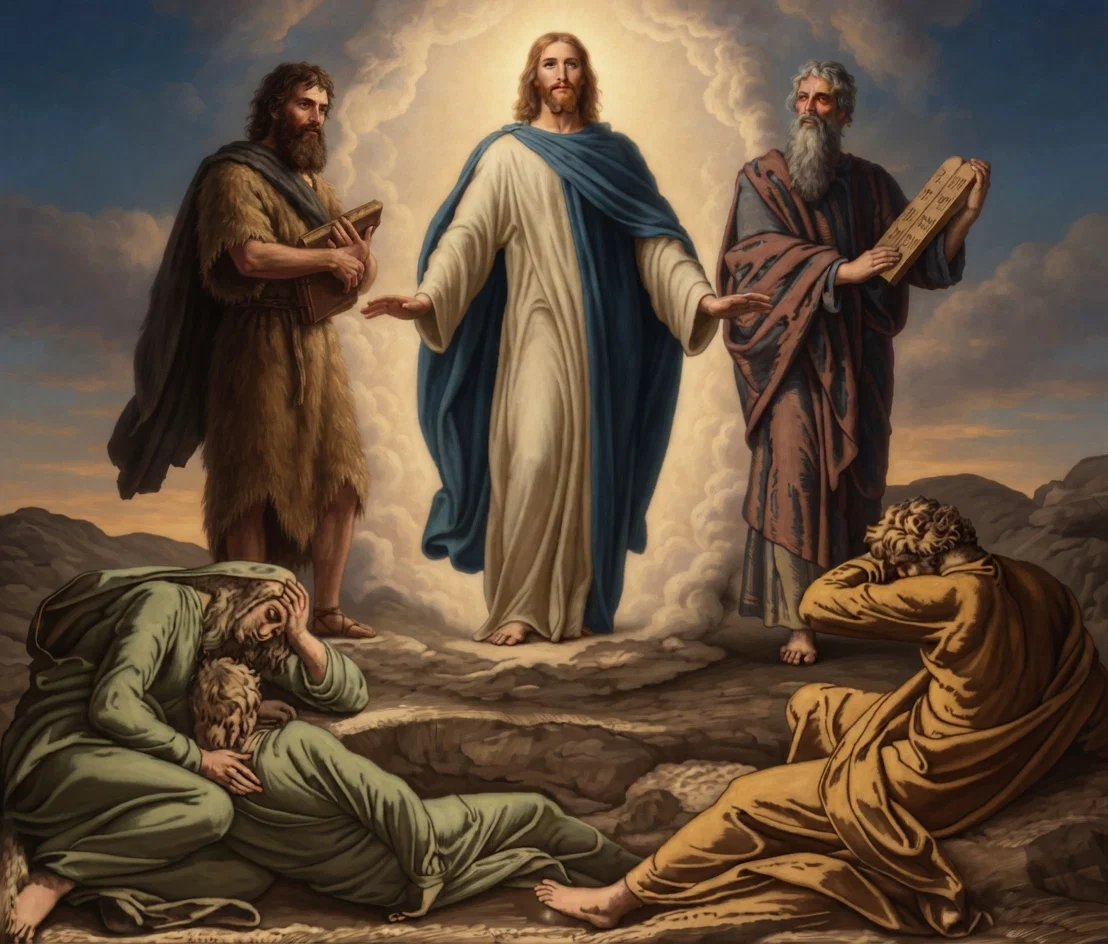
When Jesus was baptized, he went up out of the water, "and, lo, the heavens were opened unto him; . . . and lo a voice from heaven, saying, This is my beloved Son, in whom I am well pleased." Matt. 3:16, 17. Later on, when our Lord had entered upon his ministry, Peter, and James, and John were with him "in the holy mount" (2 Peter 1:18) of transfiguration; and "while he yet spake, behold, a bright cloud overshadowed them;" and
again was heard on earth the divine voice proclaiming, "This is my beloved Son, in whom I am well pleased; hear ye him." Matt. 17:5.
Under the Bible law two or three witnesses are sufficient to establish a matter; and here is God's own testimony to the divine Sonship of the man Christ Jesus, as witnessed by the Baptist and the three disciples. This testimony is faithfully recorded for all time, proving beyond controversy that the Son of God did indeed come to earth; he grew to man's estate; he was baptized in the river Jordan, and entered upon his life-work. From this time to the close of his earthly mission, our dear Lord, clothed with humanity, trod the hills and vales of Judea, seeking "the lost sheep of the house of Israel." Matt. 15:24.
AUGUSTA W. HEALD.

THE SPIRIT IS A TEACHER.

THE Comforter, or Spirit of God, comes as a teacher. It teaches in comforting. It could not comfort except by teaching. This is so, for there is and ever will be comfort in the very things which it teacheth. "For he shall not speak of himself [there is no selfishness in the Holy Spirit; and that is just the reason that it can comfort]; but whatsoever he shall hear, that shall he speak; and he will show you things to come. He shall glorify Me; for he shall receive of Mine, and shall show it unto you." John 16:13, 14. Indeed, there is a blessed comfort in receiving those things, for they are all of Jesus. And we may be assured that he will never tell us anything that the Saviour did not say.
It is for this reason that we can not believe that spirit which tells us that the first day of the week is the Christian sabbath, for Christ never taught it. And we may read still further: "But the Comforter, which is the Holy Ghost, whom the Father will send in my name, he shall teach you all things [So much so that we need not go to the Bible to learn what is therein revealed?—No, no. Listen!], and bring all things to your remembrance, whatsoever I have said unto you." John 14:26. Therefore we ask, What saith the Word of God concerning any doctrine that is presented by any man on earth? And there is a blessed comfort to that man or woman who will receive without question that which that Book does tell us, and receiving it act upon it. That Word is the Word of the Spirit.
But how can that Spirit teach or comfort when we ignore that Word, or any part of it? How can it bring to our remembrance that which he has said unless we study to know and become familiar with that which Christ has spoken to us in that Word? Thus we see that the Word of God, spoken by Christ, and the prophets, and apostles, is the agency through which the Holy Spirit is to comfort the believer. This is so, for the Spirit does not work independently of itself, it is not selfish; for it takes of the things of Christ to give to those who will accept of the comfort which it has to give. A most wonderful lesson here for the believer, who is to comfort others by the same Word of God, given through the agency of the Holy Spirit. Never can a man give true comfort by any other means. "The words that I speak unto you, they are spirit, and they are life." John 6:63. Then let us open our hearts to receive the words of Christ in their fulness, and thus enjoy all the comfort which they so freely bestow.

The Holy Spirit in Revelation.

We are not through with our subject yet. The more it is studied, the more it seems like an endless chain. "Secret things belong unto the Lord our God; but those things which are revealed belong unto us and to our children forever, that we may do all the words of this law." Deut. 29:29.
Not only was the Holy Spirit the agency in the giving of that Word, giving to us the things that he has "revealed" "unto us and to our children" in that Word, but the very "spirit of wisdom and revelation in the knowledge of him" (Eph. 1:17), is given to us that we may understand that Word; for we can not understand him nor acknowledge him except through that Word; that Word must be in us. And this is accomplished in him. He has even put that Word within us. "But what saith it? The Word is nigh thee, even in thy mouth, and in thy heart; that is, the Word of faith, which we preach." Rom. 10:8. And so, the "word of faith" being given to us, and the "spirit of revelation and wisdom" also being given, "ye may know what is the hope of his calling, and what the riches of the glory of his inheritance in the saints, and what is the exceeding greatness of his power to usward who believe, according to the working of his mighty power." Eph. 1:17-19. How good the Lord is! He gives unto us the revelation of his own will, and then gives unto us the same spirit of revelation and wisdom that we may understand his Word, having also placed that same "Word of faith" in our hearts that we may believe. And then the same Holy Spirit which indicted that revelation, is given to us that it may also bring to our remembrance whatever he has said unto us.
H. F. PHELPS.

I WONDER.

I WONDER how many are watching By night from their turrets of love For the coming of Christ in His glory, With His angelic hosts from above.
I wonder how many are waiting To see their Redeemer's dear face, As it shines from the east thro' the heavens, All aglow with compassionate grace.
I wonder how many will hearken When He shouts with a far-reaching voice, "Ye that sleep in the dust now awaken, Who have ages ago made your choice,
"And have chosen the Lamb, your Redeemer, Now awake, and your triumph receive, Who have held to the faith, thro' deep trials, On the Crucified One to believe." CLARA E. RICHESON. Lead, South Dakota.

A Full Atonement Made

LORD, I believe were sinners more Than sands upon the ocean shore, Thou hast for all a ransom paid, For all a full atonement made.
—Count Zinzendorf, translated by John Wesley.

M. L. G

No. 587. The Heavenly Sanctuary.

(1) Is THE heavenly sanctuary and its furniture spoken of in Hebrews 8 and 9 material or should it be understood as having a spiritual meaning? (2) The seven lamps being the seven Spirits of God (Rev. 4:5), is not Christ the candlestick? (3) Did Christ begin his ministry in the heavenly sanctuary as mediator at the fall of man or not until his ascension?

M. L. G

1. They are as material as the Priest—Christ—who ministers there; but they are also spiritual with spiritual meanings, as is everything which comes from God's hand. Christ is spiritual, and is called a life-giving Spirit. 1 Cor. 15:45. But he is a real Being, a material, substantial Being, not corruptible, but incorruptible and eternal. All material things are not to be judged by this earth, where matter is subjected and perverted on account of man's sin.
2. No, Christ is not the candlestick, for he is represented as walking among the candlesticks. Rev. 1:13. The candlesticks represent the churches. Rev. 1:20.
3. Jesus Christ, as the God-man, began his ministry in the heavenly sanctuary at his ascension. See Heb. 2:17; 5:5-10; 8:1; Rev. 3:21.

The Outlook

"I will stand upon my watch, and set me upon the tower, and will look forth to see what He will speak with me."

Religious Chapels at West Point.—The Catholics secured from Secretary of War Lamont the privilege of erecting a chapel on the military reservation at West Point Military Academy, and are putting up a substantial edifice. It is questionable whether a mere cabinet officer has a right to give away government land, especially when Congress, some years ago, refused to do a like act. But, as long as there is no authoritative protest, the privilege will hold good.

Instead of recalling the order, the present Secretary of War says any other religious denomination may have a like privilege. It would indeed be a strange sight if each of the one hundred or more denominations in the United States should erect a chapel on the West Point reservation. Of course there is no probability of their doing so, and the Secretary does not expect that they will. There has been so much protest by the other denominations that none of them could consistently accept the proffered privilege.
So the West Point religious training is virtually left to the Catholics and Episcopalians. The chaplaincy is usually in the hands of the latter denomination, and this special privilege will give the Catholics a prestige almost as good, excepting only the government financial support. (And the Catholics seek and obtain like privileges at all the prominent military posts.)
But in either case it is ritualism that is inculcated by government special privilege into the minds of the young men at West Point, who are to wield the physical forces of the country. The meed of religious instruction that they receive is in the line of ritualistic Church and State doctrine. The result is that far the greater portion of the officers of the army, so far as they are anything religiously, are either Episcopalian or Catholic. The difference is slight. If the Roman propaganda had consented to acknowledge Church of England orders, there would now be no difference to speak of. The American Episcopalians claim to be Protestant, but they are ritualistic; and all ritualistic churches are, in principle, supporters of practical Church and State union. They all seek State support wherever it is possible to obtain it. W. N. G.
Continue reading: MR. RADER ON THE SABBATH QUESTION