MALAYSIA includes the Malay Peninsula and the many islands south, southeast, and east of the peninsula, inhabited largely by the Malay race, with a population of about 50,000,000, speaking nearly 100 different languages. The largest islands are Sumatra, Java, Borneo, Celebes, Philippines, and the Moluccas. The islands belonging to New Netherlands have a population of 33,000,000, and the Philippines, belonging to Spain, have a population of 12,000,000. Throughout the islands the Malay is the predominant race. Bishop Thoburn says of the Malay, "He is short of stature, with a reddish-brown complexion, beardless face, straight black hair, and broad and rather flat face."
The Straits Settlements, to which the Methodist Episcopal Mission has to the present been chiefly confined, is a colony of Great Britain, and comprises the island of Singapore, the island of Penang, and Province Wellesley and Malacca on the Malay Peninsula; while all the native States on the peninsula are under British protection. Population, 512,342.
Singapore is 27 miles long, 15 miles wide, and has an area of 224 square miles, with a population in 1891 of 184,554, of whom 121,908 were Chinese, 35,992 Malays, and 16,035 natives of India. Most of these are in the city of Singapore, which is about 1,850 miles from Calcutta.
Penang, 2 miles from the mainland, is 12 miles long, 9 miles wide, and has an area of 107 square miles, and a population, including Province Wellesley, of 235,618, of whom nearly one-half are Chinese, the others being chiefly Malays and Tamils. Georgetown is the principal town, but it generally goes under the name of Penang.
Malacca is a strip of territory on the peninsula 42 miles long and from 8 to 24 miles wide, the chief town being Malacca. It has a population of 93,579.
The Europeans and Americans in Singapore number 5,254; in Penang, 1,201; in Malacca, 134.
The Malaysia Methodist Episcopal Mission was commenced in Singapore in 1885. It was organized as a Mission Conference in 1893. The three principal stations occupied are Singapore, Penang, and Ipoh, in Perak, on the peninsula. There are 15 male missionaries, 8 wives of missionaries, 3 missionaries of the Woman's Foreign Missionary Society, 9 native preachers, 269 members, 161 probationers, and 48 Sunday-schools, with 1,084 scholars. There were 75 conversions, and 41 adults and 17 children baptized in 1896.—Gospel in All Lands.
The Path of a Good Woman
By John Ruskin
THE path of a good woman is indeed strewn with flowers; but they rise behind her steps, not before them.—John Ruskin.
Mission Work Disrupted in Imerina
By W. N. G.
particular in drawing the lines between Protestant and Catholic. And the French Government, in giving the opportunity to these raiders to harass opponents of French conquest, has often found it a sword with two edges, cutting both ways. So it is not surprising when we hear such accounts as the following, told by Rev. F. A. Gregory:—
“We are in about as topsy-turvy a condition as it is possible to be. For a time mission work in Imerina, except in two or three places, is at an end. Speaking, however, for my own part, and leaving others to tell about themselves, this is how we stand: We broke up at Ambatoharanana for our holidays nearly three weeks ago, just in time to escape having to dismiss the students. The last few days were very disturbed, but we just managed to stay until the proper time. For some months there had been large bands of cattle stealers, sometimes styled rebels, to the north of us. They, however, stayed at a respectable distance, and did not give us very much concern, as we scarcely thought they would come very near. Rather more than a month ago they began to shift southwards and to frighten the more peaceful folk, stealing their cattle and burning the churches. Soldiers were sent out in various directions, but failed to stop the insurrection, which naturally grew and became more mischievous.
“The first we actually saw of it was one evening about a month ago, when a church two and a half miles north of us was fired. This was followed by others, but not to any great extent at first, and, as I said, we were able to end the term without any very serious alarm.
“We stayed at Ambatoharanana for a few days after every one had left, and then came to town for a change. The same evening ten churches were burnt within a few miles of our house, and had we been there we could have seen six or seven burning at the same time. It was evidently a concerted affair. On hearing this I went to General Vozron and asked him to put a guard of soldiers at the college. He very kindly consented, and sent out fifty the same evening, forty of these being stationed at a neighboring village, and the rest actually in our buildings. So long as these stay we have no fear for the safety of the place, and I do not expect they will be withdrawn until the district is moderately quiet. The Saturday following I went to Ambatoharanana for the Sunday, and whilst at dinner in the evening, fires were signaled. We bolted out—I had the sergeant dining with me—and took up a position. Six churches were burning within a couple of miles of the college. It seemed possible that an attack might be made upon us; but I did not expect it, for if the Malagasy are anything, they are cowardly.
“Since then the insurrection has been spreading, and at a guess I should think about 200 churches and chapels in the neighborhood and to the north have been burnt or destroyed. The R. C. Mission in that part has lost 32 out of 34. So far only eight of ours have been damaged—those with thatch roofs burnt, those with tiled roofs broken and generally injured. In two or three cases I have had the thatch taken off in order to save the rafters, and I think this is the best thing to do. In one case the thatch on the ground was burnt.
“It is impossible to say when this will stop. For the moment we can do absolutely nothing, nor indeed live at our places except under military protection. Our normal holidays end on Saturday week, but I very much doubt whether it will be possible to begin work again then, and probably I shall extend the time. The decent folk are between two fires; if they stay in their villages, they are persecuted by the insurgent party; if they leave, they are considered as accomplices by the French.”
SPECIAL SUMMER SCHOOL AT THE SANITARIUM.
By John Harvey Kellogg
THE Medical Missionary Board has arranged for a special summer school of ten weeks, beginning from July 1 to 15. This school is especially designed to meet the wants of those who need instruction in healthful cookery, hygienic dress, physical culture, simple methods of treatment, Bible hygiene, and personal evangelistic work as a preparation for missionary labor. It is especially designed for ministers' wives, Bible readers, missionaries who are going into foreign fields, teachers of denominational schools, missionary teachers who expect to engage in work in the south, and ministers and all others engaged in church work.
The course will include a rapid survey of the whole subject of hygienic reform, and the discussion of its bearings upon the present period of the world's history and our present work.
Professor Sutherland, and others connected with the Battle Creek College, Mrs. S. M. I. Henry, Mrs. E. E. Kellogg, Dr. Paulson, Dr. Winegar, Mrs. Dr. Kress, Mrs. Dr. Paulson, and others connected with the Sanitarium, will give instruction in various and special lines.
Those attending the school and desiring to do so, will be given an opportunity to board at the Sanitarium and pay their way in work. No charge will be made for instruction. Those who wish can board themselves. Several classes will be held daily, and those who can pay their board will find it advantageous to do so, that more time may be devoted to study. Practical arrangements will be made for table board at $1.50 per week; rooms, fifty to seventy-five cents a week. All interested should address the undersigned.
J. H. KELLOGG, M.D.,
Battle Creek, Mich.
CHURCH SERVICES WEST OF THE MISSISSIPPI.
By Editor
THIS column of church services, especially in our larger towns and cities, will be printed from time to time as we have room, for the benefit of strangers who may read the SIGNS OF THE TIMES, or brethren passing through. We have found it necessary to condense in the smallest possible space. The word "Sabbath" always refers to the seventh day of the week. These services consist of Sabbath-school, preaching, Bible study, missionary, and prayer-meetings. The first Sabbath service is, with few exceptions, Sabbath-school. The first address is that of the church, or place of meeting; the second, if given, that of pastor or clerk.
Alameda.—Foresters' Hall, cor. Santa Clara Ave. and Park St. Public services: Sabbath 10 and 11 A. M. and 2:45 P. M. W. C. Chamberlain, Elder.
Atchison, Kan.—Cor. 9th and Santa Fe Sts., German M. E. Church. Public services: Sabbath 10 and 11 A. M., Tuesday 7:45 P. M. City Mission, 1124 Atchison St. I. A. Crane, Elder.
Colorado Springs.—311 Boulder Ave. Public services: Sabbath 10 and 11 A. M., and 3 P. M. Prayer-meeting Tuesday 7:45 P. M. D. H. Soggs, Elder.
Denver, Colo.—Cor. W. 11th Ave. and S. 11th St. Public services: Sabbath 10 and 11 A. M., Wednesday and Friday 7:45 P. M. Ira A. Haskins, Elder.
East Portland, Or.—North Pacific Tract Society, No. 508 East Everett St. Public services: Sabbath 10 and 11:30 A. M. and 7 P. M., Wednesday 7 P. M.
Garden Grove, Cal.—Public services: Sabbath 10 and 11 A. M., Sunday 3 P. M. Harriet A. Rainsey, Clerk.
Helena, Mont.—307 N. Warren St. Public services: Sabbath 10 and 11 A. M., Sunday and Wednesday 7:30 P. M. W. T. Henton, Elder.
Kansas City, Mo.—Cor. 12th and Woodland Ave. Public services: Sabbath 10 and 11 A. M., Tuesday 7:45 P. M.
Los Angeles.—145 Carr St., bet. Main and Hill Sts. Public services: Sabbath 9:45 and 11 A. M., Tuesday and Thursday 7:30 P. M. Belle P. Baker, Clerk, 926 Hill St.
Oakland.—Cor. 12th and Brush Sts. Public services: Sunday at 7:30 P. M., Sabbath 9:30 and 11 A. M., Wednesday 7:30 P. M.
Omaha, Neb.—Near cor. N. 25th and Indiana Sts. Public services: Sabbath 10 and 11 A. M., Sunday 6 and 7:30 P. M., Tuesday and Wednesday evenings 7:30 P. M. Also at South Omaha Sabbath at 3 P. M. A. J. Howard Pastor, 941 N. 25th St.
Pasadena.—Cor. of Summit Ave. and Mountain St. Public services: Sunday 7:30 P. M., Sabbath 10 and 11:30 A. M. Mrs. H. A. Chapman, Clerk, Station 1, Pasadena, Cal.
Phoenix, Ariz.—Cor. 4th Ave. and Washington St., upstairs. Public services: Sabbath 9:30 and 10:45 A. M.; Wednesday 7:30 P. M. (Elder, C. D. M. Williams, absent.) Leader, Eugene A. Browne, 306 N. 2d St.
Sacramento.—G St. bet. 18th and 19th Sts. Public services: Sunday 7:30 P. M., Sabbath 10 and 11 A. M., Wednesday 7:30 P. M.
Salt Lake City, Utah.—Room No. 30 East 4th S. St. Public services: Sabbath 10 and 11 A. M., Sunday 7:30 P. M., Wednesday and Saturday 7:45 P. M. J. M. Willoughby, Pastor, 1227 Emerson Ave.
San Diego.—Cor. 18th and G Sts. Public services: Sunday 7 P. M., Sabbath 9:45 and 11 A. M., Wednesday 7:30 P. M. Mary J. Dimock, Clerk, National City, Box 136.
San Francisco.—914 Laguna St. Public services: Sunday 7:30 P. M., Sabbath 9:45 and 11 A. M., Thursday 7:30 P. M.
San Jose, Cal.—Church, San Salvador St., near Delmas Ave. Public services: Sabbath school 10, Bible study 11 A. M.; missionary meeting, Sunday 7 P. M.; prayer-meeting Wednesday 7 P. M.
St. Joseph, Mo.—Cor. 15th and Locust Sts. Public services: Sabbath 10 and 11 A. M., Wednesday 7:30 P. M. Mrs. Harriet W. Talbert, Clerk.
St. Louis, Mo.—2955 Sheridan Ave. Public services: Sabbath 10 and 11:30 A. M., Wednesday 7:45 P. M. Mary S. Yener, Clerk.
St. Paul, Minn.—On Wacouta bet. 8th and 9th. Public services: Sabbath 10 and 11 A. M., Sunday 7:30 P. M. H. F. Phelps, Pastor, 1634 Carrol St.
Stockton.—Cor. Miner Ave. and Stanislaus St. Public services: Sabbath 10 and 11 A. M., Wednesday 2:30 P. M. Henry Mathews, Elder.
Tacoma, Wash.—Cor. South 16th and K Sts. Public services: Sabbath 10 and 11 A. M., Sunday 6 and 7:45 P. M., Wednesday 7:30 P. M. F. H. Smith, Elder, 1507 South I St.
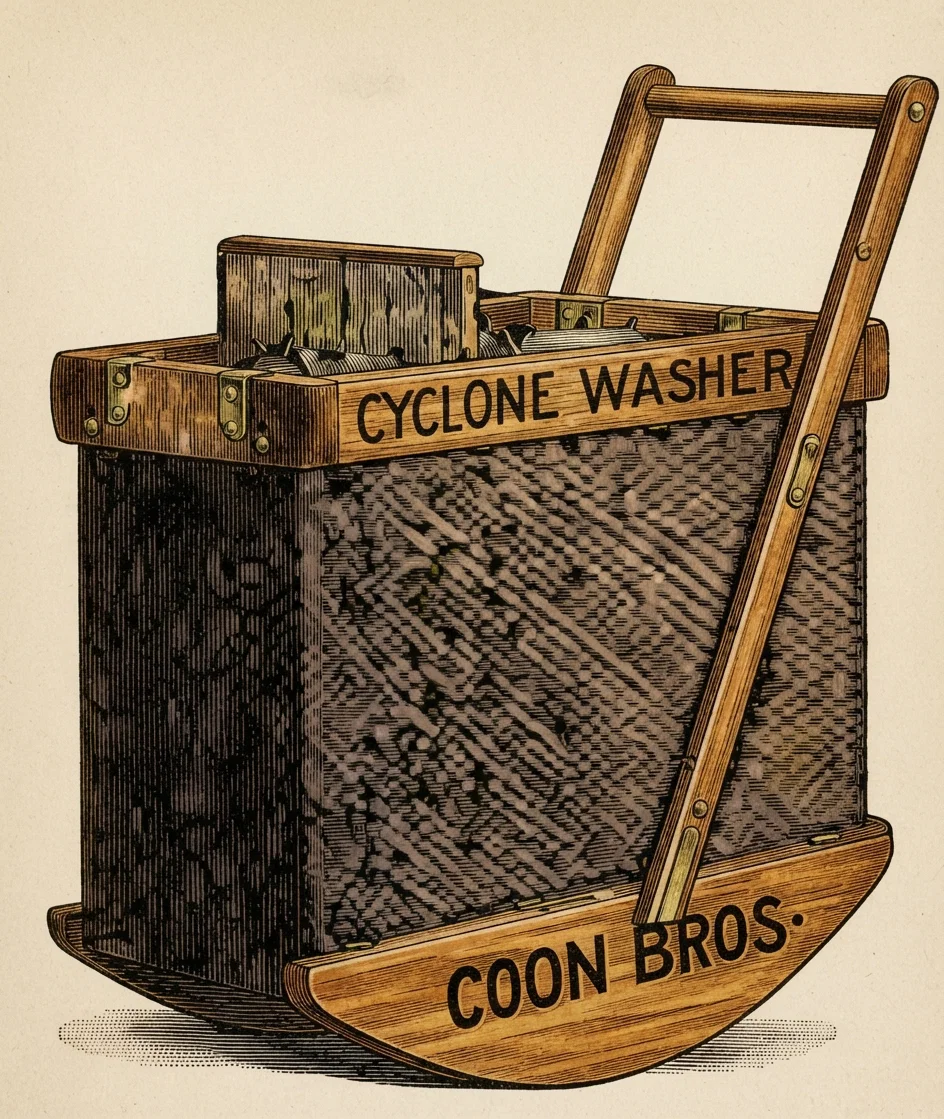
The "Cyclone" Still Whirls.
By Editor
We beg to inform our old friends and patrons that the "Cyclone" still whirls. While some have waited for a more favorable opportunity, a goodly number have grasped opportunity by the forelock, by hustling the Cyclone, and are rejoicing to-day in the fact that they have found a pleasant and profitable employment, not only for a season, but for the whole year.
In the Cyclone we guarantee you an article which, if properly handled, will bring you a rich harvest of friends and liberal cash returns.
In introducing it you will find the most enjoyable employment you have ever found in the introduction of any article to the public. The people are looking for a perfect washing machine. None but the Cyclone fills the bill. Who among you will assist us in supplying this demand?
Agents wanted everywhere. For prices and terms address, Coon Bros., 18-20 Hanover St., Battle Creek, Mich.
OUR WORK AND WORKERS.
By Editor
NEW YORK CONFERENCE is putting six tents in the field this season.
ELDER O. A. JOHNSON reports twenty-five converts at Green Bay, Wis.
JUNE 6 is set for the dedication of the new house of worship at Darien Center, N. Y.
BROTHER ABEL GREGORY reports the recent addition of six members to the church at Austin, Texas.
A CHURCH of twenty-five members was organized at Wautoma, Wis., May 2, by Elder Wm. Covert, president of the conference.
IT has been decided at Union College, College Place, Neb., to discard all text-books containing pagan or infidel sentiments, and to give the Bible the leading place in every line of study.
ELDER C. A. HALL reports to the Review the dedication of a new house of worship at Kingston, Jamaica, on the 11th of April. In connection with the meeting eleven persons were baptized, and sixteen united with the church.
FROM Blossburg, Ala., where Elder W. Woodford has been laboring, we learn that there is now a church of between thirty and forty members, and a Sabbath-school of forty-five members. A new house of worship is in process of construction.
ELDER S. THURSTON reports the result of ten weeks' labor in Orange County, Cal., as follows: "I baptized 35; 43 persons united with the churches: Garden Grove, 15; Centralia, 26; and Santa Ana, 2." As the result of a recent effort near Centralia, 11 accepted the truth.
ANOTHER case of a "union" meeting-house being denied to Adventist ministers when the people begin to be really interested recently occurred at Ottervale, Wis. But Elder W. S. Shreve and Brother M. N. Campbell were not to be outdone in that way. They pitched a tent, and the interest continues.
AT the camp-meeting held at Point Pleasant, W. Va., the following good resolution was adopted:—
Resolved, That we recommend that our Sabbath-schools and churches on convenient occasions assemble together in the woods, or by the lakes, or in some appropriate place where nature speaks most grandly of her Author, and that such times be devoted to rejoicing in the Lord and becoming better acquainted with each other.
ELDER WM. INGS, a long-tried and faithful laborer, died at St. Helena, Cal., May 19, at the age of sixty-two years. He embraced the Seventh-day Adventist faith twenty-seven years ago, and had been an active laborer in the cause most of the time since. He and his companion were twice sent on missions across the Atlantic, laboring in England (his native land) and on the continent. California has been his field since 1882, where every branch of the cause has had the benefit of his painstaking integrity. At the time of his death he was acting as business manager of Healdsburg College. "Blessed are the dead which die in the Lord from henceforth; Yea, saith the Spirit, that they may rest from their labors; and their works do follow them."
LITERATURE WANTED.
CLEAN copies of SIGNS, Sentinels, or tracts for missionary work. Address, post-paid, Walter Scott, Thurlow, Delaware County, Pa.
UPPER COLUMBIA CAMP-MEETING.
By R. S. Donnell
THE Upper Columbia Conference of Seventh-day Adventists will hold a camp-meeting in Spokane, Washington, June 24 to July 4. This camp-meeting is especially to accommodate those living in the northern part of the conference, and we hope for a good turnout from all the churches north of Spokane, and in fact all north of Snake River. Remember the time, June 24 to July 4.
R. S. DONNELL.
SABBATH-KEEPERS IN YONKERS, N. Y., AND VICINITY.
By Editor
Will you kindly send your names and addresses to John Liederman, librarian of Brooklyn Church, 44 Court Street, Brooklyn, N. Y., as a Sabbath-keeper living in Yonkers wishes to communicate with others of like faith?
CHURCH SERVICES EAST OF THE MISSISSIPPI.
Baltimore, Md.—Harlem Hall, North Stricker St. Public services: Sabbath 11 A. M., Sunday 7:30 P. M. S. E. de Bruyn Clerk.
Birmingham, Ala.—Odd Fellows' Hall, Fox Building. Public services: 2:30 and 3:30 P. M. every Sabbath, Sunday 7:30 P. M. R. D. Hottel, Pastor, 1005 N. 20th St.
Boston, Mass.—694 Washington St. public services: Sabbath 10 and 11 A. M. George B. Wheeler, Pastor.
Bradford, Pa.—Ladies' Club Room No. 1 Chautauqua Place. Public services: Sabbath 2 P. M. H. T. Morian, Clerk.
Brooklyn, N. Y.—Wurzler's Hall, 315 Washington St. near city post-office. Public services: Sabbath 10 and 11 A. M.
Chicago, Ill.—On 46th St. bet. Michigan and Wabash Ave. Public services: Sabbath 9:30 and 11 A. M. and 12:30 P. M., Sunday 7:15 P. M., Tuesday 7 P. M., and Thursday 7:30 P. M.
Cleveland, Ohio.—249 Cedar Ave., bet. Sterling and Hayward. Public services: Sabbath 10 and 11 A. M. (sun time), Sunday 7:30 P. M., Wednesday 7:30 P. M. Willard H. Saxby, Pastor.
Detroit, Mich.—424 Trumbull Ave., bet. Perry and Bagg Sts. Public services: Sabbath 10 A. M., Sunday 7:30 P. M., Wednesday 7:30 P. M. A. O. Burrill, Pastor.
Duluth, Minn.—123 First Ave., East. Public services: Sabbath 2 and 3 P. M. John Clark, Elder.
Hartford, Conn.—Room 6, 254 Main St. Sabbath-school at 2, and preaching at 3:15 P.M. O. M. Hatch, Clerk.
Jersey City, N. J.—Second S. D. A. Church. Public services: 49 A South St., Sabbath 2:30 and 3:30, Sunday and Friday 7:45 P. M. A. R. Bell, Elder.
Louisville Ky.—Second S. D. A. Church (white) mission rooms 2431 W. Broadway. Public services: Sabbath 10 and 11 A. M., Sunday and Wednesday 7:30 P. M. J. W. Collie, Pastor.
First S. D. A. Church, Broadway, bet. 8th and 9th Sts. Sabbath-school at 9:30 and preaching at 10:30 A. M. J. R. Buster, Pastor.
Lynn, Mass.—Lee Hall. Public services: Sabbath 1:30 and 3 P. M., Tuesday and Friday 7:30 P. M. A. B. Jernegan, Elder. A. B. Felton, Clerk, 35 Union St.
Nashville, Tenn.—Hall 415 Woodland St. Public services: Sabbath 10 and 11 A. M., Sunday and Wednesday 7 P. M. Minnie M. Hoyt, Lib., 56 Ramsey St.
New Bedford, Mass.—Church at Willow St., west of Cedar. Public services: Sabbath 10:30 A. M. and 12 M. J. B. Hall, Clerk, Box 72, Acushnet, Mass.
New Orleans, La.—Jefferson Hall, cor. Magazine and Philip Sts. Public services: Every Sabbath at 10 and 11:15 A. M. J. E. Evans, Pastor, 6325 Patton St.
Philadelphia, Penn.—Public services at 1724 N. 15th St.: Sabbath 10 (Sabbath-school 11:15) A. M., Sunday 7:45 P. M. E. Merrell, Pastor, 1724 N. 15th St.
Pittsburg, Pa.—Hall of Bank Building, cor. 5th Ave. and Stevenson St., entrance on Stevenson. Public services: Sunday 3:00 P. M., Sabbath 10 and 11 A. M. J. G. Excell, Pastor, 211 Dinwiddie St.
Portland, Me.—Williams' Hall, Congress St., Sabbath-school 2 P. M., social meeting 3:15 P. M. H. C. Basney, Elder, North Deering.
Providence, R. I.—Olney St. Congregational (Unitarian) Church. Public services: Sabbath 2 and 3 P. M., Friday 7:30 P. M. Wm. H. Warfield, Clerk, 27 Susan St., Providence.
Richmond, Va.—Meetings at 501 North 25th St. Public services: Sabbath 10 and 11 A. M. J. P. Neff, Pastor.
Washington, D. C.—On 8th bet. F. and G. Sts., N. E. Public services: Sabbath 10 and 11:15 A. M., Sunday 7:30 P. M., Wednesday 7:30 P. M. V. H. Lucas, Pastor, 209 8th Street, N. E.
Wilmington, Del.—Red Men's Hall, 515 Shipley St. Public services: Sabbath 10 and 11 A. M., Sunday 2:30 P. M. Edwin F. Eckel, Clerk.
Worcester, Mass.—118 Austin St. Public services: Sabbath 10 and 11:15 A. M., Wednesday 7:30 P. M. F. C. Bee, Clerk, No. 6 Furnace St.
THE UNITED STATES IS IN PROPHECY.
By Editor
WE have several large works treating this subject in detail, but not until recently have we had anything sufficiently condensed for general distribution. Elder Uriah Smith, author of "United States in Prophecy," "Thoughts on Daniel and The Revelation," "Marvel of Nations," and senior editor of the Review and Herald, has written a 32-page treatise on the prophecies relating to this country, and has entitled it "America's Crisis." That we have reached a crisis, all thinking men believe; but that this crisis and what it means to the world is foretold in Scripture, is not so generally believed.
To read this pamphlet is to become intelligent on this great question, and to awaken an interest for the details of the working out of these prophecies. Order Bible Students' Library, No. 138. Price, 4 cents. Special price on quantities for distribution.
PACIFIC PRESS PUB. Co., Oakland, Cal.
New York City, N. Y. Kansas City, Mo.
CHRIST AND THE SABBATH: Or Christ in the Old Testament and the Sabbath in the New, by Elder James White. Paper covers, fifty-six pages, sent post-paid for ten cents.
Address. PACIFIC PRESS, Oakland, Cal.
11 "BUT Mary was standing without at the tomb weeping; so, 12 as she wept, she stooped and looked into the tomb; and she beholdeth two angels in white sitting, one at the head, and one at the feet, where the body of Jesus had lain. And they say unto her, Woman, why weepest thou? She saith unto them, Because they have taken away my Lord, and I know not where 14 they have laid him. When she had thus said, she turned herself back, and beholdeth Jesus standing, and knew not that it 15 was Jesus. Jesus saith unto her, Woman, why weepest thou? whom seekest thou? She, supposing him to be the gardener, saith unto him, Sir, if thou hast borne him hence, tell me where 16 thou hast laid him, and I will take him away. Jesus saith unto her, Mary. She turneth herself, and saith unto him in Hebrew, 17 Rabboni; which is to say, Master. Jesus saith to her, Touch me not; for I am not yet ascended unto the Father; but go unto my brethren, and say to them, I ascend unto my Father and 18 your Father, and my God and your God. Mary Magdalene cometh and telleth the disciples, I have seen the Lord; and how that he had said these things unto her.
19 "When therefore it was evening, on that day, the first day of the week, and when the doors were shut where the disciples were, for fear of the Jews, Jesus came and stood in the midst, 20 and saith unto them, Peace be unto you. And when he had said this, he showed unto them his hands and his side. The 21 disciples therefore were glad, when they saw the Lord. Jesus therefore said to them again, Peace be unto you; as the Father hath sent me, even so send I you. And when he had said this, 22 he breathed on them, and saith unto them, Receive ye the Holy 23 Ghost; whosoever sins ye forgive, they are forgiven unto them; whosoever sins ye retain, they are retained.
24 "But Thomas, one of the twelve, called Didymus, was not 25 with them when Jesus came. The other disciples therefore said unto him, We have seen the Lord. But he said unto them, Except I shall see in his hands the print of the nails, and put my finger into the print of the nails, and put my hand into his side, I will not believe.
26 "And after eight days again his disciples were within, and Thomas with them. Jesus cometh, the doors being shut, and 27 stood in the midst, and said, Peace be unto you. Then saith he to Thomas, Reach hither thy finger, and see my hands; and reach hither thy hand, and put it into my side; and be not 28 faithless, but believing. Thomas answered and said unto 29 him, My Lord and my God. Jesus saith unto him, Because thou hast seen me, thou hast believed; blessed are they that have not seen, and yet have believed.
30 "Many other signs therefore did Jesus in the presence of the 31 disciples, which are not written in this book: but these are written, that ye may believe that Jesus is the Christ, the Son of God; and that believing ye may have life in his name."
QUESTIONS.
Who still remained at the sepulcher?
What did she do?
What did she see?
What inquiry did the angels make?
What answer did Mary give?
Whom did she then see? Did she recognize him?
What questions did Jesus address to her?
Whom did she suppose him to be? What did she say to him?
How did Jesus reply? What response did this call out?
What did Jesus request her not to do? What message did he intrust to her?
To whom did Mary then go? What did she say to them?
How did Jesus then reveal himself to his disciples? What day of the week was it? What time of the day? What precautions had been taken? Why? What did Jesus say to them?
What proofs did he then give of his real presence? What was the effect upon the disciples?
What did Jesus further say to them?
What did he then impart to them?
What authority was thus to be exercised through them?
Who was absent on this occasion?
What did the other disciples tell him?
What evidence did he demand before he would believe?
How long before the next meeting? Who was present? Who came to them? How did he greet them?
What did Jesus invite Thomas to do? What did he urge upon him?
What effect did this have upon Thomas?
What did Jesus say of his faith? What experience did he commend?
Were all the acts of Jesus recorded by John?
What was the purpose in writing the things which were recorded? What was to be the result of such faith?
NOTES.
1. "The same day at evening, being the first day of the week." This was the same day in which the events took place which are narrated in the previous eighteen verses. From this we know that the meeting recorded in verse 19 occurred in the evening following the first day of the week. The following account of the arrival at Jerusalem of the two disciples from Emmaus after Jesus had made himself known to them, will be of interest to the student:—
"When the disciples arrived at Jerusalem, they entered the eastern gate, which was open on festal occasions. The houses were dark and silent, but they made their way through the narrow streets by the light of the rising moon. They knew that they would find their brethren in the memorable upper chamber where Jesus had spent the last night before his death. . . . Cautious hands unbarred the door to the repeated demand of the two travelers; they entered, and with them also entered Jesus, who had been their unseen companion all the way. . . . When the disciples from Emmaus entered with their joyful tidings, they were met by the exclamation from many voices, 'The Lord is risen indeed, and hath appeared to Simon.'"—Spirit of Prophecy, vol. 3, pp. 216, 217.
2. "WHOSESOEVER sins ye remit, they are remitted unto them." "Jesus, in giving the disciples their first commission, had said, 'I will give unto thee the keys of the kingdom of heaven, and whatsoever thou [referring to responsible men who should represent his church] shall bind upon earth shall be bound in heaven, and whatsoever thou shalt loose on earth shall be loosed in heaven.' In renewing the commission of those to whom he had imparted the Holy Ghost, he said, 'Whosoever sins ye remit, they are remitted unto them; and whosoever sins ye retain, they are retained.' These words conveyed to the disciples a sense of the sacredness of their work, and its tremendous results. Imbued with the Spirit of God, they were to go forth preaching the merits of a sin-pardoning Saviour; and they had the assurance that all heaven was interested in their labors, and that what they did on earth, in the Spirit and power of Christ, should be ratified in heaven. . . . The Saviour taught that he is the only name given under heaven whereby men shall be saved. Jesus, however, delegated to his church upon earth, in her organized capacity, the power to censure, and to remove censure, according to the rules prescribed by inspiration; but these acts were only to be done by men of good repute, who were consecrated by the great Head of the church, and who showed by their lives that they were earnestly seeking to follow the guidance of the Spirit of God.'—Id., pp. 244, 245.
Through the labors of the apostles and God's servants in preaching the Word, people would believe the Gospel, and their sins would be remitted, as illustrated on the day of Pentecost. Acts 2:37, 38. The power of God's Word over the people, when proclaimed by God's servants, is also illustrated in the case of Jeremiah. (See Jer. 1:9, 10.)
Suggestions for Further Study.
What lesson is there for us in the tarrying of Jesus to meet Mary at the sepulcher?
Jesus said to Mary, "Touch me not" (verse 17), and yet later he permitted his disciples to touch him (see Matt. 28:9). How do you explain this?
In the light of verse 23; Matt. 18:15-18, and Jer. 50:20, is there any importance attached to membership in the church?
The Sunday School
International Series.
LESSON XII.—SUNDAY, JUNE 20, 1897.
PERSONAL RESPONSIBILITY.
NOTE.—This lesson may be profitably used as a temperance lesson. In it are found many of the problems which the church at the present time has to deal with—the conduct of the individual Christian, and the influence which his example may have for good or ill upon those who have not yet learned to look to the perfection of Christ instead of to the faults of their brethren. Paul's determination not to be the occasion for the fall of any of his brethren should be emulated by the professed followers of Christ everywhere. This epistle was written from Corinth to the church at Rome, in the spring of A.D. 58. Paul was at this time returning from his third missionary journey. Commit verses 19 to 21.
10 "But thou, why dost thou judge thy brother? or thou again, why dost thou set at naught thy brother? for we shall all stand 11 before the judgment-seat of God. For it is written, 12 As I live, saith the Lord, to me every knee shall bow, And every tongue shall confess to God. 12 So then each one of us shall give account of himself to God. 13 "Let us not therefore judge one another any more; but judge ye this rather, that no man put a stumbling-block in his brother 14 er's way, or an occasion of falling. I know, and am persuaded in the Lord Jesus, that nothing is unclean of itself; save that to him who accounteth anything to be unclean, to him it is 15 unclean. For if because of meat thy brother is grieved, thou walkest no longer in love. Destroy not with thy meat him for 16 whom Christ died. Let not then your good be evil spoken of; 17 for the kingdom of God is not eating and drinking, but right-18 eousness and peace and joy in the Holy Ghost. For he that 19 herein serveth Christ is well-pleasing to God, and approved of 19 men. So then let us follow after things which make for peace, 20 and things whereby we may edify one another. Overthrow not for meat's sake the work of God. All things indeed are clean; howbeit it is evil for that man who eateth with offense. 21 It is good not to eat flesh, nor to drink wine, nor to do anything whereby thy brother stumbleth."
Golden Text.—"It is good neither to eat flesh, nor to drink wine, nor anything whereby thy brother stumbleth." Rom. 14: 21.
SUGGESTIVE QUESTIONS.
(1) What two questions does Paul here ask of those to whom this epistle is addressed? Verse 10. (2) What reason does he give why such a course is inconsistent? Note 1. (3) To whom only should man bow the knee of worship? Verse 11. (4) To whom alone will all confess? Note 2. (5) To whom must we all give an account? Verse 12. (6) Therefore what admonition does Paul give? (7) What may we judge? Verse 13. Note 3. (8) What persuasion did Paul reach? (9) What would make it wrong for a professed Christian to partake of certain things? Verse 14. Note 4. (10) How may one show his charity or lack of charity for a brother in the faith? (11) From what is the Christian exhorted to refrain? Verse 15. Note 5. (12) What discredit may self-indulgence bring upon the cause? Verse 16. (13) In what does the kingdom of God not consist? Verse 17. (14) In what does it consist? (15) What is the condition of him who in these things follows Christ? Verse 18. (16) What higher things than meats and drinks are we exhorted to seek after? (17) What effect may indulgence have upon the work of God? (18) What is the condition of all foods to him who eateth without offense? (19) What does it become to him who eateth with offense? Verse 20. (20) How does the apostle sum up the duty of Christians in these respects? Verse 21.
NOTES.
1. Thou, why dost thou judge thy brother?—The word "judge" here evidently means to impute wrong motives to the individual and condemn him for such motives. This is a province in which man has no jurisdiction whatever. "There is none that doeth good, no, not one." He who would act as a judge over other men must himself be free from the guilt of which the other is accused. All men have broken the law of God—the same law—and are therefore barred from judging or condemning their fellow-men. He who has broken the law has no right to condemn another for the same offense; and all have become "guilty before God." He who would attempt to do this is putting himself in the place of God, who alone has the right to exercise such judgment.
2. Every tongue shall confess to God.—The individuality of acceptable service and personal responsibility to God is emphatically taught in this text. As true as the life of God, none should bow in worship to any other being. This statement is given in the nature of an oath, as will be seen by referring to Isa. 45: 23, from which the quotation is made. The last clause of this verse is emphasized by the same oath, that confession should be made to God alone, and not to intermediaries, or those who would be such. The fact that this is in the sight of God an important thing is shown by the way in which he emphasizes it. In the great day of judgment even the wicked will, when too late, confess to him. God desires14man to do this before it is too late. "Now is the acceptable time."
3. But judge ye this rather.—"That is, turn your judgment to yourselves, and see to it that by your use of your liberty you do not cause others to fall into sin. We are never to give up our liberty of thought and action, but to use it in the right way, as in the verses that follow."—Peloubet.
4. To him it is unclean.—That is, if he believes it to be wrong to partake of certain food, and then partakes of it while having that belief, to him it is wrong. He has violated his conscience. He has done that which he believed to be wrong, and in this act shows a lack of principle and fidelity to the right. There are things eaten which are not fit for food. There are things taken into the system which irritate it and break it down, making of the man a physical wreck. Paul is not arguing that everything that is eaten is proper diet, but that he who eats what he believes to be wrong, sins, while another may eat the same thing and have no sin. The sin in this matter comes in doing what one believes to be wrong.
5. If thy brother be grieved with thy meat.—Injured, or hurt. If we allow ourselves to do, for the sake of self-indulgence, that which may be a stumbling-block for our brother, we have not charity; we have not that interest in our brother's salvation which a Christian should have. Have a greater regard for his soul's salvation than for doing those things which gratify self.
The difficulties with which the church at this time was contending referred principally to meats and drinks and feast days. The question of the Sabbath was not troubling them. The statement that at this time the first day of the week was being kept by the Christians, both Jews and Gentiles, is not correct. They were keeping the seventh day, the same day on which the Jews worshiped, as will be seen by reference to Acts 13: 42, 44. And it will also be noticed that the day on which the Jews met for worship (the seventh day) the Bible here recognizes, in verse 44, as the Sabbath day. By reference to Acts 18: 4 it will be seen that the day on which the Jews met in their synagogs for worship is called the Sabbath. Paul remained there at Corinth one year and six months, preaching the Gospel "every Sabbath;" and yet he was not preaching in the synagogs all this time, for verses 6 and 7 of Acts 18 show that he was compelled to seek another place. The events here referred to took place in the year 54 A.D., and prove that the seventh-day Sabbath was being kept at that time by Jews and Christians alike, whether the Christians came from the Jews or the Gentiles. The days referred to in to-day's lesson were simply feast days, or holidays, and had nothing to do with the true Sabbath.
CHRIST
By Ellet Joseph Waggoner
AND
HIS RIGHTEOUSNESS
By E. J. WAGGONER.
The above is the title of a new pamphlet just issued in the Bible Students' Library.
There has been a demand for a treatise of this kind and we are much pleased to announce this new publication.
The following is a brief synopsis of the contents: How Shall We Consider Christ? Is Christ God? Christ as Creator, Is Christ a Created Being? God Manifest in the Flesh, Important Practical Lessons, Christ the Lawgiver, The Righteousness of God, The Lord Our Righteousness, Acceptance with God, The Victory of Faith, Bond Servants and Freemen, Practical Illustrations of Deliverance from Bondage.
Issued as No. 72 of the Bible Students' Library. Price 15 cents. Order of any State Tract Society, or
PACIFIC PRESS PUBLISHING CO.,
Or, 43 Bond St., N. Y. Oakland, Cal.