Review and Herald Publishing Company · Battle Creek, Mich. · June 26, 1902
The Land of Sunshine, Fruit, and Flowers
By David Paulson
Pasadena is the winter residence of some of the most wealthy citizens of America, and all that money and art can accomplish has been done to construct magnificent mansions and artistic and picturesque grounds. Lemon, orange, almond, and olive-trees flourish on every hand; and in the heart of winter, beautiful flowers are in full bloom amid well-kept shrubbery in nearly every dooryard.
Among the interesting relics of a bygone age are the quaint missions that were built by Spanish Catholic missionaries more than a hundred years ago at various points on the South Pacific Coast. The most celebrated of these is the San Gabriel Mission ten miles east of Los Angeles, which was erected in 1790. Its walls are adorned with paintings supposed to have been made in Spain more than a century ago. Its baptismal font is made of copper beaten out with a hammer.
One can not but admire the heroism of these missionaries, who, bidding farewell to friends, relatives, and the comforts and privileges of home, made the then long and perilous journey to this wild country, where they were in constant danger of being massacred by the savage Indians, as, in fact, many of them were. They succeeded in erecting buildings so substantial that after a lapse of a hundred years many of them are still in a fair condition of preservation. How many readers of the INSTRUCTOR have such a love for mankind that, if called upon to do so, they would be willing to make a similar sacrifice, in order to save perishing humanity?
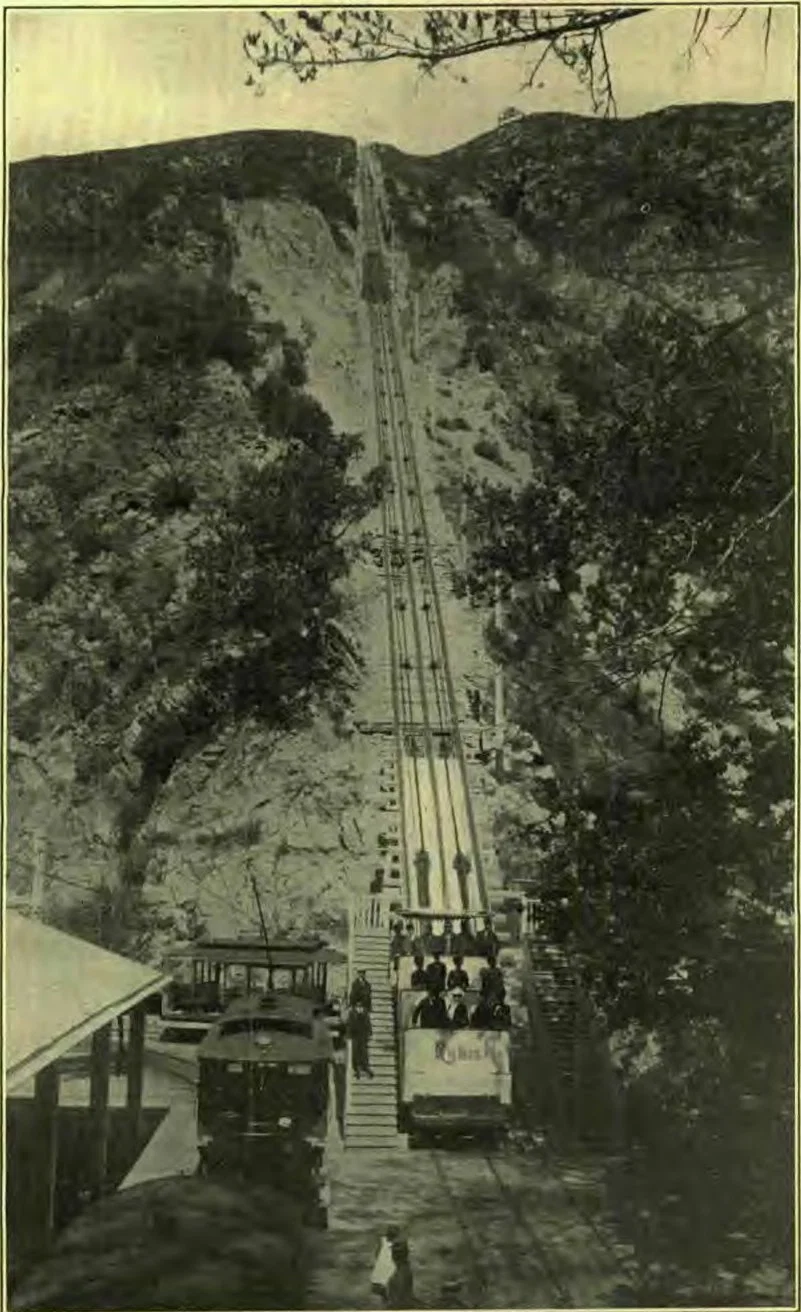
Few tourists leave Southern California without visiting Mt. Lowe. The approach to this mountain is made in an electric trolley-car, later transferring to a cable-car, when the steep ascent shown in the picture is begun. This part of the trip is three thousand feet long, and in that distance there is a rise of thirteen hundred feet. While the car is being fairly lifted up this steep incline, many travelers find it necessary to close their eyes in order to keep from becoming dizzy. Part of the time we are almost over the edge of a nearly perpendicular precipice, overlooking the wild cañon below.
UP MT. LOWE
At the top of this steep incline, another transfer is made, to a trolley-car which climbs the mountains by winding around them in such a way as to make this one of the most scenic trips in the world. At one place, in order to climb back again on the same mountainside only a little above, the road makes one of the shortest horseshoe curves I have ever seen. The construction of this entire road was certainly a marvelous feat of engineering skill. One can not but believe that God directed the minds that planned the undertaking. The divine mind is always ready to assist men in accomplishing great things in the world if they will listen to his voice.
Los Angeles is a city of perpetual summer. The weather, when I arrived there the first week in February, resembled that of the middle of June in Chicago. The streets of the city are continually thronged with sight-seers, health-seekers, and tourists. How few of this great army of invalids are aware that health is no more dependent upon a favorable climate than holiness upon righteous surroundings! Climate and environment serve only to bring to the surface our real physical and moral condition. The climate within us is far more important than the climate without. The young man who reads foul literature and harbors evil thoughts is creating a climate in his soul that is far more destructive to his physical as well as his spiritual health than unfavorable surroundings ever can be. Likewise, one who daily devours the scavengers of earth, sea, and sky, and otherwise partakes of a wretched and unsuitable dietary, is thereby creating a climate in his stomach that is many-fold times more responsible for his invalidism than the unfavorable climate that may prevail in the section of the country where he lives.
There is little satisfaction to be found in going on an excursion in search of health. How much better it is to care for ourselves before disease comes, by earnest and conscientious adherence to the laws of health! For the laws of health are in reality God’s laws, just as truly as are the ten commandments. Many who would not think of violating the Sabbath commandment are daily deliberately trampling upon physical laws that are just as divine in their origin as is that commandment. Let every reader of the INSTRUCTOR who has a discouraging Christian experience carefully consider if some such neglect may not partially account for his present condition. God can not abundantly bless those who violate his laws.
David Paulson, M. D.
The Seventeen-Year Locust
By L. O. Howard
THIS morning, April 18, I have been over in the Smithsonian grounds in the city of Washington, where, under many of the trees, I found holes in the earth about the size of the tip of one's umbrella. I expected to find these holes; for seventeen years ago—in 1885—there was here an extraordinary appearance of one of the most remarkable insects in the world—the so-called “seventeen-year locust.”
With a spade I dug down round some of these holes, and finally, two feet below the surface, found in each case an active nymph of the cicada, as it should properly be called. It was light-brown in color, horny in appearance, with large front legs somewhat resembling those of a mole.
Two feet below the surface is pretty deep. Knowing something of the habits of this insect, I approached a hole cautiously, and thrust the spade suddenly under the sod at a depth of only202two inches, and caught the creature before it could retreat to a lower depth. Just now, then, the nymphs of the seventeen-year locust have come to the surface of the ground, making these holes at night, and during the warm, sunny spring days they remain motionless near the mouth of the burrow. At the approach of a footstep the earth trembles, and they retreat, frightened, to the bottom of the burrow.
In a month from now each of these nymphs will have made up its entomological mind that it is time to be up and doing. At all events, toward the end of May some night, about dusk, moved by an unexplainable impulse, almost every one of the nymphs will come out of its burrow, and crawl rapidly to the trunk of the nearest tree. Awkwardly climbing up the bark, each one will finally come to some point, where it will cling firmly. Then the skin will split down the back, and from out the opening will crawl a beautiful snowy-white creature, with wings all crumpled up in small bunches, with bright, coral-red eyes, and with two black patches on its back. Then the wings will begin to expand until they are longer than the body.
The next day when the sun comes, the white color will rapidly change to a reddish-brown, the eyes still remain red, but the body will become nearly black, the wings will become hard and glistening, and the veins will assume a reddish hue. Then the males will begin to sing, and the armies which will fill the trees in certain regions will keep up a shrilling din for four or five weeks.
Along in June the females will begin to lay their eggs. They will puncture the young twigs of the trees which they select, laying their eggs in curious rows in the wood of the twig, and in this way many twigs will be damaged to such an extent that the leaves will turn brown, and with the first wind the twig will crack and hang downward.
After a while the eggs will hatch, and the young cicadas will drop to the ground. Then they enter the first fissure, struggle downward, attach themselves to some tiny rootlet, and begin their long, dark, underground life. They feed very little; for they have a long time to grow, and they are not very large when they are full-grown, so that the damage which they do to the roots of trees is slight, in spite of their numbers.
In the whole group of insects we know of no other species which has so long a life as the periodical cicada. Sometimes, in a certain locality, it will appear at shorter intervals than seventeen years; but that means that in that place there are two broods, the eggs of one being laid, say, in 1898, and the full-grown individuals appearing again in 1915; others laying their eggs in 1902, and becoming full-grown in 1919, as is the case with the present brood.
In the South, influenced by the warmer temperature, these insects remain underground only thirteen years instead of seventeen. Their length of life is so accurately known that we can predict with absolute certainty when their next appearance will take place. Our whole eastern country has been accurately mapped, and each year circulars are sent out from the Department of Agriculture at Washington to parts of the country in which these insects will appear; and persons who are thinking of setting out young orchards are warned that it may be unwise, since in laying their eggs the cicadas frequently damage young fruit trees to a serious extent.
People will tell you that cicadas sting severely. This is hardly true, though it is not improbable that a cicada, when caught, may thrust out the slender threads in its beak, and puncture the skin. This unusual sting, however, is slight, and the pain is only momentary. It can not in any way compare in pain with the sting of a bee, or in after-effects with the puncture of a mosquito.—L. O. Howard, Ph. D., Chief United States Entomologist, in Youth's Companion.
Rounding the Corners
By C. L. Taylor
A NUMBER of years ago, when engaged in school work in the East, it was my lot to fill the office of preceptor in a school home. In this capacity it fell to me to look after the domestic work of the boys.
In the family was a certain young man, good-looking, intelligent, active, and in many ways very affable. He was a leader in the sports of the boys, and filled the place well.
When he first came to the school, he evinced a desire to be thought well of, and took pains to perform various little duties and to extend courtesies to all. This gave him a place in the affection of both teachers and students. No one appeared more anxious than he to make a success of the work he had come to do,—no one more willing to do his whole duty.
His domestic work was to care for the boys’ parlor,—to sweep, mop, and dust, as necessity demanded. Each morning he could be heard at his work (for he was somewhat noisy about it), whistling gaily as he moved the furniture, and shook the numerous rugs and mats.
It was only a short time, however, before it became noticeable that the room was illy cared for. Dust of considerable age could be seen without difficulty in many a nook and corner, and even cobweb festoons graced the ceiling. Of course he did not understand how it was; for he “always took particular pains to be thorough,” and was “sure” that he “had done it all right.”
After a few days’ trial it was noticed that his broom and mop never marked off a right angle, but traveled in semicircular lines, and that in its expeditions his dust-cloth never reached places that were difficult of access. A little further observation showed the cause. The young man was built on circular, easy-going lines. His nature was in no way angular. He had no corners in his brain. And having a rounded brain, his hands described the circle instead of the square. Corners were outside his range of vision. He rounded the corners in sweeping, and mopping, and dusting because it was his nature to do so. The disease of his brain manifested itself in his arm as it did its work. And what he was in caring for the parlor, he was in everything else.
The disease of rounding corners is found almost everywhere. It certainly is of near kin to that other dreadful ailment,—laziness,—or, as more politely stated, “indisposition to work.” It is a disease of the soul, and in its various forms points out the character of the patient. It says that he is liable to fail at any time, and can not be depended on.
The disease of rounding the corners is incurable, except by the careful application, by consent of the person himself, of a liberal supply of God’s grace, mixed with undiluted will-power. This is a sure cure if taken early in life. But if the malady is allowed to develop during the lapse of years, it becomes chronic and hard to handle. In old age it gets into the very marrow of man’s moral bones, and only long, faithful treatment can eradicate it.
Have you ever rounded the corners? Remember that he who does so is certainly neglecting the many little corners of his heart, where the dust of neglect, the cobwebs of sin, linger. The outward life faithfully portrays what is within. Let no one deceive himself that “it doesn’t make any difference.” It does—and all the difference in the world. Like the germ, which in physical life first produces the disease, this in turn reproducing and multiplying the germ, so it is in character life. The evil tendency first breaks out in a wrong action, and then the wrong action strengthens and enlarges and multiplies the tendency, each acting upon the other till character is completely ruined.
Oh, be careful! Let no rounded corners be seen in your work or in your life. The devil’s paths are always circular, while God asks you to turn squarely to the right, and go straight ahead.
C. L. TAYLOR.
Two Coronations
SEVENTY-ONE years ago, in April, 1831, King William IV went down to dissolve Parliament during the great tumult occasioned by the reform bill. In the robing-room of the House of Lords he said: “Lord Hastings, wear the crown; where is it?”
The crown was brought to him; but when Lord Hastings was going to put it on his head, he said, “Nobody shall put the crown on my head but myself.” He put it on, and then said to Lord Grey, “Now, my lord, the coronation is over.” As William had never been crowned, he should not have worn the crown.
George Villiers, who was one of the spectators, said that as the king took his seat upon the throne of the House, with the loose crown upon his head and the tall, gaunt figure of Lord Grey close beside him, the sword of state in his hand, it looked as if the king had his executioner by his side, and the whole might be an augury of the reign.
In the following summer, when it was decided that a public coronation was essential, the king gave orders that it be “short and cheap.”
Informality and economy will not characterize the coronation plans of the man next after William to be crowned King of England. Edward VII intends that the day shall be a fête not only to the favored spectators in Westminster Abbey, but to every inhabitant of his realm. He will himself give a vast dinner to the poor of London, which example will be imitated throughout many cities; beacon-fires will be lighted on the hills; and illuminations, free concerts, and spectacles will make the day memorable.
A further contrast appears between the attitude of the wives of William and of his great-nephew, Edward. Queen Adelaide told Charles Greville that she would have none of their crowns; she did not like to wear “a hired crown.” She had jewels enough of her own, and would have them made up to suit herself.
“You will have to pay for it,” said William, slyly, to the young clerk of the privy council.
“No,” interrupted Queen Adelaide, “I shall pay for it myself.”203
In the crown of Queen Alexandra, on the contrary, will sparkle England’s chief jewel, the magnificent Kohinoor diamond, which Alexandra will not scorn as “hired.” Neither will she pay for the setting of jewels in her coronation crown out of her own private pin-money.—Companion.
The Guest
By Priscilla Leonard
Luck tapped upon a cottage door,
A gentle, quiet tap;
And Laziness, who lounged within,
The cat upon his lap,
Stretched out his slippers to the fire,
And gave a sleepy yawn:
“O, bother! let him knock again!”
He said; but Luck was gone.
Luck tapped again, more faintly still,
Upon another door,
Where Industry was hard at work
Mending his cottage floor.
The door was opened wide at once;
“Come in!” the worker cried,
And Luck was taken by the hand,
And fairly pulled inside.
He still is there,—a wondrous guest
From out whose magic hand
Fortune flows fast,—but Laziness
Can never understand
How Industry found such a friend;
“Luck never came my way!”
He sighs, and quite forgets the knock
Upon his door that day.
— Priscilla Leonard.
Education among the Aztecs
By H. A. Owen
I
After reading of the human sacrifices offered in the religious ceremonies of the Aztecs, and of the feasts on the parted members of the victims,—acts so barbarous that we recoil from their narration, feeling that there can be little that is lovely or pure among such a people,—we are scarcely prepared for the sweet and harmless rites that accompanied the birth of the Aztec child, or the system followed in his education.
If for any reason a mother was unable to care for her child, great care was used in selecting a nurse for him. Her health and habits of life were carefully looked after. At five years of age the son of a noble was sent to school. If educated at home, as many were, he was instructed by his father in the worship of the gods, and taught prayers to repeat when desiring aid from any of the household divinities. He was sometimes taken to the temples with his parents, in order that he might learn to love the worship there.
Great pains was taken to inspire children with a horror of vice, modesty of action, respect for their superiors, and love of work. A woven mat was the child's bed. He was not given all the food he could eat, but only what was necessary to support life comfortably.
At the age of twelve or fourteen, boys were taught the trade of their father. If they were to be soldiers, they accompanied him to the field of battle. Both boys and girls were kept busy. The young Aztec was brought up with such respect for his parents that years after marriage he scarcely dared speak in their presence, and this is still true in the secluded villages of Central America. The following quotations from the instruction of an Aztec father to his son will give a fair idea of the principles imparted to the Aztec youth:—
“My son,” said the father, “thou art preparing to fly into the world without its being given us to know how long heaven will grant us the enjoyment of the precious stone we possess in thee. But happen what may, endeavor to live an upright life, ceaselessly praying God to help thee. He created thee, and to him thou belongest. He is thy father; he loves thee even more than I love thee. Let thy thoughts be of him, and address thy sighs to him night and day.
“Revere and salute thy elders, and never show them any sign of contempt. Be not silent to the poor and the unfortunate; but make haste to console them with kind words. Honor every one, but especially thy father and thy mother, to whom thou owest obedience, fear, and service. Take care not to imitate the example of those bad sons who, like brutes devoid of reason, do not respect those who have given them life; who do not listen to their advice, and do not wish to submit to the punishments their elders judge necessary. He who follows the path of these evil-doers will come to a bad end; he will die in despair, thrown into an abyss or by the claws of wild beasts.
“Never mock at old men, my son, nor at deformed people. Do not mock him whom thou seest commit a fault, and do not throw it in his face. Enter into thyself, and fear lest that which offends thee in others may happen to thyself. Go not whither no one calls thee, and mix not thyself with what does not concern thee. By thy words as well as by thy deeds endeavor to prove thy good education. When thou talkest with any one, do not take hold of his garments. Do not talk too much, and never interrupt others with thy discourse. If thou hearest any one speak foolishly, hold thy tongue if thou art not charged with his conduct. If thou shouldest not be silent, weigh thy words; and do not expose the fault with arrogance, lest thy lesson be not well received.
“When some one speaks to thee, hear him with attention and respect, without moving thy feet, biting thy cloak, or getting up every minute if thou art seated, as these actions are signs of levity and a bad education.
“When thou art at a table, eat not too fast, and show no dislike if a dish displease thee. If a person arrives at thy meal-time, divide thy meal with him, and do not watch him as he eats. When thou walkest, look whither thou goest, that thou mayest knock against no one. If thou meetest any one in thy way, make room for him. Never pass before thy elders, unless forced by necessity, or unless they order thee to do so. When thou takest thy meal in their company, drink not before they do, and offer them what they need in order to gain their good will.
“If thou art made a present, accept it with gratitude. If the gift is of much value, be not proud of it; and if it be of small value, do not despise it nor mock at it; fear to wound him who wished to oblige thee. If thou growest rich, become not insolent to the poor, and humble them not; for the gods who have refused them wealth to give it to thee, might grow angry, and take it from thee to favor another therewith. Live by thy work; for thou shalt be only the more happy therefor.
“I, my son, have fed thee up to this day by my labor; I have not failed in my parental obligations; I have given thee what was necessary without taking it from any one: do thou in like manner.
“Never lie; for it is a great sin. When thou tellest any one what has been told thee, tell the simple truth, and add nothing thereto. Slander4no one, and be silent in regard to the faults thou seest in others, if it is not thy duty to correct them. When thou takest a message, if the one who receives it flies into a passion, and speaks ill of the person who sent it, in repeating his words modify their severity, in order that thou mayest not be the cause of a quarrel, or of a scandal, for which thou wouldst have to reproach thyself.
“Lose not thy time in the market; for that is a place in which occasions for excesses are many. If thou art offered an office, think that it is to test thee, and do not accept immediately; even shouldst thou think thyself better fitted than any one else to fill it, refuse it until thou art forced to accept; so wilt thou be the more highly esteemed.
“Be not dissolute; the gods may be angry with thee, and would cover thee with shame. My son, if thou art good, thy example will confound the wicked. By these counsels I wish to fortify thy heart. Neither despise them nor forget them: thy life and happiness depend upon them.”
How much of Christian etiquette is found in the advice of this Aztec father!
H. A. OWEN.
“I Would Rather Sing”
AN eight-year-old child, with a cut in her hand, was brought to a physician. It was necessary to take a few stitches with a surgeon’s needle. While the physician was making preparations, the little girl swung her foot nervously against the chair, and was gently admonished by her mother.
“That will do no harm,” said the doctor, kindly, “as long as you hold your hand still,” adding, with a glance at the strained, anxious face of the child, “you may cry as much as you like.”
“I would rather sing,” replied the child.
“All right, that would be better. What can you sing?”
“I can sing, ‘Give, give, said the little stream.’ Do you know that?”
“I am not sure,” responded the doctor. “How does it begin?”
The little patient at once proceeded to illustrate.
“That’s beautiful,” said the doctor, “I want to hear the whole of it.”
All the while the skilled fingers were sewing up the wound, the sweet, childish voice sounded bravely through the room, and the only tears shed on the occasion came from the eyes of her mother. It is, I believe, a physiological fact that some expression of one’s feelings tends to lessen pain. Since weeping and groaning are distressing to one’s friends, how would it do for us all to try singing instead? — Congregationalist.
Self-Reliance
THE story is told of a young man whose father lost his fortune and died, leaving his son penniless in the world. When he realized that he must depend upon his own exertions, he said to himself: “What shall I do for a living?” He asked his feet, and they said: “We do not know.” He asked his hands, and they said: “We can’t do anything.” He asked his head, and it said: “I never learned how to make a living.” What could he do? His feet, hands, and head had spent all their time ministering to the desires of the body, helping him to have a good time, and now they were of no service to him. Every boy and girl should learn how to work with hands, feet, and head. The ant, though one of the smallest insects, is one of the most industrious. The wise man said: “Consider her ways, and be wise.” Begin now, and train your hands and feet to work, and your head to think; and when you grow up, whether you are a day laborer or a millionaire, you will be independent and self-reliant.—Selected.
God Expects Labor, Not Idleness, From His Children
“We must not expect God to give us without labor what we can conquer for ourselves by hard work. No earthly father would encourage his son in a life of beggary instead of honest labor; and surely our Heavenly Father is not less wise than a human parent.”
“Step in Anywhere”
THE ways in which the Young People’s Societies may make themselves a power in the work of carrying to all lands and every people the advent message which we love, are too many to enumerate. Just now—next Sabbath—the collections for the relief of the Christiania Publishing House will be taken up in all the churches. It is hoped that this is the final call that will have to be made for this matter, and that with the payment of this last instalment, the indebtedness will be entirely wiped out. But in order to fulfil this hope, the collection must be a generous one. Will not our Young People’s Societies everywhere help to make it so?
A little incident of the Civil War, recently retold by the editor of the Well Spring, is worth thinking of in this connection:—
During one of the great battles a recruit who had lost his company in the tumult of the strife, approached General Sheridan, and asked where he should “step in.”
“Step in!” thundered Sheridan, in a voice that frightened the already terrified recruit almost as much as the roar of cannonading and musketry, “Step in anywhere; there’s fighting all along the line.”
Instead of hesitating about our part in the work, timidly wondering what we shall do, would it not be wiser to take the famous general’s advice, and “step in anywhere”? This Christiania offering is one good place to step in and help.
The Young People's Work in Battle Creek
By Carrie Hathaway
THE interest in the young people's work in Battle Creek continues good. The attendance at the Sabbath afternoon meetings is excellent, despite the fact that many of the Sanitarium helpers, who swelled our membership during the winter, are now away from the city. In planning for the Sabbath meetings several months ago, it was decided to devote one Sabbath every month to a special consideration of the field, following the programs outlined by the Mission Board in the INSTRUCTOR. It has been observed that recently other time is also given to the study of the field and of missionary effort. Since the trend of thought throughout the whole denomination is looking toward the extension of the work abroad, may it not be that the Young People's Societies shall arouse in their members a lively interest in these needy fields, and thus unite heart and hand in sending the “advent message to all the world in this generation”?
Situated as we are, right at the doors of the American Medical Missionary College, we receive much enthusiastic help from the students in our meetings, as well as in any other worthy effort for which we may ask their assistance.
Several months ago it was decided to make the ten-cent-a-week plan a prominent feature of our work. The collections are taken up monthly, and we are now considering the support of a worker in a foreign field; the exact place, however, has not yet been decided upon. These contributions are not made altogether without self-denial. One instance is known of a young woman who came to the Sanitarium to take the nurses' course. After the fire she was without employment for a number of weeks. Being anxious that no break should be made in her weekly donation, she did scrubbing to secure the money.
Christian Help work is being carried on to a considerable extent. The committee having this work in hand is composed of from twelve to fifteen persons. The chairman herself has a library of our denominational works, fifty of which she keeps constantly in circulation, besides giving away literature and holding Bible readings. At present about twenty families are being helped to food and clothing, mostly the latter. In many instances the children of these families are brought to Sabbath-school. One family of ten children living near a factory were receiving aid from the committee, and presented such a changed appearance that it was remarked upon by the employees of the factory. Owing to the present crowded condition of the town, persons are found living in tents and barns, often sick and destitute. These are supplied with the necessities of life, and helped to make their dwellings more comfortable. In nearly all cases the poor are unable to obtain reading-matter of any kind, and are eager for what we give them.
The music committee, including two mixed quartets, have regularly visited the Old People's Home and other sick and infirm persons, singing for them, and offering spiritual encouragement.
The Society has charge of the meeting at the Star of Hope Mission on Jefferson Street one evening each week, providing speakers and music. Besides those who lead, other young people attend the meeting, helping to make it interesting with their songs and testimonies. This night is exclusive of the one provided for by the medical students.
A few weeks ago Brother W. R. White, one of our active members, left for England, where he connects with the publishing work. Our prayers go with him, and we trust his efforts there may be as much a blessing to the young people as they were here.
We can not but believe that the work here is a training-school, and that many loyal-hearted young men and women will go out from this place to the regions beyond to hold up the light of present truth. Wherever we are, if we are willing to improve the little opportunities, greater ones will surely be presented. Let us firmly believe, as we so often sing:—
“There's surely somewhere a lonely place
In earth's harvest fields so wide,
Where I may labor through life's short day
For Jesus, the crucified.”
CARRIE HATHAWAY.
— Mabel Earle, in Well Spring
By Mabel Earle
Consecration
How shall our lips claim fellowship with Thine,
And yet be silent when thy cause is scorned?
How shall our feet walk in thy steps divine,
Yet idle wait, leaving thy world unwarned?
Touch thou the silent lips, O God, with fire.
Till in thy triumph-song of truth they sing.
Lead on the languid feet to struggle higher
On Zion’s mountains, heralding the King.
How shall our hands be thine, nor yet unclose
While souls about us faint in need and loss?
Our hearts live in thy life, nor turn to those
For whom thy heart was rended on the cross?
O Christ of God! nerve thou the hands to move
As in their touch thy healing might were shown;
Quicken the hearts thou claimest, Lord, to love
With that eternal love which is thine own.
— Mabel Earle, in Well Spring
Battles between Truth and Falsehood
STUDY PREPARED FOR THE YOUNG PEOPLE'S MEETINGS
Lesson XII—Redemption
(June 29 to July 3)
How to Study These Lessons.—(1) Read the lesson story; (2) try to recall or find scriptures in proof of each statement; (3) study the texts; (4) see how many missing links you can supply; (5) give the lesson to some one else. You will keep only what you give away.
Man was a bankrupt. He had received nothing for himself or his property. A tyrant had control of the fair homestead of Adam. But the usurper was not allowed peaceable possession. He must prove his right to rule. God's example in dealing with this arrogant rebel contains a marvelous lesson. God deals in justice and right, even with rebels and wrong-doers. All will one day admit that God has done right.
Satan claimed that it was impossible for any one to keep God's law. God had given life and property to man, on condition of perfect obedience. Now, a man must be found who would vindicate God's plan. He must also be a child of Adam, in order that he might rightfully redeem the family inheritance.
God's dear Son offered to become man's champion. He covered his divinity with humanity. He became one of the human family. He renounced his right to the throne of God, and became one of us. O, wondrous love! O, strange condescension! The Son of God became the Son of man! He went down to the very depths of human weakness, to redeem man's failure.
THE following report has been received from Clarence J. Boyd, for the young people of the North Side Chicago church:— “Our young people are few in number here in North Chicago, but we hope to band our little company together for effective service for the Master. We met last Sabbath afternoon, and the writer was appointed leader. We intend to follow as closely as possible the lessons in the INSTRUCTOR, and to make our meetings as practically educational as possible, so that our members shall be able to assist in Bible work in the city.”
Considering Fiber Beyond Pattern in Life
“REMEMBER that there is something to be considered besides pattern, in the fabric of life. There is fiber.”
On the Potter’s Wheel
By William A. Spicer
There are lessons to be learned in the workshop as well as in the school. And some lessons can be better taught at the bench than at the desk.
The Lord had something for Jeremiah to learn in the workshop. Therefore the command came: “Arise, and go down to the potter’s house, and there will I cause thee to hear my words.” Jer. 18:2.
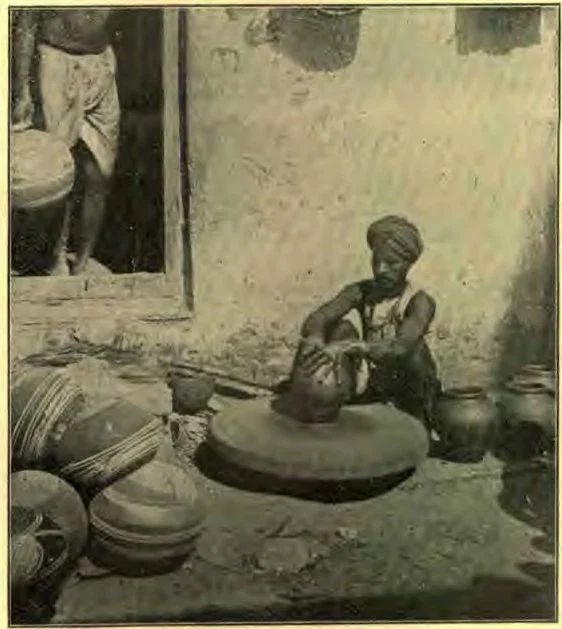
When the prophet entered the potter’s house, the workman was spinning the horizontal wheel round and round like a top, shaping the swiftly whirling lump of clay into a vessel. “And the vessel that he made of clay was marred in the hand of the potter: so he made it again another vessel, as seemed good to the potter to make it.”
Are you not glad the potter did not fling the whole lump away when some hard particle in it marred the graceful form of the vessel almost completed? Patiently he labored still, to reshape it, and turned it out as beautiful a vessel as it was possible for his hand to form.
I am thankful all the time that the divine Potter patiently perseveres with us, who are as clay upon the wheel of life’s providences. Sometimes the shifting, changing experiences seem hard, it may be; but the faster the wheel whirls, the more rapidly the clay takes shape. The pressing trial is but the pressure of the Potter’s hand, which is to mold the life according to his own gracious thought for us. We lose by rebelling against his will, even as the vessel that was marred in the hands of the potter. He can not make the life as beautiful as he might have made it had we been willing. But still he works, and he will do for us all that we will allow him to do.
This blessed lesson forever makes beautiful the work of the potter. Perhaps many of our readers have watched the clay on the wheel, and have seen it rise like a thing of life, and take its shape. I myself never saw it until in London, years ago, I watched a potter, from the Potteries district of England, who had come down during a strike to earn money by exhibiting his work on the street-corners. I confess to having followed him about for a half-hour to watch him at his work. In the East, however, one may see the potter sitting at his wheel,—just such a wheel, I fancy, as Jeremiah must have looked upon so long ago. And no doubt the potter himself looked very like his Indian brother workman of to-day.
Very likely Jeremiah’s potter never knew what a lesson he had taught for all later time that day. He was faithful to the task of the hour, and his painstaking work in that shop still blesses men. There is no drudgery in useful toil, and many a man in the shops to-day may be preaching effective sermons as he works. Thanks to the honest potter for the lesson that he taught!