People always listen during hot weather with more equanimity to charges of overeating, so the recent prominence of the subject is at least timely. At the annual meeting of the American Medical Association, held in Portland about the middle of July, one of the morning sessions was occupied almost entirely with a discussion of the origin of the various digestive ills to which our American people are so liable, and a definite expression as to the causation of these ailments, by prominent physicians from all over the country. There was practically universal agreement that the source of most of the ills to which the American stomach is so liable is to be found in overeating, and especially in the overconsumption of what is known as proteid material. The proteids comprise the heavier portion of the dietary, and include such articles as meat, eggs, cheese, peas and beans, and the like. These are the most expensive portions of the diet, and it was pointed out that in other countries where economy in the matter of food is a more serious question than it is with us, much less of these materials is consumed as a rule.
Of course, it has often been said that as a nation we overeat. It is only in recent years, however, that the persuasion as to overconsumption of food has been justified by scientific observations, which indicate just why and in what manner overeating is serious. The work of two investigators especially was recalled to attention in the meeting of the Medical Section of the American Medical Association, and the extreme significance of their results emphasized. Professor Chittenden, of Yale University, in a book which was recently reviewed in The Independent on the “Physiological Economy of Nutrition,” shows by experimental observation on three different series of individuals—hard workers, those moderately occupied, and those living sedentary lives—that scarcely more than one half as much proteid material is needed in order to maintain the body weight and the equilibrium of nutrition than these people had been accustomed to use during the time preceding the observation. Folin, in the Journal of Physiology, in a series of articles at the beginning of the present year, came to the same conclusion from the standpoint of physiological chemistry. Both these observers pointed out that proteid material is needed by human beings only for the purpose of building up tissues. It is never needed as an energy producer. The fats and the sugars represent the energy producers. If more proteid material is consumed than is needed, it is simply excreted, but before excretion it exists in the circulation for some time as irritant material, and then throws a lot of needless work on the excretory organs in getting rid of it.
One feature of the overeating problem was particularly emphasized. It was pointed out that when persons eat slowly there is much less tendency to overeat. If the food is brought thoroughly in contact with the palate and the various taste organs on the tongue during the course of mastication, then the appetite is satisfied with much less than when the food is bolted. This is true in general of all kinds of food, and has been experienced by every one with regard to the sugars and fats, but is also eminently true of meats and cognate materials, only here the less amount needed makes the possibility of overconsumption much easier. Americans are well known to be a nation of fast eaters, and especially to have the habit of washing down their improperly masticated food with coffee, ice water, and other unsuitable liquids. Hence, the accusation of insufficient mastication has a special significance, and was emphasized by American physicians from all over the country.
Very few people realize how inadequate is their process of mastication under ordinary circumstances unless this is actually demonstrated to them. Physicians who have to treat cases of stomach trouble and are under the necessity of using a stomach-tube not infrequently find that one of the best effects of this method of investigation and treatment is the actual demonstration to the patient of what large lumps of material are swallowed without having been masticated. Pieces of potato that sometimes evidently have been entirely untouched by the teeth are found in the stomach contents, and block up the stomach-tube, making the evacuation of the stomach contents very difficult. This same thing is true of most forms of food. Unfortunately for this state of affairs, the human stomach was not meant to crush materials in order to prepare them for digestion. The gizzard of the birds is a thick muscle, the action of which, helped by the pebbles, which birds instinctively swallow, serves to replace other mastication apparatus. Notwithstanding the fact that during the past month, as for centuries before, many a city boy has been sent by his country cousins hunting for hare’s teeth, none of them have been found. The gizzard effectually supplies for the absent teeth. In human beings, however, teeth are a triumphant gift of provident mother nature, and the stomach is only a thin-walled receptacle for food, with just muscular force enough in it to move the gastric contents on to the intestines, but without any active crushing ability.
The result is that when unmasticated food reaches the stomach, it fails to pass out properly, and as a consequence delay12of the gastric contents leads to dilation of the gastric walls. Another and even more serious accident sometimes occurs. The pylorus of the stomach, the gate through which food passes to the intestine, is composed of a rather strong ring of muscular fibers. When larger pieces of material approach this ring, they are usually refused exit. Occasionally, however, irritated by the presence of such unusual lumps, the pylorus attempts to make up for the lack of mastication, and during the egress of such material helps to crush it. After a time this exercise of an unusual function leads to overgrowth of the muscular fibers of the pylorus, and as a consequence, the opening from the stomach into the intestines becomes so tightly shut that ordinary liquid material does not readily pass through, and the consequence is, for another and more serious reason now, delay of the stomach contents, with consequent dilatation of the stomach walls.
It will thus be seen that from two different standpoints mastication is the most important and the most neglected process in eating. There are some further considerations, however, that serve to emphasize this importance. It is now thoroughly recognized that the stomach itself is by no means the important digestive organ that it used to be considered. It is mainly a receptacle for food material which helps man to store away sufficient food at one time, to enable him to pass a considerable period, some five hours, at least, before another meal will be required. It used to be thought that most of the process of the preparation of the food for absorption was accomplished in the stomach. This is now known not to be true. The stomach has been completely removed from a number of patients for cancer and other serious conditions, and such patients have proceeded to gain in weight and strength, accomplishing the digestion of food without any serious drawback. It is necessary that they take food in smaller quantities and at more frequent intervals, but nature even compensated for this, by bringing about an enlargement of the upper portion of the intestine, which to some extent, at least, supplied the place of the absent stomach.
It will thus be seen that if the stomach only passes on the food material conveyed to it, the process of digestion will be very well carried out in the intestines. At the present time it is well known that not a few persons, owing to abuses of gastric digestion, have no proper secretion of gastric juice, and that none of their digestion is accomplished in this hitherto supposedly so important organ. Such persons are never in as good health as normal individuals, but usually suffer few digestive symptoms. As a matter of fact, if the stomach motility is unimpaired—that is, if its ability to receive food and pass it on to the intestines without delay be retained—then digestive disturbances are rare. The two elements which are the most frequent causes of disturbance of stomach motility are overeating and insufficient mastication. Both of these make calls on the muscular walls of the stomach that they are unable to fulfil. The two ills form a vicious circle. People overeat, because they do not masticate enough, and so do not properly taste the food which they are consuming. They overeat of proteid material because this is not required in near such quantities as has hitherto been considered, and requires careful mastication in order to make its taste sufficient to satisfy appetite. The cure for stomach ills, then, is not the taking of drugs and ferments for gastric stimulation, but the accomplishment of the eating process with the care and completeness which so important an element of animal life requires.—The Independent.
Twelve Rules for the Care of the Ears
By D. H. KRESS
1. NEVER scratch the ears with anything but the finger, if they itch. Do not use the head of a pin, hairpins, pencil-tips, or anything of that nature.
2. Never put anything in the ear for the relief of toothache.
3. Never wear cotton in the ears if they are discharging pus.
4. Never attempt to apply a poultice to the inside of the canal of the ear.
5. Never drop anything into the ear unless it has been previously warmed.
6. Never use anything but a syringe and warm water for cleansing the ears from pus.
7. Never strike or box a child's ears; this has been known to rupture the drumhead, and cause incurable deafness.
8. Never wet the hair if you have a tendency to deafness; wear an oil-silk cap when bathing, and refrain from diving.
9. Never let the feet become cold and damp, or sit with the back toward the window, as these things tend to aggravate any existing hardness of hearing.
10. Never put milk, fat, or any oily substance into the ear for the relief of pain, for they soon become rancid, and tend to incite inflammation. Simple warm water will answer the purpose better than anything else.
11. Never be alarmed if a living insect enters the ear. Pouring warm water into the canal will drown it, when it will generally come to the surface, and can easily be removed with the fingers.
12. Never meddle with the ear if a foreign body, such as a bead, button, or seed, enters it; leave it absolutely alone, but have a physician attend to it. More damage has been done by injudicious attempts at the extraction of a foreign body than could ever come from its presence in the ear.
D. H. KRESS, M. D.
The Evening Trains
THE first train leaves at 6 P. M.,
For the land where the poppy blows,
And mother dear is the engineer,
And the passenger laughs and crows.
The palace car is the mother's arms;
The whistle, a low sweet strain;
The passenger winks and nods and blinks,
And goes to sleep on the train.
At 8 P. M. the next train starts
For the poppy-land afar,
The summons clear falls on the ear:
“All aboard for the sleeping car!”
But what is the fare to poppy-land?
I hope it is not too dear;
The fare is this, a hug and a kiss,
And it's paid to the engineer.
So I ask of Him who children took
On his knee in kindness great,
“Take charge, I pray, of the trains each day
That leave at six and eight.”
“Keep watch of the passengers,” thus
I pray,
“For to me they are dear;
And a special ward, O gracious Lord,
O'er the gentle engineer.”
— Selected.
The Lump on His Side
A MAN long noted for his intemperate habits was induced by Rev. John Abbott to sign the pledge “in his own way,” which he did in these words: “I pledge myself to drink no more intoxicating drinks for one year.” Few believed he could keep it, but near the end of the year he again appeared at the temperance meeting without once having touched a drop.
“Are you going to sign again?” asked Mr. Abbott.
“Yes,” replied he, “if I can do it in my way,” and accordingly he wrote, “I sign this pledge for nine hundred and ninety-nine years.”
A few days after this he called upon the tavern-keeper, who welcomed him back to his old haunt.
“O landlord!” said the man, as if in pain, “I have such a lump on my left side.”
“That’s because you have stopped drinking,” said the landlord; “you won’t live long if you keep on.”
“Will drink take that lump away?”
“Yes; and if you don’t drink, you’ll soon have a lump on the other side. Come, let’s drink together,” and he poured out two glasses of whisky.
“I think I won’t drink,” said the former inebriate; “especially if keeping the pledge will bring on another lump. This one isn’t very hard to bear after all.” With this he drew out the lump—a bag of money—from his side pocket, and walked off, leaving the landlord to his own reflections.—Selected.
No Sin Is Small
That holy God, against whose only majesty sin can be committed, hath taught me to call no sin small. The violation of that law which is the rule of good can not but be evil; and betwixt good and evil there can be no less than an infinite disproportion.—Hall.
The Latin Union and the French-Swiss Meeting
By A. G. DANIELLS
A. G. DANIELLS
The annual sessions of the Latin Union Mission and the French-Swiss Conference were held conjointly at Gland, Switzerland, July 11-16. The camp was located on the grounds of the new sanitarium and school property to which the Basel Institute Sanitaire has been recently transferred. Gland is a small French-Swiss village midway between Lausanne and Geneva, on the main railway running from the northwestern and central parts of Switzerland to France. “Ligniere,” as our premises are popularly known, is a mile from the station, and forms an estate of one hundred acres, with a frontage of about a quarter of a mile on the north side of Lake Geneva. From the water the ground rises gradually to something like an altitude of two hundred feet. The southern half of this tract has been cleared, and is devoted to buildings, lawns, and garden and fruit cultivation. Large, ancient trees have been left standing here and there, to beautify the place, and to afford pleasant shade during the summer months. The main public road between Geneva and Lausanne passes through the grounds between the buildings and the lake. This beautiful mecadamized driveway is kept in excellent condition, and it is well patronized by carriages and automobiles.
CHALET AT GLAND
In many respects this is one of the most excellent locations we have ever secured for a sanitarium or school enterprise. It is in a retired, quiet place in the country; we have enough land for cultivation, growing grain, fruit, and vegetables. The climate is all one could desire. The cool breezes from the lake and snow-clad Alps modify the temperature during the summer months, and we are far enough south to receive the benefits of the mild winters. The blue waters of Lake Geneva, the snow-topped Alps, and the ever-changing scenic views of light and shade across the beautiful inland sea and over the mountains, present nature in her best and most charming form. Directly in front of the sanitarium building, away to the south of us, rises the majestic white-capped Mont Blanc, towering far above its fellow peaks of the Savoyan Alps. This is surely an ideal place for our students, and for the weary and sick who are worn out with the bustle and noise of the cities.
The property was secured in exchange for our Basel house, which was first used as a printing plant and mission, but of late years has been utilized as a sanitarium. We took possession of Ligniere during the past winter. As the buildings already erected had to be remodeled, and new ones had to be put up, it has taken time and hard work to get started. The sanitarium is now nearing completion, and has a very fair patronage. Quite a number of young people from the various countries of the Latin Union are attending the school. As far as we could judge, this location has great possibilities for the headquarters of the Latin Union field.
The meeting was well attended by the brethren and sisters of French Switzerland, and by delegates and representatives from France, French Belgium, Italy, Spain, and Portugal. I could see that substantial progress had been made in the field since I visited it three years ago. At that time Switzerland had lately been divided into the German-Swiss Conference in the north and the French-Swiss Conference in the south. Now, either of these conferences seems as large and strong as both together were before the separation.
It was a great pleasure to me to meet all these warm-hearted believers, especially the ministers and other gospel workers. I greatly enjoyed the interviews and seasons of counsel I was permitted to have with our brethren in charge of the different mission fields. Elder Curdy, in French Belgium, finds many difficulties to surmount, but the cause is gaining a permanent foothold there. In speaking of the kind of workers he needed, he stated that they must be men who do not fear persecution or death. Brother Curdy’s courage is excellent, and he returns to Belgium determined to press on with the work. Elder Dexter, who recently came to France from the States, is making good headway with the language, and is full of hope and courage regarding France. He was chosen director of the French Mission.
I had very interesting and profitable interviews with Elder Everson, with reference to the outlook in Italy. He brought with him an Italian brother who had recently embraced the message. This brother was once a priest in the Catholic Church, but he has renounced Romanism. A few months ago he became acquainted with us, and began a thorough study of the truth, which he has accepted, and he is to-day rejoicing in the salvation it brought to him. He has a liberal education, and seems to be a talented man. He told me he should return to Rome, and while engaged in teaching, would give the whole message a thorough and critical study. May God bless him to the good of the cause in Italy.
Elder Robinson and his wife had three Spanish converts with them at the meeting. These are among the first-fruits in that mission field. It seems impossible that any one could enjoy such an occasion more than did these dear friends from Spain. They had never seen the like before. The joy expressed in their countenances made all who saw them happy. From what we learned of the peculiarities of Spain, it is evident that it will be a difficult field in which to labor; but we believe that the right kind of workers,—workers who are cheerful and fearless,—will have success, and we trust that God may reward our efforts in that dark land, with fruit that will be garnered into his kingdom.
Brother Rentfro could bring no representative from among the natives of Portugal, for he has been in the field less than a year, and has had everything to learn, including the language. He is well and joyous and confident. The Lord is blessing him in his study of the Portuguese language, and is enabling him to become acquainted with the customs of the people. He expects to see souls saved in the kingdom as the result of his efforts.
The Latin Union Committee decided to send Brother and Sister Jespersson to Algeria, thus adding one more mission field to our list. These workers have labored in Palestine. They have a good speaking knowledge of Swedish, English, German, French, and Italian, and are able to make themselves understood in the Arabic. They are now on their way, and will soon begin preliminary work in that new field. The First-day offerings of the Latin Union will be given to the Algerian Mission field for some time to come.
These Latin Catholic countries are certainly dark, hard fields in which to carry on operations. We can not expect the same results, as to numbers, that we hope for in more favored lands; but none who receive this message will prize it more highly, nor rejoice in it more sincerely, than those who are reached by the truth for these days in these countries so filled with error and superstition. The glorious light of the gospel that God has given his remnant church will stand out in great contrast to the terrible darkness that has enshrouded them all their lives.14
The business proceedings were very interesting, and passed off harmoniously. The officers who had been serving in the immediate past were, in the main, re-elected, and they enter enthusiastically upon their arduous duties among the one hundred million souls of the Latin Union for the coming year.
Three Years in India
By L. F. HANSEN
L. F. HANSEN
By this time one has become quite accustomed to beholding the dark faces and often scantily clothed bodies of the East Indians. The peculiar habit of bathing much in public, which is practised by men, women, and children, no longer excites surprise. Indeed, we are familiar with their simple habits, the preparation of their food, eaten unencumbered with fork and spoon, but with fingers only, the conclusion of the humble repast by rinsing the plate and cup at the nearest hydrant; their philosophic contentment with their comfortless homes; their habitual serious looks, for even in their songs there is a vein of sadness. The sharp dealer at the market seems less given to defrauding. Withal, we feel that at times when their services are fruitless, it is more from lack of judgment than designed disobedience. This of course has reference only to the poorer classes. The wealthier Indians are imitating the Europeans in habits of living and dress. Western civilization is rapidly revolutionizing the East.
The longer we are here, the more we realize that there are mighty influences operating to disestablish time-honored customs. With the introduction of railroads, electricity, and the many lines where modern science is applied, comes an influence that has a decided revolutionary effect. In these old countries, ancestral worship enters into every detail of daily life, and influences thoughts of religion, and domestic and social life. And to hope for a change in either line, the entire life must be influenced. And so there are reserved for this generation far-reaching changes contemplated in heaven's program for the last days. To the student of prophecy there are many side-lights, which in their nature impress also to some extent every rational being. The long series of improvements in modern methods of transportation, in communication, in practical education, in the enforcement of hygienic measures by municipalities, important discoveries in sciences that govern health and disease—all these are advance lessons in preparing the way for the coming of the Lord.
AN INDIAN VILLAGE
This Is an Age of Missions
is the conclusion that impresses the observer in the West; and in the very heart of heathen darkness, the progress of missions in the past century is so marked that the impression in the East is that this is truly an age of missions. William Carey arrived in India one hundred and nine years ago. By acting as cobbler, plantation manager, printer, government translator, and missionary all combined, he lived to see many converts to Christianity. This was under the aid of the Baptists. But in time other societies were represented, till to-day almost every church in Europe and America has missionaries in India. Here are Baptist, Methodist, Congregationalist, Church of England, Scandinavian Alliance, Lutheran, Quaker, First-day Adventist, Seventh-day Adventist, United Brethren, Salvation Army, etc. I have not mentioned the Catholics, though numerically they can doubtless vie with the strongest of the Protestant denominations.
Missions are established in many quarters and cities of India, Ceylon, and Burma.
Many of the societies have learned by experience that industrial schools are important factors in mission work. There are also medical missionary departments connected with most of the missions.
Inasmuch as these have the gospel, they have an influence, and are doubtless, through their many sincere missionaries, doing a preliminary work in translating the Scriptures and teaching them to the natives. And as was the case in the early church, says Jesus: “I sent you to reap that whereon ye bestowed no labor: other men labored, and ye are entered into their labors;” so to-day there are throughout the length and breadth of this great empire, devoted men and women, working, perhaps often in obscurity, conducting a school far away from kindred and fellow workers, and after a time succumbing to overwork, impoverished diet, or fever, or all combined, which is most frequently the case.
Dear reader, these are all our friends, and they are working day by day, year by year, preparing India for the last message. And, thanks be to God, the message is going.
Iusien, Burma.
Bible Distribution Among Russian Soldiers
The British and Foreign Bible Society colporteur, distributing Bible portions among the wounded Russian soldiers in the far East, says that one of them read aloud the twenty-fourth chapter of St. Matthew as far as verse 14, when another interrupted him: “I see this free distribution of the evangel is also happening under God’s guidance.” Another soldier added, “May all be richly blessed who have part in it.” Scorn of the dissolute men who have ruined Russia should not blind us to the sturdy qualities of Russian peasants like these soldiers, who are often deeply pious, and who are yet to make the nation strong again.
Mexico
By G. M. Brown
GUADALAJARA.—We have had most excellent meetings here. Yesterday the Lord came especially near to us. The eighth annual convention of young people's societies and Sunday-schools of Mexico, which has been held here in the sanitarium, closes to-day. I have been in attendance, and have met missionaries from all over the country. They have treated me very cordially, and shown a friendly spirit in many ways, asking me to present a paper on the inspiration of the Bible, and to preside over one of the meetings of the convention, which I did, though I was rather diffident about doing so, on account of my imperfect use of the Spanish. Many of the missionaries are, of course, opposed to our work; but I feel that as long as they are willing to seek our co-operation along lines that are right, we ought to meet their advances in a brotherly spirit, rather than to hold aloof. They have done pioneer work, and we are reaping, and will reap more, of the fruits of their seed-sowing, and I think that it is right to recognize this fact.
Since coming here I have baptized a young lady patient, who has united with this church. She is having a good experience. Personally I have much for which to thank God; and as he has given me a little part in the work, I hope by his help to do faithfully what my hand finds to do. G. M. BROWN.
Costa Rica
By I. G. Knight
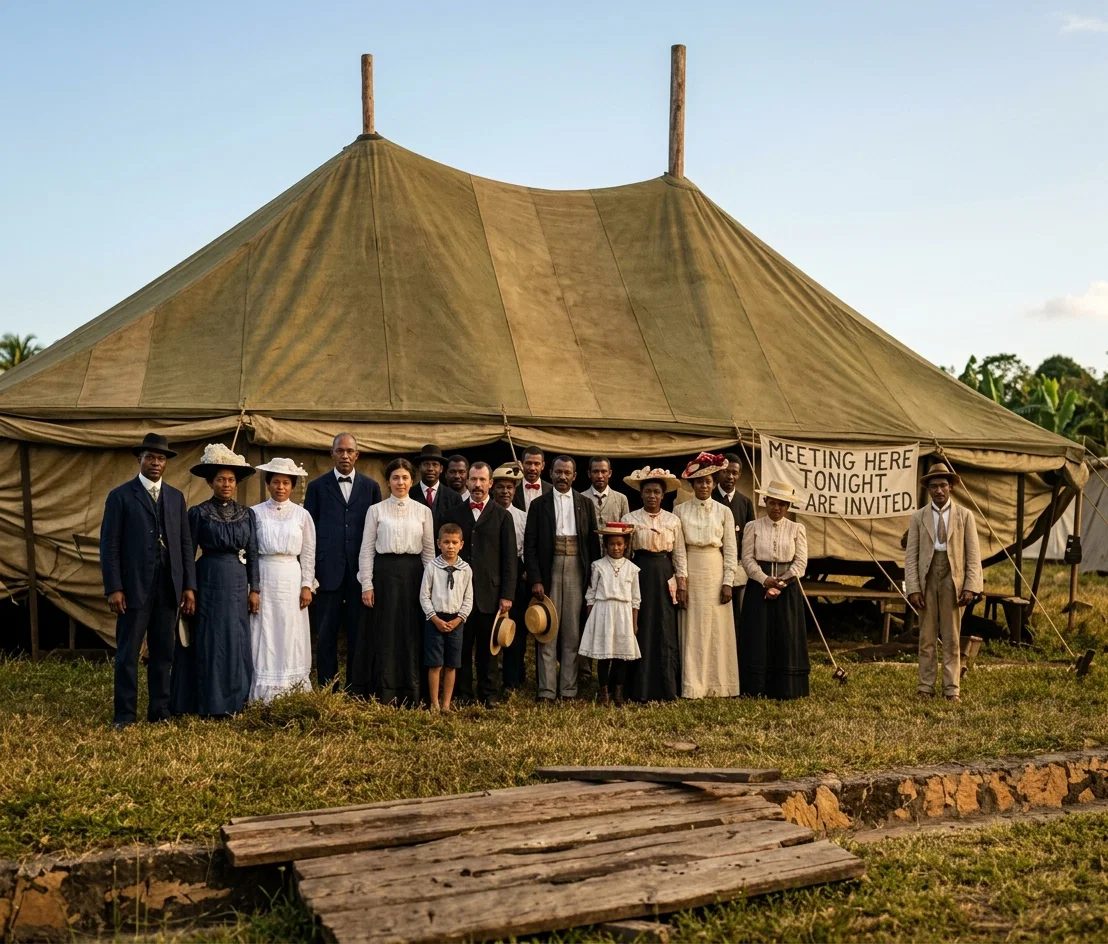
PORT LIMON.—While in the States last winter, we purchased a tent with little folding seats, and shipped it to Port Limon. It arrived some months ago; but, on account of the quarantine regulations, we have been unable to reach this place sooner. At last the way opened for us to secure passage on a small schooner, not knowing how things might turn at this end of the line. They are very strict, not allowing white persons to land, as they are not immune to yellow fever. When we sailed into port, the owner of the boat, who is a white man, came on board with the officials, and through his and the captain's influence, we were allowed to land. This was a surprise to all, and seemed even more remarkable when, the next morning, other white people came up from Bocas, and the captain of the Port would not allow them to land, but sent them over to the quarantine cay for five days. We could look deeper, and see God's hand in it all, and felt to thank him.
OUR FIRST TENT EFFORT IN THE PANAMA MISSION FIELD
We soon selected a spot on which to pitch the tent for our first meeting in the Panama mission field. The first man I called on when looking for a place, gave his lots freely, and was very kind and obliging. Everything was soon in readiness, and the meeting was announced to begin Wednesday evening, June 21. As Costa Rica had never before had a gospel tabernacle meeting, this one proved to be quite a novelty. The first night the tent was full, with many more outside. The meetings have continued three weeks, with unabated interest. However, the rains, which at times prevail, keep many away.
There have been five accessions to our little company here since we began services, and still more are to follow. We have been obliged to refuse baptism to some who have applied for membership and that rite. We have to be very guarded on receiving those who apply for baptism; but guarded as we are, we sometimes make mistakes, and find it out too late.
With this I send you a picture of our first tent-meeting, with a group of our people. The man at the left with his wife, is one of our workers. The work is onward throughout this field. Remember us at the throne of grace.
I. G. KNIGHT.
Chile
By F. H. Westphal
VALPARAISO.—I know that you are interested to hear from the laborers from many lands, and to see that the message is onward. The work will continue to progress until the end, when the career of sinners shall be finished in this dark world. I am content to stay here and work for souls who are perishing for want of the light that the Lord has given me. My family is also content, and we are of good courage in the Lord.
At Rengo I have organized a church of about thirteen members. There is some outside interest at that place, also. With a little labor, I think quite a number who are deeply interested can be brought into the truth.
I have received a letter from Brother Davis, from Ecuador, in which he says: “I made my first trip up the railroad last week, visiting a few of the sugar estates. I worked eighteen hours, and took twenty-one orders for large books, and sold over thirteen sucres ($6.50, United States money) worth of small ones. I find a few interested, and expect to go up again this week.”
Brother Steele writes that the ‘Coming King’ is being translated into Spanish, and adds, “I only wish that ‘Daniel and the Revelation’ and16‘Great Controversy’ were printed in Portuguese, that language. I could sell them rapidly among the better class. More books in Spanish is what we need.”
I am now on my journey north, and shall go as far as Iquique. Brother Thomann and I are laboring together, and shall be for a few weeks. There is a spirit of courage among all our people as far as I can see. This will be a good year for crops in Ecuador.
I have written a tract on the commandments, which will be published in Spanish soon. The brethren expect to give it a wide circulation. We are going to publish ten thousand copies at first. When these are distributed, I think we can better see how many the people will need. It will no doubt do our brethren and sisters good to get to work. F. H. WESTPHAL.
Italy
By Chas. T. Everson.
ROME.—I am sure that this field will not be without its precious gems for the garner, even if they will not be so abundant. Very often, the more rare they are, the more precious and valuable.
We are glad to say that the Lord is blessing us, and we are not stopping while we wait for help, but are pushing right ahead.
The professor whom I mentioned in a former report, is daily becoming more thoroughly established in the truth, and has now been a member of the church nearly three months. He lost his position in the college, as they refused him the Sabbath, and he resigned. But the Lord helped him, and he got another position a few days afterward, in the home of one of the most prominent members of the Italian Parliament, as a private professor.
The young officer mentioned in the article has decided in favor of the truth, and will be received into the church next Sabbath. We have many other interesting things to report, but I shall write them later.
I have read with interest the reports of the General Conference. I wish you much of the Lord’s blessing in your efforts for him.