The Work in Nashville; Its Encouragements and Needs
By Ellen G. White
MRS. E. G. WHITE
My heart has been made glad by the encouraging advancement of the Lord's cause in Nashville, Tenn. As a few tried, faithful workers in this city have labored perseveringly, God has gone before them in a most wonderful manner, and has opened the way for a great work to be done. Those who have advanced in faith, now see so many opportunities for establishing the truth firmly in Nashville that they feel like making an effort to arouse every believer in the third angel's message to meet the emergency and help them take advantage of these opportunities. I have the same desire; and so confident have I been regarding the willingness of our brethren and sisters throughout the churches in America to meet the situation nobly, that I have encouraged our brethren in the South to arise in the strength of God, and with faith and courage enter his opening providences.
The Lord has set the seal of his approval on the effort to establish memorials to his name in the city of Nashville. He has signified that from this important center, the light of the truth for this time shall radiate to every part of the Southern field. Nashville is a natural center for our work in the South. And the influence of the various educational and publishing institutions established there, makes the city a favorable place in which to carry on the various phases of our work.
In Nashville much interest is taken in the colored people. In and near the city are large schools for the colored people. The truth is to be brought before the white people of Nashville, including those who have given of their means and influence for the benefit of the colored race. They have taken a noble stand for the uplifting of this people. They should be given a representation of our work that will be an object-lesson in genuine Christian education and medical missionary training. We are to do all that we can to remove from the minds of the people the prejudice that exists against our work. If the efforts we put forth are in accordance with God's will, many will be converted.
For the accomplishment of the work that should be done in Nashville the best talent is needed. In so important a center of influence, we need men who talk courage and faith,—men who never become discouraged,—men who cling to the Mighty One, and in his strength make decided efforts to advance,—men who believe that the God of Israel still lives and reigns, and that he will surely fulfil his word. And how thankful we should be that at this time there are in Nashville tried soldiers of the cross,—laborers of long experience, who with voice and pen are effectively proclaiming the vital truths of the third angel's message. God desires the gray-haired pioneers, the men who acted a part in the work when the first, second, and third angels' messages were first given, to stand in their place in his work today.
The Nashville Meeting-House
For a long time the Sabbath-keepers in Nashville have met for worship in a room in the publishing house. But some have felt that in order to give a correct impression regarding the exalted character of our faith, we ought in some way to provide for a church building. But considering the lack of means, it seemed impossible to secure a suitable house of worship.
About the time that Elder Haskell and his wife united with Elder Butler in labor at Nashville, the Lord instructed me in the night season to bear to the brethren and sisters in the South the following message:—
“God would have the standard lifted higher and still higher. The church can not abridge her task without denying her Master. Meeting-houses must be built in many places. Is it economy to fail to provide in our cities places of worship where the Redeemer may meet with his people? Let us not give the impression that we find it too great an expense to provide properly for the reception of the heavenly Guest.
“In laying plans for building, we need the wisdom of God. We should not needlessly incur debt, but I would say that in every case all the money required to complete a building need not be in hand before the work is begun. We must often move forward by faith, working as expeditiously as possible. It is through a lack of faith that we fail of receiving the fulfilment of God's promises. We must work and pray and believe. We are to move forward steadily and earnestly, trusting in the Lord, and saying, ‘We will not fail nor become discouraged.’”
“Let our brethren in Nashville and in all parts of the South lay aside their doubts, and come over to the side of faith. Let them say, ‘We will do our best. No longer will we question the work and ways of the Lord. From this time we will believe the word of the Lord, and obey his command to ‘arise and build,’ whether all the money required is in sight or not.’”
“The Lord has instructed me that in some places there are buildings suitable for our work, and that we can secure these buildings at reasonable cost.”
In the providence of God, about a year after our brethren received this message, and after they had decided that they could not afford to buy land and build a meeting-house suitable for their needs, an opportunity came to them to purchase a good house of worship in a desirable location for five thousand dollars. The brethren made a careful examination of the property, and decided that it be purchased. The step required an exercise of faith; for no funds were in hand to make the first payment of one thousand dollars. Their great need led them to go forward, trusting in God for help.
The building is in need of some repairs, in order that it may correspond with the directions God has given regarding the places in which his people meet to worship him.
The opportunity to purchase this church property is one fulfilment of the light given me by the Lord that to our people would be offered at a price far below the original cost, properties that could be used in our work. It was in the providence of God that our brethren obtained possession of this house of worship in Nashville. We are confident the means to pay for it will come in, because we have asked for it, and God has signified that it will be received by the workers in Nashville.
The Nashville Mission and Bible Training-School
Brother and Sister Haskell have rented a house in one of the best parts of the city, and have gathered round them a family of helpers, who day by day go out giving Bible readings, selling our papers, and doing medical missionary work. During the hour of worship, the workers relate their experiences. Bible studies are regularly conducted in the home, and the young men and young women connected with the mission receive a practical, thorough training in holding Bible readings and in selling our publications. The Lord has blessed their labors, a number have embraced the truth, and many others are deeply interested.
It was in this way that the fishermen who left their nets at the call of Christ were trained. A similar work should be done in many cities. The young people8who go out to labor in these cities should be under the direction of experienced, consecrated leaders. Let the workers be provided with a good home, in which they may receive thorough training. The Lord has a precious, sacred work of soul-saving to be done in the world, and it is to be done now. This work is to be carried forward on a higher plane of individual responsibility than ever before.
The Tent-Meeting
For a long time the workers in Nashville have been searching for a suitable place in which to pitch a tent for a series of tent-meetings. For months it seemed impossible for them to find a place, but recently the Lord opened the way for them to secure a good place, and the tent has been pitched, and the meetings opened.
The God of Israel has commanded that the work in the South shall go forward. How grateful we should be that he has placed in Nashville experienced workers who are determined to make a success of the work, surmounting all difficulties! So long as these workers keep their hands uplifted to heaven, the Lord will be their strength, their front guard and their rearward.
The Nashville Sanitarium
Medical missions must be opened as pioneer agencies to prepare the way for the proclamation of the third angel's message in the cities of the South. O how great is the need for means to do this work! Gospel medical missions can not be established without financial aid. Every such mission calls for our sympathy, and for our means, that facilities may be provided to make the work successful. These institutions, conducted in accordance with the will of God, would remove prejudice, and call our work into favorable notice. The highest aim of the workers is to be the spiritual health of the patients. Medical missionary work gives opportunity for carrying forward successful evangelistic work. It is as these lines of effort are united, that we may expect to gather the most precious fruit for the Lord.
For some time, Brethren Hayward and Hansen have been carrying on sanitarium work in a modest way in the heart of the city, and in a rented building a few miles out of the city. The difficulties and inconveniences against which they have had to contend have greatly retarded the work, making it doubly hard.
During my visit to the Southern field a year ago, we tried to find, near Nashville, a property suitable for a sanitarium. We examined several places, but arrived at no definite decision. Recently I have been rejoiced to learn that there has been found a desirable property four miles south of the city, and near the terminus of a street-car line. In this tract there are thirty-three acres of land. Our brethren regard the location as an ideal site for a sanitarium. An ample supply of water comes from a lithia spring, pure, and clear as crystal. Our brethren were able to buy this property for eight thousand seven hundred and fifty dollars, by paying cash. The amount was loaned to them by a brother in Kentucky.
A sanitarium building should soon be erected on this property. Our brethren must have help in order to build up this much-needed institution. The establishment of medical institutions in the South will make the work more expensive; but the importance of this line of effort can not be overestimated.
Our Opportunity
And now, my dear brethren and sisters, how shall we relate ourselves, individually, to the work that is being carried forward in Nashville? My heart is stirred. I can not but feel the deepest sympathy for my brethren in the South, who have been laboring earnestly and untiringly to carry out the directions given that in Nashville the truth is to be proclaimed. Elder Haskell and his wife and Elder Butler have been and still are most earnest, self-denying workers in that field. They and their associates are advancing at the command of the Lord, in order that a knowledge of the truth for this time may be given to the people of Nashville and of the entire South. Shall not we encourage them to continue their aggressive work, by revealing our sympathy in a practical way?
In the name of the Lord, I now call upon the members of our churches in the North and the South, the East and the West, to contribute liberally for the work at Nashville. Let the children act their part. The Lord will greatly bless you as you help this needy field. He expects those for whom he has made so great a sacrifice, to show their appreciation of his love by denying self for the good of others.
God has bestowed gifts on man, not capriciously, but with equality. To every man God has given talents according to his ability to use them. And it is his purpose that the different parts of his field shall receive the help that their needs demand. When his stewards act unselfishly, his work is advanced, and rejoicing is the result.
True Christians, whose interests are bound up with the interests of Christ, are pained to the heart as they see that by man's cupidity the Saviour is dishonored in the person of his saints. They are cut to the quick as they see their fellow men perishing in their sins, and precious opportunities to save them passing by unimproved because means for the carrying forward of the work of soul-saving are not available.
The workers in Nashville have not received the help that they should have had; and we now entreat you, my brethren and sisters, to send of your means to the workers there; for they are greatly in need of help. This morning I have been asking the Lord to move upon your hearts to do this, that his work in Nashville may not be delayed. I have faith and hope to believe that you will respond with gladness of heart.
A Prayer for Help
We must all look to God. We must all present our necessities to Christ our Burden-bearer, the One who knows the great burdens that are borne by his servants in important centers, and who knows how greatly they need help.
I am pleading with God to enlighten our brethren in all matters, that they may understand the work that needs to be done just now in Nashville. My prayer is: “We come to thee, O thou Saviour of the world, pleading the promise, ‘Ask, and it shall be given you; seek, and ye shall find; knock, and it shall be opened unto you.’ I ask sincerely, earnestly, because I believe thy word. Help our faithful, aged workers in Nashville, Tenn. I, thy dependent, believing child, take thy words, and call upon thee to open the hearts of thy people throughout the United States, and lead them to send in their offerings to Nashville now, just now. Help Elder Butler and Elder Haskell in their tent effort. Help them to secure means to pay for the meeting-house and to set it in acceptable order, so that it will make a presentation corresponding with thy directions. Help thy servants to establish a sanitarium for the honor of thy name.
“In thy lessons to thy disciples thou didst say, ‘What man is there of you, whom if his son ask bread, will he give him a stone? or if he ask a fish, will he give him a serpent?’ Thou hast said, ‘If ye then, being evil, know how to give good gifts unto your children, how much more shall your Father which is in heaven give good things to them that ask him.’”
“My Heavenly Father, we ask thee in Christ's name to give to the workers in Nashville the things they so much need to advance thy work. Encourage the hearts of thy servants to do this work, to look to thee, to ask of thee the things they need, to believe in thee. Sustain their faith and courage. O, sustain their courage, and indite their prayers! Keep them ever looking to thee, ever believing and receiving thy promised gifts. Keep them glad, hopeful, rejoicing, that their words may glorify thee.
“O Lord, I do believe. O Lord, thou wilt hear. Make thy servants strong in faith, strong in hope, strong in courage, mighty in word and deed to proclaim thy truth. Amen.”
Closing Events of the Judgment
By J. O. CORLISS
The Final Adjustment of Human Awards—No. 4
Closing Events of the Judgment
J. O. CORLISS
It seems quite evident that the book of life is kept for the purpose of retaining names in remembrance of those who are to be “caught up” to meet the Lord at his coming. The fact that the Saviour says that he will not “blot out” the name of the overcomer from that book, at the final examination of his life-work, shows this to be so. But the retention of one’s name in that book as he who is accounted worthy to have part9in the first resurrection, is evidence of another act on the part of the Saviour. So long as one’s sins are held in the book of remembrance as a witness against him, he could not well be accounted worthy of receiving glory at the Master’s coming. It follows, therefore, that whoever is so regarded, has all evidence of guilt taken away. In other words, his sins have been blotted out when it was decided to retain his name in the book of life.
It is true that when one gives his heart to the Lord, his sins are forgiven. Matt. 9: 2, 5; 1 John 1: 9; 2: 12. It is then that the name is written in the book of life, in heaven. Luke 10: 20; Phil. 4: 3. When one has been “cleansed from all unrighteousness,” his name belongs in the book of life, as a candidate for heaven and eternal glory. But there comes a time of examination, when it will be determined whether he has forfeited forgiveness through a course of unrighteousness, or whether, through his acceptance of the merits of Christ, that forgiveness shall be confirmed by the blotting out of all his sins, and the retention of his name in the book where it was placed when he first decided to follow the Lord.
This order of dealing with sin is clearly established by the Word. Thus we read: “Repent ye therefore, and be converted, that your sins may be blotted out, when the times of refreshing shall come from the presence of the Lord; and he shall send Jesus Christ, which before was preached unto you: whom the heaven must receive until the times of restitution of all things.” Acts 3: 19-21. It will be noticed that this text makes the blotting out of sin occur in connection with the Lord’s coming, at the restitution of all things. This places it as a distinct work from original forgiveness, which is bestowed as the sinner is taken into confidence with the Saviour.
The teaching of Christ in Matt. 18: 23-35 is a good illustration of this point. In the parable a man was forgiven a debt of ten thousand talents, because he possessed nothing of his own with which to pay it. But on being graciously released from so great a debt, he went out and found a man who owed him the paltry sum of one hundred pence, but was too poor to pay even that amount. Instead of forgiving his debtor, he had him put in prison. So because of this ungracious act, he himself was seized by his former creditor, who had already forgiven him, and was thrust into prison, there to remain until he paid the last farthing of the debt from which he had once been released. In applying the parable the Saviour added: “So likewise shall my Heavenly Father do also unto you, if ye from your hearts forgive not every one his brother their trespasses.”
From this we gather that forgiveness of sins, to be permanent, depends on the life record of the recipient which follows the decree of forgiveness. This record must show in the judgment that the individual’s life has been one of obedience and trust; one in which the will of God has been the criterion of every action. Failing in these at any time, the record must show that these, as acts displeasing to God, have been heartily repented of and abandoned.
But such an examination, close as it may seem, must be met not only by those who are dead, but by those as well who shall be alive when Christ comes, and are ready to meet him. We know that the record says of these: “Then we which are alive and remain shall be caught up together with them [those raised from the dead] in the clouds, to meet the Lord in the air: and so shall we ever be with the Lord.” 1 Thess. 4: 17. As in the cases of those who are to be raised from the dead, so these, too, must first be accounted worthy to stand before the Son of man when he comes.
But what a test this will be! Those who have died before the examination comes, had opportunity on their dying beds, not only quietly and calmly to review their lives, but to be away from the world’s temptations, where they might constantly look up to God for salvation. Not so, however, with those who pass the test of the judgment while still living. These are moving about among men, subject to all the vicissitudes of strife and temptation. To such the test of the judgment means infinitely much, and demands a work of consecration which shuts the world out from every plan.
It is as if one were to have his case called now,—at any moment,—before the Judge of all the earth, even in the midst of the temptations which are likely to be pressing for recognition. But how is one to know when he must pass this test? Will God bring men to such an ordeal without warning them of its approach? He never has dealt thus with the world. The prophetic pages of his Word are filled with warnings against that day. In fact, that time is the point of convergence for all the prophecies. We may therefore expect that those predictions which have to do with the time just prior to the Lord’s coming will specially deal with the judgment work itself. A study of the subject in the light of prophecy, will therefore be the subject of the following paper.
Mountain View, Cal.
“My Grace Is Sufficient for Thee”
By Anna H. Munson
ANNA H. MUNSON
In life's early morning, when cloudless the day,
She heard then the voice of the kind Master say:
“O take me, dear heart, thy companion to be,
And thus shalt thou find a sweet refuge in me.
“My grace is sufficient for thee, trusting one,
Sufficient for thee, till thy journey is done.
In me thou shalt find an abundant supply,
My love and protection shall ever be nigh.”
She listened in youth to that voice from above,
And gave to her Saviour her heart’s purest love,
O’er all her life’s pathway her Pilot and Guide,
Determined to follow, whatever betide.
When billows of sorrow swept over her way,
He then was her comfort, her strength, and her stay.
She heard his sweet promise, “Now cling close to me,
And doubt not. My grace is sufficient for thee.”
When to the dark valley of death she drew near,
O list to the sweet words that fell on our ear:
“Unworthy and sinful my heart though it be,
He whispers, ‘My grace is sufficient for thee.’”
O beautiful promise he gives to his own,
To all his dear children who kneel at his throne,
Through all of life’s pathway thy comfort shall be,
“My grace is forever sufficient for thee.”
Covetousness
By Rev. C. H. Spurgeon
COVETOUS men must be the sport of Satan, for their grasping avarice neither lets them enjoy life nor escape from the second death. They are held by their own greed as surely as beasts with cords, or fish with nets, or men with chains. They may be likened to those foolish apes which in some countries are caught by narrow-necked vessels; into these corn is placed, the creatures thrust in their hands, and when they have filled them, then can not draw out their fists unless they let go the grain. Sooner than do this they submit to be captured.
Are covetous men, then, so like the beast? Let them ponder and be ashamed.—From “My Note-book,” by Rev. C. H. Spurgeon.
Babylon and Assyria
By M. E. KERN
M. E. KERN
The story of the deciphering of the ancient language of Babylon and Assyria is also full of interest. The valleys of the Tigris and Euphrates Rivers are literally covered with mounds or hills which are the decayed ruins of ancient cities. Travelers often picked up about the gullies of these mounds bricks and pieces of clay tablets inscribed with strange, wedge-shaped characters. Whether these characters were a language was not known. Finally men began10to dig into these mounds, when it was possible to get permission from the Turkish government, and to be free from attacks of robbers while at work. In 1842 Botta, a Frenchman, succeeded in unearthing what afterward proved to be the grand palace of Sargon, king of Assyria, a king mentioned once in the Bible, and whose existence had been doubted by the critics. Sargon was the king who carried Israel captive. The walls of this wonderful palace were wainscoted with sculptured slabs, which contained in relief pictures of battle and hunting scenes and triumphal processions. The palace covered twenty-five acres; and as Botta passed from room to room, his interest was raised to the highest point, for he realized that he was face to face with a new-old civilization. And how he longed to read the characters that evidently told about the pictures. New interest was aroused everywhere.
The Behistun Rock
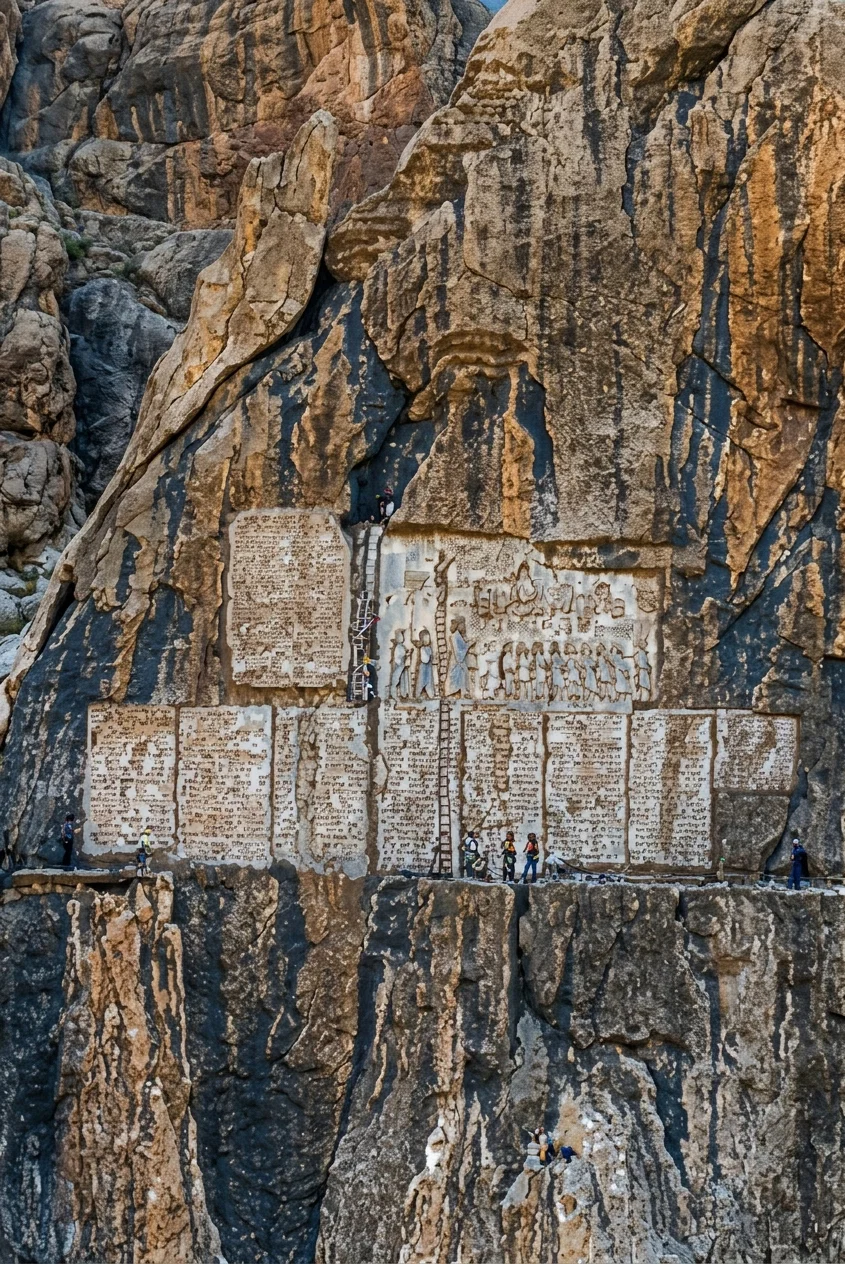
THE BEHISTUN ROCK
In the meantime a young English army officer had discovered the key to this language, and was diligently trying to use it. In 1835 H. C. Rawlinson (brother of Geo. Rawlinson, the author of “Seven Great Monarchies” and other books) discovered in the Zagros Mountains on a limestone cliff seventeen hundred feet high, an inscription which gave a clew to the Babylonian language. Three hundred and fifty feet above the plain, on the perpendicular side of this Behistun rock, was a polished surface on which was a large figure of a king in relief, leading a line of captives, and beside the picture several columns of inscriptions. The story is a long one; but Rawlinson, finding that he had three languages side by side, set about it to learn Sanskrit, Zend, and the Pehlevi languages, which, with the knowledge of modern Persian, which he already knew, equipped him well for his work. The three languages were Old Persian, Median, and Babylonian. In 1857 it was proved to the world that the Babylonian language could be read, “a discovery,” says a late writer, “as great in the field of history and philology as the telegraph in the commercial world.”
The Cuneiform Writing
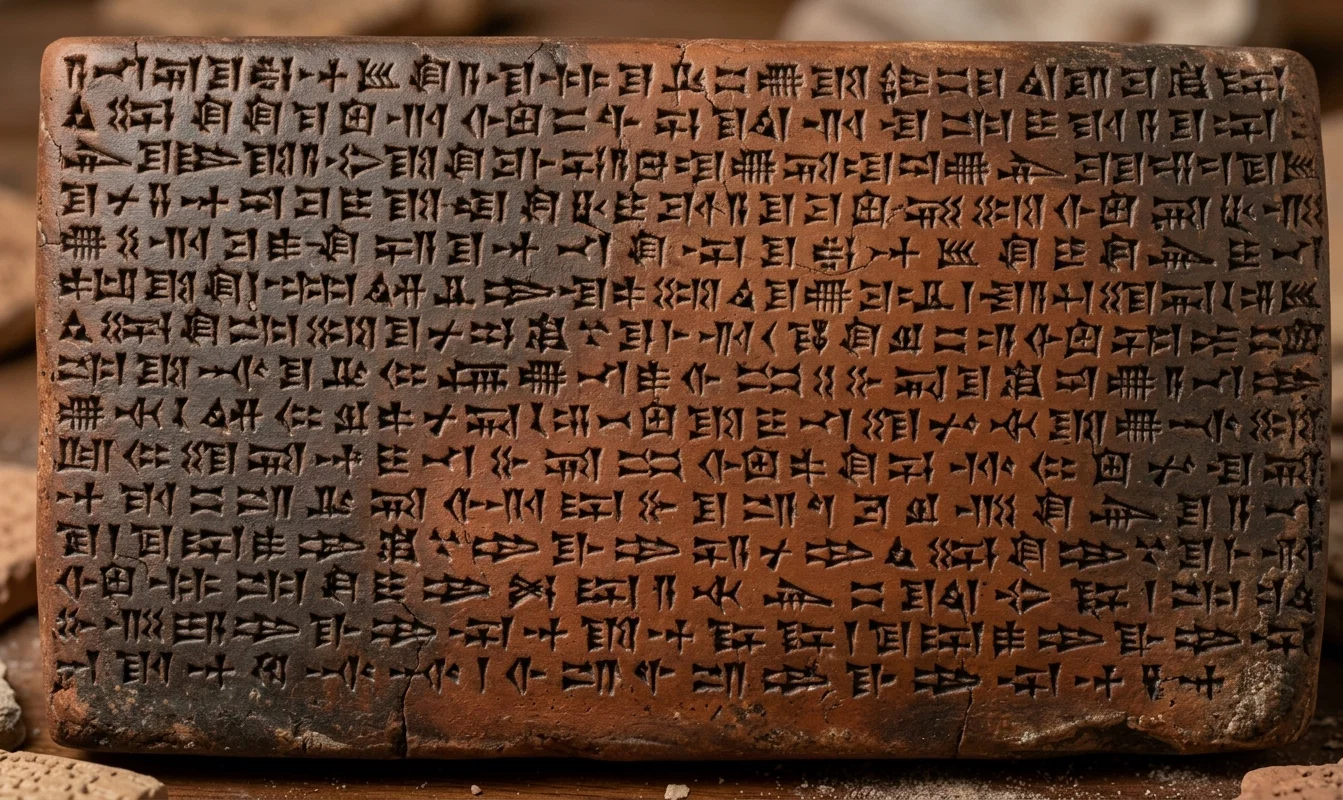
A CONDENSED ACCOUNT OF THE CAPTURE OF BABYLON (539 B.C.)
The accompanying illustration shows a sample of this beautiful writing. This is taken from the cylinder of Cyrus, and tells how he captured Babylon. We have now another cuneiform account also of the capture of Babylon, that of Nabonidus, father of Belshazzar.
The knowledge of how to read the Babylonian writing of course gave a wonderful impetus to Oriental archeology. Many have gone to this country to excavate, some with the express purpose of finding inscriptions that illustrate Bible times. The very sites of Nineveh and Babylon, those renowned cities of the ancient world, had been lost sight of. For centuries they had rested under the curse of God, but now they were made to reveal their secrets, and we are able to read their history and follow the courses of their ambitious rulers, and to read their own accounts of their contact with the chosen people of God.
The Black Obelisk
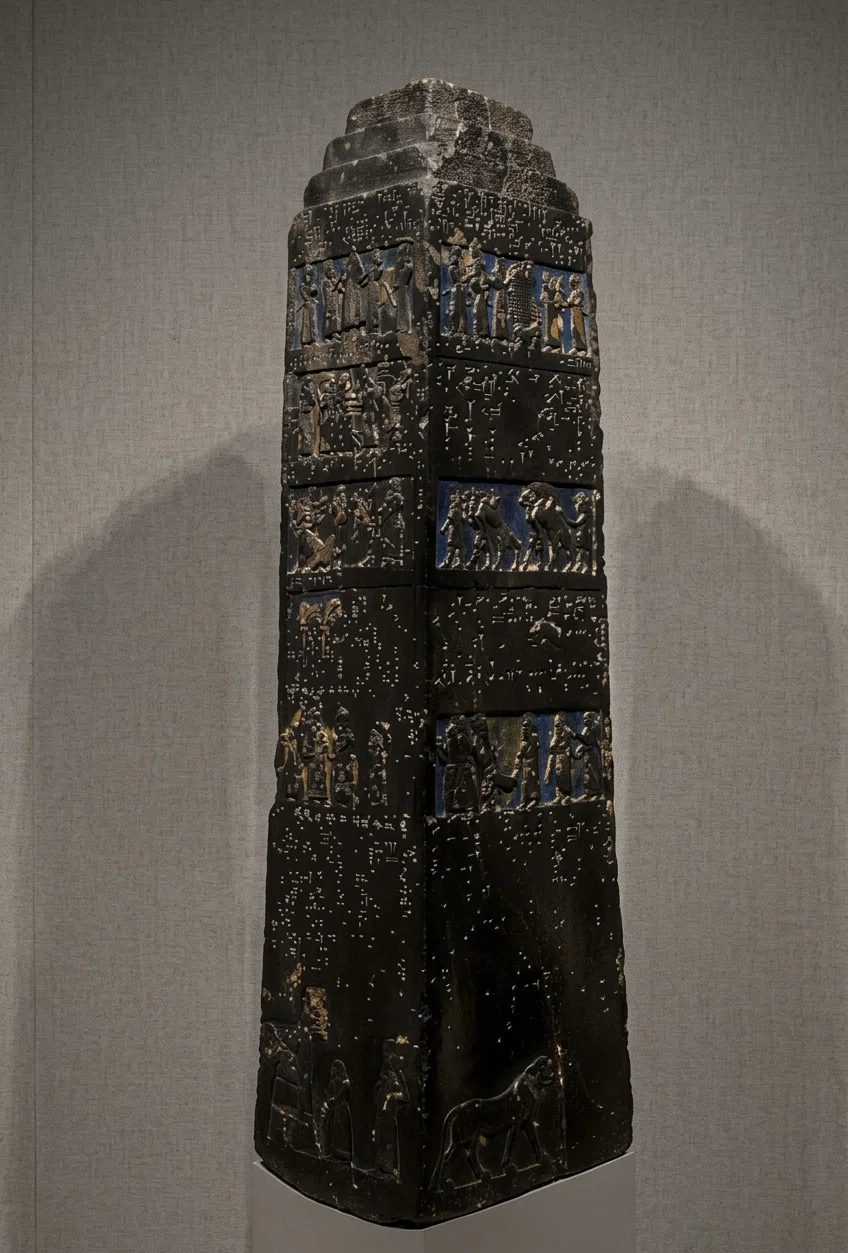
THE BLACK OBELISK, CONTAINING THE NAME OF JEHU KING OF ISRAEL
In 1845 A. H. Layard, a young English scholar, succeeded in uncovering several great palaces, among them that of Sennacherib, who ruled Assyria from 705 to 681 B. C. He found in one palace the famous black obelisk of Shalmaneser II, which contains the name of “Jehu king of Israel.” The obelisk represents, both in words and in pictures, the several nations that paid tribute to Shalmaneser. Over one line of tribute bearers (the second from the top) is written, “The tribute of Jehu, the son of Omri, silver, gold, basins of gold, lead, a royal scepter, staves, I received.”
Sennacherib’s Inscription
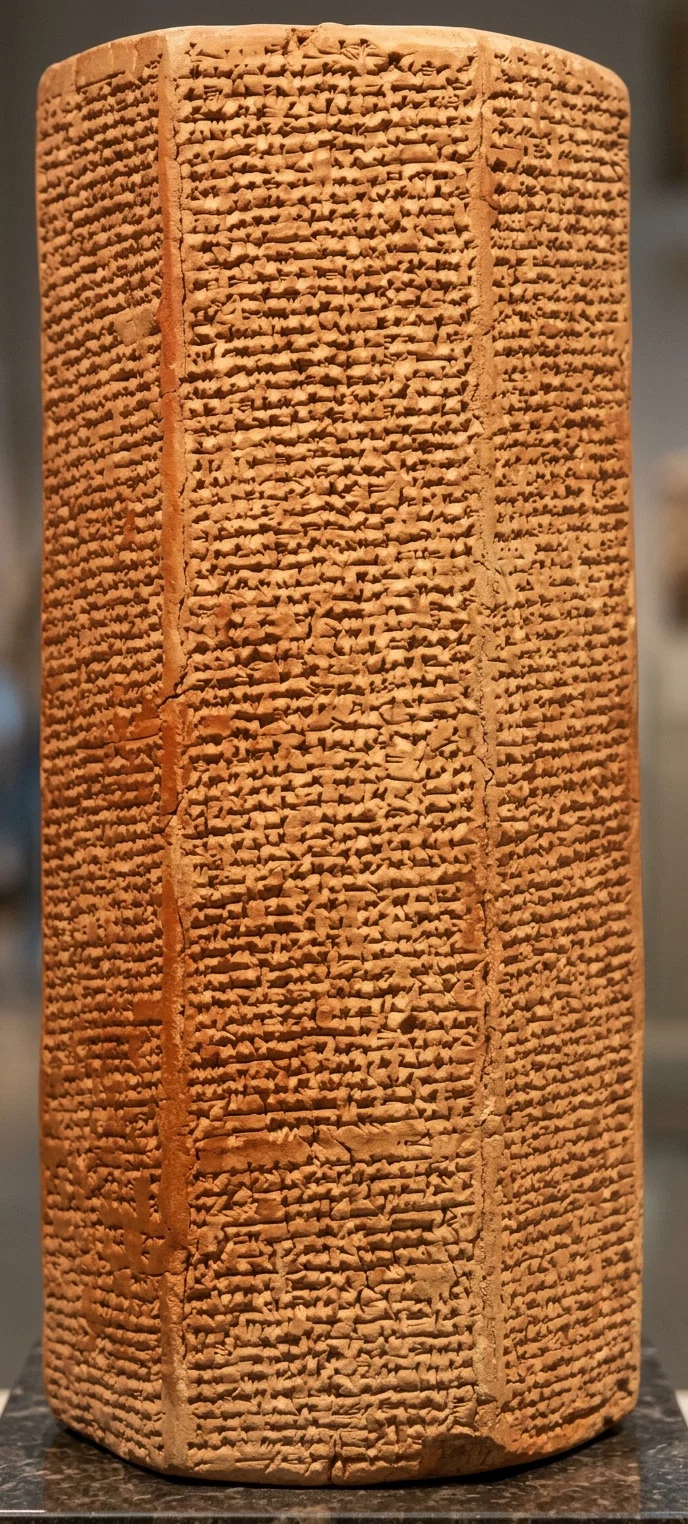
Another very remarkable inscription is that of Sennacherib, who in 701 B. C. made an expedition against Judah. On a six-headed cylinder fourteen inches high he wrote the records of his reign. He records eight campaigns, the third of which is against the cities of Palestine.
After a full account of the conquest of the Hittites, Phenicians, and Philistines, he gives the measures he took to subdue the fenced cities of Judah. He says:—
“And Hezekiah of Judah, who had not submitted to my yoke—forty-six of his strong walled cities together with innumerable small places in the vicinity, with the assaults of battering-rams and the blows of siege engines—I besieged, and I conquered 200,150 persons, small and great, male and female, horses, mules, camels, oxen, and sheep without number from their midst I brought and reckoned as booty. Himself (Hezekiah) like a bird I shut up in a cage, in Jerusalem his royal city I penned up—I diminished his territory. As for Hezekiah himself, the terror of the glory of my sovereignty overwhelmed him. Thirty talents of gold and eight hundred talents of silver I caused to be brought after me to Nineveh my royal city.”
It seems strange to have such a remarkable supplementary account of this memorable invasion. The story is very much like the Bible account, and in many details is the same.
Naturally Sennacherib does not tell of the great calamity that befell his army, when, according to the Bible, “the angel of the Lord went out, and smote in the camp of the Assyrians an hundred fourscore and five thousand.” We would not expect it; for the Assyrian kings did not record defeats. But this is noticeable, that he only shut up Hezekiah and exacted tribute, and though he lived twenty years after this campaign, and carried on extensive warfare in other places, he never again returned to Palestine, no doubt because of the dread of again coming in contact with Jehovah the God of Israel.
College View, Neb.
INSCRIPTION OF SENNACHERIB, KING OF ASSYRIA, RECORDING HIS EXPEDITION INTO PALESTINE
A Song of Motherhood
By J. W. Foley
Sew, sew, sew! For there's many a
rent to mend!
There's a stitch to take and a dress to
make,
For where do her labors end?
Sew, sew, sew! For a rent in a dress
she spies,
Then it's needle and thread and an
aching head,
And see how the needle flies!
Brush, brush, brush! For there's many
a boy to clean
And start to school with a slate and
rule,
With a breakfast to get between.
Comb, comb, comb! In the minute she
has to spare,
For what is so wild — unreconciled —
As the wastes of a youngster's hair?
Sweep, sweep, sweep! O, follow the
flashing broom,
As with towel bound her forehead
'round,
She goes from room to room!
Dust, dust, dust! As down on her knees
she kneels,
For there's much to do in the hour or
two
Of interval 'twixt meals.
Bake, bake, bake! For the cooky jar
piled high
But yesterday, in some curious way
Is empty again, O my!
Stir, stir, stir, in a froth of yellow and
white,
For well she knows how the story goes
Of a small boy's appetite.
Scrub, scrub, scrub! For the floor that
was spick and span,
Alas, alack! has a muddy track
Where some thoughtless youngster ran.
Splash, splash, splash! For the dishes of
thrice a day
Are piled up high to wash and dry
And put on their shelves away.
Patch, patch, patch! And O, for a
pantaloon
That would not tear or rip or wear
In the course of an afternoon!
Patch, patch, patch! And see how the
needle flies,
For a mother knows how the fabric
goes
Where the seat of trouble lies.
Toil, toil, toil! For when do her labors
end,
With a dress to make and a cake to
bake
And dresses and hose to mend?
Stew, stew, stew! Fret and worry and
fuss,
And who of us knows of the frets and
woes
In the days when she mothered us?