LABOR is rest from the sorrows that greet us,
Rest from all petty vexations that meet us,
Rest from sin’s promptings that ever entreat us,
Rest from world sirens that lure us to ill.
—F. S. Osgood.
Sweetest Things Grow in Sorrow
“ART thou weary, tender heart?
Be glad of pain;
In sorrow sweetest things will grow,
As flowers in rain.
God watches, and thou wilt have sun
When clouds their perfect work have done.”
Question Corner
“Enquire, and make search, and ask diligently.”
No. 620. A Prediction of Latter Times. 1 Tim. 4:1-4.
Please explain to me 1 Tim. 4:1-4, 7. It has been explained many times before, but I want it now if you can, because it is of great importance to me and others, also Rom. 14:14. M. O.
Thus the passage reads:—
“Now the Spirit speaketh expressly, that in the latter times some shall depart from the faith, giving heed to seducing spirits, and doctrines of devils; speaking lies in hypocrisy; having their conscience seared with a hot iron; forbidding to marry, and commanding to abstain from meats, which God hath created to be received with thanksgiving of them which believe and know the truth. For every creature of God is good, and nothing to be refused, if it be received with thanksgiving; for it is sanctified by the Word of God and prayer.” 1 Tim. 4:1-4.
This passage is a prophecy of a class which will arise in the last day. They are developed by departing from the faith of Jesus Christ, and thus turning from his Word to the teachings of demons. These same doctrines are taught by these apostates. Having their consciences hardened, they speak lies; they forbid to marry, enjoin celibacy, command abstinence from food (not meat in the sense of flesh), food that is good, food proper for the children of God, food to be received with thanksgiving, food sanctified or set apart by the Word of God and prayer. To what class or people does this refer?—To any who teach and command these things. Forbidding to marry is found in some of the teachings of Spiritualism and in the enjoined celibacy of the Roman Catholic priesthood. The doctrines of demons are any and all that build man’s hopes on the supposed inherent “immortality” of man instead of upon Jesus Christ. It is seen in adoration of saints, in the worship of the Virgin Mary, and in Modern Spiritualism. All that God requires is living faith in him; and living faith will work. All requirements outside of this, on which hope of life is hung, are from beneath, not above. For suggestions on Rom. 14:14 see Question Corner in issue of July 8, No. 597. We have not space to repeat these so often.
Please explain Gal. 5:4. What law is meant? Why are not Christians justified by it? E. R.
The law which points out sin (1 John 3:4), the law of Ten Commandments (Rom. 7:7; James 2:8–12). In Rom. 2:17–22 we are expressly taught that the law as held by the Jew was “the form” of the truth, that that law taught the “will” of God, and three of the commands are referred to. In Rom. 3:9–19 it is proved that all are sinners, transgressors of God’s law, and hence condemned by that law. Now a law which condemns can not justify. “Therefore by the deeds of the law there shall no flesh be justified in His sight; for by the law is the knowledge of sin.” Rom. 3:20. But that same righteousness of God which is in the law (because the law bears witness to it, Rom. 3:21, 22), worked out in the obedience of Christ, is imputed to the believer for his past sins (Rom. 5:18, 19). We are therefore made just only by faith in Christ (Rom. 3:28; Gal. 2:16); but by that same faith that law is established in the heart (Rom. 3:31). Now if we seek to be justified from our past sins by our own works of the law, we really turn from Christ, reject his justification, and his obedience becomes of no effect to us. He only can be pronounced just by the law who has always kept all of it. Only Christ did this. The law condemns all others. Rom. 3:19, 23. But Christ justifies us through faith, establishes his law in our hearts, that by his grace we may keep the law. Rom. 3:31; 8:4; Gal. 5:6; 1 John 5:3.
Did the whole 5,000 then believe, or only a part of them? P. B.
The Revised Version gives the correct idea: “And the number of men came to be about five thousand.” The 5,000 included the 3,000 of Acts 2:41. Of course there were more than 5,000 believers. This does not include the women and children.
THE SPRING HIGH TIDE THAT CARRIED AWAY GRAN'SIR'S MUG.
By E. A. Rand
BY THE REV. E. A. RAND.
“Cephas, do look at that ’ere boy!” said old lady Smith, watching from a window her grandson Peter.
Cephas Smith, who was in the room, smacking his lips over a mug, came to the window, and remarked:—
“It is a dreadful high tide. Peter’s hen-coop may have to go. I’ve told that boy more’n fifty times to put his hens somewhere else.”
“Yes, it is a master tide. It keeps a-comin’ in and a-comin’, and all the time this ’ere storm is a-blowin’ guns down the chimney. Jest hear it! And that tide is a-risin’, and keeps a-comin’ in, nearer, nearer, jest like a livin’ and breathin’ bein’. O, I don’t like sich things!”
While she spoke she sharply watched her husband. She was thinking of another tide that for some time had been rising, even Cephas Smith’s habit of drinking.
He had just taken his favorite mug of flip at the kitchen stove, and nigh the kitchen cupboard.
Grandmother Smith had had a confidential talk with Peter, now in the yard trying to prop up his hen-coop. She had frankly confessed to Peter that “gran’sir was gettin’ into a dreadful foolish habit,” and “what to do she didn’t know.”
“I’d slave myself to stop his drinkin’. He’ll jest ruin hisself, Pete.”
Here Grandmother Smith buried her face in the folds of her long apron, and sobbed pitifully.
Then he did not know but he had gone altogether too far in thus speaking his mind, and he went up to Grandmother Smith, and began, by way of reparation, to stroke her back fondly and pityingly.
“Don’t worry, grandma. He—he—don’t10worry. I’ll stand by ye, and perhaps,—why, who knows?—between us both, we may do something. We can put our heads together, you know.”
This made Grandmother Smith smile, for Peter was just a small boy, and his head was not a very big one. At any rate, his curly head did not seem very large beside grandmother’s, with big folds of soft white hair all about it, and outside of that a fluffy white cap and its ribbons and bows.
Then there was silence. What next?
“We can pray, grandma,” murmured Peter.
“Yes, dear, we will do that,” said grandmother soberly.
And that very night two pairs of hands were folded in prayer,—one in grandmother’s chamber, and one in a little nook under the low slanting roof where Peter slept.
The conference with Peter came into the grandmother’s thoughts as she and Gran’sir Smith stood side by side at the window, and watched the high tide deepening round Peter’s hen-coop.
“There may be chance for Peter to save his hen-coop by all his sticks and props,” observed Gran’sir Smith, “but he ought to have built on higher ground, and I will tell him so.”
He took his old tarpaulin hat from its nail, and went out into the yard.
“Peter,” he shouted, as he faced the storm, “you ought to have built on higher ground!”
“I think so too. Do you know, gran’sir, that the shed is in danger?”
“You—you—don’t say!”
He looked at the shed, now encompassed by water.
The Smiths lived on a lane that ran down to a river making in from the sea, and subject, in certain storms, to violent tides. An “equinoctial,” for instance, would beat down fiercely, and scourge the river as it were to madness.
The tide was now rising steadily about the hen-coop, and threatening soon to lift it on its blue shoulders and bear it away. Peter prudently had removed the hens to a safe retreat. What safety was there for the hen-house? It was the shed, tho, that was now the object of anxiety.
“I see that there is suthin’ to be done about that ’ere shed,” remarked gran’sir. “I will be back soon.”
He went into the kitchen, prepared a stiff mug of flip, and drank it down eagerly.
“O Cephas!” moaned grandmother.
“Now, wife, why do you say anything! I have a hard job before me.”
She wiped her tears in reply. She knew that gran’sir already had had more mugs of flip than he could carry off.
“You’re cryin’?”
“Yes; you can’t handle yourself out there.”
“Can’t I handle myself? You’ll see, you’ll see, madam! I think I can!”
It was a foolish boast.
He strutted across the yard, but unsteadily, and went into the shed to get a joist with which to prop up the shed on the outside. He carried it outside. The Smith lot went down to the river. Here a wharf had been built, and the shed and hen-house were on this wharf, the rear wall of each coming to the wharf’s edge.
Gran’sir went to the edge of the wharf to see where he could best set up his prop. He was feeling the liquor he had drunk. He made a careless movement, and down he tumbled, and over the edge of the wharf he went.
“Help! help!” rang out his voice.
Peter was on hand, small boy tho he was. Somebody else was on hand—Grandmother Smith. She came fluttering out of the house, and then ran to the wharf. In her hand she carried her old red shawl. The faded fabric was homely now, but it was strong. Holding on to her end firmly, she flung out the other end to Gran’sir Smith.
“Ketch it! ketch it!” she shrieked.
Gran’sir Smith grabbed it.
“Now, Peter, help your grandma! Pull in! All together—now!”
Grandmother Smith showed herself an expert. Peter did his share. They pulled together. They pulled gran’sir to the wharf. They pulled him over the edge of the wharf. How they did it they could not say. Then they led him into the house. He was put into dry clothes. He was placed before the kitchen fire.
He looked so comfortable there before the cheerfully purring fire. He wore a blue dressing-gown that Grandmother Smith had made for him, and it contrasted finely with his long white hair that the same faithful wife had brushed back from his forehead.
Now and then he looked up at the old flip-mug on the mantel over the stove, glancing down at his blue dressing-gown. He looked very solemn.
“What are you thinkin’ of, Cephas?”
“I was thinkin’ if I had looked this way, all slickt up so neat, if I had gone down to the bottom of the river.”
“O!—O husband, don’t speak of it!”
“But I must, wife; if—if—if it hadn’t been for you and Peter I should have been down at the bottom of the river, sartin. I know why I fell over.”
Here he gave a savage glance at the mug.
“Is that shed a-standin’?”
“Yes, and I believe it won’t go, after all.”
“Well, that hen-coop, hen-house—won’t that go?”
“No, it is standing, and I don’t believe it will go.”
Gran’sir rose in his chair.
“Suthin’ has got to go!” he said energetically; “and it shall be that mug! Peter!”
“What, sir?”
“Take my mug and a piece of board, and put the mug on the board, and then put the board on the edge of the wharf, and then—then”—here gran’sir’s voice became almost terrific—“then launch her! That thing has got to go! Not goin’ to have this tide for nothin’!”
The mug went. The tide swept about the board, drifted it away, and quickly smothered it.
Its fate was watched from the kitchen window, and then gran’sir said:—
“Now, wife, pray for me. Where’s Peter? O, here he is! Peter, pray too. I want my appetite sunk way down—way down—same as that mug. God help me!”
Such a time of prayer!
The wind raved down the chimney. The rain rattled against the windows. Above all these sounds, tho, could be heard the voice of Grandmother Smith earnestly crying to God, and then came a boy’s voice, clear and penetrating. Never such a day in that house as the day when the spring high tide carried away gran’sir’s mug.—S. S. Times.
“SECULARIZING” SUNDAY.
By W. N. G.
THE great burden of Sunday observers, especially that increasing class who desire to compel its observance, is that the day is in danger of being “secularized.” Now, if the first day of the week ever was made anything but a secular day (and no power but God could do so), no one but the authority which sanctified it could by any means secularize it, or take away its sanctity. But suppose the day had been sanctified by a competent authority, and suppose that unsanctified men could take away the sanctity thus bestowed, what could be more conducive to such a result than cumbering it with secular law, making it to rest upon secular law, and enforcing it by the power of secular law, under penalties inflicted by secular law?
At the recent Christian Endeavor Convention in San Francisco, Dr. Temple, in referring to the defense of the Sunday institution, said, “We have to stand guard over it with drawn swords, lest some new form of iniquity put its hoof upon this sacred institution, and defile it.” The thought of defending a so-called sacred institution with the secular sword is at least a tacit admission that the assumed sacredness is a very thin varnish. When it comes to defending any doctrine of Christ’s promulgation, he says emphatically, “Put up thy sword.” Only secular institutions need secular defense, and when the human law and the human sword are called to defend the Sunday sabbath, it is indubitable proof that the defenders have no practical faith in the sanctity of the day.
When Israel took the sacred ark of the covenant into battle, and attempted to defend it with carnal weapons, they were sorely defeated, and the ark was carried away by the Philistines. But when the holy law of God and its sanctified receptacle were out of the hands of those who would defend them with carnal weapons, they were successfully defended and rescued by an unseen hand. The fact that even a measure of temporary success has attended the enforced observance of Sunday by secular power, is evidence that the institution so defended is a secular one. And no class of people is doing so much to prove this fact as those who persist in such enforcement. They are doing more to “secularize” the day, or rather to demonstrate that it is nothing but a secular day, than all other forces combined.
W. N. G.
RELIGIOUS CONDITION OF FRANCE.
A WRITER in the Christian (London) thus speaks of the religious condition of France:—
“Great material prosperity; secular education. An increase in drinking habits and depraved literature in the lowest classes. A decided reaction from infidelity towards religion (especially among the educated classes), which is turning almost exclusively to the profit of Roman Catholicism. This is attributed by some to the low spiritual state of Protestantism and its divisions, but is probably due to ‘Modernism’ in Protestant pulpits, especially doubts cast on the deity of Christ, and the plenary inspiration of the Scriptures (happily by no means universal, but still too prevalent). A spirit of patriotism, so intense that, when it does not take the place of a religion in itself, exalts Roman Catholicism as the national religion of France, as opposed to the Protestantism of her traditional foes, England and Germany, and excites opposition to foreigners, especially English, evangelizing either in France or her colonies. This feeling is shared even by Protestants, tho, of course, not by all.”
But the reaction toward Roman Catholicism is the result of two things, superstition and fear. “Protestantism” in France presents nothing better; for if it did, those who truly seek after holiness would turn to God; those who seek to be saved by a religion, yet in sin, would turn to Roman Catholicism. It is a sad condition, and France is not alone in Europe in presenting like conditions. “When the Son of man cometh, shall he find faith on the earth?”
MISUNDERSTOOD
COULD we but draw back the curtains
That surround each other’s lives,
See the naked heart and spirit,
Know what spur the action gives,
Often we should find it better,
Purer than we judge we should;
We should love each other better
If we only understood.
Could we judge all deeds by motives,
See the good and bad within,
Often we should love the sinner
All the while we loathe the sin.
Could we know the powers working
To overthrow integrity,
We should judge each other’s errors
With more patient charity.
If we knew the cares and trials,
Knew the effort all in vain,
And the bitter disappointment—
Understood the loss and gain—
Would the grim external roughness
Seem, I wonder, just the same?
Should we help where now we hinder?
Should we pity where we blame?
Ah! we judge each other harshly,
Knowing not life’s hidden force,
Knowing not the fount of action
Is less turbid at its source,
Seeing not amid the evil
All the golden grains of good.
O, we’d love each other better
If we only understood!
—Fireside Magazine.
THE “DAINTY” CIGARET.
Scavengers going about picking “snipes” (cigar stubs) is a familiar sight. From the gutters, from hotel and saloon cuspidors, no matter from whence they are taken or from whose mouth they and the rejected quids of tobacco may have come, all find a place in the bag or basket. These are taken to the manufactory, ground up and mixed with any old thing for filling, wood pulp and chopped straw being largely used, and are then ready to be doctored. Liquor, opium, cocaine, Havana flavoring, belladonna (the deadly nightshade), are all found in the cigaret by chemical analysis. After becoming thoroughly permeated, this mass is rolled up in its paper wrapping, an imitation of rice paper, which can be made so cheaply that 1,000 can be wrapped in two cents worth. This is often made of filthy rag scrapings, bleached with arsenic, which in burning forms the oil of creosote. In rolling cigarets the rollers constantly moisten their fingers from their mouths. Many of the cigarets are wrapped in filthy tenements, sometimes in the very room with the most loathsome disease, and leprosy has been known to be thus disseminated.
Fastidious young men who despise a pipe about their pockets, and enjoy the “clean,” dainty cigaret, may possibly not have so clean a smoke after all. The facts here given have been widely published, and persons familiar with the business vouch for their truthfulness. The thousands of cigars thrown away but partly smoked every day in our cities afford cigaret manufacturers a fine source of income, and account somewhat for the tremendous profits in the business.
Most of the nicotine of a cigar is drawn by the moisture of the lips into what the smoker throws away. This makes it the more valuable for the cigaret maker, and the boy gets the poison thrown away by his father. Can the reader of this wonder at the deadly effect cigaret smoking is having?—Christian Citizen.
BETTER THAN LEECHES.
By Dr. E. Miller
A FATHER, by prayer, precept, and flogging, had done his best to reform his boy, whose staple diet was meat, and sausage, and pie, and cake, at his meals, with cake between. The family physician said to the father, “If you will put leeches back of each of your boy’s ears, once a week for a month, you will do more to reform him than your preaching and pounding will do in a year.” The father asked for the philosophy of this prescription. “Why,” said the doctor, “your boy has bad blood and too much of it; he must behave badly or he would burst.” “Then,” said the father, “I’ll change his diet from beef and pie to hominy and milk.” In three months thereafter a better boy of his age could not be found in the neighborhood. The acrid, biting, vile blood had not become food for leeches, but it had done its wicked work and passed away; and a cooler, blander, purer, safe blood had been supplied from sweeter, gentler food sources. —Dr. E. Miller.
AN “INSANE” PAPER.
The inmates of the provincial lunatic asylum of Saint John, New Brunswick, says the Christian Advocate, publish a monthly called the Lancaster Argus. Its editors and writers are all insane, but it has considerable circulation among the sane. The New York Tribune publishes its prospectus: “An elegant, moral, and refined miscellaneous family journal. Devoted to polite literature, wit and humor, prose and poetic gems, and original matter written expressly for this paper. Nothing of an immoral nature will ever be admitted into its columns, therefore making it emphatically a paper for the million and a welcome visitor to the home circle.” Some newspapers speak of this as unprecedented. This is not the case. The inmates of the lunatic asylum at Utica, N. Y., published a magazine known as The Opal about forty years ago, of which we have several copies, and from time to time have published extracts in this paper, in two instances not indicating the origin, and in one of these cases we had several letters asking the name of the author and declaring the article to be, as was the case, one of unusual beauty and pathos.
MONSTER CATALOG.
THE British Museum catalog, which has been in process of compilation for a long time, will probably be completed within the next 2 years. This catalog will contain a list of nearly all the books that have ever been published. The first British Museum catalog was completed 110 years ago. This consisted of two manuscript folio volumes. In 1819 this catalog had grown to 8 volumes. A new edition was commenced in the thirties. Only the first letter was printed; the rest were written. It was completed in 1851, and consisted of 150 folio volumes. In 1875 the list had grown to 2,000, and 5 years later to 3,000 volumes. The new edition commenced in 1881, and, now nearing completion, will be printed, and is to consist of 600 volumes, containing a list of 3,000,000 titles.—Christian Advocate.
MISSION NOTES.
KOREA remained the hermit nation until, in 1882, God used medical missions as the key to unlock its doors to the Gospel. Dr. Allen, by a strange accident—to human eyes, a strange Providence, as disciples see it—became installed as court physician, and the king built a “house of civilized virtue”—a government hospital under the care of this Presbyterian missionary. And now Korea’s valleys are being penetrated by Gospel messengers.—Missionary Review.
SAYS Isabella Bird Bishop: “We often hear, but not so much, I believe, as formerly, of the craving of the heathen for God, of the heathen flying as the doves to their windows to hear that Gospel which is for the healing of the nations. It is really no such thing at all. The craving of the oriental mind is for money, for wealth, for the things of this earth, and not for God. The longing which is represented to exist has, I believe, no existence at all. And it is this discovery which often tends to disappoint and crush the spirit of some young enthusiast who has come out thinking that he has only to preach and that he will gather hundreds into the fold of Christ.” And yet there are a few longing souls in all lands, like the Syro-Phenician woman of old, that are reaching out after God; and he who has the mind of Christ will find them by seeking the salvation of all.
THE total expenditure for foreign missions, says the Missionary Review, during 1896 was, from reported gifts, about £3,000,000 sterling. The whole number of ordained missionaries is about 4,300; of layman, 2,500; married women, 4,200; and unmarried, 3,300; this gives a total missionary force, from Christian lands, of 14,300. Mission churches have themselves given to the work 3,350 ordained natives, and over1251,700 native helpers, making a grand summary of nearly 70,000 actually engaged in a world’s evangelization, in some 21,000 mission stations, and sustained by a body of 1,115,000 native communicants, that stand for five times as many adherents; 62,000 communicants were added in 1896. And there are 18,000 schools, with a total of about 700,000 pupils.
THE NEEDS OF PORTUGAL.
By J. E. Budgett Meakin
As yet there are only two centers of evangelical work in Portugal—Lisbon and Oporto—for, tho there is a growing desire all over the land for more Gospel teachers, the supply is almost nil. Very little is known abroad of the needs and opportunities there. Even Coimbra, the university town, is yet unoccupied, notwithstanding all the advantages of work among the students, and numerous applications received from residents there. In the country districts work is still difficult, as there is not yet legal liberty to convert Romanists, to attempt which is a criminal offense. But in the cities public opinion is so far with the Protestants that the Romanists dare not enforce the law.
A most promising feature of the work in Portugal is the success of the primary schools, in the face of much opposition. In Oporto, tho the Romanist schools are free, and a penny a week is charged at the Protestant schools (accommodating 180), sixty-five are waiting for admission to the latter. In another, which accommodates eighty-nine, there are 109 applicants.
In Lisbon the work is chiefly divided between the Lusitanian and Presbyterian Churches. There are also two or three independent workers here and in neighboring towns. Among the native pastors there are several who were once Romish priests, one of whom continues in his old parish. All these agencies pull well together, and denominational walls are overlooked, even to the extent of both using the same hymn-book.
A peculiarly promising branch of the work, with a strongly unifying tendency, is the circle of Young Men's Christian Associations established some two years ago, in connection with the Swiss center. In Oporto, where they were first established, there are three branches, in connection with as many churches.
Priestcraft stands in but poor repute in Portugal, where its representatives lack the respect of most, tho in the villages they still hold sway over the minds of the women. In place of faith, tho side by side with hard-dying superstitions, there is a growing spirit of indifference, which must inevitably absorb the majority of the half-enlightened young if more is not done to bring before them the truth.
One hopeful sign is an increasing readiness to purchase Bibles, altho their circulation without authorized “notes” is prohibited. There are several small evangelical publications in Portuguese, some of which come across the Atlantic from Brazil. A Portuguese merchant returning from Brazil has offered to build a new Protestant church in Lisbon.
In Lisbon and Oporto there are Episcopal and Nonconformist services for the considerable colonies of English to be found there, and at both places seamen's missions exist, doing excellent work. At Oporto, too, there is a small German service conducted by a layman; but except at Portalagre, where Mr. Robinson conducts evangelistic services at the cloth factory, there is practically nothing done as yet to spread the Gospel in Portugal.—J. E. Budgett Meakin.
RHODES
By H. P. H.
A short distance to the west of the island of Cyprus, in the Levant, lies the island of Rhodes, but twelve miles from the mainland of Asia Minor. Tho but 20x45 miles in extent, this island attained great wealth and power during the last few centuries before the Christian era. It is believed to have been first settled from Greece; however this may be, it is certain that the Greeks obtained possession of Rhodes in the twelfth century B.C., shortly before the Trojan war, and to the present constitute the principal part of the population. Situated in the line of commerce between three continents, and possessing the most delightful climate of all the islands of the Levant, Rhodes attained great importance as a trading center, and was noted for its learning, art, and architecture.
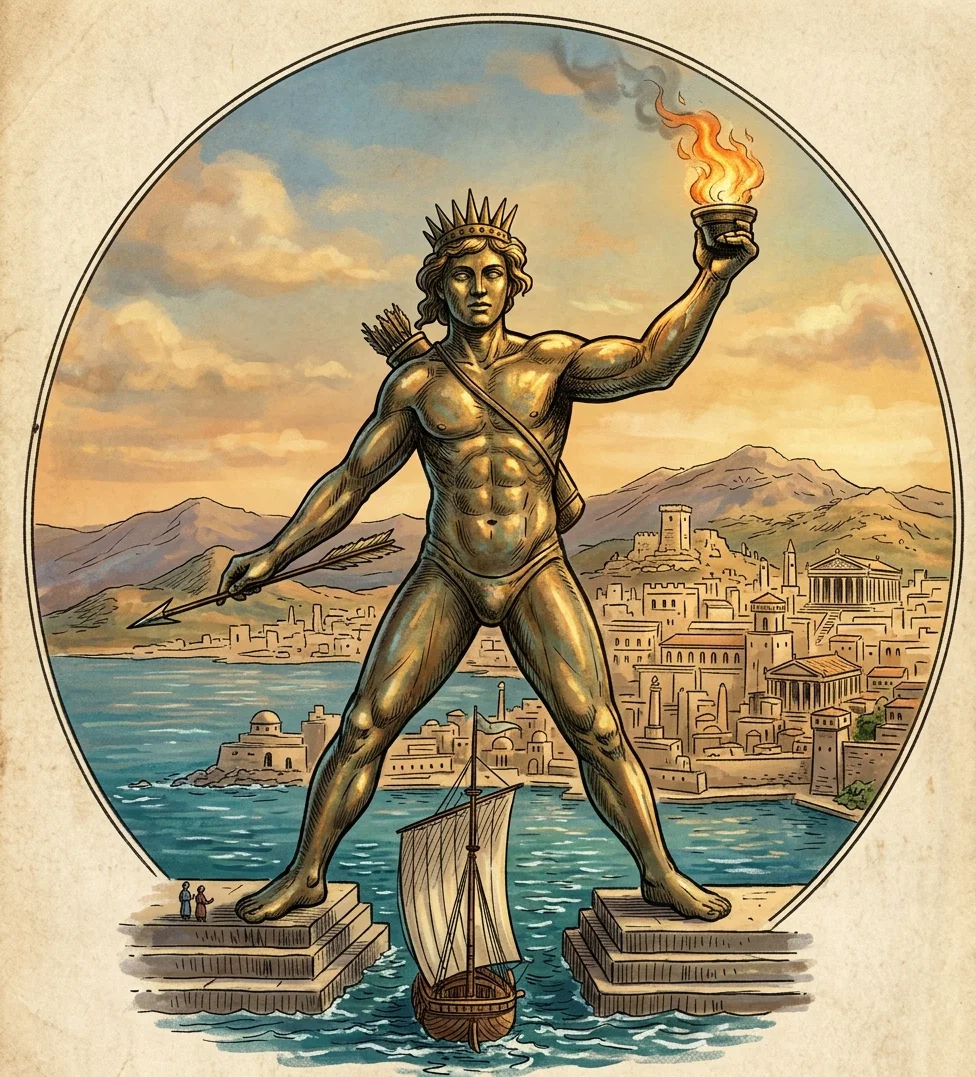
At the close of the fifth century B.C. the city of Rhodes was founded for a new capital, and soon rose to importance. It possessed two good harbors, at the entrance of one of which was the famous brazen statue, known as the Colossus of Rhodes. The Greeks called it the statue of Helios (the Greek word for sun). The Greeks had temples to the sun at Corinth, Argos, Elis, and many other cities, but their principal seat of sun-worship was at Rhodes. It will be remembered that the island of Cyprus, near by, was noted for the worship of Ashtaroth, or the Greek Astarte and Roman Venus, the female deity corresponding to the male sun-god Baal, and the Hercules, Apollo, etc., of the Greeks and Romans. Hence it is not surprising that the chief seats of worship of the sun-god and goddess should be on neighboring islands.
The Colossus of Rhodes was 70 cubits, or 105 feet, high, and was considered one of the seven wonders of the world. It was completed in 280 B.C. and was thrown down by an earthquake in 224 B.C. Besides this Colossus at the entrance to the harbor, there were about 3,000 other statues in the city of Rhodes, 100 of which were colossal. Rhodes was also noted for the beauty and strength of its architecture. Art continued to flourish here for some time after the beginning of its decay in Greece. Its power was broken by the Romans in the year 42 B.C. In 1310 A.D. the Knights of St. John of Jerusalem, headed by the Crusaders, captured Rhodes and held it till 1523, when they were driven out by the Turkish sultan Solyman. Having so long held the island of Rhodes, they are often called the Knights of Rhodes.
These Knights of St. John were a religious order which originated 1048 A.D. in the Hospital of St. John the Baptist, established to aid poor pilgrims who visited the holy sepulcher at Jerusalem. They are noted for having been the most powerful religious and military order of the Middle Ages. Having been expelled from Rhodes by the Turks, the emperor Charles V. assigned them the island of Malta (Melita, where Paul was shipwrecked on his way to Rome, Acts 28:1), where they remained till 1798, when the island was captured by the French. They were long considered as a bulwark against the Turks.
At the present time, Rhodes, like Cyprus, is much depressed. The entire population, mostly Greek, is but 30,000, two-thirds of these being in the city of Rhodes. So far as known to us, the truth has not yet been represented on this island. But as we gain Greek members in Turkey, doubtless the truth, through them, will soon find its way to Rhodes, and at the last the Sun of Righteousness, whose name is Wonderful, will stand as its ensign instead of the pagan wonder, the colossal brazen sun-god. H. P. H.
THE LOVE OF GOD.
By J. G. Whittier
So to the calmly-gathered thought
The innermost of truth is taught,
The mystery dimly understood,
That love of God is love of good,
And chiefly, its divinest trace
In Him of Nazareth’s holy face;
That to be saved is only this,—
Salvation from our selfishness,
From more than elemental fire,
The soul’s unsanctified desire,
From sin itself, and not the pain
That warns us of its chafing chain;
That worship’s deeper meaning lies
In mercy, and not sacrifice,
Nor proud humilities of sense
And posturing of penitence,
But love’s unforced obedience;
That Book and Church and Day are given
For man not God,—for earth, not heaven,—
The blessed means to holiest ends,
Not masters, but benignant friends;
That the dear Christ dwells not afar,
The king of some remoter star,
Listening at times, with flattered ear,
To homage wrung from selfish fear;
But here, amidst the poor and blind,
The bound and suffering of our kind,
In works we do, in prayers we pray,
Life of our life, He lives to-day.
—J. G. Whittier.
OUR WORK AND WORKERS.
THE church in Nueva Helvetia, Uruguay, now numbers eighteen members.
BROTHER N. Z. TOWN reports the addition of five new members to the church in Buenos Ayres.
NINE persons have taken their stand on the Lord’s side as a result of tent-meetings held at Winterset, Iowa, by Elder H. M. J. Richards.
A CAMP-MEETING for the accommodation of the brethren in the northwestern part of Wisconsin has been announced for September 6–13, to be held at Menomonie.
TWO WHOLE families and other individuals are reported among the acquisitions to our ranks at Villisca, Iowa, under the labors of Brethren E. E. Gardner and B. E. Nicola.
ELDER W. B. EVERHART notes the fact that the brethren at Traer, Iowa, “have erected a neat little church building.” Also the addition by baptism of two members to the church at Cedar Rapids.
THE place of the special meetings in San Francisco has been changed from Kearny Street to Market Street, near Seventh. These meetings, conducted by Elders Andross, Rine, and Dexter, have attracted much attention, and by such means the Gospel may reach many people otherwise inaccessible.
ELDER F. H. WESTPHAL reports to the Review that he held meetings in the frontier town of Malabrigo, province of Santa Fé, Argentina, where he baptized eight persons and organized them into a church. Others are keeping the Sabbath there, among them a native Indian. The colony is Swiss-German. He also reports some converts at Crespo, among them a man who had once tried to intimidate them with a revolver. At this place four were baptized.
TWO OF our brethren in New Brunswick were recently arrested for working on Sunday, but were discharged. The complaint against one of the brethren was made by a man who habitually works on Sunday himself. The other complaint was by a woman over fifty years old, who several times walked two miles to see if the brother was working, in order to have him arrested. Such is the use to which laws of this character are adapted. They are simply scourges in the hands of people who love to punish those who dissent from their views.
A MINISTER of the Christian Church recently undertook to defend the Sunday institution in a discussion with Elder J. D. Pegg, at Elbridge, Tenn. In his last speech he surprised his own adherents by admitting that Sunday has no sanctity more than other working days, and that were it not for the State law, men could do ordinary labor without doing any wrong. He also admitted that the State had no right to pass Sunday laws. These admissions by a leading advocate of Sunday sacredness, in a community where observers of the seventh day have been heretofore bitterly maligned, has caused quite a reversion of feeling on the part of many of the people.
PENNSYLVANIA, the “Keystone State,” seems bound to keep up its Sunday-law reputation, and be the “keystone” of compulsory Sunday observance. To what means some of its people are willing to resort in “stooping to conquer,” is shown by the following extract from a letter to the American Sentinel.—
“WASHINGTON JAIL, August 4, 1897.
“EDITOR American Sentinel: At my trial before Justice Berry, of West Washington, yesterday, the charge against me was that of servile labor on Sunday. They proved by witnesses that I carried a stand and box the distance of a block and a half. I replied to the charge, pleading my case by the principles of God’s Word. The justice showed me every mark of respect. After my reply, the squire said he respected the stand which I took in harmony with my convictions; and, while making out my commitment, he said he would be willing to trust me to take it myself to the sheriff’s office. When I entered the jail, the inmates flocked around me to learn why I was put in; and, when I explained, they expressed their disapproval—some in a rather profane manner. A colored man came to me and wanted to know if I had not preached in their church a couple of times (stating name of the church). I said, Yes. He said he was a member of the church, and that his wife had been telling about me, and described me, so he had recognized me when I came in. Then the prisoners wanted me to preach to them that evening, and I did so. I spoke from Isa. 52:3. They took a vote to have preaching each evening during my stay. The vote was unanimous in favor of Gospel services. The prisoners number in all about forty-two. My sentence is for six days. The Lord willing, I hope to find a man to continue services after my release. My jailer is glad of the work I am doing, and gives me encouraging words. The prisoners are friendly.”