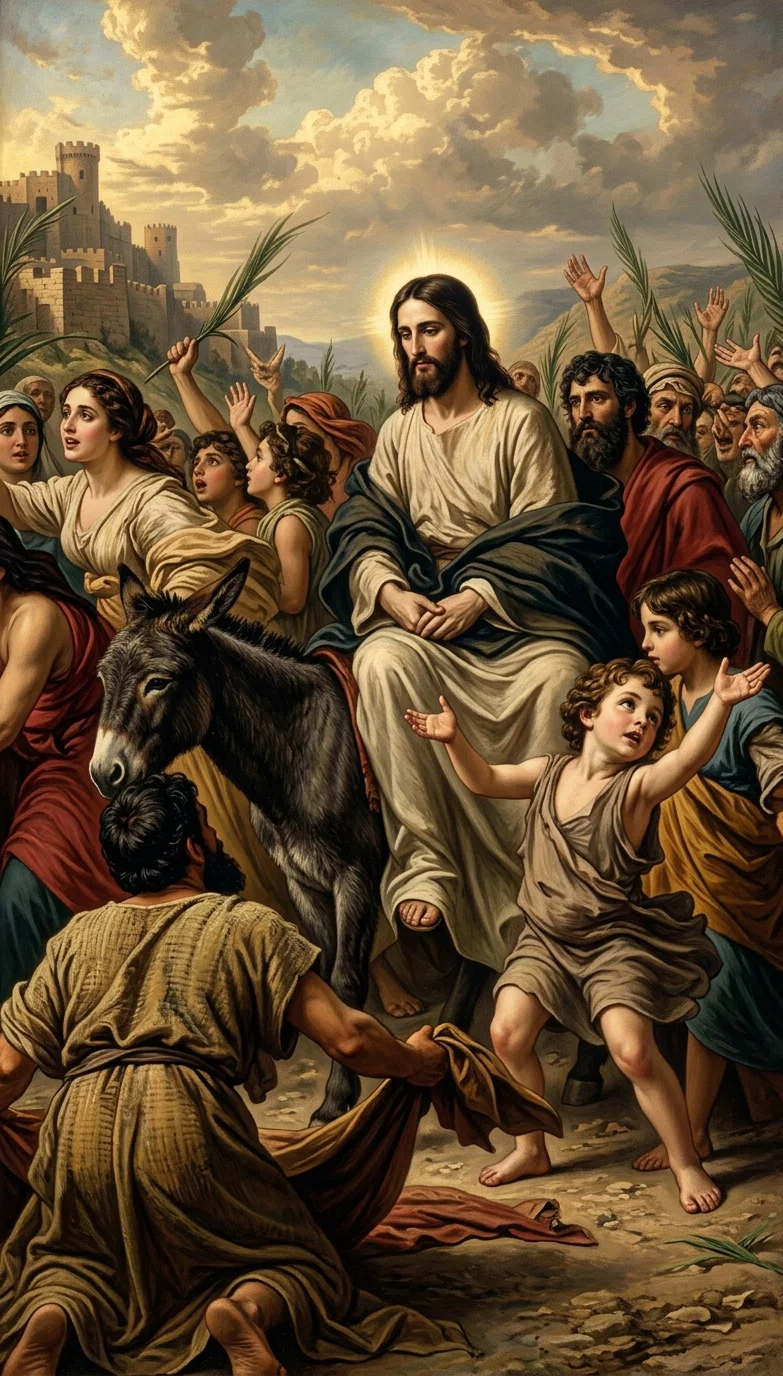
NO TRUTH is any more plainly taught in the Bible than is the second coming of our Lord Jesus Christ. Says the apostle, “Christ was once offered to bear the sins of many; and unto them that look for him shall he appear the second time without sin unto salvation.” Heb. 9:28.
THE ENTRY INTO JERUSALEM.
How the Lord will appear is just as plainly told in Acts 1:11: “This same Jesus, which is taken up from you into heaven, shall so come in like manner as ye have seen him go into heaven.” This could have meant only one thing to the disciples who had seen the Lord, and even handled him after his resurrection, namely, a visible, personal, bodily appearing; and if we receive their witness, it can mean nothing less than that to us, for this same thought stands out prominently in very many texts bearing upon the subject, not only in the New Testament but also in the Old.
Another truth just as plainly taught in the Scriptures as the second coming of our Lord, is that while no man knows the day or hour of the second advent, the people of God will not be overtaken as by a thief. Says the apostle, “Ye, brethren, are not in darkness, that that day should overtake you as a thief.” 1 Thess. 5:4. And again, in Matt. 24:32, 33, we find our Saviour himself giving this charge in view of certain signs which he had just foretold: “Now learn a parable of the fig tree: When his branch is yet tender, and putteth forth leaves, ye know that summer is nigh; so likewise ye, when ye shall see all these things, know that it [margin, ‘he’] is near, even at the doors.”
As might be expected in view of the facts already cited, and sustained by plain texts of Scripture, the Bible teaches that a warning message goes to the world just before the end, to prepare a people for the coming of the day of God. This is more than hinted at in verses 42–51 of the twenty-fourth chapter of Matthew, while it is plainly commanded in many other scriptures. Says the prophet Joel: “Blow ye the trumpet in Zion, and sound an alarm in my holy mountain; let all the inhabitants of the land tremble; for the day of the Lord cometh, for it is nigh at hand.” This scripture can no more fail of fulfilment than could the prophecy that foretold the entry of the Saviour into Jerusalem; and on that occasion he said of those who were sounding his praises, “If these should hold their peace, the stones would immediately cry out.” Luke 19:40. God had foretold that event, and his word could not fail. No more has it failed, nor can it fail, in regard to the proclamation of the second advent. The message of the second coming of our Lord Jesus Christ is now going to the world. In every land and in every clime is heard the warning, “The day of the Lord cometh,” “it is nigh at hand.”
But, sad truth, while some are sounding this warning and some are receiving and obeying the truth, others are fulfilling the words of Peter: “There shall come in the last days scoffers, walking after their own lusts, and saying, Where is the promise of his coming?” But none need to occupy this position, for the apostle adds, “For this they willingly are ignorant.” God has given us “line upon line, and precept upon precept.” No one needs to remain in such ignorance. The promise is, “The meek will he guide in judgment; and the meek will he teach his way.” It is the privilege of every soul to love “that blessed hope” (Titus 2:13) now, and in the near future to realize its consummation. C. P. B.
A DREAM AND A REALITY.
By M. E. K.
That all the people of the world will be converted to Christ before he shall come again is one of the illusions which is dearly cherished by many sincere Christians. But the fact that good Christians, even very many of them, so believe, has no real bearing upon the question whether there will or will not be such a condition of things prior to the return of the Master. There are three ways in which one may study the subject: (1) What would we like to see; (2) the teaching of the Scriptures upon this subject, and (3) the probabilities that such a condition will ever ensue, judging from the present condition of the world and its trend of thought and action.
1. Of the first point mentioned we may say that probably every one would be glad to believe that there will be such a time, and, further, that there is little doubt that this very natural desire to have it so is the greatest cause why so many persons believe that it will be so. But really our desires upon this subject have no bearing upon the question, tho personal desires have, no doubt, been largely instrumental in causing many to overlook the more weighty considerations of the testimony of the Scriptures and the probabilities as forecast by the present aspect and condition of the world. To treat this question from the standpoint of the natural desires is the way that it was recently treated by a writer in the Christian Oracle. He indulges in a dream of the time when by present processes of grace sin will have been eliminated from the world. He visits (dreamily) a town where he had once lived, and finds every one holy and happy. He draws a beautiful picture of society as seen in his dream,—no jails, drunkenness, assignations, riots, assaults, wars, and murders. People had forgotten the word “saloon,” so long had it been unknown. It could not be found in the dictionary. Other words of a similar character,—the names of bad actions,—could not be found. It was an ideal picture, but there was one great blot,—death was there. The last enemy was not destroyed. It seemed very singular that sin should all be gone, and still that death, which came by sin, should reign. There must certainly be something wrong in this theory. The dream can not be a true forecast and revelation of what is to be. It can never come to pass.
2. Looking at the subject in the light of the second proposition, what the Scriptures teach, we see where the mistake lies. It is in assuming6that the world will be converted, and all the people holy, before the coming of Christ. The testimony of the Scriptures is against this theory. Let us look up a few texts which throw light upon the subject.
There will never be a time before Christ’s coming when all mankind will serve him. The wheat and the tares grow together until the harvest (Matt. 13:30), which is the end of the world (verse 39); at the time of Christ’s coming there is lamentation and mourning (Matt. 24:30); kings and great men will be in sore distress (Rev. 6:17), and vengeance will be taken on those who do not obey the Gospel (2 Thess. 1:7–10). As that time draws near, many will deny that he will ever come (2 Peter 3:3, 4), and the day of the Lord will come upon them unexpectedly, as a thief in the night, and as a snare (2 Peter 3:10; Luke 21:35). These scriptures and many more that might be adduced prove that the last days are not to be days noted for the piety of the people, but for something exactly opposite. Paul describes them as days of great peril, when every kind of sin will be practised, and when the form of godliness shall have superseded the power. 2 Tim. 3:1–5. See also Matt. 24:37–39.
3. And now as to the probabilities of the world’s conversion. Are they in harmony with, or are they against, the teachings of the Scriptures upon this subject? Christianity is spreading, but there never was a time when a profession of Christianity meant so little as now. Professed Christians embark in all kinds of selfish and wicked enterprises; they oppress the hireling in his wages, do just as those do who make no profession, and but for the fact that they attend some popular church, and have their names upon the church-book, no one would suspect that they were Christians. Infidelity of all kinds is everywhere in so-called Christian lands, in the pulpit as well as out. Lands once illuminated by the Gospel have been obscured by the smoke of darkness from the Mohammedan pit of error. Romanism, which distorts every Gospel truth, sits enthroned in the temple of God showing that its head is God. Missionaries are disregardful and dismayed at the forces of evil to be encountered in the dark places of the earth, and at the supineness and indifference of the churches in Christian lands who have sent them out and then fail to adequately support them; and everywhere the words of Scripture are being fulfilled, that “evil men and seducers shall wax worse and worse, deceiving and being deceived.” 2 Tim. 3:13.
Shall we be discouraged at this outlook?—No indeed. This condition will not always last. It is very dark, but the day is about to break. The same Jesus who gave his servants the commission to go to all the world and preach the Gospel to every creature, with the promise of his continued presence and blessing, said of its finality, “And this Gospel of the kingdom shall be preached in all the world for a witness unto all nations; and then shall the end come.” Matt. 24:14. We have not to wait for a world’s conversion, but only for God’s measure of witnessing, and then the end.
There will be an end: (1) Of the preaching of the Gospel. Not always will mercy be offered. As a priest Christ now sits upon a mediatorial throne (Heb. 4:14–16), but he will lay aside that office and come as a king (Matt. 25:31; Rev. 19:16). The saints will then be taken to heaven (1 Thess. 4:16), the wicked will be destroyed (chap. 5:3), and an eternal separation between those who have accepted Christ and those who would not, will take place (Matt. 25:46). (2) There will be an end to the earth itself in its present state (2 Peter 3:10). Dissolved by the fires of the last day, it will be made new for a final home of the blessed (2 Peter 3:13; Matt. 5:5). (3) There will be an end of sin. Penitent sinners are saved from sin and from sinning; impenitent sinners are destroyed in their sins. Sin can not survive sinners. (4) There will be an end of death (Rev. 21:4; 1 Cor. 15:24–26). The work of the Gospel is preparing for that time. The world, under the influence of the Spirit of God and the spirit of Satan, is rapidly approaching the final end, the harvest. Soon will the command be given, “Thrust in thy sickle, and reap; for the time is come for thee to reap; for the harvest of the earth is ripe.” Rev. 14:15. Day of judgment, day of wonders, day of glorious rewards and of righteous retribution! This is no dream; it is reality. Are you ready to say with the beloved John, “Even so, come, Lord Jesus”? M. E. K.
“HEAR YE HIM.”
By W. L. Iles
Christ and the Law.
Christ is the head of the Christian church. He has all authority in it. He has all power in heaven and earth. His godly life upon earth is the attraction of the universe. His holy precepts are the study of man and the wonder of the angels. His life upon earth was to reveal God to man. It was the righteousness of God. In his life the law was seen in living characters. He, being the wisdom and knowledge of God, is competent to speak upon all points of Christian doctrine. All truth centers in him, for he is the truth. What does he say about the Sabbath and the law? Does his teaching belong to us?
First Proposition.
Christ, while upon earth in human flesh, was a prophet, and we must hear him in order to obtain salvation.
“For Moses truly said unto the fathers, A prophet shall the Lord your God raise up unto you of your brethren, like unto me; Him shall ye hear in all things whatsoever he shall say unto you.” Acts 3:22.
When Christ was transfigured, a voice was heard out of the cloud saying, “This is my beloved Son, in whom I am well pleased; hear ye him.” Matt. 17:5. We are to hear him in all things, and the Sabbath and the law are a part of the all things. The result of not hearing him in all things is expressed in the following words: “And it shall come to pass, that every soul, which will not hear that prophet, shall be destroyed from among the people.” Acts 3:23. It is very important, therefore, that we “hear him,” for he has the words of eternal life. If we refuse to hear him we depart from the path of life. To hear him is to believe and practise what he says. To refuse to hear Christ is to refuse to hear God, for God spake through him.
“And it shall come to pass, that whosoever will not hearken unto my words which he shall speak in my name, I will require it of him.” Deut. 18:19.
“The word which ye hear is not mine, but the Father’s which sent me.” John 14:24.
Second Proposition.
Christ taught us to keep a law in which we find a command enjoining the observance of the seventh day.
The fourth command of the Decalog says, “The seventh day is the Sabbath of the Lord thy God” (Ex. 20:10), and if Christ taught us to keep the Decalog, or the Ten Commandments, then he taught us to keep the seventh-day Sabbath. What did he say about the law?
“Think not that I am come to destroy the law, or the prophets; I am not come to destroy, but to fulfil. For verily I say unto you, Till heaven and earth pass, one jot or one tittle shall in nowise pass from the law, till all [things] be fulfilled. Whosoever therefore shall break one of these least commandments, and shall teach men so, he shall be called the least in the kingdom of heaven; but whosoever shall do and teach them, the same shall be called great in the kingdom of heaven.”Matt. 5:17–19.
Christ said, “Think not.” Here is a command or entreaty. He who thinks that which Christ tells him not to think, breaks Christ’s command. Christ came to “fulfil” the law, not to destroy. If Christ did not destroy the law, then it still exists. In the life of Christ we see the law in living characters, because he did fulfil it. What is it to fulfil a law? How does it affect a law to have it fulfilled?
“To fulfil” can not have the meaning of “to destroy.” If the law was abolished by Christ, or made to pass away, then he did do that which he said he came not to do. Christ fulfilled the law by keeping it. He could not fulfil (fill full) the law by breaking it. He fulfilled the commandment, “Thou shalt not steal,” by refusing to steal. He fulfilled the fourth commandment by remembering the Sabbath day to keep it holy. He fulfilled all righteousness by doing all righteousness. “Suffer it to be so now; for thus it becometh us to fulfil all righteousness.” Matt. 3:15. If fulfilling the law by Christ caused it to pass away, then fulfilling “all righteousness” would cause all righteousness to pass away.
“Bear ye one another’s burdens, and so fulfil the law of Christ.” “Love is the fulfilling of the law.” It is evident that to fulfil a law, that law must be kept. If the fulfilling of the law by Christ released us from obligation to fulfil its commands, why did he pronounce a blessing upon those that would do them and teach them, and a curse upon those who break them and teach others to do the same?
The law can not be divided, and a part of it be abolished, and the rest remain. One of its parts can not be abolished and the other nine remain binding. Jesus says, “One jot or one tittle shall in nowise pass from the law [be separated from it], till all [things] be fulfilled.” Every commandment, even every jot and tittle, is still binding in this dispensation, if we accept of Christ’s teachings.
The man who breaks one of these commandments, and teaches others to do the same, shall be called least in the kingdom of heaven. It is a sad fact that many professed ministers of the Gospel are breaking the fourth commandment, and teaching their flock to do the same. Those who do and teach them shall be called great in the kingdom of heaven. We have in these words of Christ good authority for teaching people to keep the Sabbath, or the seventh day.
Some, in evading the Sabbath, and the law regulating the Sabbath, jumble together the moral law and ceremonial law, thus making one law, and then try to make it appear that Christ abolished all at the cross. If this be true, then Christ in Matt. 5:17–19 is speaking of this one law, and makes every jot and tittle, even the least commandment of all the Jewish economy, binding upon the Christian church. Those who make this claim must refuse to hear Christ, as some who opposed the Sabbath have done,7and claim that the words of Matt. 5:17 were spoken to the Jews and not to the Christian church; or, to be consistent, must practise all the commands, even the least one, of the Jewish economy. We believe Christ is referring to the moral law, or the law of righteousness (verse 20), and not to the law regulating the priesthood.
Jesus says in Matt. 7:21, “Not every one that saith unto me, Lord, Lord, shall enter into the kingdom of heaven; but he that doeth the will of my Father which is in heaven.” The “will of God” must be done by those who would enter into the kingdom of heaven, and this only can be done by faith in Jesus Christ. But what is the “will of God” that we must do to receive this great blessing?
Let the Bible answer: “Then said I, Lo, I come; in the volume of the Book it is written of me, I delight to do thy will, O my God; yea, thy law is within my heart.” Ps. 40:7, 8. Law is the expression of the will of a king, ruler, or lawmaker. God’s law is the expression of his will. Those who do his will, or his law, are the ones who enter into his kingdom. In this text Christ teaches us to keep the law. “Hear ye him.”
“And, behold, one came and said unto him, Good Master, what good thing shall I do, that I may have eternal life?” “If thou wilt enter into life, keep the commandments,” is the reply of Jesus. He said unto Jesus, “Which? Jesus said, Thou shalt do no murder, Thou shalt not commit adultery, Thou shalt not steal, Thou shalt not bear false witness, Honor thy father and thy mother; and, Thou shalt love thy neighbor as thyself.” Matt. 19:16–19. If we would enter into life, we must keep the commandments. These are the words spoken by Jesus, and God demands that we hear him. The commandments we are to keep are the Ten Commandments, for Jesus quoted five of them. One of the commandments says “the seventh day is the Sabbath,” and if we keep the commandments, as Jesus says, we will keep the Sabbath. “Hear ye him.”
Jesus reproved the scribes and Pharisees for making void one of these commandments by their tradition. He said, “Why do ye also transgress the commandment of God by your tradition.” Matt. 15:3. “In vain they do worship me, teaching for doctrines the commandments of men.” Christ taught us to keep every jot and tittle of the law. His life was the law in living characters. He desires to see that it then appears in our lives. He that hath ears to hear, let him hear what Jesus has to say about the law. W. L. ILES.
ROMAN CATHOLIC LIBERTY.
On Roman Catholic liberty in reading as compared with Protestant, the Independent, among other things, has this to say:—
Probably Catholics and Protestants would agree that there is no greater practical difference between them than that which is indicated by the expression, “the right of private interpretation.” It is the right of each person, claimed by the Protestant and denied by the Catholic, to use his own best intelligence in the interpretation of Scripture, and, accordingly, in deciding what is duty.
No better illustration of the rigid control which the Catholic Church exercises over the consciences of its members can be given than the rules it lays down as to what they may or may not read. We give some of these rules as promulgated only last year by the present rather liberal pope as popes go. Here is one:—
Books of apostates, heretics, schismatics, and all other writers which defend heresy or schism, or in any way tend to overthrow the basis of religion, are absolutely forbidden.
Every book which defends our Protestant forms of faith is thus absolutely interdicted. Here is another rule:—
Likewise are forbidden books of non-Catholics which professedly treat of religion, unless it is known that they contain nothing contrary to Catholic faith.
It is not enough, it seems, to forbid books which defend heresy or schism, but any book on religion written by a Protestant is forbidden unless it is known that there is nothing in it that contradicts any part of the Catholic faith. But we are further told in another rule that books by non-Catholic writers which are not on religion, such as novels, we suppose, or scientific treatises, may be read even altho they may “merely incidentally touch on truths of faith.”
Next follow, in the document from which we quote, the rules about the Holy Scriptures. No edition of the Bible in the original tongues, and no ancient version in Greek, Latin, Syriac, Armenian, Arabic, or any other language of the earlier church, prepared by a non-Catholic, is allowed to any except those engaged in theological or Biblical studies, and to them only, provided no attack is made “in the prefaces or notes, on dogmas of the Catholic faith.”
Much more is it forbidden to read any edition of the Holy Scriptures in the vernacular prepared by a non-Catholic.
Since experience has proved that, on account of man’s boldness, more evil than good arises if the Sacred Books are allowed to all without check in the vulgar tongue; wherefore all versions in the vernacular, even those made by Catholics, are entirely forbidden, unless approved by the Holy See or issued under the care of bishops, with notes taken from the holy fathers of the church and from learned Catholic writers.
Prohibited are all versions of the Holy Scriptures made by whatever non-Catholic writers, in whatever vulgar tongue, and those especially which are spread broadcast by Bible societies, again and again condemned by the Roman pontiffs, since they entirely discard the most salutary laws of the church relative to the issuing of Divine Books. But these versions are allowed to those who are engaged in theological or Biblical studies, on observing the regulations set forth above.
If any Catholic wants, for any reason, to read a book thus forbidden, he must ask permission not of his confessor, but of his bishop; and this permission must not be easily granted, for the rule says that this permission may be given “only in chosen cases and for good and sufficient cause,” “only in urgent cases,” and “for single books.” Furthermore, bishops must “proscribe and take out of the hands of the faithful” any forbidden books that have been circulated. And still further, no Catholic layman is allowed to publish any book on religion without episcopal permission, and no priest can publish on any subject, religious, scientific, or social, without such license.—The Independent.
ISRAEL
By Frank A. Frost
ONE of the grandest truths in God’s great plan of redemption is contained in the word “Israel.” The word is first used in Gen. 32:28, and the meaning is, “One who prevails with God.” Jacob represented a person whose sins were as scarlet; Israel, one who had prevailed with God, whose sins were made white as snow. In fine, it is the family name of all the children of our heavenly Father, for those who have comprised the true Israel in all ages have been those sinners who by God’s grace have been forgiven, and have prevailed over sin.
In Gen. 35:11 God told Israel that a nation should be of him. In Ex. 19:5, 6 he tells the children of Israel that he has called them to be a holy nation, and under that name he showed them by types and shadows his great purposes concerning Israel for eternity.
Israelites were citizens of that commonwealth. Gentiles were all those of any nation who were not worshipers of the one true God, altho those who were descended from Jacob after the flesh held the conceit that they were the conservators of all God’s favors, and that those not of their lineage had no hope for the future more than a dog, hence the name “Gentile dogs.” But God would teach them that he is no respecter of persons, but of character, so John the Baptist says, “Think not to say within yourselves, We have Abraham to our father; for I say unto you, that God is able of these stones to raise up children unto Abraham.” Matt. 3:9. This was no new truth, for we read in Lev. 19:34: “But the stranger that dwelleth with you shall be unto you as one born among you, and thou shalt love him as thyself; for ye were strangers in the land of Egypt; I am the Lord your God.”
God caused Paul to repeat this thought in Rom. 9:6, 8: “For they are not all Israel, which are of Israel;” “that is, They which are the children of the flesh, these are not the children of God; but the children of the promise are counted for the seed.” In Gal. 4:28, 29 we find that the children of the promise are those born of the Spirit. In Gal. 3:29 we are told, “If ye be Christ’s, then are ye Abraham’s seed, and heirs,” or children, “according to the promise.” Most expositors have stumbled over Gen. 17:8, which to them seems to include the literal seeds. But the promises were not made “to seeds, as of many; but as of one, and to thy seed, which is Christ.” Gal. 3:16. “If ye be Christ’s, then are ye Abraham’s seed.”
Israelites are those to whom pertaineth the adoption, and the glory, and the covenants, and the giving of the law, and the service of God, and the promises, and should they become corrupt and blackslidden, the treatment of them by God is no different than of others, for he changeth not.
To find what this is we turn to Heb. 10:26–29: “For if we sin wilfully after that we have received the knowledge of the truth, there remaineth no more sacrifice for sins, but a certain fearful looking for of judgment and fiery indignation, which shall devour the adversaries. He that despised Moses’ law died without mercy; . . . of how much sorer punishment, suppose ye, shall he be thought worthy, who hath trodden underfoot the Son of God, and hath counted the blood of the covenant, wherewith he was sanctified, an unholy thing, and hath done despite unto the Spirit of grace?”
In this we read the fate of the first house of Israel, and all others who determinedly, wilfully turned from God.
God and Christ have no fellowship with a Gentile; for when he comes into fellowship with them, he is no longer a Gentile, but one of Israel. As a Gentile he is an alien from the commonwealth of Israel, and a stranger “from the covenants of promise, having no hope, and without God in the world.” Eph. 2:12. But a person, Jew or Gentile, who has been “naturalized,” so to speak, by the blood of Jesus, is no more a stranger and foreigner, but a fellow-citizen with the saints, and of the household of God, which is Israel. Hence all true Christians are Israelites, even as Nathaniel, of8whom the Saviour said, “Behold an Israelite indeed, in whom is no guile!”
So James was perfectly consistent when he addressed his epistle to the twelve tribes scattered abroad, for he was delivering God’s message to the second house of Israel. God’s plan of division into tribes for the second house of Israel, or the Christian church, is the same as that for the first house, or church in the wilderness. They were divided into twelve tribes, each with a name. So we read in Revelation 7 that the redeemed will be divided into the same twelve tribes, that the purpose of God might stand. So to-day we can say with Paul, We by faith in Christ are Israelites, “to whom pertaineth the adoption, and the glory, and the covenants, and the giving of the law, and the service of God, and the promises.”
Those who were Israelites indeed in the first house of Israel waited for the consolation of Israel, or the Messiah, the Babe of Bethlehem. So true Israelites to-day wait for his Son from heaven, “looking for that blessed hope, and the glorious appearing of the great God and our Saviour Jesus Christ.”
FRANK A. FROST.
Marblehead, Mass.
THE W. C. T. U. AND THE “AMERICAN SABBATH.”
By G. W. Reaser
[The following is the conclusion of a report of the “Summer School of Methods” held at Pacific Grove, Cal., August 1–7. This report had to do with the position of the W. C. T. U. on the questions of Sunday law and Christian Citizenship.—EDITOR.]
“The Continued Moral Obligation of the Sabbath.”
The above was the subject of an address by the Rev. M. S. Killough, of which the following is an epitome:—
“There are various ideas in regard to the sacredness of the day. Some would do away with Sabbath sacredness on the ground that the idea is Jewish. Some say we are not under the law, but under grace. True, and I thank God for it, but we are still under obligations to observe God’s law, for it has never been abrogated. It was given to Adam in Eden for all the members of the human family. At Sinai God said, ‘Remember the Sabbath day, to keep it holy,’ thereby calling the attention of his people most forcibly to an institution that already existed. The Sabbath institution is of the utmost importance, and no one has license to violate the fourth commandment. It is presumption to hold to nine of the commandments, and ignore the binding claims of the fourth. Either they are all binding, or else none of them are in force. The very nature of the Decalog proves it to be obligatory upon all mankind. That law is perfect, that day is perfect, and is binding on all the members of Adam’s race. Christ observed the Sabbath of the fourth commandment; it is God’s day. Will a man rob God? The Sabbath is one of the greatest blessings of God to man. It can not be Jewish, as it was given to man 2,000 years before the existence of a Jew. Jesus said of his Father’s law, ‘One jot or tittle shall in nowise pass from the law till all be fulfilled.’”
“Everything that God made had a purpose. The sabbath was made for man, to lift his mind to God; it is one of God’s means of grace. Do away with its sacredness and you destroy Christianity. May the Lord save us from Sabbath desecration. I appeal to you, as W. C. T. U. workers, don’t leave a stone unturned till you compel the legislature to give us a sabbath law. The day in which our Father delights is turned into a footstool by his creatures.”
The Rev. Dr. McCormack followed Mr. Killough, and said:—
“I am always ready to say a word for the ‘Christian sabbath,’ which is one of God’s first gifts to man; one of those gifts of Paradise that will never be taken from us to all eternity. It was crystallized in the fourth commandment, and cleared of rubbish and observed by our Saviour. The sabbath brings one of the choicest privileges of all the gifts of Jesus to man, and Christ himself is Lord of the Sabbath. Many Christian ministers make the assertion that it is not binding; but this is not debatable ground; the sabbath must be observed.”
“The strikes and labor troubles which so alarm the nations, are caused by sabbath desecration. When men rob God of his day, God gets even with them. Remember that ‘holy’ is the prominent word in the fourth commandment. May God help the W. C. T. U. people to work along the line of better sabbath observance, until we shall secure upon our statute-books a law for the protection of the sabbath.”
Let us examine some of the statements of the above-mentioned gentlemen. How could any language be stronger, in regard to the sacredness and binding claims of the Sabbath of the fourth commandment? Yet why bring the fourth commandment to the front to prove the first day of the week, (Sunday) sacred, or as having any claims upon us, except as one of the “six days in which thou shalt labor and do all thy work”? Neither of the speakers advanced the thought that there was any divine authority for the change of the Sabbath from the seventh to the first day of the week. How true it is that “holy” is one of the most prominent words in the fourth commandment, but note that it is applied to a particular day; and if applied by us to any other day, its force is lost! Has God ever transferred his blessing to any other day, and thereby made it holy? If so, where is the record? Dear reader, will you and I ever be called to account for not observing a sabbath which has no divine sanction? Again, can human authority make a day holy? The Papacy claims the honor (?) of having changed the Sabbath; but shall we, as Protestants, acknowledge that the papal power has authority to transfer the Lord’s blessing from the seventh to the first day of the9week? If we observe the first day of the week without divine sanction, are we not guilty of obeying man rather than God? Again, observe the statement, “No one has license to violate the fourth commandment;” yet, unless the speaker keeps the seventh day, he violates that sacred command each week of his life. Truly, “it is time for thee, Lord, to work; for they have made void thy law.”
“Strikers and Labor Troubles.”
The Rev. Eugenia F. St. John, of Kansas, in speaking of the importance of legal protection for the sabbath (Sunday), said, in brief: “One of the greatest works of the hour is to preserve our blessed ‘American sabbath.’ It is the paramount question before the American people. Laboring men have this question to meet constantly, ‘Will you work on Sunday?’” She then referred to five cases where individuals, putting their trust in our heavenly Father, and taking their stand firmly not to work on the day which they regarded as sacred, were prospered even more than they had ever been before, and closed her remarks with the statement: “We must preserve the ‘American sabbath,’ in order to prevent the strikes and labor riots, by which the peace and security of our country is threatened. Give us back our ‘American sabbath,’ and we will have a more peaceful and prosperous reign.”
When we consider the numerous scriptures which speak of the fact “that in the last days perilous times shall come,” “and wicked men and seducers shall wax worse and worse,” can we hope for the establishment, by Sunday legislation, or otherwise, of a more “peaceful and prosperous reign,” until the proclamation shall be made in heaven, “The kingdoms of this world are become the kingdoms of our Lord, and of his Christ; and he shall reign forever and ever.” But that time of peace will not be until, sad to say, the wicked are “destroyed by the brightness of his coming.”
Mrs. E. G. Green was next on the program, with a Bible-reading, entitled,
“On the Throne.”
She referred to the sabbath question, in these words, “When Christ is king, the Christian sabbath will be observed from one end of the land to the other.”
True, but what day will he and the redeemed hosts thus observe? Will it be the day which he sanctified at creation, and kept faithfully (John 15:10), while here on earth; the day concerning which he declares, “The Son of man is Lord also of the Sabbath day”? Or will he cease to keep his Father’s commandments, and adopt the popular “American sabbath”? We were in hearty sympathy with the speaker when she said, “Never before has the world been looking for help as now; from the peasant in his hut, to the king on his throne, all are looking for some great event to transpire. The time is coming when Christ shall be this world’s King, and in the last days of the nineteenth century everything points to his coming.”
Rev. Jas. B. Orr, of Park Street Congregational Church, San Francisco, in a lecture on the subject of
“Good Citizenship,”
related his experience, and expressed his “horror” at the sights which greeted his eyes when he arrived in San Francisco from London, England, his former place of residence. He stated that in the latter city the saloons were closed by the arm of the law during the hours of Sunday, but in the former place they were permitted to open their doors and carry on their vile traffic on that day just the same as other days. It seems a little strange to us that those who would throw their influence against the liquor business, and who long for its suppression, do not realize that the same power that can close these soul-and-body destroying dens one day of the week can likewise close them seven days.
We have nothing but feelings of kindness toward our W. C. T. U. friends, and give them credit for being honest in their convictions as regards “Christian Citizenship,” but honesty of purpose will not make wrong principles right. Saul was conscientious when he persecuted Christians, for he afterward said of himself: “I verily thought with myself, that I ought to do many things contrary to the name of Jesus of Nazareth. Which thing I also did.” But he was in the wrong, nevertheless. As workers together with the Master for the uplifting of suffering humanity, we will gladly unite heart and hand with the W. C. T. U. people in every Gospel method of freeing our fair land from the curse of intemperance; and may the Lord add his blessing to, and place the imprint of his approval upon, every effort that is thus made. G. W. REASER.
THE PROPHETS OF OLD.
By N. M. Hall
And yet there is another aspect which must not be overlooked, and that is the deep spiritual nature of the prophets’ mission. They did not demand simply that social conditions be bettered, that the rich cease to oppress the poor, that the laborer be justly treated by his employer, that the wealthy class cease from extravagant luxuries. They did not make the mistake of many modern reformers, and some within the church even, and insist that the whole difficulty lies in the maladjustment of social conditions; they did not expect a millennium based upon legislation.
They looked more profoundly into life, and saw that the difficulty lies in the moral constitution of man, that sin is the root of all evil conditions. So they demanded a personal regeneration. “Away with mock holiness,” they cried. “Away with formal religion.” “Will the Lord be pleased with thousands of rams, or with ten thousands of rivers of oil? . . . He hath showed thee, O man, what is good; and what doth the Lord require of thee, but to do justly, and to love mercy, and to walk humbly with thy God?”
It was Habakkuk who said, hundreds of years before Paul made the thought his own, “Behold, his soul which is lifted up is not upright in him; but the just shall live by his faith.” The prophets were evangelists before John preached repentance at the fords of the Jordan; they preached the Gospel before Christ announced it in its fulness to his disciples.—Rev. N. M. Hall, in Christian Work.
Build Up, Soul, a Lofty Stair
By Lucy Larcom
Build up, soul, a lofty stair;
Build a room in healthier air.
Here there is no rest;
Better climbs to best.
—Lucy Larcom.