The Youth’s Instructor, Vol. 29, No. 50.

BENJAMIN FRANKLIN

The Youth’s Instructor

Dec 14, 1881

S. D. A. Publishing Association · Battle Creek, Mich. · Dec 14, 1881

BENJAMIN FRANKLIN.
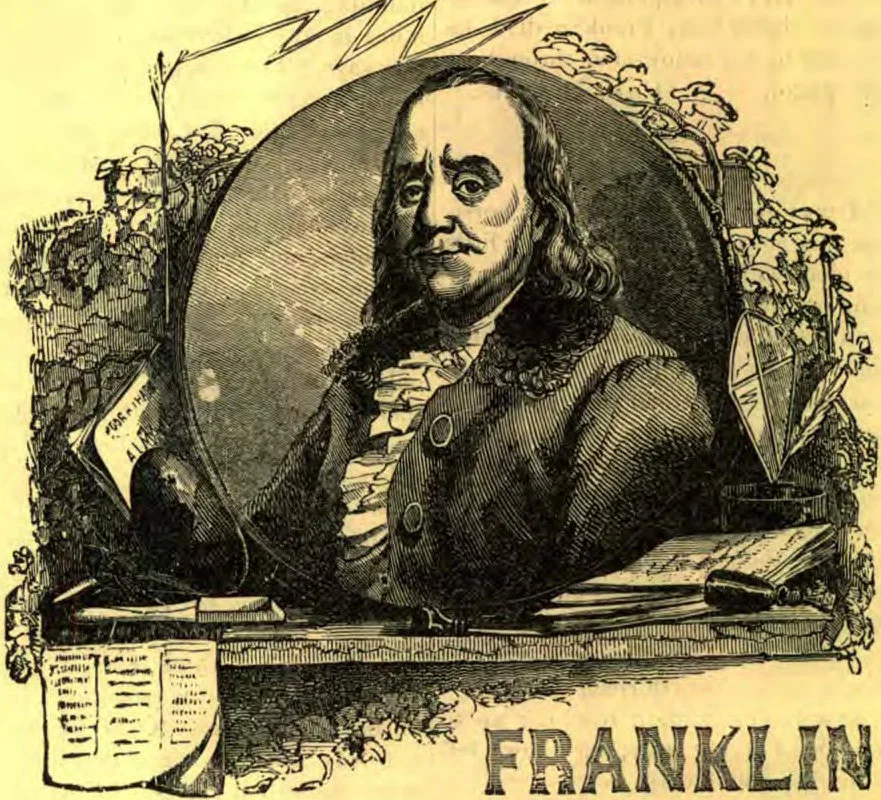
Just two hundred years ago, Josiah Franklin left England for the shores of the new world, that he might worship God in a manner he thought right, but which he was forbidden to do in his native country. Landing at Boston, he immediately set to work at boiling soap and making candles, in order to support his family, and in this business he remained until his death. The youngest but two of his seventeen children was named Benjamin, and was born in 1706. His father wished him to become a minister, but finding that he could not meet the expenses necessary for his education, he took him from school at the age of ten, and set him at cutting wicks, tending the shop, and running errands.
This work was not at all pleasant to the boy, who had while at school taken a great liking to books. One of his older brothers had run away to sea; and the father, seeing that his business was distasteful to Benjamin, and fearing he would follow his brother’s example, resolved to put him at some trade with which he was better suited. Noticing his tendency for reading, he was led to think that the printing business would be better suited to his taste, and therefore placed him under the charge of another brother, who had set up an office in the city. He was to serve his new master nine years, or until he was twenty-one years of age; and so diligently did he apply himself to his new calling that he soon became a good workman, and was able to give his brother much valuable help.
His passion for reading continued strong, and the greater part of many a night, after a hard day’s work in the office, he spent poring over—not story books which most at his age would have chosen, but books of travel, history, and others from which he gained much useful knowledge. His taste for reading soon led him to try his hand at writing. When his father one day pointed out some faults in the composition of some of his letters, Benjamin resolved to cultivate a better use of language. It will perhaps be interesting to learn how a youth, faithfully serving his master at a trade, receiving no wages with which to buy books or hire instruction, and master of his own time only after the others had retired for the night, would set to work to acquire an excellence in the use of language. But his extensive reading had filled his mind with ideas which he burned to give to the world, and he permitted no difficulty to prevent him from carrying out his purpose. He persuaded his brother to allow him one-half of the sum paid weekly for his board, with which to board himself. He then adopted a vegetarian diet, eating only vegetables and grains, purchasing his food and preparing his meals himself. In this way he saved one-half of the sum his brother allowed him, and with the money bought books. He made a practice of remaining at the office while the others were at dinner, and after swallowing his simple meal by himself, spent the rest of the noon in study. Of the effect of this course of diet he says: “I made the greater progress from that greater clearness of head and quickness of apprehension which generally attend temperance in eating and drinking.”
Soon after resolving to acquire a better use of language, he obtained an odd volume of the Spectator, an English journal to which the best writers of that day contributed. He was so charmed with their language that he conceived the idea of making the paper his instructor and critic, which he did in the following manner: After carefully reading an article and noting down the different points which were discussed therein, he would, after a few days, compose a piece himself, from the hints he had committed to paper. After comparing his production with the original article, and thus discovering the faults in his composition, he would rewrite, and again compare with the Spectator. By this and numerous other self-imposed drills he made great improvement, not only in his writing, but also in his conversation. Soon after this, Franklin’s brother started a newspaper, the second established in America. This brought many of the literary men of Boston to the office; and as Franklin heard them discuss the merits of the different articles in his brother’s paper, he became desirous of receiving a share of their criticism. So he wrote out a paper in a disguised hand and slipped it under the door of the office, where it was found next morning, and submitted to the critics when they had assembled.
“They read it,” he says, “commented upon it in my hearing; and I had the exquisite pleasure to find that it met with their approval; and that in the various conjectures they made respecting the author, no one was mentioned who did not enjoy a high reputation in the country for talent and genius.” Thus encouraged, he slipped many a paper under the same door, the contents of which always found a place in the columns of his brother’s paper.
It was not alone in his writing that Franklin manifested this application and industry, but it characterized his every undertaking, and enabled him to master by himself study after study which others of his age acquired only in school.
But Franklin did not receive from his master that treatment which he thought his good services deserved, and when he remonstrated with him, received only blows in return. This he could ill brook from his own brother, and he finally became released from his apprenticeship, and found his way to Philadelphia, where he arrived, at the age of seventeen, unknown and almost penniless. Here he obtained employment at his trade, and by his application to his work and remarkable gift of invention, made his services very valuable. He soon gained much credit in the city for his studious habits and remarkable intelligence, and thereby obtained access to the libraries of gentlemen of wealth and influence, which not only increased his stock of knowledge but was the means of leading him into the best society.
At the age of twenty he laid down a set of rules to govern his future conduct, and these he closely observed throughout his life. The following are a list of the virtues which he resolved to cultivate:—“Temperance; silence, or abstaining from frivolous talking; order; resolution, or determination to perform promises and duties; frugality; industry; sincerity, or the avoiding of all deceit; justice, or the wronging of no one; moderation; cleanliness; tranquility of mind; chastity; and humility.”
In order to make the best use of his time, he rose at five every morning; divided the day into study and work hours; and devoted each evening to reading, or intercourse with friends on matters of profit. He also influenced many of the young people in the city to follow his example of self-improvement, and in order to interest them in study and reading, he persuaded them to establish a public library, the first project of the kind started in America.
Seven years from the time he left Boston he found himself the proprietor of an office of his own, and the editor of a popular newspaper. From this time on, his reputation and usefulness steadily increased, and he began to reap the rewards of his self-denial and patient toil, not only in the accumulation of wealth, but in the love and respect of his countrymen. He had a remarkable insight into the wants of the people, and many were the projects which he devised for their good. Among these may be mentioned the first association for extinguishing fires, and the first insurance company. He also made many useful discoveries in electricity while engaged in the study of chemistry and philosophy. The most noted of these was the discovery of the similarity between electricity and lightning, by which he was led to invent the lightning-rod; indeed, he did not rest satisfied with any discovery until he had turned it to some useful end in everyday life. In his paper he always espoused the cause of the people against the oppression of their rulers, and evinced such clear ideas of just laws and good government that after filling several prominent city offices, he was elected to the General Assembly of Pennsylvania.
While a member of that body, he gained great distinction as a statesman, and was often enabled by a single sentence or the recital of a story with a moral bearing on the point at issue, to defeat the arguments of the most eloquent orators. In so great esteem was his judgment held, that when differences arose between individuals or parties, he was often chosen arbitrator by both sides. For twenty-five years he published annually a little pamphlet called Poor Richard’s Almanac, which contained numerous maxims and proverbs suited to the interests of business men, and written by Franklin. These maxims were so highly valued that they were afterward collected into a pamphlet, entitled, “The Way to Wealth,” which was translated into various languages. In some future number of the INSTRUCTOR may appear some of these wise sayings. He also published an account of his wonderful discoveries, and by this means became known to the most eminent scientists throughout Europe. A gold medal was struck in his honor, degrees were conferred upon him by royal societies; and upon crossing the ocean, he was received with great respect by kings and their glittering courts, who considered him the greatest philosopher of the day. His economical use of time when at home had enabled him to master many of the modern and dead languages, and his instructive conversation with these foreign rulers gave evidence of such intelligence and sagacity that they stood in veneration in his presence; and much credit did the American colonies gain through their loyal son. Yet through all this prosperity he preserved the same simplicity of dress and manner that characterized him when a printer in his native country.
It would be interesting to follow through the remainder of this great man’s career as minutely as we have thus far done, but space forbids. Suffice it to say that after remaining for several years at the court of England, whither he was sent in the interests of the colonies, he returned to America in time to urge a declaration of independence; and his name, among others, appears signed to that courageous document. In 1778 he was sent as ambassador to the court of France, where by his diplomatic skill he secured the aid of that country in our war for independence. Returning again to America, he assisted in framing the Constitution of the United States. At Philadelphia, in 1790, at the age of eighty-four, Franklin died, lamented by his fellow-men throughout the world. CHAS. H. GILES.

SNOW-FLAKES

Out of the bosom of the Air, Out of the cloud-folds of her garments shaken, Over the woodlands brown and bare, Over the harvest-fields forsaken, Silent and soft and slow Descends the snow.
Even as our cloudy fancies take Sudden shape in some divine expression, Even as the troubled heart doth make In the white countenance confession, The troubled sky reveals The grief it feels.
This is the poem of the air, Slowly in silent syllables recorded; This is the secret of despair, Long in its cloudy bosom hoarded, Now whispered and revealed To wood and field. —Longfellow.

ONLY SISTER.

I was going down town in a horse-car this morning, and noticed a little incident which made quite an impression on my mind.
A family party, consisting of mother and five or six children, entered the car, and sat and stood nearly opposite me. They had two or three well-filled baskets, and numerous shawls: so I concluded that they were going on a picnic. The girls were dressed in clean though faded calico dresses, and the boys were washed and brushed until they shone.
One of the girls, who seemed to be about twelve or thirteen years old, was standing, and, in reaching up to take hold of the strap, her shawl fell from her shoulders.
Now, if you, Tom and John, had seen your sister drop her shawl when reaching up after a strap, I wonder if you wouldn’t have laughed at her. A good many boys would think, “It’s only sister; we can laugh at her.”
This girl dropped the strap, and was about to stoop for her shawl, when her little brother, about nine years old maybe, quickly picked it up, and politely put it around her shoulders. No grown young gentleman could have done it more courteously, or with less fuss. Yet it was “only sister,” and the whole party were colored people. And I said to myself,—
“Although that little fellow’s skin is as brown as a nut, he is a little gentleman. Such boys as he are an honor to any mother.”
When that boy is a little older, he will be courteous to all women, whatever their rank. He will not sit calmly in a car or on a boat, and see them stand; at a ticket-office, or in any crowd, it will not be he who will jostle them rudely aside.
I suppose there is not a boy that reads this who does not desire to be considered a gentleman when he becomes a man; but I assure you, boys, you will have hard work to gain the title deservedly, unless you begin now to cultivate manly attributes. For a thoroughly manly man is always a gentleman,—a gentle man; not a rough, or a clown, but a gentleman to his equals and inferiors, whether in age, sex, or position; for every one is civil to his superiors, from selfish motives at least. It is no sign of a weak mind to be thoughtful of the comfort of your mother and sisters.—Frances E. Wadleigh.

J. N. LOUGHBOROUGH

DANISH RULE IN ENGLAND. NO. 2.

One thing of great interest, as we look at England, is the relics of “ye olden time” when Roman, Saxon, Dane, and Norman occupied the soil. One of these is found in Dudley Castle, at Dudley, in the midst of the “Black Country,” mentioned in our last. This castle stands on a high point of ground, and from the top of one of the towers of “the keep” we get a commanding view of the surrounding country for nearly thirty miles in every direction. The historian says, “There is, perhaps, no place in our sea-girt island, which can present, on a clear day, such extraordinary views.” Here are columns of fire and smoke, there collieries, canals, railways, towns, villages, churches, mansions, and parks extending as far as the eye can reach, and forming such a scene of mining, manufacturing, and commercial activity as can only be found in Great Britain; and there is not a locality in this busy Isle where there is so great a length of canal and railway in a circuit of six miles as is found here.
This castle, tradition says, “was built here, or named so by one Dupo, or Dodo, an English Saxon, about the year 700.” The Grand Court entrance is composed of three distinct gates, with a portcullis suspended over each of the inner gates. Over the main gate-way was the magazine in which were stored all the varied weapons and missile that human ingenuity could then invent. As we pass into the great court-yard of the castle, we behold on the left the keep, some thirty feet high. This was originally a room some twenty feet square, surrounded by a wall eight feet thick, and a tower at each corner. In one of these towers, still remaining, is a winding staircase for ascent to the top. Under this tower there was an immense vault and dungeons, in which prisoners of war were confined.
The court of the castle is surrounded by a wall at least twenty feet high, and outside this is a moat more than twenty feet deep and broad. This of course was originally filled with water. The court-yard has six irregular sides, and the inclosure is about 500 feet by 300. On our right from the triple gate are more than a dozen buildings, from scullery and kitchen, and vaults for storing wines, to a great dining hall which originally had a table made of one oak plank three feet wide and thirty feet in length. Here is also a justice hall,—quite a large chapel with a great vault under it, with iron grated windows, used as a prison for prisoners of higher grade, as this is above ground, the chapel being in the second story.
In the center of the castle-court is a great well one hundred and eight feet deep, and six feet square. It is now covered by an iron plate. Our guide said that this well not only furnished water, but had a stairway by which persons could go from the court-yard to the great caverns that were excavated under the hill on which the castle stands. These caverns are really more wonderful than the castle itself; there being accommodations under ground for a large army of men and horses too. There are five passage-ways into these caverns on different sides of the hill. These passage-ways, which are large enough to admit a horse and rider, are, some of them, more than a mile in length, and are furnished at their outer end with strong gates. To look upon this work of men, we should conclude that with their mode of warfare at that time, it was an invulnerable fortress. Even in Cromwell’s time, when cannon were used, the occupants withstood a siege from the Parliamentary forces for three weeks.

J. N. LOUGHBOROUGH

THE TWO HOUSES.

THERE went a wise and a foolish man, And each to build him a house began: One built on a rock, and one on the sand, And when the two houses erect did stand, While the sun shone on them, no man could see Which house of the two might the firmer be. But when the dark sky began to frown, And the wind and the storm and the rain came down, The rock-built house bore the shock right well, While its neighbor tottered, and crashing, fell. So those shall stand in the tempest’s shock, Who build on God’s promise,— the Bible rock; While the hope that wars against God’s command, Shall fall with a crash, like the house on the sand.

THE MUSTARD-TREE.

THE mustard is a tiny seed, which, sown in favorable soil, shoots up, and becomes, to all intents, a tree; so that there is no longer any proportion between its “shadowing shroud” and the germ from which it sprung.
Such is the kingdom of heaven; such is the history of real religion in an individual mind, in a community, in the world at large.
The one copy of the Scriptures which had been brought from the ship ‘Bounty,’ and which at last changed into a Christian community the mutineers and their children, was a mustard-seed.
So was the gospel which Columbia and his companions brought from Ireland to Iona, and which, transferred to the mainland, became a mighty tree, so that the hills of Caledonia are now covered with the shade.
The little text, “The just shall live by faith,” in the mind of Martin Luther, was the mustard-seed from which shot up the glorious Reformation.—Selected.

SCENES IN THE LIFE OF CHRIST.

LESSON 47.—JOHN THE BAPTIST BEHEADED.

Not many months after Jesus began to preach, John the Baptist was cast into prison, as you will remember. John had not committed any crime, but had been bold enough to reprove Herod for his sins. The Herod that caused the children of Bethlehem to be slain, had now been dead for years. He was called Herod the Great, and was the father of Herod Antipas, who put John in prison. Herod Antipas was not so cruel as his father, but he liked very much to please himself. He built the city of Tiberias, on the south-western shore of the Sea of Galilee. There he had a palace, where he held his court a part of the time. But he had also another palace, at Machaerus, a very strong castle on the east side of the Dead Sea, and not far from Mount Nebo, where Moses died. This castle was built on the top of a very high rock; and it is said that its walls, many feet thick at the bottom, were in some places, two hundred feet high. The ruins of this castle still remain, and under them travelers, who have lately visited the spot, find two very great dungeons, cut out of the solid rock. One of these gloomy cells was, doubtless, the prison where John the Baptist was confined for eighteen long months. It seems that a few of John's disciples were sometimes allowed to visit him; for it was from this place that he sent some of them to Jesus to ask him if he were really the Messiah. Perhaps John wondered why Jesus, if he were the Christ, did not deliver him from prison. Herod took no risk in allowing the disciples of this man of God to visit him; for the rock on which the fortress was built descends almost perpendicularly, on three sides, into gorges so deep that one standing at the top can scarcely see to the bottom; and the other side is so steep and rugged, and so cut up by ravines and precipices, that a few men could easily beat back a large army before it could make its way to the lofty summit.
In this palace at Machaerus, Herod, on his birth-day, held a great feast. While he and his lords were making merry over their wine, Salome, the daughter of Herodias, came in and danced before them. It was a custom of those days for some cunning person to amuse the company by acting out a story without speaking a word, all the while keeping time to music. This is what this damsel probably did; and she pleased Herod so well that he promised to give her whatever she should ask for, even to the half of his kingdom. Now the father of Salome, and the real husband of Herodias, was the half brother of Herod; but Herodias had left him without a cause, and was now living with Herod as his wife. This, of course, was very wrong, and John reproved Herod for it, saying, “It is not lawful for thee to have thy brother Philip's wife.” This made Herodias very angry at John; and so when Salome went to her to ask what she should demand of Herod, her mother thought it a good chance to get this holy man put out of the way. So the damsel, following her wicked mother's counsel, went in before Herod, and said, “I will that thou give me presently the head of John the Baptist.” Herod was now very sorry that he had made such a rash promise; but rather than break his oath, and displease the bad men that were feasting with him, he ordered his soldiers to go to the prison, cut off the head of John the Baptist, and present it to the damsel.

QUESTIONS.

1. When was John the Baptist cast into prison?
  1. Had he committed any crime?
  2. How had he offended Herod?
  3. How was the Herod that cast John into prison distinguished from the other Herods?
  4. How was he related to the Herod that slew the children of Bethlehem?
  5. By what title was that cruel Herod distinguished?
  6. Was he living when John was cast into prison?
  7. What may be said of the character of Herod Antipas?
  8. What city did he build?
  9. Where was it situated?
  10. At what two places did Herod hold his court?
  11. Where was Machaerus situated?
  12. Give some description of this castle.
  13. What have been discovered by travelers, who have lately visited the ruins of the castle?
  14. How long was John confined in one of these?
  15. How do we come to the conclusion that some of his disciples must have been allowed to visit their noble teacher while he was in prison?
  16. How does it appear that Herod took no risk in allowing John's disciples to visit him?
  17. How was Herod's birth-day celebrated?
  18. Who greatly amused Herod and his lords on this occasion?
  19. What custom did she probably follow?
  20. How did Herod offer to reward her for her performance?
  21. What wrong course had been pursued by Herodias, the mother of Salome?
  22. What had made Herodias angry at John?
  23. How did she now seek revenge?
  24. Following her mother's counsel, what demand did Salome make of Herod?
  25. Why was Herod unwilling to take John's life?
  26. Why did he not have the courage to refuse the damsel such a cruel and unreasonable demand?
  27. What was accordingly done?

NEW-TESTAMENT HISTORY.

LESSON 60.—THE GOOD SHEPHERD.

WHEN Jesus heard how the Jews had treated the man unto whom he had given sight, he sought him out, and said, “Dost thou believe on the Son of God?” The man replied, “Who is he, Lord, that I might believe on him?” Said Jesus, “Thou hast both seen him, and it is he that talketh with thee.” Then said the man, “I believe,” and worshiped him.
Jesus addressing the people, then said, “For judgment I am come into this world, that they which see not might see, and that they which see might be made blind.” Some of the Pharisees, hearing these words said, “Are we blind also?” Jesus replied, “If ye were blind, ye should have no sin; but now ye say, We see; therefore your sin remaineth.”
Jesus then began to discourse in the following words: “Verily, verily, I say unto you, He that entereth not by the door into the sheepfold, but climbeth up some other way, the same is a thief and a robber. But he that entereth in by the door is the shepherd of the sheep. To him the porter openeth, and the sheep hear his voice; and he calleth his own sheep by name, and leadeth them out. And when he putteth forth his own sheep, he goeth before them, and the sheep follow him; for they know his voice. And a stranger will they not follow, but will flee from him; for they know not the voice of strangers.”
Jesus, perceiving that his hearers did not understand him, began to explain, saying, “I am the door of the sheep. All that ever came before me are thieves and robbers; but the sheep did not hear them. I am the door; by me if any man enter in, he shall be saved, and shall go in and out and find pasture. The thief cometh not but for to steal, and to kill, and to destroy. I am come that they might have life, and that they might have it more abundantly. I am the good shepherd; the good shepherd giveth his life for the sheep.”
“But he that is an hireling, and not the shepherd, whose own the sheep are not, seeth the wolf coming, and leaveth the sheep, and fleeth; and the wolf catcheth them, and scattereth the sheep. The hireling fleeth, because he is an hireling, and careth not for the sheep. I am the good shepherd, and know my sheep, and am known of mine. As the Father knoweth me, even so know I the Father, and I lay down my life for the sheep. And other sheep I have, which are not of this fold: them also I must bring, and they shall hear my voice; and there shall be one fold and one shepherd. Therefore doth my Father love me, because I lay down my life, that I might take it again. No man taketh it from me, but I lay it down of myself. I have power to lay it down, and I have power to take it again. This commandment have I received of my Father.”
“There was a division therefore again among the Jews for these sayings. And many of them said, He hath a devil and is mad; why hear ye him? Others said, These are not the words of him that hath a devil. Can a devil open the eyes of the blind?”

QUESTIONS.

  1. What caused Jesus to seek out the man that the Jews had cast out of their synagogue? John 9:35.
  2. What lesson may we learn from this?—That Jesus will always come to the relief of those who are persecuted for his sake.
  3. When our Lord had found the man, what did he say to him?
  4. What reply did the man make?
  5. What said Jesus?
  6. What did the man then do?
  7. What did Jesus, addressing the multitude, then say?
  8. What question was asked by some of the Pharisees who heard these words?
  9. What answer did they receive?
  10. By what figure did Jesus then illustrate the difference between hypocrites and those who are truly doing the work of God? John 10:1–5.
  11. What does he say of those who try to enter into the fold in some other way than by the door?
  12. How does a true shepherd gain admittance to the fold?
  13. How is he recognized by the sheep?
  14. What is he enabled to do for them?
  15. How do the sheep regard a false shepherd?
  16. When Jesus saw that his hearers did not fully understand this figure, what did he do?
  17. What did he say with respect to the door of the fold?
  18. What did he say about those who had preceded him?
  19. For what purpose did he say he had come?
  20. How is the good shepherd distinguished?
  21. What course will he take who is a mere hireling?
  22. Why will he do so?
  23. Who is emphatically the Good Shepherd?
  24. Who are the under-shepherds?
  25. What example must they follow?
  26. What intimate relation exists between the Good Shepherd and his sheep?
  27. How does he bring them into close relation to his Father?
  28. What does Jesus mean by “other sheep, that are not of this fold”?
  29. What does he say shall be finally accomplished?
  30. What special cause has the Father for loving the Son?
  31. What did Jesus say about laying down or withholding his life?
  32. What did these sayings cause?
  33. What was said by the party that was opposed to Jesus?
  34. What reply was made by those who were disposed to believe on him?

Every Mother Should Teach a Home Sabbath School

Each mother should have a Sabbath-school of her own,—not to supersede, but to supplement, the one held at the church. Her own children should be her class; her home should be her school-house.—Central Baptist.

NOTES

Who is he, Lord?—The word Lord here, as in many other instances in the New Testament, means “Sir.” It is clear that the man did not know that it was the Lord Jesus that addressed him, and he therefore replied to him in the common language of respect, and asked him to point out to him the Son of God.
For judgment I am come into the world.—To judge is to express an opinion in a judicial manner, and also to express any sentiment about any person or thing. The meaning here may be thus expressed: “I came to declare the condition of men; to show them their duty and danger. My coming will have this effect, that some will be reformed and saved, and others more deeply condemned.”—Barnes.
Perhaps our Saviour has special reference to passing judgment on the doctrines and practices of the religious teachers of that time. The principles of true religion, as taught by Moses and the prophets, had been perverted, traditions and superstitions had been introduced, and thus the people had been led into darkness. Jesus condemned these errors, and showed how kind and beneficent all God’s requirements really were. Thus the humble people were enabled to see, while the blindness of the proud Pharisees was made apparent. This was a part of Christ’s mission,—one thing for which he came into this world,—a work which was necessary in order to show that the principles of the new dispensation were not contrary to those of the old.
That they which see not.—Jesus took this illustration, as he commonly did, from the case before him; but it is evident that he meant it to be taken in a spiritual sense. He refers to those who are blind and ignorant by sin; whose minds have been darkened, but who are desirous of seeing.
They which see.—They who suppose they see; who are proud, self-confident, and despisers of the truth. Such were evidently the Pharisees.
Might be made blind.—Christ does not affirm that such was the design of his coming, but that such would be the effect, or result. He came to declare the truth, and the effect would be that it would exasperate some, and their pride and opposition would confirm them more and more in their erroneous views. This is always the effect of truth. Where it does not soften, it hardens the heart; where it does not convert, it sinks into deeper blindness and condemnation.
If ye were blind, ye should have no sin.—If ye had been really ignorant, your sin had not been so deeply aggravated, nor should ye have had so much sin to answer for as now ye have. It will be more tolerable for those who perish for lack of vision than for those that rebel against the light.—Henry.
Your sin remaineth.—You are guilty, and your sin is unpardoned. When the Scripture speaks of sin remaining, it is always put in opposition to pardon; for pardon is termed the taking away of sin.
I am the door of the sheep.—It is through Christ alone that mankind can find an entrance into the heavenly fold.
All that ever came before me.—This does not refer to the prophets, but to those who, like the Pharisees, came pretending to be the pastors or guides of the people. They came seeking their own glory rather than that of Christ, holding their own exaltation “before” (in higher estimation than) his. They sought wealth, office, and ease, at the expense of the people, and thus deserved the character of thieves and robbers.
I am the good shepherd.—As the good shepherds of that day went before their flocks, leading them in paths of safety, watching to bring back the straying sheep, and sometimes laying down their lives in defense of their charge, so Christ instructs his followers in the way of righteousness, supplies their every need, and even lays down his life for their salvation.
Other sheep I have, etc.—Multitudes of honest-hearted ones among the Gentiles would hear his voice,—receive and obey his words,—and share with the believing Jews the Good Shepherd’s care.
No man taketh it from me.—Do not suppose that I shall be put to death by your rulers because I have not strength to resist them. I lay down my life voluntarily and cheerfully; no one can take it from me.—Clarke,

WHY MOTHER IS PROUD.

Look in his face, look in his eyes, Roguish and blue and terribly wise— Roguish and blue and quickest to see When mother comes in as tired as can be; Quickest to find her the nicest old chair; Quickest to get to the top of the stair; Quickest to see that a kiss on her cheek Would help her far more than to chatter, to speak. Look in his face, and guess if you can, Why mother is proud of her little man.
The mother is proud—I will tell you this; You can see it yourself in her tender kiss. But why? Well, of all her dears There is scarcely one who ever hears The moment she speaks, and jumps to see What her want or her wish might be— Scarcely one. They all forget, Or are not in a notion to go quite yet. But this she knows, if her boy is near, There is somebody certain to want to hear.
Mother is proud, and she holds him fast, And kisses him first and kisses him last; And he holds her hand and looks in her face, And hunts for her spool which is out of its place, And proves that he loves her, whenever he can, That is why she is proud of her little man.
—Geo. Klingle, in Independent.
Continue reading: ONE AFTERNOON