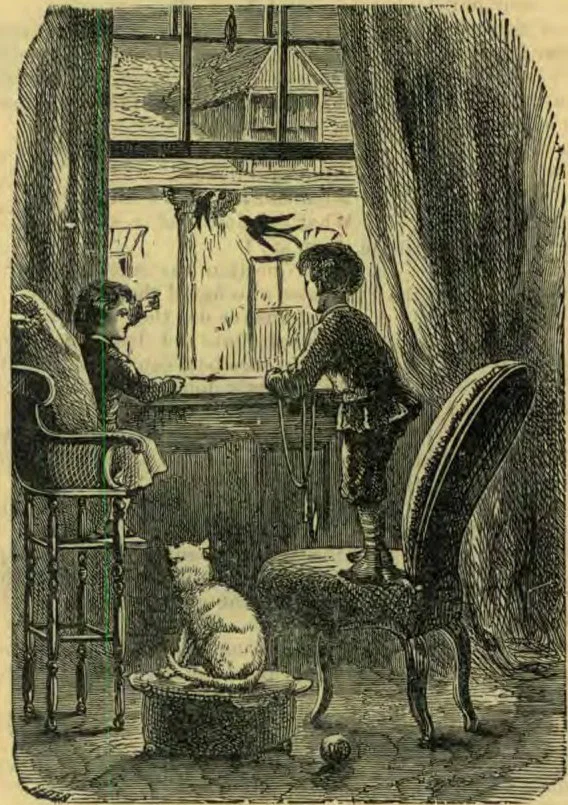
Carl and Freddie had been sick with the measles, and had had to stay in the house for several days. But now they were better; and Carl, the older of the two, had made up his mind that he should go out to play, that bright afternoon. When Freddie, who was a little fellow, found it out, he began to cry to go too. But Carl paid no heed to him, only kept right on putting on his coat and hat.
Just then mamma came in, and after hearing the story, at once settled the matter by saying they must both stay in doors. She said that although the sun was bright, there was a raw spring wind, and it was wet under foot; and if they were to go out, they would be likely to take cold, and perhaps be very sick again. She also told them that she was going to town, and should leave them with Ann, the servant girl. If they needed anything, Ann would get it for them, but they were not to go out of doors. So she left them, and soon they saw her going down the street.
Freddie had stopped crying when he found his brother was not to go out, and was now ready to play. But Carl felt very cross, and not at all in a mood for it. He wanted to go out doors to play, and he thought it was very hard of mamma not to let him go. If Fred was not well enough to go, why, he could stay in; but that was no reason that he should not go; for he was sure that he was as well as ever. So he sat before the fire on a hassock, and pouted, paying no attention to Freddie’s entreaties to “come and play horse.”
But all at once something seemed to whisper to him (perhaps it was his conscience), “Now, Carl Newman, aren’t you ashamed of yourself? Here your mamma has had to work so hard to take care of you and Fred since you have been sick, sometimes even staying up all night; and now you are not willing to mind her, and think you know better than she does what is good for you to do.”
Come to think of it in this way, Carl did feel ashamed; and jumping up, he went over to Fred, who was standing sadly by the window, and told him he would play horse now. So they had a fine time racing up and down the sitting-room; for as Ann was in the kitchen ironing, there was no one to tell them they mustn’t make so much noise. At last, however, they grew tired of being horses, and so they played ball, rolling it from one end of the room to the other; and pussy, who had been sleeping by the fire, got up and played with them, and seemed to enjoy the fun as much as did the boys.
Finally Carl spied some birds, which he thought must be swallows, under the eaves of the carriage-house. He wondered what they were doing there, so he stood on a chair and watched them. Then Freddie wanted to “see too,” so Carl put him in his high-chair, by the window. As they looked, they saw that the birds seemed to be building a nest, for they kept flying back and forth, bringing straw, sticks, and mud in their mouths. Pussy, too, who now sat upon the hassock, seemed as much interested as the boys, in watching the little builders. Perhaps she was thinking what a nice meal the young swallows would make for her one of these days, if she could only get at them!
Just then the boys saw mamma coming up the street, and Carl could hardly believe that she had been gone two hours. The time had seemed to pass so fast since he stopped pouting. Mamma came in, tired after her long walk; but she said it rested her to see her little boys looking so happy, and to think they had minded her so cheerfully. When she opened her parcels, she took out a nice picture-book for each of them, which she had bought to comfort them for staying in doors.
But Carl did not feel just right about it after all, for someway it seemed as if he had been deceiving his mother; so that evening, after Fred had been put to bed, he sat down on the hassock by her, and told her all about how he had felt. She stroked his hair softly, and said, as she kissed him, “Mamma is glad her little boy drove away the wicked, angry feelings; and now let us ask God to forgive you for having felt so, and to keep you from having such naughty thoughts again.”
So they kneeled there in the firelight, and when the prayer was finished, a strong, manly voice pronounced an earnest “amen;” and as they arose, they saw papa standing, with bowed head, just inside the door. Then Carl went to bed with a light heart, for he felt that it was all right now. E. B.
ONE STEP AT A TIME.
By Early Dew
George Manning had almost decided to become a Christian. One doubt held him back.
“How can I know,” he said to himself, “that, even if I do begin a religious life, I shall continue faithful, and finally reach the better country?”
He wanted to see the whole way there before taking the first step. While in this state of indecision and unhappiness, he one evening sought the house of his favorite professor (for he was a college student at the time), and they talked for several hours upon the all-absorbing topic. But the conversation ended without dispelling his fears, or bringing him any nearer the point of decision.
When he was about to go home, the professor accompanied him to the door, and observing how dark the night was, prepared a lantern, and handing it to his young friend, said,—
“George, this little light will not show you the whole way to your room, but only one step at a time; but take that step, and you will reach your home in safety.”
It proved the word in season. As George walked securely along in the path brightened by the little lantern, the truth flashed through his mind, dispelling the last shadow of doubt.
“Why can I not trust my Heavenly Father,” he said to himself, “even if I can’t see my way clear to the end, if he gives me light to take one step? I will trust him; I do trust him.”
He could hardly wait till he reached his room to fall on his knees, and thank God for the peace and joy that filled his soul.
Early the next morning the professor was summoned to the door. There he found George Manning. With beaming face he looked up to his teacher, and as he handed him the lantern, said significantly,—
“Doctor, your little lamp lighted me all the way home last night.”—Early Dew.
“BENE ORASSE EST BENE STUDUISSE.”
“What strange words these are!” says John. “What can they mean? Perhaps brother Will knows. He studies German.”
Brother Will at once sees that they are not German, and so cannot throw any light on them.
I will tell you. They are Latin. Luther used to say, “Bene orasse est bene studuisse;” that is, “To pray well is to study well.”
He sometimes had so much to do that the days were too short, and he knew not how to get through with his work. Then he would say to his friends, “I must pray more to-day, or I shall not get done.”
That was good doctrine then, and it is equally true now. But many people just turn it around; and when very busy, they say, “Really, I have not time to pray to-day.”
When we have the most to do and to bear, then we most need to pray.—Youth’s Evangelist.
A Sweet Temper in the Household
A SWEET temper is to the household what sunshine is to trees and flowers.
Doing Willingly What Seems Troublesome
NOTHING seems troublesome when we do it willingly.
Letter Budget.
Celia Hill and Millie Luthultz write together, from Eagle Lake, Minnesota. Celia seems to have written the letter. She says: “As I was spending the day with one of my class-mates, we thought we would write a letter for the Budget, as neither of us have written before. We had a dear Sabbath-school teacher who died last summer. She left a class of seven members, and we all thought so much of her. Her name was Mary Carpenter. We hope to live so as to meet her in the new earth. We have another good teacher in her place now.”
Ella May Warren, of Oronoco, Minn., says: “I am a little girl four years old to-day. It is the Sabbath, but we cannot go to meeting, as we have to cross two rivers, and the water is too high. So I teased mamma to write me a letter for the Budget. I can say all my letters, and repeat three of the commandments. I am trying to be good.”
Here is a nice little letter from Don and Irvie Rust, Texas, and their father says that they wrote it without any help. They say: “We are nine and ten years old. We like to read the INSTRUCTOR, especially the ‘Children’s Corner.’ We go to Sabbath-school, and like to learn our lessons. We have a little sister three years old; her name is Myrta May. Our parents and our grandmother, who is seventy years old, all go to Sabbath-school with us.”
We are glad that these boys “like to learn” their lessons. Did you ever think, children, that it is one thing to do anything, and quite another to like to do it? And do you not think the Lord is pleased to have us like to learn what he has told us in his word?