The Youth’s Instructor, Vol. 29, No. 52.

HOW TO MAKE A MERRY CHRISTMAS
Earlier text: NEW-TESTAMENT HISTORY

CONSTITUTION OF THE GEN. S. S. ASSOCIATION.

The following is the Constitution of the Gen. S. S. Association as it now stands revised.

CONSTITUTION.

ARTICLE I.—NAME.

This Society shall be known as the General Sabbath-school Association of Seventh-day Adventists, and shall be composed of all the Sabbath-school Associations that shall report quarterly to this body.

ARTICLE II.—REPRESENTATION.

Each Sabbath-school Association shall be represented in the meetings of this Association by its officers and by one delegate for the first one hundred members or less in such Association, and an additional delegate for each additional one hundred members; said delegates to be appointed by the President of each Association.

ARTICLE III.—OFFICERS.

The officers of this Association shall consist of a President, a Vice-president, a Recording Secretary, a Corresponding Secretary, a Publishing Committee of three, and an Executive Board of five, of which the President and Vice-president shall be members. The officers shall be elected annually.

ARTICLE IV.—DUTIES OF PRESIDENT.

The duties of the President shall be to preside at all the meetings of the Association and of the Executive Board, and to call special meetings thereof.

ARTICLE V.—DUTIES OF RECORDING SECRETARY.

The duties of the Recording Secretary shall be:—
1. To record all the proceedings of the Association, and to present a yearly summary of the same at the annual meeting.
2. To present such other summary reports as may from time to time be ordered.
3. To attend the meetings of the Executive Board, and keep a record of its proceedings.

ARTICLE VI.—DUTIES OF CORRESPONDING SECRETARY.

It shall be the duty of the Corresponding Secretary:—
1. To execute all the correspondence ordered by the Association and by the Executive Board.
2. To make to the Recording Secretary an annual report of such correspondence, at least two weeks previous to the annual meeting of this Association.
3. To make reports at such other times as may be ordered.
4. To act as treasurer of the Association, and to receive and hold all moneys belonging to the Association, giving receipts therefor, and paying out the same as the Association or the Executive Board may direct, through the written order of the Recording Secretary.

ARTICLE VII.—DUTIES OF EXECUTIVE BOARD.

The functions of the Executive Board shall be:—
1. To represent this Association when not in session assembled, to execute all its recommendations and orders, and to fill all vacancies which may occur from death or otherwise.
2. To assist, either personally or by authorized agents, in organizing and conducting Sabbath-schools, Sabbath-school Institutes, and Sabbath-school Associations.
3. To induce those possessing the requisite ability, and having a heart in the work, to write in the interest of Bible study and proper Sabbath-school instruction, and to secure the publication and distribution of needed Sabbath-school literature.
4. To make all necessary provisions for rendering the sessions of the Association interesting and profitable; and in general, to labor to make our Sabbath-schools efficient in preparing their members to be fruitful workers in the grand mission of the third angel’s message.

ARTICLE VIII.—FUNDS.

The funds for defraying the expenses of this Association shall be obtained by contributions and donations.

ARTICLE IX.—AMENDMENTS.

This Constitution may be altered or amended by a two-thirds vote of the delegates present at any regular meeting.

QUESTION BOX.

How long an absence does it require to lose one's membership in the Sabbath-school?
This depends upon circumstances. Persistent, unexcused absence of three weeks is sufficient excuse for the removal of the name from the records; but this should not be done until the teacher has made all necessary effort to bring the delinquent back to his class. It is, of course, unpleasant for the teacher to be obliged to drop a member from his class; but justice to the other members of the class demands that when one is absent, either from lack of interest or from continued sickness, for more than three Sabbaths in succession, his name be dropped from the record. This is no unkindness to the pupil, and when he has, by a few Sabbath's steady attendance, regained his membership, the name may again be taken. Instances have come to our notice where the record has been continued of scholars who have been gone from the State for months. This gives an incorrect and unfair showing for the school, and must be discouraging to the class. No name should be dropped from the records, however, without the person's having been repeatedly and kindly visited, and the cause of absence ascertained. If the teacher's duty were promptly done, the record of most of our Sabbath-schools would be vastly improved.
J. E. W.
What shall be done with those who will not learn the lesson or take place in the class, and still insist on being members of the school?
No one can be considered a member of the school unless he takes some part in its exercises.
Are teachers' meetings necessary?
How often should they be held?
How should they be conducted?
These are questions that have been so repeatedly asked as to demand an answer. In reply to the first, it may be said, that a teachers' meeting is desirable in any school, and is well-nigh indispensable to success in a school of considerable size. The larger the school, the more imperative is the demand for a teachers' meeting. No one can doubt the importance of frequent consultation between the Superintendent and the officers and teachers of the school. When the officers and teachers are few, the Superintendent may find opportunity for consulting them separately; but if they are many, such a course becomes impracticable. Again, if there are not more than five teachers, the Superintendent, in visiting them separately, is obliged to spend five times as much time as any one of the teachers, besides the trouble of looking them up, and finding them at leisure. This course, too, almost always has the bad effect of either making the Superintendent unnecessarily servile, or of making him appear like a taskmaster.
The teachers' meeting, too, has this advantage—that while it gives opportunity for the Superintendent to consult with those who work under him, it also gives opportunity for all to be benefited by mutual suggestions and experiences.
Again: the teachers' meeting promotes thoughts on the subject of Sabbath-school work, and thus awakens a deeper interest in it. We can there unite in asking God's blessing on our efforts to bring ourselves and others into a better knowledge of himself and his truth. Indeed, the teachers' meeting is as important to the prosperity of the Sabbath-school as the prayer meeting is to the prosperity of the church.
The frequency with which teachers' meetings should be held depends much on circumstances. It is desirable, though in some cases not practicable, to have a regular meeting on some secular evening of each week. When the teachers' homes are several miles apart, it might be well to have a short teachers' meeting every Sabbath, either before or after services, and a meeting on some secular day once a month. This would give opportunity for keeping up such business as could not properly be attended to on the Sabbath-day.
The manner of conducting these meetings has been quite fully suggested in talking of their utility. They may be a little dull at first, but the earnest, active Superintendent will soon find enough to do. One thing is always in place, and that is a good earnest season of prayer, in which all may supplicate our Heavenly Father to enlighten and direct, to the end that the lessons may be properly written, properly studied, properly taught, properly appreciated, and properly lived out. Some of the important matters to be considered at a teachers' meeting are—The lessons for the next Sabbath; How to secure a better attendance; How to awaken and keep up a healthy interest; the perplexities and successes of individual teachers; the dangers to be avoided; and last but not least, the encouragements that have been noticed, and the hope of success in a cause which enlists the interest and help of Christ and the angels.
G. H. B.

Fear Nothing in the Way of Duty

FEAR nothing when you are in the way of duty.

GENERAL SUMMARY OF S. S. REPORTS

For Quarter Ending Sept. 24, 1881.
Names of States Names of State Secretaries No. Schools reported Membership Average Attendance New Members Enrolled Dropped from Record Number Under 14 Number Over 20 Church Members Number of Classes Number of Members in Primary Division Intermediate Division Senior Division Keep Complete Records Number of S. S. Teachers Taken Hold Teachers’ Meetings Contributions Received Amount Sent State Association Amount Sent General Association
California E. A. Chapman 27 958 689 126 170 313 345 308 129 217 247 445 25 619 5 $119 18 $12 24 $2 00
Colorado
Dakota M. M. Olsen 13 310 176 47 35 82 134 117 36 52 72 92 11 83 10 63 48 10
Indiana Leanna Morrell 12 398 270 13 8 134 129 176 40 72 83 121 11 202 3 22 24 1 91 48
Illinois Lizzie S. Campbell 43 870 569 23 15 276 362 403 101 167 166 328 27 253 31 32 2 08 21
Iowa J. H. Durland 30 1047 650 144 80 428 436 448 118 319 268 333 24 367 30 86 1 98 20
Kansas Mrs. Clara A. Gibbs 25 631 429 32 29 244 294 280 75 169 209 333 16 181 19 07 1 68 53
Kentucky Lulu Osborne 5 103 80 26 6 38 65 75 5
Michigan Eva Bell 66 2206 1395 264 133 747 976 1117 282 520 395 1076 61 1356 2 $190 16 $14 12 $3 00
Missouri
Maine Hattie Gifford 7 185 138 6 9 54 110 87 23 29 35 73 3 91 8 53 81
Minnesota E. S. Babcock 45 1117 676 129 84 390 492 566 147 249 202 528 37 442 54 22 4 98 63
New York Mrs. N. J. Wadsworth 22 397 245 4 7 98 241 239 65 84 80 221 18 177 15 47 1 23
North Pacific R. D. Benham 8 162 126 19 27 64 91 20 36 23 70 80 11 65 60
Nevada
New England Mrs. E. D. Robinson 25 489 329 15 17 141 289 238 63 88 60 283 18 319 4 48 21 6 93 1 00
Nebraska Mrs. Mary Clausen 19 646 441 85 31 265 241 230 59 190 146 213 15 205 38 21 1 28 13
Ohio Verna Null 22 676 462 33 52 263 349 96 143 86 95 248 27 378 4 48 09 3 71 37
Pennsylvania Mrs. F. C. Oviatt 17 384 335 31 22 130 191 135 49 87 111 114 14 141 3 15 73 1 43 20
Tennessee & Va. Mrs. Mary Remley 4 65 44 3 5 22 30 9 10 31 24 16 1 14 1 15 15 12
Texas T. T. Stevenson 8 216 147 34 37 60 78 54 28 72 34 107 7 112 18 75 30 20
Vermont Ann E. Smith 12 318 193 20 6 94 156 167 40 77 77 171 10 99 2 15 49 1 74 30
Wisconsin Mrs. Nellie Taylor 49 1089 859 81 91 404 422 443 153 338 305 326 42 441 42 37 4 11 41
Upper Columbia Mrs. M. O. Beck 4 129 68 3 13 41 39 84 12 40 20 43 3 13 20 42 12
Totals 453 12386 7011 1138 877 4251 5499 4290 1593 2923 2652 5041 375 5560 23 $762 53 $61 56 $10 40
EVA BELL, Secretary General Association.

BETHLEHEM

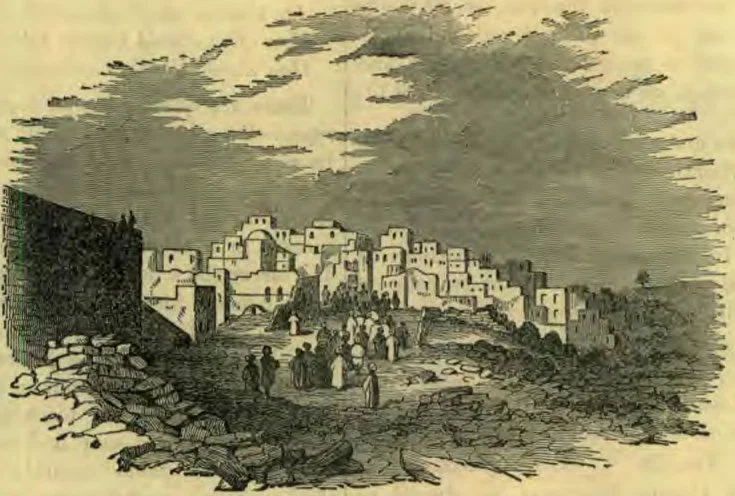
Going south from Jerusalem five or six miles over a winding road, you come to the little village where Jesus was born. It is called Bethlehem, and it is this town that we have a picture of on this page.
It is built on a hill, and has but one street, which is about half a mile long. On each side of the street are white stone houses, which look very pretty through the green olive-trees which are planted around them.
The country about Bethlehem is very pleasant. On the hill-sides are terraces, and on these are planted grape vineyards. On the plains below are fields, where grain is raised, and sheep and cattle are pastured. On some of these very fields it was that Ruth, the grandmother of King David, gleaned after the reapers of Boaz, so long ago. Here, too, the company of shepherds were keeping watch by night when a great light shone about them, and the angels came bringing them “good tidings of great joy,” which shall be to all people,” because that a Saviour, Jesus the Christ, was born in the city of David, which is the same as Bethlehem. Then when the shepherds had gone up into the village, they found the child Jesus in a manger, just as the angels had told them.
Now this was the greatest joy the world has ever known,—that God should send his only Son to earth to save us from our sins; and it is to keep this in mind that we celebrate Christmas every year. And although we do not know that Christ was born on the 25th of December, it will do us no hurt to keep the day in memory of his birth. It is all right to be happy on this day, and to show our good-will by giving and receiving presents; but amid all our joy we should remember “the good tidings of great joy” that came to the shepherds that night on the plains of Bethlehem. And as we look over the presents given us by our kind friends, we must not forget to thank our Father in Heaven for the great gift of Christ his Son, for whose sake all Christmas gifts are hallowed.
E. B.

THE LOST KEY.

Jet was only five years old, but she was a busy little girl, and wanted to do everything her mamma did; so she had learned to sew quite nicely. One day there was a tiny hole in the pocket of Jet’s dress, and mamma said, “Jet, be sure to mend that hole.”
“Yes, mamma, in a minute,” answered Jet.
But she was a forgetful little girl, like some others that I know, and after a while, when cook gave her the pantry key to carry to mamma, she did not think at all about the hole, but put the key into her pocket. It was not long before the key was needed, and mamma said, “Come, Jet, quick, and help me look for it; I need it right now.”
Tears came into Jet’s pretty brown eyes, and a bright red spot showed on both her cheeks. “Oh, mamma, I put it into my pocket, and now it is gone.”
Up stairs, down stairs, Jet ran, looking for the key, but it could not be found. At last, the little girl sat down on the nursery rug, and hid her face in her hands, for the tears came so fast she could not see. She did not even notice kitty playing about the room, until the merry puss came and sprang right into her lap.
And what was that in kitty’s mouth? Jet looked down with her tearful eyes. What was kitty playing with? Just think! The dear little puss had found the lost key, and was amusing herself by dragging it after her and biting the string to which it was tied.
Up sprang Jet, and ran with the key to mamma. Then she sat right down and mended the hole in her pocket, thinking, “I will never, never, never again delay doing what mamma tells me.”—New York Observer.

Come Inside.

Recently, in illustrating the theme, “A man in Christ,” Mr. Spurgeon told a story that is worth repeating. He said: Some Christians remind me of the little boys who go to bathe; all frightened and shivering, they enter the water just a little—up to their ankles they wade, and shiver again. But the man who is really in Christ, is like the practiced swimmer, who plunges into the stream head first, and finds water to swim in. He never shivers. It braces him; he rejoices in it. And see how at home he is in the river of grace. It has become his element. Now for him to “live is Christ.” He has devoted himself, his substance, and all that he has, to the glory of God. This is the man who understands the happiness of religion, in a manner far beyond the conception of the half-and-half professor, who has religion enough to make him miserable. I sometimes illustrate this by a quaint American story. An American gentleman said to a friend, “I wish you could come down to my garden, and taste my apples.” He asked him about a dozen times, but the friend never came, and at last the fruit-grower said, “I suppose you think my apples are good for nothing, so you won’t come and try them.”
“Well, to tell the truth,” said the friend, “I have tasted them. As I went along the road, I picked up one that fell over the wall, and I never tasted anything so sour in all my life; and I do not particularly want any more of your fruit.”
“Oh,” said the owner of the garden, “I thought it must be so. Why, don’t you know those apples around the outside are for the special benefit of the boys? I went fifty miles to select the sourest sorts, to plant all around the orchard, so the boys might give them up as not worth stealing; but if you will come inside, you will find that we grow a very different quality there, sweet as honey.”
Now you will find that on the outskirts of religion there are a number of “Thou shalt nots” and “Thou shalts,” and convictions, and alarm; but these are only the bitter fruits, with which this wondrous Eden is guarded from thievish hypocrites. If you can pass by the exterior bitters, and give yourself right up to Christ and live for him, your peace shall be like the waves of the sea; and you shall find that the fruits of “this apple-tree among the trees of the wood,” are the most delicious fruit that can be enjoyed this side of our eternal home. —Messenger.

Small Kindnesses Along the Roadside of Life

Do little helpful things, and speak helpful words, whenever and wherever you can. They are better than pearls or diamonds to strew along the roadside of life, and will yield a far more valuable harvest.

Adversity Draws Out the Faculties of the Wise

ADVERSITY exasperates fools, dejects cowards, draws out the faculties of the wise and industrious, puts the modest to the necessity of trying their skill, awes the opulent, and makes the idle industrious.

SUFFER LITTLE CHILDREN.

TWO little girls had chanced to meet; Their eyes were blue, and gold their hair. One richly clad, one poor and neat, One bright and glad, one sad and sweet, Both pure as angels seemed.
They stopped and looked, as children will, From timid hearts, with glances bold; One saw blue eyes with joy-light thrill— One saw blue eyes with tear-drops fill,— And all the tale was told.
Plenty and Want stood side by side, Beneath the winter's cold, gray sky, The child of plenty gently tried To tell the tale of Christ, who died For men, on Calvary.
The child of want with bended head Wept o'er that story, old and rare, And lisped, “Will He who thousands fed, Give to my mother ‘daily bread,’ If I but ask in prayer?”
With trustful faith both knelt to pray— Unburdened all their childish care To Christ, who, throned above the day, Bade white-robed angels haste away, And bring an answer there.
And while the pleading voices trilled To Heaven through the silent air, The giving hand that Christ had willed, The home of want with comfort filled, Till no more want was there.
'T was Christmas—and the chilly light Grew soft with radiance from above, As morning from the summer night, Through crimson rays grows softly bright, With sunshine of God's love.
—ELISHA P. THURSTON, in Advance.

ADVICE TO LITTLE ONES.

I WOULD not say, “I don’t care,” so much, if I were you. Just think how many times you say it, and you generally say it when you are angry and do not think what you are saying. When your mamma said, “I am sorry my little one is so naughty,” you did care, but you were angry, and so you said you did not. Never say, “I don’t care,” unless you are very sure that you don’t. After you have thought a little while, instead of not caring, you will want to say, “I will try not to be naughty any more, mamma.” If the scholars laugh when you make mistakes in your Sabbath-school lesson, don’t get angry and say, “I don’t care.” That would not be exactly true. If you really did not care, you would not get angry.—Anon.

Be true to your own conscience.

LETTER BUDGET.

We have a plainly written letter from Jennie Ireland, Oakland, California. She is a little orphan girl ten years old, and has two brothers and a little sister. She thinks the INSTRUCTOR is the best child’s paper she ever read. She hopes to be ready to meet the Lord when he comes.
Alice and Maryetta Morton write from Slack’s Canyon, California. Alice is fourteen years old, and Maryetta twelve. They do not go to Sabbath-school, because there is none nearer than sixty miles. None of their neighbors keep the Sabbath, but they are trying to get some of their mates to send for the INSTRUCTOR. They are both trying to be good girls.
Jennie Emerson writes from Grove Lake, Minnesota. She says: “I have two sisters and two brothers. We go to school every day, and we have to walk two miles and a half. We go to Sabbath-school too, and there are eight scholars in our class. We just received Bible Lessons No. 3. We think it is a very nice book. Yesterday our Sabbath-school was very sad and lonely. Our Grandpa Richardson, who had always been with us, was killed last Monday by his horse running away. He was well Sabbath before last, and was at Sabbath-school, and taught his class. We hope the INSTRUCTOR family will pray for us away out here in Minnesota.”

You have reached the end of this edition.

The Youth’s Instructor · Dec 28, 1881