The Youth’s Instructor, Vol. 29, No. 52.

HOW TO MAKE A MERRY CHRISTMAS

The Youth’s Instructor

Dec 28, 1881

S. D. A. Publishing Association · Battle Creek, Mich. · Dec 28, 1881

HOW TO MAKE A MERRY CHRISTMAS.
I guess we shan’t have much of a Christmas,” said Jamie Lawton to his sister Ellen, as they sat by the table doing their “sums” by the light of a tiny kerosene lamp. “Father don’t have work a quarter of the time now, and mother is so discouraged that she won’t feel like doing much.”
“I wish we could get up something ourselves, and make mother forget her troubles a little while,” said Ellen. “She looks lately as if she never expected to be happy any more.”
“I don’t know what we can do,” answered Jamie. “I can’t think of anything that we can give up.”
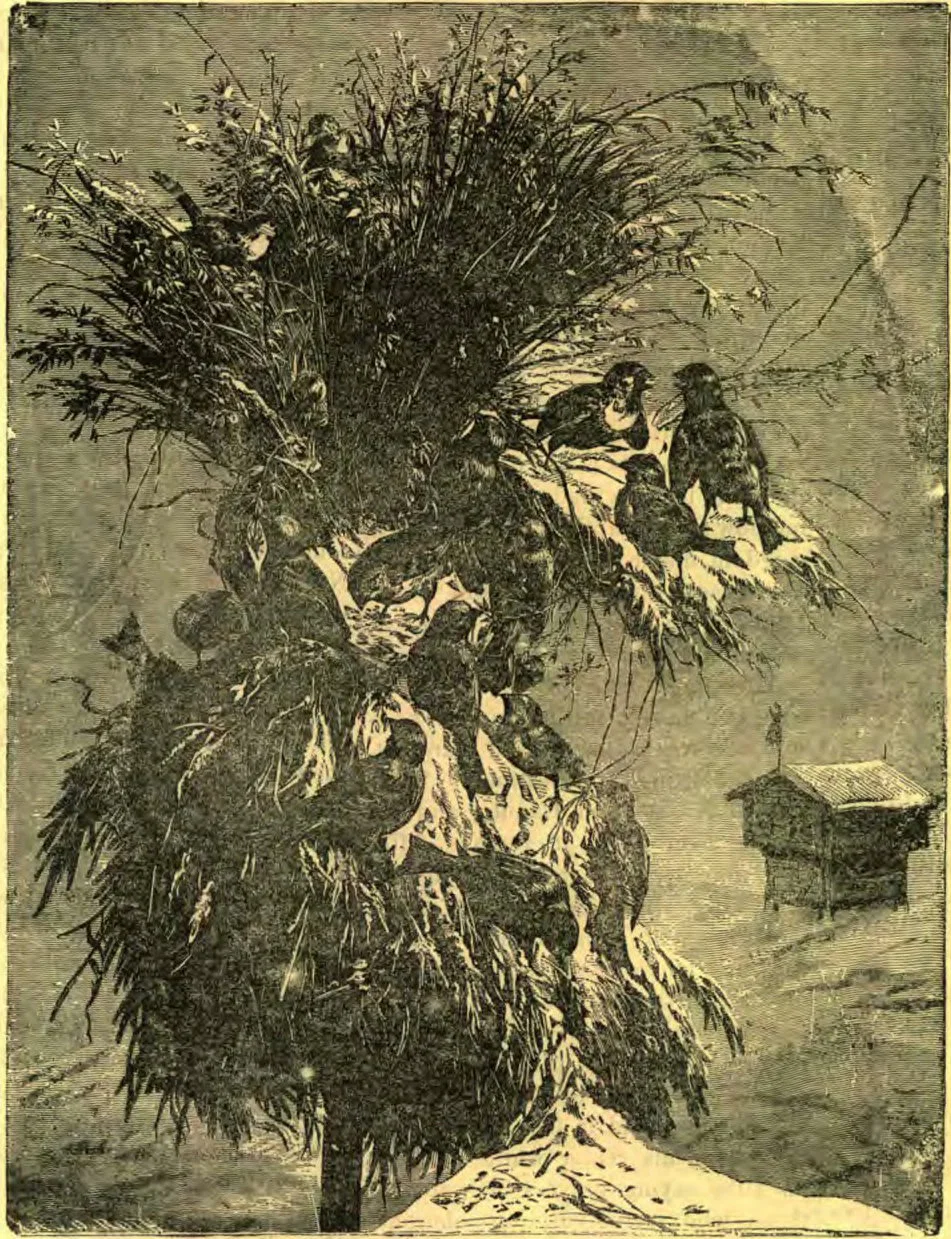
CHRISTMAS SHEAF.
CHRISTMAS SHEAF.
“We could do without meat and butter,” said Ellen; “and you could earn something, I am sure, if you should try real hard. Let’s try, Jamie, harder than we ever did before in all our lives. I will ask papa to-night if he won’t let us have the money that we save on our part of the meat and butter.”
“All right, sis; and I’ll ask Colonel Wright to-day if he hasn’t any jobs for me to do. I think he’ll want somebody to help carry home Christmas orders, there is so much extra business at that time.”
The children talked in a loud, clear voice, and just through the thin partition there sat a man with a cigar in his mouth. He heard every word that the brother and sister said.
“Give up their meat and butter,” he said to himself, “and I spending money for tobacco!” Then he remembered how pale and tired his wife looked lately, and how late she had had to work every night to keep the worn garments patched. They were all willing to save in every direction, and here he was spending their money in smoke. He was a generous man at heart, and he felt very much ashamed of himself.
The children went out together, one to do an errand for her mother, the other to see Colonel Wright about the holiday work. The father also went out to his ordinary business, but his thoughts were very different from what they were before he heard his children’s plans of self-denial.
That night Ellen and Jamie asked their father if he would let them give up meat and butter, and pay them for what these two articles of food would cost.
“Certainly,” said he, “and I will join you.”
“What, you give up meat and butter?” asked Jamie.
“Why not?” answered the father. “I don’t want my children to get ahead of me in generosity.”
The good mother saw that there were secrets in the air, as she went wearily about her work. She wondered much why her husband didn’t smoke all the time, as usual; but she supposed that he was out of money, and would soon take up the habit again.
But Christmas eve had a joyful surprise for her. While she was busy all day in the kitchen, husband and children had been equally busy in the little parlor. They had put up a Christmas tree, and hung thereon presents for mamma and the baby—a new dress for each, candies, oranges, and pretty trifles to decorate it; and on the topmost bough the father hung a loving letter, in which was written:—
“I will never use tobacco again until I am rich enough to furnish everything needful for my wife and children.”
Toward evening the children were sent out on an errand. A new suit was put on the tree for Jamie, and a felt hat, trimmed with black velvet and a scarlet wing, swung gaily on one of the green boughs for Ellen. The children had been obliged to stay at home from Sabbath-school for want of these very things.
I need not tell you what a merry Christmas they had; but I will say that though the mother was thankful for all the good things, including the nice dinner that her husband brought home, nothing pleased her so much as the letter that hung at the top of the tree.
—Mrs. M. F. Butts.

THE SPARROWS.

In the far-off land of Norway, Where the winter lingers late, And long for the singing-birds and flowers, The little children wait,
When at last the summer ripens, And the harvest is gathered in, And food for the bleak, drear days to come The toiling people win,
Through all the land the children In the golden fields remain, Till their busy little hands have gleaned A generous sheaf of grain;
All the stalks by the reapers forgotten They glean to the very least, To save till the cold December, For the sparrows’ Christmas feast.
And then through the frost-locked country There happens a wonderful thing: The sparrows flock north, south, east, west, For the children’s offering.
Of a sudden, the day before Christmas, The twittering crowds arrive, And the bitter, wintry air at once With their chirping is all alive.
They perch upon roof and gable, On porch and fence and tree, They flutter about the windows, And peer in curiously,
And meet the eyes of the children, Who eagerly look out, With cheeks that bloom like roses red, And greet them with welcoming shout.
On the joyous Christmas morning, In front of every door A tall pole, crowned with clustering grain, Is set the birds before.
And which are the happiest, truly It would be hard to tell, The sparrows who share in the Christmas cheer Or the children who love them well!
How sweet that they should remember, With faith so full and sure, That the children’s bounty awaited them The whole wide country o’er!
When this pretty story was told me, By one who had helped to rear The rustling grain for the merry birds In Norway, many a year,
I thought that our little children Would like to know it too, It seems to me so beautiful, So blessed a thing to do.
To make God’s innocent creatures see In every child a friend, And on our faithful kindness So fearlessly depend.
—Celia Thaxter, in Independent.

Pictures Hung on the Chamber Walls of the Heart

WE are hanging up pictures every day about the chamber-walls of our hearts, that we shall have to look at when we sit in the shadow.

NORMAN CONQUEST OF ENGLAND.

We have spoken of Britain in its wild, savage state, when the sun and serpent were worshiped, while the people were taught under the “sacred oaks” by Druid priests from the island of Iona. We have noticed the subjugation by the Romans, when civilization was partly effected and Christianity was introduced into Britain, also the invasion by Saxons and Angles from Schleswig, who brought with them their wood and clay images of Thor, Woden, Frea, Tu, etc., and sought to abolish Christianity and exalt their heathen gods. We have noted the inroads made by the Danes, and how they established here a united kingdom, under Canute, during which time peace was enjoyed, and Christianity again flourished. Now we call attention to another great change.
After the death of Canute there were two more Danish kings in England, one was called Harold Harefoot, and the other Hardicanute. They were different from Canute, and the people soon tired of them. After they were dead, the people made Edward king. This Edward was one of the princes of King Alfred’s family, who fled to Normandy, in France, at the time of the Danish invasion. The people at first were very fond of King Edward, but he was idle, allowed himself to be governed by the great men of his kingdom, and in fact he left them to manage his realm while he spent his time saying prayers or watching those who were building churches in various parts of the kingdom. Of course it was right for him to pray, but it was his duty also to attend to the affairs of his kingdom. Because of his much praying, the people, after his death, gave him the name of “Edward the Confessor.”
Godwin, one of the great men who had ruled Edward and a part of his kingdom, was a cruel man. After Edward’s death he set up Harold, his son, to rule. Harold put himself earnestly to the task of righting up matters which ought to have been attended to by Edward in his lifetime. Harold did not rule long.
While Edward was residing in Normandy he was very kindly treated by the Normans, and in fact he brought over many of the Normans with him to England. In the latter part of his reign he was very busy building Westminster Abbey, and he encouraged many Norman bishops and soldiers to come over to England, giving them some of the best places to live in. Edward had a near relative named Edgar, whose the kingdom was by right, but he agreed that Harold, the son of Earl Godwin, should rule after his death. It was claimed, however, by the Duke of Normandy, a great friend of Edward, who came over from France to see him before his death, that Edward had promised the kingdom to him.
Edward died after reigning twenty-two years. As soon as Harold had been proclaimed king in the south of England, his brother Tostig set himself up as king of the north. The people did not like this, and joined Harold in fighting Tostig, who was slain in battle. While Harold was subduing Tostig, the Duke of Normandy came over with a great many ships and soldiers, and landing in Sussex, he took possession. Harold went to fight him, but was killed in the battle of Hastings, and so in A. D. 1068 the Duke of Normandy became king of all England, being called “William the Conqueror.” This brings us to what is called “The Norman Conquest.”
J. N. LOUGHBOROUGH.

INTO THE ARK.

At one time in the history of the world, when it had become very wicked, there was but one family found who feared God, and that was Noah’s. The Lord told Noah that he would bring a flood upon the earth to destroy all flesh, but told him to build a vessel which would bear him upon the bosom of the great waters. This servant did as he was told, and when the work was completed, God called to Noah, “Come thou and all thine house into the Ark.” They obeyed, and the Lord shut them in. They were safe from all the storms without, while the wicked world perished outside the ark.
The earth has since been replenished, so that there are now more people than there were then, and full as many wicked ones. The Lord set the rainbow in the heavens as a sign that he would never destroy the earth again by water; but he has said that he will purify it by fire, and set up a kingdom which shall endure forever. He tells us who are to live in that kingdom. They are those who have “clean hands and a pure heart.”
The Lord looks down upon the world in love—is not willing that any should perish. He says, “Look unto me all the ends of the earth, and be ye saved.” He has sent his only Son from Heaven to open the way, and to help us to perfect such a character that we may become citizens in his new kingdom. Especially does he confer a high honor upon the youth by calling them to himself; for, “Those who seek me early shall find me,” and many like expressions are found in his word.
Jesus is our Ark of safety. In him we may feel secure. He is stronger than all the foes with which we have to contend. The invitation is extended not only to our fathers and mothers to come into the Ark, but it is said to them, “Come thou and all thine house.” This includes the weakest, the youngest. He knows who are his, and when the time comes to gather the elect for his kingdom, he will “bring his sons from far and his daughters from the ends of the earth.” Those who have chosen to remain outside the Ark will be left to perish.
Reader, are you in the Ark, or are you content to remain outside?
NETTIE T. HOLT.

A JOYFUL FACE.

“How that biggest sunflower does hold on, Mrs. Jerome! Did you ever see anything so determined to do its best to the last?”
“Yes; I have been noticing it all the day,” said mother; “I can see it from my work-table in the kitchen, and it has been a great help to me, that great sunflower has. It has taught me a great many lessons,—patience and courage and joy.
“I cannot look at its face without feeling brighter; for I've thought again and again that it seemed to hold the essence of a laugh. I do not know but most people would call me silly; but only the other day I went out to carry some potato-parings, and, as I threw them upon the waste-heap, I said to myself, ‘I wonder if I must do this, day after day, all my life.’ You know, when a person is tired and worn, such things do come naturally to mind. Just as I thought it, I looked up, and the sunflower, ever so much taller than I am, was looking down on me,—you know it grows out of the refuse-heap,—and what do you think it seemed to say?
‘Do as I do. If I should spend my time looking down at this garbage-heap, I should get quite sick of life. My roots lie in it; but you see I've grown above it. I can look off at pleasant things, and the trees and the sky are open to my view; and so I manage to keep myself happy by getting above the sickening, noisome things.’ That was one lesson.
“The holding-on is another. Day after day to keep this restful state, when pleasant friends and pleasant circumstances are lost in the change, is a triumph. Yes,” as she looked again at her tall, nodding, joyful-faced friend, she said, “that sunflower has been to me a friend.”—Selected.

Courage Abounds Where Love Is Fervent

COURAGE is sure to abound where love is fervent.

A CHRISTMAS CAROL.

There's a song in the air! There's a star in the sky! There's a mother's deep prayer And a baby's low cry! And the star rains its fire while the beautiful sing, For the manger of Bethlehem cradles a king!
There's a tumult of joy O'er the wonderful birth, For the virgin's sweet boy Is the Lord of the earth. Ay! the star rains its fire, and the beautiful sing, For the manger of Bethlehem cradles a king.
In the light of that star Lie the ages imperiled; And the song from afar Has swept over the world. Every hearth is aflame, and the beautiful sing In the home of the nations that Jesus is king.
We rejoice in the light, And we echo the song That comes down through the night From the heavenly throng. Ay! we shout to the lovely Evangel they bring, And we greet in his cradle our Saviour and King. —J. G. Holland.

INFLUENCE

How wide our influence spreads, and whether it be for good or evil, we too seldom pause to think. In the daily round of life we grow accustomed to thinking that it requires all our time and thoughts for our work, and we shut out from our thoughts and sympathies the thousands with whom we come in contact, regardless of what influence our actions are exerting upon others, and careless of what harm our coldness and thoughtlessness may do those whom we might benefit.
If a person is pointed out to us as very needy, almost any one is humane enough to give something toward supplying his immediate wants, but it is too often flung out to him with a coldness that chills his heart. Bread is acceptable in the hour of want, but it only satisfies the body, while a kind word, a friendly smile, a warm pressure of the hand will cheer the fainting heart and encourage the despairing. It will gain their confidence, too; and your life, if it is an upright one, will influence them for good. Kind words do not cost anything, while they enrich the giver; and isn't it worth the effort they may cost, when we think how they help to lighten heavy burdens, and put sunshine into the lives of weary ones.
A kind, encouraging word may turn some wayward feet from the downward path, and a word of warning spoken with earnest, heartfelt love for humanity, may save a precious soul from a ruin worse than death. “No man lives to himself alone.” How careful, then, should we be, that our influence may be only for good.—Selected.

Choosing Companions Wisely for Future Happiness

YOUNG people should never forget how much the choice of associates has to do with success or failure in life. Not only does the selection of friends show what a man's tastes and inclinations are, but it reacts, creating inclination and desire. If you associate with those who have noble ambitions and worthy purposes, your own ambitions and purposes will be ennobled and purified, it may be unconsciously to yourself. On the other hand, if your friends are those of base desires and petty aims, they will no less surely debase and degrade you by mere contact. Choose your companions wisely, then, for your future, no less than your present, happiness.

LITTLE BUILDERS.

John Brown and Jemmy Atkins were great friends. At school, at play, everywhere, they were together, and when one learned anything new, it was not long before the other knew it also. Now they were watching the masons, who were building a fine house.
“Did you know that we are builders, John?” said Jemmy, as he watched the men putting brick after brick upon the wall.
“No, we are not; we're only boys,” said John.
“But we are; we are building a house which is to last forever and ever,” said Jemmy, earnestly.
“Pooh! now you are not in earnest,” said John. “Nothing in the world lasts forever and ever. That old Morgan house is a hundred years old, and it won’t last a hundred more.”
“I can’t help that,” said Jemmy; “mother told me that we were building houses that would live forever.”
“How is that?” said John, soberly.
“Well, she said that we build our characters day by day, brick by brick, just as that man is doing. And if we build well, we shall be glad forever and ever; and if we build badly—if we use shaky bricks, or rotten wood, or stubble—we shall ever after be sorry.”
“That is strange. We ought to be pretty careful, then,” said John. “But your mother is such a good woman, she must know.”
“I think it is nice to be builders, don’t you?” said Jemmy.
“Yes, if we build right. But let’s see; what kind of bricks had we better use?”
“Always tell the truth; that’s one. Be honest; that’s another,” said Jemmy.
“Good!” cried John. “Mind your mother; there is another.”
“Yes, and father and teachers, too,” said Jemmy. “There’s a big beam of temperance in my building. Mother says that’s a good beam, and keeps the frame steady.”
“Be courteous; there’s a brick,” said John. “And don’t covet; there’s another.”
“And don’t speak against anybody, and don’t say any bad words,” interrupted Jemmy. “And we shall go on building as long as we live, mother says; and every single day we add something to our house.”
The gentleman who owned the new building stood close beside the boys, hidden from their sight by a high wall. He listened to their talk intently, and then he stepped round beside them and said,—
“Pretty good work, my boys; only build on the sure foundation.”
They looked a little frightened, but he smiled so pleasantly upon them that they soon felt at ease, and listened while he said:
“Believe on the Lord Jesus Christ. Give your young hearts to God, my boys; he is the great Master Builder. He will teach you to build so that he will say, ‘Well done.’” Seek first the kingdom of God, and all things else will be added unto you.” Then he added: “I wish everybody would build on your plan, dear boys. May God help you to keep his commandments.”—Children’s Friend.

JAMIE, THE SAILOR BOY.

In a very small village, there lived a little Scotch boy named Jamie. His mother loved him and he loved his mother. This little boy wanted to be a sailor. His mother did not like the idea of losing her little Jamie, but he had read so much about sailors and about foreign lands that he said,— “O mother, I do want to be a sailor!” and at last his mother said, “Jamie, you shall go.” She gave him her blessing, and added:—
“Jamie, wherever you are, whether at sea or on land, never forget to acknowledge your God; and give me a promise that you will kneel down every night on shipboard and say your prayers. If the sailors laugh at you, don’t mind; say your prayers, and trust in God.”
Little Jamie looked up to his mother, the tears trickling down his cheeks, and said, “Mother, I promise you I will.”
The boy went on board a ship bound for India. They had a good captain and some very good sailors, and when little Jamie knelt down at night, there was no one who laughed at him. He had an easy time of it then. But coming back from India, some of the sailors deserted, and the captain had to get fresh ones; among them there was a very bad fellow. The first night, when the sailors were gone to their berths, seeing little Jamie kneel down to say his prayers, he went up to him and giving him a box on the ear, said,—
“None of that here, sir.”
Now among the crew there was another sailor, a swearing man, I am sorry to say, but I think he had been taught what is right when he was a lad. He came up to this bad fellow who had struck the boy, and said,— “Come on deck, and I will give you a thrashing;” and they went on deck. Now I am not approving of the fight, but these men did fight, and the swearing sailor whipped the one who boxed the little fellow. Then they came back again into the cabin, and the swearing man said,—
“Now, Jamie, say your prayers, and if he dares to touch you, I will dress him.”
Well, the next night Jamie said to himself, “I don’t like to make any disturbance on board ship; I will say my prayers in my berth; I won’t kneel down before the sailors, I will get into my hammock and say my prayers to myself.”
Now was that wise? Was that fearless? But mark the effect it had on the swearing sailor. The moment he saw little Jamie get into his hammock without saying his prayers, he went up and took him by the neck, dragged him out of the hammock and said,—
“Kneel down at once, sir! Do you think I am going to fight for you and you not say your prayers, you young rascal?”
During the whole voyage back to London, little Jamie had, in that reckless, thoughtless sailor, a man who looked after him like a father, and every night saw that he knelt down and said his prayers. The little fellow began to grow industrious and to read. He said to himself, “Here is a swearing sailor who has reproved me because I did not kneel down boldly before the men.” Well, he began to learn all about ropes and and ships, and about taking latitude and longitude.
Now let me tell you a little of his history. Some years ago, the largest steam-ship ever seen, was built. You remember it—the “Great Eastern.” You know that she went across the Atlantic with the wonderful cable. Now who do you think was the captain of that great ship? They wanted the cleverest captain they could find in England, and they selected little Jamie. When the great ship came back, after fulfilling her mission, the captain knelt before Queen Victoria, who said, “Rise, Sir James Anderson;” and Sir James Anderson was none other than the little boy I have told you of.—Home Visitor.

JAPANESE NAPKINS.

THE Japanese regard it as vulgar to use a second time any fabrics which have been employed to cleanse the hands, mouth, or nose; hence their napkins and handkerchiefs are made of paper, and when soiled, are thrown away. But Japanese paper is quite different from that of other countries, except China, and is one of the truly remarkable productions of the flowery kingdom. It is manufactured from the inner bark of four or more species of trees, the most noted of which is the morus papifera sativa, or the true paper-tree.
Paper-making in Japan is an art to which great skill and care are given, and the result is the manufacture of the finest qualities of paper. Some kinds are so strong that they may be used instead of cloth, and are as fine as silk or woolen. Japanese napkins and handkerchiefs have lately been introduced into this country, and it is said that the demand is large, and is constantly increasing.
Samples of napkins and handkerchiefs of various patterns, that have been recently sent us, are light as the finest silk, and almost as strong. They do not rustle, like ordinary paper, and serve perfectly the purposes for which they are intended. It is not improbable that, in a few years, they may be almost as well known among us as paper cuffs and collars, and quite as popular for ordinary use.

PROVE IT BY MOTHER.

While driving along the street one day last winter in my sleigh, a little boy, six or seven years old, asked me the usual question, “Please may I ride?”
I answered him, “Yes, if you are a good boy.”
He climbed into the sleigh; and when I again asked, “Are you a good boy?” he looked up pleasantly, and said, “Yes, sir.”
“Can you prove it?”
“Yes, sir.”
“By whom?”
“Why, by mother,” said he promptly.
I thought to myself, “Here is a lesson for boys and girls.” When children feel and know that mother not only loves, but has confidence in them, and can prove their obedience, truthfulness and honesty by mother, they are pretty safe. That boy will be a joy to his mother while she lives. She can trust him out of her sight, feeling that he will not run into evil. I do not think he will go to the saloon, the theater, or the gambling-house. Children who have praying mothers, and mothers who have children whom they can trust, are blessed indeed. Boys and girls, can you “prove by mother” that you are good? Try to deserve the confidence of your parents, and every one else.—Early Dew.

A MISCHIEVOUS PARROT.

OPPOSITE the residence of Polly’s owner, there were some buildings in course of erection, and the men at the top of the scaffold were in the habit of calling to those below for such material as they wanted, “More brick!” “More mortar!” and so on.
In a short time, Polly had these terms by heart, as well as the gruff tones in which they were uttered. No sooner did the Irish laborer relieve himself of a load, than the everlasting cry, “More mortar!” assailed his ears. He bore it with exemplary patience till the mortar-board at the top of the scaffold was piled up; but once more the order for “Mortar—more mortar!” was given. Then, to the delight of the parrot’s master, who was standing by, the Irishman flung down his hod, and making a speaking-trumpet of his hands, bawled to the bricklayer above, “Is it mor-r-tar mad that ye are? Such a man may have as many legs as a centerpig [centipede] to wait on the like o’ yez!”

THE SNOW-FLAKES.

A MYRIAD frail and tiny things Let loose from heaven with silver wings:
Birds without song they seem to be, Or white ships on a misty sea.
On crags of cloud they, wrecked, go down To drift o’er forest, field, and town.
The trees stretch out their brawny arms, And they are clad with jeweled charms.
The gate-posts don their crowns of white, And mantled is the distant height.
The school-boy’s heart is jubilant Upon the nearest road-side slant.
He freights his sled with laughing girls, With cheeks of rose and glossy curls.
The sleigh-bells chant their winter chime Preluding Merry Christmas time.
The brook puts on a muffled tone With treble on its keys of stone.
Inside the door the cheerful grate Keeps summer time with joy elate.
The loving heart devoutly prays, And goes its way with words of praise.
—Rev. Dwight Williams.

SCENES IN THE LIFE OF CHRIST.

LESSON 49.—JESUS WALKS UPON THE SEA.

When the men saw what a wonderful miracle Jesus had performed, they said, “This is of a truth that prophet that should come into the world.” Now the Jews expected a prophet who would rule over the people as Moses did, only in a much grander way. They thought he would sit on the throne of David, and that he would subdue all the nations of the earth, and make them serve him. This was the one that the woman of Samaria meant when she said, “I know that Messiah cometh (which is called Christ); when he is come, he will tell us all things.” The Lord had, indeed, often spoken of the Messiah through the prophets, but the Jews did not put a right meaning to what was said of him. They did not seem to understand that the Messiah was to come twice,—the first time to teach the way of life, and die for our sins; the second time to destroy the wicked, and set up his kingdom. They seemed to overlook what he was to do at his first coming, and to think only of what was said about his destroying the nations, and ruling the righteous. So these people whom Jesus had so miraculously fed thought that a man who could do such things must be the Messiah, and wanted to take him and make him king. But Jesus would not consent to this. He told his disciples to get into the boat, and go back to the other side of the sea, while he remained behind to send away the people.
When it came night, and the people had departed, Jesus went up into the mountain alone to pray; and staid there a good share of the night. All this time the disciples were on the sea, rowing with their utmost strength; but the wind blew so hard against them that they had not been able to get much farther than the middle of the lake. About three o’clock in the morning, they saw some one walking on the water not far from the boat, as though he would pass by them. At first they thought it was a spirit, and cried out for fear. But Jesus began to talk to them, saying, “Be of good cheer; it is I; be not afraid.” Then Peter said, “Lord, if it be thou, bid me come unto thee on the water.” And Jesus said, “Come.” Then Peter stepped out of the boat, and walked on the water to go to Jesus; but when he saw how boisterous the wind was, he grew afraid, and began to sink. Then he cried out, “Lord, save me;” and Jesus, coming immediately to help him, caught hold of him, saying, “O thou of little faith, wherefore didst thou doubt?” As soon as Jesus and Peter had come into the boat, the wind ceased. Then all that were in the boat worshiped him, saying, “Of a truth thou art the Son of God.”
They soon came to shore on the west side, where the fertile little plain of Gennesaret slopes down to the blue waters of the lake. As soon as they were landed, the people began to crowd around him; and as the news of his return spread throughout the country, the people took their sick on beds and carried them wherever they heard he was. “And whithersoever he entered,—into villages, or cities, or country,—they laid the sick in the streets, and besought him that they might touch, if it were but the border of his garment; and as many as touched him were made whole.”

QUESTIONS.

  1. When the men saw what a wonderful miracle Jesus had performed in feeding the five thousand, what did they say? John 6:14.
  2. Whom did the Jews expect?
  3. What did they think he would do for the people?
  4. Where did they think he would sit?
  5. What did they think he would do to the nations of the earth?
  6. Who spoke of this prophet, as we have learned in a former lesson? John 4:25.
  7. To whom was she talking?
  8. What did she say?
  9. What cause had the Jews for expecting the Messiah?
  10. How had the Jews made a mistake?
  11. What did they not seem to understand?
  12. For what purpose did the Messiah come the first time?
  13. What did Jesus say about the Messiah? John 4:26.
  14. For what purpose will he come the second time?
  15. What part of the Messiah’s work did the Jews overlook?
  16. Of what alone did they seem to think?
  17. What did the people think whom Jesus had so miraculously fed?
  18. What did they want to do?
  19. Did Jesus encourage them?
  20. What did he tell his disciples to do?
  21. What did he do when night came on, and the people had departed?
  22. How long did he stay there?
  23. What were the disciples doing all this time?
  24. How far had they been able to proceed?
  25. What hindered their progress?
  26. What frightened them about three o’clock in the morning?
  27. What did they do?
  28. How were their fears calmed?
  29. What did Peter say when he heard his Master’s voice?
  30. What success did he have in walking on the water?
  31. How was he rescued?
  32. What did Jesus say to him?
  33. What happened as soon as Jesus and Peter came into the boat?
  34. What did the men in the boat then do?
  35. Where did they soon find themselves?
  36. How were they greeted when they landed?
  37. What did the people do wherever they got news of our Lord’s return?
  38. What was done in the cities, in the villages, and in the country, where he passed?
Continue reading: NEW-TESTAMENT HISTORY