S. D. A. Publishing Association · Battle Creek, Mich. · Aug 4, 1886
THE LION.
By L. E. Orton
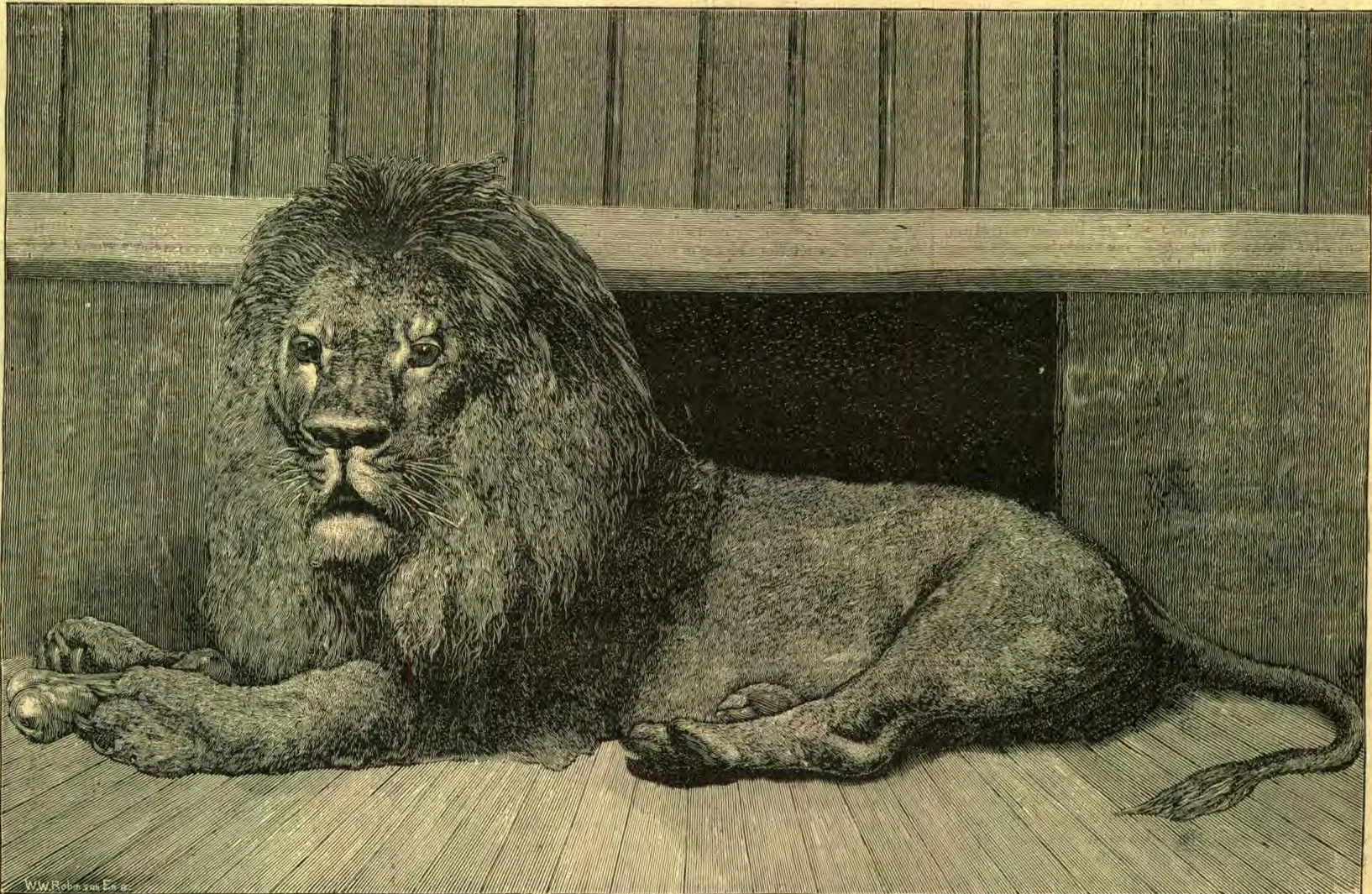
The lion is a native of Asia and Africa. It is about three feet high, and of a tawny yellow color. The lioness looks exactly like a huge cat; the lion differs only in having a full, shaggy mane encircling his neck. Hunters in those countries tell us that his tongue is sometimes as soft as velvet, and sometimes of file-like roughness. At nightfall he usually crouches near some water where animals come to drink, and lies in wait for his prey. While the poor victim stoops to quench its thirst, the lion springs, like a flash, upon it, and kills it with one crash of his powerful jaws. He is so strong that one blow from his paw would break a man’s leg.
Being a sort of great uncle to the cat, he cannot be trusted. Though the “king of beasts,” he does not always show the nobility that high rank obliges; and his savage disposition will manifest itself, even after long years of docility and familiarity with human beings.
Many years ago, a German king, when a boy, had a lion’s cub for a pet and playmate. They grew up together, and were very fond of each other. The king had a wise counsellor, who advised him to send the lion away now that he had become large and strong, or at least to confine him where he could do no harm. The king laughed, and said, “He is my oldest friend; why should I turn him off? He is as tame as a dog.” But he was not so tame, however, as the king imagined.
One night, after going to bed, the king had a queer dream. He dreamed he was dressed, and a servant was brushing the sleeves of his coat with a very hard brush; and as the brush touched his hand again and again, it hurt him so that he gave a cry. He awoke. Something was brushing his hand, which lay over the side of the bed. It was the rough tongue of the lion, who had crept into his master’s room through a door carelessly left ajar. The hand had just commenced to bleed. At the first taste of warm blood, all the savage nature of the lion awoke, and he stood there, just ready to spring, his mane bristling, his tail lashing, and his eyes flashing fire.
The king saw his peril, but he did not lose his wits; he kept his bleeding hand perfectly quiet, and with the other he softly and swiftly reached under his pillow for his pistol, and saved his own life by shooting his “friend” through the brain. Had he slept one minute longer, it would have proved his last sleep.
We were fortunate enough one day to reach the menagerie in Central Park at feeding time. When the animals saw the meat, they were so impatient and hungry that they acted much like naughty children under the same circumstances. The tigers snarled, and the panthers hissed, and paced up and down their cages; while the lions roared so terrifically that it shook the whole building, and some of the people ran out of doors. It seemed as if the iron bars were not sufficient to hold such animals in check.
The attendant threw a large piece of raw meat into the lion’s cage; as he crouched there, licking it, with the sleepy look in his eyes, I wondered if he could remember his home far away in the jungle, when his roar made all the beasts fear, and when the dizzy spring through the air was the prelude to all his feasts. It is rather hard to be confined in a cage all the rest of his life, after such a free condition; but he serves as a lesson in natural history to thousands of children, who could never go to see him in his native land. If he could only reason about it, he might console himself some by thinking he was fulfilling a mission. L. E. ORTON.
TRUST
By J. G. Whittier
PICTURE memory brings to me:
I look across the years and see
Myself beside my mother's knee.
I feel her gentle hand restrain
My selfish moods, and know again
A child's blind sense of wrong and pain.
But wiser now, a man gray grown,
My childhood's needs are better known,
My mother's chastening love I own.
Gray grown, but in our Father's sight
A child still groping for the light
To read his works and ways aright.
I bow myself beneath his hand;
The pain itself for good was planned.
I trust, but cannot understand.
I fondly dream it needs must be,
That as my mother dealt with me,
So with His children dealeth He.
I wait and trust the end will prove
That here and there, below, above,
The chastening heals, the pain is love!
—J. G. Whittier.
THE POCKET-BOOK.
“Tom Jackson says he does not believe there is a God; he says he never saw him; and I don’t know that I believe—I never saw him,” said John Clary, just come in from the company of Tom Jackson.
“I do,” said his mother. She said nothing more.
A week or more after this, John burst into the kitchen with Tom at his heels.
“See, mother,” he cried, “what I have found—such a handsome pocket-book!”
“Where did you find it?” asked his mother.
“In Pine Grove; now, whom do you suppose it belongs122to?” said John with a puzzled look.
“I dare say it grew there,” said his mother.
“Grew there,” exclaimed John, lifting up his eyebrows with great surprise; “a pocket-book grow in the woods! Who ever heard of such a thing? It could not be.”
“Why not?” she asked.
“Why not?” replied the boy; “the pocket-book was made on purpose. Look here!” opening it; “here is a place for bank-notes, and here is a little out-of-the-way spot with a snug fastening for gold, and a memorandum-book, and a pencil-case, and a beautiful gold pencil. Look, mother, with a pen and a lead, both; it was made for a man to use.”
“Some contrivance here, certainly,” said his mother, putting down her work and taking it into her hands for further examination. “It is one of the most useful pocket-books I ever saw; if it did not grow there, perhaps it made itself.”
Both boys stared at her more and more.
“Why, mother, you talk foolishly,” said John, with a sober and puzzled look; “there must have been a man with a mind to make this.”
“A man that knew how—a pretty neat workman,” added Tom Jackson.
“How do you know? you never saw him.”
“No, but I have seen his work, and that’s enough to convince me; I am just as certain that somebody made it as if I saw him.”
“You are!” said Mrs. Clary; “how so?”
“Why, mother,” said John, very much in earnest, “you see the pocket-book had to be planned to answer a certain purpose; now, it must have had a planner, that’s the long and short of it; and I know it just as well as if I saw it planned and done by the man himself.”
“That is,” said his mother, “it shows wise contrivance, and it must have had a wise contriver. Somebody must have made it, and thought beforehand how to make it.”
“Just so!” exclaimed both boys at once. “It would be foolish to think otherwise,” added John.
“I think so,” said his mother. “And it is just as foolish,” she continued, as she looked into the boy’s eyes, “when you see the wonderful contrivance in the beings and things around you, the end for which they were made, and the skill with which they were put together, for you to doubt or deny that there is a God who made them. Who planned your eyes to see with, and your ears to hear with? Can eyes make themselves! Can a man make a bird? Who created the sun, and planned night and day? Did your mother and father plan your fingers and make them grow? You never saw who does all these things, but you know perfectly well that a great somebody thought beforehand, designed and contrived the eye, and the ear, and your fingers—all things and all beings which are around you. And that great somebody is God, the eternal Mind, and great Maker of us all.”
The boys did not expect to be condemned from their own mouths in this way.—Scotch Tract.
THE POWER OF OBSERVATION.
By N. J. Bowers
THE habit of going through the world with our eyes open, and training them to see the things around us, is a good one. Many great and useful discoveries have been made by persons of an observing turn of mind. A little boy in Scotland, by noticing the lid of his mother's tea-kettle rise and fall when water was boiling in it, found that steam had great power, and this led him to experiment until the steam-engine was the result. This lad was James Watt. Hundreds of boys and men had seen kettle lids bob up and down, but their eyes were not wide open, that is, they saw to no useful purpose.
It is said that the great French naturalist Cuvier had studied the anatomy of animals so closely, had observed the parts so carefully, that he could tell to what kind of an animal a piece of bone presented to him belonged. One day some students thought to have some sport with the old professor. One of their number wrapped himself in an ox-hide and got under a table. When the baron came in, he said in deep, solemn tones: “I am Satan, and am going to eat you.” At once came the response, “Divided hoof, grass and grain eating, can’t do it.” From his knowledge of animals, he instantly classified the object under the table, and concluded that he was in no danger of being made meat of, as oxen do not eat flesh.
The guides and trappers of the far West have trained their senses of sight to a remarkable extent. Many anecdotes of their proficiency are told. One was able to tell what kind of a horse passed the camp during the night. He said it was black; it had a long tail; it was very hungry, lame, etc. He gave good reasons for all these particulars, and proved he was right. Another, seeing a human track, said it was that of an Indian, although it was made by a white man's shoe. He said that in all probability he had killed the white man and taken his shoes, as Indians do not buy shoes. He said he had a double-barrelled shot gun. He knew this because he had noticed here and there where the muzzle of the gun had dipped into the snow. He had passed a week ago, because then the snow had become very soft by reason of a thaw. The tracks were deep. Since then the snow had been frozen hard, and they could not have been made.
In how many thousands of ways can a little wide-awake attention to what is going on be made of great use. Notice things, their location, shape, size, color, and relation to other objects. Think over at night what you have seen, and try to profit by it. Whatever is bad, avoid; whatever you see is good, make the very best of it you can. Let us all keep our eyes open, and ears too, and learn all we can by what we see and hear. N. J. BOWERS.
EARLY HISTORY OF AUSTRALIA.—NO. 1.
By J. O. Corliss
AUSTRALIA and its surrounding islands are so far away from most of the INSTRUCTOR readers that probably they know very little of its early history. Coming from America to this country, the writer found himself very ignorant of many important facts, and even the information he had gathered, he learned from actual observation was not always correct.
The first known navigators in the Southern Ocean were the Spaniards; but with the exception of the few smaller islands to the north, their discoveries gave the world no knowledge of the almost boundless resources of the great southern continent. During the great struggle of the Dutch for their national freedom against the Spanish in the days of the tyrant Philip II., the Dutch became experts in navigation. Early in the seventeenth century, a vessel was fitted out by that people for a cruise of discovery in the Southern Ocean. The voyagers sailed along the north-east coast of the continent, and landed at a few points, naming the country New Holland; but as they found it only a desert place, and occupied by wild, black savages, who murdered a part of the crew, they concluded it was nothing but a barren island, and took no further interest in it.
After this, voyages to the Southern Ocean became frequent. In 1628 Francis Pelsart sailed thither in command of eleven vessels, but the vessels being separated in a storm, and some of them being wrecked, nothing definite came of the expedition. In 1642 the great navigator Tasman was sent out to learn what became of the missing ones of Pelsart’s expedition, of which he could gain no account. The voyage was not without fruit, however; for on his return to Europe, the world was apprised of the existence of large and rich islands that had hitherto been unknown. These now bear the names of Tasmania and New Zealand.
The next adventurer to explore the Southern Ocean was an Englishman named William Dampier. With some bold companions, he seized a Danish vessel, and set off to circumnavigate the globe. After meeting with many wild adventures, he managed to get control of a vessel called the “Cygnet,” in which he sailed for the Philippines, and from there to New Holland. Dampier, in his report of the country, said he could not determine whether it was an island, or was attached to the main continent. He was certain of one thing; and that was, that it was a “very large tract of land.” His description of the Eucalyptus tree, that is so common in the country, is very accurate: “They are about the bigness of our large apple-trees, and about the same height, and the rind is blackish, and somewhat rough. The leaves are of a dark color; the gum distils out of the knots or cracks that are in the bodies of the trees.”
His explorations on shore could not have been carried on very extensively; for he reports having seen “no sort of animal, nor any track of beast, but once, and that seemed to be the tread of a beast as big as a great mastiff dog.” This was undoubtedly the track of the kangaroo, which abounded in Australia at that time. In fact, there are great quantities of them now in the interior beyond the pale of civilization, where they are hunted and killed for their skins, which are made up into very pretty floor mats and carriage robes, or, as they are called in English countries, “carriage rugs.”
He described the people as being the “miserablest” people in the world, differing but a little from the brute. The native bushman of Australia has to this day lost nothing of his hideousness. He is tall and thin, with small limbs, great head, and prominent eyebrows. His skin is nearly coal black, without one graceful feature in the face. He has a large bottle nose, thick lips, and wide mouth. His eyelids seem half closed, and so when he looks away into the distance, he tips his head backward as if looking at something overhead. In early days the bushmen lived in any way they could. They had no houses, but herded in companies of twenty or thirty. They would build stone fences across little coves of the sea. As the tide arose, it brought in little fishes, many of which were left behind the stones when the tide receded. These, with what shellfish they could find on the beach at low water, was their principal diet. A fire was kindled by rubbing together briskly dry sticks, and their food was cooked by broiling on the coals. Having eaten what was provided, they lay around again until the next low water, when, if fish were found in their rudely constructed weirs, they would feast again.
And thus they lived without any knowledge of their Creator or of a future life. How strange it seems that any part of the human family should fall so low after being created in the likeness of Jehovah, and having the high privileges that were given them in the beginning by their Maker! And yet this came about by forgetting God, and not rendering to him the worship that belonged to him. This is made very plain by the words of the apostle in Rom. 1:20–23.
But the blacks of Australia are fast disappearing. Like the American Indian they cannot live where the white man pursues his industries. The most of those now on this island continent are in the interior, away from civilization. A few, however, who formerly lived in the districts now occupied by the whites, are kept at stations provided by the Government. Here they are cared for, and some religious instruction is given them; but they are fast dying out, and must soon become extinct. In another paper we will say more upon these points. J. O. CORLISS.
Melbourne, Australia.
“LIKE UNTO SHIPS.”
By Henry Wadsworth Longfellow
LIKE unto ships far off at sea,
Outward or homeward bound, are we.
Before, behind, and all around,
Floats and swings the horizon’s bound.
Seems at its distant rim to rise
And climb the crystal wall of the skies,
And then again to turn and sink,
As if we could slide from its outer brink.
Ah! it is not the sea,
It is not the sea that sinks and shelves,
But ourselves
That rock and rise
With endless and uneasy motion,
Now touching the very skies,
Now sinking into the depths of ocean.
Ah! if our souls but poise and swing
Like the compass in its brazen ring,
Ever level and ever true
To the toil and task we have to do,
We shall securely, and safely reach
The Fortunate Isles, on whose shining beach
The sights we see, and the sounds we hear,
Will be those of joy and not of fear!”
—Longfellow.
CUSTOMS OF THE MAORIS.
By S. N. Haskell
The Maoris, or natives of New Zealand, are superior to other natives of the South Sea Islands. Those of Samoa, or Navigator’s Islands, somewhat resemble them. The Maoris are very intelligent, and learn what is taught them in the schools more rapidly than Europeans. They are naturally reflective, have a high regard for justice and morality, and are susceptible to religious impressions. At the present time most of them profess the Christian religion. Their number is estimated at fifty thousand.
They were never known to injure the white man until after the white men had injured them.
If dealt with unjustly, they will retaliate. This is characteristic of all savages. At one time a Maori was employed by the captain of a ship coming from England to New Zealand. During the passage, he was for some cause flogged, but nothing revengeful was said at the time, and every thing passed off quietly. After they reached New Zealand, the entire crew were invited by the natives to visit a retired spot some distance from the ship. Upon arriving there, the natives surrounded them and murdered every one. Other natives went on board the ship, and killed all who were there, excepting one woman, who escaped. Years afterward she was recaptured, and told the story.
They found some soap on board the vessel, and not knowing any other use for it, ate it. They also found a quantity of gunpowder, with which they had a more serious experience. While examining it, one of them lit his pipe, and the fire came in contact with the powder, which exploded, killing many of them. Since then, they have learned the use of gunpowder and fire-arms.
Many of their customs have changed. Formerly they practiced tattooing the face, but this custom is fast falling into disuse. Girls were tattooed on the upper and under lip, and were called by the nickname of “blue lips.” Men of rank were tattooed all over the face and forehead. All persons of rank were tattooed. This is a very painful process, and only a very little can be done at a time. The coloring matter that is inserted under the skin is very poisonous, and the marks thus made can never be removed.
Their language sounds very musical when pronounced properly. Many of their words are short and easily spoken, while others are very difficult to pronounce, as for instance the following: Whakarewarewa, the name of a place; Au-Tawa-Kokori, the name of a hot spring; Te Porhipi Tukairang, the name of a chief. Kainga means a village. Kaeo is also the name of a village. Tauranga, Maketu, and Rotorua are names that have been retained. In fact, many of the cities, villages, and mountains in New Zealand still bear the names given to them by the natives. They have eighteen letters in their alphabet, and every syllable ends with a vowel. Next week we will tell you something about the salutation of friends when they meet.
S. N. HASKELL.
IT CANNOT SHAKE.
“You look bright and happy,” said a young man to a poor old Christian woman. With some difficulty she raised herself, and said:—
“I am happy, and I ought to be. I’m the child of a King; my sins are all forgiven; my feet stand on the Rock—the Rock of Ages—and I’m only waiting to see his face.”
“But do you never feel the Rock shake under you?” he inquired.
“The Rock shake? Well, I never heard of such a thing as a rock shaking! No, it’s immovable; it cannot shake.”
—Selected.
Beer Spilled in the Gutter: A Temperance Anecdote
Once, when a dray was passing along a street, a keg of beer fell off, and in falling burst open, so that the beer all ran into the gutter. A man passing along, said, “What a pity that the beer should all be wasted!” But another man answered, “No pity at all; better that the stuff should be on God’s earth than in God’s image.” Was not that a very true answer?
HOW TO MAKE AN ÆOLIAN HARP.
In heathen mythology, the god of the winds was called Æolus, hence Æolian means something produced by the wind. An Æolian harp is a stringed instrument played by the wind's blowing upon it. One thread of silk, or a horse-hair, stretched across a window-sash, near a crack, will produce pleasing musical sounds. But by following the directions below, a boy who is skillful with the jack-knife may construct a really desirable musical instrument. We give the article entire:—
“THE wind is a musician by birth. We extend a silken thread in the crevices of a window, and the wind finds it, and sings over it, and goes up and down the scale upon it, and poor Paganini must go somewhere else for honor; for, lo! the wind is performing upon a single string. It tries almost everything on earth to see if there is music in it; it persuades a tone out of the great bell in the tower, when the sexton is at home and asleep; it makes a mournful harp of the giant pines, and it does not disdain to try what sort of whistle can be made of the humblest chimney in the world. How it will play upon a great tree till every leaf thrills with the notes in it, and the river that runs at its base is a sort of murmuring accompaniment! And what a melody it sings when it gives a concert with a full choir of the waves of the sea, and performs an anthem between the two worlds that goes up, perhaps, to the stars, which love music the most, and sang it the first! Then how fondly it haunts the old house; mourning under eaves, sighing in the old halls, opening the old doors without fingers, and singing a measure of some sad old song around the fireless and deserted hearths!”
“One might go on for hours telling of wonderful stories called to mind by the musical wind, and of its power to stir our feelings to their depths, to rouse and quiet, to sympathize or mock us according to our mood, or perhaps to what we have anchored ourselves. But I wish to give you the directions which a friend has sent to me for making an eolian harp, and if you choose to follow them, perhaps you will find that the wind is a much greater musician than you thought. ‘Its construction is very simple,’ writes my friend, when speaking of his æolian harp, ‘and any cabinet-maker can make it easily.’”
“Some twenty-five years ago I made an æolian harp after my own notion, and it is giving forth its sweet sounds to-day. Mine is made of whitewood, with the ends of cherry. It consists of eight pieces, and is simply an oblong box, glued together, with bridges or raised pieces at each end for the strings to rest on. It has a round hole about one and three-quarter inches in diameter in the center of the top covering, for a sounding-hole. At one end are ten little pegs, to which one end of each of the strings is fastened; in the other end are ten pegs or screws, like a violin, with little holes to put the strings through to tune them, or to raise and lower their tension. The best strings are made by about six strands of coarse silk when twisted and doubled to form a cord. The number of strings is immaterial. Of course, the more strings the greater and more varied the sounds. The strings are fastened to the little stationary pegs, and passed over the bridge immediately above, and fastened through the little holes, like violin strings, so as to tune them. The best way is to tune the strings in unison. A good “pitch” is F, G, or A, in the natural scale of music. The strings may be tuned to one’s fancy, but a high pitch will cause them to break. The box, or harp, is then put on the window-sill, on the side of the house where the wind is blowing into the room; the window-sash is raised from one and one-half to two inches above the strings over the center of the harp, when, if the wind blows a gentle breeze, a beautiful combination of sounds will be heard floating in the air, seeming to be miles away. The length of my harp is two feet; width, eight and a half inches; height, three inches; thickness of the bottom and top boards, one-eighth of an inch; thickness of the ends, three-quarters of an inch; made of cherry or some hard wood to hold the pegs; height of the bridges, five-eighths of an inch. The harp must be glued carefully, and may then be stained and varnished, and made as cheap or expensive as one wishes. Pine would be just as good as whitewood, and possibly better, and deal-wood would be better than either. With these plain directions any one of ordinary skill in the use of tools can have music of his own, and no household need be without its soothing ministrations.”
IMPORTANT BIBLE SUBJECTS.
LESSON 18.—THE DAY OF THE SABBATH.
1. How many days are there in a week?
2. How are the first six days of the week to be occupied? Ex. 20:9; Lev. 23:3.
3. What example have we of such a use of the first six days of the week? Ex. 20:11.
10. Since they rested on the day before the first day of the week, on what day did they rest?—On the seventh day of the week.
11. In so doing, with what did they agree? Luke 23:56, last part.
12. Then what day of the week is enjoined in the commandment?
13. And what is the name of the seventh day of the week? Ex. 20:10, first part.
14. Was it a particular day of the week, or only the Sabbath in a general way, that God blessed and sanctified? Gen. 2:3.
15. Is there any doubt as to which day is the seventh day, the true Sabbath?—Bishop E. O. Haven, of the M. E. Church, while president of Michigan University, said: “There is no good reason for denying that the Jewish Sabbath [by this he meant the Sabbath which the Jews keep] is the true seventh day, reckoning from the creation of man, and that the Christian Sunday is the first day of the Hebrew week, or of the genuine week.”—Pillars of Truth, p. 89.
Webster’s Unabridged Dictionary defines Saturday as follows: “The seventh or last day of the week; the day following Friday and preceding Sunday.”
17. On how much of the earth did God design that man should dwell? Acts 17:24–26.
18. Then did not God design that the Sabbath should be kept in every part of the world?
19. Since it is evident that God designed that the Sabbath, the seventh day, should be kept in every part of the world, what can you say as to the possibility of doing so?
20. Upon whom does the Lord pronounce a blessing? Isa. 56:2.
21. Is this promise extended to any besides the Jewish people? Isa. 56:6.
A PLEA FOR PATIENCE.
DR. ARNOLD, who was once the head master of the famous Rugby school in England, was a great and good teacher. Unlike the rest of us who are teachers, he was not quite perfect, and on one occasion, marvelous to tell, he lost his patience. The timid boy who stood in his awful presence was blundering in his recitation, and the doctor began to scold. Then the boy looked up and taught him a lesson that he never forgot to his dying day.
“Why do you scold me, sir?” he exclaimed in gentle tones. “Indeed I am doing the best I can.”
To the honor of Arnold be it said he did not flog the boy for that rebuke, but thanked him. He tried to teach that boy a lesson in Latin, but he was taught himself a lesson in patience, and in our journey through life we need patience even more than Latin.
Patience is a virtue, and has a stunted, sickly growth unless placed under careful cultivation. The teacher needs it in the Sabbath-school, for one scholar is listless, and the other is bent on mischief, and so on through the class. But how grand a thing it is to have a stupid pupil! You rouse yourself in order to rouse him, and you tell what you know in clearest words, and then you practice on him the art of questioning until you become a master of that happy art. If you triumph and wake up that dull intellect, your triumph is complete; but if you fail, even then you have not failed to improve yourself as a teacher. Even the dunces have their part to act in improving us, and so let us not grow angry while we try to reduce their number. Patience—patience!—S. S. Journal.
He Went About Doing Good
“The most comprehensive description of our Lord's life-work that has ever been produced is that given by the apostle Peter: ‘He went about doing good.’ It is also in perfect harmony with the other inspired delineations of his life. The first recorded utterance from his life, ‘I must be about my Father's business,’ is significant and prophetic. It reveals to us the hidden purpose and lofty ideal of the Son of man.”
Satan Selects Idle; Christ Calls Busy Workers
SATAN selects his disciples when they are idle; but Christ chose his while they were busy at work mending their nets, or casting them into the sea.
GOOD WORKS.
By W. R. Alger
“Of all good works of men, which is the best?”
A young man once a prophet thus addressed;
And this reply the wise man on him pressed:
“From strife exempt, good works together chime,
And all the beautiful each in its time.”
—Oriental translation by W. R. Alger.
The American Plow.
Do the boys who help on the farm know any difference between the farming tools in use now and those of a hundred years ago or more? When “father” tells you what his experience has been in the use of tools, you will perceive that marked improvements have been made in them, enabling the farmer to perform a great deal more work with much less effort. But their present perfected condition was not brought about in a short time, nor by one inventor. It was by continued improvement upon the original plan. As an example, we give you some facts in the progress of the American plow, as they were published in the Inter-Ocean last year:—
“The plow used in this country during the colonial period was made of wood, covered with sheet-iron, the share being of wrought iron. In 1793 Thomas Jefferson, who had been experimenting on his Virginia farm, invented an improved mold-board, which would turn a furrow without breaking it. In 1797 Charles Newbold, Burlington, N. J., invented a cast-iron plow, and spent about $30,000 in perfecting it. It proved a great loss and failure to him, however, for the report spread among the farmers that the new plow poisoned the soil, ruined the crops, and promoted the growth of rocks, and as they refused to use it, the manufacture of the new invention ceased. About 1804 Daniel Peacock patented a plow having its mold-board and landside of cast iron and separate, while its share was of wrought iron, edged with steel. Jethro Wood, of Scipio, N. Y., patented improvements on this in 1819, and the prejudice against new inventions among farmers having somewhat abated, he did a very successful business as a maker of these implements, and his plans have been the basis of most all of those of modern construction. The first steam plow in the United States was patented by E. C. Ballinger, of South Carolina, in 1833, but did not come into practical use until much later. Perhaps the ‘Great Plow,’ invented by Daniel Webster, which was twelve feet long, drawn by four yoke of oxen, and turned a furrow two feet wide and one foot deep, may be regarded as the unwieldy precursor of the admirable and efficient sulky plows of later times.”
But the improved inventions of the reaper and mower, which have taken the place of scythe, sickle, and cradle, are probably of most value to the farmer.
SOME THINGS ABOUT INDIA RUBBER.
The following interesting paragraphs about India rubber were furnished the S. S. Classmate by Mrs. V. C. Phœbus. She writes:—
“In the early manufacture of India rubber it became stiff and unbendable in cold weather, and in the hot days of summer it melted into a liquid paste. When rubber coats were first manufactured, a specimen was sent as a present to Daniel Webster. It seemed a wonderful prize when he first looked at it on a cool day in the fall. When, however, he wished it to do duty in the winter, he found it as stiff as a piece of sheet-iron. He took it to the front piazza, and finding it stiff enough to stand alone, he left it there after having placed upon its shoulders the India rubber hat that had accompanied it. They stood there together through the cold, stormy day, amusing the passers by as a winter scare-crow.”
“The first India rubber shoes brought to this country were manufactured in South America. We are told by those who are exact about dates, that the first pair of rubber shoes seen in the United States was in the year 1820. These were exhibited as a curiosity. Afterward they began to be brought here for sale, and though heavy and badly shaped, they sold readily, bringing from three to five dollars. Little skill was required in their construction. The sap, when it first runs from the tree, is liquid, but it hardens slowly upon exposure to the air. The South American natives made lasts of clay, which were dipped into the vessel containing the liquid sap. Each dipping left a fresh layer of the rubber. As each layer dried, it was dipped again, until the shoe had been subjected to this process about twenty or twenty-five times, when it was hung up to harden. After a few days the clay last was broken and removed, and the shoe packed away for the foreign markets.”
“All this seemed easy enough, and some of the people of the United States began to think that they might buy up great quantities of the hardened gum, melt it, dip into the melted mass better shaped lasts than the clay ones of South America, and thus make better shoes and at a cheaper rate than the imported ones. They tried it, and all did so well and worked so smoothly that the manufacture was started without difficulty. The next summer brought them a trouble of which they had never dreamed. The South American shoes were made from the gum in its natural liquid state; but the shoes made in our country were made of gum, which, having first hardened in the lump, had been melted by being dissolved in turpentine and afterward hardened again. The first summer showed that gum thus treated would not retain its shape under the influence of intense heat, but becoming sticky at first, it gradually melted into a liquid paste as adhesive as molasses.”
“Charles Goodyear was the man who, after long years of study and experiment, learned how to make rubber the pliable, durable substance which we now know.”
THE BLOWING STONE.
In the park of “Kingston Lisle House,” Berkshire, England, is a wonderful stone. It is three feet high, three feet six inches broad, and two feet thick, and is pierced with holes. There are seven in front, and three at the top, and several at the back.
Just blow into any one of these holes, and you will hear a noise like the bellowing of a calf.
A pretty big calf it must be, with powerful lungs, too, for when the weather is fine, the folks who live six miles off can hear plainly, and a person standing three feet from the stone will feel the ground shake under his feet.
If a bit of stick is pushed into one of the holes at the top of the stone, it will come out at one of the holes at the back, showing what a wonderfully breezy place the inside of this stone must be.
In the old, old times, when there were wars and rumors of wars in England, this “Blowing Stone” was very useful in giving alarm when the enemy was coming. Now it makes fun for the children.—Exchange.
CHIMNEYS
In the year 1200 chimneys were scarcely known in England. One only was allowed in a religious house, one in a manor house, and one in the great hall of a castle or lord's house; but in other houses the smoke found its way out as it could. The writers of the fourteenth century seem to have considered them as the newest invention of luxury. In Henry VIII.'s reign, the University of Oxford had no fire allowed; for it is mentioned that, after the students had supped, having no fire in winter, they were obliged to take a good run for half an hour to get heat in their feet before they retired for the night. Holinshed, in the reign of Elizabeth, describes the rudeness of the preceding generation in the arts of life. “There were,” says he, “very few chimneys; even in the capital towns the fire was laid to the wall, and the smoke issued out at the door, roof, or window. The houses were wattled and plastered over with clay, and all the furniture and utensils were of wood.” In 1689 a tax of two shillings was laid on chimneys.
A NATURAL CURIOSITY.
ONE of the natural curiosities of Florida is a subterranean river, which is known as Silver Springs. It bubbles up in a basin nearly one hundred feet deep and about an acre in extent, discharging a stream sixty to one hundred feet wide and extending six or eight miles to the Ocklawaha River. It forms a natural inland port, to which three steamers run regularly from St. John's. The water is so clear that it seems even more transparent than air, and not only the fish that frequent it, but every object on the bottom, can be seen with remarkable distinctness.