We have a number of letters in type, and shall give you all there is space for in this paper. You will also find much besides that you will enjoy reading. Because so many write such excellent things for the INSTRUCTOR, one would suppose that in morals and manners the readers of the paper would be very nearly correct. Is this true of them? We wish it might be said that none are forgetful readers, and that all are doing the things they are taught from week to week. What strength it would add to our Captain's army if the whole INSTRUCTOR family would prove themselves his tried soldiers! and what trophies they might lay at his feet if each served faithfully at his post! and oh, what a shining wreath of victory would crown each immortal brow when the battles are all fought and the victors receive their recompense of reward! We hope none of our readers will let some one else have the crown that may belong to him. Now for our letters. First—
BERTIE B. ORR, of Comanche, Kan., in renewing his subscription to the INSTRUCTOR, says: “I am a little boy eight years old. I have a brother five years old. We both go to subscription school. There are no public schools yet, as this is a new country. We have organized a union Sunday-school and introduced the INSTRUCTOR, but the school feel too poor to take a paper yet. My ma is one of the teachers. We like the school. We have lots of chickens. Mamma has given me some young ones to raise for missionary money, so I call them my missionary chickens. I have to be very careful to shut them up every night, for the coyotes [a kind of prairie wolf] are so bad out here. I am trying to be good, so that the Lord will take me when he comes. I send my love to all.”
It would seem as if those coyotes were very ungrateful to meddle with missionary chickens; but we suspect they have so little regard for any one's rights but their own, that the only safe way is to shut up the chickens. Hope to hear a good report from your fowls.
LEONORA DIEFFENBACH writes a letter from Merrick Co., Neb. She says: “I wrote a letter for the Budget when I was nine years old, and now that I am twelve, I thought I would write again. We live five miles from Sabbath-school, but we try to go as often as we can. We have nice flowers in Nebraska. One plant, called the cactus, and another, the soap-plant, each has lovely blossoms. I have a nice little brother five years old. I had a little sister between two and three years old, but she died most three months ago. I long to clasp her in my arms again, and to hear her say, ‘How I love you!’ I am trying to be good so I may meet her in the resurrection morning. If there is any little boy or girl who does not have the INSTRUCTOR, if I can have the address, I will send mine.”
It is kind in this little girl to offer her paper to some boy or girl who has none. If the address is sent to YOUTH'S INSTRUCTOR, Battle Creek, Mich., it will be forwarded to Leonora.
Here is a letter from New York City, written by EDWIN J. KEUCHMAN. He writes: “As long as I have had the INSTRUCTOR, I have never seen a letter in the Budget from this city, so I thought I would write one. I am twelve years old. I have three sisters and one brother. The first time I heard of the INSTRUCTOR was through my sister's friend in Sedalia. He sent me a copy, and I liked it so well he sent it a year, with the ‘Golden Grains.’ I was very much delighted. I think every boy and girl ought to read them, there are so many pretty stories in them. The little readers of the INSTRUCTOR would like to hear about this great city. In it is a very large, nice park, called Central Park. It is about two and a half miles long, and about half a mile wide, and contains several large lawns on which the children play. There is a menagerie in this park, in which one can see the different animals from all parts of the world. My letter is getting so long I will stop.”
You stopped in a very interesting part of your letter, Edwin. When you write again, can you not give the young readers other interesting items of that large city?
GRACE S. OSTERHOUT, of Oswego Co., N. Y., says: “I have written a letter for the Budget once before, but as it was a number of years ago, I thought I would write again. I am thirteen years old, and enjoy reading the INSTRUCTOR very much, especially the letters. I do not go to Sabbath-school or meeting, as the nearest church of our people is nine miles away; but I get lessons every Sabbath in Book No. 5. I was baptized at the Syracuse camp-meeting last fall. I am trying to live so near like my Saviour that when he comes, he will take me home with him.”
We are glad Grace has loved the INSTRUCTOR so long; and we hope she may ever find it a help in living a Christian life.
WILLIE MCCARTHY writes a letter from Rome, N. Y. He says: “I am ten years old, and try to be a good boy. I go to Sabbath-school every Sabbath. This is a very nice city, of about thirteen thousand inhabitants. The streets are straight, the blocks are square, and the ground is very level. The walks are all nicely flagged [that is, paved with flat stones]. Last fall they put in electric lights, and they are going to put in the street railroad in the spring. I have a little sister Fanny, four years old. She goes to Sabbath-school every Sabbath when the weather is pleasant. I have taken the INSTRUCTOR four or five years, and think it is very nice, and that I cannot get along without it. This is my first letter.”
You have written an intelligent letter, Willie; sometime you must write again. We are glad you “think you cannot get along without the paper.” We want to make it so entertaining and useful that all the little boys and girls will feel just as you do about it.
A BOY WHO PERSEVERED.
By W. E. L.
SUPPOSE most of the INSTRUCTOR boys and girls have heard of the wonderful electric lights, and that many of them have seen them on a dark night, sending out their bright rays like a little sun, so dazzling that you could not look squarely at them. You have heard, too, of Mr. Edison, who invented the electric light, and perhaps have wondered where he lives, and what he did when he was a boy; if he liked his books, and studied hard; or whether he was mischievous, and gave his teachers a great deal of trouble. And so I shall tell you some things that I have heard about him, and that I suppose are true.
Even when a very little boy, he was fond of making experiments, trying this, that, and the other thing to see what would come of it. One time his mamma missed him for quite awhile, and where do you think she found him?—In the barn, with his dress-skirt spread over a nest of goose eggs to keep them warm. He had brought along something to eat, and meant to stay there until he had hatched the eggs, as he had seen the old mother-goose do. When he grew older, he learned to make wiser experiments than this.
He went to school only two months, but he was not allowed to grow up in ignorance; for, like all men who have become great, he is found to have had a good mother, who taught him very carefully, as did his father, who paid him for every book he read. But the boy did not need the money to help him to be studious, for he read every book he could get hold of; and as these were mostly good books, no harm was done.
Edison's parents were poor, and so the little fellow had to help himself. He found a place as train-boy on the Grand Trunk Railroad in Michigan, when he was twelve years old, where he sold peanuts, apples, song books, and papers, and you may be sure he drove a thriving business; by and by he had four boys working under him.
But this wasn't enough to keep him so busy that he forgot all about his books, and did not care for experiments. He bought an old chemistry and some chemicals, and turned an old baggage car into a laboratory, where he spent every spare moment. And for fear somebody would meddle with his bottles, he labeled them all “Poison.”
After awhile, he bought some type, and began printing a paper in this old baggage car. Where did he learn the printer's trade, do you ask? Well, nobody taught it to him; he simply made good use of his eyes when he went to the printing houses to buy his papers, and found out how it was done. The baggage men and brakemen furnished such news as would be of interest to the travelers, and soon this little Grand Trunk Herald became very popular. But one day such an accident befell this old printing house! A bottle of phosphorus fell to the floor and set things afire. The conductor rushed in, threw the chemicals and type out of the car, and gave young Edison a thrashing; and the boy picked up what he could find of his precious belongings, and moved them into the basement of the house where his father lived. All the time he was train-boy he stayed at home nights, and that, I suppose, helped to keep him good.
Every day the train went to Detroit; and whenever he could, Edison visited the library, and made up his mind that he would read every book in it; but when he had read a space fifteen feet in length, of dry, old books, he made up his mind that he should never live long enough to read all the books in the world.
He started another paper about this time, called the Paul Pry. Once one of his subscribers became very angry at some things that were put in the paper, and on meeting the young editor on the banks of the St. Clair, he coolly picked him up and threw him in. As Edison was a good swimmer, he did not mind the ducking, but he concluded he would give up editing papers.
One day he saw a little child playing on the track in front of a swift-coming train, and braving the danger, he rushed for the child, just saving it. It was the two-year-old boy of a telegraph operator, who was very grateful for this kindness, and offered to teach Edison to send messages over the wires. You may be sure he went at it with a will, toiling all day at his regular work, and then going down on the freight train to the station where the operator lived, to study his new trade at night. Pretty soon he became a good telegraph operator, and was employed first at Port Huron and then in several other large cities. He worked very hard to make himself perfect in his new business. But he kept on making experiments and inventions, that everybody laughed at, until his employers, one after the other, sent him off, because, as they said, he had “such a thinking mind;” and I suppose they concluded he was something of a nuisance to have around.
Then he went to Louisville, where he stayed two or three years; but one night, when he was making some experiments, he tipped over a large quantity of acid, spoiling the ceiling of the room below, and the nice carpet and furniture, and he at once lost his place.
At length he went to New York, and wandered up and down in search of work, but nobody seemed willing to hire him. By and by he went into a telegraph office where their instrument needed mending, and asked to be allowed to fix it. He succeeded so well that he was given a good place; and now it seems that his hard times were over. He kept on making experiments and getting inventions patented, until the people at Washington spoke of him as the “young man who kept the way to the patent office hot with his footsteps.” When he invented a way whereby four messages could be sent over the wire at a time instead of one, people ceased to laugh at him, and began to think he was a genius.
But I will not have room to tell you of all the useful and wonderful things he has invented,—the telephone, the phonograph, or “talking machine,” and the electric lights. He is hard at work yet, and I suppose we shall hear of more wonderful things he has invented some day. But I do not believe he would have been able to do any of these great things if he had not read a great deal, thought hard about what he read, and been so persevering. W. E. L.
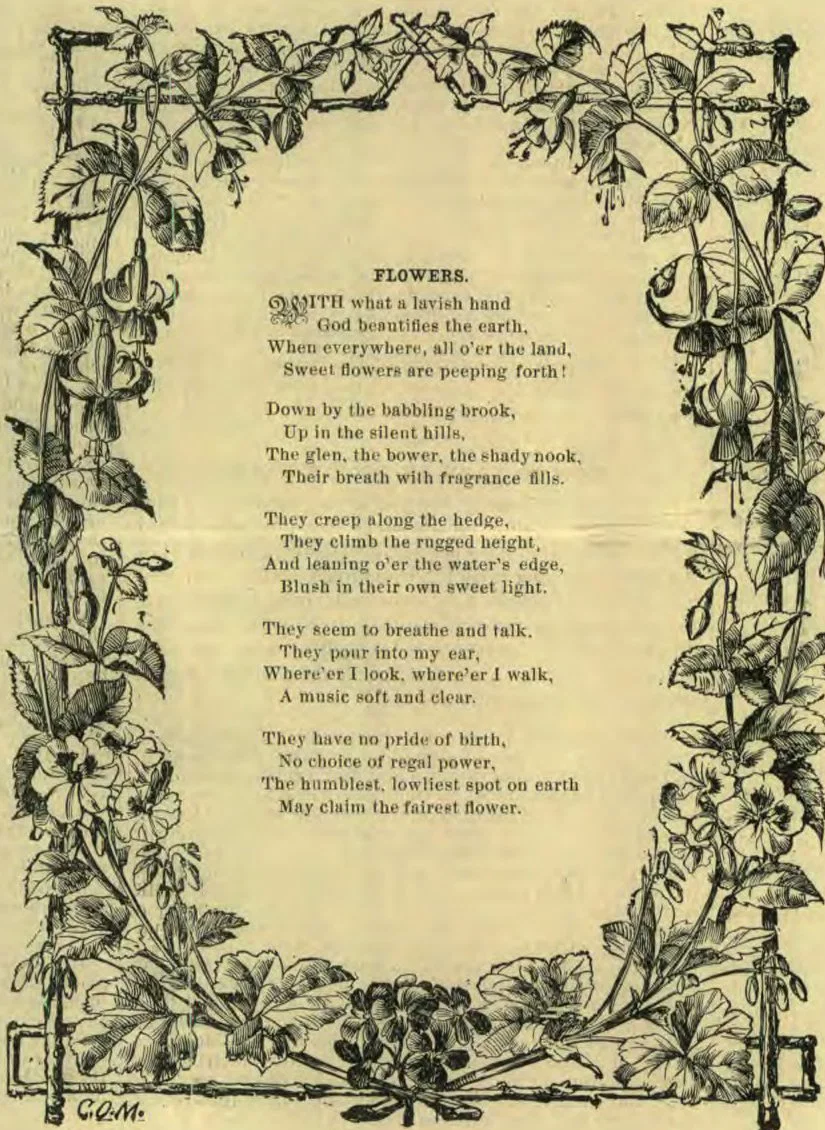
FLOWERS
With what a lavish hand
God beautifies the earth,
When everywhere, all o’er the land,
Sweet flowers are peeping forth!
Down by the babbling brook,
Up in the silent hills,
The glen, the bower, the shady nook,
Their breath with fragrance fills.
They creep along the hedge,
They climb the rugged height,
And leaning o’er the water’s edge,
Blush in their own sweet light.
They seem to breathe and talk.
They pour into my ear,
Where’er I look, where’er I walk,
A music soft and clear.
They have no pride of birth,
No choice of regal power,
The humblest, lowliest spot on earth
May claim the fairest flower.