We have said, time and again, that we are ever so sorry that each little writer of letters for the Budget cannot see his letter in print; but don’t you see it is quite impossible when so many write? That need not keep any from writing, however. Supposing your letters are not all printed, some of them will be; and if you write with as much care as you should, every letter you write will help you to become better letter-writers. This week we shall try to close out the April letters, by printing all we can of them, and then finishing the Budget with the names of the others who wrote in the same month. We begin with one from—
Walter Leavitt, of Stearns Co., Minn., who says: “I am a little boy ten years old. We take the INSTRUCTOR, and like it very much. We have had the meetings at our house most of the time for nine years, but a church is now being built just three blocks from our house. It will soon be done. I have cut five cords of wood this spring, and harrowed eight acres of wheat for papa. I send my love to the INSTRUCTOR family.”
Gertie G. Johnson writes from Osage Co., Kan. She says: “It seems a long time since I wrote for the Budget. At that time I was living in town; but now we live on a farm, and have a nice pond for our ducks to swim in. I am keeping the Sabbath with my parents. I have five brothers. Willie is the oldest. He goes to school at Battle Creek College. I am trying to be a good little girl.”
Otis A. Palmyer, of Ottawa Co., Mich., aged twelve years, writes his first letter, in which he says he takes the INSTRUCTOR, goes to Sabbath-school, and was baptized July, 1885. Also: “I have two little twin sisters who will be six years old in July. We think they are very smart; for they have learned all their letters, and can repeat all the names of the United States. I am trying to keep all of God’s commandments.”
Lizzie R. and Lillie E. Prince send a letter from Hillsborough Co., N. H. They are both trying to keep the commandments. They have two brothers, Willie and Ollie. Lizzie says: “Willie has a rabbit which he calls Bunney. He likes to run after the hens. I have a large hen and pullet which I raised by hand. The hen lays eggs now.”
Lillie writes: “Willie got some birds when they were small, and when they had grown larger, they would fly up in the trees to sleep. In the morning they would fly down on the window sill and strike the glass with their bills and wake us up. Then we would go and feed them. They have long bills, and eat the ants off from the trees. The birds are very fond of us. One of them died and the other was picked up in the road. The boys call them ‘whicherquakers,’ but they are woodpigeons.”
Etta Hugley, writing from Collins Co., Texas, says: “My father and mother have kept the Sabbath nearly eight years. Father will soon start to lecture with the tent. He took me last year, to play the organ. I am secretary of our Sabbath-school of about twenty-seven members. We live in a very pretty place, about two and a half miles east of Plano. I have never been out of Texas, but would like to go with my uncle who talks of going to Battle Creek. I am trying to be a good girl that I may have a glittering crown of gold placed upon my brow by Jesus’ own hand.”
Tommy Blackburn, of Rice Co., Minn., says: “I tried to get up a club for the INSTRUCTOR, but some said they hadn’t the money, and others, that they had lots of papers; but I will renew my own subscription. I am twelve years old. My papa is dead. I went to the Mankato camp-meeting last summer and the year before; I don’t know whether I will go this summer or not. We have twenty little lambs. Sometimes they all get together and run and jump and have a good time. We also have three little calves, two spotted ones, and a red one. I want to be saved when our Lord comes.”
Edward A. Johnson, of Brown Co., Minn., writes: “I am eight years old. I will tell you how I got the INSTRUCTOR. I caught a fox one day and sold the skin for one dollar, and now I have the paper, although I have only received one copy of it yet. Mamma read some in it last Sabbath, and I think it is a very nice paper. I go to Sabbath and day school. We are all keeping the Sabbath.”
Hattie R. Read writes from her pleasant prairie home in Stearns Co., Minn. She says: “We have one hundred and sixty acres of land, and the house is surrounded with a variety of trees. As the Sabbath-school is eighteen miles away, we learn the lessons in Book No. 2 at home. Four of our family do not keep the Sabbath.”
Hattie A. Marvin writes from Osceola Co., Mich. She says: “I am eleven years old, and have two brothers. My ma is almost blind, and my pa is sick. I haven’t been to school to amount to anything in six years. We keep the Sabbath, and have Sabbath-school at home because it is eight and a half miles to the nearest school. We have a little mule and pony, and call them Jim and Jenny. We have two kittens and eighteen chickens. My brother is making sugar. I read the INSTRUCTOR every day. It is Sabbath to-day, and I am trying to keep the commandments.”
Other letters, just as nice, were written this month. Those from Ohio, by Edith Stone and Sammy Hoover; Colorado, Allie Rice; Texas, Mary E. Stone, Ella Slayton, and Ula Smith; Iowa, Charlotte A. Mountain; Tennessee, Fletcher Taylor; Province of Quebec, Orson Rublee; Pennsylvania, Mabel S. Gue and Silas H. Brown; Indiana, George Hess and Rada Edwards; Illinois, Josie Trombly, and from Minnesota, Mary Nelson and Geo. L. Jensen. How many of these dear little people will be gathered as jewels by and by?—All who show their love to God by right doing; who are making their lives pure like the angels’.
BUTTERFLIES
By W. E. L.
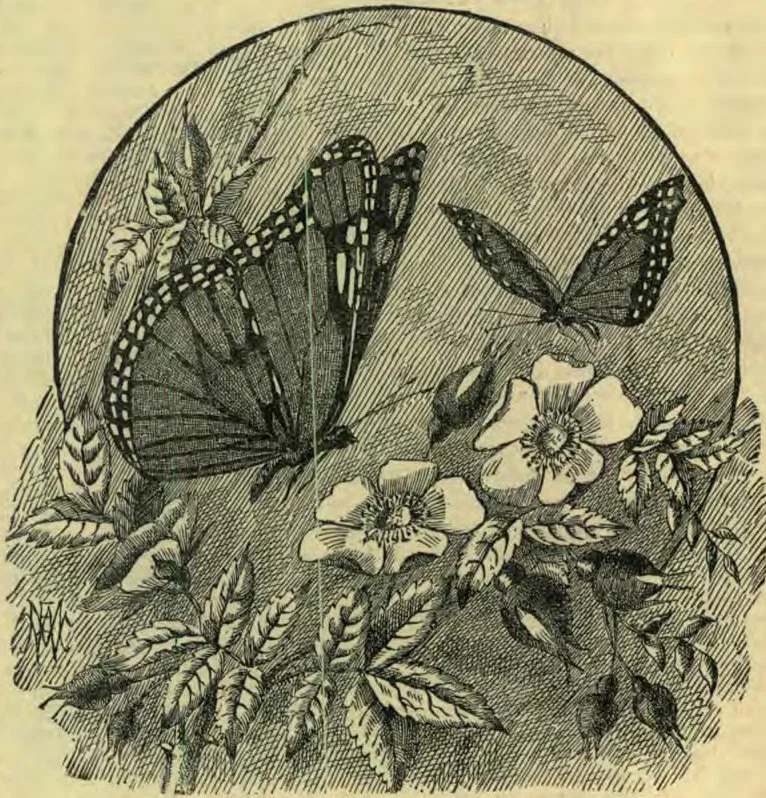
Did you ever catch any butterflies? If you caught them by the wings, no doubt you spoiled their beauty, and found that the velvety “dust” with which they were covered came off on your hands. This “dust” is really very small scales, which overlap one another like the scales on a fish. They are so small that you can not see them without a microscope, and they have a great many different shapes. It is these scales that give the insect its name. I will tell it to you, but you need not try to remember it; it is lep-i-dop’te-ra. You may call them scale-winged insects, which means the same thing.
You would hardly believe that these gay-winged butterflies and the ugly caterpillars and worms were the same things, would you? Yet this is really so. The insect undergoes a great many changes before it becomes one of the beautiful creatures that we see flitting about over our flower beds.
When the eggs that the mother butterfly lays are hatched, they do not turn out little butterflies, but little worms or tiny caterpillars, that eat all sorts of roots and leaves and flowers. Just think what times we would have to feed our horses and cows if they every day ate their own weight of food! Yet this is what many caterpillars do. Some even eat more than this. What would you think of a little boy who weighed fifty pounds and could eat one hundred pounds of meat in twenty-four hours, and gain five pounds in his own weight? Some caterpillars, we are told, eat as much according to their size as this.
But the caterpillar cannot keep this up. He has what we may call sick spells, when for two or three days he eats scarcely nothing. Then he sheds his skin, and has a bright new coat. When he gets a little rested and used to his new dress, he eats again as greedily as ever. He usually changes his coat three times while he is a caterpillar.
Then comes a greater change. He stops eating, and finding a leaf that suits him, begins spinning a web on the under side, to which he firmly fastens himself. Now he spins threads from a little spinning apparatus near his mouth, and does himself all up in a silken winding-sheet, or cocoon. Some insects make very pretty cocoons, and some do not make hardly any. Some spin a little web on the leaf, and hang themselves up by their last pair of feet, swinging by their heels in the air. You can see these things for yourselves if you will watch closely in the garden and hedge.
By and by the great change comes, when out of this cocoon that looks so dead, the beautiful butterfly emerges. At first its wings are small and all doubled up, but very soon they spread out and flaunt their gorgeous colors in the sunlight.
The butterfly has four wings; but often they are joined together by a little hook so that it looks as if he had only two wings. When at rest, the wings of a butterfly stand up so that you can see only the underside. Moths rest with their wings spread out. Butterflies fly in the daytime, and moths at night. Then there is another difference; the antennae, or feelers, of the butterfly are club-shaped at the end, while those of the moth are pointed. They both have very long tongues rolled up in their mouths, with which they take honey from the flowers. Both moths and butterflies belong to the division of scale-winged insects. You will feel paid if you should spend some time to watch the butterflies and the changes they undergo, and would learn many interesting things.
W. E. L.
THE HEATHEN HAVE BEAT.
One day Robert’s uncle gave him a penny.
“Now,” said he, “I’ll have some candy; I’ve been wanting some for a long while.”
“Is that the best way you can use your penny?” asked his mother.
“Oh, yes! I want the candy very much.” And hurrying on his cap, he ran off in great haste. His mother was sitting at the window, and saw him running along, then he stopped. She thought he had lost his penny; but he started off again, and soon reached the door of the candy store; and then he stood there awhile with his hand on the latch, and his eye on the candy. His mother was wondering what he was waiting for; then she was more surprised to see him run back home without going in.
In a minute he rushed into the parlor, with a bright glance in his eye, as he exclaimed,—
“Mother, the heathen have beat! the heathen have beat!”
“What do you mean by ‘the heathen have beat’?”
“Why, mother, as I went along, I kept hearing the heathen say, ‘Give us your penny, to help to send us good missionaries. We want Bibles and tracts. Help us, little boy, won’t you?’ And I kept saying, ‘Oh! I want the candy.’ At last the heathen beat; and I am going to put my penny into the missionary box. It shall go to the heathen.”
BUTTERFLIES ARE PRETTY THINGS.
BUTTERFLIES are pretty things,
Prettier than you or I;
See the color on his wings,—
Who would hurt a butterfly?
Softly, softly, girls and boys;
He'll come near us by-and-by;
Here he is, don't make a noise,—
We'll not hurt you, butterfly.
Not to hurt a living thing,
Let all little children try;
See, again he's on the wing;
Good-by! pretty butterfly.