The Youth’s Instructor, Vol. 34, No. 37.

HOW LOTTIE HELPED

The Youth’s Instructor

Sep 15, 1886

S. D. A. Publishing Association · Battle Creek, Mich. · Sep 15, 1886

HOW LOTTIE HELPED.
“Did you ever see such a looking room!” The sharply accented exclamation sprang from the red lips of a young girl as she crossed the threshold of the old farm-house kitchen on her way to school.
Very pretty and wholesome Lottie Emery looked, as she came lightly tripping down stairs, across the shaded, orderly dining-room, in her airy suit of nun’s veiling and graceful sun-hat knotted about with a wide blue sash.
Early risers were the inmates of this busy farm home, and not three-fourths of an hour before, Lottie had left that same wide, low-ceiled kitchen in “apple-pie” order, which was her favored term for scrupulous neatness and orderly arrangement of a room.
“Clearing up” after breakfast was always Lottie’s work, and so, too, was the care of the dining-room and chambers. Very seldom did the old “Townsend” clock perched on one end of the kitchen mantle whirr for eight o’clock in the long summer mornings but found Lottie’s tasks neatly accomplished and she at liberty to commence her half-mile walk to school.
This morning it wasn’t quite eight, yet beds had been aired and made, chambers and kitchen put to rights, the dining-room swept and dusted, fresh flowers picked for the parlor vases, and she, lunch-basket and book-strap in hand, ready for school; but on the kitchen threshold she paused in dismay. “Such a looking room! Who did it?”
Well, that great stack of milk-pans smeared with bonny-clabber inside and out, that Lottie’s tired-faced mother had just brought from the milk-cellar and piled into the sink till leisure—no, not leisure; who ever heard of leisure in a farm-house kitchen in the summer time?—helped in the confusion, and that litter of ash-shavings by the wood-box, that father Emery had scattered there not ten minutes before, as he whittled an ox-goad while he chatted with mother a moment, added to the chaos; and the unwashed churn, also from the milk-cellar, with dasher and ladle and dripping butter-paddles tilted across its top, waiting for those same tireless mother hands and hot water, added not a little to the disorderly state of affairs; and the overturned box of red bell-peppers in the open window, with dirt sifting along the ledge and across the floor—the combined work of a hungry foraging hen and the June breeze—helped in the clutter; and a big slop by the sink and a train of little slops across the floor leading from the well to the water-pail rest on the sink-board told that careless Fred had for once brought his mother a pail of water.
But this patient, ever-busy mother, where was she?
A pile of pie-plates flanking the heaped pan of flour on the long kitchen-table, another pan of prepared pumpkin and bowls of “mixing” and cream, gave promise that toothsome pumpkin pies were under way. The cellar door standing open and the big dinner-pot jarring its iron cover with imprisoned steam and a flank of corned beef over the hot stove noisily testified that the house-mother was in the cellar foraging for vegetables.
“I should think mother would stifle working all the forenoon in this sweltering kitchen!” Lottie exclaimed, reaching for her sun umbrella that hung on the wall.
“Better help her by putting the kitchen to rights,” whispered the little voice that sometimes gives an unpleasant jog to our thoughts. “You will have plenty of time before school, and think of her surprise and pleasure!”
A little scowl came between Lottie’s pretty blue eyes.
“It’s not my work to wash the milk-dishes, nor is it my fault if the kitchen is all in a clutter. I am sure I put it in apple-pie order not an hour ago.”
“For even Christ pleased not himself.”
Why should that Scripture passage flash in mind just then?—the day’s verse on the little bright-colored calendar that hung just under the clock. Lottie had read it with a quick glance as she paused in her dusting that morning to tear off yesterday’s leaf.
“But it is so stifling hot here, and I have hurried all the morning to finish my work that I might walk to school before the sun gets scorching high in the heavens; besides, mother doesn’t expect me to help her.”
“Then give her a pleasant surprise as well as rest by setting the kitchen in order before she comes in,” buzzed the little voice close at hand.
“Pleased not himself.”
The red letters of the calendar seemed to grow before Lottie’s eyes, but that wasn’t it; it was only those red bell-peppers that had toppled on to the floor from the window-sill.
“I’ll do it. Mother will have her hands full with the vegetables and pies and the dinner. It’s a pity if I am not willing to give her a little extra lift in the work now and then.”
The shade-hat went up on the nail with a toss, off came the dainty cuffs and tiny ruffled apron, and in place—broadly covering the neat school suit—went on her big checked apron.
“I hope mother will dress the vegetables before she comes into the kitchen, and then I shall have plenty of time to straighten things before she sees it,” thought Lottie, softly latching the cellar-door that the clatter of pans and whisk of broom might not reach her mother’s ears.
A shadow fell across the kitchen window, and looking up, Lottie saw her mother carrying from the roll-way a basket of vegetables carefully selected from last year’s sand-packed supplies to the cool shade of the lilac trees in the back yard, there to dress them for the dinner-pot.
Broom and dish-cloth, wing and dust-pan—how they flew that next half-hour!
A little later in the day, deep in the intricacies of geometry and the bewildering dates of history in the cooler temperature of the breezy schoolroom, out of mind went the remembrance of her morning’s kindness. Only once she thought of it, and that was in the noon hour, when little Johnny Andrews confidentially whispered to a classmate that “ma is going to have a ‘biled dish’ for supper.”
Lottie smiled, thinking of the vegetables she had seen losing their rough coats in the shadows of the lilac trees that morning, and, “I wonder what mother said when she came in and found the revolution in her kitchen,” was the thought that set her bright eyes dancing as she passed to her desk.
“Dear child! God bless the dear child!” was just what her mother said as she entered the kitchen, heated and tired, wearily thinking of the work that must be met before noon.
Oh, it was such a help and so restful for that hurried, discouraged mother to find her kitchen in order, her sink cleared of its stack of milk-pans.
“The dear, dear child!” Lottie little knew how often she was in her mother’s thoughts that day, and how her loving attempt to lift a burden from her mother set a little bird singing in that heart all day as she toiled; for love lightens labor, and these mothers never forget, never overlook or cease to hunger for expressions of love and sympathy from the dear ones of their household unto whom they minister unceasingly and uncomplainingly; but in many and many a home, all too late, this lovingly expressed sympathy and tender care comes.
When the tired feet are still, the hands crossed in strange whiteness and idleness, the sweet lips that never before in all our lifetime refused to answer us or be dumb to our entreaties, mute and cold, then, all too late, we wake to her worth and bitterly regret we had not “made more of mother” when she was with us.—The Quiver.

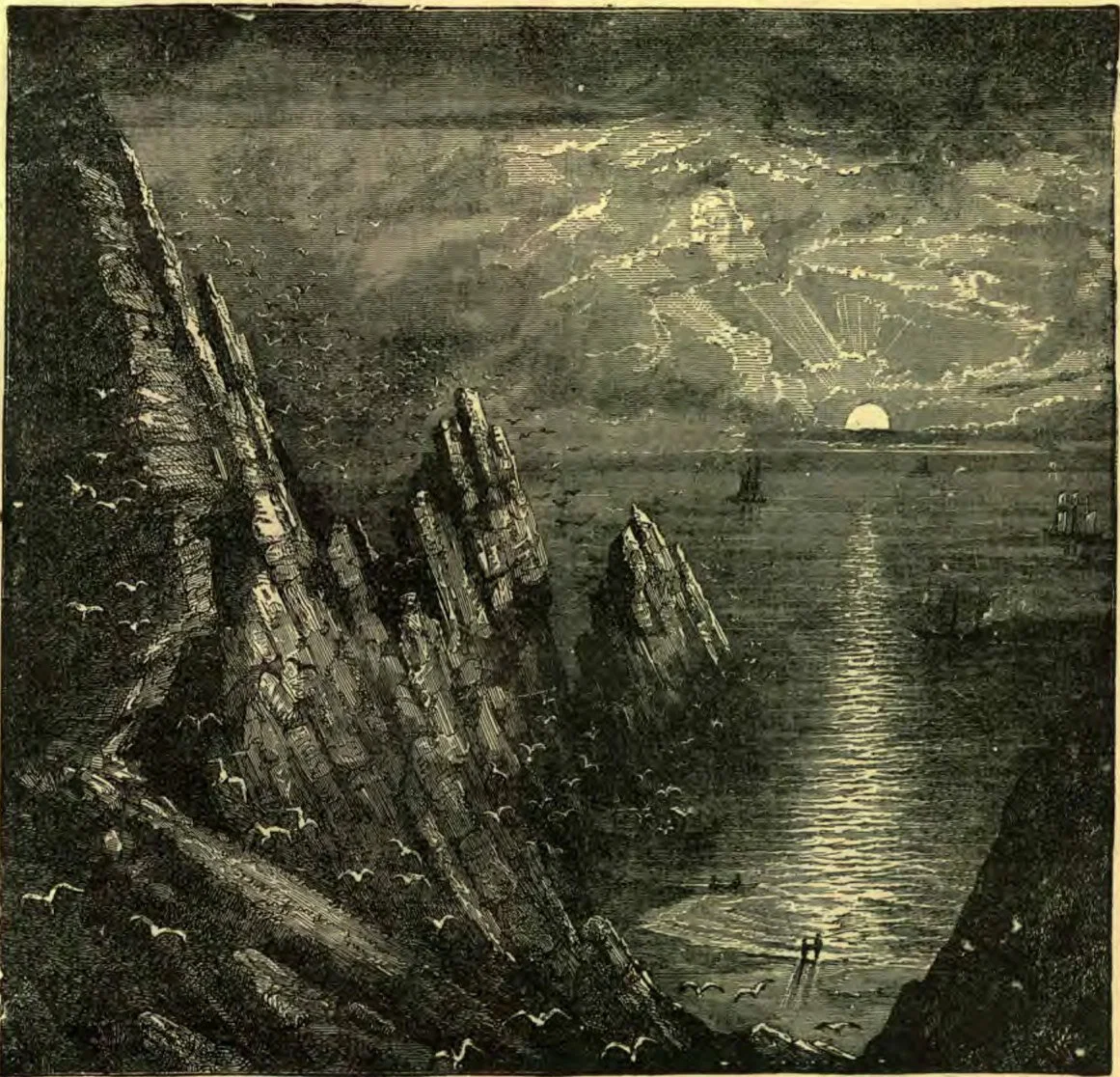
"NO MORE SEA."

MIGHTY, beauteous, restless ocean, Stretching far from strand to strand, Oh, to think our Father holds thee In the hollow of his hand!
How I love to note thy changes, As I watch thee day by day, When thy soft and rippling wavelets Seem like children at their play;
At the chill and evening hour, When shine forth the moonbeams pale, And the cry of wandering sea-bird Sounds like some sad spirit's wail;
When the howling winds distress thee As they beat upon thy breast, And thy dashing waves remind us Of the human soul's unrest—
Ever longing, thirsting, yearning, Never fully satisfied, So impatient for the blessings That are yet by God denied.
But a glorious time is coming, When our hearts will restful be In our Father's love and mercy; Then there shall be "no more sea."
—The Christian.

WRONG DOING ALWAYS BRINGS SORROW.

THE Bible tells us that we cannot do any wrong without sooner or later suffering for it. “Be sure your sin will find you out,” the Lord said a long time ago, and it has proved true thousands of times. Do wrong as secretly as you can, sometime it will be found out.
Again the Lord says: “Though hand join in hand, the wicked shall not be unpunished” (Prov. 11:21); that is, though several should agree in doing wrong, yet in some way that wrong will be punished. But what good comes of doing wrong? It never pays in the end; it brings sadness and sorrow to the one who tries it. Does the child who disobeys his parents, who runs away from duty, who tells a falsehood, who steals from his neighbor, or who does anything wrong, obtain happiness by doing so? No; that child is never happy. “There is no peace, saith the Lord, unto the wicked.” Isa. 48:22.
Even if you should make money by doing wrong, you could never really enjoy that money. I have just read in the papers of the sorrowful confession of a man who stole some money and ran away. It was the cashier in a bank at St. Louis. The owners of the bank had trusted him with their money. He wanted more than his wages. He thought that he could take the money out and use it, and then pay it back when he got wealthy; so he kept taking a little at a time, but he could not pay it back. Then he took more, and went on in his wrong-doing. He found that when he got started on the wrong road, it was hard to stop. By and by he knew that he would soon be found out. What to do he did not know; and at last he took what money he could get and ran away. He left his wife, his children, his home, and all his friends, and went away off into a strange country.
But was he happy? No; he was very miserable indeed. He wrote home like this; and, children, you should weigh his words and see if it pays to do wrong: “So I have fallen, a ruined man. What I am to do I do not know. Poor, alone, disgraced, I must hide my name, my family. What can I do? and O, what will my wife and children do? Be kind to them. I do love them, and this is worse than death. And now, a disgraced man, I go out into some strange place to begin again, with all I loved behind me, and out of my reach.”
Thus the poor man goes on lamenting the sad condition he is in. You see, just as the Bible says, his sin found him out. And you see again that the wicked have no peace. Just think of that old man. He cannot see his wife, he cannot see his children, he dare not come home, his money is all gone, he has no friends. He dare not even let people know what his name is, nor where he lived.
Then what disgrace, what sorrow, that must have brought on his poor wife and on his children! Besides, he had used up a lot of money that had belonged to widows and poor people, and they had to suffer for it. It is better to wear poor clothing and live in a poor house, than it is to get more by wrong-doing. Boys, if you want to be honorable men in society, if you want to have a happy life, be strictly honest. Never take a cent that does not belong to you. Earn every dollar you get before you use it. Do this, and you will avoid temptation and save yourself from many sorrows. D. M. CANRIGHT.

THE GRAPE.

Do you read with interest what travelers write of foreign lands and seas, with their rich fruits and rare flowers, and their thousand mineral and animal wonders? Yes, these written accounts are gratifying, though it gives us intenser pleasure to talk with one who has traveled far away, and has the rare faculty of telling what he has seen in a plain and pleasant way; but if we might see these things and enjoy them ourselves, it would be best of all.
Now there are fruits and other things which seem to flourish nearly as well under our own American sun as they do across the seas. One of these is the grape, which we ought all to know quite well. But is it not true that our seeming familiarity with things sometimes stands in the way of thorough knowledge respecting them? We may think, for instance, that we know all about a cabbage, yet how many of us ever saw one in blossom? How many ever thought that the bud of a cabbage weighs from five to twenty pounds? Possibly our knowledge of the vine may be thus defective, and a careful inspection of a specimen growing in the tangles of the wood may reveal to us facts unknown before, and besides make us more observing in the future.
Here is a summer shoot twelve feet long. Since the middle of May it has grown from a bud not larger than a pea, and it is now July twentieth; it therefore must have grown more than two inches a day. Here are thirty full joints of stem, and it continues to extend. Being so long and pliant, it cannot support itself, and is therefore provided with tendrils by means of which it clings to any object in its way which promises support. The first joints being short and near the old wood, do not need this means of support, and hence do not have it. But throughout the length of the stem the leaves are borne alternately, that is, if the first is upon the right side, the one upon the next joint above is on the left side, etc. If, now, we begin at the first tendril and count the joints of the stem upward “1, 2, 3,” “1, 2, 3,” etc., we shall find that the joints numbered “1” and “2” always have a tendril opposite the leaf; while the joint numbered “3” has a leaf only. You can see this for yourself by inspecting any number of new shoots from the wild vine; and you will further notice that every tendril is between two leaves, one above and one below it upon the same side of the stem, but that only one leaf in three sustains a like relation to the tendrils. You will see the same arrangement in the Virginia creeper or wood-bine.
The tendrils of the wood-bine, in addition to coiling around the support, flatten into little discs at the end, and thus fasten the vine securely even to a flat surface. Sometimes they insinuate themselves into little cavities or through small holes, then the end enlarges so as to fill the cavity and prevent the tendril from being drawn back. The tendrils of the grape sometimes enter such places, and then coil round and round upon themselves, thus forming a knot not easily drawn out.
Noticing the grape fruit, we have never seen it mature except on young side branches growing out of vines a year old or more. These side branches, or “laterals,” as they are called, rarely produce fruit beyond the seventh joint. In bearing vines, the clusters seem to supplant tendrils, and the regular omission of the third tendril is rarely seen in the cultivated grape.
The flowers are small, greenish white and have the fragrance of mignonette. In process of flowering, the five petals, instead of separating above, after the usual fashion among flowers, cling together at that point, but being severed at once from below all fall away together in the form of a little hood.
Fifteen hundred varieties of the grape are described in works upon its culture; and, as we might expect, they vary much in size, color, and habits. The little Corinth grape is less than one-fourth of an inch in diameter, is red or blue, seedless, and very sweet. Other varieties are green, yellow, or purple. Some are beautifully translucent and nearly an inch in diameter. When we consider the beauty of the grape, its agreeable flavor, its proverbial healthfulness, and the ease with which it is raised, we cannot wonder that its history has run parallel with that of civilization, dating at least from the time of Noah. The grapes of Eschol were noted long ago, and are very wonderful even now. They are said by one to be equal in size to prunes. One cluster sometimes weighs ten or twelve pounds. The terraced hillsides of ancient Judea were green and purple with its luxuriant foliage and clustering fruit. Columella, “the most learned of Roman writers on practical agriculture,” wrote upon the culture of the vine in the days of Paul.
Vineyards were planted upon the Rhine by the Emperor Probus, 281 A. D. The Romans introduced it into England so that its culture was well established at the time of the Norman Conquest, 1066 A. D. The summers of England, especially at the north, are not long and sunny enough to produce this fruit in that natural perfection which it attains in countries bordering the Mediterranean, yet by vigilance in trimming and training and by the application of artificial heat, the English have produced some most remarkable vines and fruit. “The famous vine at Hampton Court has a stem a foot in circumference, one branch measuring 114 feet in length, and has produced in one season 2,200 bunches of grapes, weighing on an average one pound each, or in all nearly a ton.”
The vine now found wild in parts of Europe is the original of nearly all varieties cultivated in the Old World. It seems rather to have escaped there from cultivation than to rank as a native fruit. Naturalists think it indigenous to the hilly countries south of the Caspian Sea, since there it is very abundant and luxuriant in a wild state, “climbing to the tops of the loftiest trees, and producing large clusters of delicious fruit.”
The culture and improvement of our native species, of which the United States has six, has nearly superseded that of foreign grapes first introduced by the Spaniards into Florida in 1564. Grape culture in the United States has become a great industry only during the last fifty years. The yearly production has lately risen to more than $10,000,000 in value. Grapes are now raised in nearly every State, California taking the lead. One vineyard in the Sonoma Valley covers 450 acres. That State is becoming justly famous for the production of raisins.
GEORGE R. AVERY.
(Continued.)

HOW A KING LEARNED KINDNESS.

A CERTAIN king in the East was noted for his cruelty, so that he was much more dreaded than loved by his people. One day, after he had been out hunting and returned, he caused an officer to publish that he, the king, was now sensible of his faults, and henceforth meant to rule his subjects with justice and gentleness. He kept his promise so faithfully that they gave him the surname of the Just. Some years afterward, one of his favorite ministers took occasion to ask him what had so soon brought about that great change in his conduct. The king, with much kindness, thus explained it:—
“You may remember I had been out to hunt just before making the public promise of better government. One of the dogs strayed from the pack to chase a fox, and bit him through the bone of the leg. The poor fox went limping to his hole, and the dog set off at full speed to rejoin the pack. One of my footmen wantonly threw stones at the dog and broke his leg. A runaway horse, passing by at the time, mistook the motion of the man’s arm for an attempt to catch him, and therefore kicked out and broke the footman’s leg; and the horse, frightened at the shout that was raised, dashed off to a wood, slipped his foot into a hole, and got his leg broken.”
“Here was a chain of retribution. I was forcibly struck at seeing how each was paid back for his deed of violence, and it set me to thinking what a load of evil I was heaping up that should fall one day upon my own head. It was this reflection that, by the will of God, worked such a great and instant change in my conduct.”
Thus it is in our lives. No one can do a cruel or unjust or even foolish action without suffering, sooner or later, the pains that surely spring from his folly or sin. If you sow the seed of thistles or brambles, do not wonder that when they are grown, your hands are stung and torn in grasping them.—Anon.

What Makes a True Man

MERE polish does not make a man; nor does a rough exterior necessarily make a man. The man is within. What is the heart made of? What is the grasp of the intellect? What is the quantum of solid common sense? What are you doing for others and God? These are questions by which to test manhood. See that your life and your work, wherever your place is, will abide these tests.

PARABLES OF CHRIST.

LESSON 1.—THE SOWER.

1. When did Jesus begin his public teaching? (See notes.)
2. Relate the circumstances of his baptism. Matt. 3:13-17.
3. What experience next followed? Matt. 4.
4. After choosing some of his disciples, where did Jesus go?
5. What place was the scene of his first miracle? John 2:1-11.
6. Where did Jesus then take up his abode? Verse 12.
7. How long was it from the baptism of Jesus to the time when he gave his memorable sermon on the mount?—Probably two years.
8. What notable miracles did he perform soon after giving this discourse? Matt. 8:5-13; Luke 7:1-17.
9. Where was Jesus when he spoke the parable concerning the sower? Mark 4:1; Matt. 13:1.
10. Under what circumstances was this parable given? Matt. 13:2; Luke 8:4.
11. To what extent did Jesus employ this method of instruction? Mark 4:2, 33, 34.
12. In the parable of the sower, where is the seed represented as falling? Matt. 13:4, 5, 7, 8.
13. Under which of these circumstances does the seed produce fruit?
14. Which seed does not grow at all?
15. Why does it not germinate?
16. Which seed attains a rapid but unreliable growth? Why?
17. Which seed attains growth but is unable to produce grain?
18. What is the cause of this unfruitfulness?
19. Describe the productiveness of that which falls on good ground.
20. Why were some not able to understand this parable? Verse 15.
21. How does Jesus congratulate his disciples? Verse 16.
22. What does he say of the advantages they enjoy? Verse 17.
23. When the multitude had retired, what favor did the disciples ask? Mark 4:10; Luke 8:9.
24. How did the Saviour show some surprise at this request? Mark 4:13.
25. What did he afterward say? Matt. 13:18.
26. In our Saviour’s explanation of the parable, what is the seed said to represent? Luke 8:11.
27. Who are they that receive the seed by the wayside? Matt. 13:19.
28. Who are they that receive it in stony places? Verses 20, 21.
29. Who are they that receive it among the thorns? Verse 22; Mark 4:19; Luke 8:14.
30. Describe the class that receive the seed into good ground. Matt. 13:23; Luke 8:15.
31. What inference may we draw from the fact that the seed is sown in all places, even by the wayside?
32. What, in every case, is the cause of unfruitfulness?
33. How may those find help who do not understand the word? James 1:5.
34. What encouragement may those receive who find it hard to endure trials? James 1:2-4; Matt. 5:11, 12; Acts 5:40, 41; 1 Pet. 4:13, 14; 1 Pet. 1:3-9.
35. What instruction may help those who are worldly-minded? Prov. 23:4, 5; 1 Tim. 6:9, 10; 1 John 2:15, 16; James 4:4.

NOTES.

Christ’s Teaching.—Our Saviour “taught as never man taught.” His whole life here was a lesson. He taught by look and by word, by precept, by example, and by parable. But his public ministry did not begin until after he was baptized, at the age of thirty years. On this important occasion his Messiahship was confirmed by the visible descent of the Holy Spirit, and by the voice of God saying, “This is my beloved Son, in whom I am well pleased.” After his baptism followed the temptation in the wilderness. Then, with a few followers, he went from the Jordan to Nazareth, from Nazareth to Cana, where his first miracle was performed, and from thence to Capernaum, where he abode for a time. His next public act seems to have been at the passover at Jerusalem, where he drove the money-changers from the temple, and had an interview with Nicodemus. After John was put in prison, Jesus returned to Galilee, where he entered actively into the work of preaching, healing, and preparing the disciples to aid him in the work of teaching the people, up to the time of the second passover, when he so enraged the Jews by healing the impotent man at the pool of Bethesda. It was not until some time after the second passover that the memorable sermon on the mount was given. After this sermon he healed the centurion’s servant, raised the widow’s son at Nain, received messengers from John, pronounced a woe upon the cities of Galilee, and probably made another tour through Galilee before preaching the discourse in which the parable of the sower is given.
The Seed Sown Everywhere.—The seed is sown in all places, even by the wayside. From this we may infer that salvation is offered to all men, whatever may be their class or condition.
Cause of Unfruitfulness.—The seed is all good. In every instance it is the pure word of God. The cause of unfruitfulness lies wholly in the way in which the good seed is received, cherished, and obeyed.
Thorns Sprang Up.—At the time of sowing, the thorns may be so subdued as to give promise of success to the sower, but unless they are rooted out, they will spring up and so choke the good seed that no fruit can come to perfection.
Some a Hundredfold, etc.—From this expression it would appear that there will be different degrees of fruitfulness even on what may be termed good ground; for while in some instances the seed brings forth a hundredfold, in others it yields but sixty or thirty.

COLOR IN NATURE.

Who paints the flowers their lovely and delicate tints, any of us can tell; but just how it is done, that is the mystery. After scientists have advanced their theories regarding it, many of which are no doubt correct, it will probably require a long series of lessons from the Great Teacher, in the future life, to enable us to understand all the secrets of flower-painting. But the following few paragraphs from the Sunday School Advocate will help to solve the mystery so far as at present understood:—
“What will you say when I tell you that there is no color at all in the objects we see? Yet it is so. Color is a property of light, and ceases to exist in darkness. To understand this we must go back to a sunny day about two hundred years ago. Then we might have seen that great man, Sir Isaac Newton, boring a small hole in the shutter of his window. After placing in the hole a triangular bar of glass, called a prism, such as we see nowadays hanging from old-fashioned chandeliers, he closed the shutters, thus making the room quite dark, save for the strong ray of sunshine which came through the glass and fell on a white screen placed to receive it. Instead of the white streak of light which Sir Isaac had expected, a long streak of rainbow appeared, in which he counted seven colors. From this he wisely concluded that each ray of light contains seven different kinds of beams. Since Newton’s day, much has been learned on the subject of light, but at present we have only to do with its color-producing qualities, which depend on the kind of surface on which the ray falls.
“Supposing the ray falls on a piece of black paper. All the seven beams are absorbed, just as if a charge of small shot were fired at a thin deal board from a very short distance, all the shot would penetrate and none would rebound. But take a brush and paint the paper white; now all the seven beams rebound and strike the eye; in fact, the white paint makes the paper proof against the entire ray of light, just as if you dip a piece of cloth into some waterproofing preparation, when the cloth, which before let all the water through, now holds it like a cup.
“Now let us take a petal of a scarlet geranium. We find that six of the beams which make up the ray go down into the petal. The red beam alone is returned to the eye, and that is the color we see.
“Green is the principal color of nature, and the way in which it is produced must be our last example. In each leaf are numbers of little grains of a substance which can only be perfected by sunlight. These grains are principally formed of the plant’s food, carbon, and are necessary to its well-being. When a ray falls on the leaf, all the beams, excepting the green, go down into the leaf till they reach the grains of chlorophyll, which they mature and bring to perfection. The green beam returns to the eye, and we see the green leaf.”

SPECTACLE LENSES.

Defective eyesight has become quite a general complaint with the young, necessitating the use of some sort of eyeglasses, so that it is becoming a matter of interest to know what material spectacle lenses should be made of to do the best service and be the least injurious to the eye. Common sense would teach us that the most transparent substance would be the most harmless; hence that which is least susceptible of scratches, would be best suited for the purpose. All spectacle dealers recommend pebble glass, and because it is pebble, they put a high price upon it. While it is probably the best material for lenses, one can be easily imposed upon, and pay an exorbitant price for that which is not genuine. It will be of interest to all the readers of the INSTRUCTOR to know what these pebbles are; but for the especial benefit of any who may have to resort to the use of spectacles, we give, from the Inter-Ocean, a scrap of information which may help them in selecting the real pebble. It says:—
“Pebble is the trade name for a transparent variety of rock crystal or quartz which, because of its hardness, is especially valued for making the lenses of spectacles. This crystal is obtained from three localities only—from Madagascar, Switzerland, and Brazil. That from the latter country is, on account of its exceptional hardness and transparency, preferred for the manufacture of spectacles. Rock crystal in its crude state sells for from $1 to $10 a pound, and when finished, its value is about five times as much. The superior hardness of pebble gives the best test for determining it. Glass can be readily scratched, but there are very few substances in nature hard enough to make a mark on quartz pebble.”

INSIDE THE SHELL.

In Harper's Young People for July 27 is an article from Sarah Cooper, showing the several inside parts of a bird's egg, and how the bird grows from them, until it chips its way out to begin its new life. We cannot give the cut-illustrations, but by examining an egg, you will readily understand the subject. She says:—
“What a mystery is connected with the egg! A little world of itself! Shut apart from the outside world, it seems a lifeless thing; yet within that little sphere, mighty forces are at work, which, under favorable circumstances, will produce a perfect animal, gifted with life, and soon showing the habits and peculiarities of its ancestors.
“On opening an egg we see merely the ‘white,’ in the middle of which floats the ‘yolk,’ with the whitish ‘germ cell’ clinging to it. This germ cell occupies but little space, yet it is the important part of the egg—the part for which all the rest of the egg was made, because it is just at this spot that the young bird begins to grow. We cannot see, without a microscope, the twisted cords of albumen at both ends of the egg which hold the yolk pretty nearly in the center. Those twisted cords allow the yolk to roll over from one side to another when the egg is turned, and so the germ cell, which is at the lightest part of the yolk, keeps always uppermost. Here we have a beautiful contrivance by which the germ cell is sure to be nearest the body of the bird as she sits upon her eggs, no matter how often the eggs are turned over.
“Of course that part of the egg nearest the bird gets the most heat from her warm little body and her soft, downy feathers, and a certain amount of heat is necessary to develop the new life within the egg. This, we know, is the reason that birds sit upon their eggs, and that they are so careful not to leave the nest long enough for them to become chilled.
“As we have just said, the young bird begins to grow from the germ cell. The albuminous white of the egg furnishes the building material for its growth, and the rich, oily yolk nourishes the newly formed bird as long as it continues in the shell. The more there is of this nourishment stored up in the egg, the stronger and better developed will the bird be on leaving it, as is clearly shown in the case of those birds whose eggs contain a large yolk. The young of such birds are able to run about and help themselves as soon as they are hatched; whereas the young of those having small yolks, not being so fully developed, are hatched in a blind and naked condition, and need to be fed and brooded over by their parents.
“No doubt you have often noticed in hard-boiled eggs a little hollow place at the larger end. There is a little bubble of air here, between the two delicate tissues lining the shell, for the use of the baby bird, and the shell is so full of very small pores that fresh supplies of air can easily pass through it.
“When the tiny creature, shut up in the shell, is fitted to live in the great world outside, it pierces this hard case and chips its way out by the help of a hard knob on top of its beak. This knob seems to be only a tool to help the bird escape from the shell, and as it is of no use afterward, it soon disappears.
“The bird is now fully equipped with bones, muscles, bill, claws, and internal organs. These parts have all been formed and nourished from the contents of that little egg-shell. Moreover, we find the contents of the shell have been entirely absorbed, showing that though the egg furnishes all that is needed for the formation of the young animal, there is nothing in it which is unnecessary.”

THE ENORMOUS INCREASE OF SEEDS.

A FAMOUS botanist tells us that it is no uncommon thing to find two thousand grains on a single plant of Indian corn—sprung from one seed—four thousand seeds in one sunflower, and thirty-two thousand on a single poppy plant.
Pliny, the historian, relates that a Roman governor in Africa sent to the Emperor Augustus a single plant of grain with three hundred and forty stems, being three hundred and forty ears—so that at least sixty thousand grains of corn were produced from a single seed.
In modern times twelve thousand seven hundred and eighty grains have been grown on one stalk of the famous corn of Smyrna.
It was once calculated that in eight years, as much corn might be grown from one seed as to supply all mankind with bread for a year and a half.—S. S. Classmate.

A TRUE AIM.

Aim well! No time is lost by care. Haste fails. A true aim wins; The contest dare, Make each aim tell. —Selected.
Continue reading: Letter Budget