The American Sentinel, Vol. 11, No. 48.

The French Revolution and Dangers of One-Man Power
Earlier text: The French Revolution and Dangers of One-Man Power

WHAT DOES IT MEAN?

EDITOR AMERICAN SENTINEL: During several years past we have had in our city a “Ministerial Union,” comprising nearly all of the ministers of the Evangelical churches, meeting once a month to discuss matters pertaining to the religious welfare of the people.
A few weeks ago they decided to reorganize upon a broader foundation, change the name to “Ministerial League,” and in one sense, to enter upon a more liberal policy as to their work. They therefore decided to extend an invitation to the ministers of all denominations, including the Catholic clergy, in particular, to join the league. According to the papers they met yesterday and formed the league, comprising about all of the Protestant ministers; but not any of the Catholic clergy were represented.
There seemed to be much disappointment that the Catholics were not present. The matter was fully discussed, and it was shown that a committee had visited the Catholics and were informed that it would be impossible for them to attend if there were any devotional services whatever, even so much as opening with the Lord’s prayer. It was thought by some that they should at least open their meeting with the Lord’s prayer. A vote was taken, which stood 17 to 14 against opening even with the Lord’s prayer. “The main idea of those who voted to reject the proposal,” said a city paper, “was to show to the Catholic clergy of the city how willing the Protestant pastors are to dispense with anything which would prevent them from joining the organization.”
They then proceeded to adopt a constitution and by-laws which were in part as follows: “Its objects shall be the cultivation of civic righteousness in our community by an insistence upon the close and vital relations between Christianity and the proper administration of municipal affairs and all matters of general interest and moment in the commonwealth and general government.
“Its objects shall also be to discuss matters of common interest pertaining to the religious welfare of our community, and generally to watch and guard our common church interests, that they may have proper recognition and influence in moulding and shaping public sentiment and the practical, ethical affairs of our city.”
Now will you kindly explain to us through the columns of the SENTINEL what all this means, so that the people of our city may understand it?
We have read it over several times; it sounds like the voice of ministers, but we don’t really know what hand there may be behind it.
If the ministers are so much interested in our community, certainly the community should be interested in what the ministers say and do. And as they speak sometimes in language that we do not understand, we appeal to you to interpret the constitution for us so that we may know what they propose to do.
We would like to know also why these Protestant ministers are solicitous as to the coöperation of the Catholic clergy in their reform work, so far as to surrender all religious devotions in their meetings in order to gain the attendance of the Catholics.
They (the Protestants) do not say anything about trying to convert these clergy from the errors of Catholicism; there must be some other object in view.
Will you please give some information or word of prophecy that will instruct the people as to the meaning and consequences of this movement inaugurated by the ministers, if carried out to its full intent and purpose?
Very respectfully,
P. P. LANE.
Worcester, Mass., Nov. 24.
We think the matter printed in the present number of the AMERICAN SENTINEL gives a complete answer as to the intent and purpose of all such movements as described by our correspondent.—EDITOR.

WHAT IS CHRISTIAN POWER?

BY M. E. KELLOGG.
The New York Independent of November 12 contains an article on “Islam and Christianity,” which has near its close the following very striking and suggestive sentence: “We have no more right to dethrone the Sultan in order to make it easier for Turks to become Christians, than the Turk has to present to the Armenians the alternative of Islam or death. But we have a right to insist that Christian power shall be used for protection of those who hold to the Christian faith.”
The query which arose in our mind when reading this sentence was, What is Christian power? And the answer which came to us, from our understanding of the Word of God, was that Christian power, properly so called, can be no other than the power of Christ. At the first this power was manifested by Christ. He healed the sick, cured the blind, raised the dead, and, what is more remarkable, gave to his disciples power to triumph over the evils in themselves. It was his intention that his work should be carried forward by his disciples after his ascension to heaven, that they should be his representatives in holiness and power even as he had represented the Father. “As my Father hath sent me, even so send I you.” “Ye shall be witnesses unto me both in Jerusalem, and in all Judea, and in Samaria, and unto the uttermost part of the earth.”
Witnesses of what?—That he is the Christ, the Saviour, and that he saves men. Could they do this of themselves? No indeed, and hence at the same time that he told them what their duty and calling were to be, he assured them that divine power—Christian power—for the accomplishment of their task would be given them. “All power is given unto me in heaven and in earth. Go ye therefore, and teach all nations.” Again: “But ye shall receive power, after that the Holy Ghost is come upon you: and ye shall be witnesses,” etc. Nor could they go until this Christian power was given them: “And behold, I send the promise of my Father upon you: but tarry ye in the city of Jerusalem, until ye be endued with power from on high.”
Much more evidence might be adduced, but this is sufficient to prove what Christian power is. It is the power of the Holy Spirit which comes from heaven and works in and through the disciples of Christ in a marked manner for the purpose of carrying on the work of Christ in the earth, and in the same manner that he worked.
Should we further ask for the precise moment when Christian power was the strongest, truth would compel the statement that it was when a hundred and twenty disciples of One who had been crucified as a malefactor were assembled in an upper room. The manifestation of Christian power at that time is thus described: “And suddenly there came a sound from heaven as of a rushing mighty wind, and it filled all the house where they were sitting. And there appeared unto them cloven tongues like as of fire, and it sat upon each of them. And they were all filled with the Holy Ghost, and began to speak with other tongues, as the Spirit gave them utterance.” Here was the fulfillment of the promise to His disciples, “Tarry ye in the city of Jerusalem, until ye be endued with power from on high.”
The power of the Holy Ghost, as revealed directly in some of its various ways of working, is Christian power. Christian power is manifested in the Christian religion. It certainly is not manifested through the power of States or governments. There never was a period in all the history of Christianity when Christian power was so manifest, so far-reaching, and so powerful, as during the first century after the ascension of Christ. So powerful was it that the empire of Rome began to fear for its own overthrow, and struck back at the Christian power in cruel acts of persecution which only hastened its own downfall. Christian power was all-conquering then. It had no army of soldiers, no fleet, no munitions of war; yet it went forth “conquering and to conquer.” Its weapons of warfare were not carnal, but, at the same time, they were “mighty through God to the pulling down of strongholds, casting down imaginations, and every high thing that exalteth itself against the knowledge of God, and bringing into captivity every thought to the obedience of Christ.” This is Christian power. We may go further, and say that it is the only Christian power.
But is this the conception of Christian power which is referred to in the Independent? Not at all. Real Christian power, the Christian power recognized in the Scriptures, is not meant. On the contrary, by the expression “Christian power,” the Independent means the worldly, mortal, cruel, military power of England, France, Russia, Germany, and the United States. We grant that there is power in these nations. But to accept the idea that the power of manifestos, ultimatums armies, and battleships is Christian power is, to us, a virtual denial of the power of Christ. The power of the British army is in no true sense any more a Christian power than is the power of the Turkish army. An army of Mohammedans may be truly called a Mohammedan power, because Mohammed taught and justified the use of the sword in the propagation of his doctrines; but no army of soldiers can be a Christian army, or represent Christian power, because the Author of the Christian religion declared against the use of violence in the propagation of his religion, or for any other purpose. All war is unchristian. It cannot, therefore, be a manifestation of Christian power. But this war-like power, national power, the power of armies and battleships, is just what the Independent means by the term “Christian power” in the quotation we are considering.
Another sentence from this article will prove this: “The Moslem Turks feel that, for the present at least, Islam is more powerful than Christianity.” This is measuring Christianity and the power of Christ by the Mohammedan standard.
The Independent further says: “The battle royal of Christianity is to be with Islam. The other great religions are to be met with argument, persuasion. Islam must be met by force. . . . Power is the one quality of religion which they [the Mohammedans] appreciate, and they will yield their faith only as they become convinced that it has met its superior in strength.”
Justice to the Independent demands the statement that in this same article it denies the intention of using force against Turkey for the compelling of individual Moslems to accept Christianity; yet indirectly it asserts this very thing, when it calls for this force to be employed for the destruction of Turkey as a nation, that individual Mohammedans may see and recognize the power of Christ and so be led to become Christians! It says distinctly: “For centuries the Sultan has represented to the Moslem world, the element of power. . . . To drive him from that vantage ground would be to give a fatal blow to the system itself, and thus release from its thrall many who are already in doubt, but are held by fear from acknowledging that doubt.”
If this idea of Christian power, of Christian progress, is to prevail; if the “battle royal” between Christianity and Islam is to be fought with gun, bayonet, and battleships in order to humble Turkey, that Moslems may more readily become Christians by recognition of Christian power,—then it matters very little to true Christianity which power gains the victory. The Christianity of the one is little above the Mohammedanism of the other. Brute force alone is glorified. Moslems converted to Christianity under such influences would be no better men as Christians than they were before as Moslems. They would simply transfer their allegiance and faith from one cruel, brutal power to another. Indeed they would not be converted to Christianity at all, but to a power which violates every principle of the religion it professes to sustain.
National Christianity, which many so admire, has nothing to commend it above Mohammedanism. Turkey is as bad a product of Mohammedanism as the world ever saw, but to-day she is not equal in national crimes to Spain in the days of the Inquisition, or France at the time of the St. Bartholomew massacre.
The question might here very properly be asked why Islam cannot be met and influenced by the same means that other religions are met and conquered. The answer of the Independent is that Islam respects nothing but force. But if the application of force is a correct principle, why confine it to national affairs, or to the relations of the so-called Christian powers to Turkey? Men who respect nothing but force are not confined to Moslem countries. They are found everywhere. Argument and persuasion have utterly failed in their cases. Why, then, should they not be coerced? These questions let in the light upon the whole plan of national Christianity, and the use of this so-called Christian power.
It is not Christian power. Nations, like individuals, may steal the livery of the court of heaven that they may better serve their own interests or some high church party. Let the nation interfere to protect its citizens in Turkey, if they are in danger; and in the name of a common humanity let them interfere to prevent the killing of the revolutionary Armenians, if they will. But why try to throw the mantle of Christianity over their actions? Why, as an authority and justification of their conduct, invoke the name of Him who once said to one of his over-zealous followers, “Put up again thy sword into his place: for all they that take the sword shall perish with the sword”? Why call a course of action Christian, when it is distinctively forbidden by the Author of Christianity? Why—unless because the virus of a national religion, a governmental religion, a union of the Church with the State, has, by false teaching, been inoculated into the very life-blood of the national sentiment so thoroughly that a touch of the nation’s pulse reveals its presence.
Is it any wonder that the power of Christ is so little manifested in the popular Christianity of this day, when that Christianity has such an erroneous idea of what Christian power is; and when, lacking the true power, it tries to take and utilize another power in its place?

WHO WOULD OPPOSE IT?

SUPPOSE an effort were made to revive the old law making it compulsory to partake of the Lord’s supper, who would most strenuously protest against it? It is safe to say that it would be those who most clearly discerned the spirituality of God’s service. Such would rightly abhor dragging men to the Lord’s table to act a lie, and would consider the law an outrageously wicked one. So, too, if those who favor Sunday laws really believed that keeping Sunday was a spiritual act, they would be protesting against such laws.—Present Truth, London.

CIVIL LAW VS. RELIGION.

BY GRANT ADKINS.
We can scarcely comprehend how that men who are seemingly ardent advocates of “liberty of conscience” and of the Christian motto “do unto others as you would they should do unto you,” can in any sense whatever ally themselves with any who are clamoring for a law that will enforce upon the minority the religious opinions of the majority, and still claim that everybody ought to be allowed to worship God according to the dictates of one’s own conscience.
It does seem that any one could see by a moment’s reflection that any civil law that will discriminate between citizens, and will concede to a corporation, a body of men, any right that it would not allow to an individual, is a wicked and unjust law; yet such is the character of all Sunday laws.
The pastors of this city have of late had much to say on “The proper observance of the Sabbath,” two sermons having been preached by two of the leading Presbyterian divines. After this the matter was brought before the Pastors’ Union, and all present were free to say that the law must be rigidly enforced, and that the Sunday newspaper was a detriment to the youth and the church. To show their disapproval, many of them decided to withdraw their church announcements from Sunday editions and print them on Saturday.
One of the divines said to the writer: “It is not so much the work that is being done on that day, but it keeps them busy so that they can’t attend church services.”
That is the secret of the whole affair. It is not so much that they entertain love for Sunday, as it is to get men to go to church. But of late I could not see much difference between the Sunday political paper and the Sunday political sermon. I would go to church and hear political issues discussed pro and con. But it was just this morning that a man who guides an editorial pen, said: “Let the minister make his sermon as interesting to men as the Sunday newspaper, and they will not need a law to stop their publication.”
A minister stated in the presence of the writer that “the Sunday paper was such a temptation to him that if it came to his house he could not help but read it, and therefore was in favor of its suspension.” We could not help wondering if He who is able to keep us from falling, and will not suffer us to be tempted above that which we are able to bear, could not give grace enough either to bear the reading of the Sunday newspaper, or else to let it alone. Let a man’s heart be full of the love of God, and of that which he believes is right, and no newspaper that he disapproves will have any effect on him whatever.
We give below a letter from a leading attorney at-law, stating how he views religious legislation. We could give more, but this presents about the same thoughts that the rest contain:—
REV. GRANT ADKINS:
In my judgment any connection between Church and State is utterly repugnant to our Constitution.
I believe religion is purely a matter of conscience with which the State and the Federal Government has no business to meddle. I am for this reason emphatically opposed to appropriations of the public money to be used in maintaining sectarian schools and eleemosynary institutions of any character.
I am equally opposed to any scheme that tends to discriminate between the beliefs of a Hebrew and a Christian, a Catholic, or a Methodist, a believer or an agnostic. To provide “a Sunday law,” is to my mind an indirect assumption by the Government of canonical jurisdiction, because such a law would be a decision upon a matter of religious doctrine upon which Jews and Christians, Baptists and Adventists, have divergent views. A decision upon a matter of doctrine must be rendered in the forum of the conscience rather than in the halls of Congress.
Yours truly,
N. C. MACNULTY.
We are glad that all men have not lost the spirit of genuine religious liberty.
Knoxville, Tenn.

Catholic Press Celebrates Defeat of Congressman Linton

THE Catholic papers, from Boston to San Francisco, are extravagantly exultant over the defeat of Congressman Linton, of Michigan, in the late election. Mr. Linton is not the only member of the present Congress who was defeated; so that there is nothing serious in that. Although Mr. Linton has done noble work in behalf of sound Constitutional principle during the two congressional terms that he has had, we have no idea that either he or anybody that favored him ever attached to it a hundredth part of the importance that these extravagant exultations show that the Catholics all over the country gave to it.

Request for Clean Copies of American Sentinel

A GENTLEMAN engaged in missionary work in Philadelphia, Pa., would be glad to have all the clean copies of the AMERICAN SENTINEL that can be sent, carriage free, to him. Send to Mr. Wm. Quinn, 2525 Turner St., Philadelphia, Pa.

A FIRST-CLASS HIGH-GRADE BIBLE

$7.00 WORTH FOR $3.50.

We propose to make it possible for each and everyone to be the possessor of

A FIRST-CLASS HIGH-GRADE BIBLE.

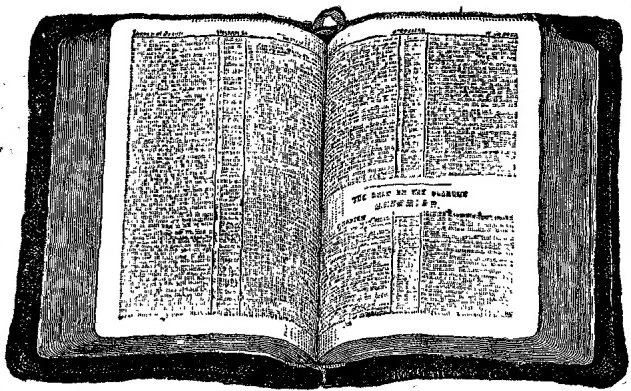
The book we offer has large clear type (see specimen page) and is what is known as the
AMERICAN OXFORD SELF-PRONOUNCING REFERENCE TEACHERS’ BIBLE,
Bourgeois Type, Bound in Imperial Seal Leather, Divinity Circuit, Extra Linen Lined to Edge, Round Corners, Red Under Gold Edges, Silk Headband, Silk Marker, Binding of the Best Quality,
REGULAR PRICE, $6.00
OUR PREMIUM BIBLE OPEN.
WITH SENTINEL, ONE YEAR $3.50
With this book reading is made easy. No more stumbling over the hard words. All proper names are divided into syllables, and the accent and diacritical marks render their accurate pronunciation a simple matter. With a little study of the Key to Pronunciation to be found in every copy of this Bible, the reader loses all fear of the long, hard names of Scripture, and pronounces them with ease.
OUR PREMIUM BIBLE
CLOSED.
OUR PREMIUM BIBLE CLOSED.
As is indicated by the name, this is a teachers’ Bible. It contains fifteen maps and 64 pages of illustrations and diagrams, copious helps of the latest revision, Bible index, concordance, dictionary of Scripture proper names with their pronunciation and meaning, and many other excellent features.
They that sealed the covenant.
NEHEMIAH, X.
The points of the covenant.
gavest before them, neither turned they from their wicked works.
36 Behold, we are servants this day, and for the land that thou gavest unto our fathers to eat the fruit thereof and the good thereof, behold, we are servants in it:
37 And it yieldeth much increase unto the kings whom thou hast set over us because of our sins: also they have dominion over our bodies, and over our cattle, at their pleasure, and we are in great distress.
38 And because of all this we make a sure covenant, and write it; and our princes, Levites, and priests, seal unto it.

CHAPTER X.

1 The names of them that sealed the covenant. 25 The points of the covenant.
NOW those that sealed were, Nehemiah, the Tirshatha, the son of Hachaliah, and
25 Rehum, Hashabnah, Maaseiah,
26 And Ahijah, Hanan, Anan, 27 Malluch, Harim, Baanah.
28 And the rest of the people, the priests, the Levites, the porters, the singers, the Nethinims, and all they that had separated themselves from the people of the lands unto the law of God, their wives, their sons, and their daughters, every one having knowledge, and having understanding;
29 They clave to their brethren, their nobles, and entered into a curse, and into an oath, to walk in God’s law, which was given by Moses the servant of God, and to observe and do all the commandments of the LORD our LORD, and his judgments and his statutes;
30 And that we would not give our daughters unto the people of the

WHAT THEY SAY OF IT.

AMERICAN SENTINEL: I received my Bible over two weeks ago, and am very much pleased with it. I hope others will avail themselves of this excellent opportunity to secure a nice Bible cheap. Yours truly, MRS. L. A. ROSS, Butte, Mont.
AMERICAN SENTINEL: I am delighted with the Bible. I don’t know how you sell it so cheap. Yours truly, THOMAS RACE, 349 E. 13th St., St. Paul, Minn.
“Dear Sirs:— “I received the Bible all right and am very much pleased with it. It is all that it is claimed to be, a first class Bible.”
A lady 75 years old bears this testimony:— “Dear Brethren:— “I sent to the express office and received the Bible in good condition and judge of my surprise on seeing the name so nicely put on. Many thanks for the same. I am well pleased with the Bible.”
It is only by special arrangement with the publishers of this Bible that we are able to make this

UNPRECEDENTED OFFER.

REMEMBER, the price of this Bible is $6.00. ANYONE, OLD OR NEW SUBSCRIBER, SENDING US $3.50 WILL RECEIVE THIS BIBLE POSTPAID, AND THE SENTINEL ONE YEAR.
Or WE WILL GIVE ONE OF THESE SUPERB BIBLES for seven new names at the regular subscription price, $7.00.
For 25 cents extra we will mark on the Bible in gold letters any name desired.
Address all orders to AMERICAN SENTINEL, 39 Bond Street, New York City.

Christian Endeavor Calls for Rescue of the Sabbath

THE western organ of the “Christian Endeavor” movement seems to be the Christian Endeavorer, published in Chicago. The November number is an “International Edition.” It calls loudly for a “Rescue of the Sabbath.” It wants literature on the Sabbath question. It wants “some scholars to restudy the Sabbaths of the Bible, and write books and tracts upon the subject.” It wants “some lecturers to unite the churches and laborers in a struggle for the Sabbath.” It wants “a Sabbath tract society to secure men who will write appropriate and much-needed tracts, and have them circulated by the millions.” It says that “every Christian family and individual should be reached.”
Good. We are interested in this ourselves. We therefore ask every reader of the AMERICAN SENTINEL who has, or can obtain, good literature on the Sabbath question, to put it into circulation at once. We ask all who can write, to restudy the Sabbaths of the Bible and write appropriate and much-needed tracts, articles for papers, etc., and do all you can to have them published and circulated by the million. We ask whoever can speak, not to lecture, but to preach the truth of the Sabbath as it is bound up with the everlasting gospel of the Son of God. Do all you can to unite all people in the struggle for the Sabbath.
Some of this Sabbath literature is needed in the office of the Christian Endeavorer itself. That paper is not well informed yet as to what day the Sabbath really is. - It thinks that the first day of the week is the Sabbath, while the Bible says plainly, “The seventh day is the Sabbath.” Some of our readers therefore who may have good literature on the Sabbath question, or who can write a good article on it, might send such to the Christian Endeavorer, 185 Dearborn Street, Chicago, Ill. Yet do not stop with this; send such everywhere and to all people, till all in the land and in the wide world shall know the truth of the Sabbath of the Lord.

Washington Supreme Court Rejects Sunday Law Conviction

The State of Washington has recently taken her stand with the number of American commonwealths which protect the rights of their people from the invasions of Sunday laws. A resident of Tacoma was convicted in the municipal court of violating the “Sabbath,” and the case was appealed to the Supreme Court, where the decision was reversed. In its ruling the court said: “If the Sabbath law is valid, then the legislature would have the right to prohibit farm labor, printing, and nine tenths of the employments which citizens usually engage in in this country, and leave the other one tenth to pursue their vocations. The ordinance in question is deemed as special legislation; and while it is true that there have been some decisions, notably in New York, holding the contrary view, this court is satisfied that the ordinance is unconstitutional, and reverses judgment, with instructions to dismiss the case.”

Women's Christian Temperance Union Protests Sunday Traffic in Washington

The late W. C. T. U. convention at St. Louis, Mo., passed a resolution protesting against Sunday traffic in the District of Columbia.

Correction Regarding Secretary of the New England Sabbath Rescue League

IN our report of the meeting of the “New England Sabbath Rescue League,” reference was made to Dr. Dewitt S. Clark as secretary of the league. This is a mistake. Dr. Clark was only temporarily in charge of the meeting, in the absence of the secretary, Dr. Martin D. Kneeland.

Thanks for Circulating the November 26 Sentinel

WE hereby express our appreciation of the hearty response given our call for coöperation in the circulation of the SENTINEL of November 26. It was an inspiring sight to see all hands busily engaged in sending out thousands of extra copies of this number. We still have a quantity of this valuable issue on hand, and will fill orders for it as long as the supply lasts; after which we will fill the orders with this present issue, which is an excellent companion number to the issue of November 26. Usual rates—one cent per copy.

California Sunday Law Petition Campaign

A GREAT stir is being made in California in behalf of a State Sunday law. One of the leaders in the movement writes, “We are flooding the State with petitions for a law, and this will be pressed upon the coming legislature as never before; at least so I hope. The work has to be done by a very few earnest men, mostly ministers.”
Of course; that has been the regular method of “National Reform” work for years. A “flood of petitions,” “whole State aroused,” “overwhelming public sentiment”—such are the usual features of a well-ordered Sunday-law campaign which frighten time-serving legislatures into enacting Sunday statutes; but which, when the noise and dust have passed away, are discovered to be only the efforts of “a very few earnest men, mostly ministers.”

Canadian Churches Propose Federal Court of Churches

The Christian Work tells of steps taken by churches in Canada looking to the “establishment of a federal court to be composed of representatives of the various churches;” and that they are “willing to empower it to give expression in cases of emergency to the opinion of the churches on moral and religious questions affecting the welfare of the community, and to take action for the churches when such action is desirable.” The Christian Work then remarks that “there is something in this plan worthy of the careful consideration of the denominational bodies on this side of the Canadian line.” Is it possible that there is not enough of this sort of thing being carried on already on this side of the line? No; it is plain that they will never be content till they possess such a “federal court” of churches, or else a federal court so ruled by the churches, that thus they shall be able to rule the country for “the welfare of the community.”

Christian Endeavorer Attacks Seventh-day Adventist Literature Campaign

The Christian Endeavorer, having fallen into the mistake of thinking that Sunday is the Sabbath, counts as enemies of the Sabbath those who believe the Bible that “the seventh day is the Sabbath,” and who attempt to get others to believe it also. Of the Seventh-day Adventists, on this score it says:—
The enemy is thoroughly organized; showers of tracts, books and papers are being circulated to mislead the Christian public. At the International Convention at Washington, recently, they boast of having put into the hands of “nearly 60,000 Christian young people, nearly 240,000 pages of tracts.”
One seventh of one per cent. of the professedly “Christian” population of this country, publish and circulate twenty fold more tracts, books and papers against our sabbath than ninety-nine and six-sevenths per cent. of the Christian population does in its defense.
Take a half dozen of their recent publications, with a circulation of from 25,000 to 1,000,000 copies each, and possibly read by three persons to each tract. Yet none of these tracts have been followed with a refutation.
In one State these people sell about $12 worth of literature to each member they have in the State, and 90 per cent. of their literature attacks the Sabbath and the churches.
If the churches would circulate 25 cents’ worth of the right kind of literature to each member of the churches our country could soon be redeemed from this curse.
Good! Let every man, woman, and child, who ever read or heard that “the seventh day is the Sabbath,” tell it to every possible person. And let all such know that whether they be counted enemies or not, they are making known the truth of God.

Errors of Our Fathers in Organizing Religion

“I HAVE arrived at the profound conviction that nothing has more hastened the loss of liberty than the errors of our fathers concerning the manner of organizing religion.”
—De Pressensé.

You have reached the end of this edition.

The American Sentinel · Dec 3, 1896