The Youth’s Instructor, Vol. 43, No. 25.

JAPAN
Earlier text: JAPAN

ALONE

The chaplain of a Pennsylvania state prison once said to a friend that one of the most pitiful of the tragic sights he had seen there was the death of a big, burly young fellow who was serving out a term of ten years. “I only knew him as Number Sixty-five,” he said. “He had an attack of angina pectoris, and when the agony abated, suddenly asked:—
“‘Is there any hope for me?’
“The doctor, after a moment’s hesitation, shook his head.
“‘How long?’
“‘But a brief time.’
“From his pallet he could look through the cell window on a patch of blue sky. He stared at it, and then cried out, ‘I can’t! I can’t go out there alone! God is waiting.’
“I told him that God was merciful; but he would not listen, and cried out, ‘Not alone! I can’t go alone! Is nobody else dying in the jail? Send for my old father. He’ll be glad to die with me.’
“I told him of Christ and his love, but he was deaf; and even when his breath was almost gone, muttered again and again, ‘I can’t face God alone!’
“His father was sent for. He was an old man, near to the grave. He would gladly have died for the boy who had so cursed his life; but he could only stand, helpless as ourselves, listening to his son’s moans of terror.
“At last the strong body lay still. The soul had gone alone to its Maker.”
Each of the life-saving men who guard our coast, when he keeps the patrol on stormy nights, gives in, at the end of his long, lonely march, a token in sign that he has faithfully accomplished his work. Another of the life-saving crew, in the midst of the night and tempest, may give him comfort and aid, may cheer and encourage him, but he must finish his own march, and give in his own token. No man can do that for him.
We each have our march to make in life, often through dark and cold ways, and we must render in our account to the great Commander—alone.
It will not help the worldly old man on that day that he has a child like God’s angels in heaven, nor the vicious young man that he has a praying, loving mother.
Each soul must pass into the unseen world, —not simply alone, but molded and ingrained by the acts, and habits, and preferences of the life it has left behind. What will follow? Each of us must know, sooner or later, for himself.—Youth’s Companion.

THE GERMAN UNIVERSITIES.

A UNIVERSITY, according to the German idea, is based upon three principles,—an object, or aim, and two conditions. The object is Wissenschaft,—knowledge in the abstract, or learning. The conditions are Lehrfreiheit,—freedom to teach,—and Lernfreiheit,—freedom to learn. Whatever does not have this object and present these conditions is not, to the German mind, a university; and an institution which does answer these requirements is a university, though it may have but two or three hundred students. Size has, in fact, nothing to do with the matter, neither has variety of instruction. The difference between a university and any other institution of learning is a difference in kind,—a difference in aims and in principles.
There are four departments, or faculties, in the university, and only four. These are the philosophical faculty,—what is known in this country as the academical, or arts department,—the medical faculty, the law faculty, and the divinity faculty. These are the only departments recognized as belonging to a university. Schools of engineering, of dentistry, of pharmacy, and the like, which are often found attached to universities in this country, are regarded in the German system as belonging to special schools of technology. Their objects are not those of the university, and they are not considered to have any place in it. Their purpose is rather practical than theoretical,—the development of mechanical skill rather than the pursuit of learning.
The degrees granted by the universities are four, corresponding to the four faculties,—the degrees of doctor of philosophy, doctor of medicine, doctor of laws, and doctor of divinity. The degree of doctor of divinity is not conferred upon students by all universities, but is by many of them given only honoris causa,—that is, on account of distinguished services to learning or to religion. Unfortunately, services in the cause of true religion are not considered essential in every case; even politicians and statesmen have received the degree honoris causa. The degree in law, juris utriusque doctor (J. U. D.), doctor of both laws, indicates that the German student of law is expected to be familiar with canon, or church, law as well as the civil law. The law of Germany came down directly from the Roman empire, through the Holy Roman Empire of the middle ages, while the canon law grew, through the relations between the latter empire and the papacy, to be a very necessary part of the legal education of a civil magistrate. This is but one of the many interesting traces of their mediæval origin which the universities bear.
The object of the university is the pursuit of knowledge. Little thought is given directly to the practical side of education. There is a strong contempt for “bread-and-butter” views of life. Perhaps this contempt is a trifle too marked, but it is soon enough lost. The “Philistine,”—the man of the world,—whether he studied mathematics or philosophy at Heidelberg or Göttingen or Berlin, or architecture in the technical schools of Breslau, or parted company with learning at the door of the Realschule or gymnasium, is always sufficiently keen to all questions of bread and butter. In the few years that are given to real intellectual living, it is well enough that the soul should spread its wings in the free air of heaven, and soar for a time, always brief enough, far above the sordid world, pursuing knowledge for its own sake.
Thought cannot live in chains, nor will the mind always follow leading-strings. When a sufficient foundation has been laid, the student should choose his own field and his own methods of study. This fact is recognized in German universities. C. B. MORRILL.

GLIMPSES OF ANIMAL LIFE.

6.—ECHINODERMATA.
We have now reached a division of the animal kingdom much more complicated in structure. Much as we have admired the skill of the tiny lime-builders in the formation of their beautiful shells, we must confess that the animal itself, like the amœba, is a frail and helpless being; and the first advance in the sponge is one rather of architecture than of individual existence. But in the lasso-thrower we begin to detect the rudiments of the senses and organs, which become more and more distinctly marked as we ascend the scale of life. The minute ears and eyes of the little jelly-bell enable it to appreciate, in a small degree, at least, the world around it, and to live a free and independent being.
In this division we have still further developments.
Here we find a tube-like digestive canal; they walk as well as swim; a sharp eye keeps a keen look-out on all things around; a battery of nerves and complicated muscles gives a more distinct individuality than any we have studied in the past.
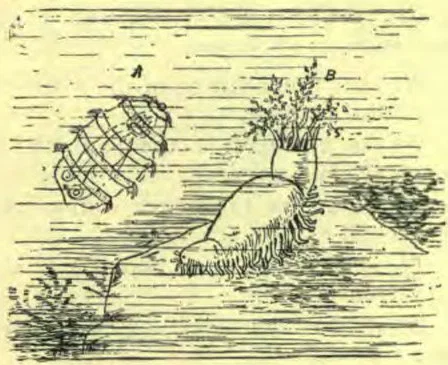
(a) Infancy of stone-lily. (b) Adult stone-lily.
This small division of life is commonly represented by four beings: The stone-lily, the starfish, the sea-urchin, and the sea-cucumber. These are representatives of families which also include some other smaller animals. They all develop from true eggs.
Only a few years ago four little jelly-bodies, we will imagine, were swimming about on the smooth waters of a quiet bay. They had each been hatched from the egg not long before, and were destined to become the four distinct animals enumerated above. At birth they were all very much alike, but each pursued a very different course of development.
No. 1 had not swam about for many hours as a mere jelly-drop before lime-plates began to form in its tiny body, arranging themselves in the shape of a cup, and below these other and smaller plates took up the form of a stalk. After a time the jelly-body began to shrink together, and the whole sank to the bottom of the sea, where it was fastened to a rock by a stony lime-plate, and remained fixed, looking like a stony plant; hence its name,—stone-lily.
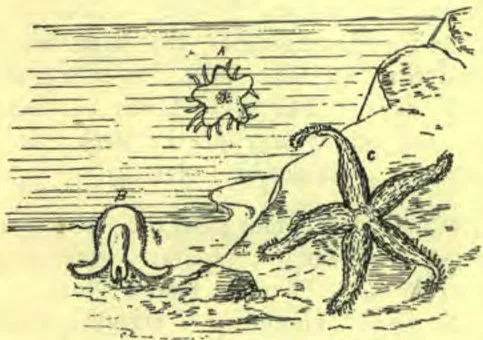
No. 2 followed much the same road for a short time, but soon took a number of curious shapes, and swam about briskly, while over his back was formed a net-work of lime, and a number of small, soft, transparent tubes grew under its body. After a time the whole sank to the bottom, swallowed its little jelly-body, and became a tiny yellow rosette with five knobs sticking out of it. The creature glided quickly over the rocks. It went on growing for two or three years, the five knobs lengthening into pointed rays, till it became the common five-fingered starfish.
No. 3 took a different path from the preceding. It had long, thin rods in its body, all pointing one way, so that it looked like a painter’s easel. At the top of the easel little plates of lime began to form a tiny round box with prickles all over it. By and by this box inclosed the jelly-body, leaving only a thin film over the shell; and sinking to the bottom, a tiny sea-urchin, it burrowed a hole for itself in the sand.
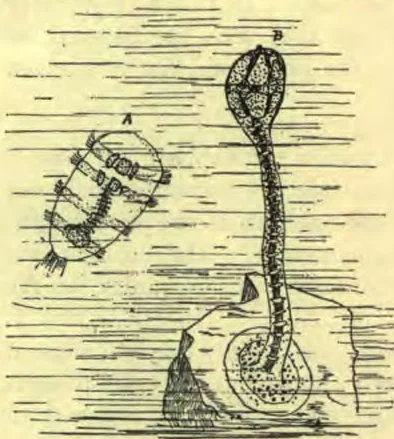
(a) Infancy of sea-cucumber. (b) Adult sea-cucumber walking on its tube-like feet. (Greatly magnified.)
No. 4 formed nothing solid, but growing a stomach and feet, stretched itself out in the shape of a tube. Then it put out some leaf-like tentacles around its mouth, while a few little lime spikes formed in the skin. Sinking into a crack in a rock, it became the worm-like creature called the sea-cucumber.
Now we will study them from a different point of view. The stone-lily is now almost extinct, only one species yet remaining,—the Medusa’s head, so called from the many arms that wave about its summit, which bears some resemblance to the fabled head of Medusa with its burden of venomous serpents.
The preferred abode of the starfish is not in the water,—except to secure the proper amount of oxygen to breath,—but in the solid ground beneath. It can swim, although it is really a creeping animal, and loves to poke about on the sandy bottom with its mouth down to the ground, sucking up mussels and shell-fish for food. But how does it glide along so smoothly? If you were to examine the grooves under each of the five rays, you would see hundreds of tiny transparent tubes waving in the same direction. In this way the body is drawn along like a canopy resting on the heads of more than two thousand bearers.
(a) A jelly-animal swimming, and the starfish forming within it. (b) The starfish settling down. (c) The starfish assuming its true shape.
The sea-urchin (Echinoidea), though not conspicuous for its beauty, leads a very interesting life. It walks by means of little tubes, like the starfish, aided by the tiny spines which cover its body. They have a kind of ball-and-socket joint, and rotate continually, which helps to propel the body. The animal looks like a hedgehog rolled up in a ball. But perhaps the most interesting thing about the creature are the little snapping claws at the end of each spine. We would naturally think that these were to catch little animals for food, but this is not the case; they are to protect the body against the small animals which would otherwise get down between the spines, and feed on the soft parts. The sea-urchin is used as an article of food by the Italians.
We have now reached the fourth and last form of life in this division,—the sea-cucumber (Halathuroidea). This animal is not so helpless as it appears; for in its skin are strong muscles by which it can draw its body in and out of the crack in the rock where it hides, much as a worm crawls. The sea-cucumber is a greedy creature, and often eats too much. When it suffers from indigestion, it proceeds to disembowel itself by vomiting up its interior viscera, its stomach, and even its tentacles, which it casts away, so that there is literally nothing left but an empty tube. Having reduced itself to a mere sack, or skin, it cannot eat, because it has no stomach, and it cannot walk, because it has no means of locomotion. It therefore remains perfectly inactive for some months. At the expiration of this period the tentacles begin to grow anew, and in a few weeks the animal has regrown a new set of the important organs which it had cast away.
T. J. ALLEN.

THE POWER OF LOVE.

A VERY rich lady heard one day of a poor family of children, who had a short time before lost their mother. This lady had a very tender heart, and was well known for her kindness to the poor and needy.
One afternoon during the Christmas holidays she ordered her carriage, and directed her coachman to drive her to the house where lived this family of whose sufferings she had been told by one of her servants.
On reaching the house, she alighted, and going to the door, inquired for the family whose name she gave. She was directed to the top floor. She ascended the stairs and entered the room, where a scene of poverty and suffering confronted her. The father, a sickly-looking man, sat by the stove with his head bowed in sorrow. In his lap sat a little one about five years of age. At his feet on the floor were three older children,—a girl and two boys.
“Good afternoon, Mr. Murray,” said the lady. “I have been informed of your affliction, and concluded to call to see if I could help you.”
“Thank you, lady. My trouble is indeed more than I can bear. It was hard enough before to provide for the children, and to keep a roof over their heads. But with what I could earn, and with their mother’s industry and tact, we managed to do it. But now that she is gone, I know not what to do.”
The good Christian woman looked with pity upon the children thus left without a mother’s watchful and loving care. Her eyes were full of tears, and she seemed in deep thought. At last she said, “I think I can help you. Let me take the little girl you are holding. If you will consent, I will adopt her, and she shall be as one of my own family.”
The poor father hesitated a moment, and then said, “O, I cannot give my child away; she is the very image of her mother. How can I part with my baby?”
“But see,” continued the lady, “how much better it will be for the child. I will be as a mother to her; she shall be educated, and shall share in all the present and future advantages of the family.”
“And when do you propose to take her? Now?” was the quick response. “I cannot think of her leaving until I can procure some new clothes for her. She would now be in a better condition had not her poor mother been sick so long.”
“You need not mind the clothes, Mr. Murray. I will soon have plenty of dresses provided, and she will look as nice as my own.”
She rose at once, went down-stairs, and procured a large shawl with which, on returning to the room, she wrapped the little one, and bearing her in her own arms, entered the carriage, and was driven rapidly home.
It was quite dark when she arrived, and the servants had lighted the gas in the vestibule and hall. The kind lady took the little girl by the hand, and led her up the marble steps into the hallway. But here the child, bewildered by the lights and the strange and elegant surroundings, positively refused to go any farther. Caresses, persuasions, and tempting offers of sweetmeats and toys proved unavailing. There she stood, and nothing that was said or done moved her.
A bright thought struck the lady, and shutting the outer door, she ascended to the nursery, where she found the children in noisy glee playing with their Christmas toys.
“Children,” she said, “listen, and I will tell you something that I know will interest you all. While out driving this afternoon, I called at a house where resides a family of children whose mother has recently died. They are in great distress. The children are all young, and the father is just now out of work. I feel greatly grieved for them, especially when I contrast their condition with yours. So I persuaded the father to let me have the youngest child,—a little girl they call Bessie. I have brought her home, and she is now in the hall. She refuses to come any farther. Everything is strange to her, and no doubt the poor little thing is already homesick. Now it occurs to me that only one thing will induce Bessie to come in, play with you, and be one with you; and that one thing is spelled with four letters. Can any of you tell what that magic word can be, that will bring the poor motherless child into the nursery, and make her willing to stay and be one among you?”
Willie immediately replied, “I know, mama, what it is. It is ‘cart’;” and taking his cart, he ran down-stairs, and calling to the little girl, who was sitting in the hall with her face buried in her hands, to look at his cart, he offered to let her have it, if she would come in with him. But the little frightened child would not lift up her head. The boy soon returned to the nursery, and reported his failure to win the little maid.
Then Mamie said: “I know what the letters spell; it is ‘doll’;” and carrying her doll, she hastened down-stairs. “See my pretty doll, Bessie. You may play with it as much as you please; only come with me to the nursery. We have plenty of pretty things there.”
But Bessie would not even lift up her head to look at the doll. Finding that she, too, had failed, she returned to the playroom.
Then Josie said: “Perhaps she is hungry. I will take her my cake; that is a word of four letters.” So, going up to the child, she said: “Little girl, here is a cake; you shall have plenty of cakes and nice things if you will only come in and play with us.” But the child still refused either to look or speak.
At last Nellie, the youngest of them all, said, “I know what the word is—it is ‘love’;” and going down to the hall, and seeing the child bent and weeping, she stood a few moments, her heart beating fast and the tears gathering in her eyes. Without saying a word, she sat down by her side, and throwing her arms around her neck, began to weep with the weeping stranger.
The charm was discovered. It was love expressing itself in tears of sympathy and kindness that won the confidence and the affection of the heart that was surrounded by strangers, and that was aching for a mother’s love. In a little while Nellie led the child into the house, and in a few days made her feel happy in her new and elegant home. Such is the power of love. When everything else fails, love will succeed. It has been known to melt hard hearts, and to conquer great kings. It is the secret that makes school cheerful and home happy. It is the bright and pleasant sunshine that gladdens everything. It is the most astonishing thing in the world. God is love, and he that has the most love will be the most like God. The thirteenth chapter of I Corinthians tells us what love is, and what love will do for us. People often talk of beauty; but I think the greatest charm a face can have is a kind, bright, loving look. I would, therefore, recommend all my young readers to get plenty of love,—beautiful, heavenly love.—Aunt Ettie, in Christian Witness.

AGRICULTURAL ANTS.

PROFESSOR W. J. McGEE, of the government scientific corps, recently paid a visit to some very remarkable farmers in Sonora, Mexico. These are the so-called agricultural ants, which plant fields of grain and regularly harvest their crops, upon which they depend wholly for food. In fact, should the crops fail, they would perish of famine. On the other hand, the cereals that they grow have been specialized by cultivation, like the wheat and other grains of the human husbandman, and would quickly disappear if the attention of the insects was withdrawn.
The fields of the farmer ants cover scores of square miles in Sonora, a large part of which is quite densely populated by them. The home of a colony is marked ordinarily by a circular clearing from five to thirty feet in diameter, on which nothing is permitted to grow. This serves as a sort of parade and exercise ground. Around the clearing is a ring of luxuriant grass from three to twenty feet wide. On the seeds of this grass the insects subsist, planting it every spring, and garnering the crop in the autumn. Across the rings which surround formicaries run turnpikes a few inches wide, connecting farm with farm for many furlongs.
In the region described there is practically no vegetation except the grasses cultivated by these ants. The latter appear to keep down and exterminate all other plants, such as cacti, greaseweed, and mesquit. The plants naturally prevailing in that part of the country are entirely absent from the most thickly settled farming districts. In short, these insects have developed an art of agriculture peculiar to themselves, have made conquest of the land for their needs, and have artificialized certain cereals as thoroughly as maize and barley have been artificialized by man. “Thus,” says Professor McGee, “the rigorous environment of the desert has developed one of the most remarkable intelligences; and incidentally, an animal and a plant have come to be mutually dependent upon each other for existence.” The favorite cultivated plant of these ants is the familiar buffalo grass.—Scientific American.

THE POTATO AS A FOOD.

EVERY one knows the great value of the potato as food, but all do not know, perhaps, how lightly it was regarded when it was first discovered. Even after it became recognized as a food, for a long time it was used about as we now use turnips. If a farmer had three or four barrels of potatoes, he expected that his cattle would eat the most of them. Now the potato, and that other valuable American food, the maize, has spread over the world, and they have obtained that recognition which their value deserves.
The following from the Inter Ocean was told to illustrate the ability of the celebrated Daniel Webster to interest a party of farmers whom he met while traveling, but as it gives so concise an account of the early history of the potato as a food, we repeat it for the benefit of our readers: —
“Mr. Webster went back to the remote times of the close of the fifteenth century, when the potato was a scrub plant, and the crew of the ‘Pinta,’ with Columbus, had landed upon the Western continent, and found comfort in it as an article of food; how it was afterward carried to Europe by the Spaniards, and cultivated with the tomato merely as a garden curiosity; how Sir Francis Drake, Hawkins, and Raleigh, in 1623, transplanted it to Ireland and England, all the time undervaluing its merit; and how long a while it took to awaken in the public mind a knowledge of its worth; how finally a confession was extorted from European high authority that the potato and Indian corn were the two greatest blessings America gave to the world; how, notwithstanding all this, they were still used as food for cattle and horses, though in a pinch it was thought they might help bridge over a starving people who had met with failure in the crop of cereals. Mr. Webster related that even in Washington’s day the father of his country had proclaimed loudly against the vile and ‘vulgar horse food,’ as he called it, known then and now as corn meal, and which was not considered good enough for the soldier. Mr. Webster spoke of the German and French people, who wouldn’t eat either of these articles of food; that when Antoine Parmentier, a philanthropist, had helped on and improved their cultivation and urged their daily use, Johnny Crapaud wouldn’t listen to him. “Finally the government felt the need of aiding in this business, and gendarmes were placed around the potato field, plentifully planted with them, as if to guard a highly precious commodity, and Louis XV ordered the potato blossom to be worn by the court ladies. This done, the tide turned in favor of the poor, persecuted potato, and under the loftier name of pomme de terre, it came out of the fire of opposition cooked, as it is now said to be by the French cuisine, in some three hundred different ways. By this compulsory recognition, it now holds an honored place upon the table, an indispensable adjunct.”

WHEN DID THE WAR END?

It is generally thought that the civil war in the United States ended in the spring of 1865, when Richmond was taken, and the Confederate generals and soldiers laid down their arms. Such was the idea held lately by Assistant-secretary Reynolds of the interior. A soldier, who did not enlist until April 19, 1866, applied for a pension under the three-months’ service act. The secretary, in refusing his claim, said: —
“It is not believed that Congress intended to pension those whose rendition of service, military or naval, had no connection whatever with the belligerent operations of the war, was not upon the theater of the conflict, and had nothing to do with the object and purposes of the war.”
But this decision of the secretary will not hold. War is begun by official action, and some official action or proclamation must mark its close. In 1887 a case under the “captured and abandoned property act,” growing out of the war, was brought before the Supreme Court of the United States. The settlement of this case involved the question as to the exact time of the end of the war. The court held that the close of the war must be marked by some formal act, and that “as Congress in its legislation for the army has determined that the rebellion closed Aug. 20, 1866, there is no reason why its declaration on this subject should not be received as settling the question whenever private rights are affected by it.” This act of Congress was the ratification of a proclamation by President Johnson, fixing that date as the close of the war.

NOW I LAY ME DOWN TO SLEEP.

The fire upon the hearth is low, And there is stillness everywhere; Like troubled spirits here and there The firelight shadows fluttering go. And as the shadows round me creep, A childish treble breaks the gloom, And softly from a farther room Comes: "Now I lay me down to sleep."
And, somehow, with that little prayer And that sweet treble in my ears, My thought goes back to distant years, And lingers with a dear one there; And, as I hear the child's amen, My mother's faith comes back to me. Crouched at her side I seem to be, And mother holds my hands again.
O for an hour in that dear place! O for the peace of that dear time! O for that childish trust sublime! O for a glimpse of mother's face! Yet, as the shadows round me creep, I do not seem to be alone — Sweet magic of that treble tone — And "now I lay me down to sleep."
— Eugene Field.

WHY WAS SHE SO HAPPY?

I was calling on a friend the other evening, and just as I stepped into the sitting-room, I heard her say to her little daughter: “It is your bedtime, dear; my little girl must go to bed early, and then she will be bright for her lessons to-morrow.”
The little girl was sitting in her papa’s easy-chair, holding in her lap a very large doll. As I sat down, I saw she was very busy brushing its hair and smoothing its clothes, looking it over very carefully, to see that everything was just as it should be.
“What a dear little dollie! How pretty her hair is, and how becomingly she is dressed!” I said. The little girl was pleased that I should notice her baby, and began telling me all about her.
“Not to-night, little one,” I said. “Didn’t I hear mama say it was her little girl’s bedtime?”
The mother very quietly began talking to me, while the little girl went on fixing dollie for the night. Only for a moment, however; then the little girl slid very slowly out of the big chair, gave her mama three long, sweet kisses, with a pleasant good-night for us all, and with dollie hugged tightly in her arms, went soberly away upstairs. But in a few moments we heard her singing a soft little lullaby to her baby.
Very likely the little girl could not have told what made her feel like singing; but I know. It was because, instead of fretting over not being allowed to sit up longer, she had cheerfully obeyed her mother’s wishes.—Child’s Hour.

A GIRL’S STORY OF LINCOLN.

I THOUGHT I would send you an anecdote concerning President Lincoln that I never have seen printed before. Years ago, when my papa was a little boy, and Abraham Lincoln was a poor young man practising law in Woodford county, during court week at Metamora grandpa brought him home to supper. It was a cold, stormy Monday night, and grandma hurried around getting supper, and thought she would have something extra; so she opened a jar of preserved peaches. When they sat down to eat, grandma dished the peaches out, three to a person. It seemed to take Abraham Lincoln a long time to eat a peach, and he did not finish it, either. So as soon as he had finished his supper, and had gone into another room, grandma went to his dish to see why it was he hadn’t eaten; and there she found she had given him the little muslin sack with the peach kernels and spice in it, instead of a peach. Grandma hurried into the other room to apologize to Mr. Lincoln, and he said to her: “That is all right, Mrs. Perry; my mother used the same thing, and it was so good that I wanted to get all the juice out of it.”—Frankie Perry, in Chicago Tribune.

Judge Judson Harmon Appointed Attorney-General

THAT President Cleveland promoted a member of his cabinet, Mr. Olney, from the position of attorney-general to that of secretary of state, made it necessary to find some one to take the office formerly held by Mr. Olney. June 7 the president announced the appointment of Judge Judson Harmon, of Cincinnati, Ohio, to be attorney-general. Judge Harmon is a distinguished member of the bar of his State, but is not known to the public generally. He is a graduate of Dennison University, and is fifty-five years old. He has never held any office except on the judicial bench. The especial duties of the attorney-general are to advise the government in all legal matters.

Japan Moves to Conquer Formosa by Force

THE Japanese have entered upon the conquest of Formosa. Although the island was ceded to them, its rebellion and attitude of resistance make it necessary for Japan to take it by force. China never had much control of the people of the interior of the island, so she could give only a kind of quit-claim deed of it. Japan, by force of arms, will make her title good. The imperial guard of the Japanese emperor has been sent to Formosa, and there are reports of a Chinese defeat with a loss of three hundred killed.

Beginning a New Series on the Sabbath

THIS week we begin the study of a new series of lessons, the Sabbath being the subject. No more important theme could claim our attention.

You have reached the end of this edition.

The Youth’s Instructor · Jun 20, 1895