S. D. A. Publishing Association · Battle Creek, Mich. · Jun 20, 1895
JAPAN
By Mrs. John A. Brunson
There is a great deal to be seen in Japan to catch the fancy and please the eye of a stranger, but also much to cause pain to the observant, the earnest, and the reflective. Facts have been glossed over and invested with a tinge of romance not true to life.
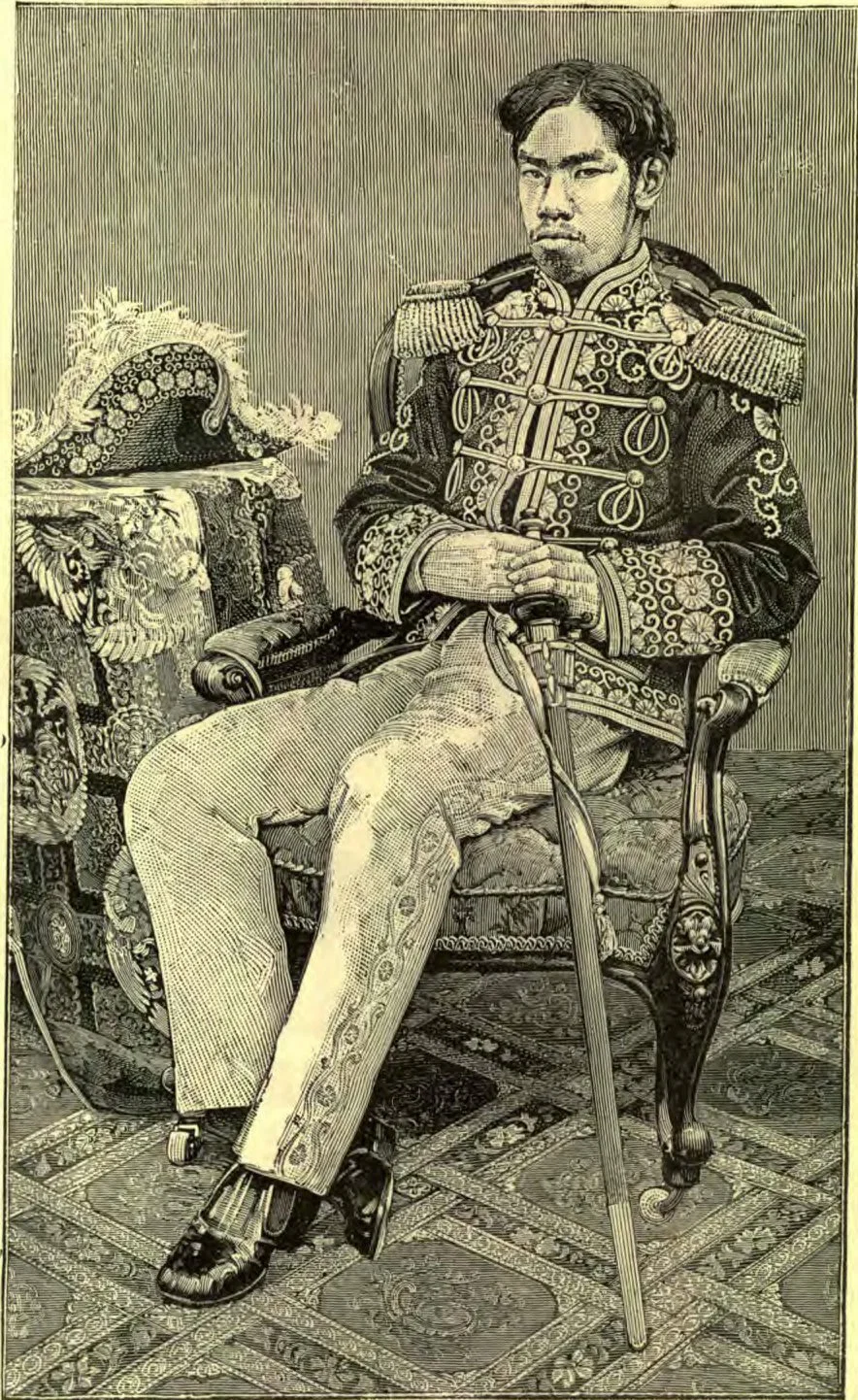
THE EMPEROR OF JAPAN.
In this little island, not larger than the New England States, and about two thirds consisting of mountainous lands, one can readily see that there is not much surplus room. The majority of the natives are extremely poor, compared with Western nations, and can live upon about a tenth, or less, of what it takes to sustain an American. They are very proud of the history of their country, and also very justly so of her fine scenery. Japan is girt round by the ocean that rolls in its restlessness or sleeps in the sunlight, and reflects on its broad bosom the over-arching canopy and the azure mountains, refulgent and glowing with the tints of an ever-varying sky. Great silver lakes nestle among the green hills mantled with flowers which seem to gaze meditatively into the deep heart of the crystal waters. The little blossoms that adorn like bright gems the banks, nod and coquette with the soft clouds mirrored beneath. Peaceful rivers flow through the country, rippling along among the tall rushes and groves of bamboo and pine, or, coming boldly out into the cultivated plains, bring life and moisture to the rice fields and tea plantations. What wonder, then, that the Japanese people have developed such fondness for beauty, surrounded as they have been for ages by such enchanting scenes of matchless loveliness!
The comity of this people is marked. They are courteous, affable, and self-depreciative,—almost beyond the limits of sincerity, so it appears to the practical American. This accounts, in a measure, for the extreme difficulty of the language to a foreigner. The speaker must refer to himself in the most depreciative and abject terms, while he addresses his companion in a very exalted and complimentary manner.
This nation is now in a transitional state. She has placed ancient religions, customs, and civilizations in the balance against Western progress and Christianity. Though old things are passing away, the prejudices, practices, and beliefs of centuries cannot be lightly cast off or discarded in a short time. For instance, some time ago the mikado visited various portions of his dominions; but, although vast crowds flocked to see him, it was observed that no one mounted an eminence, or looked from an upper window, but all stood with bared heads upon the ground. Why?—Because no one dared to look down upon such an exalted personage as the “Son of Heaven,” as the ruler of Dai Nippon (Great Japan) is called. Formerly the emperor’s subjects were not permitted to look upon him, and he was worshiped as a god. The present empress is said to be a most gracious lady, discouraging such old and absurd practices as shaving the eyebrows and blacking the teeth, and promoting by her patronage and assistance the establishment of schools for the education of girls and women. Though wonderful progress has been made in the last few years, and civilization and Christianity have made rapid strides in the island empire, still to-day the masses of the people are heathen.
There are three distinct systems of religion in Japan, so intermingled that the majority of the people can be said to be adherents of all three, without a clear comprehension of any of them. Though the Sabbath is unknown among them, they yet have festivals and set days when they flock to the temples, to make offerings and hear the priests chant prayers. The paraphernalia used in the Buddhist temples is almost exactly like that employed in the worship of the Roman Catholics. These are images, pictures, lights, holy water, altars, and beads; almost everything found in Roman Christianity is found in Buddhism. Even the holy objects belong to the same category. The Buddhists pray to bones of saints, foot-prints of Buddha, holy toe-nails, statues of wood, from which blood flows (so they say), and numerous other sacred relics.
The religion of the Japanese heathen sits lightly upon him, unless he is in trouble. He then begins to haunt the shrines of the gods whom he imagines may be able to help him. He will petition the god to slay a man as quickly as he will to bless him, if he has cause of complaint against him. The priests as a class are very corrupt; and though the people have but little confidence in their priests, they will go on permitting these “blind leaders” to do their praying for them and giving them money to live in idleness, until we teach them a better way. It is considered a very meritorious deed to make a pilgrimage to a sacred shrine.
Among the most popular of the shrines are those of the sun goddess at Isi. Scenes have been dramatized from the life of this deity,194and have had a most debasing effect upon the purity and morals of the people. They are particularly fond of visiting the shrines upon high mountains; and as they ascend, they ring bells and chant an invocation, which, being interpreted, means: “May our six senses be pure and the weather on the mountain be fair.” They repeat this in Chinese, and have no idea what it means. After bowing down a few times before the idols and paying the priest, they go to the theaters, gambling dens, and other resorts of similar nature by which the favorite temples are usually surrounded.
The temples are never shut, so that the devotees go whenever they wish, and tap the bell to call the attention of the deity if he happens to be sleeping, visiting, or inattentive. They clap their hands and mutter vague prayers, such as “Namu Amida Butsu” (Save thou, great Buddha), a great number of times. They attach no special meaning to the words, and if the more ignorant among them are asked for an explanation, they will reply: “Our fathers made that prayer, and we make it, knowing that the gods will understand it and bless us.”
THE EMPRESS OF JAPAN.
They never leave the temple without making an offering. Surely that is a lesson for us. If we appreciated as fully as we should our duty and privileges in giving our means to the Lord, to be used for the spread of the gospel, it would not be long before the light would shine brightly not only in Japan, but all over the world, and all the honest-hearted would forsake their idols of wood and stone for the worship of the true God.
MRS. JOHN A. BRUNSON.
THE BLESSEDNESS OF NOT KNOWING.
By J. R. Miller, D.D.
It is one of the mercies of our life that we do not know what shall come to us. In the unopened years there may be waiting for us trials, disappointments, and losses. None of us knows what chapters of sorrow will yet be written ere our life-story is finished. Would it be a blessing if the veil were lifted to-day, showing us all, down to the close, that will be painful or sad?
There are old people now well through life's journey. They have had many cares and trials. Friends have failed them. Children have been taken away. They have had struggles and hardships. They have endured sickness and loss. They have not found what they had hoped to find in life. Suppose they had known all this when they had set out from some bright spot in sunny youth; would it have been a blessing to them? Would it have made their life a happier, richer, better one?—No; it would have cast a tinge of sadness over it. It would have taken out of it much of that zest and interest which have been such an inspiration to them through all their years. If a man had known, for example, that, after all his toil, struggle, and self-denial, a certain great undertaking would fail, he would not have begun it. Yet, perhaps, that very labor of years, though it proved in vain at last, has been the richest blessing of his life. It drew out his soul's energies. It developed his strength. It taught him lessons of diligence, patience, courage, and hope. It built up in him a splendid manhood. The mere earthly results of our work in this world are but a means to a higher, nobler end, and are of small importance in comparison with what our work does in us. But if a man had known in advance that nothing permanent would come out of all his toil, economy, and self-denial, he would probably have said, “I may as well have an easy time. What is the use of working like a slave for forty or fifty years, and then have only weariness and emptiness of hand at last?” Not knowing, however, that his efforts would fail in the end, hoping that they would succeed, he lived earnestly, laboriously, putting his whole soul into what he did. His work failed, but he did not fail. There is no material result to tell men of any achievement; but there are imperishable results in the man himself, in life, in character, in manhood—results far nobler than the noblest work could have achieved in mere material forms. It was better he did not know that all would fail; for if he had known it, he would have missed all this good.—J. R. Miller, D.D.
“BROKEN CISTERNS” AND “LIVING WATERS.”
By M. C. Guild
MEN plunge into the current of the world in search of wealth, hoping when they have gained it to find happiness and satisfying pleasure. It is estimated that not more than one man out of five hundred who seek material wealth succeeds, and the few who are successful in gaining it, often find that it brings only care, sorrow, and perplexity. Although sought with the hope that it will bring true joy and contentment, it proves like a broken cistern that can hold no water.
Others seek to find in worldly amusements that which will satisfy the longing of the soul. Such pleasure is soon found to be only as a glittering bubble that soon vanishes away. Often the effect is that “even in laughter the heart is sorrowful; and the end of that mirth is heaviness.” Is not this another broken cistern?
Then there are those whose height of ambition is to gain honor and fame. History testifies that but few of the vast army of men and women who cherished this desire have ever succeeded. Those that have gained worldly distinction and honor have finally had to leave it all, and many of them have been led to say with one who fell from a high position, “Alas, for all my greatness!” In the end all worldly motives lead to results that are but as broken cisterns which can hold no water.
On the contrary, little things become great and glorious when wrought from a great motive of love, and the cup of the doer runs over with joy and contentment. The living water is the only thing that can satisfy the soul.
Have you been drinking from any of the broken cisterns of this earth? Then the invitation of Jesus to you is: “Come unto me, and drink.” Are you weary and heavy laden? His tender voice is saying to you, “Come!” Are you sick of sin, and do you long to be cleansed from its polluting stains? Plunge into the fountain, and be made “every whit whole.” There he will wash you “whiter than snow.” Have you heard the pleadings of the sweet voice of mercy? It says: “Let him that heareth say, Come.” Are you longing and thirsting for something better than you now possess? “Let him that is athirst come.” Do you say that you are too great a sinner? “Whosoever will, let him take the water of life freely.”
“Come to the living waters, come!
Obey your Master's call;
Return, ye weary wanderer, home;
My grace is free for all.”
M. C. GUILD.
Blessed is the man that endureth temptation.
DEATH OF SECRETARY GRESHAM.
WALTER Q. GRESHAM, secretary of state of the United States, died at his home in Washington, D. C., at 1:15 o’clock, May 28. The secretary had been ill for some time, but he was not known to be in danger, and his death was generally unexpected. Probably few men were better known in this country than Judge Gresham. He has been prominently before the people for many years, holding important offices in both military and civil affairs, rising to the high and responsible position of secretary of state, and whether in peace or in war, discharging his duty with a conscientious fearlessness that won the respect of all parties and the admiration of the world.
He was born in Harrison county, Indiana, March 17, 1832, and was sixty-three years old at the time of his death. He was a farmer’s boy, and gained his education by dint of much hard work. He chose the profession of law, and was admitted to the bar at the age of twenty-one. Politically he was a Whig, but united himself to the new party which nominated Fremont for the presidency. At the commencement of the civil war he enlisted as a private, was immediately promoted, and continued to rise, until in the spring of 1865 he was made a major-general. He took part in all the fortunes of war, and was severely wounded at Atlanta.
It is not necessary to name the different offices which Mr. Gresham has held, but among them may be mentioned United States Judge, postmaster-general, and his last office of secretary of state. In 1888 he was named for president in the Republican national convention, and received one hundred and twenty-three votes. He would give no pledges of what he would do if elected, which lost him the support of many politicians.
Judge Gresham disconnected himself from the Republican party in 1892, and received his appointment of secretary of state from President Cleveland. It is understood that he has not always been in harmony with the president, but he probably would have retained his position to the end of the term, but for his death. He has had many perplexing questions to grapple with, and if he has not satisfied all, it is safe to say that no other man could have pleased more. His good offices in the interests of peace between China and Japan were appreciated by both those powers. Finally, he was a thorough American, true to his convictions of duty; and one of the most beautiful traits of his character was that he never took advantage of his position to hedge himself about with an artificial and unnecessary dignity, but was accessible to all, and treated high and low, rich and poor, with consideration and respect. His political foes were often his personal friends; and American citizens, of all parties, will mourn his sudden death.
Central American Union.
The people of the various States of Central America have for some time been discussing the project of forming a union of their now independent States under one general government, after the manner of the union of the United States of America. There are many who do not favor such a union, fearing that the States will lose their independence. It is not strange that some of the people of the Central American States should take that idea of it; for it was precisely in this way that many of the people of the English colonies which became the several States of the United States looked at this question when, at the close of the war of the Revolution, a general government for all the colonies was proposed. It took all the personal influence of Washington, aided by the adroit and skilful statesmanship of Alexander Hamilton, to overcome the scruples of those who feared that their States would lose their independence should a general government be established. Of course the several States did lose some of their independence, but by the union each State gained the protection of all the rest, and a nationality was secured that never could have come under separate and absolutely independent State governments.
The Central American States are now addressing themselves to the same task. The same objections will be urged there that were used here against the union, and similar reasons and arguments will be adduced in its favor. The argument urged by those who favor the union, which is based upon the idea that by a coalition these States will be better able to resist foreign aggression, is much strengthened by the late difficulty between Great Britain and Nicaragua, in which the latter country was compelled to pay its powerful adversary seventy-five thousand dollars, or go to war with the certainty of being defeated in the end. This affair with England has certainly had a strong effect toward promoting a union of these weakly States, and lately the first practical steps were taken by a new treaty between Nicaragua and Honduras. May 15 this treaty was put into effect by proclamation of the presidents of these countries, and foreign powers were notified of the new relations between them.
Among the important points mentioned in this new treaty are an offensive and defensive alliance against foreign powers, an agreement to arbitrate their own differences, and a promise to endeavor to make the relation of each to other powers of a uniform character in the matter of duties and business affairs generally. It is expected that the other States of Central America will later come into this union. If they can be persuaded that it will be an advantage to them, no doubt a general union of these States will be secured. Then a constitution covering them all can be adopted, and Central America will become a nation,—the United States of Central America.
ARMENIAN REFORMS.
THE sultan does not take so kindly to the proposed reforms in Armenia as was at first reported. The idea that the powers of Europe are to dictate to him who he shall appoint as governors of provinces, has evidently touched his pride a little. He thinks of Amurath and of Solyman the Magnificent, whose throne he occupies, and longs for their power, that he might bid defiance to the hated giaours. At any rate, his answer to the demands of the powers is not at all satisfactory. England has now seventeen ships of war at Beyroot, and there is a clear understanding between England, France, and Russia that they will not abate a jot of their demands for complete reform in the Turkish administration of Armenia.
The slowness of the sultan to acquiesce in the demands of the powers is believed to rest upon his hope of the help of other European powers. Germany is supposed to be the power to which the sultan looks for support, as he is known to have written, himself, to Emperor William in regard to the matter.
Lately a murderous assault was made by Turks at Jiddah upon the foreign ambassadors there, in which the British vice-consul was killed, the consul wounded, and the Russian consul was also seriously hurt. This makes another grievance for the powers. Three French cruisers have gone to Jiddah to support some British ships which are there. Once England and France supported Turkey against Russia, but they now join with Russia in a threatening attitude toward Turkey. Startling developments may be expected at any time.
SECRETARY OLNEY.
SCARCELY had Secretary Gresham breathed his last when speculation was rife as to who would be appointed by the president as Gresham’s successor in office. June 3 President Cleveland tendered the office to the Hon. Richard Olney, of Massachusetts, who has served the administration in the capacity of attorney-general. It was at once accepted, and Mr. Olney is now secretary of state of the United States. Mr. Olney is said to be very well informed on the present relations of the United States with all foreign governments, and concerning all matters left unfinished by his predecessor. It is also thought that he is in better accord with the president than was Mr. Gresham. In the Hawaiian episode, and in regard to foreign affairs generally, the president and Mr. Olney have been in harmony. Probably this had something to do with his appointment to a higher and more responsible office.
CUBAN SUCCESS.
By M. E. K.
THE rebellion in Cuba, which General Martinez Campos was going to put down in such short order, has entirely outgrown the calculations of that doughty hero, and he is calling lustily to the mother country for more battalions. Some seemed to think that his presence in Cuba, alone, would, like Sheridan at Winchester, turn the tide of battle; but neither he nor his army, nor both together, has checked the rising tide of revolution. The Cuban leaders have been several times reported to be killed, but with singular obstinacy they have refused to remain dead, and their operations are now more active than ever. Several expeditions are reported to be nearly ready to sail to Cuba from this country; and in response to the call of General Campos, Spain will send ten more battalions of troops and another general. Spain is greatly stirred over the success of the rebels, and the failure of Campos to end the war. In the Spanish Chamber of Deputies a republican member asked that there might be a free discussion of Spanish and Cuban affairs. A resolution which he offered to that effect was rejected by a vote of one hundred and thirty-two to nineteen. There is not much hope for free discussion in Spain, nor hope for Spain either, until there is a change of sentiment there. Spain has a good deal of the Bourbon in her; she never forgets anything nor learns anything. As the historian Buckley says: “She is proud of everything that she ought to be ashamed of.” But what can a people do when they are bound body and soul to the Catholic Church? A nation cannot advance until the people are weaned from superstition and are ready to go forward.
M. E. K.
REPENTANCE
When God would work in an especial manner for his people, to manifest his power among them in the salvation of their souls and the spreading abroad of the knowledge of himself, he has invariably begun his work by calling upon the people to repent. The reformations wrought in the days of Elijah and Elisha and of Josiah, were preceded by earnest calls of the people to repentance.
This was especially true of the time of the advent of Christ. The Jews had been conquered by the Romans, and were suffering a most galling bondage. Their national pride had been greatly humbled, but they were not inclined, as a people, to recognize in the Roman conquest a partial punishment for their own sins. They hated the Romans as they did the Samaritans, and had little interest in their salvation. They multiplied their fasts; they paid their tithes with great exactness and the most scrupulous honesty; they made all the offerings required by the law, and really did about everything but the one important thing, which is the hardest of all for human beings to do,—to recognize their own personal sins, to repent of them, and by God’s grace to put them away. This they did not do. They increased the number of their outward forms of religion, but their hearts were unchanged.
At this time they were expecting the Messiah, and that he would subdue their enemies, and make himself and them with him the masters of the world. Thus they were fostering their pride; and had Jesus given them the desires of their hearts, it would but have increased their pride, and made them become more and more like Satan and less like the God whose chosen people they were, and whom they professed to serve.
What, then, must be the message that God will send to that people to prepare them to receive the Messiah so soon to appear? What can it be but a call to repentance? God had his agent prepared,—not from the schools of learning, though some, like Paul, at a later date joined in the great work; but in the wilderness of Judea, in the country, a man all unknown to men, but known to God, began to preach, and to call in no uncertain tones upon the people to repent. The prophecy of seven hundred years before was fulfilled,—“the voice of him that crieth in the wilderness, Prepare ye the way of the Lord,”—and when we realize the nearness of the coming of their king, the great good that he could do them, and how much depended upon their own attitude toward him and the truths he would unfold to them whether his coming would be a blessing to them or not—when we realize this, we may better see the great force in the preaching of John, when he said, “Repent ye: for the kingdom of heaven is at hand.” Those who did repent of their sins under the preaching of John, were thereby prepared to accept the Messiah when he came, and to receive the truths which were the rules of the kingdom of heaven which he came to establish.
Repentance is to see ourselves as we really are, and, recognizing the terrible condition into which we have been led by sin, to have that deep and thorough sorrow for our wrong conduct that will result, with God’s help, in a change of life. The above may not be a theological definition, but it is one that all can understand. God calls upon all to repent. The message of John, taken up by Christ and his apostles, and by their successors to the present day, is still: “Repent ye therefore, and be converted.” There is no salvation without repentance; for evil will not be allowed to exist forever in the kingdom of God, and sin is evil and only evil. It is never too early to repent; there is danger that many will repent when it is too late. Jesus tells of some who will say, “Lord, Lord, open to us,” and he will answer, “I know you not.” To-day we may repent, be forgiven, and be accepted in Jesus Christ, the Beloved. We cannot be too soon in giving our hearts to him; and as giving our hearts is giving ourselves, we may rest assured that he will keep us, as he has promised, in perfect peace. The Lord desires to do great things for us and through us; but he can use us only as we yield ourselves to him. Shall we do it, and do it now? “To-day if ye will hear his voice, harden not your hearts.”
ARCHBISHOP KENRICK.
ARCHBISHOP KENRICK, of the Roman Catholic diocese of St. Louis, was relieved, June 3, from the position which he has held for many years, and the active duties of the office have been conferred upon John J. Kain, his coadjutor in office. A telegram from Rome on June 4 announced this very important change. The cause for this may probably be traced back to 1870. He was a member of the Vatican Council which declared the infallibility of the pope. In all that great conclave there were but two dissenting votes cast. Kenrick was one of these dissenters; and although afterward, as a loyal son of the Catholic Church, he accepted the dogma, Rome never forgave him for his independence, nor could he be let to die in peace; and now the stroke of Roman displeasure, long delayed, has fallen upon him, and the aged prelate will close his days, from a Catholic point of view, with an eternal stigma attached to his name. Had the civil power of this country been under the control of the pope in 1870, as Sigismund, emperor of Germany, was in 1440, and had Kenrick retained the courage of his convictions, he might have become the Huss of America. But Kenrick was not a Huss. He submitted, but Rome did not forget.
Archbishop Kenrick was born in Dublin, Ireland, in 1806, and was made bishop of St. Louis in 1843. His brother, who died in 1863, was bishop of Baltimore, and at one time had charge of the whole Catholic Church in this country.
Mental infirmity and an unwillingness to work in harmony with his coadjutor are the reasons for the diminishing of Kenrick’s authority, and the enlargement of the power of his colleague. It is quite likely that the propaganda at Rome saw the evidences of mental infirmity in the archbishop in 1870, when he voted against the dogma of the infallibility of the pope! When Roman bishops show any independence, if they are allowed to hold their office they are generally surrounded with spies; and it is likely that it was in this capacity, as well as that of a colleague, that Kain was appointed to the St. Louis diocese. The position of the aged archbishop could not be pleasant under such circumstances, and it is no wonder that there was some friction between him and Kain.
All Things for Our Sakes: Creation and Redemption
By M. E. K.
PAUL, writing to the Corinthians, says: “For all things are for your sakes, that the abundant grace might through the thanksgiving of many redound to the glory of God.” God for his own glory made man. He created him that he might have intelligent beings in his likeness upon whom he could bestow his love. They sinned, but God gave his Son to redeem them. All this, both creation and redemption, was for our sakes, that we might be holy and happy. Thus the thanksgiving of many thousands of redeemed souls will, through countless ages, redound to the glory of God. M. E. K.
A LIVING SACRIFICE.
It is the privilege of a Christian to give himself to Christ and to his service, for that is what giving oneself to Christ means. When this is done, he will do the works of Christ, which can be done only by the presence of Christ with the believer. In other words, one cannot do the works of Christ apart from him. Christ’s works are his own works, though wrought through the believer. This is what is meant by a “living sacrifice.” Says Paul: “I beseech you therefore, brethren, by the mercies of God, that ye present your bodies a living sacrifice, holy, acceptable unto God, which is your reasonable service.” Christ’s sacrifice was and is a living sacrifice. True, he died for us; but the sacrifice began when he offered himself for man, has been continued through all man’s history, both before and since the crucifixion, and will last through the eternal ages. It will always be an eternal truth that he gives himself for us and to us. It is in view of this fact that we are invited to give ourselves to God in the same way, for the service and benefit of our fellow-men.
The sacrifices of the Jews, which were symbolic of Christ, were dead, because during his sacrifice Christ died, and because beasts could be of no service any other way; but mankind, intelligent, redeemed from sin,—they can give themselves to God’s service, living illustrations of the great sacrifice of Christ. They can, too, if need be, die for the cause of their Master. Said Paul: “I am ready not to be bound only, but also to die at Jerusalem for the name of the Lord Jesus;” and again: “Yea, and if I be offered upon the sacrifice and service of your faith, I joy, and rejoice with you all.” To do all this, if need be, is our “reasonable service”—reasonable, for we have received all from God, and because nothing, not even death, takes us from his loving care. To work for Jesus while we live is a preparation to “sleep in Jesus,” should we die, and to rise with him to a life that has no end.
The living sacrifice should be “holy.” The command of God is: “Be ye holy; for I am holy.” Holiness is an attribute of God, and can be attained by us only as through faith we become partakers of Christ’s holiness. Then, when our chief desire is to serve him, when his words abide in us, we can lift up holy hands, without wrath or doubting that we shall receive what we desire. Paul was himself a living sacrifice. He reckoned himself as “dead indeed unto sin, but alive unto God.” He regarded himself as belonging to God. Thus he said: “For there stood by me this night the angel of God, whose I am, and whom I serve.” Acts 27: 23. He was the Lord’s, and his service belonged to him. To stand in that place, recognizing and granting the rights of the heavenly Father, and enjoying the sweetness of his blessed service, is the glorious privilege of every child of God.
LESSON 1.—THE SABBATH—ITS INSTITUTION.
By M. E. K.
(July 6, 1895.)
ANALYSIS.— The Sabbath,—when made, how made, for whom made, by whom made.
1. WHAT is the meaning of the word “Sabbath”? Ans.—Rest.
2. Whose rest-day is the Sabbath? Ex. 20:10, first clause.
3. What had the Lord been doing just before he rested? Gen. 1:1, 3.
4. Then at what time was the Sabbath made? Gen. 2:1–3.
5. What three distinct things were required to make the Sabbath? Gen. 2:2, 3.
6. Why did God bless and sanctify the seventh day? Gen. 2:3.
7. Is there anything real in God’s blessing? (See note .)
8. What is it to sanctify? (See note .)
9. Was one day only thus blessed and sanctified? (See note .)
10. For whom was the Sabbath thus sanctified, or “set apart”? Mark 2:27.
11. Of what would it naturally remind him? Ex. 20:11.
14. What else was made through, or by, Christ? Col. 1:16.
15. Then who made the Sabbath?
16. Christ says he is Lord of what day? Mark 2:28.
17. Then which day is the Lord’s day?
18. It comes next before what day of the week? Mark 16:1, 2.
19. So the Sabbath is the seventh day of what? (See note .)
NOTES.
ADDITIONAL NOTES.
The Sabbath is the Lord’s. It is then as if God said: “It is my day; therefore devote it to my special service.” In this way we may understand the fact that it is the Sabbath of the Lord, and at the same time that it is given to man.
If God had designed the Sabbath for only a part of the human race, he certainly would not have instituted the Sabbath at the very beginning of the human race. He brought the Sabbath into contact with humanity at the earliest possible moment. Human nature is alike everywhere. Not only are all men of one blood (Acts 17:26), but they all possess the same nature. Then what is adapted to one race of men is good for all. God gave the Sabbath, as it were, in trust to the head of the whole human family, to be remembered by all his posterity.
Paul says of certain heathen nations that they “did not like to retain God in their knowledge.” Rom. 1:28. The very purpose of the Sabbath was that they might not forget God, their Creator. A failure to keep the Sabbath would thus be a great step toward forgetting the God of the Sabbath, while the observance of the Sabbath would be a direct means of retaining God in their knowledge.
It is in this sense that the Sabbath is a blessing. Surely what serves to keep fresh in our memory the Creator of all things and the Author of all our mercies, must be a blessing to us. Such the Sabbath has ever been to those who have “remembered” to “keep it holy.”
The Sabbath was a part of God’s plan. It existed in the mind of God from the beginning. Every one of the six days of the first week preceding the first Sabbath, had reference to that Sabbath; they marked the steps by which the Sabbath was reached. It was in recognition of this fact that the Jews named each day of the week after the Sabbath as follows: “First day of the Sabbath,” “second day of the Sabbath,” etc. It would be well for us if we could look at the Sabbath as God did, and let each day of the week be to us a daily reminder that the Sabbath is approaching, and that we should be prepared to enjoy its blessings.
The wisdom of God is shown in giving man a commemorative institution as a remembrancer of the work of creation rather than anything else. All the people of this country know of the Fourth of July, and its signification. The yearly observance of this day engraves upon the mind of every child the facts which the observance of the day commemorates. Not yearly, but once in seven days, would God have us remember, in an especial and public manner, that he is our Creator, and that we are under obligations to him.
The Sabbath was instituted before sin entered the earth,—before it existed in the universe of God. It brings with it a suggestion of that holiness that once existed in the earth; and its permanence, through all the ages of sin, may be regarded as an assurance that that holiness will again be seen. The Sabbath, then, is like a gleam of light from paradise lost, lightening the pathway unto paradise restored. M. E. K.