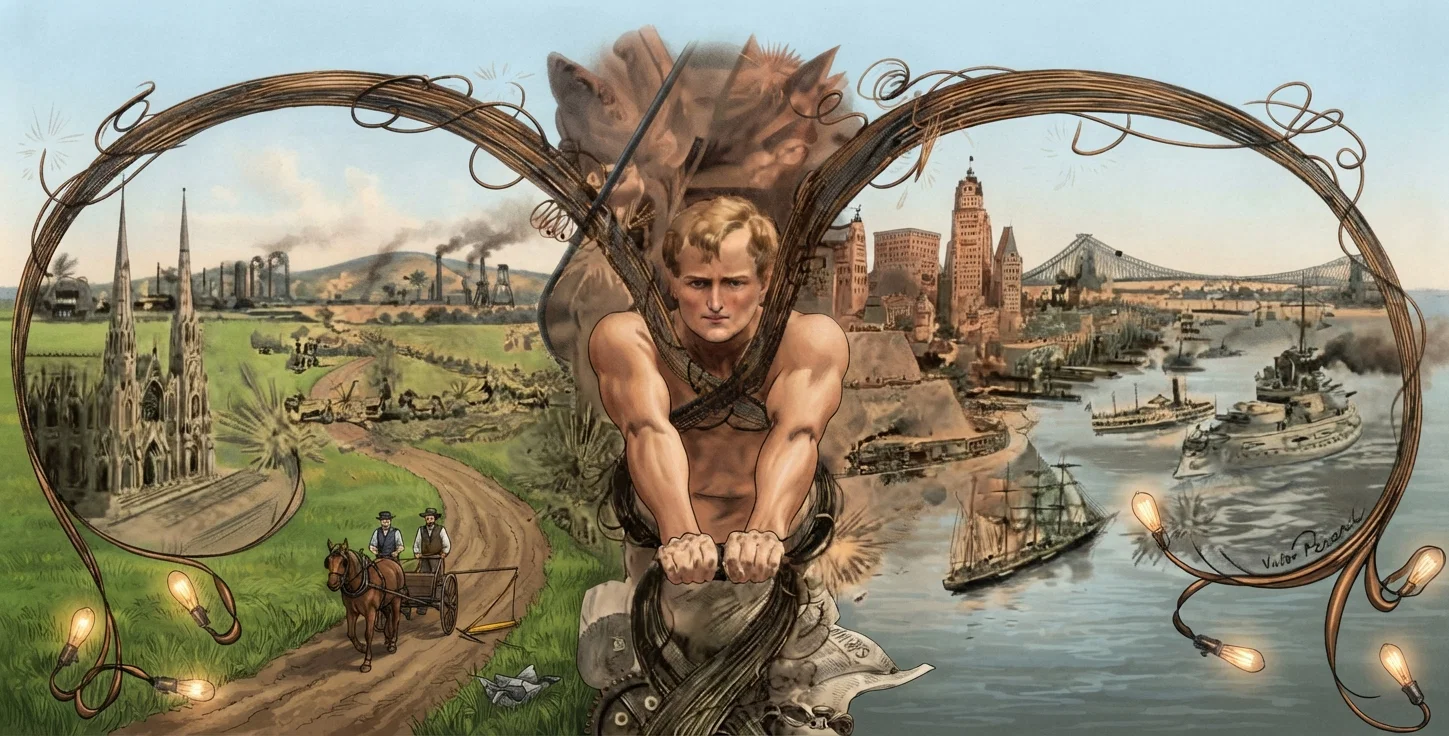
THE nineteenth century is the marvel of all the ages. In its material progress it has gathered up everything of value belonging to the past, and has advanced to build the railroad, the steamship, the telegraph, to perfect the printing-press, to do a multitude of things with electricity, to make marvelous discoveries and developments in chemistry, in the science of medicine, and particularly in surgery and sanitary science. This inventive age has produced instruments that have made it possible to enter the broadest realm of new truth in the field of both the telescope and the microscope; invention has also given us machines that do nearly all the work that has to be done at the present time, from knitting our stockings to reaping and threshing our fields of grain. Numerous books are written to tell of the marvels of this time, and certainly it takes large volumes to give even the briefest mention of what has been achieved. Truly the material progress of this age is a marvel that outstrips all the other marvels that have before held the minds of men.
But the material progress—the advancement in the arts and sciences and the inventive genius of this time—is by no means greater than the results that have been accomplished in the individual liberty that has been acquired by the masses. The advent of this century marked a rising tide in the great battle for freedom. In England, France, Germany, and elsewhere in Europe, the vigorous sentiment for reform was driving to the background the old régime of tyranny and despotic rule. The seeds of the Reformation were taking strong root, and the outlook for the future seemed glorious because of the promise for an order of things that would give the poor man a chance, and break the shackles from all who were bound by the slavery of superstition.
Progress in Civil Government.
The right to rule had been monopolized by kings and nobles, and it was considered a crime worthy of the extremes of punishment for any one to question their "divine right." Certain ones inherited the ability and the right to rule, so their political creed taught, and no others could possibly do it. It was affirmed with all the dignity peculiar to that particular form of superstition, that the common people should not meddle with the affairs of either State or Church, because they could not understand them. Their work was to do the serving, while the nobles temporal and the nobles ecclesiastical did the ruling.
One of the strongest characteristics of the beginning of this century was the hold that the fundamental principles of truth were gaining in the minds of men. This spirit of truth, the foundation of all true liberty and reform, was trampling the old ideas of darkness and error underfoot, and the hearts of men everywhere were swelling with songs of emancipation from that thralldom in which the world's midnight had enchained both their minds and their bodies. The struggle was intense. A terrible contest was waging, and thousands of lives were sacrificed at the altar of truth and progress, and in the defense of justice.
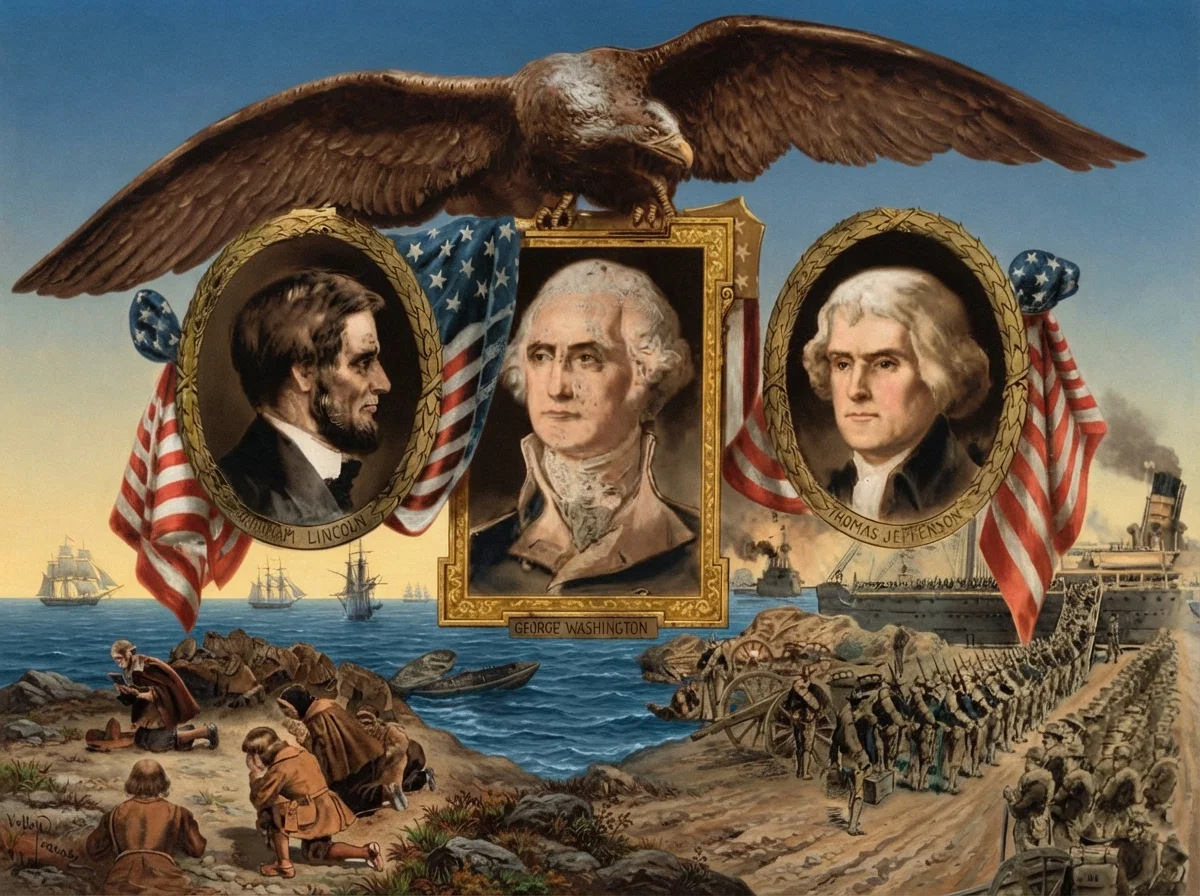
The ages do not afford a greater marvel than the asylum that was preparing at the beginning of this wonderful century for those who would escape from the cruelties of Church and State despotism. A new nation was being born, in which the lamb-like principles of righteousness were to have a chance to develop, and show the result to all the world. Noble-hearted men in England, feeling the iron heel of despotism, had fled to Holland, and then to America. Many others, not only from England but from all parts of the Old World, fled to these shores direct. Influential men in England were not backward in saying that the "mother country" had no right to hold the colonies in subjection, and France was prompt in lending her aid in a substantial way. The new nation was born, and the new principles (old principles in reality, but seemingly new, because they had been so long covered up) were to be given a chance.
In this new nation the fullest freedom was allowed in the State, and the matter of religion was left entirely to the conscience of the individual. The great asylum that America afforded for the ardent lover and supporter of liberty of conscience and of action caused the battle to grow less pronounced in the Old World; for when men could no longer endure the exactions of a superstitious priesthood, nor the tyranny of a despotic State, they had only to come to this new land to find that for which their hearts were panting.
With such principles as were laid in the foundation of this government, contrasting so sharply with the old order of tyranny and superstition, the perfectly natural result was a nation that stands not merely as a marvel among all the marvels of this time, but one the majesty of whose splendor stands as a mountain peak, lifting its lofty head above all the wonders of all the ages. The freedom of thought that was allowed here insured the freedom of discussion also, and in this interchange of ideas the science of government was given a new meaning, and all the material progress of this time was largely developed. The majority of the inventions that mark the age were made in this country, and concerning the part that other portions of the world have taken in the work, who can tell how much of it would have been done had it not been for the stimulus that was given by the freedom of this new nation?
It was the Reformation that originated Protestantism, and Protestantism stands for the religion of the Bible, unmixed with human creeds or speculations. Protestantism in its purity stands for freedom of thought and of action, and is the revival of the Christianity of apostolic times. Protestantism shows a marked contrast to the Papacy, and in this century Protestant principles have made their greatest growth, and have4been allowed their most untrammeled freedom. The seeds had been sown in other years, but this has been the time of fruitage. Every form of error was swept before the light of this new day of reform. Old heresies and superstitions that had held sway in the days of darkness, were placed before the lamp of truth, and shown to be unworthy of men formed in the image of the Creator of the heavens and the earth.
The Midday of Civil Liberty.
But this new world was not without its dark spots of character. Slavery had fastened its chains about a whole race of men, and bound them as chattels under the very shadow of this great tree of freedom. The new nation, however, was equal to the task of striking off these manacles at one strong blow. The immorality and injustice of slavery had been strongly presented by Garrison, and Lovejoy, and Phillips, and hundreds of others, and a vigorous effort was made to rid the nation of this evil by the persuasion of morals; but, these measures failing, slavery was washed away in a deluge of blood. Thus between 1861 and 1865 the principles of the Constitution of this new country were affirmed anew, and the sentiment at that time was so strong in favor of universal and untrammeled freedom that it seemed to all human sight that the thongs of slavery, either of body or mind, could not be bound again to the sensitive flesh of a fellow-man. The new nation was a statue of liberty, not built of marble or of bronze, but a colossal brotherhood of brave-hearted, liberty-loving men, and this mighty statue was set by the God of heaven Himself for the enlightenment of the world. The midday of the world's greatest enlightenment, and the time of its most glorious liberty and freedom, is reached. And how fitting that in such a time, and as an emblematic crown of victory, there should be proclaimed the year of jubilee for an oppressed people, that a whole race, riding on the tidal wave of freedom, should be anchored in the haven of liberty and hope!
Will the light of this new and glorious day shine on and on? or will it be darkened by shadows of returning night? The evidence is conclusive that the night is returning. The high-water mark of progress has been reached, and the tides of reform and freedom are receding. It is hard to see this unless we carefully study the facts; and this some will not take the time to do. Many will still cling to the shadow of liberty and freedom, long after the substance has departed. They will close their eyes to the present, while they try to make themselves believe that the glories of other days are still shining upon us.
A new form of slavery has arisen, and a new kind of nobility has come to take charge of the bodies and souls of men. Under the old régime, nobility was handed down from father to son by right of birth; but in these days a nobility of wealth has been built up. Under the old order of things, those nobles claimed the right to hold great communities and empires of men under control, and they led them forth as soldiers, or commanded them to till their lands, as they saw fit. But in these days colossal combines of wealth have given men the power to hold their fellows in a slavery that is none the less servile or exacting, while the mental development of the age makes it more exasperating. A nobility is forming in the heart of a democracy, and the new nation is forging the chains for another kind of slavery. While America was advancing under the flag of freedom, and was doing such wonderful things for God and humanity, all the nations of the world were learners in her school. Will they not be equally apt to take her teachings as she changes her standard and marches under another leadership? How quickly it will be caught up and heralded that democracy is a failure, and that the Protestantism that is the basis of all true democracy is a failure also! And then how quickly, too, will the Papacy come forward to say that since Protestantism is failing to fulfil its promises, the Church of Rome, with all its arbitrary rulings, should be allowed to take its old position, and guide the various nations through the troublous times upon which the world has entered!
Revivification of Ancient Cults.
A time of reform is a time when superstition, and ignorance, and all that it represents, is driven to seek shelter in the abodes of a still denser darkness. But when the spirit of reform is losing its hold on the minds of men, then the superstitions that mankind had cast off begin to reassert themselves. And who has not marked with wonder and astonishment the advances that old oriental religions are making in enlightened Europe and America? The very liberality that freedom engenders is turned in the direction of glossing over the ignorance and idolatry of the heathen of India and Persia, and the countries of the East in general; and occult sciences and hidden and mysterious arts, such as we used to affirm belonged to the Dark Ages, are gaining adherents, and men who are said to be intellectually gifted are following these superstitions madly.
The teachings of Buddha and the morals of Zoroaster have had centuries of operation and their value has been tested. But what has been the result?—Those who are under the influence of any of those old oriental religions are wallowing along in the quagmire of the grossest superstitions and the lowest depths of mental darkness. And now that men and women who have the advantages of the enlightenment of this time are advocating that this heathen darkness holds forth a great light, what is the only conclusion that can be reached? There are some who do not especially take to the superstitions peculiar to the orientals, but they transform these religions of the East into the more modern forms of Christian Science, Hypnotism, and Spiritualism. To the thoughtful mind these facts must indicate the strong current in the direction of mysticism, and the thirst for the mysterious and subtle fancies of the occult arts. And such a condition as this, more than anything else, was a distinguishing feature of the Dark Ages.
The individual who is guided by the light of inspiration, and who closely analyzes these times in the light of history, can not fail to see that the high noon of the wonderful enlightenment of this wonderful century has been passed, and we are going again into the shadows. The corruptions and the frauds, the vices and the crimes, of these times are consuming, as in a great conflagration, the materials of morality out of which reforms are made. Rings and bosses control politics, and tools that can be molded at will are too often lifted into the offices of state. These things drive away the great statesmen skilled to build and guide nations; and the ships of state of all the countries of the world, amid much of the hollow sounds of oratory and delirious rejoicings, are drifting upon the rocks of everlasting ruin.
But the darkness of this picture that so frowningly beclouds the world to-day is being driven before the splendors of the light of the Lord's clear prophecies. While the nations of earth are crumbling to decay, the evidence is overwhelmingly abundant that the Prince of Peace, the Lord Jesus Christ, is about to establish His everlasting kingdom. All who are seeking a citizenship in that kingdom will stand with the Master in these times, and still hold up the torch of righteousness and liberty, so that every bewildered mariner upon the troubled waters of these closing moments of time may see clearly how to guide his bark into the haven of secure and everlasting rest.
A. O. TAIT
A FRUITFUL ERROR
By Ellen G. White
NO ERROR accepted by the Christian world strikes more boldly against the authority of Heaven, none is more directly opposed to the dictates of reason, none is more pernicious in its results, than the modern doctrine, so rapidly gaining ground, that God's law is no longer binding upon men. Every nation has its laws, which command respect and obedience; no government could exist without them; and can it be conceived that the Creator of the heavens and the earth has no law to govern the beings He has made? Suppose that prominent ministers were publicly to teach that the statutes which govern their land and protect the rights of its citizens were not obligatory,—that they restricted the liberties of the people, and therefore ought not to be obeyed; how long would such men be tolerated in the pulpit? But is it a graver offense to disregard the laws of States and nations than to trample upon those divine precepts which are the foundation of all government?
It would be far more consistent for nations to abolish their statutes, and permit the people to do as they please, than for the Ruler of the universe to annul His law, and leave the world without a standard to condemn the guilty or justify the obedient. Would we know the result of making void the law of God? The experiment has been tried. Terrible were the scenes enacted in France when atheism became the controlling power. It was then demonstrated to the world that to throw off the restraints which God has imposed is to accept the rule of the cruelest of tyrants. When the standard of righteousness is set aside, the way is open for the prince of evil to establish his power in the earth.
Wherever the divine precepts are rejected, sin ceases to appear sinful, or righteousness desirable. Those who refuse to submit to the government of God are wholly unfitted to govern themselves. Through their pernicious teachings, the spirit of insubordination is implanted in the hearts of children and youth, who are naturally impatient of control; and a lawless, licentious state of society results. While scoffing at the credulity of those who obey the requirements of God, the multitudes eagerly accept the delusions of Satan. They give the rein to lust, and practise the sins which have called down judgments upon the heathen.—Great Controversy.
THE AMERICAN OUTLOOK
By Calvin P. Bollman
By Calvin P. Bollman
Associate Editor of the "Sentinel of Liberty."
THE AMERICAN OUTLOOK
THAT this government is a subject of prophecy seems probable from the fact of its prominence in world politics, and even more because here was pre-eminently the first asylum and subsequently the home of aggressive Protestantism.
Here, as nowhere else in all the world, is seen the heaping together of "treasure in the last days," spoken of in James 5:1-9, R.V.; and here as nowhere else are seen indications of the speedy fulfilment of the first verse of this prophecy.
The Prophetic Description.
But it is in Rev. 13:11-18 that this government is specifically described and its course outlined. The chapter opens with a description of Rome, both pagan and papal, but having special reference to the papal phase of that power.
The leopard beast of verse 2 has some of the characteristics of each of the national systems used from time to time by Satan to oppose the work of God in the earth and to oppose His people, but special prominence is given to the papal head. Roman Paganism was soon to give way to Roman Papacy; and when once that system gained supremacy, it would never cease to dominate Christendom. Dynasties might rise and fall, and even the Papacy itself be nominally abolished, but the evil principle would survive, to die only when all sin shall be blotted from the earth.
For 1,260 years, or from A.D. 538 to A.D. 1798, this papal head held sway over what had once been the Roman Empire. In the year 1798 the Papacy received what was designed to be, and what to any other power would have been, "a deadly wound" by the sword. At that time a French army entered the city of Rome, made the pope a prisoner of war, declared the Papacy abolished, and established a republic upon the ruins of that religio-political system.
At this same time the prophet sees "another beast coming up out of the earth." This power does not arise as the result of war; it does not come up in territory already densely peopled; but, as it has been aptly expressed, it comes "forth from vacancy;" it "grows up as a plant;" and these expressions describe as accurately as can be done briefly, the beautiful rise of the United States in new territory.
It was about 1798 that this government first began to attract seriously the attention of the world. The new nation was then only ten years old; for it was in 1788 that the ninth State adopted the Constitution, which by its own terms was to become operative when ratified by that number of States.
Here, then, was a new nation, represented by a new symbol, and in its incipency dominated by a milder spirit than had characterized any preceding power, but later it was to speak with the voice of a dragon.
Horns in prophecy represent power, or the source of strength. Of the Lord the prophet Habakkuk says, "He had horns coming out of His hand; and there was the hiding of His power." The strength of God is His character, or righteousness. Were it possible for God to experience a moral fall, He would in such fall cease to be supreme; for of whom any being is overcome, by "the same is he brought in bondage."
The Strength of This Government.
In its earlier history the strength of this government was in the principles upon which it was established. Republicanism and Protestantism attracted to these shores the flower of European manhood. These principles were the strength of the new nation. They challenged the admiration of the world, while the conviction that a people devoted to such principles could not be conquered and held in vassalage restrained the ambition of such as coveted additional territory for purposes of colonization.
But there is another and a sadder side to the prophetic picture. Of the symbol representing this nation, it is said, "He had two horns like a lamb," but "he spake as a dragon."6It was Thomas Jefferson who, with a wise foresight, born of close study of men and of political systems, raised this note of warning:—
The spirit of the times may alter, will alter. Our rulers will become corrupt, our people careless. . . . It can never be too often repeated that the time for fixing every essential right on a legal basis is while our rulers are honest, and ourselves united. From the conclusion of this war we shall be going down-hill. It will not then be necessary to resort every moment to the people for support. They will be forgotten, therefore, and their rights disregarded. They will forget themselves, but in the sole faculty of making money, and will never think of uniting to effect a due respect for their rights. The shackles, therefore, which shall not be knocked off at the conclusion of this war, will remain on us long, will become heavier and heavier, till our rights shall revive or expire in convulsion.
This was but putting in other phrase the prediction of the inspired Word—not that Mr. Jefferson so designed, but he nevertheless expressed the same truth. And those who live to-day see the beginning of the end of the fulfilment of the words of both prophet and statesman.
The leopard beast of Rev. 13:1-10, with its papal head, was characterized by a denial of the very principles which for more than a century of its history were the strength of the government of the United States—namely, Republicanism and Protestantism. The image to the beast will in like manner develop clearly these same principles, and this has already been done to a surprising extent by this government.
A Denial of Principles.
In the Supreme Court dictum of February 29, 1892, declaring this a "Christian nation," and in the World’s Fair legislation requiring the closing of the Exposition on Sunday, in professed obedience to the fourth commandment of the Decalogue, are bound up all the elements of Church and State union. If our courts may decide what is Christian either as pertaining to the nation or to individuals, and if Congress may declare which day is the Sabbath according to the fourth commandment, it is difficult to draw a line which the government may not pass in the decision of religious questions. In Sunday legislation, in the exemption of church property from taxation, and in the relations of the government with the Roman Catholic Church, especially in respect to territory recently acquired from Spain, are bound up vast possibilities. The inexorable logic of events points to only one conclusion. "Manifest destiny" hurries the nation toward the predicted consummation. Indeed, in the decision of the religious questions to which reference has been made, and the denial of self-government in Porto Rico and the Philippine Islands, the dragon voice is already heard. And since "the jurisdiction which government takes, it keeps," we can not close our eyes to the fact that future measures of the government will be still more strongly marked, or even completely controlled, by the influences and principles already referred to.
With purely political questions the writer of this article has nothing to do. Whether or not it is wise statesmanship to acquire territory foreign to our shores, and to annex and govern foreign peoples without their consent, it is not the purpose of this article to discuss. But the fact can not be denied that the three years last past have witnessed a complete revolution in the policy of this nation respecting these questions; and from the positions taken, there can, in the very nature of the case, be no turning back.
The current of events is to-day running in the channel indicated eighteen centuries ago by the Word of God. As a nation we are following in the trail of Rome, and this article is written for the sole purpose, not of influencing political sentiment, but to invite the attention of the reader to the great truth that the events now taking place in our own land, and in which American soldiers and sailors are participating in other lands, tell in trumpet tones that "the coming of the Lord draweth nigh."
The Marshaling of the Nations.
Nor is it alone in the scriptures cited that this country is referred to. The sixteenth of Revelation tells of a great battle, to which is to be gathered "the kings of the earth and of the whole world." Verse 14. Only three years ago it seemed impossible, from any standpoint other than that of the prophecy, that the United States could ever become involved in any great conflict in the East. In the light of recent events and of the present situation in the Philippines, in China, and in Turkey, it now seems just as impossible for the United States to escape participation in the approaching Titanic struggle for supremacy in the Orient.
Already we see the marshaling of the nations for this last great battle. The five great powers that virtually control the whole earth are now face to face in the East. Steam and electricity have made the earth practically no larger than was a single country a century ago. Thus are brought together nations once widely separated. The dangers of strife incident to close proximity might be overcome by civilization, but greed and ambition are busy stirring up strife, and few are so blind as not to see that the arbitrament of arms must "settle" the differences which selfishness has created; and, according to the sure word of prophecy, the United States of America will be one of the parties to the conflict.
The sands of time are rapidly running out of God’s great hourglass, which is now almost empty of the years allotted to earth’s history. The last generation of men is upon the stage of action. The end of all things is at hand. Prophecy foretells this, events testify to it; and, in view of it all, the Saviour says to all who will hear His voice, "Behold, I come quickly; and My reward is with Me, to give every man according as his work shall be."
CALVIN P. BOLLMAN.
"THE WISDOM OF THE WISE SHALL PERISH"
SO GOD declares concerning the great men of earth who will not heed His counsel and walk in the way of His precepts. "God is light." Apart from Him all is darkness. Men may walk in the light; they may reject it, and walk in darkness. And in darkness concerning the future the great men of the world find themselves to-day. Following are some of their sad heart utterances:—
Said Lord Salisbury, in speaking of threatened wars:—
These wars come upon us absolutely unannounced and with terrible rapidity. The war cloud rises in the horizon with a rapidity that obviates all calculation, and, it may be, a month or two months after the first warning you receive, you find you are engaged in or in prospect of a war on which your very existence is staked.
Two years ago, after a European tour of inspection, Gen. Nelson A. Miles said:—
I have seen all the great armies of Europe except the Spanish army. What I have seen does not indicate that the millennium is at hand, when swords shall be beaten into plowshares.
The late Bishop Newman gave his view of the situation in these words:—
This is the most unsettled condition of the world since the crucifixion of Christ. The stability of government is no longer a fact. Change is in the atmosphere. It is just as true now as a thousand years ago, "Thou knowest not what a day will bring forth." . . . Statesmen are at their wits' end. Philosophers speculate in vain.
Archbishop Ireland, Roman Catholic, declares:—
The bonds of society are relaxed; traditional principles are losing their sacredness, and perils hitherto unknown are menacing the life of the social organism.
Prof. E. Benjamin Andrews, ex-president of Brown University, is led to say:—
No well-informed person in Europe seems to believe that peace is destined to endure there very long. On all hands people are preparing for war. Armies and navies are strengthened; fortifications multiplied; immense war treasures of gold piled up; all possible hypothetical plans of campaign, offensive and defensive, studied and discussed; firearms, great and small, ceaselessly experimented upon and improved; civil measures subordinate to military, and statesmen to great army men and navy men.
Signor Crispi, for many years prime minister of Italy, comparing Europe with Spain, at the time of the Spanish-American war, said:—
Europe resembles Spain from a certain point of view. Anarchy is dominant everywhere. To speak frankly, there is no Europe. The European concert is only a sinister joke. Nothing can be expected from the concert of the powers. We are marching toward the unknown. Who knows what to-morrow has in store for us?
And, finally, the Springfield (Mass.) Republican, one of the ablest-edited papers in the United States, comparing ten years ago with the present, remarks:—
The view ten years ago showed a placid, smiling river; now we see the boiling rapids of a torrent plunging toward what abyss no one knows. War has followed war with swift succession. . . . What the next stroke will be who shall say?
And there is much more of the same import. And yet the way out of the darkness and perplexity is clearly revealed in the Word of God. "Thy Word," says the royal psalmist, "is a lamp unto my feet, and a light unto my path." "We have also a more sure word of prophecy," says the apostle Peter, "whereunto ye do well that ye take heed, as unto a light that shineth in a dark place, until the day dawn." We may heed God’s light, and know the outcome, or we may walk on in blindness and darkness, to death and destruction. Which is the wiser way?