called "the spirit of prophecy." It was "the Spirit" of Christ which was in the prophets, "which did signify," or testify, "beforehand." Thus it is made clear as to why "the testimony of Jesus" is called "the spirit of prophecy."
Every line, then, of Heaven-sent prophecy, is "the testimony of Jesus," for He was especially commissioned of Heaven to testify, or bear witness, to the world, through the prophets.
The Text Made Clear by Paraphrasing
Let us now take a careful mental view of the words of our text, "The testimony of Jesus is the spirit of prophecy." To get their meaning more clearly, we will paraphrase them, and in so doing associate them with the fact that Jesus was "given for a witness to the people," and that He witnesses by foretelling future events through the prophets. We will thus have the whole thought before us in this form: Jesus, who is given as the Witness of Heaven to the children of men, has chosen to bear witness by speaking through the prophets, who were inspired by His Spirit to write the prophecies to which they gave utterance.
The Importance of Prophetic Study
When we consider that when Enoch, Moses, David, Isaiah, and all the holy prophets, opened their lips in prophetic utterances, they spoke "the testimony of Jesus," or were mouthpieces through whom Jesus bore testimony to mankind, how important is the study of prophecy to every Christian, and what weight of interest should attach to such investigation!
Every true minister of the Gospel of Christ will bear witness to the importance of the prophetic portions of God's Word, for without prophecy the plan of salvation can not be established on a basis for intelligent faith. Therefore, the minister who does not preach prophecy, does not give his flock the mightiest evidence of God's existence, nor of the all-important truth that Christ is the true Messiah.
It is to be regretted that many so-called Christians hold that which is really Heaven-sent prophecy in a certain degree of contempt. Some even ridicule the figures and symbols employed in certain of the Bible prophecies. Possibly the degree of prejudice which exists in the minds of many Christians against prophecy, has been occasioned by false interpretations of prophetic statements. Nevertheless, we are assured by Inspiration, in the texts previously quoted, that prophecy, correctly understood, is the surest and safest possible guide for the seeker after truth, for it is Jesus' own method of witnessing to the ages.
Heaven Supplies the Basis for Faith
It is written that "without faith it is impossible to please God." But Jehovah does not exact faith of any being without first giving a firm basis for faith, even such as will stand the closest possible test of the highest order of intelligence, for He is absolutely "just and true" in all of His "ways."
Prophetic Symbols Originate in the Mind of Divinity
It should be remembered that each prophetic symbol originated in the mind of Divinity, and is not the conception of the mind of mortal man.
It is well worth while, in the study and presentation of every prophecy, to note the truths which God designs to have impressed upon the mind by each. One example of this will suffice. In the revealing and interpretation of Nebuchadnezzar's dream, in which the world's history was outlined by a great metallic image, Daniel emphasized the points which God desired to have impressed upon the mind, as follows: "There is a God in heaven that revealeth secrets, and maketh known . . . what shall be in the latter days;" and that all earthly kingdoms will terminate with the setting up of God's everlasting kingdom. Dan. 2:28, 44, 45. Keeping before the mind the fact that each prophecy is designed to substantiate some essential feature of the plan of salvation, and is the "testimony," the witnessing, of Jesus, should effectually undermine all objections to prophecy in the mind of every believer in Christ.
If every minister of the Gospel would preach prophecy as "the testimony of Jesus," the united effort thus put forth would be a mighty factor in stemming the fearful tide of so-called higher criticism, and consequent infidelity, which threatens to engulf the world in unbelief and final destruction.
Neglect of Prophecy
"While the world in its present condition is aptly described in Scripture as 'this present darkness,' we are not left to grope our way through that darkness." "We have also a more sure word of prophecy; whereunto ye do well that ye take heed, as unto a light that shineth in a dark place, until the day dawn, and the day-star arise in your hearts." 2 Peter 1:19.
"Unfortunately for the whole world, this light of prophecy, given for the special purpose of guiding us through the present darkness, is sadly neglected by Christians." "Neglect of the Bible, and particularly of prophecy, directly serves Satan's purposes." "But God's people are waking up to the recognition of this neglect, and are beginning to realize the importance of studying that part of the Word which contains yet unfulfilled prophecy. This awakening is, indeed, one of the many and increasingly numerous signs which indicate the near approach of that long-expected time of the restitution of all things which God has spoken by the mouth of all His holy prophets since the world began. Dan. 12:4; Acts 3:21."—"The World and Its God," pages 95, 98.
Christ's Chosen Method of Witnessing
Reader, if you were chosen to bear witness to the absolute essentials of the plan of salvation, how would you witness so that all of the combined wisdom and cunning of skepticism could not overthrow your witnessing? Simply telling the story of divine love and of "things unseen" would not suffice. Are you willing to accord to Jesus Christ the right to choose His own medium of witnessing? Prophecy, fulfilled in every minutia, is His pre-eminent method of witnessing, and it is to-day and forever the most effectual and crushing weapon that Heaven has provided against skepticism, and at the same time the strongest foundation for intelligent faith.
While the gift of prophecy in the church is of priceless value as a guide and in giving instruction, reproof, and warning, and the study of the theme from that view-point is of great importance, yet the special design of these articles is to show the utility of prophecy in foretelling future events: first, that their fulfilment may provide the strongest possible foundation for faith in those things which are essential to the plan of salvation; and second, that God's people may be prepared for the events which decide the eternal destiny of our race.
A Threefold Meaning from the Text
We may get three harmonious thoughts from the expression, "The testimony of Jesus is the spirit of prophecy." First, He witnesses to His church, of God and His truth, and through them to the world, by the spirit of prophecy. Second, the spirit of prophecy witnesses of Him, and proves Him to be the Messiah. Third, the gift of the Holy Spirit, as a divine guide to correct interpretation of prophecy, is a certain manifestation of the spirit of prophecy, as it is written, "But the Comforter, which is the Holy Ghost, whom the Father will send in My name, He shall teach you all things, and bring all things to your remembrance, whatsoever I have said unto you." John 14:26.
Keeping Sight of Jesus
By Reuben Archer Torrey
ONE of the simplest and yet one of the mightiest secrets of abiding joy and victory is to never lose sight of Jesus.—R. A. Torrey.
The Harm of Newspaper Caricatures
THE rude, vulgar, and often malicious pictures put forth in the guise of wit and caricature through the daily and Sunday papers, are destroying the artistic sense, if not the kindly instincts, of a whole generation of young people, who are growing to maturity looking upon them as one of the ordinary incidents of life. Carry the abominable things out of the house with the tongs, for the sake of the children.—Farm Journal.
A Prayer for Perfection
By Edson Carpenter
By Edson Carpenter
When Thou shalt come in glory, Lord,
And in the clouds of heaven appear,
When o'er earth's wide domain is heard
That trumpet call the dead shall hear,
Waiting and watching may I be;
With joy may I behold Thy face;
With undimmed eyes Thy glory see,
And with Thy people have a place.
O, may I Thy commands obey,
Thy law be treasured in my heart,
And in Thy service spend each day,
Nor from the narrow way depart;
May I retain no cherished sin,
No evil passion rule my will,
But may Thy presence dwell within,
With joy and peace my spirit fill.
O, give me strength my load to bear;
I can not go my way alone.
And may I feel Thy presence near
In night's dark gloom, through ways unknown.
Tho friends may fail, Thou art the same.
To Thee, O Lord, be glory given,
Exalted high be Thy great name,
By all on earth, by all in heaven.
And when that last great day shall come,
And earthly things shall pass away,
And Thou shalt take Thy people home,
To dwell with Thee in fadeless day,
O, grant that I may worthy be,
Robed in Christ's righteousness to stand,
To wear a crown of victory,
And have a place at Thy right hand.
Studies in Daniel
God the Revealer — A Divine Fore-view of the Kingdom of Man
(Concluded)
N our last was given the dream of Nebuchadnezzar, its effect upon the king, his efforts to secure its correct interpretation, and the part of God and His prophet in the matter. In this we continue the study, and the numbering as well, and learn the divine explanation.
Thou, O king, art king of kings, unto whom the God of heaven hath given the kingdom, the power, and the strength, and the glory; and wheresoever the children of men dwell, the beasts of the field and the birds of the heavens hath He given into thy hand, and hath made thee to rule over them all: thou art the head of gold. Verses 37, 38. Note 7.
8. What power was represented by the breast and arms of silver?
And after thee shall arise another kingdom inferior to thee. Verse 39. Note 8.
9. What did the brass symbolize?
And another third kingdom of brass, which shall bear rule over all the earth. Verse 39. Note 9.
10. What is said of the fourth kingdom?
And the fourth kingdom shall be strong as iron, forasmuch as iron breaketh in pieces and subdueth all things; and as iron that crusheth all these, shall it break in pieces and crush. Verse 40. Note 10.
11. What change was to take place in the fourth empire, and how was it symbolized?
And whereas thou sawest the feet and toes, part of potters' clay, and part of iron, it shall be a divided kingdom; but there shall be in it of the strength of the iron, forasmuch as thou sawest the iron mixed with miry clay. And as the toes of the feet were part of iron, and part of clay, so the kingdom shall be partly strong, and partly broken. And whereas thou sawest the iron mixed with miry clay, they shall mingle themselves with the seed of men; but they shall not cleave one to another, even as iron doth not mingle with clay. Verses 41-43. Note 11.
12. What follows the kingdom of man?
And in the days of those kings shall the God of heaven set up a kingdom which shall never be destroyed, nor shall the sovereignty thereof be left to another people; but it shall break in pieces and consume all these kingdoms, and it shall stand forever. Forasmuch as thou sawest that a stone was cut out of the mountain without hands, and that it brake in pieces the iron, the brass, the clay, the silver, and the gold; the great God hath made known to the king what shall come to pass hereafter: and the dream is certain, and the interpretation thereof sure. Verses 44, 45. Note 12.
13. How did the revelation impress the king?
Then the king Nebuchadnezzar fell upon his face, and worshiped Daniel, and commanded that they should offer an oblation and sweet odors unto him. The king answered unto Daniel, and said, Of a truth your God is the God of gods, and the Lord of kings, and a revealer of secrets, seeing thou hast been able to reveal this secret. Verses 46, 47. Note 13.
14. What was the result to Daniel and his fellows?
Then the king made Daniel great, and gave him many great gifts, and made him to rule over the whole province of Babylon, and to be chief governor over all the wise men of Babylon. And Daniel requested of the king, and he appointed Shadrach, Meshach, and Abed-nego, over the affairs of the province of Babylon: but Daniel was in the gate of the king. Verses 48, 49. Note 14.
Note and Comment
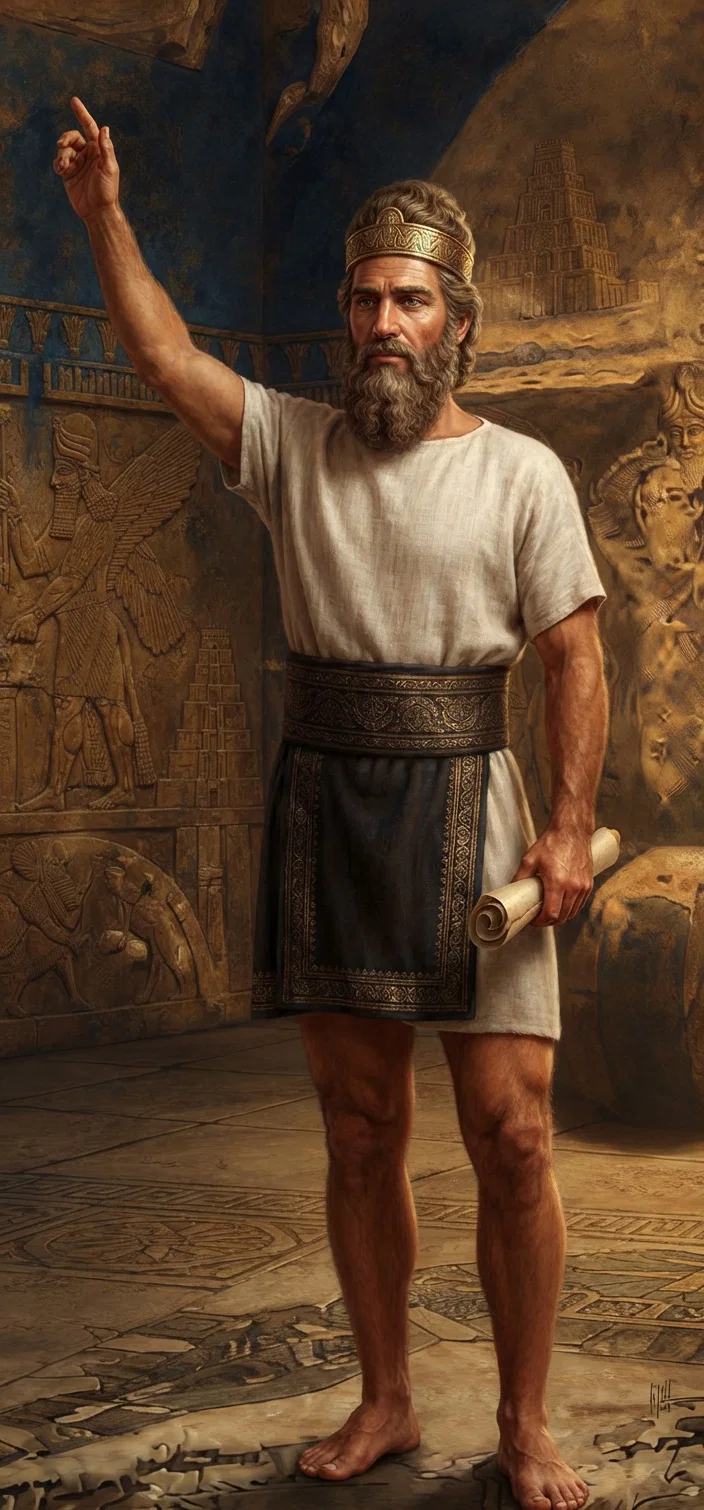
7. THOU ART THIS HEAD OF GOLD. We need not take time to go into the early history of the Babylonian Empire; in fact there is not space for it in the explanation of this chapter. Suffice to say that the city of Babylon was the center of the oldest world civilization of which we have any account, that is, since the great Noachian Deluge. We read in the 10th chapter of Genesis that Nimrod, the great-grandson of Noah, was the builder of Babylon; and we read in the 11th chapter that the center of that city was a great tower which men called the "Gate of God," but which God called Babel, indicating what all history has demonstrated, that men's ways apart from God inevitably lead to confusion, that altho men may build what seem to them to be gates of God, or openings to futures of felicity and happiness and success, God writes upon them confusion, and inevitable destruction. That early Babylon passed through many vicissitudes. Among the tribal chieftains of those ancient times, and the various kings that ruled over the different cities, there were interminable wars,—Babylon sometimes the great dominant city, and sometimes ruled by others, such as Nineveh. And yet Babylon seems to have been the great center of worship of all the other powers. Even Assyria, in the time of her strength and dominance, seems to have worshiped at Babylon. One historian tells us that the king at Nineveh did not feel that his kingdom was safe until he had laid his crown before great Marduk of Babylon, and received it as from him. There seems good reason to believe that many times the same king that ruled over Nineveh and Assyria, ruled by another name over Babylon. It was but a little while before Nebuchadnezzar's accession to the throne, that Babylon, in conjunction with Media, had thrown off the Assyrian yoke, had swept down through Syria and the provinces on either side, and had even conquered Egypt. Nebuchadnezzar was the greatest king of earth; his empire was dominant. All others, far and near, bowed to him. Doubtless his thought was, as we shall afterward learn, that Babylon should persist forever, that there would never be any other empire upon the earth. But the prophet tells him that he is but the head of a series of changes which would take place in the kingdom of men.
We would note this, in passing,—that it is not the anatomical parts of the image which represent the various changes which follow; but the changes in government are indicated by changes in metal. The whole image is symbolical. The whole image represents the kingdom of man upon earth. But the different dynasties in the rule of man are represented by the metals. Babylon was the golden kingdom of the Golden Age. Her great temples and palaces were overlaid with gold. Nebuchadnezzar had built more splendidly and with greater elaboration than any ruler before him. He had undertaken the restoration of that ancient tower of Bab-il, the "Gate of God." He had built a wonderful temple to the gods. He had erected for the royal court a magnificent palace, that exceeded in its barbaric splendor anything upon which men had looked. He had brought all the spoils of the various nations which he had conquered to beautify and embellish his capital city. He had built a wall around it fifteen miles on each side, eighty-seven feet thick, with great bronze gates at the end of each of the avenues, or streets; and around this mighty city was a moat filled with water from the Euphrates River, that ran through the city, rendering it almost invulnerable to any enemy which might in those days attack it. Two other great walls separated the interior of the city from the Euphrates River, so that no attack could be made from the river itself. Besides these temples, Nebuchadnezzar built great hanging gardens, one of the seven wonders of the world. Story above story they rose, covered with plants, flowers, and trees from the mountains of Media, to cheer the heart of Nebuchadnezzar's bride, Amylita, the Median princess. Truly it was "Babylon, the glory of kingdoms, and the beauty of the Chaldees' excellency." And Nebuchadnezzar, as the king, represented that kingdom. Into his hand God had given the empires of earth. (See also Jer. 27: 5-8.)
8. "AFTER THEE." Nebuchadnezzar's kingdom was not to last forever. After him there should arise another kingdom, not inferior in strength, because it overthrew the Babylonian kingdom, but inferior in wealth, in magnificence. In B.C. 538 the Babylonian kingdom passed away. Its glorious career under Nebuchadnezzar had been very brief indeed. His descendants that followed him seemed to lack in all the essential characteristics that make great rulers. Nebuchadnezzar reigned forty-two years, six months. He left the crown to his son, Evil-Merodach, who after a short reign of three years was murdered by his brother-in-law, Nergal-sharazar. His son who succeeded him was a mere boy, and was murdered after a brief reign of four months, by name Laborosoarchod. Following him Nabonidus came to the throne, sometimes given as Nabonadius, sometimes Nabu-nahid. His reign lasted seventeen years and five months. There was associated with him the last three years of his reign Belshazzar, or Belsharuzzar, the Babylonian kingdom passing away B.C. 538, succeeded by the Medo-Persians under Cyrus. Persia continued to B.C. 331, when it yielded to Grecia.
9. ANOTHER (THIRD) KINGDOM OF BRASS. We call the reader's attention again to the fact that it is not the thighs as anatomical parts, which represent the kingdom7that followed Medo-Persia or Grecia, but the metal — brass — inferior to the Babylonian and Persian kingdoms in glory and unity, magnificence and splendor, but superior in strength. The Grecian Empire came to power under Alexander the Great in B.C. 331, losing its dominion gradually to Rome.
10. THE FOURTH KINGDOM. The great world empire which succeeded Grecia is known to all students of history, and that was Rome, known as "the iron monarchy of Rome," ponderous, cruel, crushing in its might. All the kingdoms of earth known or of worth were subdued by it. It was a saying in the Roman Empire that all roads led to Rome; it became so in the world, and over these roads were brought the kings and rulers of subdued and conquered kingdoms to grace the triumphs of the Roman conqueror. This kingdom is represented by the remaining parts of the great metallic image. It has been stated that the two legs represented Eastern and Western Rome; but if this were the case, Rome ought to have been divided in the beginning, because the leg begins at the knee. And according to the same principles of interpretation, the two arms would represent Media and Persia. The brass part of the image begins as a unit and divides into two, but this does not correspond with Grecia, which began as a unit and divided into four. The whole thing is very simple, if we will bear in mind that the image itself represented the kingdom of man, and the various empires are represented by the metals; and Rome is represented by the iron.
11. PART OF POTTERS' CLAY AND PART OF IRON. Division came into this strong iron kingdom in the latter years of its history. It began as one. Iron can be welded together; and as long as the kingdom was of iron, imperial, it could be held as one. But the prophet sees another element enter into it a little later; clay is intermingled with the iron. Iron and clay can not be united, amalgamated, welded, or mixed. Democracy, the rule of the people, had broken through the imperial idea of absolute crushing unity of the world empire. The Northern barbarians swept down upon the mistress of the world. Phrased in the old poem,
Rome, for an empire far renowned,
Tramples on a thousand States.
Soon her pride shall kiss the ground;
Hark! the Gaul is at her gates.
But note that it is not the toes, as has been stated, which indicate the division of the kingdom. Nowhere are we told that there are TEN toes. Toes are simply mentioned because they are a part of the great image of man, just as the feet are mentioned, just as the other parts are mentioned. The empire proceeds onward from the head to the end, and the toes are at the end. But the division is indicated by the intermingling of the iron and the clay. Note the express language: "And AS the toes of the feet were part of iron, and part of clay, SO the kingdom shall be partly strong, and partly broken. And WHEREAS thou sawest the IRON MIXED with MIRY CLAY, they shall mingle themselves with the seed of men; but they shall NOT CLEAVE one to another, even as iron doth not mingle with clay."
Between the years A.D. 351 and 476 Rome was broken to pieces. At that later period there existed just ten kingdoms, but this division is indicated by the intermingling of the two substances which would not unite. Men have tried to unite them. Charlemagne dreamed of a great empire which would be one; Napoleon dreamed of a great empire which would be united under his sway; but as has been remarked, one line of God's prophetic Word is stronger than all the schemes of men. "He removeth kings, and setteth up kings." "The Most High ruleth in the kingdom of men," and He had said that that should be a divided kingdom even to the end, and a divided kingdom shall it remain.
12. THE DAYS OF THOSE KINGS. But the kingdom does not last forever. The human image had an end, even as it had a beginning. The kingdom which that image symbolized, had a beginning; it will also have an end. But it will be succeeded by no other human kingdom. In the days of that divided kingdom — in the very last days of that divided kingdom — shall the God of heaven set up a kingdom that shall never be destroyed. That is not likened to an image; it is likened to the enduring rock. It shall remain throughout all eternity. It shall not be left to other peoples. The heirs of God's kingdom are immortals; they will not see their highest built hopes swept away by a cruel conqueror; they will not see the city of their kingdom overturned as was Babylon. They will not see fathers, or husbands, or sons, or daughters carried away into ignominious captivity. They will not see those in whom they had hoped, buried forever from sight, or turned to ashes by the funeral pyre. In that kingdom of God there shall be no death, no sickness, no pain, no sorrow. Even as the King shall reign forever and ever, so the subjects of the kingdom shall reign with a life paralleling with His. "And the kingdom and dominion, and the greatness of the kingdom under the whole heaven, shall be given to the people of the saints of the Most High, whose kingdom is an everlasting kingdom." Dan. 7: 27.
That kingdom does not come by the conversion of the nations of the world. It does not come through political means; it does not come through law. Christ is gathering out subjects for His kingdom now. He is taking the fittest from this world to survive death and the grave. And those fittest to survive in His kingdom are those who are in harmony with the law of life. "Thy people shall be all righteous," and because they are righteous and are in harmony with the law of life (for righteousness is life), they shall endure forever. All these other kingdoms passed away because they were living contrary to the law of life, and righteousness perverted is sin, and life perverted is death. But those who are preserved for the kingdom of Christ, when all other earthly kingdoms are swept away, are those who are in harmony with the great law of His life. They have found the way in Him, and "in the way of righteousness is life; and in the pathway thereof there is no death."
13. THEN THE KING (Nebuchadnezzar) fell upon his face, and worshiped Daniel — offered him honors—yea, divine honors, which, tho we are not so told, we are sure the prophet repudiated, even as he had already done, stating that it was not through his wisdom or might that this came, but because of God's goodness. But the king acknowledges just what God desired that he should acknowledge—that GOD IS THE REVEALER. All the future is open before Him. That is one of the characteristics of Deity; "I am God, and there is none else; I am God, and there is none like Me, declaring the end from the beginning, and from ancient times the things that are not yet done." Isa. 46: 9, 10. And as Daniel declared before he had told the vision, "There is a God in heaven that revealeth secrets," Nebuchadnezzar after hearing the dream and its interpretation declares, "Of a truth your God is the God of gods, and the Lord of kings, and a revealer of secrets."
14. THEN THE KING, quaintly our scripture declares, made Daniel great — that is, from the world standpoint. He made him no greater than he was by any honor which he paid him. In the eyes of his subjects he did, in the sight of God he did not. God had made Daniel great before this, by placing within him His own Spirit; but Nebuchadnezzar had bestowed upon him great honor, and because of Daniel he honored also his three companions, Shadrach, Meshach, and Abed-nego. There seems to have been a division of the affairs of Babylon, over which these three men were placed; but Daniel stood as the prime minister at the king's court.
This was the second lesson which God gave Nebuchadnezzar, the great king of Babylon, and one of the greatest of earth's rulers. He would have the rulers of earth learn both these lessons now: THAT THE ONLY TRUE EDUCATION IS THAT OF GOD, THAT THE ONLY TRUE REVEALER OF THE FUTURE IS GOD'S PROPHETIC WORD.
Our Bible Reading
By H. W. Cottrell
The Law of God — What It Is
1. What is God's law?
It is the expression of His will — summarily embodied in the Ten Commandments.
2. Does the Lord call the Ten Commandments a law?
And the Lord said unto Moses, Come up to Me into the mount, and be there; and I will give thee tables of stone, and A LAW, and commandments which I HAVE WRITTEN; that thou mayest teach them. Ex. 24: 12.
And He wrote on the tables . . . the TEN COMMANDMENTS, which the Lord SPAKE unto you. Deut. 10: 4.
3. Was the moral law complete, or did He add thereto?
These words the LORD SPAKE unto all your assembly in the mount . . . with a great voice; and He ADDED NO MORE. And He wrote them in two tables of stone. Deut. 5: 22.
Which voice they that heard entreated that the word should not be SPOKEN to them any more. Heb. 12: 19.
4. What, then, is the nature of this law?
The law of the Lord is perfect, converting the soul. Ps. 19: 7.
5. How does law have to do with one's conversion?
Whosoever committeeth sin transgresseth also the law: for sin is the transgression of the law. 1 John 3: 4.
6. What coöperates with the law in convicting the sinner?
And when He [the Holy Spirit] is come, He will REPROVE . . . of SIN. John 16: 8.
7. Why is the perfect law of liberty compared to a mirror?
For if any be a hearer of the Word, and not a doer, he is like unto a man BEHOLDING HIS NATURAL FACE IN A GLASS: for he beholdeth himself, and goeth his way, and straightway forgetteth what manner of man he was. But WHOSO LOOKETH INTO THE PERFECT LAW OF LIBERTY, and CONTINUETH THEREIN, he being not a forgetful hearer, but a DOER of the work, THIS MAN SHALL BE BLESSED IN HIS DEED. James 1: 23-25.
Is the law sin? God forbid. Nay, I had not known sin, but by the law: for I had not known lust, except the law had said, Thou shalt not covet. Rom. 7: 7.
NOTE.—As a mirror points out soot on the face, so God's law (mirror) points out sin (soul tarnish). The Holy Spirit convicts, and Christ is the open fountain from which cometh cleansing.
In that day there shall be a FOUNTAIN OPENED . . . for sin and for uncleanness. Zech. 13: 1.
If we confess our sins, He is faithful and8just to forgive us our sins, and to cleanse us from all unrighteousness. 1 John 1: 9.
8. Will all men finally have to reckon with God's law of liberty?
For whosoever shall keep the whole law, and yet offend in one point, he is guilty of all. For He that said, Do not commit adultery, said also, Do not kill. Now if thou commit no adultery, yet if thou kill, thou art become a transgressor of the law. So speak ye, and so do, as they that shall be judged by the law of liberty. James 2: 10-12.
H. W. COTTRELL.
Truth
By H. D. Helgesen
By H. D. Helgesen
God, the Creator of the universe, is a Spirit, and is everywhere. Heaven is a spiritual place, prepared by God for righteous souls. Its location is not known. A soul is that part of a human being which is immortal and never dies. When the body ceases to exist the righteous soul goes to heaven, the wicked soul goes to hell. Hell is a place prepared for the devil and his angels and all wicked people. Its location is not known. Satan is an evil spirit.
Christ is the Son of God. He was crucified and resurrected, and eventually returned to heaven, whence He will some day come to this earth for the purpose of reuniting the soul and body. He will at this time pass judgment on those who have lived on earth, and reward all according to the deeds done in the body, the righteous inheriting a mansion somewhere in the sky, while the wicked are doomed to everlasting torment somewhere in a fiery pit.
HE foregoing and many other equally contradictory ideas form the basis of the majority of the religious doctrines and teachings advanced in this day of modern ologies and isms.
It is really remarkable how people can live in such error for an indefinite length of time, believing with all their heart, and at the same time not knowing what they believe. How ridiculous to think that a person should receive his reward at the time of death, and then, as is generally supposed, the soul, after it has been in heaven perhaps for thousands of years, be reunited with the resurrected body and judged. It would be just as reasonable to send an accused man to the penitentiary for a term of years before giving him a trial.
Is it any wonder that we have lukewarm Christians and crumbling church organizations having "a form of godliness, but denying the power thereof"?
Incredulous and Doubting
The world of to-day is an incredulous, doubting, and skeptical world at best, and it demands something more sound, reasonable, and simple, based on positive evidence, and within their scope of comprehension.
The world is hungry for the message of truth. People have tired of listening to fanciful theories and pretty fairy tales, and are eagerly grasping at each new ray of light, hoping to find something substantial which will serve to dispel the veil or shroud of mystery which hangs over the question of eternal life.
Living the Christ life is in reality a regeneration and a putting on of the new man, and we are taught that a great change must take place. "Things once loved are now hated," etc. In some inconceivable way, however, but for reasons of which there are not a few, and which are very apparent, Christianity has become hidden or obscured in the advent of religion—religions of every conceivable description, and which will permit of laxity and looseness of morality beyond belief; religions which act as a cloak or shield for the hypocritical degenerates who are endeavoring to convince themselves that a crown of righteousness is awaiting them, and who feel safe from the reproach of their fellow men, because their names and characters are in the keeping of the church records and influence, for which they grudgingly pay whatever the poorly paid preacher can beg from them.
He Spoke with Authority
Some of Christ's most bitter enemies are quoted as saying He spoke as one having authority; which is to say, "There is no room for doubt or argument." He spoke facts; and facts are truth; and where there is truth, there must be positive, absolute, and unquestionable knowledge. That knowledge Christ possessed, and gave to all who were willing to accept.
Man, with all his God-given advantages, who should be, above all else, the one to remain true to God, and thus retain the positive knowledge, has so far departed from the true teachings of the Almighty, and given ear to the traditions of men, that the churches of to-day are separated from each other and from God by an ever-widening gulf of hypocrisy and unbelief.
Nature Remains True
As if protesting against all the discordant strife of humanity, nature remains true. The seasons follow each other the same year after year through the ages. After the winter's chilling blasts, comes the refreshing springtime; and true to their instincts, the beautiful flowers and grass peep shyly as it were from their place of retreat and slumber; and soon old mother earth, the home of man, is richly festooned with the grandeurs of the original Garden of Eden. The birds also, inspired by the beauty of the surroundings, sing the songs they were taught to sing ages ago, at the time of creation.
Amid all the resplendent glories in nature's realm, all is peaceful serenity and unity, where everything moves with that symmetry and harmony of spirit which mark the existence of truth, until man, in his dissatisfied condition of unrest and rebellion against order, unity of purpose, and all that serves to bring harmony and good-fellowship into the world, looms on the horizon as a storm or squall is sometimes seen approaching on a quiet body of water, destroying the calm and tranquil order of things, and marring the beauty of the picture.
The Crowds Ready to Follow
There are many religions in the land to-day, and new classes and factions are continually springing up; and no matter how inconsistent or radical the newly introduced ideas may be, there is always a herd of people who are ready and anxious, seemingly, to be deceived and led "as the horse, or as the mule, which have no understanding."
The Master said, however, "Heaven and earth shall pass away, but My words shall not pass away." Truth can not perish. To-day the breach in the wall is being repaired, and God's truth in the form of the great threefold message is being heralded to the uttermost parts of the world by the remnant church, and the way being prepared for the great and final closing events, and the triumphant return of Christ, the Author of truth and life everlasting.
The crying need of the world to-day is for light. God has placed the great and solemn responsibility of satisfying and filling that need, upon His faithful commandment-keeping children. The harvest is great, and the reapers few; but by divine power, the search-light of truth is penetrating the darkened recesses of men's hearts, and illuminating their conception of God's great plan of salvation in all its beautiful simplicity.
Let us work while it is yet day. The night cometh, when no man can work.
The Nativity of Christ
By T. E. Morgensen
By T. E. Morgensen
Out on the hills near Bethlehem,
The shepherds watched their flocks by night,
When suddenly appeared to them
A strange, a wondrous sight.
The angel of the Lord came down
To tell them of the Saviour's birth,
While glory from the Lord shone round,
Enlightening the earth.
While in a far-off Eastern land
The magi watched the stars by night,
In starry skies appeared a grand,
A strange, a wondrous sight—
A luminary brighter far
Than e'er before appeared to them.
They followed this inviting star,
And came to Bethlehem.
The shepherds hastened to the place,
And found the Babe, as they were told.
The magi, too, increased their pace,
Brought frankincense and gold.
They poured their treasures at His feet,
And worshiped Him, the Son of Man,
The Son of God, who should complete
Salvation's entire plan.
And even all the hosts of heaven
Sang praises to the God above
For this great gift He now had given
Of everlasting love.
On earth be peace, good will to man,
Re-echoed from unnumbered tongues.
Praise God again, and yet again,
Praise Him in holy songs.
Tygh Valley, Oregon.
Lincoln's Faith in Prayer
The faith and power in prayer of Abraham Lincoln were illustrated by a personal reminiscence which Gen. Daniel E. Sickles gave in Plymouth Church, Brooklyn, recently. President Lincoln visited General Sickles in the military hospital in Washington to which the general had been carried with one chance in five hundred to live, after a bullet at Gettysburg had shattered his right leg.
"Sickles, I couldn't help coming to see you as soon as I heard of your arrival," President Lincoln said. "I never prayed so fervently for anything in my life as for success for our arms at Gettysburg. As I prayed, a feeling of peace came over me, and I rose sure of victory, for I knew that God had answered 'Yes' to me and would be with us on the field. Now, I am in prophetic mood. The doctors say you have one chance in five hundred to recover. I say you will get over this trouble, that you will outlive the war, and will be able to serve your country in years to come."—Selected.