IN the last issue of this paper we considered some of the evidences which show that the "Holy Roman Empire" was a matter of prophecy. The "Holy Empire" existed in the minds of men all through the Middle Ages, and was essentially an empire of this world. Consequently it could not have been an empire of God's own choosing. But nevertheless, as was shown last week, it was predicted in the prophecy of the "falling away," and of the rise of that power that would attempt to exercise the prerogatives of God upon earth.
The Bible has taught all through the ages, both in the old dispensation and in the new, that the kingdom of God during this earth's reign of sin would be a spiritual kingdom, in which all who would accept the principles of the divine Master, and through His power become like Him in character, would be subjects. But notwithstanding the clear statements of the Word of God, there have always been those who would persist in believing and teaching that the kingdom of God was a temporal kingdom, founded upon force and pertaining to this world.
The establishing of the kingdom of ancient Israel was not according to God's plan. The Israelites demanded a king, so that they might be like the nations around them; but the Lord told Samuel that in making this demand, they had not rejected the prophet, but had rejected God Himself. 1 Sam. 8: 5-7. Thus the establishing of the kingdom of ancient Israel, to which so many have pointed as being a part of the plan of God, is shown to be without question an act of apostasy on the part of that great nation. But then, as now, the Lord was kind to the erring, and sought to gather out of the great chaos of apostasy individuals, here and there, who would accept His spiritual and divine teaching, and follow Him.
When Christ was here upon earth He taught, as was shown in our last article, that His kingdom was not of this world. Yet despite His personal teaching, we read, "Jesus therefore perceiving that they were about to come and take Him by force, to make Him king, withdrew again into the mountain Himself alone." John 6:15. And just before His ascension, the disciples "asked of Him, saying, Lord, wilt Thou at this time restore again the kingdom to Israel?"
Thus it was not until Christ Himself had ascended in person, and the minds of the early disciples were fully illuminated by the mighty descent of the promised Spirit, that they saw the spirituality of the kingdom of Christ, and that it would be established, as is being shown in the studies in Daniel in another department of this paper, upon the utter destruction of all earthly kingdoms at the second coming of Christ. And while the early disciples stood true and loyal to God, the true doctrine of the spiritual kingdom of Christ upon this earth was held in its purity. But when the "falling away" came, and the church began to lose her correct doctrine and power, then she began to seek for earthly help; she began to rely upon the carnal sword instead of the Spirit and power of God. The Word of God was lost sight of, and the decrees of councils and the teachings of men were made to take the place of the pure utterances of Jehovah. And but a little more than three centuries had elapsed when we had what history has styled "the first Christian emperor."
The old doctrine that the emperor of Rome was the pontifex maximus, or the high priest of the religion of the empire, as well as the head of the civil State, began to find its way into the theories of the nominal Christian church. All through the dissensions, apostasies, and wars of the early centuries of the Christian era, the church and the State were courting each other, and the teaching was gaining ground more and more strongly that the church must have the protection of the civil power in order to overthrow heresy and to do its appointed work. Finally there was established what was known for a thousand years as the "Holy Roman Empire." "Strictly speaking, it is from the year 800 A.D., when a king of the Franks was crowned emperor of the Romans by Pope Leo III, that the beginning of the Holy Roman Empire must be dated."—Bryce's "Holy Roman Empire," edition of 1907, pages 2, 3.
In the foregoing quotation, the "king of the Franks" referred to, was Charles the Great, or Charlemagne. Speaking of Charlemagne, Archbishop Trench calls him the "mightiest man whom the Middle Ages produced," and he further adds:
King of the Franks, by which we do not mean king of the French, for Germany had very much the largest part in him, while Aachen (Aix-la-Chapelle) and not Paris was the capital of his dominions, he had carried his victorious arms as far as to the Eider on the north of Europe, to Pomerania on the east, far into Hungary, to the river Theiss, on the south. All which the Lombards owned he had not very long before added to his dominions; while in Spain, despite of one severe but isolated check, which romance has made more of than history would warrant, he had driven back the Arabs beyond the Ebro.—Trench's "Mediæval Church History," page 83.
When Charlemagne was crowned the emperor of the Romans on Christmas Day in the year 800, he was recognized not merely as the head of the State, he was the civil arm of the "Holy Empire" that had long been a dream in the minds of men, but was now enacted into fact.
For nearly two hundred years the followers of Mohammed had been the scourge of Christendom. The apostasy that had come in had filled the churches of the time with images of Mary, the apostles, and other "saints" that had died. The Mohammedans turned all the furies of their fanatical zeal to the work of crushing the "idolaters," as they termed those who had assumed the name of Christian, and who had filled their places of worship with images of dead "saints" through whom they sought to approach the heavenly Father. Through appealing to the basest passions, and by permitting the most wholesale plundering, these Saracenic hordes were encouraged to sweep up from Arabia and Egypt, as expressed in the symbolic language of the Apocalypse, like swarms of "locusts." Invasion followed invasion, and thousands upon thousands of the professing Christians were slaughtered, the images in their churches were broken to pieces and cast out, and the buildings themselves were transformed into mosques. Said Mohammed:
The sword is the key of heaven and of hell. A drop of blood shed in the cause of God, a night spent in arms, is more avail than two months of fasting or prayer. Whosoever falls in battle, his sins are forgiven. At the day of judgment his wounds shall be resplendent as vermilion and odoriferous as musk; and the loss of his limbs shall be supplied by the wings of angels and cherubim.
Commenting on the foregoing promises of Mohammed, Gibbon says:
The intrepid souls of the Arabs were fired with enthusiasm. The picture of the invisible world was strongly painted on their imagination; and the death which they had always despised became an object of hope and desire. . . . The first companions of Mohammed advanced to battle with a fearless confidence. There is no danger where there is no chance. They were ordained to perish in their beds, or they were safe and invulnerable amidst the darts of the enemy.
The teaching of Mohammed had filled his followers with an inflamed zeal and fanaticism, and the object was placed before them of ridding the earth of the image-worshipers, or idolaters, as the professed Christians were called. And it looked for a time as if they would be successful in doing it. But when it would seem that Mohammedanism would sweep away all of what passed for Christianity, then it was that the mighty Charlemagne arose to do his mighty deeds.
His grandfather, Charles Martel, had done much to open the way for his work; his father, Pepin, had done still more; but Charlemagne himself did the master-stroke that formed the embryo of the "Holy Roman Empire," sentiments in favor of which had been growing in the minds of men for the past several centuries.
To note the influence and results of this "Holy Empire" that was thus formed will have to be reserved for next week.
He who would sail Love's endless sea,
Each hour must drink Love's waters free.
Reach, then, the draft for other's need;
Be swift to hear the thirsty plead;
Ever the sinking in Time's wave
Rescue—and tell Love's power to save;
Tell them Love's Captain loves in word
and deed.
The English Bible
By Macaulay
THE English Bible—a book which if everything else in our language should perish, would alone suffice to show the whole extent of its beauty and power.—Macaulay.
Patience Under Wrong
By Christian Herald
A DISAPPOINTMENT, a contradiction, a harsh word, an annoyance, a wrong received and endured as in His presence, is worth more than a long prayer; and we do not lose time if we bear its loss with gentleness and patience, provided the loss was inevitable, and was not caused by our own fault.—Christian Herald.
An Eventful and Ominous Year
THE year 1911 was in many respects one of the most eventful and ominous of modern times. It marked a turbulent high tide of unrest in almost every field of activity.
Speaking of the unsettled condition of the world, a despatch from London in September of that year said the following:
To-day's news gathered from all parts of the Old World tells of socialistic uprisings, food riots, general strikes, wars or preparations for war, in every important country in Europe with the exception of Holland, Sweden, and Switzerland. A careful analysis of the situation in each of the countries which are now taking part in a general movement of unrest such as Europe has not before experienced in the present generation, reveals the fact that in every case Socialist agitation of a revolt against the fast increasing cost of living, is at the bottom of the disturbance.
A month earlier "Leslie's Illustrated Weekly" reviewed the condition in the world in the following striking paragraphs:
The world seems to be upset. Agitation, unrest, and distrust prevail. Kingdoms are being uprooted, monarchies undermined, while rankest Socialism seeks its day.
Great labor disturbances with loss of life are chronicled on both sides of the ocean. Bombs and dynamite do their fearful work.
Lynchings, north and south, of innocent and guilty, are reported. Mobs gather at slightest provocation and defy the authorities. Rioters, young and old, desecrate the Sabbath. Peaceful excursionists are insulted in our cities by young toughs and rowdies of both sexes.
The divorce courts are working overtime, and young women parade the streets in costumes that the chorus girls of the stage have made notorious, ridiculous, and indecent. Chorus girls are on every street in flimsy, clinging garments, and the white slave traffic increases by leaps and bounds.
Legislative bodies are debauched by demagogs, and rankest municipal corruption is wide-spread. The prosperity of the country is overlooked, while upstart "uplifters" clamor to be heard, and climb for every office in sight.
The blazing sun consumes the crops, and the water supplies of cities great and small are threatened. Rain refuses to fall, and vegetation is parched.
The theaters are crowded, while the pews of the churches are empty, and religion is at the lowest ebb.
Under what sign of the zodiac are we living?
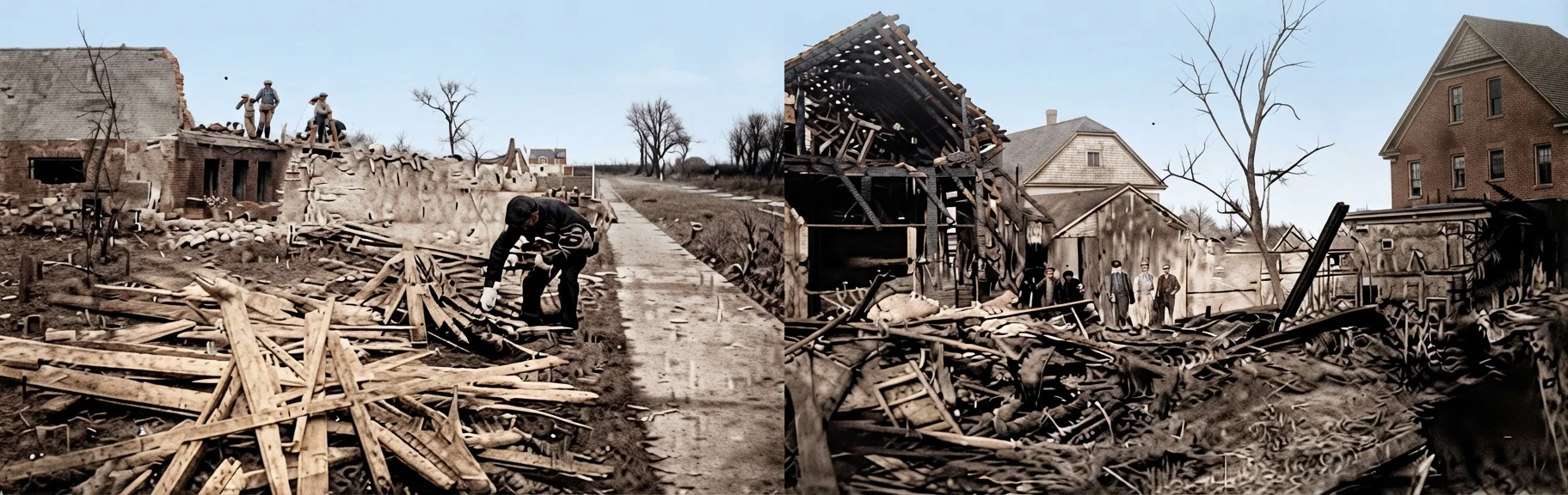
These pictures tell us a graphic story of what dynamite has been doing in different parts of the country. The one on the right is the wreck of Albert Von Spreckelson's planing-mill, North Street and Highland Avenue, Indianapolis, blown up at midnight, October 22, 1909. The one on the left is the wreckage of the Indianapolis new library building, blown up by the dynamiters; also mentioned in Detective Burns's statement.
But God reigns, and the world will still survive.
When the year was almost spent the "Wall Street Journal" expressed itself in regard to the situation as follows:
We are going through just such another period of unrest as that of 1848. Labor troubles have never assumed such formidable dimensions as in
The young sultan of Persia, Ahmed Shah, from a recent photograph—the tiny monarch who doubtless would be glad to be rid of his throne, and play and act like other boys, but whose very kingdom is in a critical position just now, between Russia and other powers. Russia demands the dismissal of the American who is putting her finances in order. Among other things, the energetic young man has brought Russians to time, and demanded of them what was due from them to the Persian government. Persia refuses to dismiss Mr. Shuster. What the outcome will be is difficult to say.
the recent past in England and France. Germany is afraid of her own citizens, so rapid is the spread of social democracy in that country. Of the conditions of the Iberian peninsula it is needless to speak. Old established monarchies are trembling, and the hour is thunderous with the reverberant shaking of thrones.
The foregoing paragraphs present the situation as it actually exists in the world from the view-point of various writers, but all are unanimous in showing that the entire world is hanging on the brink of an indescribable revolution. Some of the world events that have occasioned such statements as are found in the foregoing paragraphs may be mentioned:
The Field of Labor and Capital
In the field of labor and capital there has been perhaps no other year in the history of the world when there were such unsettled conditions and such wide-spread unrest and rioting. England had its great strike, which was compared to an actual civil war because of the strong military force that had to be called out to suppress the rioting. Portugal and Spain had similar labor riots, altho not so strong, perhaps, as the one in England. There were bread riots in France and in Austria. There were labor disturbances in Germany, and even far-off Japan has begun to feel the impulses of the Socialist movements that claim to be working for the betterment of humanity, but which so frequently result in warlike clashes between the laborer and the capitalist.
In our own country a strike was declared, and a most bitter struggle was threatened. The sudden and complete exposing of the great dynamite conspiracy through the confession of the McNamara brothers seems for the present to have quieted the apprehensions in regard to any immediate difficulties between capital and labor in this country; but incidentally this confession shows the determined and bitter struggle that is on between the men of wealth and the men of brawn. And while the course of the struggle may be changed by this confession, the bitter fight will go on just the same, because we must reckon with strong convictions on both sides of the controversy, even tho these convictions in many instances are based upon the strongest sentiments of selfishness.
War Among the Nations
Early in the year Diaz was driven from Mexico by the revolutionary forces, and Madero was placed at the head of the affairs of State. But the turbulence has gone on, and the end is not yet. War was declared on Turkey by Italy. This war is still in progress. The revolution in China has been bitterly waged, and the outcome is not yet fully known.
And then, in addition to these actual wars that have been in progress, Germany and France have bitterly quarreled, and for a11number of months it was feared that there would be an actual outbreak. England and Germany, who have been quarreling for the last two or three years, have not fully settled their difficulties. Russia and Persia have been in a quarrel, troops were mobilized, and war may yet be declared. Conditions in India were so very much unsettled that some of his best advisers requested King George to refrain from his journey to that part of his realm to be crowned as emperor.
And while these greater disturbances have been in progress, many minor ones that the reader will readily call to mind have agitated and disturbed different localities.
Preparation for War
During the past year a new implement of warfare has made marvelous strides toward perfection. The aeroplane has come to be an established fact, and one nation after another is providing itself with these fleets that sail the skies. And while early in the year Mr. Carnegie was much lauded throughout the world for his donation of ten millions toward the peace movement, yet the various nations of the earth have laid down one of the great Dreadnought battle-ships on an average of about every ten days; and while there was ten millions of money given by Mr. Carnegie for peace, the nations have spent over seventy times that much, or seven hundred millions, on their battle-ships. Thus there is much peace talk, but the preparations are all for war.
In the Religious World
Mighty movements are also working strongly in the religious world. The strongest of these movements is that toward a great world federation of the various religious bodies, so that their combined influence can be brought to bear upon the civil power to compel what they believe proper reforms. Many of these reforms in themselves are good; but the religious despotism that they will establish in seeking to promote these reforms, will simply be a repetition of the history of the past. There has never been a religious despotism but what has been a mighty persecuting power. A number of notable conventions during the year have been held, the central theme of which seemed to be to turn the minds of men toward this great federation movement. The Methodists had a meeting for the purpose of combining the various orders of Methodists into one church, and their speakers also expressed themselves in favor of having all religious bodies united in one great federation. The convention of the followers of Alexander Campbell that met in Portland had for its central theme the uniting of all religious bodies, not excepting the Catholics. The Good Citizen Movement had a convention in Chicago, and one of its great thoughts is to combine the religious sentiment of the world in favor of certain reforms.
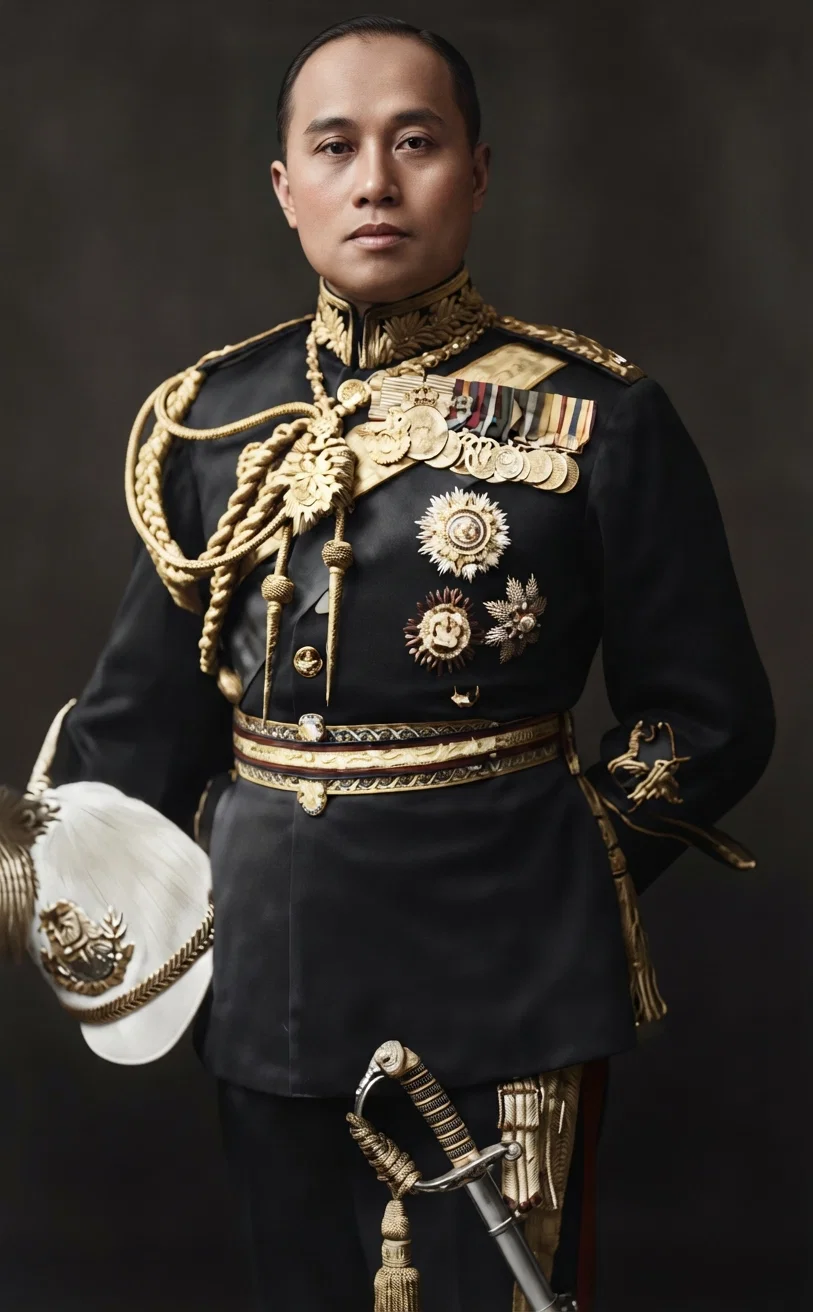
The latest photograph of Maha Vajiravudh, the new king of Siam, whose coronation at Bangkok began December 1 and lasted several days. He has six beautiful sisters, but these must be consigned to "single blessedness," for fear of their rearing, in any marriage they might contract, some rival to the throne. Of course there is a possibility that they may be joined to some royal harem, but they can not be first wives and have a household of their own.
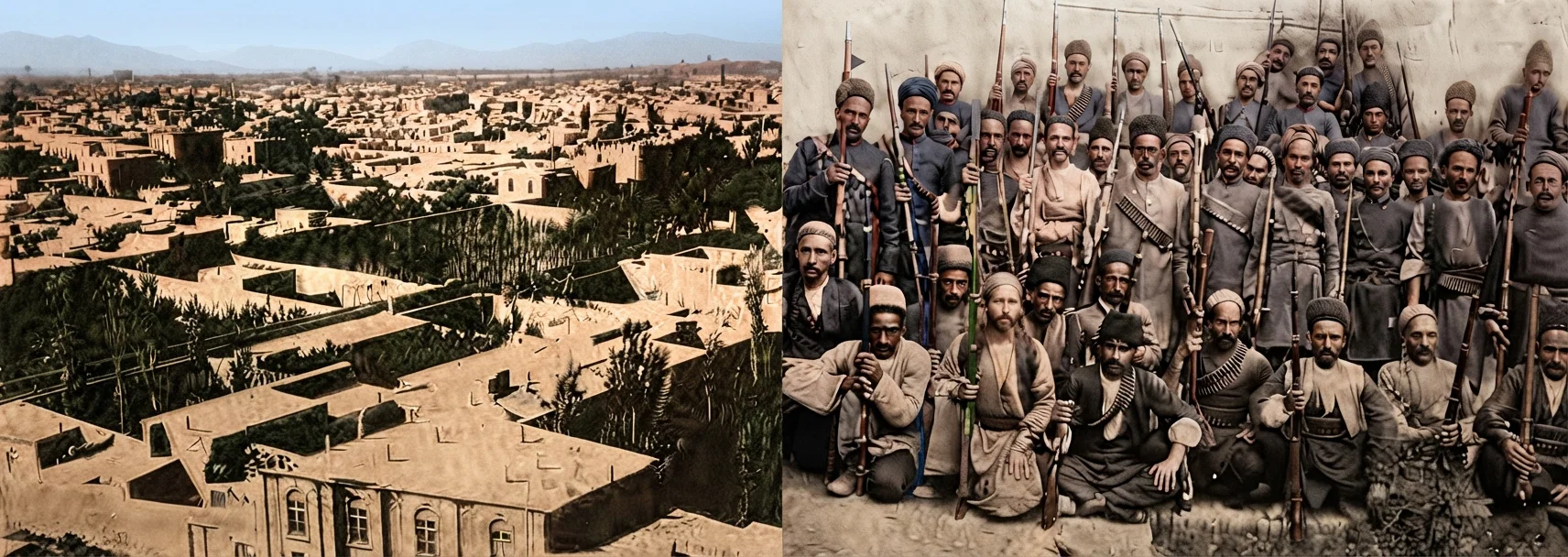
The capital of Persia, Teheran, toward which Russian troops are now going. Sharpshooters in the Persian army — men who, if Russia and Persia go to war, will take an active part
Then there has come to the front, and perhaps is attracting the most attention of anything just now, the "Men and Religion Forward Movement."
But standing out above all of these movements, and destined in the end to lead every one of them, is the advancement that the Catholic Church is making in the United States. We had during the past year the jubilee celebration of Cardinal Gibbons, and also the appointment of three more American cardinals. The Papacy has become very aggressive, and the call for three more cardinals in this country is merely an indication of what the Catholics themselves regard as well-nigh a marvelous advancement that they are making in this great nation. The Papacy boasts that she never changes; and the same principles that actuated the Papacy in the Middle Ages, actuate it still. One of the strongest and most repressive efforts of the Papacy during the last year, was directed against the "Modernists." By this fact alone we can see that she is determined that modern principles and modern views shall not break in upon the cherished history and traditions of the Papacy. She may seem to give way to these modern notions at times; but when the Papacy finally rights herself to take the lead of this great federal movement that is so strikingly active in the modern Christian world, she will be the Papacy of the Middle Ages.
The reader may smile at the idea of the Papacy's being placed at the head of these great federations that are being formed; but if you will closely study the prophecies of the Bible, you will see the clearest and most striking evidence that such will be the case; and if you watch closely the events of the passing days, you will see that these prophecies are being very clearly enacted into history.
Criminality
It is only necessary, in passing, to make mention of the fact that the newspapers and the magazines of the day are filled with accounts of the most unspeakable crimes. Jurists, politicians, and reformers are declaiming against these, and declaring themselves fearful for the outcome. And if we will but watch the gathering storm of criminality and violence as it is rising to sweep over the world, we will see an unmistakably clear fulfilment of the words of Jehovah which say that evil men and seducers shall wax worse and worse, deceiving and being deceived.
Thus may we see, as we briefly scan some of the leading events that have disturbed the minds of men during the past year, that there was an abundance of cause for alarm; and the years that lie just before us will serve only to intensify and increase these troubles and disturbances. And while the great religious movements of the time were not in the minds of the men who wrote so alarmingly, yet are these movements filled with ominous portents. They foreshadow the great religious despotism that is to be one of the leading conditions of the closing hours of time.
Men may call it pessimism to talk in this way; but that may only be called true optimism which deals with actual facts, and refuses to build our hopes on fable and fancy. This old world is passing through her death agonies, and there is no mistaking it. The second coming of Christ lies just before us; and it is the most glorious event, and the most to be desired, of anything that has occurred in all the ages. We desire to have the optimism that will see the meaning of the turmoil and strife that is in the world, and that will know of a surety, from God's prophetic Word, that while the end is at hand, it is only12the end of sin, of strife, of crime. The beginning of the glorious day of eternity when Jesus the Saviour of men will reign supreme, lies just beyond. T.
Why We Oppose Its Passage
By W. A. Colcord
The Johnston Sunday Bill—No. 4
Why We Oppose Its Passage
THE Johnston Sunday Bill for the District of Columbia is very similar, both in its phraseology and in its leading provisions, to the old Maryland Sunday law of 1723, which was incorporated into the laws of the District by act of Congress in 1801, when the District became the permanent seat of the National Government. This will be apparent from a brief comparison of the two.
One, the Maryland law, prohibits “bodily labor on the Lord’s day, commonly called Sunday;” the other, “labor at any trade or calling” on “the first day of the week, commonly called Sunday.”
One prohibits “unlawful pastimes and recreations;” the other, “any circus, show, or theatrical performance.”
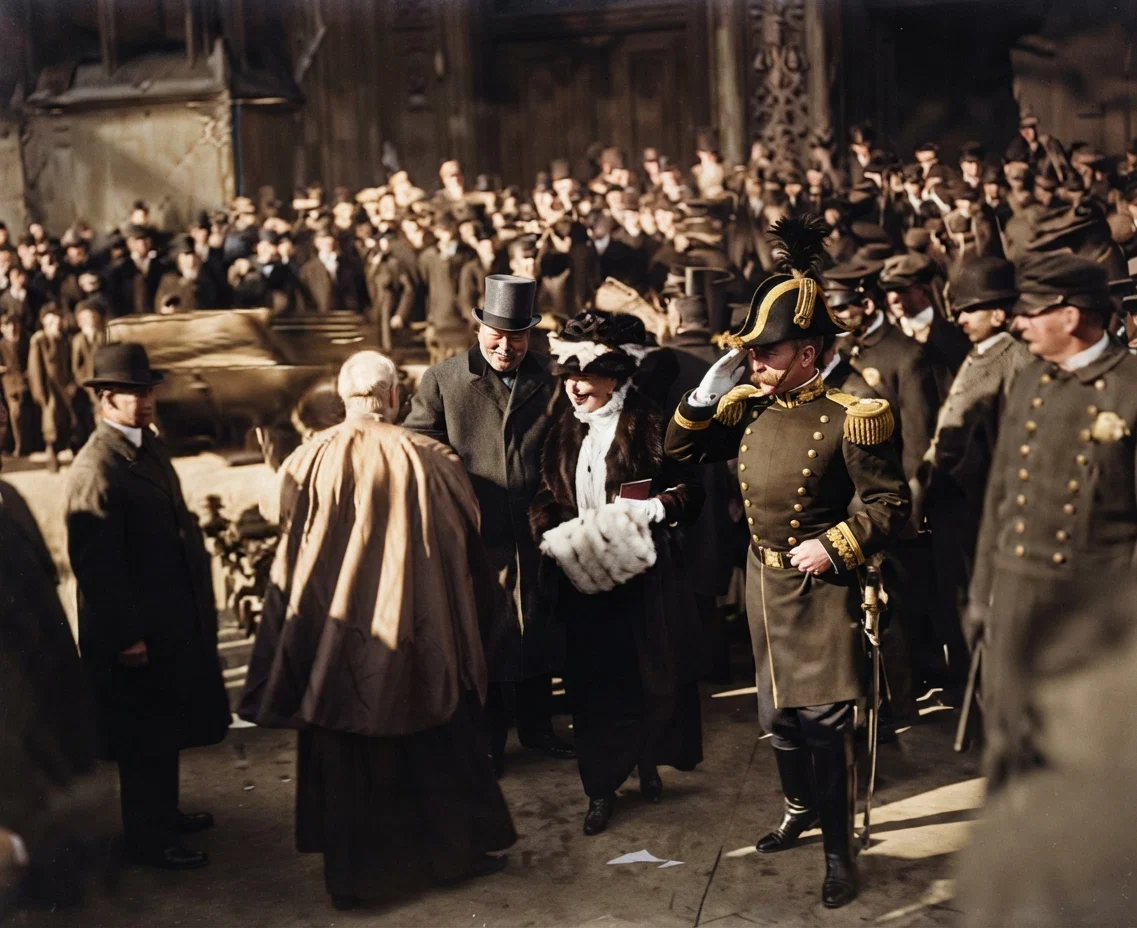
A photograph of President Taft, Mrs. Taft, and Major Butt, arriving at St. Patrick's Church, Washington, for the Thanksgiving mass
One prohibits any one to suffer his “children, servants, or slaves . . . to do any manner of work or labor on the Lord’s day, works of necessity and charity always excepted;” the other forbids any one to “employ, or cause to be employed, his apprentice or servant in any labor or business, except in household work or other work of necessity or charity.”
One forbids any one to “profane the Lord’s day;” the other requires that all shall observe one day in the week, preferably Sunday, “as a Sabbath.”
One provides a fine of “two hundred pounds of tobacco,” or in default, “three hours in the stocks” or “thirty-nine lashes;” the other, a fine of ten dollars, or ten days’ imprisonment, or both.
Neither requires church attendance; but both are religious, and assume to prescribe religious and not civil duties.
January 21, 1908, the old Maryland law was set aside by the District Court of Appeals as “obsolete;” as prescribing “religious and not civil duties,” and therefore unconstitutional; and as “the outgrowth of the system of religious intolerance that prevailed in many of the colonies.” This being so, what can the enactment of the Johnston Sunday Bill, so similar to it, be but the revival of that system of religious intolerance, and an attempt once again, and this time by the National Government itself, to enforce religious duties upon men by law?
Already in no fewer than seventeen of the forty-eight States of the Union, Sunday laws have resulted in oppressing conscientious observers of another day. Even in States, as in Arkansas, where they were exempt from the provisions of the law, the exemption has been repealed, and they have been singled out as special objects of attack, and made to suffer unjustly. From 1885 to 1896, under a revival of Sunday enforcement, over one hundred Seventh-day Adventists in this country, and about thirty in foreign countries, were prosecuted for quietly going about their work on Sunday, resulting in fines and costs amounting to $2,269.69, and imprisonments totaling 1,438 days, and 455 days served in chain-gangs. If such proceedings are possible and have actually occurred under existing Sunday laws, why may we not expect similar results to follow the enactment of a national Sunday law?
The Exemption Clause Examined
The exemption, in the first section of this bill, for observers of another day, contains what may properly be styled the first step toward intolerance. It reads as follows:
Provided, That persons who are members of a religious society who observe as a Sabbath any other day in the week than Sunday shall not be liable to the penalties prescribed in this Act if they observe as a Sabbath one day in each seven, as herein provided.
This exemption places the Government of the United States in the attitude of assuming the right to compel all to observe Sunday as the Sabbath, but of permitting those who observe another day, not to do so — to labor on that day, — a right which they already possess without such permission. This is simply of the nature of toleration. But while, from INTOLERANCE, toleration is a step toward LIBERTY, conversely, from the standpoint of LIBERTY, our present standpoint, it is equally true that toleration is a step, the first step, toward INTOLERANCE. According to Madison and other founders of our National Government, freedom in religious matters is “something which every man may demand as a RIGHT, not something which he must ask for as a PRIVILEGE. To grant to the State the power of tolerating is implicitly to grant to it the power of prohibiting,” whereas the founders of this Government denied to it “any jurisdiction whatever in the matter of religion.” See Appleton’s “Cyclopedia of American Biography,” volume 4, page 165.
There is a vast difference, therefore, between TOLERATION and LIBERTY. It is for the latter that we plead. An exemption of this kind is class legislation, and a permission which may easily be withdrawn. In enacting its “Lord’s Day Act” of 1907, the Canadian Parliament, at the urgent solicitation of certain church elements, refused to insert an exemption of this kind in the act; and according to a report in the “Literary Digest” of October 3, 1908, the efforts of the Federation of Sunday Rest Associations of America to secure a Sunday law for the District of Columbia, were accompanied with a request “that no exception be made on account of religion.” From this it is evident that tho the Johnston Bill should pass with this exemption in it, it would not be in accordance with the ideas and wishes of those most desiring it, and that, sooner or later, the exemption would in all probability be repealed.
Even where such exemptions exist, they are not always respected. The Sunday law of Virginia contains a very plain exemption for conscientious observers of the seventh day; and yet in October, 1910, an observer of this day at Colonial Beach was hailed into court by a prejudiced neighbor for performing a little piece of work on Sunday which his employer, an observer of Sunday, had requested him to perform then, and fined.
From still another standpoint this exemption in the Johnston Sunday Bill condemns it as out of place in civil legislation. Its very presence in the bill is a virtual acknowledgment of the fact that without it the measure would come in conflict with the conscientious convictions and the religious observances of a certain class of citizens. This of itself is sufficient proof that the measure is religious, and therefore improper legislation for Congress.
An Attempt to Settle a Religious Controversy by Law
Moreover, as pointed out in both the Sunday Mail Reports adopted by Congress in 1829 and 1830, the enactment by Congress of any law of this kind would be an attempt to settle by law a religious controversy “in which good citizens may honestly differ in opinion,” and “in which even Christians themselves are at issue,” and to determine and define by human law “what are the laws of God.” As to the results of such attempts, these reports significantly say that “the catastrophe of other nations furnishes an awful warning;” and they add:
If the principle is once established that religion, or religious observances, shall be interwoven with our legislative acts, we must pursue it to the ultimatum. We shall, if consistent, provide for the erection of edifices for worship of the Creator, and for the support of Christian ministers, if we believe such measures will promote the interests of Christianity.—Senate Report of 1829.
If a solemn act of legislation shall, in one point, define the law of God, or point out to the citizen one religious duty, it may with equal propriety proceed to define every point of divine revelation, and enforce every religious obligation, even to the forms and ceremonies of worship, the endowment of the church, and the support of the clergy.—House Report of 1830.
Such are the logical results, and history shows that such are the actual results, of enacting Sunday laws.
Foreign Commerce of the United States
The foreign commerce of the United States will total two billion dollars, altho there is a falling off of imports. Among the exports cotton leads, — over $500,000,000 worth; iron and steel come next, $250,000,000; and meat and dairy products, $160,000,000.
Aid for Pitcairn Island
By Editor
The first response to our little note on the needs of little Pitcairn Island came this morning, enclosing $5.00. We will wait a few days for others, and then forward it. We are sure that it will be appreciated by those on that little speck of land in the broad Pacific.
The Spirit of War
By Editor
The "Scientific American" of December 9 is a great issue. It is a naval number, and gives many tremendous facts regarding not only the navy of the United States, but the navies of the world. The facts and statistics therein presented show very clearly the spirit of the times. Said a naval officer to the editor of the Scientific American, "I tell you, sir, it is the greatest game in the world;" and the editor replied: "A great game, but dangerous; no protection; ricochet shots; high explosive shells. These masts, if the enemy can shoot like the North Dakota, must come down early in the action." The officer immediately replied, "Then it is the grandest way to die;" and the editor summarizes it, "Yes, there is the whole story,—the greatest game, the grandest death,—an epitome of the spirit of our navy; and it is that same spirit of war which possesses the nations of the world."
It Saves the Boys
THE best argument I have found in Maine for prohibition was from an editor of a paper in Portland, that was for political reasons mildly opposed to it. I had a conversation with him that ran something like this:
“Where were you born?”
“In a little village about sixty miles from Bangor.”
“Do you remember the condition of things in your village prior to prohibition?”
“Distinctly. There was a vast amount of drunkenness, and consequent disorder and poverty.”
“What was the effect of prohibition?”
“It shut up all the drink shops, and practically banished liquor from the village. It became one of the most quiet and prosperous places on the14globe.”
“How long did you live in the village after prohibition?”
“Eleven years, or until after I was twenty-one years of age. Then I went to Bangor.”
“Do you drink now?”
“I have never tasted a drop of liquor in my life.”
“Why?”
“Up to the age of twenty-one I never saw it, and after that I did not care to take on the habit.”
That is all there is in it. This man and his schoolmates were saved from drink by the fact that they could not get it until they were old enough to know better. Few men become drunkards who know not the poison until they are twenty-one.—Selected.