"I am come that they might have life, and that they might have it more abundantly." John 10: 10.
THE plan of salvation is a life-giving, healing plan. The whole purpose of Christ's work in behalf of humanity was "that they might have life, and have it more abundantly." God's Word is life and spirit to those who receive it. John 6: 63.
Christ is the Fountain of spiritual life for our fallen world; and the reason we have so little of His life is that we doubt its reality and refuse to co-operate with the Life-giver. Says the Master, "Ye will not come to Me that ye might have life." John 5: 40.
There is life in light, death in darkness. The light that shines forth from the word of revelation, in nature, or through the laws of health, contains life for all who receive it. Jesus said, "I am the Light of the world. He that followeth Me shall not walk in darkness, but shall have the light of life." John 8: 12.
"Search the Scriptures, for in them ye think ye have eternal life, and they are they which testify of Me." John 5: 39.
Through Christ a flood of light is shed abroad in our dark world, light concerning the physical life, the mental life, and that greater and deeper light concerning the spiritual life—life everlasting. The light of these truths, brought to us by the revelation of God, contains life and health and healing in their respective spheres.
The living principles of truth are, as it were, leaves from the tree of life, which are for "the healing of the nations," in that they enable us to turn our practises from wrong channels into those of obedience and co-operation with the Life-giver.
In Contrast with the False.
"She said, If I may but touch His clothes, I shall be whole. And straightway the fountain of her blood was dried up; and she felt in her body that she was healed of that plague. And Jesus, immediately knowing in Himself that virtue had gone out of Him, turned about in the press, and said, Who touched My clothes?" Mark 5: 28-30.
When this poor sufferer had been made whole, Jesus knew that virtue—healing power—had gone out of Him. What the suffering woman had received, the Master had given. And it is the same with each and every sufferer to-day. Whatever is received in the sick room in the way of health and healing, comes to us through the channel of our blessed Redeemer. Christ Jesus is the only source of life and health for fallen humanity. Those who seek for spiritual and physical healing at the hands of false and bogus "healers" are sure to meet with bitter disappointment. Is it not the duty of every soul who has found the genuine fountain of healing to give the trumpet of truth a certain sound, that honest souls be not swept from their anchorage by the flood of deceptive teachings, false divine healers, "Christian Science," "Theosophy," "Spiritualism," "New Thought," etc., many of which are spreading throughout the country with prairie-fire rapidity. The day has arrived when we should unfurl our banners to the breeze with the truths of health and healing written thereon so plainly that the honest in heart may read and be saved from the many deceptions springing up on every side.
The Word of Life and Light.
"And the Word was made flesh, and dwelt among us." John 1: 14.
The Word of God, the channel of healing to the world, was "made flesh and dwelt among us." And there, in the person of Jesus, was a fountain of life and health. Everywhere He went He was found healing diseases and forgiving sin.
"Then spake Jesus again unto them, saying, I am the Light of the world; he that followeth Me shall not walk in darkness, but shall have the light of life." John 8: 12.
There is life in the light that shines from the cross of Calvary. Every ray of divine light is laden with divine life. While God, in His love, because He is no respecter of persons, gives a certain amount of His healing ministry to both saint and sinner, yet the believer in Christ, the one who obeys the Healer's laws, is in personal communication with the unbounded resources of health and the infinite powers of healing that are bound up in Jesus—God's great gift to man. The divine way is the path of health and holiness. It is not enough to hold truth as a mere theory of the mind; it must reach the heart, transform the character, and find actual expression in the life. "Sanctify them through Thy truth; Thy word is truth." John 17: 17.
We must become acquainted with God's way in our bodies. There is purifying power and sanctifying possibility in God's truth. The laws of health are God's ways in the physical man; and by diligent study and conscientious obedience we may so relate ourselves to God's ways that we shall experience for ourselves "His saving health," and through us it will be shown forth to the nations. It is by the aid of the light of truth that we come to know God, whom to know aright "is life eternal." John 17: 3.
There is health in His way,—the right way, the way of obedience,—while there is disease of the body and anguish of the soul, in the enemy's way, the wrong way,—"the way of sinners."
So the conscience ever admonishes the sin-sick soul, saying, "This is the way, walk ye in it." Isa. 30: 21. Likewise, physical pain all the while seeks to direct the transgressor back to the paths of obedience, saying, "You are in the wrong way; turn back to the path you have strayed from; cease your transgression." The trampling underfoot of truth, and the rejection of light is the crucifixion of life.
"Behold, I will bring it health and cure, and I will cure them, and will reveal unto them the abundance of peace and truth." Jer. 33: 6.
The abundant revelation of God's peace and truth should precede and accompany the ministry of healing. We must first cooperate, to the full extent of our knowledge, with the healing power that God has placed within us, before we can consistently make requests for the manifestation of additional and miraculous healing in our behalf. In accepting the light of truth, we lay hold of the most powerful transforming agent in the whole universe. "Know ye not that ye are the temple of God, and that the Spirit of God dwelleth in you? If any man defile the temple of God, him shall God destroy; for the temple of God is holy, which temple ye are." 1 Cor. 3: 16, 17.
W. S. SADLER, M. D.
NO EXCUSE ALLOWED.
A SUCCESSFUL business man told me there were two things which he learned when he was eighteen, which were ever afterwards of great use to him—namely, "Never to lose anything, and never to forget anything." An old lawyer sent him with an important paper, with certain instructions what to do with it.
"But," inquired the young man, "suppose that I should happen to lose it, what shall I do then?"
"You must not lose it," said the lawyer frowning.
"I don't mean to," said the young man; "but suppose I should happen to?"
"But I say you must not happen to. I shall make no provision for such an occurrence; you must not lose it."
This put a new train of thoughts into the young man's mind, and he found that11if he was determined to do a thing he could do it. He made such a provision against every contingency that he never lost anything. He found this equally true about forgetting. If a certain matter of importance was to be remembered, he pinned it down on his mind, fastened it there and made it stay. He used to say, "When a man tells me he forgot to do something, I tell him he might as well have said, 'I do not care enough about your business to take the trouble to think of it again.' I once had an intelligent young man in my employment who deemed it sufficient excuse for neglecting an important task to say, 'I forgot.' I told him that would not answer; if he was sufficiently interested, he would be careful to remember. It was because he did not care enough that he forgot. I drilled him with this truth. He worked for me three years, and during the last of the three he was utterly changed in this respect. He did not forget a thing. His forgetting, he found, was a lazy and careless habit of the mind, which he cured."—Selected.
STEP UP HIGHER.
By Adelbert F. Caldwell
(Adelbert F. Caldwell, in Wellspring.)
If to-day you've made some progress,
Do not tire.
Sit not down!—upon the morrow
Step up higher!
If to-day you've felt a soul-growth,
Then aspire!
Loftier ideals still await thee,
Step up higher!
If you've seen the mountain summits
Tipped with fire;
Beyond are scenes aflame with glory,
Step up higher!
If you've heard the Master's whisper,
Then draw nigher.
There is offered life to him who
Steps up higher!
MISS HARRIET'S CORNERS.
'ROUND the restaurant table sat an agreeable little company, composed of some gentlemen, a lady, and a girl with a charming face and vivacious ways. Meal and conversation were proceeding pleasantly, until—the waiter upset a cup of chocolate in the girl's lap!
After an interval, during which chairs were thrust back, napkins flourished, and exclamations launched, the frightened waiter doing his best to repair damages, the flurry subsided somewhat and the party reseated itself.
"My dear Harriet," cried the lady, ruefully, "your pretty suit is ruined!"
"O, there are more in the shops," was the gay rejoinder.
The waiter having got a smile from the heroine of the accident, went off in a dazed condition. The gentlemen were staring silently.
"Now look here, Miss Harriet," began the man with white hair, recovering first, "tell us how you did it!"
"Did what?" mischievously.
"Kept your equanimity, when most women would have—well, no matter! I was looking right at you when it happened, and the corners of your mouth went back instantly in a smile and—"
"O, did you notice that?" asked the girl, suddenly interested. Then she checked herself, coloring. But the others scented a story and insisted, until Miss Harriet yielded, laughing.
"Well, since Mr. Pierce is so discerning—but really there is nothing to tell, you know. I had a new hat sent home once, the night before Easter. I was to sing in church, and that hat was the prettiest thing! O, don't be frightened,"—she laughed merrily,—"I won't describe it. In fact I never got very familiar with it, anyhow; for, when I left my room a moment, my puppy found it and had a personal interview with it.
"No, I didn't shake the puppy—he was a dear. I just dropped into a chair and contemplated the ruins.
"But presently I caught sight of my face in the dressing-table mirror, and—I forgot even the ruins! I was so shocked that I said right out, 'Is that you, Harriet Corey?' Why it was the most woe-begone, forbidding countenance—my mouth made a perfect capital U, turned upside down.
"It came to me that that was how I probably looked whenever things went wrong.
"Well, I experimented immediately. I made the corners of my mouth move back and up, and I decided that a presentable face was better than an Easter hat. And I concluded right there that when things went wrong, I'd at least see that the corners of my mouth stayed up.
"Really, you've no idea," she finished ingeniously, "how it helps when horrid things happen. You just can't feel cross and blue if you keep your corners right."
Miss Harriet, absorbed in her narrative, had been unaware of admiring eyes. Now her cheeks began to redden.
"It's better than controlling corners in wheat!" murmured Mr. Pierce.—Christian Worker.
A TEMPERANCE STORY.
A WOMAN entered a barroom, and advanced quietly to her husband, who sat drinking with three other men. She placed a covered dish on the table, and said, "Thinking ye'd be too busy to come home to supper, Jack, I've fetched it to you here." And she departed.
The man laughed awkwardly. He invited his friends to share the meal with him. Then he removed the cover from the dish. The dish was empty. It contained only a slip of paper that said: "I hope you will enjoy your supper. It is the same your wife and children have at home."—Selected.
BE SIMPLE IN HOSPITALITY.
By Ralph Waldo Emerson
"I PRAY you, O excellent wife, not to cumber yourself and me to get a rich dinner for this man or this woman who has alighted at our gate, or a bed-chamber made ready at too great a cost. These things they can get for a dollar at any village. But let this stranger, if he will, see in your looks, in your accent, and behavior and will, that which he can not buy at any price in any village or city, and which he may well travel fifty miles and dine sparsely and sleep hard in order to behold.
Certainly, let the board be spread, and let the bed be dressed for the traveler; but let not the emphasis of hospitality lie in these things. Honor to the house where they are simple to the verge of hardship, so that there the intellect is awake and reads the laws of the universe.—Ralph Waldo Emerson.
Individual Communion Cups
More convenient, sanitary; add impressiveness to ceremony. We introduced individual service, make the best and supply over 4,000 satisfied congregations. They never go back to the old way. List of users on request. Send for free catalogue. Return outfit (our expense) if not satisfied after trial Sanitary Communion Outfit Co. 64th St. Rochester, N.Y.
Overland Limited
Chicago 68 Hours
Electric Lighted Equipment
World's Events Telegraphed, Train Daily
Unexcelled Dining Service
Observation---Parlor---Cafe Cars
Drawing-room---Stateroom Sleepers
Through without Change
Across Great Salt Lake and High Sierra by Daylight
Fastest Time---Most Direct Route
VIA
Southern Pacific
Personally Conducted
Tourist Cars
ON THE
UNION PACIFIC
Operate daily between principal Eastern points and California. The route of the Overland Limited.
S. F. BOOTH, General Agent,
San Francisco, Cal.
E. L. LOMAX, G. P. A.
Omaha, Neb.
Bank of Mountain View
By Editor
If you haven't already done so, why don't you drop us a postal asking us to send you a copy of our monthly paper, "The Bank of Mountain View Journal." It is very interesting. It is full of good ideas, and it is free to you for the asking. If you live in the East, send for a copy and see how we do it in California. We still hold ourselves ready to furnish you with information about Mountain View. Write us.
Address
Bank of Mountain View
Mountain View, Santa Clara County, California
Single Comb Buff Orpingtons
SINGLE COMB BUFF ORPINGTONS. — We breed nothing else, for we believe them to be the best. Hens, pullets, and cockerels, $2 each. Trio, $5. Eggs in season, $1.50 per fifteen. Satisfaction guaranteed. Union College Poultry Yards, College View, Neb.
NEW YORK AND PHILADELPHIA, VIA NIAGARA FALLS.
An attractive way is via the Grand Trunk-Lehigh Valley Route; double track; solid trains. Write Geo. W. Vaux, A. G. P. & T. A., Grand Trunk Railway System, 135 Adams Street, Chicago, for particulars.
IV. WORK DAYS AND PLAY DAYS IN JAPAN.
By F. W. Field
It hardly need be said that the Japanese as a people possess a good degree of energy and thrift. The first sight of their shores bears evidence of this. Fishing boats throng the coasts; and every available plot of land is carefully cultivated, even steep mountain-sides being terraced to their summits, and verdant with growing crops. And a closer examination of the country, and a better knowledge of the people sustain the first impression.
Labor Methods.
And yet, in Japan, as elsewhere, varying standards seem to exist in different lines of work as to what constitutes a day's labor. To illustrate: The Japanese carpenter seems to have reached or even passed the goal of the eight-hour day. He begins work anywhere from half past seven to eight o'clock, spends considerable time in sharpening his tools, stops work three or four times in a half day for a smoke, and in cold weather frequently stops to warm himself at a fire of shavings. At the other extreme of the laboring class are the factory hands, often mere children, who work from early morning till night for a very small wage indeed.
One curious custom among some workmen in the Orient is that of concert work. It is interesting and amusing to see twenty or thirty men and women working a pile-driver with rhythmic movements, to the accompaniment of a kind of chant, in which all join. In this instance the unison of effort is necessary.
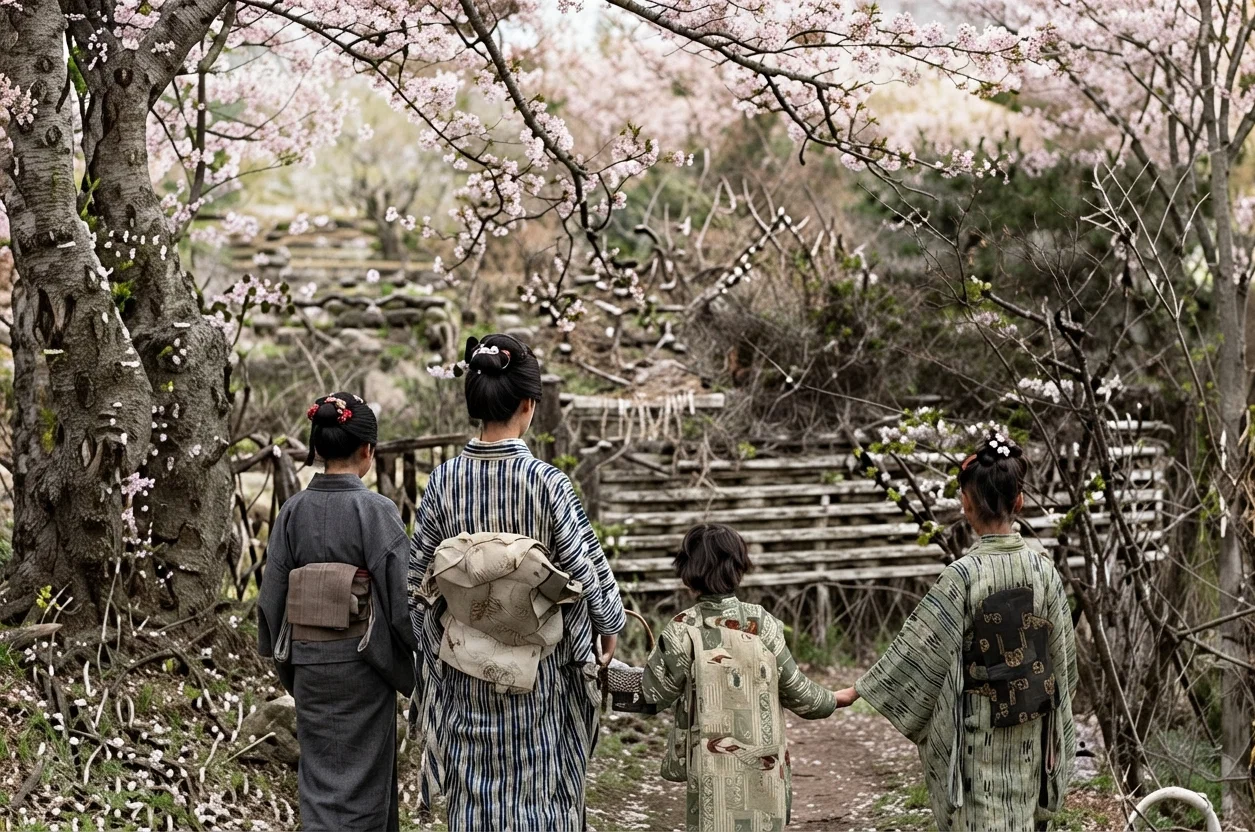
Viewing the Cherry Blossoms.
Not so, it would seem, in the case of a squad of railway section hands, all raising their picks at the same time and letting them fall together. It has been pointed out that this mechanical method of labor necessarily detracts from the excellence that results from more individual effort. But of course this method of working can only be applied to certain forms of unskilled labor.
The Artistic and Poetic.
The more recent history of Japan has convinced the world that the Japanese are to be taken seriously, and no longer regarded as "pretty, interesting, artistic little dolls or children, fantastic and whimsical." And yet this artistic, playful vein in their character lies very near the surface, which fact doubtless accounts for its having been discovered by foreigners earlier than their sterner traits. The cares of life seem to rest lightly upon them, and their highly developed artistic sense responds to all the beauties of nature. It is difficult for foreigners to appreciate their keen enjoyment of these. A Japanese will walk miles to see a display of red maple leaves in the fall, or a pond full of lotus blooms in summer. In April the resorts famous for cherry blossoms are literally thronged with sightseers. In June the morning-glories are at their best. Here in Tokyo there is one place famous for these flowers. Throngs of people come to see them in the early morning, and return home by way of the lotus pond, to feast their eyes on the pink and white beauties that stud the surface of the water. The full moon on a clear night offers attractions that draw many admiring spectators, and furnish the topic for many a poem.
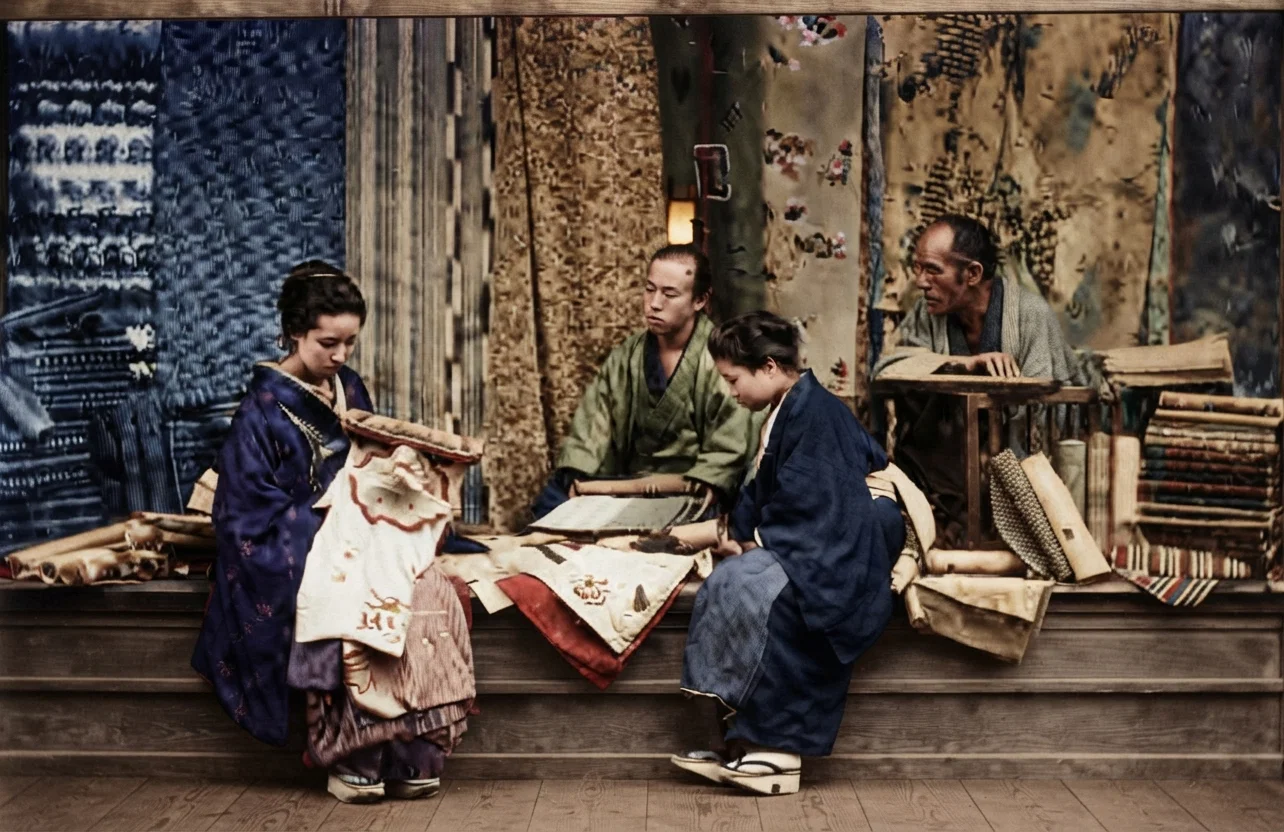
Interior of a Japanese Shop.
With this keen appreciation of the beauties of nature, it is natural that the people should be much given to outdoor excursions and pastimes. Long trips are made on foot to noted shrines, and to places famous for their scenic beauty. Frequent outings to parks and groves are planned for the school children. Old and young of all classes seem to enjoy such recreation very much.
But for all this, and with all their holidays and festivals, the Japanese really have few true rest days; for there is no weekly Sabbath. Workmen in factories and other establishments are allowed two rest days in a month, commonly the first and fifteenth days, regardless of the day of the week.
Among artisans and shop-keepers generally business is carried on without any regular interruption. In some parts of the country the farmers rest half a day every fifth day—at times when their work is especially taxing upon their strength.
The Principal Holidays.
The principal holidays of the year are the New Year's season, the festival for girls on the third of March, the boy's festival on the fifth of May, and the emperor's birthday on November 3. The most popular religious festival comes in mid-summer, and is held in honor of the souls of the departed dead, who are believed to return to their former abodes during this time. Festivals at the various Buddhist and Shinto temples are common, but the time of these varies for different temples.
Until the early days of the present era, the Japanese reckoned time by the old lunar calendar, still in vogue in China, and in the rural and more remote parts of Japan. The beginning of this year occurs in February, several weeks after the rest of the world have begun a new year. The year is composed of twelve lunar months, with an occasional intercalary month. The months have no specific names, but are known by their numbers.
Lost Account of the Week.
It has already been observed that the Japanese have no weekly rest day. And it is interesting to note that until their recent contact with Europeans, they had practically lost all account of the week. Yet there are customs and traditions which prove quite conclusively that they once had a knowledge of the week, and observed a weekly rest day or holiday. Among physicians it was common to prescribe a course of medicine for one mawari. The literal meaning of this word is "a turn; revolution; rotation;" but as used above it meant, and still means, "one turn or a period of seven days." It is also said that among priests a similar period of seven days was assigned to the13performances of certain ceremonies and prayers. There is also a tradition among the people that in ancient times their ancestors observed a rest day or festival once every seven days.
But the most remarkable and convincing proof on this point pertains to their old calendar. In their calendars as issued from year to year, from time immemorial the Chinese character for the sun was written in regularly recurring intervals of seven days. The reason for this became lost, even to scholars. But in time, when the Japanese came in contact with Europeans, and compared calendars, the days in their calendar to which the character for the sun was attached were found to coincide exactly with Sunday, the first day of the week. The candid reader is left to decide the bearing of this remarkable fact upon the "lost time" question.
Early in the present era the Japanese government adopted the Julian calendar; and with this change came the complete recognition of the week. Specific names were attached to the days of the week. The first day of the week was named for the sun, the second for the moon, as in our calendar. The remaining days were named for the planets Mars, Mercury, Jupiter, Venus, and Saturn, in the order given.
Sunday in Japan.
Through contact with foreigners, it has come about that Sunday is observed as a sort of legal holiday or "civil sabbath." All schools are closed on Sunday. Also all government offices, and such government establishments as the arsenal in Tokyo and the government paper mills at Oji; but the work in these is continued on Sunday when urgent. But with these and similar exceptions, the work-a-day world in Japan pays little attention to the "venerable day of the sun," except that the day is coming to be regarded as a day of recreation and pleasure. It is said that the Sunday receipts of theaters, restaurants, tea-houses, and other resorts in the cities, are twice what they are on other days. The day is often chosen for celebrations and other large gatherings. The triumphal procession of the army through the streets of Tokyo after the war was set for a Sunday.
When the missionaries came to Japan with the Gospel, the Japanese had no weekly rest day, as has been shown. Under existing conditions a low standard of Sunday observance has been accepted or tolerated in the churches. Sunday is observed much as it was during the early centuries of the Christian era. Japanese Christians commonly attend church on Sunday, but, having done this, the great majority then feel free to carry on their usual work. It is exceptional for a Christian shop-keeper to close his shop on Sunday. Even among the native pastors the standard is surprisingly low. The case of a pastor sending out on Sunday morning to buy bread for communion service will serve to illustrate.
Wanting a Divine Command.
Some of the leaders in the churches, both natives and foreigners, are quite exercised over the situation; and a few years ago an organization was formed, called the Japan Sabbath Alliance, having for its object the furtherance of Sunday observance. The principal obstacle met has been the indifference of the native believers. The chief drawback in the furtherance of such a work is the lack of a divine command for Sunday observance.
And not only this, but the people are being taught the binding obligation of the fourth commandment, just as it reads. And a little company of believers has been brought out to observe the true, seventh-day Sabbath. Literature on the subject is being circulated, and personal work is being done, to turn the people from every false way to the obedience of all God's commandments. This work has had a small beginning, but it is growing like the mustard of the parable. It is a work of faith, as the Lord's work always is; and so we are confident of the final triumph of truth over error in the Land of the Rising Sun.
F. W. FIELD.
OUR WORK AND WORKERS.
By Editor
OCTOBER 13, eight members were added to the church at Stanley, N. D.
FIVE persons were baptized at Pasadena, Cal., November 10, by Brother G. W. Reaser.
OCTOBER 27, two persons were baptized at Kansas City, Kan., at the close of the morning service.
LAST week the regular Signs list increased 1,024 copies, making an increase in three weeks of over 2,000.
NINE members have recently united with the church at Thief River Falls, Minn., where Brother J. F. Anderson is laboring.
A CHURCH was recently organized at Lucky, Ark., by Brother H. Clay Griffin. The brethren have also erected a house of worship.
ON Sabbath, November 17, four persons were baptized by Elder Hanhardt, as a result of the German tent effort in Jersey City, N. J.
TEN have accepted the truth at Thief River Falls, Minn., during the summer just closed, through the labors of Brother John F. Anderson.
AT the last quarterly meeting of the church at Stevens Point, Wis., three members were added. They were baptized by Brother F. F. Peterson.
AT Holton, Kan., about twenty-five have taken hold of the truth, and the interest is still good. The laborers are A. R. Ogden and L. F. Trubey.
TWENTY-FIVE new Sabbath-keepers are reported in the Kansas Worker, as a result of meetings held at Holton, by Brethren A. R. Ogden and L. F. Trubey.
THE Northern Union Reaper says: "Five have accepted the truth at Clifford, N. D., during the past summer as the result of Martin Olson's labors."
AT Peoria, Ill., on the 10th ult., twelve candidates were baptized by Brother W. D. Parkhurst. These were mainly the fruit of home missionary work by the church.
THE annual meeting of the Nebraska Conference will be held December 24-31. The notice in the conference organ does not state the place. It is probably College View.
IN all there have been one hundred and thirty-five baptized members added to the church in New York City during the year. A Swedish church of about twenty-five members has been organized. In South Brooklyn the interest has been very good among the Scandinavians, twelve of whom have accepted the truth as a result of a tent effort.
BROTHER C. A. Pedicord baptized three persons in the Ohio River recently. Two united with the Cincinnati church and the other with the church at Hamilton, Ohio.
SIX willing souls were buried in baptism at the South Side church, Chicago, Sabbath, October 26, by Brother Williams. A few weeks later five more were baptized by L. D. Santee.
THE church at Vernon, Southern California Conference, has increased so much that it has been found necessary to enlarge the house of worship. An extension of 34 by 24 feet has been added.
MEETINGS held at Cats, Ark., by Brother V. B. Watts, have resulted in twenty-seven converts to the truth, and when he reported to the Record, he was contemplating the organization of a church.
IN nearly every conference and state paper that we see are reports of those who learn the truth through reading the Signs and other literature. Are you doing all you can to sell, loan, and give these truth-filled books and periodicals to your neighbors?
RECENTLY three candidates were baptized at Stevens Point, Wis., by F. F. Peterson. Two of these are young people who have given up home and home ties to fit themselves for service in the great needy harvest field.
FOUR new churches have been organized in New Jersey during the last year, making the number of churches in the conference eighteen, with a total membership of 491, a gain of 51 from January 1 to September 30, 1906.
AT a mass meeting recently held in the Majestic Theater, Grand Rapids, Mich., Prof. J. G. Lamson spoke against Sunday legislation. The meeting was an enthusiastic one, the address well received and well reported by the city paper, the Grand Rapids Herald.
THE first Italian Seventh-day Adventist Church in the United States was organized November 17 in New York City, with a membership of ten. Among them are two highly educated men, one formerly a Methodist minister. This is the result of the labors of Brother Zecchetto.
BROTHER F. C. Gilbert and his associates are doing a good work among the Jews of Boston. They report encouraging progress. A monthly paper, Good Tidings of the Messiah, is published in the interests of the work. The subscription price is 25 cents a year. Address, Good Tidings of the Messiah, 105-107 Staniford St., Boston, Mass.
THE Elmira (N. Y.) Evening Star of November 1 contains a column-and-a-half report of an address on "Christian Liberty in the Civil State," by Brother K. C. Russell, chairman of the International Religious Liberty Association. He was greeted by a large audience, and gave special attention to the Sunday-law agitation of the New York Sabbath Association in that city.
DO OUR readers realize the real missionary work that can be carried on through regular correspondence? A sister in one of the central states spends a large share of her time corresponding with isolated ones, encouraging and instructing. Any worker could give names of many who have few if any church privileges, and who would appreciate good Christian letters, and be greatly helped by being thus remembered.
WANTED FOR MISSIONARY WORK.
(Always prepay postage.)
CLEAN copies of the SIGNS, Instructor, Life Boat, and Life and Health, for use in missionary work. Address, MRS. N. C. FREEMAN, 2122 First Ave., Birmingham, Ala.
SIGNS, Review, Watchman, and Instructor, for ship and penitentiary work. Address, Mrs. C. D. M. Williams, 290 D Karrotti Lane, Honolulu, H. T.
CLEAN copies of the SIGNS, Liberty, Life and Health, and Life Boat. Address, C. J. Cole, Box 157, Roseburg, Ore.
SIGNS and Life-Boats for missionary work. MRS. JAS. F. WOODS, Warsaw, Ind.
Help Wanted
HELP WANTED.—Carpenter to do light work and take treatment, also mason or man handy with trowel, and common laborers. Address, GARDEN CITY SANITARIUM, San Jose, Cal.
Sunday and Religious Law
The man who pleads for a religious law or a civil law to protect a religious institution, either has little or no faith in God, or he does not believe that God is back of the institution he seeks to have the civil law protect. Is Sunday of God? If so, it needs no law to protect it. It will stand because connected with Him, fed of His life. Is it not of God, then let it forever die. Jesus says, "Every plant, which My heavenly Father hath not planted, shall be rooted up." Matt. 15:13. Let it be supported by God's word if it be of God's word; if not, let it perish. Do not let it be used as an instrument of tyranny, intolerance, persecution.
TOLD BY THEMSELVES.
By Editor
THE stories of brigandage and municipal corruption in San Francisco are not made up by rival localities. The very worst representations come from the city papers and prominent citizens. Just now, however, as active investigation has set in, the air is full of recrimination on the part of rival politicians. A published statement by Archbishop Montgomery is significant as touching life in our large cities. It is pertinent testimony in evidence of the wisdom of God when He discouraged city building on the part of the people who, in replenishing the earth after the Flood, came to the great plain of Shinar and attempted to build the city and tower of Babel. The archbishop says:
'I do not believe that we are worse than other large cities, and if San Jose and the outside world generally regard us as being very bad, I suppose we have ourselves to thank for it. We have been making a rather ugly confession of our civic sins lately. But if the saying proves true in this instance that 'an open confession is good for the soul,' we must have good times ahead of us. The proposed investigation of our municipal affairs seems at the present moment to overshadow every other interest. We have suffered disaster from fire and earthquake, but are suffering far more just now from the exhibition we are making of ourselves before the world. We are losing the respect of those who came to our aid so generously in the hour of our need. As matters now are, I believe every well-wisher of San Francisco feels that the only way to retain our self-respect and regain the respect of others is to push the investigation as rapidly as possible to a conclusion.'
We wish, however, to keep it before the people that during the two months or more after the fire, while the saloons were closed, the city was remarkable for good order, as compared with any other period of its history. Even the administration and the police force, which openly sympathize with the saloon element, were compelled to acknowledge what was patent to all.