Your ShelfYour Projects

Signs of the Times, Vol. 32, No. 48.

CHRISTIAN WARFARE
Earlier text: CHRIST THE LIVING CHANNEL OF HEALTH AND HEALING

FRANCE AND THE VATICAN.

THE war seems to be on in earnest between the Vatican and the French Government. The New York World reports in a despatch from Paris, November 10, that the prelates of the church are very outspoken in their antagonism. For instance, at a meeting of Catholic lawyers at Perigueux, Mgr. Delamaire, coadjutor to the Archbishop of Cambray, who presided, announced that it was the duty of all Catholic priests throughout France to hide the portable treasures preserved in the churches before December 11 next, when the law of separation goes into effect.
The bishop openly exhorted all French priests to preserve the sacrament in the tabernacles and to remain in the churches until expelled by military force.
"As to the sacred vases and other articles used in the ceremonies of the church," the bishop said, "the parish priests must cause every one of them which is not inventoried to disappear."
As to the treasures of the fabriques, the prelate advised them to present some sort of an account to the representatives of the government in order to prove their honesty, but strongly advised them to get away with the cash on hand and to answer all questions of the government officials in such a way as not to reveal the whereabouts of the safe, the keys, and the bonds possessed by their churches.
Speaking of the present situation of the church in France, the same prelate said: "The time has now passed for philosophy. War has been declared, and the enemy is at the gates. It is necessary to adopt an energetic plan of offensive. Let us attack Clemenceau and his gang; let us strip them all off and show to the world the turpitude of their action. No quarter shall be given."
The French ministers, it is said, will take action on this.

Sunday Law Has Its Roots in Religion

the police regulation pretext are all mere subterfuges to veil the real purpose of the desired law. And this has been many times acknowledged by the religious advocates of the measure. Any purpose excepting a religious regard for the day could be conserved by resting on any other day of the week; but no advocate of a legal rest-day would consider for a moment the adoption of any day but Sunday. Why?—Because, as declared by a prominent Fresno pastor, the Sunday law "has its roots in religion."

Peary Reaches 87 Degrees North

Commander Robert E. Peary, in his search for the North Pole, has reached the highest point north, 87 degrees, 6 minutes, 203 miles from the pole. In his ship "Roosevelt," he met fearful and incessant storms, and suffered terrible privation. But no deaths are reported. Gales broke up the ice, destroyed his caches, where food was stored, and cut off communication with supporting bodies. On the return, his party was forced to eat eight dogs.

Insurgent Arms Sunk in Havana Bay

The arms recently taken from the Cuban insurgents by the United States Government have been thrown into Havana Bay. A Havana despatch says, "Thousands of rifles and carbines were sunk in thirty fathoms of water from Morro Castle." But all the insurgents are not yet satisfied, as protection from depredations is asked by the people of three provinces.

Mutual Interest

Mutual Interest.—It is doubtful which of the two is more interested, the pope in America, or American politicians in the pope. Every opportunity that is offered, the pope takes occasion to express his kind interest in America, glad of the conditions that exist here and the progress the church is making; while at every seeming opportunity politicians seem to vie with each other to obtain his blessing; as for instance, one very active politician, who controls four or five great papers, raised a fund for the sufferers from the Vesuvius eruption, and received a letter from the pope containing the papal blessing, which has been widely circulated, evidently to obtain as much Catholic support as possible. The blessing, however, did not seem to tell much in a political way as the politician in question was badly defeated in a recent state election. The pope, of course, is doing all in his power to get the support of America. France, "the eldest daughter of the church," has split with the Vatican, and Spain, the faithful, occupies an exceedingly uncertain position just now. But the Papacy is doing good political work in making itself strong in the great western republic as well as in Protestant Germany. It seems to be the very irony of history that the so-called Protestant countries should now be the main support of the Papacy, yet so it is. It ought to tell to us that Protestantism is vastly different from what it was at the time of the Reformation.

Russia's Second Douma.

When the emperor dissolved the first Douma in July, he announced March 5, 1907 as the date for the second Douma. It is now reported that the government has fixed on December 30 for the elections of the new Douma. A circular has been sent to the various provincial governors, advising them of this decision, and instructing them to bend all their efforts to secure the election of government candidates. "Government candidates" are understood to mean at least "Regenerationists," and Constitutional Democrats are to be defeated. In view of the elections, doubtful points in the election laws are receiving governmental interpretation. Only actual resident houseowners will be counted as peasant electors. Persons of peasant origin, who are no longer residents of the villages will not be permitted to vote. This will exclude educated leaders of the peasant group, like Alladin and Annikin, who have been considered to be peasants, no matter how long they have been absent from the paternal village. Such educated peasants are usually extremely radical. The new rulings will also disfranchise sons who are not heads of households, even if they have passed the qualifying age of twenty-five. Thus in several ways the peasant suffrage will be restricted. Exiles will be held ineligible to stand as candidates. A similar ruling before the last Douma would have barred several prominent members. As a further limitation of the activity of leaders of the Alladin type, who travel from village to village educating the peasantry, Premier Stolypin has ordered the local authorities to prohibit non-residents from speaking at, or participating in, ante-election meetings in the cities or villages.—The Public.

Roosevelt on Religious Dogma and Sunday Laws

President Roosevelt, in an article in the Century Magazine for October, 1900, expressed the following sentiment: "In this country we are long past the stage of regarding it as any part of the state's duty to enforce a particular religious dogma." It is to be hoped that he will remember and honor this utterance when the time comes, as it surely will, when he will be called upon to affix his seal to any Sunday-enforcement law. For compulsory Sunday observance in any degree is the enforcement of a religious dogma. Nothing but religion ever made Sunday in any way distinctive from other days, and but for the alleged religious character of the day we would not hear any clamor for its enforced observance on any pretext whatever. The physical rest argument, the sanitary claim, and
Two of the Famous Swiss Guards of the Vatican.

Sunday Observance as a Vote-Catching Expedient

The play for religious support on the part of a politician was well illustrated in New York recently, when a prominent candidate for office, who runs several seven-day papers, with their special sensational and comic Sunday editions, told a company of people assembled before his residence that he had "no desire to make any political address on Sunday." And this is a fair sample of the politician's view of enforced Sunday observance—it is a vote-catching expedient.

New Jersey’s Sunday Law and Temperance

While New Jersey is the recognized home and foster-mother of most of the great trusts and many other corrupt corporations, it has the credit of having a good Sunday law. Theoretically, it ought to counteract all the evils of such institutions, rather than to encourage them; at least that is the doctrine that is being advocated in California as an inducement for a state Sunday law. The Sunday law is to be the great purifier and disinfectant of all branches of society; but it has no undisputed testimonials from other states. Even Utah Mormonism sustains its Sunday law. New Jersey's Sunday law makes the buyers as well as the sellers of liquors amenable to the law, which is at least equitable; but all Sunday-closing laws make the liquor traffic and its auxiliaries legitimate six days in the week. How temperance advocates can favor legislation giving the business the dignity of legal support six-sevenths of the time is a mystery.

Asia for the Asiatics

"Asia for the Asiatics."—Late advices state that the Japanese are working quietly in India to cultivate friendly relations between the two countries, and to instil Japanese sentiment regarding the problem of a general Asiatic cause. The Buddhists of the two countries are said to be exchanging visits, with a view to the encouragement of Hindu students to attend Japanese schools. Hindu students now in Tokyo have published an address, in which they appeal to India to heed the call of "Asia for the Asiatics." This means for the people of India to cast off the British yoke. It is also said that Japanese merchants are endeavoring to supplant British merchandise, now under boycott in India, with Japanese goods.

Roosevelt Upholds Workers’ Union Rights

President Roosevelt has again taken his stand on the right of a workingman to resist the demands of a labor union. According to a Washington despatch in the Woman's National Daily, he has ordered a reprimand for Willis L. Moore, chief of the Weather Bureau, for his action in the case of a printer named Cooper in his office who had been expelled from the Typographical Union for not paying his strike assessments. It is said that Moore urged Cooper on two occasions to pay his assessments, but the latter refused, and was expelled from the union. Then Cooper was transferred to New Orleans, and he alleges that this action on the part of Moore was intended as a punishment for not complying with the demands of his union.

The Sabbath Question

The great religious question of the day, burke it as men will, is the Sabbath question.
The question is not merely a question between two days of twenty-four hours each; it is a question between the living Word of God and dead human tradition.
The question is more than this. It is a question between evolution and creation; between a long process of education and the regenerating power of God. Evolution destroys the dying sinner's hope.
God's creative power, of which the Sabbath is a sign, a memorial, is filled with present help to the weakest.
Therefore, the question of the Sabbath is all-important to every soul. The great distinctive mark of the true God, the one attribute which the Bible ever sets before us, in contrasting Him with false gods, is His creative power. "All the gods of the nations are idols; but the Lord made the heavens." Ps. 96:5. See Jer. 10:10, 12; Acts 14:15; 17:24-26; Isaiah 40; Rev. 14:6, 7. The good tidings which God sends the world is that the power of God manifest in creation is the power which is manifest in salvation. He who knows it in his life can truly say: "I am not ashamed of the Gospel of Christ; for it is the power of God unto salvation, to every one that believeth. . . . For therein is the righteousness of God revealed from faith to faith." For all this God's Sabbath stands; it is the mark, the seal, of His covenant love and saving power. It asks no other place in this world than the hearts of those whom God has regenerated. None other can observe the holy day.
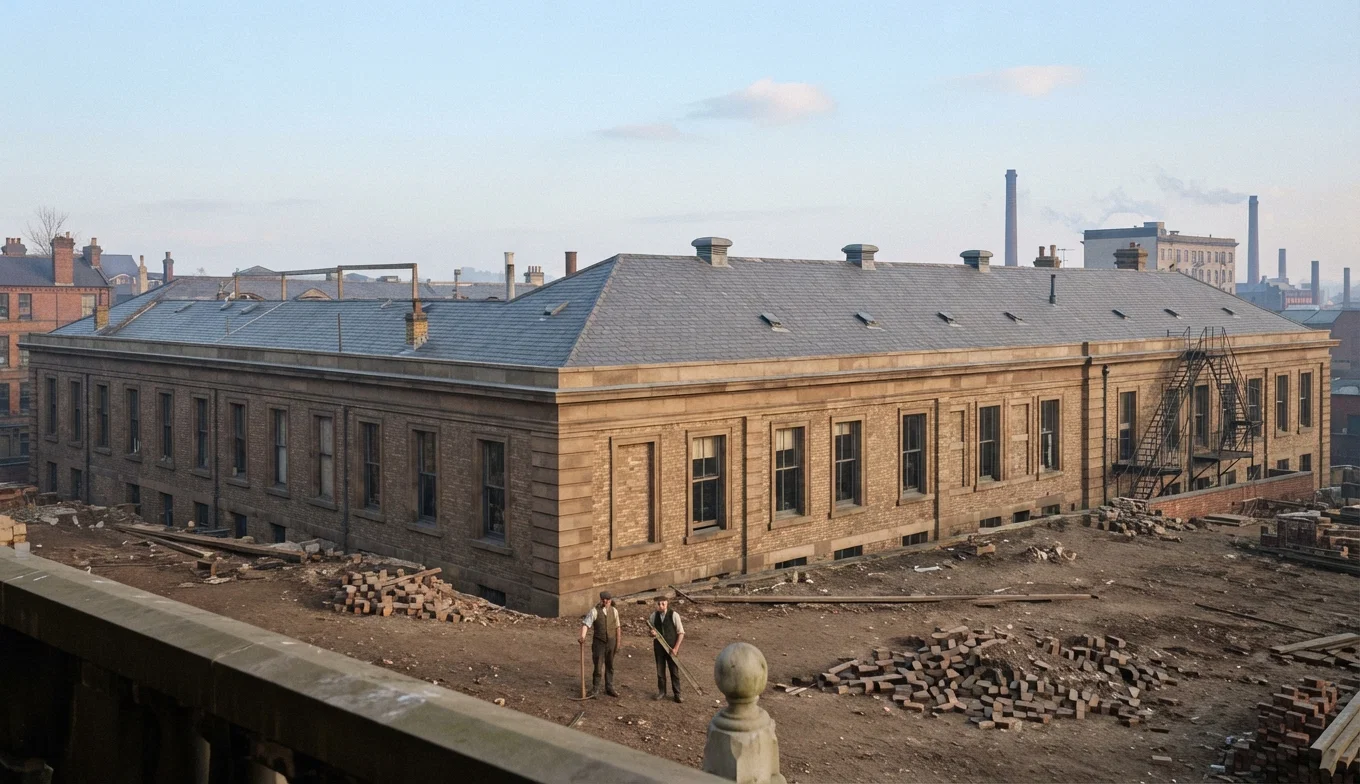
Press Building, Nov. 14, 1906, looking southeast from across railway track. The building is much further along now. Progress on interior work can not, of course, be shown. The cement floor is well started, and the roof nearly covered.
The great religio-civil question of the day is the Sabbath question. It meets the legislators of every land and state. They must meet it. They may laugh it down, may bury it in committees, may kill it with amendments; but it will face them the next session—this demand for a legally enforced day of worship. Legislators, who understand the principles of government and liberty, know that such legislation is wrong; know it in their very souls, and yet they fear to face a religious element who are clamoring for it. If they oppose such legislation, they fear defeat at the polls when they again come before the people; and so many weakly yield manhood, principle, justice, to the religio-political clamor, which never ought to have a place in American government or politics. Any religious institution whatsoever, that demands legislative support may be set down at once as not of God and the Bible.
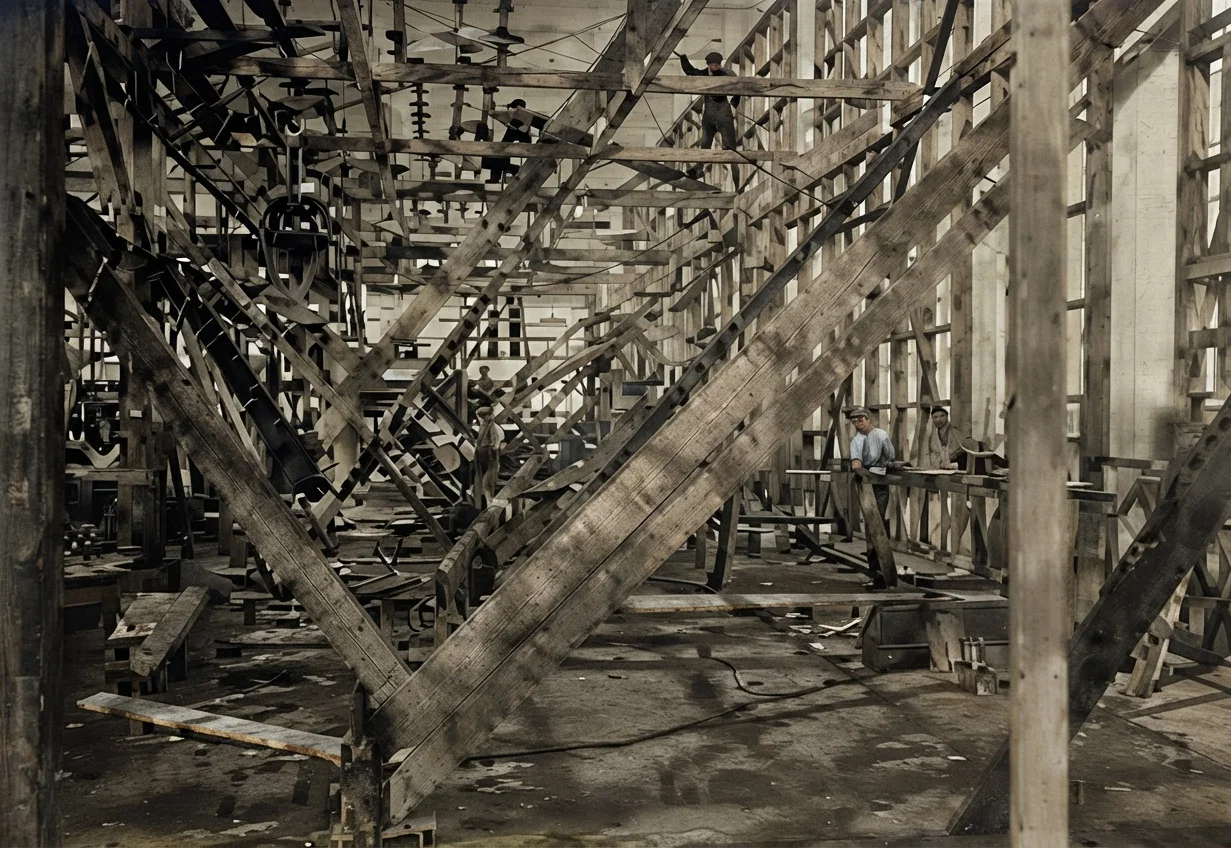
Interior of Press Building, Nov. 14, 1906, looking eastward; diagonal strips are temporary braces.
To yield to this demand is to encourage the church to go into politics; is to turn the ecclesiastical conscience in the wrong direction. Bigotry is always conscientious. The worst persecutors the world has known have been conscientious. Better a thousand times the rough old legislators of early California, who were ready to fight to the death at the drop of a hat, whose language was not always fit for the drawing-room, but who loved justice and believed in equality, than a legislature of preachers. The preacher's business lies elsewhere. Let him be God's mouthpiece for saving souls. There his worth
is priceless. But perverted good is the worst of evil. And when we write this, we know that every true, intelligent, fair-minded preacher in California, be he Sunday-keeper or not, will agree with us. The church of Jesus Christ has no business in politics. The minister of Jesus Christ has no business lobbying in legislative halls, and the truth of Jesus Christ needs no support from civil law.
Destruction to both church and state is in this demand of religious legislation if the state yields to it. If the state does not yield, she will save herself, and the church left to herself and God may find the good way. If the state yield, she yields to ruin. The United States Senate well said in 1829: "Religious combinations to effect a political object are . . . always dangerous. The first effort of the kind calls for the establishment of a principle which . . . would lay the foundation for dangerous innovations upon the spirit of the Constitution and upon the religious rights of the citizens. If admitted, it may be justly apprehended that the future measures of the government will be strongly marked, if not eventually controlled, by the same influence. All religious despotism commences by combination and influence; and when that influence begins to operate upon the political institutions of a country, the civil power soon bends under it, and the catastrophe of other nations furnishes an awful warning of the consequence." Wise, indeed, will he be who reads aright the omens of the day.
Press Building, Nov. 14, 1906, looking southwest, from engine room.
Mayor McClellan, of New York City, says that the project of bringing water for the city from the Catskill Mountains, a distance of a hundred miles, is a greater undertaking than the digging of the Panama Canal. But it is safe to predict that the city will do the work in much less time than the United States Government will take to finish the Panama enterprise. The difference is that New York people want and need the new water supply, while the men who were influential in securing the choice of the Panama over the Nicaragua canal route, were moved by a desire to delay, and eventually to kill, the canal project altogether.
At the annual convention of the American Federation of Labor, held in Chicago a few weeks ago, the following bit of statistics was presented in the report of the secretary: "There is $111,540.60 in the treasury of the federation. During the year there were 887 strikes, in which there were 91,530 men involved. Of that number, 68,812 were benefited and 11,183 not benefited. The total cost of strikes during the year was $3,982,865.66."
It would be a fitting climax to the graft and greed and grime of San Francisco officialdom to finish off with a Sunday-closing ordinance, as proposed. Pittsburg, whose record now stands about as dark morally as her belching coal smoke has painted her physically, began with a Sunday law. The dark city in western Pennsylvania has for years been a head center of National Reformism and Sunday-law agitation.
Why did not the United States Government use those arms, taken from the Cuban insurgents, and forge them into "plowshares," and give them to the poor Cuban peasants. This would have been in harmony with many of our latter-day predictions.

Death of William Newton Glenn

With deep feelings of sadness we record the loss of one of our faithful workers, the oldest and longest with the Pacific Press of any of our office force, William Newton Glenn, associate editor of the SIGNS OF THE TIMES. He was taken with a severe chill, Sabbath, November 24, which rapidly developed into pneumonia in one lung. Everything was done that could be done by skilful physicians and intelligent nurses. The crisis of the disease passed safely in one week, and temperature fell to normal, but the extremely weak heart was not strong enough to throw off in the circulation the poisons in the system, and the next day acute jaundice set in and he failed rapidly, falling asleep, near sunset, Sabbath, December 1, in his seventieth year. More of the particulars of his life and service will be given next week. Personally he has been directly associated with us for eighteen years, and we feel his loss greatly, but our heart goes out to the bereaved widow, who, in her feeble health, will feel her loss more keenly and deeply than words can express. May God comfort her heart in this sad hour of sorrow.

Christmas Features and Subscription Growth

Our next number will have some "Christmas" features which will be of interest, and we hope of profit.
There are but two more numbers in this volume of the SIGNS OF THE TIMES. We are glad to report a rising subscription list. There has been added during the last three weeks an aggregate of 2,000 subscriptions. This is good; push it on, and on, till the 100,000 mark is reached.
Our Thanksgiving number sold well in this valley. A few of our earnest workers went out from this church and found a ready sale. Two young ladies sold each twenty-five copies in about three-fourths of an hour in Redwood City. One young man in part of a forenoon sold fifty copies in Mountain View.
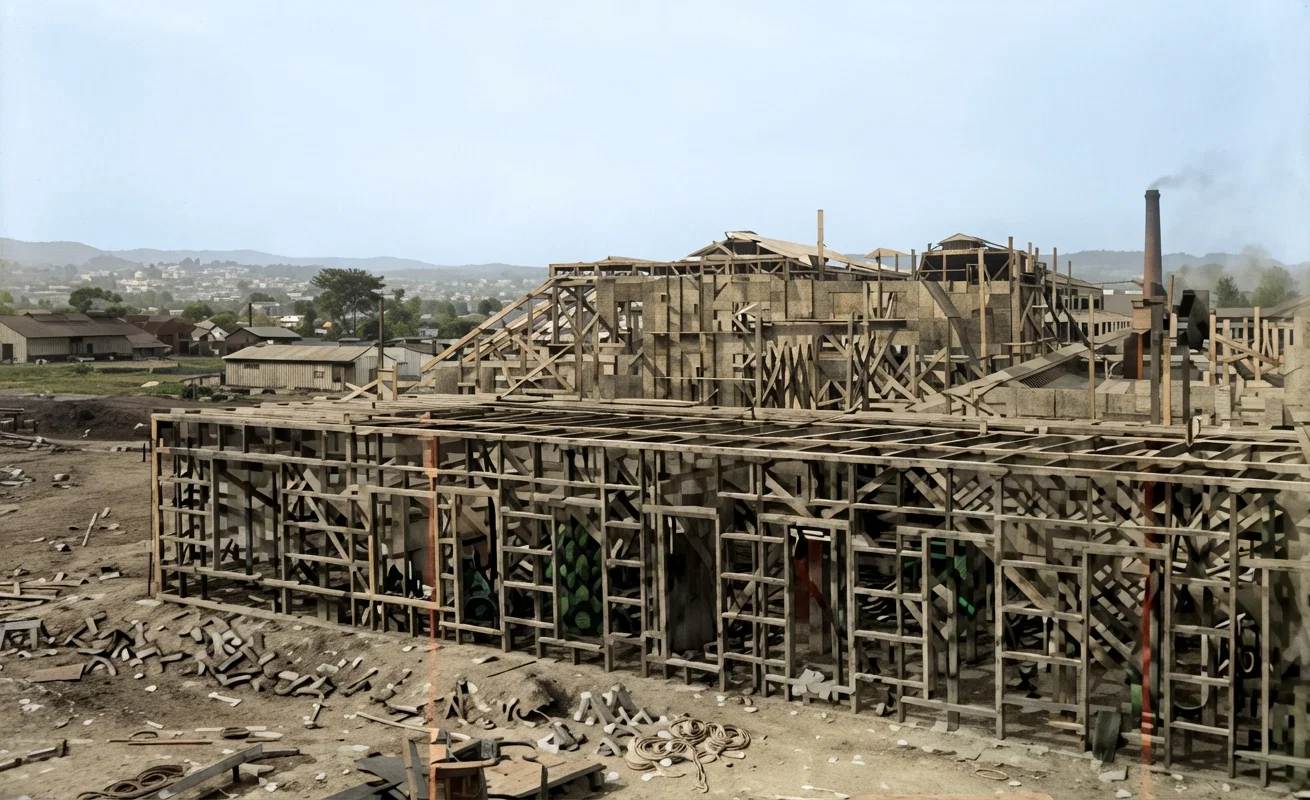
Press Building, Nov. 8, 1906, looking northeast, from boarding-house balcony.

You have reached the end of this edition.

Signs of the Times · Dec 12, 1906