Significant Actions of the Presbyterian General Assembly in Its Recent Session in Kansas City.
HE question of securing and enforcing Sunday laws was a leading topic of the one hundred twentieth session of the General Assembly of Presbyterians in Kansas City, Mo. It passed resolutions against Sunday funerals, Sunday excursions, and employment of labor on Sunday; tabooing the Sunday paper, urging a half holiday on Saturday, the omission of Monday morning classes in schools, pledging alliance in work with Sunday leagues, recommending Sunday-observance committees in each synod, indorsing the work of the American Sabbath Union, and the Woman's National Sabbath Alliance, recommending a sermon on the subject of Sunday observance to be preached in each church next April, and memorializing Congress to pass a Sunday-closing law.
The foregoing list of resolutions would indicate that the enforcing of Sunday by law occupied quite an amount of the attention of the Assembly. It is well for people to keep Sunday who are of the opinion that it is right for them to do so. But people who do not believe in it, or who are indifferent to it, should be allowed the same freedom NOT to keep it that others enjoy to observe it. This is the statement of one of the commonest principles of freedom. It is a principle that the fathers of this Republic suffered much to establish as a corner-stone in the temple of freedom that was erected on this soil.
The Presbyterians believe that Sunday is the Sabbath, and they insist on calling it the Sabbath; they do not as a general thing speak of the day merely as Sunday.
Everybody knows that Sunday is a religious institution. People are asked to refrain from working on that day because some think that the day has a degree of sacredness attached to it. The claim is made that since Christ rose from the dead on the first day of the week therefore the Sunday should be observed sacredly and religiously. Now since this is the very nature and the character of the day it is absolutely impossible to make something secular out of that which is essentially religious—out of that which has its whole history woven full of religious sentiment. And for this very reason Sunday legislation must always be religious legislation.
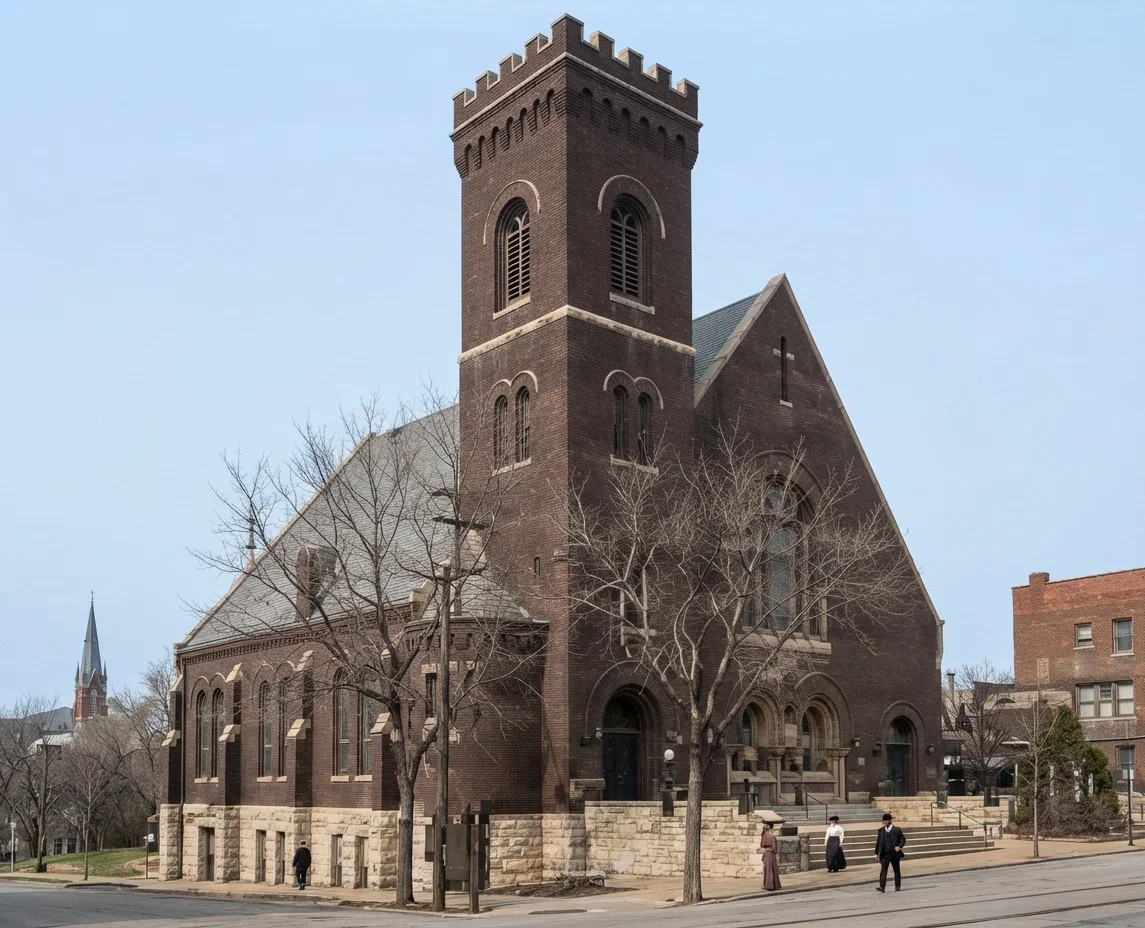
First Presbyterian Church, Kansas City.
Sunday legislation is always asked for by the churches. If any society that is not essentially a church organization joins in asking for Sunday laws it can in almost every instance be found that the church is back of the asking. The church is responsible for the interest that any particular society outside of the church may take in securing and enforcing Sunday laws.
When this government was formed, the object was kept prominent of having religion entirely separated from the state. The experiences thru which many of the fathers had passed impressed upon their minds strongly
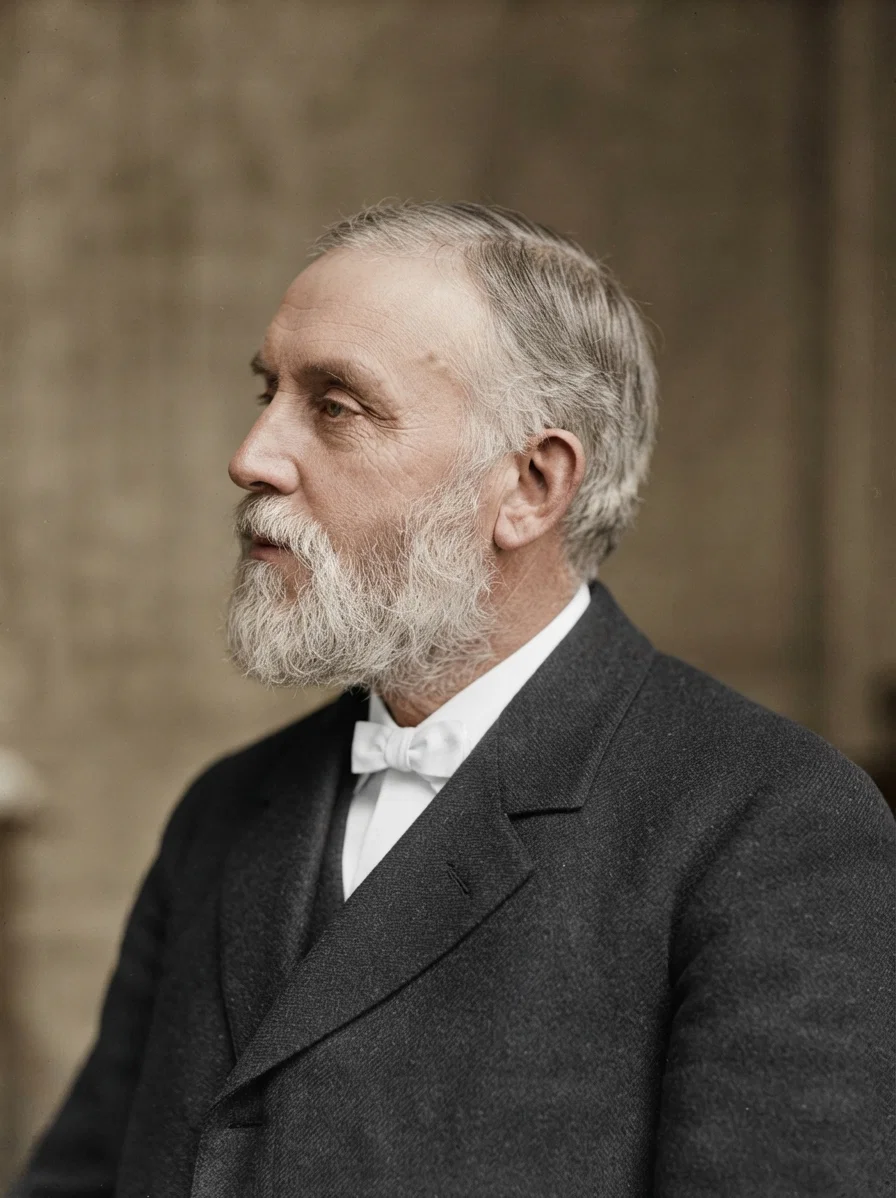
Rev. William Henry Roberts, D.D., LL.D.
Moderator of the Presbyterian General Assembly, Kansas City.
that where the state undertook to control or influence the religion of men, it brought on the cruelest kind of persecutions.
The Declaration of Independence set forth these principles, and no sooner was it promulgated than the Presbytery of Hanover, Va., proceeded to indorse it by sending a memorial to the Legislature of their state. This memorial was indorsed by the Baptists and Quakers, showing that the religious sentiment of that time was in favor of allowing freedom in religious matters, and in order to have this freedom the state must not legislate upon religious subjects. The memorial that they sent is the following:
"Now, when the many and grievous oppressions of our mother country have laid this continent under the necessity of casting off the yoke of tyranny, and of forming independent governments upon equitable and liberal foundations, we flatter ourselves that we shall be freed from all the encumbrances which a spirit of domination, prejudice, or bigotry has interwoven with most other political systems.
"This we are the more strongly encouraged to expect by the Declaration of Rights, so universally applauded for that dignity, firmness, and precision with which it delineates and asserts the privileges of society, and the prerogatives of human nature, and which we embrace as the Magna Charta of our commonwealth, that can never be violated without endangering the grand superstructure it was designated to sustain. Therefore we rely upon this Declaration, as well as the justice of our honorable Legislature, to secure us the free exercise of religion according to the dictates of our consciences.
"In this enlightened age, and in a land where all of every denomination are united in the most strenuous efforts to be free, we hope and expect that our representatives will cheerfully concur in removing every species of religious as well as civil bondage. Certain it is that every argument for civil liberty gains additional strength when applied to liberty in the concerns of religion; and there is no argument in favor of establishing the Christian religion but may be pleaded, with equal propriety, for establishing the tenets of Mohammed by those who believe the Alcoran; or, if this be not true, it is at least impossible for the magistrate to adjudge the right of preference among the various sects which profess the Christian faith, without erecting a claim to infallibility, which would lead us back to the church of Rome.
"We beg leave farther to represent, that religious establishments are highly injurious to the temporal interests of any community.
"We would also humbly represent that the only proper objects of civil government are the happiness and protection of MEN in the present state of existence; the security of the life, liberty, and property of the citizens, and to restrain the vicious, and encourage the virtuous by wholesome laws, equally extending to every individual; but that the duty which we owe to our Creator, and the manner of discharging it, can only be directed by reason and conviction, and is nowhere cognizable but at the tribunal of the universal Judge.
"Therefore, we ask no ecclesiastical establishments for ourselves; neither can we approve of them when granted to others. This, indeed, would be giving exclusive or separate emoluments or privileges to one set of men, without any special public services, to the common reproach and injury of every other denomination. And for the reasons recited, we are induced earnestly to entreat that all laws now in force in this commonwealth which countenance religious domination, may be speedily repealed; that all of every religious sect may be protected in the full exercise of their several modes of worship; exempted from all taxes for the support of any church whatsoever, farther than what may be agreeable to their own private choice or voluntary obligation. This being done, all partial and invidious distinctions will be abolished, to the great honor and interest of the state, and every one be left to stand or fall according to his merit, which can never be the case so long as any one denomination is established in preference to others."
The Episcopalian Church was the established church of Virginia at that time. Thomas Jefferson supported the memorial that was sent by the Presbyterians, and after what he pronounced "the severest contest in which he was ever engaged," a law was passed Dec. 6, 1776 totally disestablishing the church in Virginia.
The action of the Presbyterians of to-day in seeking to have such rigid Sunday laws passed and enforced is very much in contrast with the action of their brethren a little more than a hundred years ago. The people of this11world seem to keep revolving around a circle. The principles that have been shown to be oppressive and that are therefore cast off in one age are brought out in another, thinking that they can be made to work all right now. And thus history is constantly repeating itself. The people of this time are moving strongly toward another religious despotism. We should keep in mind what it all means.
Many of the good people in each of the various churches are coming to feel that the church must deal with the many social problems that are confronting us. This would be all right if the church felt that she must deal with them by preaching the Gospel in the demonstration of the Spirit and of power. But that is not the plan on which they propose to work. They propose to combine and bring the state to their aid, and there is where the danger before the world lies. The church deplores its weakness, and so is seeking to the state for help. There is an abundance of history to show what the result will be. There is also clear prophecy to foretell the outcome of it. T.
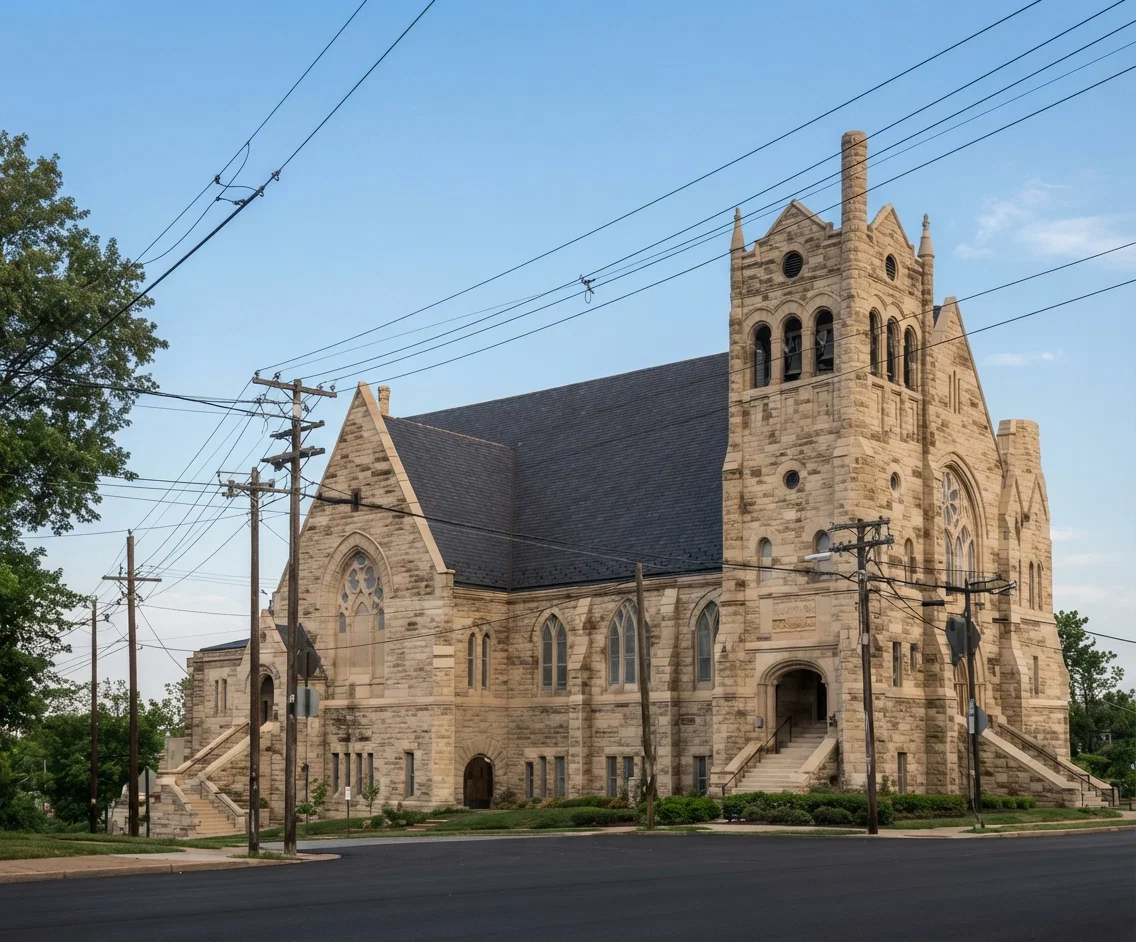
Fifth Presbyterian Church, Kansas City.
How Far Are We from Revolution?
THERE are times when everything seems to move peaceably, and we think it will continue so. There are times when mob spirit is manifest, and we get somewhat of an idea of the condition of things underneath the surface. Men of note have declared within the last few years that the world is sleeping upon a volcano, and now and then utterances of radical Socialists or anarchists emphasize these statements. Take the following, for instance, from the Chicago Inter-ocean of the report of the meetings in Union Square, New York City, March 28. The correspondent's report begins with a conversation between a policeman and the Inspector of Police:
"They have brought many carts into the Square to serve as speaking stands," reported a policeman. "Drive them away; use your clubs if necessary," replied the Inspector. A man in the crowd hearing the command, pulled a paper from his pocket, tapped it with his finger, and said to the Inspector: "That is the strongest thing in America. It is the Constitution of the United States. It says that the people have a right to peaceable assemblage." The reply of the Inspector was, holding aloft his club: "This is the strongest thing in Union Square." The crowd fell back before the bluecoats, and a man in the throng started up the defiant battle-song of the French Revolution, "The Marseillais," and surging in and out, the march of the people began, bearing mottoes like these:
"We Demand Work."
"Why Should We Go Hungry?"
"Public Thievery Makes Private Property."
Then came the mounted police, a splendid company which bore down upon the multitude like so many mounted soldiers in the French army. "Drive them into the East River," commanded the Inspector. The horses turned into the crowd; many fell beneath the hoofs of the animals. The reporter tells us that the red-hatted Socialist columns dashed backward and massed upon the sidewalks; on came the charging police cavalry, pushing, even on to the sidewalks with their prancing horses. The Omaha World referring to it declares that "it reads like a page from Carlyle's 'French Revolution,' or like an account of what might have happened in darkest Russia." It is a significant comment on the condition of things in free America in the 20th century.
How They Regard Protestants.
The Western Watchman (Catholic) of May 21 has an editorial on the dissolution of Methodism, and declares that when they, at their recent assembly at Baltimore, repealed the rule against theaters, cards, and dancing, it was amidst the deafening applaud of over seven hundred lay and clerical delegates." The Watchman draws contrast between this and the beginning of Methodism under Wesley. It says: "Now in the year of our Lord 1908, the grandest general assembly ever held by Methodists in any country has decided to let down the bars and permit the profane children of Belial to enter the fold. The last distinction of the true Methodists has disappeared and 'Zion has capitulated to the enemy.' There is no longer a shadow of reason for the continued existence of a Methodist Church. It has seen the end of its usefulness; the time has arrived for it to die, and die it must. We have been asked if we could rejoice at the dissolution of Protestantism, and we answer in the affirmative. If asked now if we see with pleasure the ruin of the work of John Wesley, we answer in a similar manner. 'Why should these weeds occupy the ground?' "
This from Father Phelan sets forth very frankly and emphatically the attitude of Roman Catholics toward Protestantism. It tells some plain truths to which Protestants would do well to take heed. Just as soon as Protestantism left its Bible, it became weakened; its only hope is to go back to Protestant principles, which are really New Testament, Pentecostal principles. In that only lies its power.
The Coming Revolution in the East.
Not many years ago Emperor William made himself quite famous as an artist, in a great painting called "The Yellow Peril," in which the yellow races were represented as a great cloud overwhelming Europe. Just recently Justice Harlan of the Supreme Court of the United States, in his speech referred to the same thing as the yellow peril. He said: "We refer to the people of Asia as the yellow race. There are 400,000,000 Chinese, as strong physically and mentally as we are. There is over there another nation whose people are progressive and ambitious. We may some day see a skilled army in Japan of 5,000,000 to 10,000,000. They will say: 'You claim Europe as your country; this is ours. Get out.' I don't think they have any such idea now, and we have no hostility toward them, but there will be a conflict between the yellow race and the white race that will shake the earth." We read in Revelation 16:12 of certain changes that are to take place that "the way of the kings of the East might be prepared." The kings of the East must refer to these great Eastern powers. A few years ago some thought China was to be divided among the powers of Europe; Japan would be constantly held in check, but there seems to be very good reason to believe that when the time comes for action, China will be a great martial nation, and will have as allies in that last great conflict Japan on the one side and some of the great tribes of India on the other. It is well to study the prophecies of God's word concerning these things in these days.
Heavy rains visited northern Texas and Oklahoma May 22 to 24, and the Red, Canadian, and Trinity Rivers were so swollen that all bridges were either made unsafe or swept away. For many days all traffic north of Fort Worth, Texas, was suspended, the high water exceeding any known by the oldest inhabitants. Thousands of sheep and cattle were drowned, and it has been reported that about twenty persons perished. The Texas Pacific Railway bridge between Fort Worth and Dallas was swept away from its foundation on the 26th, carrying eight or ten people down with it. Only four of these were saved. The water and light plants of Dallas have been under water, and in large sections of the city the water has been from one to three feet deep. One of the most serious features of the disturbance has been the washing of the contents of the sewers back into the city, which is likely to endanger health. Guthrie, Oklahoma City, and other large cities have suffered severely. The property loss will reach several millions of dollars. Elder Clarence Santee, who furnished us the information, adds these striking words: "It does seem that every effort of this old earth is an extreme attempt to still hold its way, and that every storm has a destructive center. The judgments of the Lord are certainly felt in the land."
To break all previous records has been the ambition of the Atlantic steamship lines of late years. On her last trip the Cunard liner "Mauretania" broke the record over the long course from Queenstown to New York, covering the distance in four days, twenty hours, and fifteen minutes, with an average speed of 24.86 knots. This beats the record of her sister ship, the "Lusitania," by seven minutes.
The race question is becoming a tremendously serious one. One of the more recent indications, perhaps, is the organization and spread of what is called "The Anti-Miscegenation League," the center of which seems to be Vicksburg, Miss. Its name indicates its purpose; namely, to prevent in every way the mixing of the black and white races. Judge Thomas M. Norwood goes so far as to suggest, according to the Atlanta Constitution, that the evil should be made a capital offense, the guilty man hanged, and the woman sent to the penitentiary for life. The League hopes to accomplish something by the scattering of publications and appeal to the people. The Constitution remarks: "These are but scattering indications of the gathering storm which is unquestionably soon to sweep the South."
The one hundred twentieth general assembly of the Presbyterian Church, held in Kansas City the last week in May, passed resolutions against the alliance of Presbyterian synods with anti-saloon leagues or other non-ecclesiastical organizations. While Presbyterians believe in temperance and good government, they evidently do not believe in yoking the church up with organizations carrying on work outside the church, a belief and practice every religious body might follow with profit to itself. The church and truth of God need no alliance with the world for strength or advancement; in fact, such alliances divide the interests and lessen the powers of the church.
The trustees of Stanford University, Palo Alto, Cal., have taken a splendid and a decided stand in regard to the drink question. Their rulings apply not only to drunkenness on the campus, but the Academic Council is instructed to prohibit the use of liquor in fraternity chapter houses, student clubhouses, and other student lodgings. The presence of liquor on any premises leased from the university will be sufficient cause for the revocation of the lease and the suspension of the guilty parties. This action is largely the result of the vigorous efforts of the Student Affairs Committee to absolutely suppress the use of liquor, both on and off the campus.
America's two great perils, says Cardinal Logue, of Ireland, who sailed from America June 6 after a visit of several weeks, are overprosperity and divorce. In his farewell address, he said: "Prosperity and material power are beset with dangers; prosperity often degenerates into luxury, and power may turn into injustice. America, I am sure, will be well able to take care of herself in the face of a foreign foe; her greatest enemy will be within her own borders. Luxurious living would weaken the strength of the country, and injustice would ruin its prosperity."
Accidents in the Navy.—Under full steam, making nineteen knots an hour, Admiral Sibree's flagship, the "Tennessee," of the Pacific cruiser fleet, burst a steam-pipe of one of her boilers, June 5, while on her semi-annual official speed test provided for by the naval regulations. Six men were killed by the escaping steam, and eight others were terribly scalded, literally cooked by the boiling water and steam. During the past five years, since the modern naval policy was inaugurated, 125 men have been killed and 68 injured.
According to a statement made by Captain Wentworth Harry Moore, who has just returned to the United States from San Salvador, where he incurred the displeasure of the president, "there is a spirit of unrest among all the Central American states at present, and something will happen very soon. President Cabrera, of Guatemala, holds the rulers of all the little countries down there together, but he will not last long, according to present indications, and when he goes, they will all go."
June 5, eight persons were killed and twelve injured when a car crowded with passengers on their way to attend the June ball of the Naval Academy at Annapolis, Md., collided with another car, utterly wrecking both, and strewing the tracks with the killed and wounded.
The Attorney-General of California recently decided that the laws of that state do not permit separate schools for negro pupils. The issue was raised at Riverside where there are many colored pupils in the schools.
Lightning killed two persons and injured eight others in central Ohio, May 31. A number of horses were killed, several barns were burned, and much damage was done to crops by the lightning in the neighborhood of Mount Vernon and Kenton.
The temperance cause in Oregon scored a number of victories in the last election, June 1. The eight "dry" counties voted to remain "dry," and twelve new counties went over to the prohibition side.
The Spanish People.
By Frank S. Bond
Their Customs and Conditions in General.
SHOULD one endeavor to describe in detail the races which have in different times peopled the Iberian peninsula, he must not hope to stop short of numerous thrilling volumes. From the earliest dawn of history, this sunny portion of Europe was known as Iberia, and its inhabitants as Iberians. It is believed that the earliest inhabitants came from the South, and that they had been allied with the Libians who inhabited the northern coast of Africa.
How long this fair peninsula was the undisturbed home of the Iberians no one knows. Behind the rocky ramparts of the Pyrenees, they may have remained for centuries unconscious of the Aryan torrent which was flooding Western Europe as far as the British Isles. Nothing has been discovered by which we may reconstruct this prehistoric people and (perhaps) civilization. But their physical characteristics we are able to guess; for just as we find in Cornwall, England, lingering traces of the ancient Britons, so in the mountain fastnesses of northern Spain linger the Basques, who are by many supposed to be the last survivors of that mysterious primitive race.
The Phenicians, who were attracted to the Iberian peninsula by its gold and silver as early as 1300 B.C., soon began to establish permanent settlements and build cities. As early as 1100 B.C., they had founded the city of Gades (Cadiz), which is to-day quite an important seaport and educational center of southwestern Spain. It was in the year 850 B.C. that the Assyrians came down with "their cohorts all gleaming with purple and gold," and the power of the Phenicians was partly broken.
Just about this time the Phenicians founded the city of Carthage upon the northern coast of Africa, and for several hundred years a torrent of Carthaginian life was pouring into the Iberian peninsula.
A Valencia Farmer.
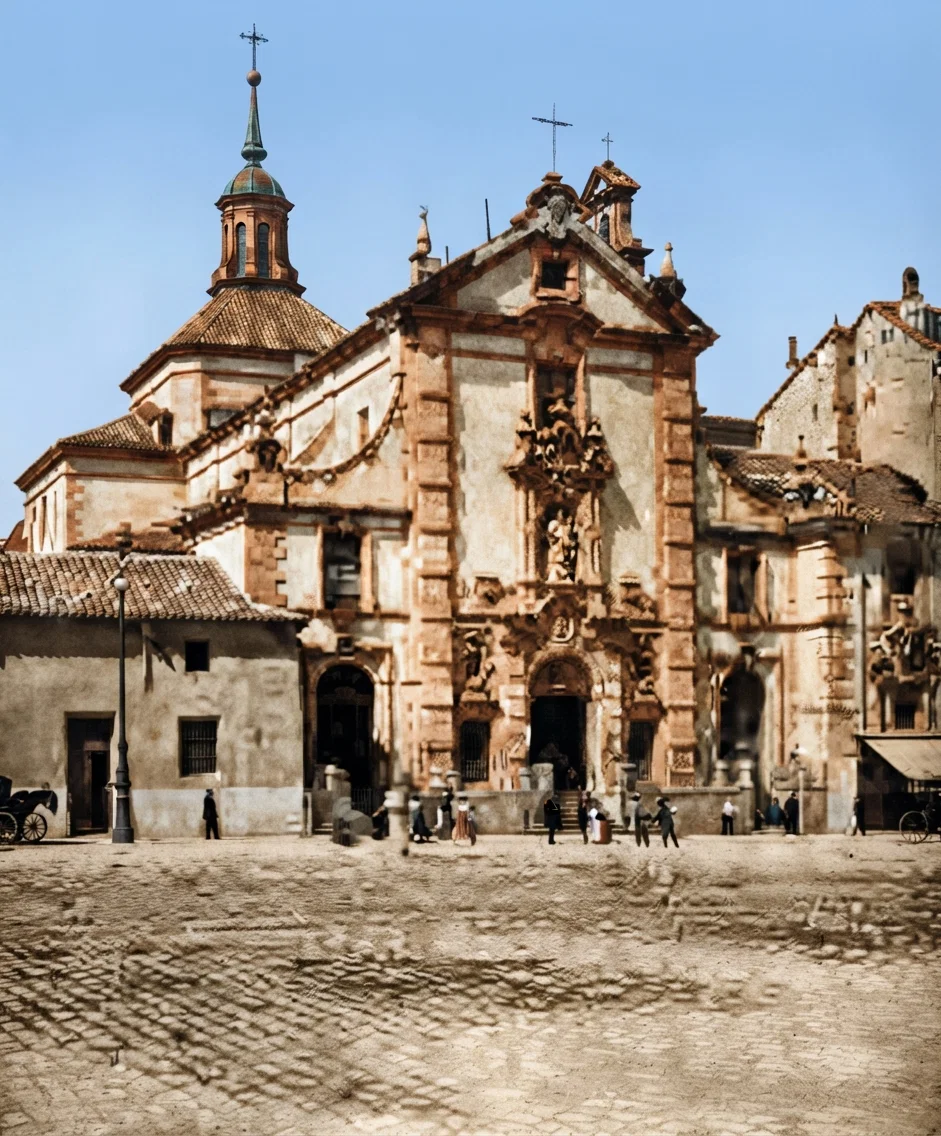
Church of San Jose, Madrid.
The city of Barcelona was named after the powerful family of Barca, in Carthage, to which Hannibal belonged. It was from the millions of Spain that Hamilcar recruited his army. It was on the eastern shores of Spain that Hannibal carried on one of the most determined and desperate struggles the world has ever seen.
Roman Domination.
It was in the year 206 B.C. that Cadiz, the last stronghold of this peninsula while under Carthaginian rule, surrendered to the Romans. In the year 197 B.C. the entire peninsula was organized into a Roman province, thenceforth known not as Iberia but Spain, and its people, Spaniards. The Romans held sway until 412 A.D., when Ataulphus had established his court in Barcelona, and Romanized Spain became Gothic Spain. Just three centuries later, or in "711 A.D., the Visigoth king had disappeared, and a Mohammedan empire was fastened upon Europe." The descendants of the Visigoth kings never lost their patriotism; and altho for several centuries their power did not extend beyond a few mountains of northwestern Spain, they did not fail to keep up an unbroken chain of kings. The ruling power in Spain to-day, the Castilians, are descendants of these mountaineers.
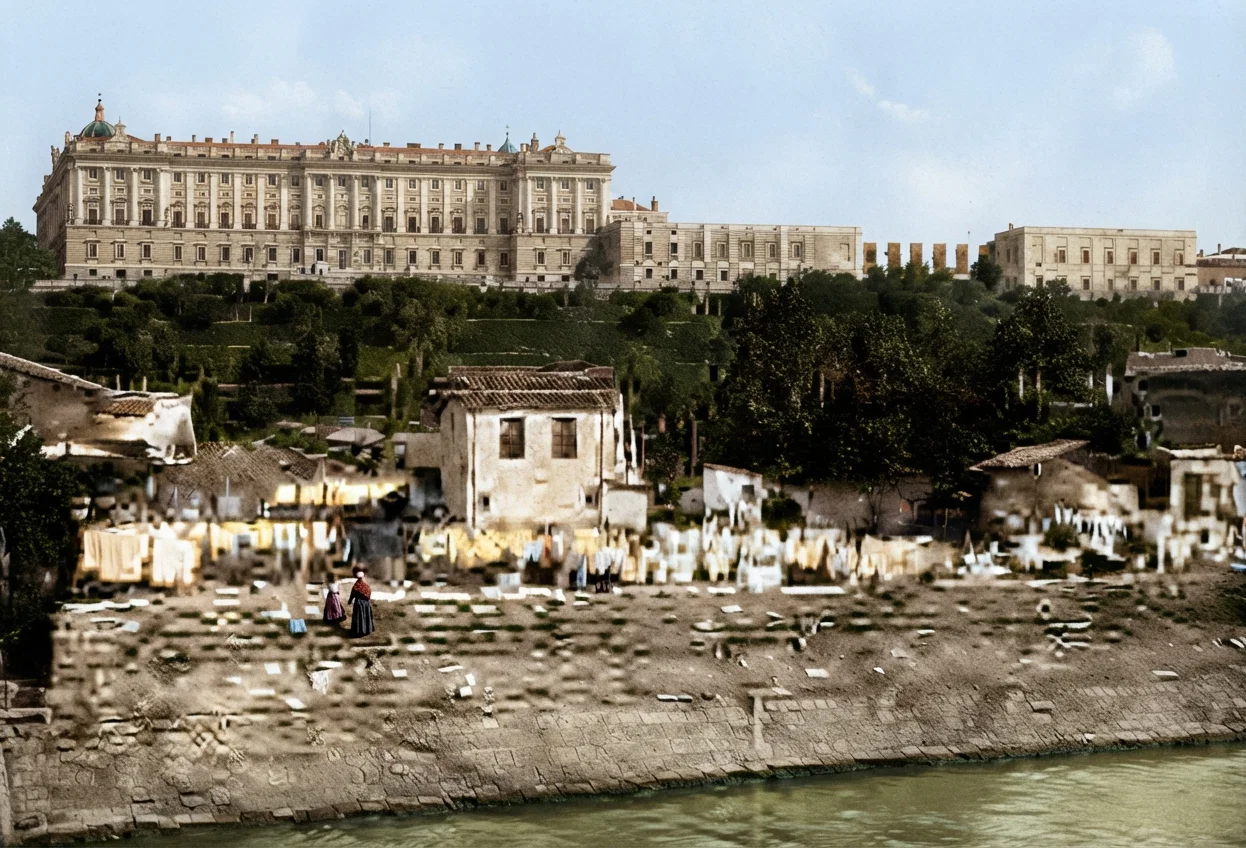
The Royal Palace at Madrid.
Last Moorish Stronghold.
It was in the year 1212, that under the command of Alfonso IX, King of Castile, the power of the Moors in Spain was broken, and most of them were driven from the country. Thus, the once great Mohammedan empire in this country was reduced to the single province of Granada, where the Moors entrenched themselves in their last stronghold. As monuments of the superior intelligence and advancement of that people, there remain to-day the excellent irrigation system of Valencia, the beautiful and artistic Alcazar of Seville, and the splendid Alhambra of Granada.
The Spaniards of to-day are the result of the intermingling of these different peoples for so many centuries. As a result of this peninsula's having been occupied by many different races of people, we find to-day in this country a number of distinct types with reference to physical features. Especially are the Roman and the Arabian elements very prominent. Likewise there are several distinct dialects spoken in different parts of Spain. While the Castilian is the official language of the country, there are thousands of Spaniards who are able to speak but very little of that, the most musical of all languages. The Basques have a dialect which seems very unlike any other known language. In the four northeastern provinces the Catalan is spoken. This is similar to the Patois of southern France. The Valencian dialect is quite similar to the Catalan but is a little more like the Castilian.
Condition of People.
It is conceded by the best authorities that not more than about fifty per cent of the Spanish people are able to read and write. This is a deplorable condition; and because it exists, the problem of getting the Gospel into the homes of this people is a difficult one to solve.
The great majority of the people have very limited means; many are in extreme poverty. Truly the prophecy of James 5 with reference to the last days is being fulfilled in this country. Laboring classes here are terribly oppressed. Farm-hands work long hours and receive from thirty to fifty cents a day for their work. Some may receive a little more than this in harvest-time, but it is a rare thing. Mechanics and other high-class laborers receive from fifty to eighty13cents a day, and if one gets a dollar a day, he considers himself extremely fortunate.
We find living expenses here just about as high, and perhaps a little higher, than in California, so one can readily see what a struggle these people must have in order to exist. The prophet, in speaking of the time when these conditions would exist, exclaims: "Be ye also patient; stablish your hearts: for the coming of the Lord draweth nigh."
The National Sport.
While Spanish people as a rule are high-tempered and easily excited, we find them to be courteous and very hospitable.
The national sport is the bull-fight. This is the most barbarous custom existing in Spain. The masses are simply carried away with it. Its influence upon the people is very depressing; but just as the fiend takes another and still another dose of opium or morphin, so the Spaniard keeps on returning to the arena. This has undoubtedly been one of the most powerful elements in producing the decline in Spanish power.
We hope to deal with another of those elements in a future letter.
"Is not My word like as a fire? saith the Lord; and like a hammer that breaketh the rock in pieces?" The only remedy for the evils of Spain, and for the individual Spaniard, is the unadulterated word of God. I am thankful for a part in making known the power of the Gospel.
FRANK S. BOND.
Our Work and Workers.
"SINCE my last report, I have baptized five persons at Ferndale, Wash."—L. Jolinson.
CHURCH NUMBER ONE, of New York City, has added seventeen members during the last three months.
A. W. KUEHL reports five accessions to the truth at St. Paul, Minn., as the result of Bible work there.
THE WEST SIDE CHURCH of Indianapolis, Ind., is rejoicing over four additions to their number, all adults.
CAMP-MEETING was held at Caldwell, Idaho, May 13-20. At the close of the meeting eleven were baptized.
NINE souls are keeping the commandments at Groveton, Texas, thru the labors of Brethren W. R. French and J. I. Taylor.
AT Minneapolis six persons have obeyed the command, "Repent and be baptized." F. E. Rew presented the truth to them.
"BROTHER R. W. LEACH reports a good interest at Peru. Four have embraced the truth there, all heads of families."—Indiana Reporter.
A CHURCH of fourteen members has been organized at Freeland, Texas, by Brethren T. W. Field and W. M. Cubley. Eight of the new church are recent converts to the message.
FROM Oxly, Mo., Brother J. E. Wolcott writes in the Workers' Record: "Seventeen dear souls at this place, all adults, have signed the covenant to keep all of God's commandments."
"THREE souls were baptized and united with the church, two others promised to keep all God's commandments, while several others are under deep conviction."—S. W. Nellis, Everett, Wash.
AT Fall River, Mass., four persons, two brothers and two sisters, were baptized recently by Brother H. C. Hartwell. A little company of eight are banded together at that place in the service of the Lord.
DURING the last few weeks of the spring term at Union College, College View, Neb., Brother W. A. Spicer conducted a series of meetings which resulted in winning twenty-two students to the service of the Lord.
THRU the labors of Brother and Sister G. R. Hawkins at Muscatine, Iowa, about fifty substantial people have lately been brought into the church. Thirty-four of these were baptized in the Mississippi, May 23.
A PRIVATE letter from Brother Clarence Santee, Fort Worth, Texas, says: "We dedicated the new church at Corpus Christi last Sunday, the 31st of May. During the two days' meeting four adults were added to the church at that place."
BROTHER WALTER G. BOND writes from Gracia, Barcelona, Spain, May 22: "We are now in the midst of a series of meetings in the city of Valencia. Six or seven have just begun to keep the Sabbath. Please remember this needy field in your prayers."
THE WABASH VALLEY SANITARIUM, at LaFayette, Ind., was dedicated Sunday, May 31. The mayor of the city and one of the leading attorneys gave addresses. Elder A. G. Daniells delivered the main address, "The Object of Our Sanitarium Work."
UNION COLLEGE SUMMER SCHOOL holds from June 23 to August 4. Applications should be in as early as possible. Teachers and others who plan to attend should address the Principal of Union College Summer School, College View, Neb., for information.
THE largest senior class in their history, is the report of both Union College, at College View, Neb., and South Lancaster Academy (Mass.). The former numbered thirty and the latter twenty-four. In each class several courses were represented, and practically all the graduates are taking up some line of active missionary work.
Wanted for Missionary Work.
By Editor
SIGNS, Watchman, Bible Training School, and Life Boat. Address James Harvey, 1055 Bush St., Oakland, Cal. Brother Harvey can use any quantity of clean papers all the time.
THE address of the clerk of the Los Angeles church is Mrs. Belle P. Baker, 1323 Toberman St., Los Angeles, Cal.