[The following article in four parts is not from some ancient tome written by some prejudiced Protestant; it is from the Ilustracao Portugueza of June 18, 1906, a popular magazine of Lisbon, Portugal. We do not print it because we have aught of enmity or ill-feeling against one single Roman Catholic in this world. We have warm friends among them; we pray for them all. Many of them are Christians, far better than their creed. We publish the article to show a logical outworking and legitimate fruitage of the union of church and state. The members of the Roman Catholic Church are like other men and women by nature—neither better nor worse. If that church had not assumed to legislate and execute for God and demand that the state should submit to her creed, she would not have authorized the Inquisition. The Inquisition was but the logic of the church's claim and demand for power to punish heresy. Let all men take heed. Let those "Protestants" who are seeking religious legislation in behalf of Sunday learn the lesson. The translation of the article is not finished English; it has too much of the idiom of the Portuguese, but it does not misrepresent the original.]
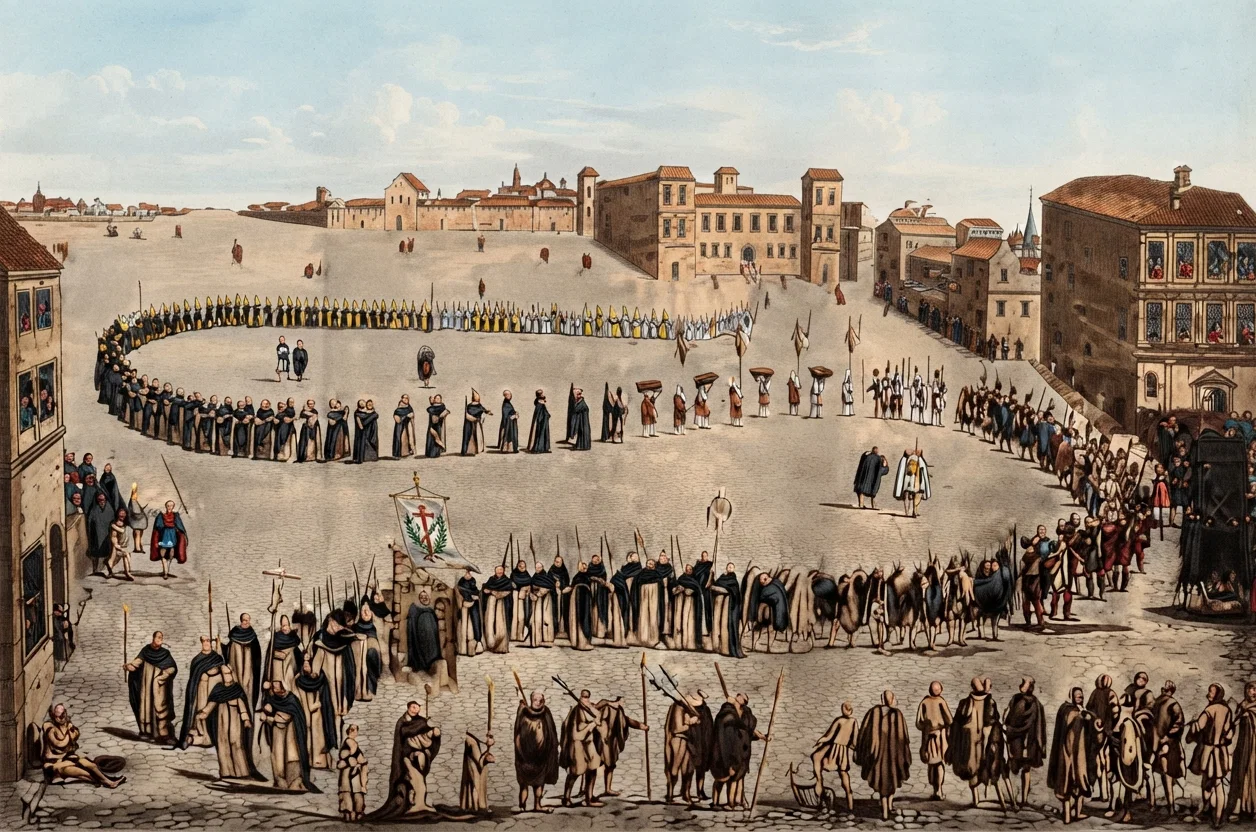
A Procession of Dominicans Going to a Burning in the Palace of Estaos, at Rocio.
I T was on the twenty-third of March, 1536, that the bull of Paul III, establishing definitely the tribunal of the Holy Inquisition, arrived. It is a celebrated date.
The people and the monks, especially the monks, to whom the divisions of Jewish merchants, learned men, money-lenders, jewelers, and doctors, were a provocation and a constant blasphemy, rejoiced and ran thru the streets in great crowds, the "habits" caught up, the rosaries hanging down, the faces purpled and apoplectic. The king, an apathetic imbecile, also bloated and sickly, wrapped in a monk's gray dress with cardinal's cap, surrounded by Dominicans, bishops, parasites, and doctors, praised God in the auditorium of the palace, convinced above everything of his prestige with the Roman ecclesiastical tribunal and of the unquestionable excellence of his ambassadors. The great dream of D. John III was finally attained. The bull of the Holy Father named four inquisitors in Portugal—the bishops of Coimbra, Lamego, Ceuta, and a doctor of theology, freely chosen by the king,—and it gave them together with the judge of the diocese the authority to proceed against heretics.
From here a few months, D. Diogo da Silva, bishop of Ceuta and confessor of the king, was named chief of the inquisitors; he was our friar Thomas de Torquemada. On the death of the bishop, the brother of the king, the Cardinal D. Henrique, ascended the supreme chair, another purplod imbecile that obtained six votes for pope on the death of Paul III, who in the end of life fed himself on woman's milk and who at eighty years thought of having a son as heir to the crown; he was our D. Diogo Deza. Finally the archbishop of Lisbon, D. George d'Almeida, a subtle, intelligent, crooked, and hypocritical prelate, succeeded the Cardinal D. Henrique in the discharge of the horrid office; this was our Cardinal Cisneros. These three men, after Philip II, later the entire people, succeeded in rooting among us, as an institution both sacred and unmovable, the greatest monstrosity that could nurse itself in the bosom of an authoritative, centralized, and Cæsaristic regime.
The Holy Inquisition became as indispensable to the spirit of the people in the sixteenth and seventeenth centuries as the processions, bull-fights, or national games. It was not only the fanaticism of a king to impose it; it was to every soul popular to demand it, in a frightful, inexplainable, collective hallucination, in riots and slaughter, thru the churches and public squares, in the eloquent pulpits of Saint Domingos and in the plebeian benches of the Courts of Torres Novas. It was the hatred of the Jew, of his chest-hoarded gold, of his goldsmith's jewels, of his medical science, of his infinite, absorbing, infiltrating, and dominating power. The flames of the human sacrifices arose; in the stuffy, subterranean chambers were erected polés and potros; filed thru the open squares the processions of yellow carochas and lighted torches, while the miter of the inquisitor and the long gowns of the clergy crossed corridors of the old inquisitorial palace in the dark and silence, and the sounds of breaking bones arose from the aspas; the flesh crackled while tied to the post of the fogueiras—the imbecile multitude raised its hands to heaven, thanking God for being allowed to exterminate the heretics, and it, itself without feeling, without perceiving, was peopling the gloomy dungeons of the Inquisition, and multiplying the endless sentences of the relators of the Holy Office.
An animated Spanish historian who exhibited the delirium of statistician and the most desirable good humor, had the patience to make an account of the victims of the first inquisitor of Castella, friar Thomas de Torquemada, during the eighteen years of his inquisitorial ministry: 10,220 died in the flames; 6,870 were burned in effigy, being absent by death; 91,321 he punished with infamy, confiscation of goods, perpetual imprisonment, and incapability of any employment as a penitent; all of these three classes compose 114,401 families lost forever! When only one inquisitor in Spain realized such devastation in the short period of eighteen years, calculate how many millions of victims would not have been made by the sixty inquisitors in Portugal during three centuries!
"But Portugal had what it asked, and had what it merited."
(To Be Continued.)
Worldly Wealth Cannot Satisfy
By Thomas Brooks
A MAN may have enough of the world to sink him, but he can never have enough to satisfy him.—T. Brooks.
Some Points on the Sabbath.
By James Ferguson
[The following is from quite an extended article written by a boy of thirteen years. It was sent us by a minister. The article, of which the summary below is a fair sample, was written without other help than was obtained in the Bible and other publications. It is well done, tho it doubtless could be duplicated in merit many times by children well instructed in the truth. It shows how the children and youth properly instructed can grasp and teach the word of God.]
LET us see the contrast between the Bible and some of man's theories concerning the Sabbath. Truth can stand fire, and when contrasted with error shines brighter than before, as the following will show:
Man's theory: The Sabbath was made for the Jews.
The Bible: "The Sabbath was made for man." Mark 2:27.
Man's theory: The seventh day of the week is the Sabbath of the Jews.
The Bible: "The seventh day is the Sabbath of the Lord thy God." Ex. 20:10.
Man's theory: Christ did away with the law.
The Bible: "Think not that I am come to destroy the law, or the prophets; I am not come to destroy, but to fulfil." Matt. 5:17.
Man's theory: All were once under obligation to keep the law, but it has long since been abrogated.
The Bible: "All His commandments are sure. They stand fast forever and ever, and are done in truth and uprightness." Ps. 111:7, 8.
Man's theory: The first day of the week is the Sabbath.
The Bible: "The seventh day is the Sabbath of the Lord thy God." Deut. 5:14.
Man's theory: If the seventh day was the Sabbath, our best talent would find it out.
The Bible: "Ye have plowed wickedness, ye have reaped iniquity; ye have eaten the fruit of lies: because thou didst trust in thy way, in the multitude of thy mighty men." Hosea 10:13.
Man's theory: We should obey the laws of our country.
The Bible: "Whether it be right in the sight of God to harken unto you more than unto God, judge ye." Acts 4:19. See Dan. 3:16-18.
Friend, which do you choose? God in many scriptures claims the seventh day as His own, He never so claimed the first, but gave it to man for labor. He blessed and sanctified the seventh day; He did neither to the first. He commanded the seventh day to be kept holy; He never commanded to keep the first day. There is but one commandment in the Bible for a weekly Sabbath, and that says, "The seventh day is the Sabbath of the Lord thy God."
JAMES FERGUSON.
Our Bible Reading
The Joy of Repentance.
What invitations are extended to sinners?
"Come unto Me, all ye that labor and are heavy-laden." Matt. 11: 28.
"If any man thirst, let him come unto Me and drink." John 7: 37.
"Return unto Me, and I will return unto you, saith Jehovah of hosts." Mal. 3: 1.
"Turn ye, turn ye from your evil ways: for why will ye die?" Eze. 33: 11.
"I have blotted out, as a thick cloud, thy transgressions, and as a cloud, thy sins: return unto Me; for I have redeemed thee." Isa. 44: 22.
"Return ye, and turn yourselves from all your transgressions, wherein ye have transgressed; so iniquity shall not be your ruin; . . . and make you a new heart and a new spirit: for why will ye die?" Eze. 18: 30, 31.
Why should the sinner turn to God?
"My son, forget not My law; but let thy heart keep My commandments: for length of days, and years of life, and peace, will they add to thee." Prov. 31: 1, 2.
What effect will turning to the Lord have upon the sinner?
"My son, give Me thine heart; and let thine eyes delight in My ways." Prov. 23: 26.
"Let all those that take refuge in Thee rejoice, let them ever shout for joy, because Thou defendest them: let them also that love Thy name be joyful in Thee." Ps. 5: 11.
What others will be made happy?
"Let thy father and thy mother be glad." Prov. 23: 25.
How do angels feel over repentant sinners?
"There is joy in the presence of the angels of God over one sinner that repenteth." Luke 15: 10.
To every one who has not named the name of Jesus, the only name "under heaven, that is given among men, wherein we must be saved," the invitation comes; "whosoever will may come;" a welcome awaits you. For your own joy and peace and happiness, come; for the joy of Christian father and mother, come; for the rejoicing of angels and the Redeemer Himself, come.
"O taste and see that Jehovah is good:
Blessed is the man that taketh refuge in Him;
O fear Jehovah, ye His saints;
For there is no want to them that fear Him."
"The angel of the Lord encampeth round about them that fear Him,
And delivereth them." Ps. 34: 8, 9, 7.
Within Prison Walls.
By Jennie Conyngham
ONE Sunday morning, as is our custom here, we sang in a prison corridor these words:
"Over the Dead-Line."
"O sinner, the Saviour is calling for thee,
Long, long has He called thee in vain;
He called thee when joy lent its crown to thy
days,
Called thee in sorrow and pain.
Chorus
"O turn while the Saviour in mercy is pleading,
And steer for the harbor bright,
For how do you know but your soul may be
drifting
Over the dead-line to-night?
"O sinner, thine ear has been deaf to His voice,
Thine eye to His glory been dim;
The calls of thy Saviour have so wearied thee,
O what if thy sins weary Him!
"O sinner, God's patience may weary some day
And leave thy sad soul in the blast,
By wilful resistance you've drifted away
Over the dead-line at last."
Elder Bairle remarked that they should take that as a warning and turn to the Lord before the awful "dead-line" is reached.
When prayer was offered, many raised their hands as a request that they be remembered in our petitions. Before the sun had set that day, one soul of that number was cold in death. He had crossed the "dead-line."
May God help us to remember those behind prison-bars, that we may not hear those fatal words from our Saviour's lips, "In prison and ye visited me not," and may we who are out of the fold of safety answer the Spirit's pleading voice, ere we reach the "dead-line."
Your sister in the faith,
JENNIE CONYNGHAM.
A New Leaf.
By Anon.
He came to my desk with a quivering lip—
The lesson was done—
"Dear teacher, I want a new leaf," said he,
"I have spoiled this one."
In place of the leaf so stained and blotted
I gave him a new one all unspotted,
And into his sad eyes smiled—
"Do better now, my child."
I went to the throne with a quivering soul—
The old year was done—
"Dear Father, hast Thou a new leaf for me?
I have spoiled this one."
He took the old leaf, stained and blotted,
And gave me a new one, all unspotted,
And into my sad heart smiled—
"Do better now, my child."
—Anon.
"The Common People."
AFTER all, the common people are the salt of the earth and the hope of the world. They are the dependable element of society—the safe and sane element. They are the multitude, the masses, the rank and file. They live and move and have their being outside of officialdom. The scribes and Pharisees and aristocrats and plutocrats are not found in the ranks of the common people.
The common people heard Christ gladly. They do yet. They have always been hospitable and responsive toward the Gospel. There is something in the Gospel which appeals to them. There is something in them which responds to the Gospel. When you hear of a revival, it is among the common people. The crowds that gather to hear the Gospel are from the common people. The fertile field for evangelism is among the common people. The churches that are throbbing with the spirit of Jesus and glowing with the fires of evangelism are churches of the common people. The common people keep the prayer-meeting and the Sunday-school going. The preachers and missionaries come, mainly, from the ranks of the common people. They are the conservators of orthodoxy. They furnish the constituency of the denominational paper. They are the great working force in the kingdom of God. Thank God for the common people.—Word and Way.
There Is Help in God for You.
THERE come to every soul who has left the ways of sin to walk in the highway of righteousness times of discouragement, hours of darkness. Hope seems to have forever fled. The pathway is shrouded with the blackness of darkness. Evil demons whisper to us out of the gloom innumerable temptations and doubts. God seems to have forgotten us, and left us a sport and a plaything to the spirits of darkness.
"Beloved, think it not strange" that these experiences should come. Every aged saint of God, upon whose brow seems to rest the calm of eternal peace, has known the struggles alone in the darkness. Your case is unique only in the fact that it is yours and peculiar to you. It is no harder, no deeper in its blackness, than that of many others. Perhaps it is far lighter in shadows, shorter in its duration, less intense in its power to depress.
Jesus, the Son of God, knew the power of these seasons of depression and fearful soul-conflict. He knew it in the desert of temptation for forty long days and nights. He knew it under the pale paschal moon, in the deep shadows of Gethsemane; when denied the comfort of His disciples, He could clutch the cold earth and pour out His agonizing prayer to the Father—"Thy will be done." And it is true of His children that—
"All paths that have been or shall be
Pass somewhere thru Gethsemane."
Every soul
"Must kneel alone in darkness there
And battle with some fierce despair.
God pity those who can not say,
'Not mine but Thine,' who only pray,
'Let this cup pass,' who do not see
The purpose in Gethsemane."
Dry and shriveled would be the plant which had always the sunshine. Flaccid and weak would be the muscle which never knew the weariness of exertion.
"God never would send you the darkness
If He thought you could bear the light;
And you would not cling to His guiding hand
If the way were always bright."
Do these thoughts help you?—Perhaps not. Let us talk further. Settle these things forever:
1. God has no hatred, no thoughts of evil toward you. "For I know the thoughts that I think toward you, saith Jehovah, thoughts of peace, and not of evil, to give you hope in your latter end." Jer. 29:11. Know that God's thoughts are not affected by your moods or feelings.
2. However sinful you are, He wants to save you. "As I live, saith the Lord Jehovah, I have no pleasure in the death of the wicked; but that the wicked turn from his way and live; turn ye, turn ye from your evil ways; for why will ye die?" Eze. 33:11.
3. Are your sins great and many? He says in tones of infinite appeal: "Tho your sins be as scarlet, they shall be as white as snow; tho they be red like crimson, they shall be as wool. If ye be willing and obedient, ye shall eat the good of the land." Isa. 1:18, 19.
4. But does the darkness abide? "Who is among you that feareth Jehovah, that obeyeth the voice of His servant? he that walketh in darkness, and hath no light, let him trust in the name of Jehovah, and rely upon his God." Isa. 50:10.
5. Are you beset on every side? and do the demons of darkness whisper, "There is no hope"? Answer them: "For the Lord Jehovah will help me; therefore have I not been confounded: therefore have I set my face like a flint, and I know that I shall not be put to shame. . . . Behold, the Lord Jehovah will help me; who is he that shall condemn me?" Isa. 50:7-9.
O soul, the whole Book abounds in life-giving promises. Do not trust your faith; rest in the power of God. Do not look to your weakness or unworthiness; the Son of God gave Himself to save you because you were weak and unworthy. There is no need in your life but what it is met in His own divine fulness. Cast feeling and fears to the winds and rest upon the eternal verities of His word. No man can shut His door of mercy; no human or demon can pluck you out of His hand. He will never turn from you. Why do you turn from Him? Why do you not return to Him?
Studies in Romans
By Ellet Joseph Waggoner
The Israel of God.
"I say the truth in Christ, I lie not, my conscience bearing witness with me in the Holy Spirit, that I have great sorrow and unceasing pain in my heart. For I could wish that I myself were anathema from Christ for my brethren's sake, my kinsmen according to the flesh: who are Israelites; whose is the adoption, and the glory, and the covenants, and the giving of the law, and the service of God, and the promises; whose are the fathers, and of whom is Christ as concerning the flesh, who is over all, God blessed forever. Amen.
"But it is not as tho the word of God hath come to naught. For they are not all Israel that are of Israel: neither, because they are Abraham's seed, are they all children: but, In Isaac shall thy seed be called. That is, it is not the children of the flesh that are the children of God; but the children of the promise are reckoned for a seed." Rom. 9:1-8.
PAUL felt so keenly for his "kinsmen according to the flesh" that he had "great sorrow" and "unceasing pain" of heart. His kinsmen were the people of the Jewish nation. But they rejected the great riches of Christ that had been given to them.
Paul recounts the blessed things that the Lord bestowed upon the Jews. His mind grasps the inestimable value of the prize, and then when he thinks that all this has been spurned by his people, he feels heart-sick. They have turned from these true and enduring riches that their Father in heaven has urged upon them and are seeking the fleeting riches of this world. Paul feels so keenly over this that he would be willing to give up his own hopes and blessings in Christ if it would only bring his kinsmen to acknowledge their Lord and Redeemer.
This shows the zeal for the salvation of souls that was ever burning in the heart of the great apostle to the Gentiles. He was so intent on winning others to Christ that he would be willing to be blotted out of existence if it would only accomplish the work of saving this people that have such a wonderful history, and who had enjoyed such inestimable advantages. But now they have rejected their Christ; they have crucified the very One who came into the world to save them.
But in thus rejecting the Redeemer the Jewish people of Paul's time are not isolated examples by any means. The same Redeemer is in the world to-day by His Holy Spirit, and is seeking to win your heart. He is still offering salvation on the same terms that He offered it in Paul's day, and if we reject Him now we commit the same mistake that the people of that time committed. The righteous life that Christ offers as a free gift to each individual is still proffered by the hand of the divine Father, and to reject Him now is just as disastrous to the one who does it as it was to the Jews who lived two thousand years ago.
Observe the things that Paul enumerates as belonging to the Jews: To them belonged the "adoption," "the glory," the "covenants," "the giving of the law," "the service of God," and the "promises;" theirs were the "fathers," and even "Christ as concerning the flesh" belonged to that historic people. But they became engrossed with the thought of their national importance; they trusted in their lineage, and boasted of being the literal descendants of Abraham and of the "fathers." They thought the Lord would surely do great things for them because of their parentage. But God makes it perfectly plain that what He is seeking to develop is character. It does no good to lay claim to being a child of Abraham unless we do the works of Abraham.
"For they are not all Israel, that are of Israel: neither, because they are Abraham's seed, are they all children: but, In Isaac shall thy seed be called. That is, it is not the children of the flesh that are children of God; but the children of the promise are reckoned for a seed." God does not ask the question, Have you been born of certain honorable parents? But He invites us to be born again thru the power of His Spirit. We can not control our birth or ancestry.9That part is fixed; but we can control the matter of being born again. We may have the birth of the Spirit by simply accepting the gift of God. Being born of some certain line of parents, may implant within us certain tendencies, or it may give us certain temporal advantages. But being born again thru the influence of the Spirit of God gives us the character of God's own righteousness, and that is the thing that the Lord is seeking to accomplish in each one of us.
The heavenly adoption into the family of God, so that we become the sons and daughters of God, is most strikingly presented by the apostle Paul in the first part of the eighth chapter, as noted in recent articles. It is this adoption that interests you and me. It is this adoption that each one should seek. This will bring us to the place where we can say "Abba, Father" to the great Person who controls the universe itself. What an indescribable comfort to have it as an actual fact of experience that we are the acknowledged children of the Infinite One! When in distress or perplexity, how good it is to be able to come to Him that is all-powerful and know that He hears us and know that He works for us. Any one who is in possession of the knowledge that he is the son of God, having been adopted into the heavenly family, can meet with no disaster or grief that will crush him. Infinite power can always reach far beyond any of our finite ills. Praise the Lord for His abundant and full salvation!
T.
A word further concerning the book of Ezra. Ezra himself was a Jewish priest and scribe (see chapter 7:11), and was the organizer of the company that went up from Babylon. He was highly favored of Artaxerxes Longimanus, the king of Persia. He evidently was not with the first company, but was with the second—about 1,800 men, Israelites, who left Babylon for Jerusalem in 457 B.C., when the decree was given by Artaxerxes for the rebuilding of Jerusalem, and the restoration of the commonwealth. Here the decree of Dan. 9:25 and the 2,300 days of Dan. 8:14 begin. A very sturdy reformer was the priest, casting out foreign wives and their children, establishing a regular synagogal service.
The book of Nehemiah is supplemental to that of Ezra. Ezra occupied the position of priest; Nehemiah, as governor. The latter was cup-bearer to the Persian king Artaxerxes Longimanus, who gave him permission to return with a colony of Jews in 455 B.C. While Nehemiah was opposed bitterly by certain factions led by Sanballat, Tobiah, and Geshem, still God prospered the works of his hands. Ever diligent was Nehemiah, and ever zealous indeed for his God, something which he continually brings before the Lord and pleads the Lord's blessing, because of his faithfulness. In the Jewish scriptures, Nehemiah is called the second book of Ezra. Both Ezra and Nehemiah are valuable books, giving the history of the Jews during this period of restoration.
Our devotional readings of this week carry us out of the Old Testament, into the New, so that the last chapter of each day's reading will be a New Testament chapter. These New Testament readings will begin with the book of Matthew, written by the evangelist whose name it bears, one of the twelve apostles of our Lord. His name in the Hebrew means "faithful man." He is also called "Levi." Mark 2:14. When he was called of Jesus he was engaged as a publican, or tax-gatherer; in the Galilean region, one of a class which was despised of the Jews, because the paying of taxes showed they were under the power of another nation. Then, too, many of the publicans no doubt were avaricious and unjust. This, however, could not have been the case with Matthew. It has been stated that there was a Hebrew Gospel written by Matthew; over this scholars are divided. It is supposed that the Gospel of Matthew in Greek was written about 60 A.D., or thirty years after the death of Christ. The first chapter traces the genealogy of Mary from Abraham to the birth of Christ, omitting some generations in order to divide it into three different sections of fourteen generations each.
The Aaronic and the Melchizedek Priesthoods.
IN the Aaronic priesthood all that was necessary to be a priest was to have descent from Aaron, with certain necessary limitations. The priest must be a male; he must not be crippled or dwarfed or deformed; he could serve only between certain ages; and normally, he must be a good man, and the legitimate heir.
Every high priest in the Aaronic priesthood was a type of Christ. Each year's service represented in its great features the entire priesthood of Christ for His sinful children, from His ascension till His glorious coming. The priests of Aaron's order served "unto the example and shadow of heavenly things." Heb. 8:5; 9:1-12. The Aaronic priesthood was an "order." Heb. 7:11. That is, they were made priests after a regular arrangement. In an order there must be more than one. One only could not constitute an order of priests.
Even so the Melchizedek priesthood is an order. There is more than one priest found in it, not necessarily in succession. There are characteristics of this order of priests as follows: (1) They are called of God. Heb. 5:1-5. (2) They are sons of God. Verses 5, 6. The declaration of sonship is equivalent to an appointment to the priesthood. Verses 8-10. (3) They are king-priests. Chapter 7:1, 2. Each stands alone in his priesthood, preceded and succeeded by no one in his priestly office; his priesthood is unchangeable. Verses 17, 24. All these specifications are met in Christ Jesus.
The expression in Heb. 7:3, "without father, without mother, without descent, having neither beginning of days, nor end of life," must not be pressed too hard. Remember it pertains to the priesthood; and in that priesthood, the priest of the order of Melchizedek serves alone. Therefore of the example given in Genesis 14 there is no record of ancestry or descent, no record as to when his priesthood began or when it closed; no record of when his life began or of any ending of that life. A little segment of a circle of unending priesthood is presented before us in that ancient record, and this segment is of the same order of priesthood as is that of our Lord.
Of course, on the human side, Jesus did have birth of the tribe of Judah. He did have beginning of priesthood, when "He ascended up on high," and sat down "at the right hand of the throne of the Majesty in the heavens." Of this priesthood which began with Christ's ascension, the Aaronic priesthood was a type, but the Melchizedek priesthood of Christ is everlasting. In other words, He is a priest because He is a Son. Note that the one is equivalent to the other. "So Christ also glorified not Himself to be made a high priest, but He [the Father] that spake unto Him, Thou art My Son, this day have I begotten Thee: as He saith also in another place, Thou art a priest forever after the order of Melchizedek." Heb. 5:5, 6. A.R.V. The declaration of sonship is made equivalent to the office of priest after the order of Melchizedek. The same thought is given in verses 8 to 10: "Though He was a Son, yet learned obedience by the things which He suffered; and having been made perfect, He became unto all them that obey Him the Author of eternal salvation; named of God a high priest after the order of Melchizedek." Sonship and priesthood are equal terms in the Melchizedek order of priesthood.
He who became Jesus was and is preeminently the Son of God. He was with the Father before the world was. As the Son of the Master of the universe, He was the Priest of the universe, the great connecting, life-giving link between all creatures and the throne of the Infinite.
As this earth was created "not in vain," but was "formed" "to be inhabited" (Isa. 45:18), it is reasonable to suppose that God's plan is to people His universe with inhabitable globes after the same general manner which He did the earth, at the head of each of which was one who came direct from the hand of the Creator, as did "Adam, the son of God" (Luke 3:38). Thus there came to be an order of the Sons of God, as incidentally revealed in Job 1:6; 2:1; and 38:7. Analogy would say that each of these sons was the father and priest of his world or planet, as was Adam of this world, but all under the Son of God and the Priest of the universe.
The father and priest of this world was Adam, a life-giver and instructor to his children, binding them to the Son of God and to the Throne of the Infinite. But Adam sinned. He yielded himself and his dominion to Satan, the usurper; and therefore as head of this world de facto, Satan met with the sons of God, before Jehovah. Job 1:6. But this world must be won, and the Priest of the universe, the Son of God, gave Himself for this lost world, invested Himself with fallen humanity, that He might win what Adam lost, and so He also became the Melchizedek of this world; and the record in Hebrews 5 gives us mighty glimpses of this wonderful condescension of the Son of God. How His humiliation ought to stir our own hearts to devotion to such love and sacrifice! How faithfully obedient ought we to be to Him who is the Author of our eternal salvation! Truly He is One who is "able to save to the uttermost," all who will trust Him.