WILL THE SEAT OF THE CATHOLIC CHURCH BE TRANSFERRED TO JERUSALEM?
THE past centuries have venerated the pope of Rome, and the present and future centuries will continue to see the pope at Rome. This is the fact, at least from what one can lawfully judge from the nature of things. It is ridiculous to suppose anything else." These are the words of a leading prelate of Rome, who is a general of a religious order, and a person that is very well acquainted with the inner workings of the Vatican.
A friend of mine who is well acquainted with this prelate secured a private interview with him and asked him concerning the possibility of the Church of Rome transferring its seat of government from Rome to Jerusalem, and the above words are his answer to the question. He furthermore stated: "Nobody has said that by divine right Rome belongs to the pope; but Providence has so placed matters that it seems that there is no other city outside of Rome which corresponds better with the great Gospel mission which has for its object the civilizing of the people. The character of the papal mission is really Roman in the sense that Rome was, and still is, the great teacher and corrector of the people. From this point of view, the city of Rome belongs to the pope, at least morally."
"Savors of Peter."
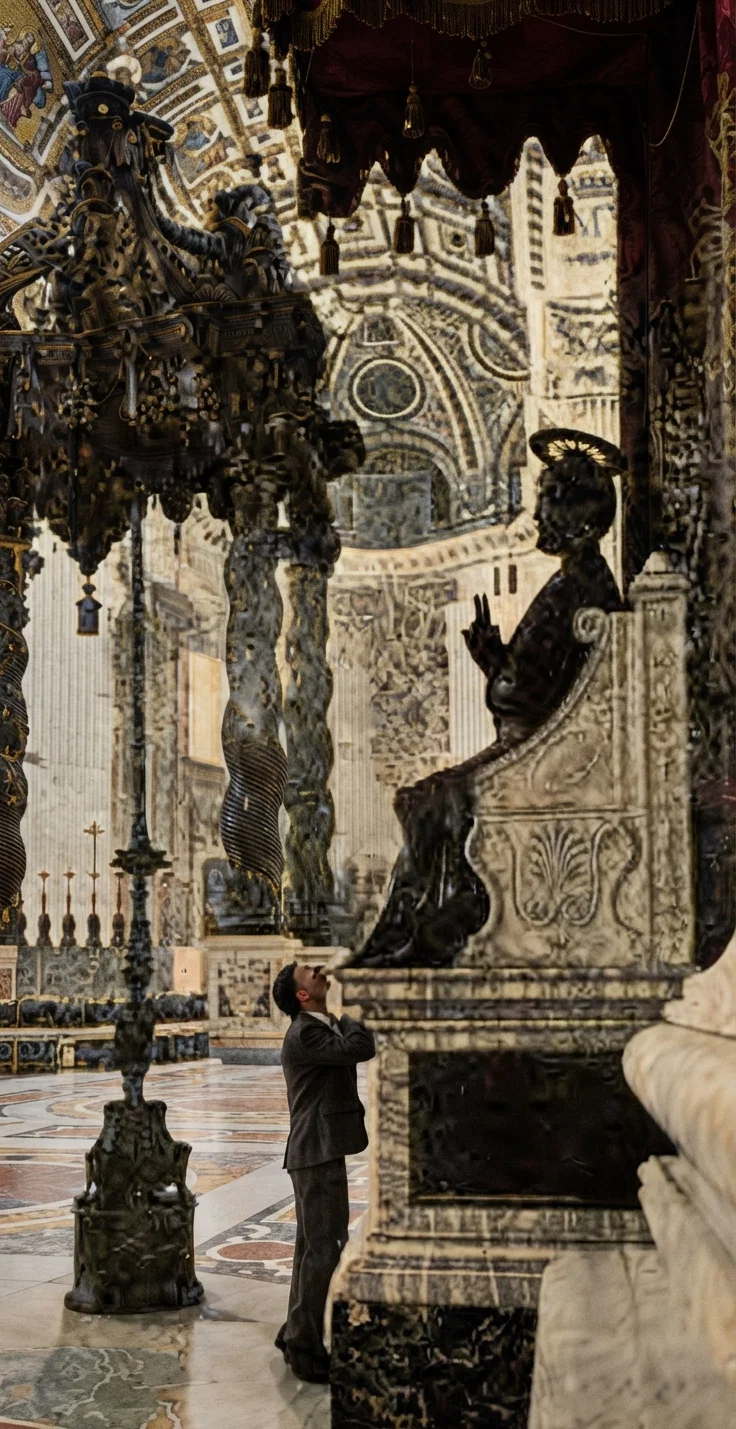
No one that is at all acquainted with the history of the Catholic Church will doubt the prelate's statement that "the character of the papal mission is really Roman," for Rome has always been to the church, what the hub is to the wheel. The fact that Rome has always been to the church what Catholic Church is not without its significance. Rome and the traditions clustering around "the Eternal City" are absolutely necessary to the very existence of the church. A visit to the fifty-million-dollar cathedral of St. Peters at Rome gives one some reasons for believing the foregoing statement. In this colossal church, which is the center of Catholicism, everything savors of Peter. The church is named after Peter, who is the patron saint of Rome. Then around the base of the gigantic cathedral dome are found, written in immense letters, the words: "Tu es Petrus et super hanc petram aedificabo ecclesiam meam et tibi dabo claves regni coelorum." ("Thou art Peter, and upon this rock I will build My church; . . . and I will give unto thee the keys of the kingdom of heaven.") Toward the center of the church on the right side, is the famous statue of Peter, which is the object of such veneration on the part of the devout Catholics that the great toe on the right foot has been worn away by their kisses. Then, in the very further end of the church, where it enjoys the most prominent place, is the great bronze throne which is said to enclose the original wooden chair upon which Peter sat in his official capacity as pope.
The name of the church itself, the inscription upon the base of the dome, the statue of Peter, and the so-called chair of the same apostle, are full of significance to the Church of Rome. For the principal argument to which Catholicism resorts to prove its claims to being the only true church rests upon the words inscribed upon the base of the dome of St. Peters. They claim that Christ built the church upon
Kissing St. Peter's Toe.
In the nave of St. Peter's, Rome, stands the bronze statue of Peter, said to have been cast by Leo the Great to commemorate the deliverance of Rome from Attila in 451. It is of crude workmanship. Its extended foot is eagerly kissed by devout Catholics, who rub their heads against the toes. So many have done this that the toes have been worn away. On high festivals this image is adorned with miter and pontifical robes.
Peter, and consigned to him the keys of authority whereby he was empowered to close or open the gates of heaven.
The keys were given to him in his official position as bishop, or pope, and, therefore, his successors are invested with the same authority. The proof that the popes are in the direct line of succession is established by the fact that the church possesses the body of Peter, the very apostolic chair upon which he sat, and are in the very bishopric over which he presided. It will not be necessary for me to stop here to dispose these claims, because of their falsity I am sure that we are persuaded, and this point does not enter into the scope of the present article; but we can plainly see that Peter as the foundation of the Catholic Church is an absolute necessity for its very existence.
But when the question arises, How would this argument that places Peter as the foundation of the church be affected by the removal of the seat of the Papacy from Rome? The removal of the residence of the church from Rome would be fatal to the maintenance of this position. The pope would then no longer preside over the bishopric of Rome, the so-called seat of Peter, and consequently he would not be in the direct line of succession. The church of St. Peters itself certainly could not be removed from Rome, and even if such a thing were possible the traditional spot upon which it stands has much to do with the veneration that it receives. And then it would take a century to build another church like it, and, in fact, it could never be duplicated for we have no Bramante or Michelangelo at the present time. And one can not imagine what a powerful influence the grandeur of the churches of Rome exert in keeping the people within its grasp.
Then the body of Peter is said to be buried under the high altar of the church; but it is quite certain that the body of the apostle is not there, and the church has been afraid to open the vault in order not to expose its fraud. Upon the belief of the existence of the body of Peter in the vault of the cathedral, the ecclesiastical supremacy of Rome has largely been built; for should we consider this question from a historical point of view its importance would immediately appear.
When, in the early centuries, the church of Constantinople was striving with the Church of Rome for
the Ecclesiastical Supremacy,
the relics of the apostle Peter were the great bone of contention. In fact, the church of the East attempted at one time to steal the body of Peter and carry it away to Constantinople, but the expedition failed. Later the empress, wife of Maurice of the Eastern Empire, tried to persuade the pope to give to Constantinople some relic of Peter, but the pope refused to concede the request.
One leading historian says: "The most prominent factor that contributed toward raising the pope to the ecclesiastical supremacy, is the tradition, accepted without controversy until the Reformation, that the apostle Peter came to Rome, was bishop of the city for twenty-five years, and suffered martyrdom under Nero, about the year 67, in defense of the Christian religion." "I say," he continues, "the tradition of the coming, the stay, and the martyrdom of Peter, retained as certain and without opposition for eleven centuries, served more than any other reason to extol the head of the Roman Church to a supreme and absolute authority."
Also the coming, stay, and martyrdom of the apostle Paul at Rome has been made use of by the Roman Church to further fasten its claims upon the world. To these apostolic traditions of the first order were united the antiquity and imperial majesty of Rome, and together they formed tremendous8factors in raising the Papacy to its exalted position. For centuries pilgrims and devoted Catholics from all over the world have poured into "the Eternal City" to visit the tombs of the apostles, the catacombs, and the traditional spots of the church, so that the Papacy gained great power and influence. The stream of pilgrims to the city of Rome has not ceased, but the stream that flows toward "the Eternal City" has rather been greatly augmented by the addition of thousands of tourists that come in ever-increasing numbers every year. Many of this latter class make their visit serve the double purpose of seeing the many interesting places of a historical value, and at the same time paying their respects to the Church of Rome.
Therefore, looking at the question from a historical point of view, we find how indispensable to the making of the Catholic Church have been the traditions that cluster around Peter and Rome. A removal of the seat of the Papacy from Rome would, therefore, be fatal to the maintenance of the traditional position of Peter, and the pope as his successor. Rome has, therefore, we might say, practically made the Roman Catholic Church. And it is a great question whether the Roman Catholic Church can get along without Rome.
But I have not been content to let the question rest simply upon argument drawn from history, and, therefore, in order to speak with more certainty upon the present aspect of the question, I have thought best to secure some information from a reliable source inside of the Catholic Church.
I sought, therefore, to obtain an Interview with Cardinal Rampolla, the famous Secretary of State under Leo XIII., who is by far the strongest man politically in the Vatican. It is by no means an easy task to obtain an interview with a person of his standing in the church; but, however, by the assistance of a friend of mine who is well acquainted with some of the leading prelates of the Vatican, it was obtained. Therefore, one evening toward sunset, I sought the massive palace of the cardinal which is situated a few steps from the Vatican. I was kindly received and after a short wait in the reception room, was ushered into the cardinal’s private office.
From what I had seen of Cardinal Rampolla in the large church functions in St. Peters, I had judged him to be a very austere and stern character, and therefore was much surprised to find him so pleasant and extremely cordial in this interview. But this affability was not without its purpose, for knowing that I was a Protestant, he did his best to leave a favorable impression upon me.
In the preliminary exchange of compliments, he used his subtlety to its best advantage in his endeavor to find out who I might be, but to no purpose, for I was on my guard.
I then came directly to the question in hand, and asked him if there was an intention on the part of the Catholic Church to move its residence or seat of government from Rome to Jerusalem. The cardinal answered, "The church has no intention whatsoever of making such a change." I then asked him if there had never emanated such a thought from the church. He replied, "The contemplation of such a move on the part of the church would be impossible on account of the traditions clustering around Rome." I then asked him how this rumor came into existence about the church removing its seat to Jerusalem. He replied that a few years ago some newspapers advocated this move as a hypothesis upon which to resolve the difficulties existing between the Catholic Church and the Italian Government. "They suggested that by transferring the seat of the church to Jerusalem, the Italian Government would be free to exert its functions, and at the same time the Papacy would have full liberty to govern its affairs without molestation." "This," added the cardinal, "was a hypothesis of the newspapers, but it was never contemplated or thought of by the church." He then told me, "You may say absolutely and categorically that the church has no intention whatsoever of transferring its seat of government from Rome to Jerusalem." The manner in which they were spoken and the words in which the expressions were formulated seem certainly to give the impression that such a move from the point of view of the church is not contemplated, nor is it possible.
In closing, I might say that when I was taking leave of the cardinal, he took my hand in both of his and said, as he shook it warmly, "We have the very best wishes for the Americans," and then repeated, "We have the very best wishes for the Americans." These words are also full of significance when viewed in relationship with the prophecy which points out the United States as the great power that will help the Papacy to regain its lost prestige. The prophecy has predicted this state of things for this present time, and we notice that the church on its part sees it coming, looking at it not from a prophetic, but a practical, point of view. The Papacy has never failed to fulfil the predictions of prophecy made concerning it in the past, and it is now getting ready to shoulder its share of those that deal with the present.
C. E. MILTON.
EARTHQUAKES.
By Editor
It ought to be dawning upon the minds of men everywhere by this time that there is some special significance in the great disasters that are befalling the earth. In all parts of the world these terrible visitations are being experienced. During the present year the islands of the Pacific, Japan, Europe, North and South America, have all witnessed terrific convulsions of nature, attended by heavy loss in life and property. Where the next blow will fall none can tell. Human wisdom and human strength are alike helpless in the presence of these judgments. Men are asking the meaning of this chain of disasters, and there is only one clue to the mystery—the Word of God:
“And there shall be signs in the sun, and in the moon, and in the stars; and upon the earth distress of nations, with perplexity; the sea and the waves roaring; men’s hearts failing them for fear, and for looking after those things which are coming on the earth; for the powers of heaven shall be shaken. And then shall they see the Son of Man coming in a cloud with power and great glory.” Luke 21:25-27.
The signs in the heavens have been given many years ago. Many signs have been seen already in the earth, and, naturally, as the end draws near, the signs increase in number and in power. The time is at hand when the earth shall reel to and fro like a drunkard, and when all iniquity shall come to an awful end. Isaiah 24. The present earthquakes are premonitions of the final shaking when every mountain and island shall be moved out of their places. Rev. 6:14. The instability of all things earthly is being shown, that men may learn to transfer their treasure and their affections to a kingdom which will abide. Judgments come that men may learn the lessons they despise in hours of ease. Isa. 26:9. Here is a confession from one daily paper of man’s impotence in the presence of such catastrophes as the earthquake at Valparaiso.
“We ask the meaning of these things, and obtain no certain answer. Science can not tell us why a quiet crater suddenly boils up without warning into an active volcano, or why the ground trembles, and in trembling destroys the habitations of man. Progress here has left us as ignorant and as impotent since the first observers at the dawn of history ascribed these cataclysms to the wrath of the offended gods. Modern mechanical invention, indeed, seems only to insure that the destruction when it comes shall be complete. The complication of great buildings, the gas and electric light, the tubes and wires, so useful in time of security, only add to the danger and collapse in the time of upheaval.
“We may say that it is unlikely that Northern Europe and its cities should share the fate of Valparaiso and San Francisco. The most dogmatic scientist would not affirm that it is impossible. In our pride at human achievement in control of the forces of nature, it is well that we should be reminded how powerless and futile is all man’s strength and intelligence in face of these mysterious,9uncontrollable changes. . . . No one to-day believes that the guilt of San Francisco or Santiago has called to Heaven for vengeance and received answer. But the scientific progress which has destroyed the ancient belief in divine anger as a cause of these miseries has provided no intelligible substitute. And to-day we confront these scenes of ruin and suffering in silent wonder what the meaning of it all can be, or whether it has any meaning at all.”
God has foretold the meaning of these scenes which we witness so often to-day. And when the tribes of the earth mourn as they see the Son of Man coming in the clouds of heaven, not one will be able to say that God has entered into judgment with His creatures and made no effort to warn them that the supreme crisis was at hand. By mighty signs and wonders God is again confirming the testimony of His servants and compelling attention to the voice of warning that is now echoing throughout the world.—The Present Truth.
THE KEY THAT OPENS DOORS.
God does not often open the way to a half-hearted man. “How are you going to do it?” asked a doubter of one who was seeking to enlist the other’s co-operation in a course that God had clearly pointed out, yet that was beset with seemingly impassable barriers. “I don’t know,” was the answer, “and what’s more, I am sure that we shall not be permitted to know until we show God that we are ready to spend ourselves to the uttermost in bringing this thing to pass. Then He will tell us how to do it.” And God did,—not to the half-hearted one, but to the one who was in life-and-death earnestness. It is never necessary to know beforehand how we are going to do something to which God calls us. He knows; that is enough. And He will tell us, if we have enough confidence in Him to show ourselves worthy to be told.—S. S. Times.
FROM THE LAPIDARY’S TABLE. NO. 2.
By Gualterio
“The counsel of peace shall be between them both.” Zech. 6:13.
ADAM’S sin had placed a gulf between the Creator and His creatures as wide as eternity, and only the sacrifice of One whose life measured with eternity could bridge it. And so the counsel of peace was between God the Father and Christ the Son as they arranged the details of the sacrifice.
Long before the dire calamity had cast its gloom over the universe, the Son of the Highest had pledged Himself as surety for a transgression of Heaven’s holy law; and now He is put to the test. As they in counsel look down the stream of time six thousand years and view the terrible results of Adam’s transgression, and consider the trials of faith it will take to meet and conquer by love only, a determination to patiently endure takes possession of the Son of God. Then He is heard declaring, “Lo, I am come; in the roll of the Book it is written of Me, I delight to do Thy will, O My God: yea, Thy law is within My heart.”
Pledged to the task, all heaven is enlisted in the plan. Heb. 1:14. For four thousand years before coming to earth He pleaded by His Spirit in the hearts of men, giving object lessons, parables, line upon line and precept upon precept. Thus He was revealing, to all who would learn, that faith in His promised propitiatory sacrifice would plant the germ of eternity in their hearts and open to them the portals of the city of the great King. For it was designed that by the death of Christ, who was equal with God, a vicarious atonement would be accomplished for every sinner who confessed faith in the Saviour. And power to finally overcome Satan would be implanted in the heart of the believer by the Holy Spirit, which is Christ’s representative, but divested in humanity. The impartation of the Spirit is the impartation of the life of Christ. It imbues the recipient with the character of Christ, and teaches him how to exercise every faculty and talent to the glory of God.
The earthward manifestation of the Saviour was outlined again and again, and His faith in the Father’s love and co-operation with Him was voiced by the sweet singer of Israel many times, as by the Spirit he delineated the trials and temptations attending Him from birth until the cruel death upon the cross. The faith expressed in the ninth and tenth verses of the twenty-second psalm was a wall to preserve Him from the power of Satan until He came to years of understanding. For as man He must pass under the rod and become a man of like temptations with us, subject to the principles of the kingdom, “for whatsoever is not of faith is sin.” Rom. 10:23.
As He grew up and reason began to expand, His heavenly Father was His standard of excellence, His law the test of every temptation. The psalmist has prophetically sung, “I will bless the Lord, who hath given Me counsel; My heart also instructeth Me in the night seasons. I have set the Lord always before Me; because He is at My right hand I shall not be moved.” Ps. 16:7, 8.
Truly His life was a marvel to men and angels. Limited as He was by the accumulated frailties of a degenerate race, still He manifested in a practical godlike life the great ideals God would have man aspire to. “Let this mind be in you, which was also in Christ Jesus,” says the Word. Phil. 2:5. A spiritual writer has most logically stated the conditions:
“The ethics inculcated by the Gospel acknowledges no standard but the perfection of God’s mind, God’s will. God requires from His creatures conformity to His will. Imperfection of character is sin, and ‘sin is the transgression of the law.’ All righteous attributes of character dwell in God as a perfect harmonious whole. Every one who receives Christ as his personal Saviour is privileged to possess these attributes. This is the science of holiness. Higher than the highest human thought can reach is God’s ideal for His children. Godliness—God-likeness—is the goal to be reached.”
Christ as man’s elder brother worked out the plans and laid the foundation. If we would successfully build upon that foundation—none other will withstand the test of fire—we must work in like lines with Him. “We must keep the Lord ever before us,” that there may constantly be a freshness in our religious lives that will breathe forth an atmosphere of love and peace to build up the souls that are weak, and make straight paths for those easily turned from the way. “Study to show thyself approved of God, a workman that needeth not to be ashamed, rightly dividing the Word of truth;” for “all Scripture is given by inspiration of God, and is profitable for doctrine, for reproof, for correction, for instruction in righteousness; that the man of God may be perfect.” 2 Tim. 2:15, 16; 3:16, 17.
GUALTERIO.
Mountain View, Cal.
HARVESTING.
By S. H. Carnahan
IN every line of work we may find lessons of moral and spiritual worth. Especially is this true in our labors that have to do with the natural world—plant and animal life.
The reapers, or harvesters, go out into the great grain fields to gather in the sheaves. These are often collected under great difficulties. Many of the fields are rough and hard to traverse; at times the weather is unfavorable—extreme heat, or perhaps heavy rains, and winds, interfere with the work.
Even tho the sheaves appear to be solidly bound upon the vehicle to be carried to the eternal garner, some unexpected experience may cause them to fall out by the way.
All these trying things give to the Gospel harvesters great anxiety, besides extra trouble and work, that the sheaves may be safely housed at last. These sheaves must be looked after and picked up again and again, in order to save them, else they would be devoured by the wild beasts or fall into decay.
But let those who are devoting their lives in the Gospel harvest-field take courage from the fact that these hardships shall be more than repaid in souls saved in the kingdom; for “he that goeth forth and weepeth, bearing precious seed, shall doubtless come again with rejoicing, bringing his sheaves with him.”
S. H. CARNAHAN.
Plodding Progress in San Francisco
Dr. Herbert Law, one of the owners of the big Fairmont Hotel in San Francisco, puts the emphasis on the rebuilding of that great city just where it belongs in any right progressive work. He says that the work looks formidable, but it will not take as much time as it seems to require. It is patient, plodding growth that is almost magical in effect. If one will accept the present conditions as they are, forget to make comparisons, and make every day, yes, every hour, count to some progressive, forceful thing, the totals will always take care of themselves. Nature has done much, opportunities are splendid, the country is prosperous; but, after all, he tells us that it is the measure of the man that tells the final story. And so it is. And that is just how difficulties in God’s work are met, for each individual to do his level best, and keep plodding on, and it is wonderful how much can be accomplished.
BATUSCHKA.
By Thomas Bailey Aldrich
FROM yonder gilded minaret
Beside the steel-blue Neva set,
I faintly catch from time to time,
The sweet, aerial midnight chime—
“God save the Tsar!”
Above the ravelin and the moats
Of the white citadel it floats;
And men in dungeons far beneath
Listen, and pray, and gnash their teeth—
“God save the Tsar!”
The soft reiterations sweep
Across the horror of their sleep,
As if some demon in his glee
Were mocking at their misery—
“God save the Tsar!”
In his Red Palace over there,
Wakeful, he needs must hear the prayer.
How can it drown the broken cries
Wrung from his children’s agonies?—
“God save the Tsar!”
Father they called him from of old—
Batuschka! * How his heart is cold!
Wait till a million scourged men
Rise in their awful might, and then
“God save the Tsar!”
—Thomas Bailey Aldrich.
THE WATCHWORD.
By John Hendrick Bangs
GIVE of your mass of gold.
Send to the prostrate West
Some of that wealth untold
Digged from her virgin breast.
Give!
Give of your meager store,
Send from your cupboard bare
Out to the wasted shore,
If but a pittance share.
Give!
Give of your brother heart
Quick of its golden glow.
Let the love cargo start
Out to the field of wo.
Give!
Give of your health and strength,
Give of your helping hand.
Over its breadth and length
Vieing with all the land.
Give!
Give of the healing light
Quick to the souls that grope;
Send to the hearts affright
Messages filled with hope.
Give!
—John Hendrick Bangs.
THE SOURCE OF HEALTH
By W. S. Sadler, M. D.
By W. S. SADLER, M. D.
III. HEALTH A CONTINUOUS MINISTRY OF HEALING.
"I taught Ephraim also; . . . but they knew not that I healed them." Hosea 11:3.
THE wonderful and mysterious arrangement whereby bodily health and mental vigor are momentarily sustained, and the physical powers constantly renewed, is nothing less than a continuous ministry of the healing power of God. When we consider that the body is, as an eminent scientist has said, "a laboratory for the manufacture of poisons," it becomes apparent that extraordinary protective forces must be constantly at work, or else life would speedily be extinguished.
Infinite wisdom and creative skill alone were able to devise a plan whereby man might be able to maintain his physical equilibrium in the face of the ever-changing conditions which constantly threaten his existence. Continued good health and mental vigor are in themselves, a tangible evidence of God’s faithfulness in the ministration of life.
The remarkable fact that the physical mechanism of man possesses the faculty of continuous self-repair, demonstrates that the healing power of God is all the time at work within the human body. The fact that man, under normal and natural conditions, does not have to cease his activities for long periods in order to recuperate his physical powers, is due to the unremitting care of the One all-wise and all-powerful who "knoweth our frame" and "remembereth that we are dust." In love and wisdom God provides for the renewing of our wasted energies and the momentary repair of the wear and tear incident to our daily life and action.
The inexplicable process by which our food is converted into blood, bone, and muscle, each to act its part in the maintenance of the physical economy, is likewise a mystery. The plant world utilizes the elements of the mineral kingdom, out of which it builds up the various food elements, and these in turn are utilized by man in the sustenance of physical life, being ultimately resolved into heat, force, and thought.
"I will put none of these diseases upon thee, which I have brought upon the Egyptians; for I am the Lord that healeth thee." Ex. 15:26.
God has pledged that He will maintain health free from disease for the people who will perfectly obey His laws—all of them. It is indeed remarkable that men of to-day, even after centuries of physical decadence, are able to maintain their physical health in the face of such overwhelmingly unfavorable circumstances. When we pause to consider that the average individual, under ordinary conditions of life, is surrounded by untold millions of disease germs, it is truly wonderful, not that a few succumb, but that any are able to maintain a state of health and physical well-being.
If the instantaneous and miraculous restoration of lost health may be regarded as a manifestation of divine power, certainly it requires no less a power to constantly maintain the physical health under the varying conditions and struggles incident to our daily life. The state of health in which the mental, moral, and physical powers are performing their normal work under favorable conditions, is of itself no less a mystery than when this normal arrangement has been interfered with, and the Lord sees fit to heal disease and restore health by the instant touch of His miraculous power.
The precision and faithfulness with which even the smallest cells of the body carry on their allotted work, the ability of the physical organism to adapt itself to unfavorable environment, and to intelligently combat the many foes of life and health, are all evidences of the sustaining and healing power at work within the man. While it is indeed a wonder that those who are stricken by disease ever recover, it is an equal mystery that so few succumb to the death-dealing influences that abound in contaminated air, polluted water, and unwholesome food.
VEGETARIANISM.
DR. RAMARAT, of Madras, India, speaking before the British Medical Association, held at Toronto, August 21-25, as reported in the Medical Record, said he represented hundreds of thousands of his fellow countrymen who had never touched meat or eggs or fish in any form. Even on his trip of ten thousand miles, he had given vegetarianism of this absolute kind a fair trial. He had not found it wanting. He had carried on a very active professional life for twenty-four years, and was sure that all the ordinary activities could be exercised without meat or the abundance of proteids consumed in the West. On the voyage he had seen many pitying glances cast at him because of his abstemiousness. He thought that the pity should be bestowed rather on those who bothered themselves with eating so much. The experiment of limited proteid diet had been carried on in India for many thousands of years by a people noted for its intelligence and for all life’s activities.
Speaking on the subject of nutrition at the same meeting, a statement was several times repeated that more people die from overfeeding than from the consumption of alcohol, and that more people suffer from overfeeding than from underfeeding. In fact, experiments conducted through a series of years by Prof. Russell H. Chittenden, of New Haven, Conn., shows that far too much of fats and proteids are consumed. Discussing the subject, Professor Halliburton, of London, remarked that excess in meat-eating is more harmful than excess in almost any other line.
REFLECTIONS.
By Kathrina Blossom Wilcox
At the close of the day when the evening shadows gather and the mantle of night drops gently down to robe the quiet earth, and the star-besprinkled heavens hang above like a great canopy studded with sparkling diamonds, then how sweet it is to bow in the presence of the Infinite! This is the silent season of communion, of heart-searching, when we examine ourselves, look back over the day's record, and ask our loving, forgiving Father to pardon, in the name of His dear Son, every thought or word or look or action which has been in any way displeasing to Him.
We claim His promises, and as our petitions silently wing their way to the throne above, we accept His answer; for He has said: "Before they call, I will answer; and while they are yet speaking, I will hear." Then what a sweetness and peace comes over us as we seek our rest! We can truly say with the psalmist, "I will both lay me down in peace, and sleep; for Thou, Lord, only makest me dwell in safety!"
And then, when the dewdrops sparkle on the grass and the morning calls us to light and life, and we awake refreshed for the duties of another day, we again feel with David of old: "I laid me down and slept; I awaked; for the Lord sustained me."11But before we enter upon the labors of the day, we must not forget to kneel in humble adoration and lift our hearts in praise and thanksgiving to the Father of all for His tender love and watchful care toward us.
How precious His promises seem as we seek Him for strength and wisdom, which we know is His alone to give. We know not how we may be tried and tested and tempted. But we do know that His "grace is sufficient;" "He will not suffer us to be tempted above that we are able to bear;" His help is sure, His love is constant, His truth is steadfast, His promises are unchanging.
How sweet to hold communion with Him, and how we would linger longer at the sacred altar and continue to receive of His hallowed blessings! But stern duty calls us forth, and we go out with His daily benediction resting upon us—His servants, witnesses for Him, laborers in His vineyard.
And again at the busy noonday hour, amid the hurry and bustle and confusion of Life's rush and turmoil, in the midst of business or household cares and perplexities, can we not pause for a moment at the threshold of heaven to renew our strength and replenish our ammunition from the storehouse of infinite resource?
Then shall we know that we are not alone; we know that He "will never leave us or forsake us," and thus fortified, the humblest task, the severest trial, the hardest temptation, the greatest disappointment, can be cheerfully and patiently borne. He will bear them for us.
Teach us, Lord, to trust Thee more,
Serve Thee not as oft before,
Claim Thy promises each day,
Ever walk the narrow way.
Live for Thee each day, each hour,
Give the best of life and power
All to Thee; in service sweet
Lay our offerings at Thy feet.
KATHRINA BLOSSOM WILCOX.
WHO WANTS THE LIQUOR SALOON?
Under this heading the Portland (Maine) Press comments as follows:
“Who wants the saloon legalized in our communities? Who wants the liquor traffic to become a factor in all our state, county, and municipal affairs? Who wants the rumsellers to set themselves up as bosses in ward, town, city, and state management? Who wants the degrading influence of the saloon to offset the influence of our churches and schools? It is easier to tell who does not want it. No good citizen wants it. No man with a family of growing boys wants it. No one with the good of the community at heart wants it. No man with a business which the profits of the saloon would interfere with wants it. No man who loves his fellow men wants it. No one who hopes for the welfare and happiness of the rising generation wants it. Even the man who has an appetite for strong drink and who realizes the harm it is doing him and his family would be pleased to have no temptation put in his way. It is simply a question of greed rather than of appetite. The rumseller is the real party who wants the saloon, and he wants it solely for the money it will bring him. Shall he have it?”
Admitting that this is all true, it remains a fact that the rumseller is not a majority. If this is a republic he ought not to be able to carry his point against all the other classes mentioned above. But he does, and there must be a reason why his greed can wield such a strong political power; for it is political power that gives him his prestige. It must be that the real influence of the rumseller lies in the imagination of many people. Business men who do not want the saloon fear to oppose it, because of its imaginary powers of retaliation on their business. Politicians especially dread to antagonize the saloon element because of its imaginary power to control votes. It does control votes, but many of the votes it controls are the votes of the men who do not want it, but are afraid to oppose it. If all the voters who profess that they do not want the saloon would throw away the idea that there is an innate power in the rumseller to ruin their business prospects or political ambitions; if they would fearlessly back their convictions by judicious action; they would soon learn that the power of the saloon’s influence is just what they give to it through their fear of it. But there are two classes not explicitly mentioned by the Press in its enumeration of those who want the saloon: (1) the class who make the saloon their headquarters for concocting evil schemes, and (2) the political agents who are paid to carry out the devices of the liquor traffic for perpetuating its influence and its business. If all the professed temperance people who are content to allow the saloon to exist six days in the week, if only it may be closed on Sundays, would throw away their timidity and demand prohibition, the saloon power would be broken.
G.
Stewardship of Earthly Riches
The silver and gold and all the earth-stowed treasures are God’s, and He could bring them all into the hands of faithful stewards, who would use them to His glory. But then He would have fewer to share in His joy. Therefore He distributed His gifts according to man’s ability to use them. He would have us learn to use them to His glory and for our good. He would develop in us in the use of them a heart like the heart of God. He would have us the masters of the means, not their slaves. In all our use of God’s blessings, He would have us plan for God, that He may plan for us, or connect us with His infinitely wise plans for our good. If we fail in this, His blessings become to us curses. The riches of earth, which we gather and love, forever shuts us from the eternal riches of God.