THERE was somebody who said unkind words which hurt somebody else. Was it you?
There was somebody who was selfish and thoughtless in her home. Was it you?
There was somebody who disobeyed mama and made her a great deal of trouble and sorrow. Was it you?
There was somebody who was often too late at school. Was it you?
There was somebody who spoke unkindly of somebody else. Was it you?
There was somebody who found nothing but fault with everybody in the belongings of her friends. Was it you?
There was somebody who borrowed a book and kept it for months. Was it you?
There was somebody who never stopped to think who was hurt by the sarcastic word. Was it you?
There was somebody who day in and day out never did anything to make anybody else happy. Was it you?
Southern Pacific
Whether going East or coming West, do not fail to take advantage of the most essential features of traveling
Speed,Comfort,Safety
Which are given the greatest attention in the equipment of the
Overland Limited
Running over the Southern and Union Pacific. Secure tickets and make reservations for berths from any
Local Agent
Southern Pacific Company
— OR —
City Ticket Office,
Ferry Bldg., San Francisco, Cal.
IMPORTANT TO TRAVELERS
The WASHINGTON-SUNSET ROUTE announce the opening of their through line via New Orleans. Personally conducted cars, San Francisco to Washington, D. C., via Coast Line and Los Angeles, tri-weekly. Tickets at lowest rates to Washington, Baltimore, Philadelphia, New York, New England, and all Eastern points. Through the Old South. Quick time. Best service. Write Phil K. Gordon, 1708 Filmore St., San Francisco, for full information.
The Perils of Gold Fever
At Beatty, Nev., in the heart of the new gold-fields, the first railroad train has been celebrated. This is a branch of the Salt Lake and Los Angeles road, and it is said that its completion to the very mouths of some of the big gold-producing mines will be “the signal for a mining rush such as the world has not seen since the days of ‘49.” The next thing in order will be a few financial successes and thousands of disappointments. Very few human ailments are more disastrous than the “gold fever.”
Is your husband proud of your COOKERY?
Likes good things to eat—does he?
Wouldn't it be a pleasant surprise to him in the winter time to set out some sliced tomatoes on a pretty white plate, fixed up just the way he likes them—
ECONOMY JARS
Or some sweet corn on the cob, as juicy and creamy as the day it was plucked, or green peas, or—
Say—a dish of brook trout—
Or some other article of food of which he is particularly fond, but which can not be obtained for love or money, out of season?
Well—
The ECONOMY Jar enables you to give him that very surprise.
The ECONOMY Jar is a wide mouth, self-sealing, perfectly air tight jar. Nothing else like it.
By its use, you can perfectly preserve fruit, whole or sliced; vegetables, fish, game, or any other article of food, without the use of preservatives or any means except heat and pure water.
No burned or cut fingers when you use the ECONOMY—no rubber rings to contaminate—no dangerous acids to develop.
The next time the man of the house brings in a basket of trout or game, just put up some of them in an ECONOMY Jar. Then, without saying a word to him, set them out for his dinner some day next winter. They will be as sweet and wholesome and appetizing as the day they were put up. The treat will be like a vacation day in the woods or mountains. A single dozen ECONOMY Jars will prove this to you. Get them at your dealers.
Sit down right now and write us your name and the name of your dealer and state whether he sell the ECONOMY Jar, and we will send you (FREE) a booklet of recipes—tell you all about preserving the Economy way—tell you where you may buy the jars, and all about "pleasant ways to surprise the man's palate," without a penny of cost to you or any trouble further than writing us one short letter.
KERR GLASS MFG. CO. 275 Hoyt St., Portland, Ore.
Eastern Office Dept. O., Philadelphia, Pa.
JAPAN AS MISSIONARY GROUND.
By Editor
In all lines of recognized modern progress, Japan is leading the Orient. Her brilliant dash against Russia begat a desire among all Asiatics to emulate her, and inspired the thought that it was possible for all the brown and yellow peoples to do so by adopting her methods. Japan, too, recognizes that she gained her prestige by learning and adopting western methods. Therefore, to a considerable extent, Japan is in the position of medium through which western progress and thought is being imparted to Asia. Great numbers of pupils from China and adjoining countries are attending Japanese schools. For these reasons it is very important that special attention be given to Gospel work in Japan. Such a course will surely prove both expeditious and economical in reaching the Asiatic millions. To this end it is well to note conditions in Japan that have a bearing on the transition from hide-bound orientalism to the expansion into freedom of thought. For this purpose we reproduce some statements by Theodore M. Macnair, a missionary of the American Presbyterian Church, as given in the Missionary Review, under the caption, “Influences That Are Moulding Japanese Thought.”
Periodical Literature.
In accounting for the remarkable progress made in Japan during recent years, large emphasis must be placed upon the influence of literature, particularly periodical literature. These influences are second only to those of the schools, which have made of the Japanese people a nation of readers.
The Meiji era had scarcely begun, thirty-eight years ago, when Japanese periodical literature took its rise contemporaneously with public speaking; and if at the first it was crude, and played little part in the shaping of popular thought, that condition did not last. Rapid literary development took place, and now, a generation later, it makes a fairly creditable showing. In 1898, the thirty-first year of Meiji, there were 829 newspapers and magazines published; but five years later these had increased to 1,328; and figures for 1905 show not less than 1,500 as the present aggregate. Moreover, there are some among the more influential of the Tokyo dailies that have reached a circulation of a quarter of a million of copies.
All varieties of opinion, secular and religious, are provided, through this medium of periodical literature, with the means for exploitation; but in Japan, as elsewhere, the results are widely varying. The secular journals, especially those of Tokyo, are in the lead, as the great moulders of public opinion. With their machinery for news gathering, manipulation (!), and scattering, through the agency even of the gogai, or “extra,” they justify the claim that they are fully “up-to-date.”
There is one daily paper edited and published by Japanese, entirely in the English language—namely, The Japan Times. It is a creditably conducted journal, and though only eight years old, has numerous patrons from among the Japanese, as well as in the foreign community.
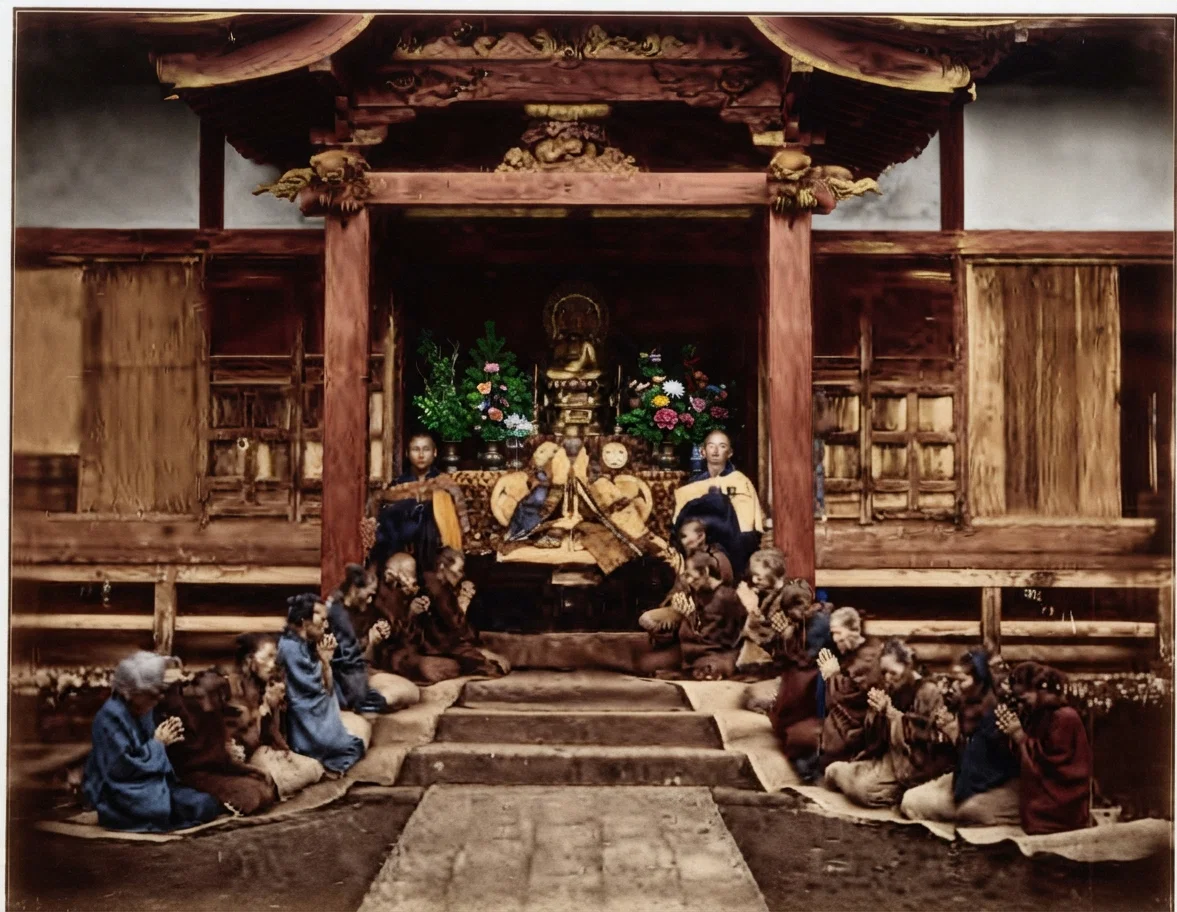
JAPANESE WOMEN WORSHIPING AT ENTRANCE TO A BUDDHIST TEMPLE.
The Japan Mail, however, under foreign management, is recognized as the leading English newspaper, and has been so ever since its establishment in 1865. Its present editor is the well-known Captain Brinkley, a retired English army officer.
Magazine literature can not be said to have developed in Japan correspondingly with that of the newspaper class. There has been no lack of enterprise in this direction, but the patronage secured is as yet relatively small. Still, there are some magazines which pay well, and among them the Taiyo, or “Sun,” which was begun as far back as 1887, and easily takes the leading place, with a monthly circulation of a hundred thousand copies.
There is a constant and increasing inflow into Japan of foreign literature, however, particularly English. In fact, the imports of English-printed books nearly trebled, between 1901 and 1903, while for German and French they remained practically the same, and the latest available figures (in yen) stand relatively at 371,000 for English, as compared with 94,000 German and 15,000 French. This drift in favor of English will no doubt continue, as is indicated by the steadily increasing place that is given to English study in the schools. Nitobe, the author of “Bushido,” has been quoted as saying that “the Christian and Western moral ideas must be the standard for the future in Japan, and the most immediate and practical means for disseminating them, besides personal influence, will be the study of English literature. New Japan will receive her greatest impetus toward the new ethics through the desire, which is universal, to learn English, not as a language alone, but for the benefit to be derived from it in the formation of character.”
Religious Influences.
Religious literature, as at present produced, is mostly due to Christian enterprise, though there are some notable exponents of Buddhism among current books and periodicals. They are in striking contrast, however, to the number of Buddhist believers, as these are compared with the combined total of Christians, the latter a hundred and fifty thousand, the former some twenty-eight millions!
As for Buddhism, the reform element is practically the only source within it from which modern literary influences proceed. The apathy in the matter of faith, which may be affirmed of the great majority of enrolled Buddhists, does not conduce to the acceptance of new religious ideas, or favor such innovations as religious periodicals with which to circulate them. But there are some who desire that the creed of Shaka may be revised to suit modern conditions, and have adopted the usual literary means for securing a hearing with this end in view.
The role of the critic is the one they commonly adopt, and the following will serve as a sample of the kind of criticism that is offered:
“Priests have of late been freely distributing amulets among the soldiers, and when acting as army chaplains, they bear the name of imonshi (comforters); but how many of them are there that have any real faith in the efficacy of the religion they profess?”
As bearing on this very matter of the traffic in charms and on divination in general, a government proclamation of December, 1905, forbids it in toto on pain of fine or imprisonment.
The Buddhist Chuo Koron proposes a rendition of the Buddhist Scriptures into the colloquial of the people of Korea and China, and of Japan also, in order that they may become a means of Buddhist propagandism, similar to what the Bible has been in the propagation of Christianity. “Now is the time,” it declares, “for Buddhists to go in13and win, and it is earnestly to be hoped that they will show themselves possessed of the energy, the enterprise, and the sense of responsibility required for the full utilization of their unique opportunities.” On the other hand, the adherents of Christianity are convinced that the opportunities are theirs instead.
The following compliment to Christianity is taken from the Jiji Shimpo:
“Altho the Christian religion is of recent introduction, the improvement it has effected in Japan's moral condition, and the influence it has had on the minds of the people, are very great. No one can deny the great good accomplished by the believers of that religion, in establishing charitable institutions, in assisting in the progress of the nation, and in promoting the happiness of the poor and helpless. There are already many schools and colleges in the country, both for boys and girls, which are supported entirely by Christians. As for the charitable institutions, excepting those founded by the government, it is not too much to say that they are all the result of Christian enterprise.”
THE CHRISTIAN WARFARE.
By Max Hill
My Christian warfare here below,
Tho oft my weary feet
Are turned to base retreat,
Is not my own, for with my Lord I go.
The past,—I do not look that way
For it is hard and rough;
To me it is enough
That I may live and serve to-day.
The living present, now and here,
Is all that I possess;
If Jesus guide and bless,
His will be done, I will not fear.
The future looks all fair to me
If I but walk to-day
Upon the narrow way,
Not fearing what I can not see.
The war with sin shall end ere long,
And heaven's courts shall ring,
And I with joy shall sing
With ransomed hosts the victors' song.
MAX HILL.
A MARK OF DEGENERACY.
It is a pity that modern artists have such a mania for copying the often immodest work of the old heathen painters and sculptors. The modern ideal of art is not something modern and original, but something ancient. It is deemed an excuse for presenting the lewdest of pictures if only it can be said that it is classic—that it is ancient Greek or Roman or Babylonian or Egyptian. It is deemed so artistic or so scholarly to reproduce in our day what the old heathen "masters" did, or to repeat what the old heathen "philosophers" said. It was mimicry of the heathen that gained popularity for the early Christian church, and secured the nominal adoption of the Christian religion by the heathen government of Rome. So to-day artists and scholars are gaining popularity by setting forth the art and learning of the ancient heathen. And this method is gaining popularity in the church as well as in the world. It is a sign of the times, and its effect can not be different from that of former times. A correspondent of the Herald of Gospel Liberty says:
"A New York official, Mr. Anthony Comstock, has seized, under authority of law, certain publications of an art school. He was actuated by the complaint of a parent whose pure children were being polluted by the foul pictures of nude men in the pamphlets seized. Instead of being commended he is subjected to satire and abuse by some idealists, artists, art dealers, and art students who see their craft to be in danger, as the shrine makers for Diana raised uproar against St. Paul at Ephesus."
After stating this fact, the correspondent adds some very wholesome comments, from which we cull the following:
"The finer the art, the more accurately does it reproduce nature and idealism. The highest form of art does not draw attention to itself, but to that which it reveals, as tho it said, 'Behold what I reveal.' This being an accepted principle, it follows that the nude, when under the touch of art, will powerfully reveal forbidden nakedness—nakedness that God covered. Gen. 3:21. And these impressions on the plastic minds of youth become fixed mental images for vileness of thought and subtleness of temptation. 'Wo unto the world because of occasion of stumbling; . . . wo to that man through whom the occasion cometh.'"
" 'To the pure all things are pure' is appealed to in defense of the nude. But a pure mind instinctively shrinks from the nude. To use this proverb in justification of the nude is as weak as to assert to the honest man that all things are honest."
. . . What would Christ have said of modern advertising by the worst specimens selected from museums that preserve the depths of shame of the Dark Ages? What would He say of the coming together of the pure and the impure of both sexes to look upon absolute nakedness—50,000 persons every three months in one art museum?
"Let defenders of the nude claim immunity from its effects, they can not prove their assertions by either reason,—the conscience of mankind, or history. The centuries never produced a moral community where the nude was popular. Greece and Italy tried it, and failed. France has been trying it, and her death-rate exceeds the birth-rate. And if American art resorts to the nude (which is the cheapest because most shocking way of advertising) to revive public interest in art and in art museums, will not the fate that has befallen Latin nations be our inevitable punishment? 'Whatsoever a man [or nation] soweth, that shall he also reap. For he that soweth to his flesh shall of the flesh reap corruption.'"
OUR WORK AND WORKERS.
By Editor
FIVE candidates were recently baptized at Burnt Lake, Alberta, by Brother C. A. Anderson.
IN the Northern Union Reaper, Brother F. A. Detamore reports the baptism of seven persons at St. Paul, Minn., August 25.
ON the 1st inst., eight members were received into the church at Otsego, Mich., four by baptism. The brethren are preparing a room for a church-school.
A SERIES of tent-meetings, conducted by Brother O. O. Bernstein at St. Cloud, Minn., closed on the 2d inst., with seven converts to the faith. Two of the number are teachers.
UNION COLLEGE, at College View, Neb., opened on the 12th inst., with an enrolment of 204 students. Two days before the church school at College View opened with over ninety pupils.
BROTHER H. H. BURKHOLDER, president of Ohio Conference, reports to the Visitor that a church of twenty members was organized at Charloe on the 4th inst. Fifteen candidates were baptized by Brother W. E. Bidwell.
NEW treatment rooms have been opened in Fort Worth, Texas, under the supervision of Dr. D. C. Ross. The place is fitted for any treatment given at any of our sanitariums. Address, 1008½ Houston Street, between Ninth and Tenth.
A NEW church building at Eaton, Ind., was dedicated on the 2d inst. The services were conducted by Brother W. J. Stone, president of the conference, and Brother U. S. Anderson, who has had charge of the work at Eaton for a year past.
AT the recent camp-meeting at Troy, Ohio, the following brethren were ordained to the Gospel ministry: W. E. Bidwell, C. A. Pedicord, C. T. Redfield, and J. E. Shultz. The charge was delivered by Brother R. A. Underwood, and prayer was offered by Brother I. H. Evans, both of the General Conference.
At the recent camp-meeting of Ontario Conference, held at Paris, nineteen persons were baptized. In addition to this good result, the Messenger says, "The spirit of sacrifice on the part of the brethren in helping forward every branch of the work, is an indication that the latter rain is about to be poured out upon the people of God, and that the coming of the Lord is near."
AT the last session of the Wisconsin Conference, it was recommended that each church, as far as practicable, elect a local religious liberty secretary, who shall look after local interests, and improve every opportunity for disseminating appropriate literature. He is also to keep in touch with the state secretary. The recommendation is a good one for all conferences not so provided.
THE Southwestern Union Record says: "Prof. H. E. Giddings is now at Keene preparing matter in the form of petition blanks and small leaflets to be used in Oklahoma and Indian Territory during the agitation upon the formation of the constitution of the new state of Oklahoma. It will be ready soon, and our people in that field should be ready to assist in getting the matter before the people."
ALL the work done in the Signs office now, is done within a few rods of the ruins of our once splendid establishment; but there is always something to encourage us in the struggle with difficulties. Last week a telegram from the C. B. Cottrell house informed us that all the parts necessary for the repair of our large rotary Signs press had been shipped by express. It will mean much to our convenience to have this machine once more doing its accustomed work.
SURELY the new Sheyenne River Academy in North Dakota, starts out with an excellent material prospect. Prof. N. W. Lawrence, so well known in connection with the Mount Vernon (Ohio) Academy, is now in charge. Writing to the Reaper of the favorable outlook, he says: "We are pleased with what we find at the academy. Controlling this year about six hundred acres of land, with nearly five hundred acres of crops, and practically owning four hundred acres with but little liability, the school has a pretty sure foundation upon which to build. When we add to this, two substantial school buildings and a good supply of stock and tools with which to operate the farm, we are led to congratulate our brethren in this conference for their faithful efforts which show such results in so short a time."
WANTED FOR MISSIONARY WORK.
By A. Steinberg
(Always prepay postage.)
LATE, clean copies of the SIGNS, Watchman, and Instructor—a continued supply. Address, A. Steinberg, R. No. 1, Bronson, Iowa.
NOTICE.
By Editor
The St. Helena (Cal.) Sanitarium offers to our consecrated, able-bodied, young men and women, the privileges of its training school in the preparation of medical missionaries for the proclamation of the Third Angel's Message.
The advantages of the sanitarium compare favorably with any on the Pacific Coast. Among them are the following: Our climatic conditions and surroundings the entire year, thus affording an excellent opportunity for the practical demonstration of the theories of medical missionary work, set forth by the faculty so ably headed by Dr. H. F. Rand.
We would like to correspond with at least fifty consecrated young men and women, to begin with the class in October. The applicant should have a settled purpose in life to serve God. He should be of sound health, and not less than nineteen years old. He should have finished at least eight grades of studies in the common schools, and have the recommendation of the elders of the church, ministers of the conference, or other recognized brethren of good standing.
To all who have not a settled purpose as to the line of work they intend to follow in connection with the cause of God, we extend a cordial invitation to the above call.
Be free to ask for our calendar and other information you may desire.
St. Helena Sanitarium,
Sanitarium, Napa Co., Cal.
EASY MONEY.
A. E. Loveland, Johnson, Vt., writes: "On Friday I sold six dozen E-Z Washing Tablets; my mother sold five dozen, and another friend sold four dozen,—fifteen dozen in one day! Nearly every one likes the Tablets."
Agents make a profit of over 100 per cent. Not necessary to canvass. Send 5 cents for samples and particulars. Either sex. Address, Alfred Mallett, Elkridge Station, Baltimore, Md., or to Clinch Mercantile Co., Grass Valley, Cal., Pacific Coast Supply House.
Building on the Sure Foundation
The stability of a structure depends even more on the strength and solidity of its foundation than upon the oftentimes large and sightly superstructure. Yet men rarely praise the foundation; that is out of sight and out of mind, yet if the foundation of worth be wanting, in the stress of storm and earthquake the superstructure may collapse like a house of toy blocks. There are great works in which men boast themselves, like the house without a foundation, like a tree without roots. Trial reveals all. There may be work which goes painfully slow, but it goes sure. It is building to stand all storms. It is founded on the Rock of Ages, and in the time of trouble it will be a safe and sure refuge. Build, build rapidly, but build surely by building on the tried foundation, Christ Jesus. He who thus builds will never boast in himself.
The American Federation of Catholic Societies
By John S. Wightman
(Reported for the SIGNS OF THE TIMES by John S. Wightman.)
WILL the Catholic Church succeed in "winning America" for that religion, "the survival of the fittest;" will it succeed in securing for itself the universal assent to its much-vaunted right to conserve "the majesty of law and the stability of the state?" are pertinent questions that in view of the recent current events may well occupy the thoughtful attention of all true American citizens, of all genuine Protestant believers.
"Rome never changes." As she was a thousand years ago, so she is to-day. True, her policy may be tempered to the peculiar and fluctuating minds and times of localities and of centuries; she may exactly suit herself to the prevailing and exacting conditions of republics and empires alike; she may extend either the gloved hand of temporary concession, or the mailed fist of unreasoning independence, as circumstances and conditions may demand or permit. Her tactics and policies in the Orient may differ absolutely and strangely from those in the Occident; but in respect to doctrine, her unswerving purpose is to dominate the civil with the power of the ecclesiastical, in the radical and unchangeable fundamentals of her very being. In an insatiate and determinate desire ultimately to rule the whole world with a rod of iron, she is as firm, as inflexible, as immovable as the rock of Gibraltar! In her triumphant march through the centuries, down through the "moral midnight" of her supremacy, into the glaring and soul-searching lime-light of an age of republics and investigative thought; of unparalleled progress, enlightenment, and magna chartas of human liberty and inalienable rights everywhere; the church that has weathered a thousand storms and crossed a score of troubled seas, comes to us as fixed in her determination and in her loyalty to the standard set aloft in the council chambers of Babylon, as the pole-star is fixed above the quiet, the unknown, the undiscovered sea! Rome does not change. In his encyclical on Christian unity, given to the world in 1896, Pope Leo XIII., said:
"The fathers of the church are unanimous in considering as outside the Catholic communion any one who in the least degree deviates from even one point of the doctrine proposed by the authoritative magisterium of the church. . . . For the due preservation of unity of the faith, it is not sufficient that the head should have been charged merely with the office of superintendent, or should have been invested solely with the power of direction; but it is absolutely necessary that he should have received real and sovereign authority which the whole community is bound to obey."
A Rome correspondent of the New York Sun of July 11, 1892, said:
"In his (Pope Leo's) view, the United States has reached the period when it becomes necessary to bring about the fusion of all the heterogeneous elements in one homogenous and indissoluble nation. . . . According to him the church ought to be the chosen crucible for the moulding and absorption of races into one united family. . . . What the church has done in the past for others, she will do for the United States."
And Archbishop Quigley has said: "Within twenty years the United States will rule the world; when the United States rules the world, the Roman Catholic Church will rule the world."
Church Progress, a Catholic journal of St. Louis, says:
"While our government has been far from doing the right thing by way of recognizing American Catholics in the Philippines, we believe justice will prevail. For this, the demand of fifteen millions of Catholics is somewhat of a guarantee. It is one which no administration will dare ignore."
Nicholas Gonner.
Editor Catholic Tribune, Dubuque, Iowa; Honorary President German Roman Catholic Central Verein, Chairman Executive Board of the American Federation of Catholic Societies.
In Vol. 22, p. 986, art. 3, entitled "De Heretics," we find the following:
"We excommunicate and anathematize every heresy, that exalts itself against this holy orthodox and Catholic faith. Such as are condemned must be delivered over to the existing secular power, or to their officers to receive due punishment. But those who shall be found guilty only of suspicion must be smitten with the sword of anathema, and let such persons be shunned by everybody until they have given condign satisfaction.
"Moreover, secular powers must be warned, induced, and, if necessary, compelled, by ecclesiastical censure, to swear publicly in defense of the faith, that they will strive with all their might, bona fide, to exterminate from the land subject to their jurisdiction all heretics denounced by the church. So that henceforth whosoever shall assume to govern, whether spiritually or temporally, he must be compelled by an oath to conform to this article."
This was passed at the twelfth council in Rome, 1215 A.D., and in the time of Pope Innocent III. From this corollary of facts bearing upon the subject, we are bound to arrive at the unavoidable conclusions that church unity throughout the world is desirable; that it must be charged with an official head having real and sovereign authority; that Rome expects to rehabilitate Europe and save the waning power of the Papacy there with the rejuvenated types and growing power of an American church; that what the church has done for other nations she now proposes to do for the American republic; that when the United States rules the world the Roman Catholic Church will rule the world; that 15,000,000 Catholics banded together will be an influential and commanding power that the administration of government must hear and respect; that secular powers must punish heretics and ever and always conserve the interests of the church and the Roman Catholic faith.
From these conclusions there is no escape. They are logical. It is for all this that American Federation and its allied millions will and necessarily must stand! Reader, ponder these stated facts, and if you have not already done so, be persuaded to-day that with the help of God, you will turn from the federation and all its wickedness, and with new inspiration take a firm stand for American and Christian principles as against the doctrines and plans of a world-church and world federation—a power that bodes no good either for itself, for the individual, or for the government!
Federation must, from the very necessity, be crushed finally with its own weight! It is an inverted pyramid which, as it continues to grow, must reach the point of overbalance, and then it will fall with a mighty crash that will be heard around the world!
Will Federation be world-wide?—Beyond a doubt. Already the American Federation is in correspondence with federations in Germany, Italy, and France, with the view to establishing an international federation. Alaska, New Zealand, and Australia are knocking at the door for admission, and soon the consummation of the ideal—a world Catholic—will be fully realized. It was the Catholic Mirror of Baltimore that said, "The desire for the reunion of Christendom, is a striking characteristic of our times."
A reunion of Christendom! Nor can one doubt that such will be the end! And thus will the history of Rome be repeated. "All the world will wonder after the beast." "Men are closing their eyes to the real character of Romanism, and the danger to be apprehended from her supremacy. The people need to be aroused to resist the advances of this most dangerous foe to civil and religious liberty."
Pope Leo XIII. said: "May the faithful unite their efforts more efficaciously for the common good, and may their union rise like an impregnable wall against the fierce violence of the enemies of God."
This is the slogan of the Catholic hosts! It means something; it means everything! "The enemies of God," forsooth! are those noble souls of every age and every clime, those watchmen upon the walls of Zion, who stand unalterably for the principles of Christian liberty, and plead that church and state may be kept forever separate. These are called enemies.
The Catholic Convention of Federated Societies is a thing of the past; its influence is yet a matter of the future.
Chicago’s Get-Rich-Quick Schemes
"Prosperity" in this country is mainly reckoned according to the growth of cities and the profits of the great corporations. Second to New York, the fastest growing city in the United States is Chicago, and here is what a United States post-office inspector says of it:
"Chicago is the hot-bed of get-rich-quick schemes, a rookery of swindlers and fake promoters, and the birthplace of gigantic transcontinental frauds. We try to drive them out by vigorous prosecution, and we have not men enough to keep up with the complaints. While we are putting one fellow out of business, in spite of the legal talent he employs with other people's money, five others are starting in the business."
The Mayor’s Void Shooting Order
During the great fire that followed the earthquake in San Francisco, the mayor issued an order to the guards to shoot persons under certain conditions. On the strength of this order a guardsman shot and killed a citizen. The prosecuting attorney of the county had the offender arrested and charged with murder. At the trial, the paper containing the mayor's order was introduced by the defense in palliation of the crime, while the prosecution contended that the mayor had no authority to issue such an order. When the judge gave his charge to the jury, he instructed them concerning this part of the defense as follows:
"Upon this point the court charges you that such an order was legally void, and hence can not be availed of as justification for any act committed under it. The said mayor has no authority to issue such a paper, nor to declare what acts shall constitute crimes, nor the punishment therefor. The court, therefore, charges you that as to this evidence it is not to be considered as tending in any manner to legally justify the defendant in the commission of the act upon which the charge before the court is based. The conduct of the defendant is to be determined under the law of the state as it existed at the time in question."
The jury, however, gave the defendant the credit of supposing that he had a right to shoot the man who did not immediately halt when told. At least they acquitted him of the charge of murder. The judge was right.
The Catholic Church in Canadian Politics
By Editor
The Catholic Church in Politics in Canada.
The Toronto Sentinel tells us that a serious effort is being made by the Christians in the province of Quebec to have the sacred heart flag adopted as the national emblem of the French Canadians. Certainly we can see no reason in the world, unless there is a desire to bring the province of Quebec under the absolute dominion of the Roman Catholic Church, why the religious emblem should be demanded. The same paper also quotes Archbishop Langevin as saying that it is the duty of Roman Catholics to exercise their franchise upon instructions from their bishops, as it is the bishop's duty to take his instructions from the pope. The Sentinel truly remarks:
"When we find that the franchise which is given to a man because of his standing as a citizen is handed to the third party because of his religion, we see the whole purpose of the enfranchisement of the individual overridden. The laws of our country do not give to a man the right to vote because he is a Roman Catholic; they give him the right to vote because he is a citizen, and his enfranchisement carries with it the obligation to examine public questions for himself, and to exercise his own judgment, free from the dictation of priests or politicians. Politicians will always have influence with the masses, and so will the priests. But when Roman Catholics accept, as a religious duty, the direction of the parish priest as to how they shall vote on public questions, they surrender their franchise in the interest of the foreign power."
The worst that has ever been charged against Roman Catholics is admitted by Archbishop Langevin and his flock in Saskatchewan. The prelate acknowledges his duty to follow the directions of the pope. This is a state of affairs against which every Protestant and every liberal Roman Catholic should protest. Carried to its logical conclusion, it would make the pope absolute ruler in Canada, as he is in no other part of the world.