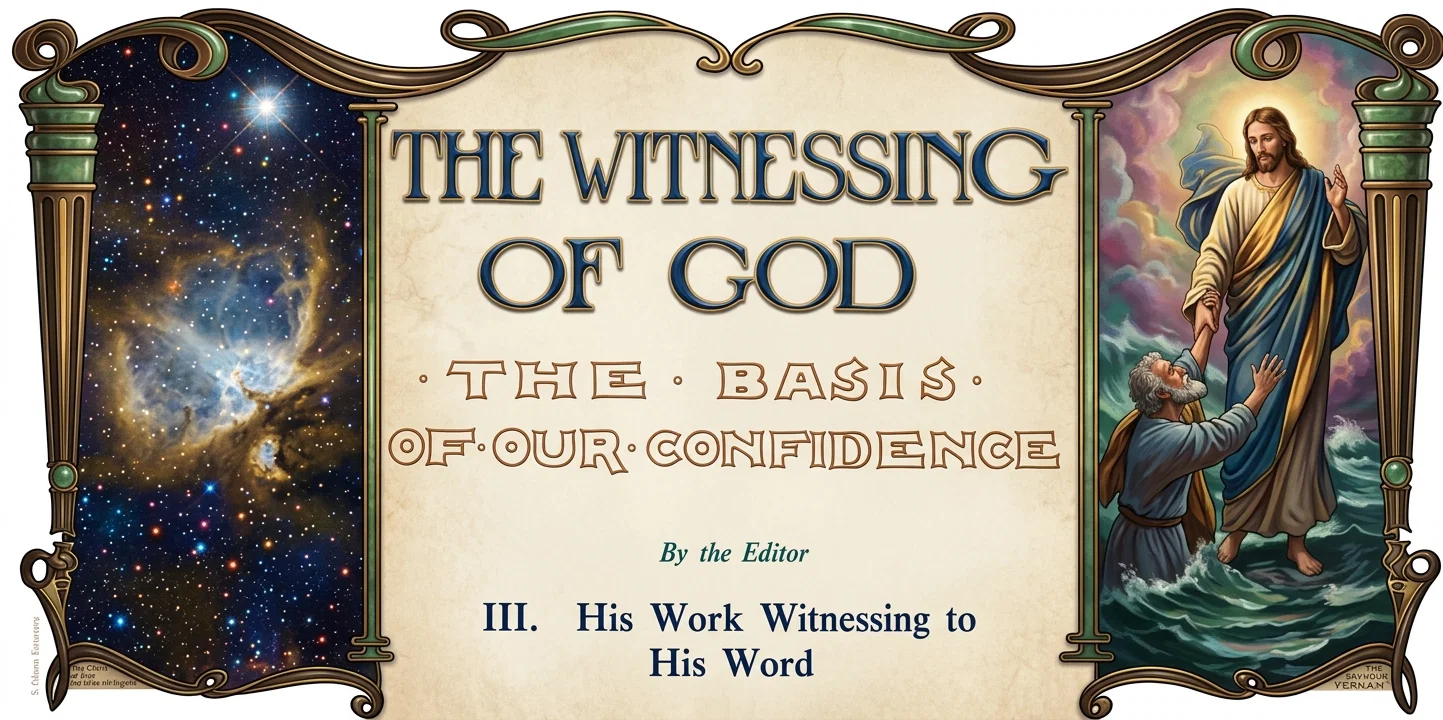
The Witnessing of God: The Basis of Our Confidence
By Editor
By the Editor
III. His Work Witnessing to His Word
The beautiful and instructive 19th Psalm opens with the mind-expanding and heart-stirring words: “The heavens declare the glory of God; and the firmament showeth His handiwork. Day unto day uttereth speech, and night unto night showeth knowledge. . . . Their line is gone out through all the earth, and their words to the end of the world.” All the heavens bear witness of the greatness and glory of God.
One of the sublimest passages of the Holy Scriptures is that which meets us at the very beginning, like an inscription on a noble archway, inviting the reverent, thoughtful mind to enter the unexplored regions of divine accomplishment:
“In the beginning God created the heavens and the earth.”
There is no apology with the statement, no modification of the direct thought that God created, that the earth and the heavens came into existence by His own inherent power. They are a witness of His word. It is the great, creative God to whom we are invited to give attention, who is the Author of the Book.
The mighty agency in this work is His Holy Spirit; for we read immediately, of the continued work of God upon the earth, that “the Spirit of God moved upon the face of the waters.”
Concerning the work of the Creation the psalmist sings: “By the word of Jehovah were the heavens made, and all the host of them by the breath of His mouth. . . . For He spake, and it was done; He commanded, and it stood fast.” Ps. 33: 6-9.
The old Idumean patriarch grasped the same living fact. “By His Spirit the heavens are garnished,” or adorned, beautified, made resplendent; and then the thought springs, Spirit-winged, to the greatness of God’s creation: “Lo, these are but the outskirts of His ways: and how small a whisper do we hear of Him! But the thunder of His power who can understand?” Job 26: 13, 14.
It is thus that God repeatedly sets Himself forth in His word as Creator, that the dying and despairing children of men may have hope in His power.
We are well aware that evolution has, in its hypotheses, set aside the story of the creative Word, and with it the basic power of the gospel—nay, more, the hypotheses of evolution accepted, the Bible as God’s word must go, and that which has been the hope of the helpless and of the despairing and the needy through all the centuries fails.
But God has met this attack upon His word by a witness to the Word in His works. In other words, the Spirit of might that moved upon the face of that primal deep, that brought cosmos out of chaos, also inspired and foretold facts concerning that creation utterly concealed from any knowledge that men possessed at that time, or subsequently, till the later days of Christianity.
The Planet Earth
Take, for instance, the belief held for so many centuries, that the earth was stationary in the universe, upheld by various fanciful things. To have said that it was a swiftly moving body in space, upheld or supported on its course without visible means, would have been counted not only error but heresy; yet the oldest book of the Bible had, nearly sixteen centuries before Christ, declared that God “hangeth the earth upon nothing.” Job 26: 7. But few dispute it now, and scientists feel that what was at first a hypothesis is now demonstrated; yet God told it long ago, and His inspired word testifies concurrently with His Spirit-wrought works, and the two witnesses are not collusive.
The Empty Place
Space is infinite. Think as broadly and as intensely and as persistently as we may, we can not comprehend infinity.6
Who can comprehend the distance even from the earth to the sun—92,800,000 miles? Prof. E. L. Larkin says: “No great minds before Galileo knew anything about even the rudimentary problems of space. They could not, because they had no telescope armed with instruments of precision.” The thinking star-students of that day did not dream, probably, that the tremendous sun Sirius, which like a flashing diamond burns in our southern sky, the brightest to us of all stars, was fifty-two trillion miles away. If we were to use the distance between the earth and our sun for our measuring-rod, we should have to lay it down 582,000 times. Astronomers estimate that the great suns Vega, Polaris (North Star), Arcturus, Aldebaran, are twice as far, at least; while others are ten, fifteen, or twenty times the distance; and should we stand on Arcturus and look onward with the same helps to penetrate space we now have, we would see as much beyond. Kopteyn estimates that light, traveling at the rate of 186,380 miles to the second, would require 60,000 years to plummet the star-depths; which is to say, we are lost in the immeasurable void. In this unsounded sea, “here and there only some projecting reef throws a star-gemmed point within touch of the astronomer’s sounding-line.” Charles Nordman, by a new method, Serviss tells us, has hooked such a crag, Delta Librae, and the length of the line is two quadrillion miles, about forty times the staggering distance to Sirius. All this is peopled space, and the infinite lies beyond.
Is the creation of God as infinite as space? Some have held that it is, others that the infinite abyss is not yet peopled. Job declares that God “stretcheth out the north over the empty place.” Just recently advanced astronomy has been finding out something about the north. The telescope has not yet penetrated to the space beyond. The eye of man at the great refractor tires after a little, and the vision becomes dim and uncertain. But the eye of the camera does not grow weary. The longer it steadily gazes into the star-depths of night, the more it sees, if there are stars to be seen. In the north a plate exposed for a certain time reveals a certain number of stars. The time is increased, and a few more are added; and this is repeated elsewhere in the heavens, but in the north a limit has been reached. The power of the telescopic camera and the time of the exposure have been increased, and no new point of light appears on the plate. The limit is reached; beyond is void space waiting for the creative power of God to fill it with marshaled armies of suns and planets.
“He Stretcheth Out the North Over the Empty Place”
How did Job know? He did not know, but God did know, and His Spirit that “garnished the heavens” spoke the word to the generation in which we live, that we might know that the God who foretells is the God who creates. The Holy Spirit confirms the text by declaring: “Lo, these are but the outskirts of His ways: and how small a whisper do we hear of Him! But the thunder of His power who can understand!” What must that mighty creation be, if those trillions of miles from the border line of the north are still but in the outskirts of His creation!
Here are the two concurring witnesses,— the works of God created in that far-off beginning, limited of necessity because infinite space can never be filled; and the Word coming centuries later, telling us, contrary to all human contemporary knowledge—when it was given—that this limit is reached in the north, that there are the outskirts of His ways, so far distant that the most powerful telephotography is required to reach it.
Centuries of ignorance have intervened since that Word was written. Man did not learn the truth of the inspired declaration concerning the creative fact till these days. The witness is complete. There can be no collusion between such witnesses. Their testimony is absolute.
[This topic will be continued in our next.]
A view in Cygnus taken at the big Yerkes Observatory. Each dot represents one of the mighty suns brought into the vision of the camera through the powerful telescope. We asked a reverent and world-known astronomer to give us some appropriate facts to place under this cut; and he said, “This illustrates one of the amazing structures of the universe, but the explanation is beyond astronomers.” Truly the heavens declare the glory of God, and the firmament does most profoundly show His handiwork.
Dome of the great Yerkes Observatory, showing the end of the telescope
A Line of Precious Texts
By Augusta Wolcott Heald
By Augusta Wolcott Heald
WAKING before dawn in a dark winter morning, these precious texts connected themselves in my mind, and impressed me strongly with their clearness and beauty:
The beginning: “In the beginning God created the heavens and the earth. And the earth was waste and void; and darkness was upon the face of the deep: and the Spirit of God moved upon the face of the waters.” Gen. 1: 1, 2.
Christ the agent in the work of creation: “In the beginning was the Word, and the Word was with God, and the Word was God. . . . All things were made through Him; and without Him was not anything made that hath been made.” John 1: 1, 2.
Christ upholds the universe: “All things have been created through Him, and unto Him; and He is before all things, and in Him all things consist [hold together].” Col. 1: 16, 17.
Christ manifest in the flesh: “And the Word became flesh, and dwelt among us (and we beheld His glory, glory as of the only-begotten from the Father), full of grace and truth.” John 1: 14.
Rejected by the world: “He was in the world, and the world was made through Him, and the world knew Him not. He came unto His own, and they that were His own received Him not. But as many as received Him, to them gave He the right to become children of God, even to them that believe on His name.” John 1: 10-12.
Christ prayed for His own: “Father, I desire that they also whom Thou hast given Me be with Me where I am, that they may behold My glory, which Thou hast given Me: for Thou lovedst Me before the foundation of the world.” John 17: 24.
The Saviour’s promise: “Let not your heart be troubled: believe in God, believe also in Me. In My Father’s house are many mansions; if it were not so, I would have told you; for I go to prepare a place for you. And if I go and prepare a place for you, I come again, and will receive you unto Myself; that where I am, there ye may be also.” John 14: 1-3.
Slain by cruel hands: “But ye denied the Holy and Righteous One, and asked for a murderer to be granted unto you, and killed the Prince of Life.” Acts 3: 14, 15.
The resurrection: “Whom God raised up, having loosed the pangs of death: because it was not possible that He should be holden of it.” Acts 2: 24.
The ascension: “And when He had said these things, as they were looking, He was taken up; and a cloud received Him out of their sight.” Acts 1: 9.
The promise of angels: “And while they were looking steadfastly into heaven as He went, behold two men stood by them in white apparel; who also said, Ye men of Galilee, why stand ye looking into heaven? this Jesus, who was received up from you into heaven, shall so come in like manner as ye behold Him going into heaven.” Acts 1: 10, 11.
The Saviour comes to receive His own: “The Lord Himself shall descend from heaven, with a shout, with the voice of the Archangel, and with the trump of God: and the dead in Christ shall rise first; then we that are alive, that are left, shall together with them be caught up in the clouds, to meet the Lord in the air: and so shall we ever be with the Lord. Wherefore comfort one another with these words.” 1 Thess. 4: 16, 17.
Windham, New Hampshire.
Controversy
By Haldane
MANY religious persons have a dread of controversy, and wish truth to be stated without reference to those who hold the opposite errors. Controversy and a bad spirit are, in their estimation, synonymous terms; and strenuously to oppose what is wrong, is considered as contrary to Christian meekness. Those who hold this opinion, seem to overlook what every page of the New Testament lays before us. In all the history of our Lord Jesus Christ, we never find Him out of controversy. From the moment He entered on the discharge of His office in the synagog of Nazareth, until He expired on the cross, it was an uninterrupted scene of controversy. . . . His censures were not confined to doctrines, but included the abetters of false principles themselves.
And as to the apostles, their epistles are generally controversial. Most of them were directly written for the express purpose of vindicating truth and opposing error, and the authors of heresies do not escape with an abstract condemnation of their false doctrine. Paul again and again most indignantly denounces the conduct of opposers of the gospel, and by name points out those against whom he cautions his brethren. When Hymenæus and Alexander erred concerning the faith, and when he delivered them to Satan, that they might learn not to blaspheme, he did not compliment them as amiable and learned persons. Even the apostle who treats most of love, and who possessed so much of that spirit which was eminently manifested in the divine Master, does not avoid controversy; nor in controversy does he study to avoid severity of censure on the opposers of the truth.
In the examples of opposing error left on record for our imitation, we perceive nothing of that frigid spirit of indifference which smiles on the corrupters of the word of God, and shuns to call heresy by its proper name.
With what holy indignation do the apostles denounce the subtle machinations of the enemies of the gospel! In vain shall we look among those faithful servants of the Lord for anything to justify that trembling reserve which fears to say decidedly that truth is truth, or that error is error. In what style, indeed, should perversions of the truth of God be censured? Ought they to be treated as mere matters of opinion, on which we may innocently and safely differ? Or ought they to be met in a tone of solemn, strong, and decided disapprobation? Paul warned Christians against men who arose from among themselves, “speaking perverse things, to draw away disciples after them,” and instead of complimenting false teachers in his day, denounced an angel from heaven on the supposition of his preaching another gospel. And if an apostle was withstood to the face when he was to be blamed, are the writings of those who subvert the gospel to be passed without rebuke?
While a spirit of indifference to truth is advancing under the mask of charity and liberality, there is a loud call on all Christians to “stand fast in one spirit, with one mind striving together for the faith of the gospel;” to present a firm and united phalanx of opposition to error, and under every name, from whatever quarter it may approach; and not to “stumble in their ways from the ancient paths, to walk in paths, in a way not cast up; to make their land desolate.” Jer. 18: 15, 16. “Thus saith the Lord, Stand ye in the ways, and see, and ask for the old paths, where is the good way, and walk therein, and ye shall find rest for your souls.” Should believers become unfaithful to their trust, and be seduced to abandon their protest against false doctrines, they may gain the approbation of the world; but what will this avail when compared with the favor of God? But if with prayer to God, in the use of the appointed means, they contend earnestly for the truth, then they may expect the gracious fulfilment of that blessed promise, “When the enemy shall come in like a flood, the Spirit of the Lord shall lift up a standard against him.”—Haldane.
The Two Resurrections
1. What promise has been given to man in order that he may be redeemed from death?
“I will ransom them from the power of the grave; I will redeem them from death: O death, I will be thy plagues; O grave, I will be thy destruction: repentance shall be hid from Mine eyes.” Hosea 13:14.
2. Through whom will be given this redemption from the grave?
“For since by man came death, by man came also the resurrection of the dead. . . . But every man in his own order: Christ the first-fruits; afterward they that are Christ’s at His coming.” 1 Cor. 15:21, 23.
3. At the command of whose voice will the dead come forth?
“For if we believe that Jesus died and rose again, even so them also which sleep in Jesus will God bring with Him. For this we say unto you by the word of the Lord, that we which are alive and remain unto the coming of the Lord shall not prevent them which are asleep. For the Lord Himself shall descend from heaven with a shout, with the voice of the Archangel, and with the trump of God: and the dead in Christ shall rise first.” 1 Thess. 4:14–16.
4. Are the wicked as well as the righteous raised from the dead?
“Marvel not at this: for the hour is coming, in the which all that are in the graves shall hear His voice, and shall come forth.” John 5:28, 29.
“I . . . have hope toward God, which they themselves also allow, that there shall be a resurrection of the dead, both of the just and unjust.” Acts 24:14, 15.
5. Is the resurrection of the righteous called by a different name from the resurrection of the wicked?
“Marvel not at this: for the hour is coming, in the which all that are in the graves shall hear His voice, and shall come forth; they that have done good, unto the resurrection of life; and they that have done evil, unto the resurrection of damnation.” John 5:28, 29.
6. What is the resurrection of the righteous called?
“And they lived and reigned with Christ a thousand years. But the rest of the dead lived not again until the thousand years were finished. This is the first resurrection. Blessed and holy is he that hath part in the first resurrection: on such the second death hath no power.” Rev. 20:4–6.
NOTE.—The expression “the first resurrection” would clearly indicate a second. Then we have the text which plainly states that there is a resurrection of “the just,” also a resurrection of “the unjust,” that there is a resurrection of “life,” and a resurrection of “damnation.” The evidence is conclusive that the wicked will, together with the righteous, be resurrected at the coming of Christ.
The Lord’s Day
By F. D. Starr
BECAUSE the term “Lord” in Rev. 1: 10, as it occurs in the original, has a different ending from that which it has in any other text of the New Testament, some have argued that an entirely new institution is here introduced. The expression in Greek, in this instance, for “Lord’s day,” is kuriake hemera; and because of the peculiar ending of the word kuriake, “Lord’s,” it is claimed it must refer to a new Lord’s day, “the lordly day,” as some would put it.
But what proves too much, proves nothing at all. This same reasoning would lead us to conclude that in Rev. 9: 11 we have a new Greek language introduced, seeing the word “Greek” as found in this verse ends in a different manner from what it does in any other passage where it is used in the New Testament. The word is Hellenike, ending, as will be seen, in the same way as kuriake. Both are peculiar; but if the use of the one implies the introduction of a new institution, then the use of the other also implies a new institution. But no one would claim that the construction in Rev. 9: 11 calls for a new language; and the claim that the same condition in Rev. 1: 10 calls for a new Lord’s day is just as fully without foundation.
F. D. STARR.
The Golden Number
THE golden number in the almanac is the number which indicates the place of a year in the Metonic cycle. Meton, a Greek astronomer, about 400 years before Christ, found that 235 lunar months almost exactly equal 19 years of 365¼ days each, the duration of a year as measured by the apparent motion of the sun. This 19-year period is the Metonic cycle, in which the phases of the moon are always the same for years occupying the same place in the cycle. This place is called the golden number; and by its aid, through a complicated system of computation, the date of the paschal moon, which determines Easter, can be calculated for any number of years ahead. The golden number for any year is the remainder obtained by dividing the number of the year plus 1 by 19. The unit is added because the ecclesiastical calendar reckons the cycles from 1 B.C.—Christian Herald.
Definite Purpose in Spare Hours
“BIND together your spare hours by the cord of some definite purpose, and you know not how much you may accomplish.”
The Blue and the Gray
By Francis Miles Finch
By Francis Miles Finch
By the flow of the inland river,
Whence the fleets of iron have fled,
Where the blades of the grave-grass quiver,
Asleep are the ranks of the dead:
Under the sod and the dew,
Waiting the judgment-day;
Under the one, the Blue,
Under the other, the Gray.9
Those in the robings of glory,
Those in the gloom of defeat,
All with the battle-blood gory,
In the dusk of eternity meet:
Under the sod and the dew,
Waiting the judgment-day;
Under the laurel, the Blue,
Under the willow, the Gray.
From the silence of sorrowful hours
The desolate mourners go,
Lovingly laden with flowers
Alike for the friend and the foe:
Under the sod and the dew,
Waiting the judgment-day;
Under the roses, the Blue,
Under the lilies, the Gray.
So with an equal splendor,
The morning sun-rays fall,
With a touch impartially tender,
On the blossoms blooming for all:
Under the sod and the dew,
Waiting the judgment-day;
Broidered with gold, the Blue,
Mellowed with gold, the Gray.
So, when the summer calleth
On forest and field of grain,
With an equal murmur falleth
The cooling drip of the rain:
Under the sod and the dew,
Waiting the judgment-day;
Wet with the rain, the Blue,
Wet with the rain, the Gray.
Sadly, but not with upbraiding,
The generous deed was done;
In the storm of the years that are fading,
No braver battle was won:
Under the sod and the dew,
Waiting the judgment-day;
Under the blossoms, the Blue,
Under the garlands, the Gray.
No more shall the war-cry sever,
Or the winding rivers be red;
Our anger is banished forever
When are laureled the graves of our dead:
Under the sod and the dew,
Waiting the judgment-day;
Love and tears for the Blue,
Tears and love for the Gray.
— Selected.
Memorial Day and Its Significance
By T.
We are now about a half century away from the struggle that engaged this nation over the question of slavery, and as to whether there should be two nations within the confines of the United States, rather than one. The lapse of time has taken out much of the rancor that was in the hearts of men on both sides of the contest, so that the issue can be discussed coolly and with fair-mindedness, both North and South. We have passed the time when the men in the North go out of their way to say hateful things about the men of the South, and when the men of the South would seek to defend themselves by making equally uncomplimentary remarks concerning those in the North.
We are all agreed that it was an awful war. A civil war that divides a nation is the worst thing into which the war gods can plunge humanity. Those that are bound by the dearest ties of either friendship or nature are broken up into opposing camps, seeking with all their might to kill each other. War is always cruel, but this kind of war is the cruelest of all.
The strife in that time had for its great center the question of property. This nation had permitted slavery to grow up within its borders, and thousands of men had come to own some of their less fortunate fellow creatures the same as they owned their cattle and horses, and worked them upon much the same plan.
Of course there were other questions involved in the strife, but it is doubtful if war had ever been declared but for the slavery problem. Lincoln and those associated with him in the North had no property interest in the matter, and saw with perfect clearness that it was wrong for one man to own another. They saw just as perfectly that the question, if permitted to go much farther, would eventually split the nation. As Lincoln expressed it, we could not have a country half slave and half free. It would soon be one or the other.
Supplied by Underwood & Underwood, N. Y.
The men in the South, however, had personal property interests involved in the contest. No matter whether it was right or wrong, the nation had permitted them to acquire and own slaves. In many instances their wealth consisted largely in the slaves that they owned; for if they had not had the slaves with which to till their soil, or to do the work that they had in hand, they would have been broken up in business. So it was a question of property right and justice with them, as the matter was viewed from their standpoint. They entered into the struggle bravely and heroically. They were the same class of vigorous, strong men that made up the armies of the North, and the struggle was a fearful and bitter one.
But we should all be thankful that it has been settled with the nation still a unity, and with the feeling of rancor so completely dying out that even in the southland itself, where the awful blight of the war was felt the worst, they are erecting monuments to both the Blue and the Gray, as is noted in the illustration on this page. It is a grand thing that the nation can again come together, and not only as citizens but as brothers, in the great commonwealth, can march side by side in the pursuits of peace.
We would that it could always remain so amicable, and that these pacific sentiments might become stronger and stronger. But there are other questions coming up now in the nation, that involve some of the same principles that caused the Civil War; and in the difficulty that confronts us, it will not be the North engaged against the South. These strifes will be interwoven into almost every community throughout the nation, so that each neighborhood will become the battle-ground of the discontented masses.
In that time, as already noted, the question of property was the one that was the center of the9controversy. In the conflicts that are now looming up, property is again the question. In that time, the men who had property interests, it must be agreed by us all, were often blinded by their possessions, so that they could not see the real principles that were at stake. In these times, we have other property interests that are causing mighty rumblings of revolution all through the nation. Men of colossal wealth have organized and are in control. Men of strong intellect and determination are organizing the forces of labor. They are in a deadly combat over this question of property.
Can we not learn a lesson from the Civil War period? There was a generation of discussion, of platform speaking, of the creating of sentiment, and then the mighty Civil War in this nation broke out, with all of its bloodshed and sufferings. We have had another generation of discussions. Through the press and on the platform, sentiment is being formed; it is becoming intense. Who can not see that we are even now in the very border-lands of the time when violent revolutions must break out! And when the thing becomes general, it will not be one side of the nation carrying war into another side, but neighborhoods will be divided among themselves in the grip of this deadly strife.
This is no visionary picture. This is no wail of a pessimist. It is simply the statement of the sober conditions as they are confronting us. We ought to learn lessons from the past, and seek to avert these calamities before they become unmanageable. But seeing that the nation as a whole will not learn the lesson, individuals should study to know the meaning of it, and should stand on the safe ground that has always been provided by divine Providence for men who will seek it. T.
The Knot of Blue and Gray
Author Unknown
Upon my bosom lies
A knot of blue and gray;
You ask me why? Tears fill my eyes
As low to you I say:
I had two brothers once,
Warm-hearted, bold, and gay;
They left my side; one wore the blue.
The other wore the gray.
One rode with Stonewall and his men,
And joined his fate to Lee;
The other followed Sherman's march
Triumphant to the sea.
Both fought for what they deemed the right,
And died with sword in hand;
One sleeps beneath Virginia's hills,
And one in Georgia's sands.
The same sun shines upon their graves;
My love unchanged must stay;
And so upon my bosom lies
A knot of blue and gray.