“But all things when they are reproved are made manifest by the light: for everything that is made manifest is light.” Verse 13. Note 1.
2. What exhortation does the apostle give in view of this?
“Wherefore He saith, Awake, thou that sleepest, and arise from the dead, and Christ shall shine upon thee.” Verse 14.
3. What pertinent admonition is given in view of this?
“Look therefore carefully how ye walk, not as unwise, but as wise; redeeming the time, because the days are evil. Wherefore be ye not foolish, but understand what the will of the Lord is.” Verses 15-17. Note 2.
4. What is to take the place of the drunkenness and riot of sin?
“And be not drunken with wine, wherein is riot, but be filled with the Spirit.” Verse 18. Note 3.
5. How will the Spirit-filled life be manifested?
“Speaking one to another in psalms and hymns and spiritual songs, singing and making melody with your heart to the Lord.” Verse 19. Note 4.
6. How will God and each other be regarded?
“Giving thanks always for all things in the name of our Lord Jesus Christ to God, even the Father; subjecting yourselves one to another in the fear of Christ.” Verses 20, 21. Note 5.
Note and Comment
1. “Manifest by light.”—The Common Version has a good thought,—“Whatsoever doth make manifest is light;” that is, it is light which reveals, and anything whatsoever which does reveal the sin is light. Men have learned, in these days of scientific research, that light is not always visible. There are some kinds of rays which can not be seen by the naked eye, but these very rays which the naked eye can not see are themselves marvelously useful in revealing things which men wish to know. Take, for instance, the X-ray, or the Röntgen ray, by which the bones of the body may be revealed. What a wonderful help has it been in science! Man can not with the naked eye discern these rays of light, but the rays of light can be so used as to make manifest to men things which the naked eye can not see. This is but an illustration of the various and many ways which God has of making manifest the good and the evil. The things which are convicted are made manifest by the light; and when these things are revealed, they themselves, of course, are made light, when we understand what they are, and see clearly through them. But it is the light which should be cherished. “Thy word is a lamp unto my feet, and a light unto my path,” says the psalmist. Of Jesus Christ, the One who gives the Word, we read that He is the Light of the world. And so God’s word cherished in our heart through Him will reveal sin in us, will cleanse the sin, will make His children what He desires them to be, the light of the world, revealing the world’s sin and the world’s deformities and the world’s failures and mistakes, and revealing also the clear, strong, righteous way in which God’s children should walk.
2. “Look carefully.”—Look circumspectly, look all around, let the feet walk in the plain path, understand and know the way in which you are walking,—not foolishly blundering into the pitfalls of the enemy, but wisely walking in the ways of God. “Redeeming the time,”—very much better, “buying up the opportunity.” The expression is used sometimes of redeeming the days that are past and gone. We can not do that. “Time” is not used in this text in the sense of duration. It is used in the sense of opportunity,—this time, the NOW. The world has a thousand things for us to do in this time. The devil will place there a thousand more, if possible; and it means sacrifice of many things, many times, in order to improve the now for God. It means sometimes selling the farm, and sometimes getting rid of our business, and sometimes giving up this party of pleasure, or that supper, or one of the many things which God calls upon His children to sacrifice. Above all things, it means giving self. Living a Christian means paying the price, means fellowship with the sufferings of the Lord; but the sacrifice of these things in the Christian life enables us to buy the opportunity of work for God. There are thousands who are dying spiritually, falling back on the lowlands of unbelief and doubt and sin, who, if they would but yield all that they have to the Lord Jesus, and seize the now for work for Him, would find all the blessings which are assured in this our lesson. The days are evil. Let us buy up the opportunity, that we may meet the evil of the days,—buying up the opportunity because the days are evil. It is foolish not to do it; wherefore be not foolish. It is wise to do it; therefore understand what the will of the Lord is, and do that will at any cost.
3. “Be not drunken.”—The world is; drunken sometimes with wine, drunken with pleasure, drunken with lust, drunken with all the various intoxicants that men and demons can brew, and out of all these comes riot, comes dissolution of character, comes destruction. Do not yield to these things. The religious may be drunken with the wine of Babylon. There is a better thing to be filled with, and that is the Spirit. Be filled with the Spirit. God waits to pour out His Spirit into the heart that wishes to receive it. See how simple it is! Read Luke the 11th chapter, verses 9-13. “Ask,” He tells us, “and it shall be given you; seek, and ye shall find; knock, and it shall be opened unto you.” For every one that truly asks, receives; and the man who truly seeks, finds; and the one that persistently knocks, will find the door opening at last. And then think of the figure which our Lord uses: Will a hungry son ask bread of a father, and get a stone? Will he ask for a fish—a common article of food at the time—and find the father offering him a serpent? Will he ask for an egg, and find a scorpion that is coiled in the form of an egg? No true father would deceive his son, or tantalize him. No more will the heavenly Father. “If ye then, being evil, know how to give good gifts unto your children: how much more shall your heavenly Father give the Holy Spirit to them that ask Him?” Be filled with the Spirit. We do not know what joy we are missing when we attempt to satisfy our souls on the wretched, barren husks of this world. We do not know of the joy that would come to us if we were willing to lay them all down at the Master’s feet forever, and receive of Him the better, blessed things that would grow better with the use, never pall upon the appetite, and bring eternal life at last.
4. “Speaking one to another”—the fruitage of the Spirit. How rich the Scriptures would be in such cases as that, for there is direct reference to the psalms of the Bible in this expression which the apostle uses, the “psalms,” and the “hymns,” and the “spiritual songs.” Our hearts would be filled with the life of them, and we would talk them and sing them to others. And whether we could sing one single correct note or not, vocally, we would make melody in our hearts to the Lord.
5. “Giving thanks.”—Receiving such blessings from God, our souls will be filled with thanksgiving. Day by day we would prove Him until we would be willing to give thanks always; and the very disappointing things to the natural heart should come to us, we would give thanks for these also, because He would make these work for our good. And so always for all things would we give thanks in the name of our Lord Jesus Christ. And we would the more willingly work in harmony with others who were like-minded, subjecting or submitting ourselves one to another in the fear of God. And thus working together would the church be built up.
Author Unknown
Good-By
Author Unknown
Good-by! Good-by! It is the sweetest blessing
That falls from mortal lips on mortal ear,—
The weakness of our human love confessing,
The promise that a love more strong is near—
May God be with you!
Why do we say it when the tears are starting?
Why must a word so sweet bring only pain?
Our love seems all-sufficient till the parting,
And then we feel it impotent and vain—
May God be with you!
O, may He guide and bless and keep you ever—
He who is so strong to battle with your foes!
Whoever fails, His love can fail you never;
And all your needs He in His wisdom knows.
May God be with you!
Better than earthly presence, e'en the dearest,
Is the greatest blessing that our partings bring;
For in the loneliest moments God is nearest,
And from our sorrows heavenly comforts spring—
May God be with you!
Good-by! Good-by! With latest breath we say it,
A legacy of hope, and faith, and love.
Parting must come, we can not long delay it;
But, one in Him, we hope to meet above,
If God be with us!
Good-by—'tis all we have for another.
Our love, more strong than death, is helpless still;
For none can take the burden from his brother,
Or shield, except by prayer, from any ill.
May God be with you!
Does It Indicate Peace?
By T.
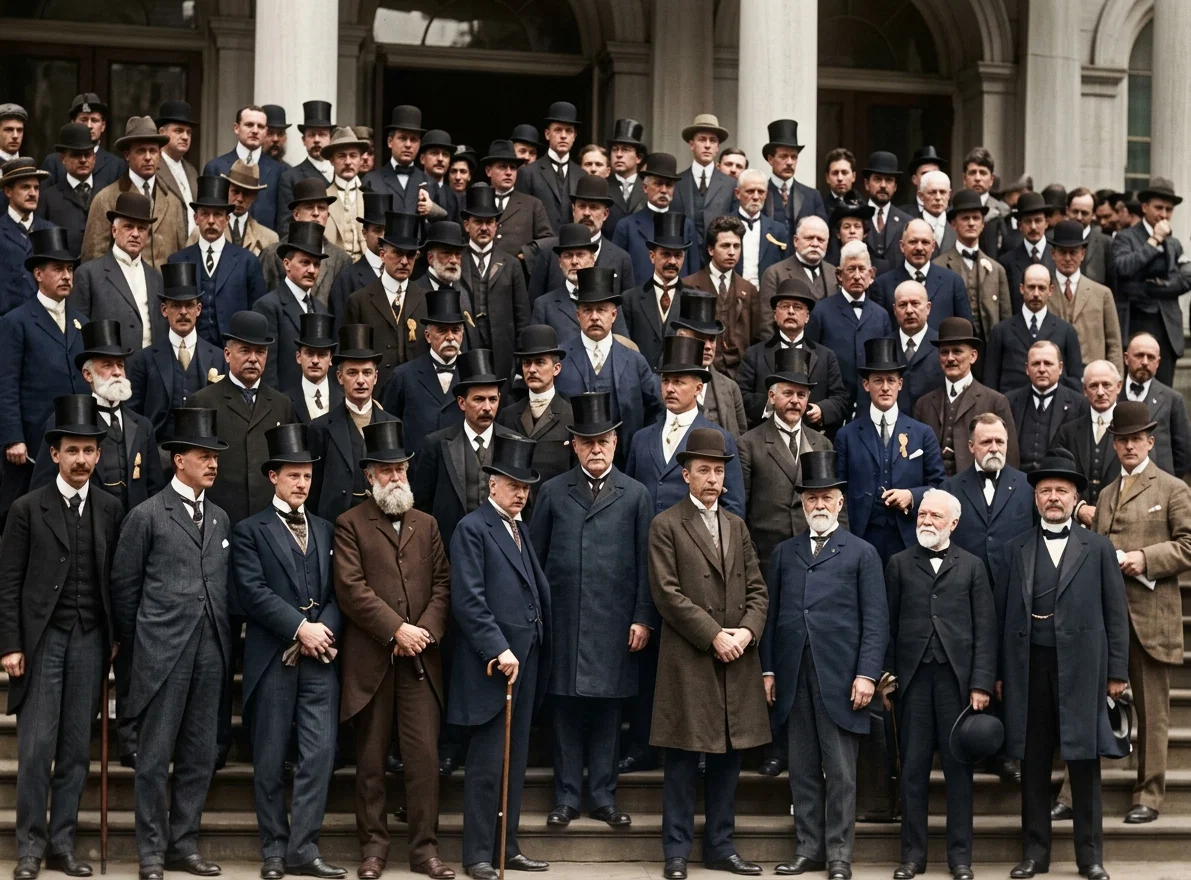
Copyright by Underwood & Underwood, N. Y. Representatives of Great Britain, Belgium, Canada, Australia, and the United States met in New York City Hall, May 5, to arrange a program for celebrating the 100th anniversary of the signing of the Treaty of Ghent, which brought the war of 1812 to an end. Mayor Gaynor, of New York, is the central figure of the front row; and on his right, with cane in hand, is Lord Weardale, of Great Britain. Mr. Carnegie is at the right of the front row, with uncovered head.
On this page we have a photograph of leading members who attended the Peace Congress in New York. Another Peace Congress was in session in St. Louis at about the same time. There are something over a hundred individual peace organizations in the various countries of the world. In these organizations are many individuals whose names are known the world around. They are working energetically and ardently for peace. They are very enthusiastic in their claims that they will yet bring this world to enjoy complete immunity from war.
This is certainly a splendid dream; but where is there any evidence that such a condition of things may ever be brought about?
The world to-day is just as it has ever been since the introduction of sin upon this planet. Men are resentful, they are ambitious, and they are covetous; and while there is much very beautiful talk in regard to the brotherhood of man, yet the great majority of men stand ready to shed blood. We have our mobs and our general rioting everywhere, which show the great discontent that is in the world. The nations are arming to the very limit. They claim, of course, it is for the purpose of maintaining peace; but why the necessity of arming so strongly if there is such a growing sentiment in favor of peace? You do not find the farmers in any community where they are peaceably abiding together exhausting all of their resources in buying the latest rifles and other instruments of destruction in order to keep their neighbors from declaring war upon them. They have no thought of getting into trouble with each other, and they can spend their means for improvements and necessities on the farm and in the home, rather than upon implements of destruction. But where these peaceful sentiments do not exist you might find men arming.
But there is a spirit among the nations that is very different from the spirit of peace; and while there is this spirit of war in the world, yet there are also these great peace societies, and the splendid hopes expressed by the men and women who believe that they are going to put an end to war by peaceable means.
Paul, in his letter to the Thessalonians, says:
“But of the times and the seasons, brethren, ye have no need that I write unto you. For yourselves know perfectly that the day of the Lord so cometh as a thief in the night. For when they shall say, Peace and safety; then sudden destruction cometh upon them, as travail upon a woman with child; and they shall not escape. But ye, brethren, are not in darkness, that that day should overtake you as a thief. Ye are all the children of light, and the children of the day: we are not of the night, nor of darkness.” 1 Thess. 5:1-5.
It will be noted, in the foregoing text, that it plainly says that the day of the Lord will come as a thief upon a certain class. The text says just as plainly that the “brethren”—that is, those who are following the teaching of the word of God—are not in darkness, and therefore that day will not overtake them as a thief; but those who are overtaken as a thief are saying “Peace and safety” when there is no evidence of peace, because right in the midst of the peace-and-safety cry “sudden destruction” shall burst upon them. This scripture is so plain as to need no further comment.
Another scripture from the prophet Isaiah is very much to the point, and is as follows:
“And it shall come to pass in the last days, that the mountain of the Lord’s house shall be established in the top of the mountains, and shall be exalted above the hills; and all nations shall flow unto it. And many people shall go and say, Come ye, and let us go up to the mountain of the Lord, to the house of the God of Jacob; and He will teach us of His ways, and we will walk in His paths: for out of Zion shall go forth the law, and the word of the Lord from Jerusalem. And He shall judge among the nations, and shall rebuke many people; and they shall beat their swords into plowshares, and their spears into pruning-hooks: nation shall not lift up sword against nation, neither shall they learn war any more. O house of Jacob, come ye, and let us walk in the light of the Lord. Therefore Thou hast forsaken Thy people the house of Jacob, because they be replenished from the East, and are soothsayers like the Philistines, and they please themselves in the children of strangers. Their land also is full of silver and gold, neither is there any end of their treasures; their land is also full of horses, neither is there any end of their chariots: their land also is full of idols; they worship the work of their own hands, that which their own fingers have made; and the mean man boweth down, and the great man humbleth himself; therefore forgive them not. Enter into the rock, and hide thee in the dust, for fear of the Lord, and for the glory of His majesty.” “And they shall go into the holes of the rocks, and into the caves of the earth, for fear of the Lord, and for the glory of His majesty, when He ariseth to shake terribly the earth. In that day a man shall cast his idols of silver, and his idols of gold, which they made each one for himself to worship, to the moles and to the bats; to go into the clefts of the rocks, and into the tops of the ragged rocks, for fear of the Lord, and for the glory of His majesty, when He ariseth to shake terribly the earth. Cease ye from man, whose breath is in his nostrils: for wherein is he to be accounted of?” Isa. 2:2-10, 19-22.
This text is talking of a time when the Lord is about to arise to shake terribly the earth. In that time the land will be full of silver and of gold. There will be no end to the treasure; and when the climax is reached, the men who have trusted in their gold and silver will be found casting it to the moles and to the bats, as they “go into the clefts of the rocks, and into the tops of the ragged rocks, for fear of the Lord, and for the glory of His majesty.” One of the conditions that precedes this climax is plainly stated,—“Many people shall go and say, Come ye, and let us go up to the mountain of the Lord.” They will affirm that “out of Zion shall go forth the law,” and that the Lord will judge among the nations, and will rebuke many people. Further, they will say that they will “beat their swords into plowshares, and their spears into pruning-hooks,” and that “nation shall not lift up sword against nation, neither shall they learn war any more.”
A great many people have read that text of Scripture, and have thought, from their superficial reading, that it taught the peace of the world, and that nations were not to learn war any more; but observe that the text is talking about something that “shall come to pass in the last days,” and it is telling what many people will be saying, and all that the Lord Himself has to do with it is to foretell it, and to tell what it portends. When the Lord comes to describe the condition, He says that these people are soothsayers, that they are pleasing11themselves in the children of strangers, and that the mean man, or the man of low degree, and the great man, are alike humbling themselves. They are making a hypocritical profession of great things, but at heart they are going on to do the wickedness that is in their perverted nature. And because of this the text says, “Therefore forgive them not.”
This scripture is so plain that any one ought to see, from the simple reading of it, that it is telling the story of what the people would be claiming in the last days, and that their claim is exactly opposite to the real facts.
Now is it not remarkable that we are living in a time of the most awful preparation for war that this world has ever seen? And yet at the same time talking about world peace was never so much in style. The style of talk with a large number of people is that we are approaching world-wide peace. The facts show that we are approaching world-wide war. Armageddon, as predicted in the prophecies, lies just before us. God has pictured it all out in His word. These inconsistencies in humanity have been declared by the prophets, and we who live in this time should make no mistake. We should understand the truth.
There is truly a world-wide peace coming, but it will not be the manufactured peace of humanity. Peace is the desirable thing. The Christ of the Bible declares Himself to be the Prince of Peace, and He will soon establish peace on earth; but it will be at His second coming, and it will be upon the destruction of everything that is wrong, unjust, and oppressive.
These man-made methods of securing peace are nothing more than the counterfeit of the most glorious peace that has ever been offered. Each individual is now making his choice. All will soon be ranged on one side or the other. Some will accept the immortal peace that is offered by the Prince Immanuel. Others will follow a plan of their own choosing, and will find, as has been pointed out so truly in the Scriptures of truth, that in the place of securing peace, they have plunged headlong into the war vortex of Armageddon.
These are times when men should study God’s word, for God’s word discloses the actual facts of truth. It is an individual question, which can not be decided by great crowds of men, no matter how ardent or vehement they may be in their propaganda. It is better to be right than to be popular. Those who are in the right, even tho they may be in a hopeless minority now, will soon be united, at the coming of Christ, with the innumerable throngs that inhabit the universe of God; and then they will stand with the overwhelming and all-powerful majority. T.
War Tensions and Naval Expansion
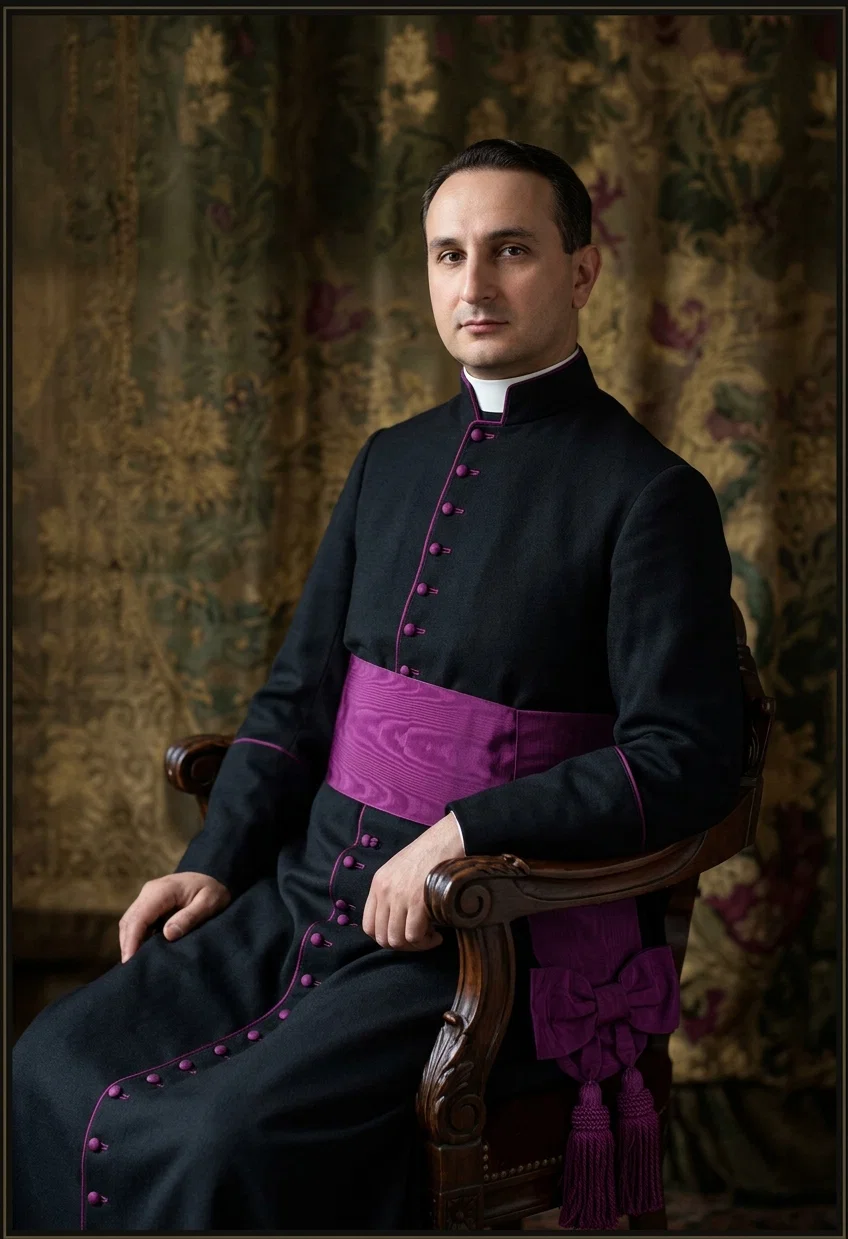
Mgr. Misuraca, the newly appointed secretary of the papal legation at Washington, D. C.
Harris & Ewing, Washington, D. C.
The talk of war between this country and Japan seems to be subsiding a little. The courageous work of President Wilson and Secretary Bryan apparently has been effective. It would appear also, from all of the facts that can be gleaned from authentic reports, that Governor Johnson of California has been maintaining a very considerate and careful course. He seems to realize the danger to which he would expose his state if the nation were plunged into war with Japan. California, of all the states of the Union, needs to be careful to maintain a strong relation with our central government; for if war should begin between this nation and any other strong naval power, such as Japan is, it would mean the destruction of an immense amount of life and property on this coast. And at any rate, in these times of such tremendously destructive weapons, a nation should think a long time before it drives ahead on a course that will plunge it into war. But the despatches say that our naval board is taking advantage of this flurry to urge again very strongly the rapid increase of our navy. The largest battle-ships under way at the present time are round about 30,000 tons in displacement, but the proposition is made that this nation shall build battle-ships of 40,000 tons displacement. The largest battle-ship of fifteen years ago was in the neighborhood of 10,000 tons. Now they are building them with a three times greater displacement, and then there is the added proposition to make them four times greater. And when it comes to their destructive possibilities, they are almost beyond comparison. The guns are of greater range and power, the marksmanship is far more accurate, and the rapidity of fire is from eight to ten times greater. In recent target practice on this coast, one of the batteries scored 100 per cent of hits. The seven shots were fired at a distance of about six miles, and all within four minutes of time.
San Diego’s 1915 Exposition
San Diego, California, is seeking not to be outdone in the exposition line. She is planning for a large international exhibit in 1915, at the same time that the Panama Exposition is in progress in San Francisco. San Diego lays claim, however, to a very unique feature. Expositions have, in the main, confined themselves to exhibiting the finished products of manufacture and commerce, but San Diego is working on the plan of exhibiting the actual process of manufacture of all these things. She will encourage the manufacturers and producers of all sorts of wares and commodities to equip themselves for making those things right on the ground, so that the visitor to the exposition will be able to see all of this work in process, as well as to see the finished product itself. San Diego has a very unique and widely advertised climate, and we have no doubt that many people, having visited the Panama-Pacific Exposition, will also avail themselves of the opportunity of seeing this other exposition in the southern part of the state. The promoters of the enterprise are asking Congress to appropriate a million dollars to help it along. San Diego itself is raising immense sums for the purpose.
Karl Hagenbeck Dies in Hamburg
Karl Hagenbeck, the world-renowned collector of wild animals, and trainer and educator of the same, died in Hamburg, Germany, on April 14. His death is said to have been due to the slow-working poison of a snake bite that he received seven years previous.
Earthquake in Northern New York
A severe earthquake shock was felt throughout Northern New York on April 30.
Roman Catholics and Education
The Western Watchman of April 10, replying to an inquiry regarding a division of public school funds, takes occasion to say:
“We have no interest in the Protestant Bible. We have no interest in the Protestant religion. We have no interest in anything Protestant. Educated Catholics do not think that Protestantism is better than no religion at all, any more than they think a false multiplication table and a false table of logarithms is better than none at all. Catholics do not want either Catholicism or Protestantism in the public schools. The denominational system, in doing justice to the Catholics, wrongs all Protestants. If the state is to conduct a system of public education, it must be either Catholic or secular. In this country it can not be Catholic; therefore it must be secular.”
What the editor demands is this, that if the religious schools do as good secular work as the state schools, they ought to receive the same financial support as the schools of the state, and that other religious schools, if they taught the same things and taught them as well as the state schools, ought to receive support also. But they want this understood, that—
“Catholics will not enter into any agreement to secure similar treatment for Protestant schools. We do not place Protestant schools on the same footing with Catholic schools; but we place Protestant and Catholic citizens on a basis of civil equality, and what the state should do in paying for the secular education imparted in Catholic schools, it should do for any schools having the same claims for recognition, Protestant, Jewish, Buddhist, or so-called Modern. We do not want our secular schools made religious; but we want our Catholic schools recognized as secular in all things in which they are secular.”
That would probably mean the entire support of Catholic schools in which it would be contended that a good secular education was given and the Catholic religion taught free; but the state can not do this, and the only logical education that the state can give is secular education. Yet after all, the only true education that can be given is religious education. Roman Catholics are right in the principle, but the state can never yield to the demand for religious education, or the support of religious schools, without departing from the very fundamentals of freedom. The quotations above, however, show clearly just how the Western Watchman regards Protestants.
King Nicholas Yields Scutari
King Nicholas has yielded Scutari to the powers. Thus he has finally succumbed to the pressure brought to bear upon him by the nations of Europe.