ABUNDANT evidence is given us of the love of Jesus. Every recorded act of His life is a revelation of that infinite love for straying, lost men and women. Then to crown it all, leaving an everlasting pledge of that mighty love, Calvary’s cross was erected. To doubt that love, to neglect to accept that love, to turn away from that love so freely given, so lovingly placed within the reach of every soul, certainly must constitute the highest insult that can be given Heaven.
Reader, have you responded to this blessed love, so freely and abundantly placed within your reach? T. E. BOWEN.
A Protestant Persecuting Power
By A. R. Bell
It Forms an Image to the Papal Beast — Organizations That Are Now Fulfilling the Prophecy — Some Even Advocate Hanging Sabbath Breakers
By A. R. BELL.
This is the third of A. R. Bell’s articles on that portion of the book of Revelation which forecasts the religious despotism to arise just before the second coming of Christ.
Last week, he gave the first of three articles on the thirteenth of Revelation. He referred to the papal supremacy during the Dark Ages as foretold in the first part of that chapter. He showed how the papal power received its “death stroke.” Then he presented the prophecy that shows “another beast” coming up, which is to form an “image” to the papal beast. The “image” could not be the beast itself, and the one great power left to form such an image is the mighty organization of Protestantism itself. The great Protestant power of the United States, as he shows in this week’s article, is to become a persecutor.
Some of the things that leading Protestants are saying to-day are very striking in indicating the tendencies working toward an accurate fulfillment of this prophecy. It is truly startling to hear men who claim to be representatives of the great liberty-loving Protestant churches of the recent past, giving utterance to expressions that are worthy of the papacy itself. Yet this is what the prophecy predicts.
The article next week will deal with the subject of the “mark” of papal authority as given in this thirteenth chapter of Revelation.
EDITOR.
No other spirit in this world has ever shown the bitterness and hatred and cruelty that the spirit of bigotry has shown; and no other bigotry has ever shown the fiendishness and murderous hate that religious bigotry has shown.
Summed up in a few words, religious bigotry means denying to others the rights and privileges we ourselves enjoy.
RELIGIOUS BIGOTRY JUST OUTSIDE OF EDEN
So far as the history of this world is concerned, religious bigotry had its rise at the very gate of Eden, when Cain denied to Abel the rights and privileges he claimed for himself. That first manifestation of religious bigotry produced the first murderer and the first martyr, and robbed Adam and Eve of their first children. And in that awful tragedy, enacted practically at the birth of the world, the lesson was taught for all time and for every race, that the religious rights and privileges of men cannot be denied them without the denial of their civil rights.
“Life, liberty, and the pursuit of happiness” are the rightful heritage, from God, of every man. When Abel’s faith and practice crossed the path of Cain’s perversion, the spirit of religious bigotry arose; and Abel’s right to worship God as he pleased, and his right to life, were denied him. From that day to this, the blood of Abel has been crying from the ground in strong protest against the doctrine which would deny to one the rights and privileges accorded to another.
CALVARY THE INCENTIVE FOR SOUL LIBERTY
The Author of liberty is the Lord Himself. The word of God tells us, “Where the Spirit of the Lord is, there is liberty.” 2 Cor. 3:17. But when the testimony of Christ’s pure, faultless life and helpful ministry condemned the hollow mockery of His time, the hideous monster religious bigotry arose, and the carping hypocrites about Him falsely declared, “This man is not of God, because He keepeth not the Sabbath day.” John 9:16. And from Calvary, the blood of the Christ of God has been crying from the ground as an inspiration to men down through the centuries, spurring them on in the age-long fight for soul liberty.
As the crowning act of that long and bitter struggle, the United States arose. In the strength and power of her new life, this nation declared a doctrine, as a foundation principle upon which to erect the superstructure of her greatness, that startled the world.
For the first time since men had been upon the earth, it was declared that “all men are created equal, and that they are endowed by their Creator with certain unalienable rights; that among these are life, liberty, and the pursuit of happiness; that to secure these rights, governments are instituted among men, deriving their just powers from the consent of the governed;” and to the lawmaking body it was declared, as the will of the people, that “Congress shall make no law respecting an establishment of religion, or prohibiting the free exercise thereof.”
Millions flocked to these shores. The nation grew, and men everywhere enjoyed and were protected in the right to worship God according to the dictates of their consciences.
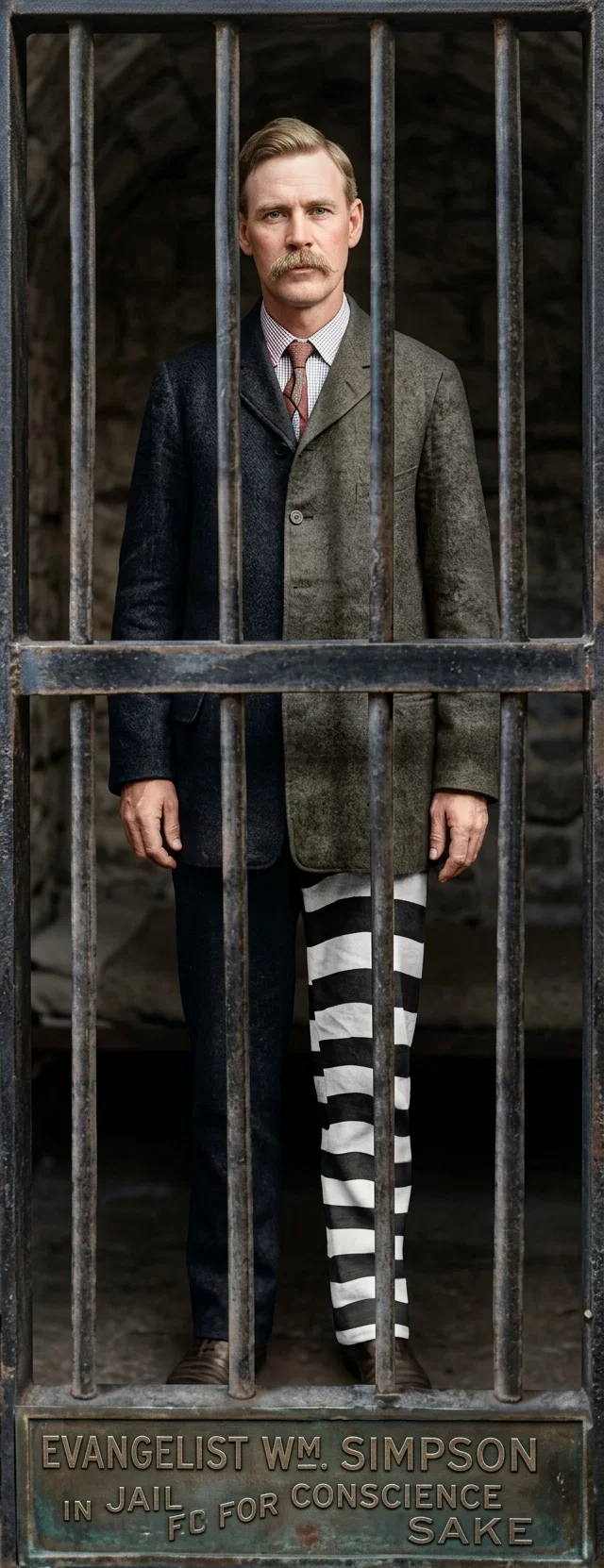
The late Evangelist William Ward Simpson as he appeared in Chatham (Ontario) jail some five years before he died. He was sentenced to hard labor for forty days for the "crime" of having quietly worked on Sunday in the preparation of a church building. His labor disturbed no one, and only by spying and inquisition was it discovered. Thousands of men, not only in Canada, but throughout this and other nations, will claim, in spite of the enlightenment of the age and our boasted religious freedom, that such a sentence is just.
THE CHURCH COURTING THE STATE
But, alas, we are living in a day when men seem to have forgotten the past experiences of the church of God; seem to have forgotten the Reformation — the reason for it, and the object of it; and history is repeating. The church, shorn of her glory and power through sin permitted and practiced within her borders, turns to the state for help, and is found putting her confidence in the arm of flesh.
Turned, by the archenemy of all righteousness, from storming the throne of grace for Holy Ghost power, she is found sending her petitions to the halls of legislation of the various states, and storming the national government at Washington, for the making of laws, the enforcement of which means the realm of conscience again invaded, man’s inalienable rights denied him, and civil and religious liberty trampled in the dust.
IT IS ALL IN THE PROPHECY
And all this is in the prophecy of Revelation 13. The great God who inhabits eternity, and who sees the end from the beginning, and has declared it (Isa. 46:10), opens up before us, in this wonderful prophecy, not only the story of the failure of our nation, but also the very reason for her fall, and the specific thing over which she will fall.
We noticed, in our previous study, that an “image to the beast,” the papacy, would be made, and that life would be given to it, and that then the image would speak. When that voice is heard, it will be in the making of a decree of death to be passed upon all who will “not worship the image of the beast.” Rev. 13:15.
WHAT THE IMAGE WILL BE
The papacy stands before the world in all her teaching and practice, so far as she has been and is still able to do, as the very embodiment of the union of church and state, with the church ruling the state. This is her ideal, and her world-wide aim. The image of the papacy is an exact likeness of the papacy, a union of church and state, with the church ruling the state.
BEGINNING OF THE MODERN CHURCH-AND-STATE MOVEMENT
Is there in our land these days anything that would lead us to conclude that the fulfillment of this prophecy is right before us? Let us see. There is an organization known as the National Reform Association — an organization of Protestant churches, which had its beginning in 1864, whose avowed purpose, as set forth in their constitution, article 2, is: “To secure such an amendment to the constitution of the United States as will declare the nation’s allegiance to Jesus Christ, and its acceptance of the moral laws of the Christian religion, and so indicate that this is a Christian nation, and place all the Christian laws, institutions, and usages of our government on an undeniable legal basis in the fundamental law of the land.”
This, dear reader, is the papacy in embryo. It means the union of church and state, with the church ruling the state; the state merely a tool in the hands of the church, to do her bidding.
PROTESTANT CHURCHES FALLING IN LINE
Numerous other church organizations have followed in the wake of this one. In fact, it would seem to-day as though nearly all the Protestant churches in America had forgotten or cast aside the principles of Protestantism, and were fixed in their purpose to have this government profess religion, and then “set up the moral law, and recognize God’s authority behind it, and lay its hand on any religion that does not conform to it.”
In regard to the “religious amendment” to the constitution, they have told us that “those who oppose this work now, will discover, when the religious amendment is made to the constitution, that if they do not see fit to fall in with the majority, they must abide the consequences, or seek some more congenial clime.”759
THE PROTESTANT PAPACY
They have asked the question, “What is the purpose of civil government?” and have answered, “Is it not to enforce the moral law?” They demand that the civil government “be placed under divine law, and that God’s spokesmen shall utter His will.”
Surely this means the papacy over again. The preachers are to be God’s spokesmen to the state. Claiming to be the voice of God, they will command the state to enforce the moral law. They will amend the constitution to demonstrate that this is a Christian nation; and then, woe betide any man who will not fall in with the majority! They are going to set up the moral law, and have the state lay violent hands on “any religion” that objects.
JUST WHAT THE PAPACY CALLS FOR
This is the very essence of what is called for in the papacy. When it succeeds, it is the “image to the beast.”
They tell us: “We propose to incorporate in our national constitution the moral and religious command, ‘In it [the Sabbath] thou shalt do no work’ except works of necessity; and by external force of sheriffs, we propose to arrest and punish all violators of this law.”
WOULD HANG SABBATH BREAKERS
At one of their conventions, at which the writer was in attendance, it was said: “We sometimes think the Pilgrim Fathers were too severe in their legislation against immorality. There was a law in the colonial statutes of New England that for a flagrant violation of the Sabbath, the offender should be hung. . . . I apprehend that we ought to return to that order of things to-day, and execute the penalty for a violation of the moral law.”
Thus would these “God’s spokesmen,” proposing to represent the Author of liberty, deny every principle of liberty, civil and religious, and trample the rights of conscience in the mire.
PERSECUTION AND THE DRAGON VOICE
This would mean religious persecution. It would mean the dragon voice. Rev. 13:11. It would mean popery under the misnomer “Protestantism.” It would mean the church again casting aside her robes of white for the purple of Cæsar. It would mean again the unsheathing of Peter’s sword. It would mean again religious bigotry, with all its Pharisaism and murderous hate. It would mean that religious liberty had come to an end in the republic of the United States.
It would mean all this, dear reader; but God still lives. Men may decree, but a divine Providence overrules. Though all the world shall worship the beast and his image, there will be found a faithful remnant, whose names are still in the Lamb’s book of life. Verse 8. “And they shall be Mine, saith the Lord of hosts, in that day when I make up My jewels; and I will spare them, as a man spareth his own son that serveth him.” Mal. 3:17.
THE RESURRECTION THE PROMISED DOOR OF HOPE
By W. A. Gosmer
If Men Do Not Rise from the Dead, They Are Perished—Why a Resurrection, if Men Go Either to Heaven or to Hell When They Die?
By W. A. GOSMER
This is the fourth of Professor Gosmer’s articles on the general theme of the relation of man to the question of immortality. In previous articles, Professor Gosmer has called attention to the fact that the immortality of the soul has been generally accepted by the pagan nations of all time, and that the doctrine has found its way into the beliefs of a large part of the Christian church without sufficient consideration from the Biblical standpoint. He has shown the Bible use of the terms “soul” and “spirit,” and carefully considered some of the texts that have been thought to teach the immortality of the soul, and has shown that the Bible clearly presents the fact that God alone has immortality, and that man has no hope for immortality outside of the life given to him in the gospel of Christ. Next week, his theme will be “The Destiny of the Wicked.” EDITOR.
In previous articles, we have examined some of the leading evidences bearing on the nature of the soul. From the scriptures presented, it must be clear that there is no life in death. It must be evident that man, left entirely to himself, “is like the beasts that perish.” Were it not for the sacrifice of the blessed Saviour, the darkness of eternal oblivion would forever seal the portals of the tomb. But for Him who is the Light of the world, and the Life of men, those who have passed the threshold of the grave would never again behold the light.
RESURRECTION PROMISE THE DOOR OF HOPE
But God is true, and the eternal promise will come to pass that “all that are in the graves shall hear His voice, and shall come forth; they that have done good, unto the resurrection of life; and they that have done evil, unto the resurrection of damnation.” John 5: 28, 29. This is the hope of mankind, “the blessed hope” toward whose glorious dawning saints and prophets have looked forward with eager, longing eyes.
Beholding it afar, the patriarch Job cried out: “I know that my Redeemer liveth, and that He shall stand at the latter day upon the earth: and though after my skin worms destroy this body, yet in my flesh shall I see God.” Job 19: 25, 26. “As the waters fail from the sea, and the flood decayeth and drieth up: so man lieth down, and riseth not; till the heavens be no more, they shall not awake, nor be raised out of their sleep. O that Thou wouldest hide me in the grave, that Thou wouldest keep me secret, until Thy wrath be past, that Thou wouldest appoint me a set time, and remember me! If a man die, shall he live again? all the days of my appointed time will I wait, till my change come. Thou shalt call, and I will answer Thee: Thou wilt have a desire to the work of Thine hands.” Job 14: 11-15.
DAVID’S HOPE WAS THE RESURRECTION
This resurrection hope was shared also by the psalmist David. He says, “Thou, which hast showed me great and sore troubles, shalt quicken me again, and shalt bring me up again from the depths of the earth.” Ps. 71: 20.
That David clearly recognized in the resurrection the hope of his eternal destiny, was shown by the apostle on the day of Pentecost: “Men and brethren, let me freely speak unto you of the patriarch David, that he is both dead and buried, and his sepulcher is with us unto this day.” “For David is not ascended into the heavens.” Acts 2: 29, 34. If the psalmist had not yet entered heaven in Peter’s day, the resurrection would be his only hope. That is certain.
AWAKE FROM THE DUST, AND SING
Isaiah testifies: “Awake and sing, ye that dwell in dust: for thy dew is as the dew of herbs, and the earth shall cast out the dead.” Isa. 26: 19.
Hosea cites the promise of God to Israel: “I will ransom them from the power of the grave; I will redeem them from death.” Hosea 13: 14.
Daniel’s prophecy shows that the dead will be raised: “And many of them that sleep in the dust of the earth shall awake.” Dan. 12: 2.
To the foregoing may be added the testimony of Ezekiel: “Thus saith the Lord God; Behold, O My people, I will open your graves, and cause you to come up out of your graves, and bring you into the land of Israel.” Ezek. 37: 12.
KNOW THAT HE SHALL RISE AGAIN
That the truth of the resurrection was correctly understood by some of the Jews during the ministry of the Saviour, is shown by the words of Martha to Jesus concerning Lazarus, who was dead: “I know that he shall rise again in the resurrection at the last day.” John 11: 24.
That is the true idea. The Scriptures plainly teach that on the last day of this world’s history will occur the first general resurrection of the dead. “For the trumpet shall sound, and the dead shall be raised incorruptible.” 1 Cor. 15: 52. Some of the Thessalonian brethren feared that death would end all. Therefore Paul wrote to them these words of hope and cheer: “But I would not have you to be ignorant, brethren, concerning them which are asleep, that ye sorrow not, even as others which have no hope. . . . For the Lord Himself shall descend from heaven with a shout, with the voice of the Archangel, and with the trump of God: and the dead in Christ shall rise first: then we which are alive and remain shall be caught up together with them in the clouds, to meet the Lord in the air: and so shall we ever be with the Lord. Wherefore comfort one another with these words.” 1 Thess. 4: 13, 16-18.
WHY A RESURRECTION?
If man at death immediately enters heaven, why is a resurrection at all necessary? And if Paul believed the popular immortal-soul theory, why did he speak of the resurrection, and say, “Wherefore comfort one another with these words?” The fact is that he saw in the resurrection the only way to heaven. He fully believed that he himself must be raised from the dead.
Dwelling somewhat on the dangers to which he was almost constantly exposed, he said: “If after the manner of men I have fought with beasts at Ephesus, what advantageth it me, if the dead rise not? let us eat and drink; for to-morrow we die.” 1 Cor. 15: 32. Paul here quotes the Epicurean philosophers, who allowed full indulgence to every appetite, and the sum of whose philosophy was expressed in the proverb, “Let us eat and drink; for to-morrow we die.” This was saying that for them the future held out no hope. Paul qualified their maxim with the saving clause, “If the dead rise not,” thus showing, without question, that the destinies8of mankind depend upon the resurrection. Speaking of his toils and his sacrifices for Christ, the apostle said to the Philippians, “If by any means I might attain unto the resurrection of the dead.” Phil. 3: 11. That he fastened his hope for the future upon the second advent and the resurrection day, is further shown by his last words to Timothy: “I have fought a good fight, I have finished my course, I have kept the faith: henceforth there is laid up for me a crown of righteousness, which the Lord, the righteous Judge, shall give me at that day: and not to me only, but unto all them also that love His appearing.” 2 Tim. 4: 7, 8. Awaiting that immortal morning, Paul rests.
Besides, Jesus taught that it is not at death that God’s people receive their reward, but at the resurrection: “Thou shalt be recompensed at the resurrection of the just.” Luke 14: 14. He further testifies: “Behold, I come quickly; and My reward is with Me, to give every man according as his work shall be.” Rev. 22: 12. The resurrection takes place at His coming.
APPARENTLY BUT A MOMENT
Besides, there is an innumerable company of God’s dear children, who in all ages have kept the faith—saints, martyrs, apostles, and prophets—who now sleep their last sleep. In the words of Luther, “They lie, not reckoning days or years, but when awakened, will seem to themselves to have slept scarcely a moment.” That is a reasonable, comforting view; for theirs is a dreamless, perfect sleep. It is as if they were to close their eyes in death, and immediately to open them in the resurrection. By the words of God’s revelation, that day of days hastens on.
Some have looked upon the Scriptural view of man’s state in death as a “gloomy doctrine.” We may therefore pertinently inquire, Which is more gloomy,—to rest all unconscious of the passing of time, or to suffer the torments of a seething, burning hell for the same period? As those who are merciful and possessed of human feeling, we must think also of the condition of the lost; for they are many. And if the immortal-soul theory be true, then countless numbers have already spent several millenniums in the agony of hell fire. Almost shuddering, we divert the mind from the fearful thought. Can there be conceived anything gloomier or more terrible than this?
PERISHED IF NO RESURRECTION
We can do no better than to quote here Paul’s argument on the resurrection, for it seems final: “Now if Christ be preached that He rose from the dead, how say some among you that there is no resurrection of the dead? But if there be no resurrection of the dead, then is Christ not risen: and if Christ be not risen, then is our preaching vain, and your faith is also vain. Yea, and we are found false witnesses of God; because we have testified of God that He raised up Christ: whom He raised not up, if so be that the dead rise not. For if the dead rise not, then is not Christ raised: and if Christ be not raised, your faith is vain; ye are yet in your sins. Then they also which are fallen asleep in Christ are perished. If in this life only we have hope in Christ, we are of all men most miserable. But now is Christ risen from the dead, and become the first fruits of them that slept. For since by man came death, by man came also the resurrection of the dead. For as in Adam all die, even so in Christ shall all be made alive.” 1 Cor. 15: 12-22.
Here Paul shows the utter inconsistency of preaching that Christ was raised from the dead, without at the same time teaching that the dead will be raised. “For if the dead rise not,” says the apostle, “then is not Christ raised.” That is to say, the resurrection of the dead is as certain as was the resurrection of Christ; for His resurrection is a pledge that all men will come forth from the tomb. “But now is Christ risen from the dead, and become the first fruits of them that slept.” “For as in Adam all die, even so in Christ shall all be made alive.” Therefore to disavow faith in the resurrection of the dead, is equivalent to denying that Christ was raised. Then “your faith is vain; ye are yet in your sins.” Then there will be no resurrection; and “if the dead rise not,” what follows is the only logical conclusion that can be arrived at,—“then they also which are fallen asleep in Christ are perished.”
FATE HINGES ON THE RESURRECTION
Then without the resurrection, humanity would come to nothing, and be destroyed; for the word “perish” implies just that. Could this possibly be true if the soul, independent of the body, goes to heaven at death? If the immortal-soul theory were true, could not the resurrection be left entirely out of the question, and mankind yet be saved? But as the Scriptures stake the fate of humanity upon a resurrection of the body, that theory must be abandoned as worthless and contradictory.
To this false teaching may be charged the widespread neglect of preaching the doctrine of the resurrection in these days. Says Dr. Adam Clarke, in his commentary: “The doctrine of the resurrection appears to have been thought of much more consequence among the primitive Christians than it is now. How is this? The apostles were continually insisting on it, and exciting the followers of God to diligence, obedience, and cheerfulness through it. And their successors in the present day seldom mention it. So apostles preached, and so primitive Christians believed: so we preach, and so our hearers believe. There is not a doctrine in the gospel on which more stress is laid; and there is not a doctrine in the present system of preaching which is treated with more neglect.”
A Refuge in Trouble
By Eliza H. Morton
“MAN is born unto trouble,” but there is a refuge. God is “a very present help in trouble.” The soul that is at rest may sing even in affliction, for “underneath are the everlasting arms.” It is sweet to know that if we give ourselves unreservedly to God, nothing can come into our lives but what is for our good.
When we look at trouble with the eye of faith, it becomes something to uplift and refine rather than something to plunge us into darkness. Eliza H. Morton.