“O MAMA! come here quick, and see this funny squirrel! It’s climbing down the tree with another squirrel in its mouth,” called seven-year-old Charlie, excitedly.
Mrs. Lawson responded to her son’s call, and was as much surprised as he at the unusual sight. “That must be the mother-squirrel, I suppose,” she said, “bringing down one of her young ones; but I wonder why she is doing so.”
“Why, she carries her baby just the way kitty does, doesn’t she, mama?”
“Something must be the matter with the young one,” his mother replied. “Usually young squirrels stay in the nest until they are old and strong enough to climb around alone.”
While they were talking, the squirrel had laid the little one at their feet. Then, sitting up on her hind legs, she looked up at them so beseechingly that Charlie cried, “O mama! I do believe the mama-squirrel wants us to take care of her baby. What can we do for it?”
“It is sick,” said Mrs. Lawson, examining it carefully. “You call Mr. William, Charlie, while I carry it into the house.”
Mr. William was the man who was studying medicine at the great university in the town where Charlie lives.
Off rushed Charlie to follow his mother’s bidding, calling out, “O Mr. William! come quick! We’ve got a sick squirrel down-stairs, and we want you to come and doctor it.”
Although Mr. William didn’t care much about working up a practise among squirrels, he followed the impatient boy down-stairs, examined the squirrel, and was about to leave it to its fate, declaring that he knew nothing about the ailments of animals, when he saw something that made him exclaim, “Look there!”
Mrs. Lawson and Charlie looked, and what do you suppose they saw?—The poor mother-squirrel had become so anxious over the fate of her little one that she had climbed up the outside door of the room, and was peering in through the glass to see what they were doing with her baby. Her anxiety seemed to touch Mr. William; and he did what he could for the baby-squirrel, just as if it had been a baby boy or girl whose mother was anxious over it.
Then Charlie picked up the little squirrel tenderly, and carried it into the grass, and the mother-squirrel took it in her mouth again, and whisked up the tree with it just as fast as she could. The next day she brought it down again, and again Mr. William tried to relieve it. The third time she brought it down, Charlie begged so hard to be allowed to take it to school to show his teacher and the other boys and girls that his mother made a soft nest for it in a basket, and Charlie carried it to school with him.
But the mother-squirrel couldn’t bear to be separated from her baby for so long a time. She kept running around looking for her little one, and finally she ran up to Mrs. Lawson and begged so beseechingly that Charlie’s mother couldn’t resist her pleading, but went over to the school and brought the baby-squirrel back.
Up the tree the squirrel whisked with her burden, and didn’t come down again for two days. Charlie was the only one who saw her the last time she came down, and he told mama about it that night at the tea-table.
“I was out there by the porch, mama, and I saw our squirrel coming down with the little one in her mouth. I thought at first that she was bringing it to us again; but when she got to the ground with it, I saw that it was dead. She didn’t pay any attention to me, but ran out of the yard with it still in her mouth, and I followed to see what she was going to do. She went over to the campus with it, and over there she met a man, and what do you suppose she did?—She dropped the little dead squirrel on the walk, and sat up on her hind legs, folding her front paws, and looking up at him so pitifully, just as if she wanted him to sympathize with her. After he’d gone by, she picked up her baby and went on until she met a woman, and then she did the same thing. I saw her do that three or four times, and then I came home, it made me feel so bad;” and a big tear splashed into Charlie’s glass of milk.
Charlie’s mother wondered what the squirrel finally did with her baby, but she never found out. But both Charlie and his mother had learned that squirrels are just as fond of their children, in their way, as folks are of theirs, and they were glad they had tried to help the poor mother-squirrel cure her sick baby.—The New Crusade.
THE RUSSIAN POST-WOMAN
I SHOULD be sad if I thought that any of the little women of America were to grow up to a woman's life so hard and dark as the lot that awaits many a little girl now living in many of the countries in Europe. Just think of it! In the terrible winters of Russia, when the air is full of a fine, stinging ice-mist, and the snow is deep, and the houses on the roads are few and far between, and the Russian peasant-men care498little to help a peasant-woman in trouble, and do not feel sorry to see a woman do work that she is not strong enough to do,—in that terrible land and in those terrible winters,—Russian women “carry the mail” from post-office to post-office, with a covered sleigh and a dog-team. Perhaps she has a passenger in her sleigh, too; and when the road is drifted full, the dogs plunge along almost lost in the snow, and the poor woman-driver strides by their side, whip in hand, now coaxing, now scolding, I am sure she must wish she had been born in a different land.
In all the countries in Europe there are fine sights to see,—wonderful old churches, castles, palaces, and historic places. In America there are no such fine sights; but Europe is full of poor people who work hard and are paid small wages for it, and who suffer like the Russian post-woman; while in America those who will work can usually be comfortably clothed and fed.—Little Men and Women.
1. On the next day after the feast at Simon’s house (John 12:12; note ), what request did Jesus make of two of his disciples? Matt. 21:1, 2. If their action should be questioned, what plea were they to make? V. 3. What prompted Jesus to take this action? Vs. 4, 5.
2. Where did the disciples find the colt and its mother? Mark 11:4. As they were loosing the animals, by whom were they called in question? In what words? Luke 19:32, 33. What was their reply? V. 34.
3. When they had brought the colt to Jesus, what did they do? V. 35; note . In what other way did the disciples show their enthusiasm? V. 36. Who joined with them in their march of triumph? Matt. 21:8.
4. What words of praise and rejoicing were taken up and shouted by all? Luke 19:37, 38. Irritated by the acts and words of the people, what did some of the Pharisees demand? V. 39. What did Jesus reply to them? V. 40; note .
5. When the great procession had reached the summit of mount Olivet, what did Jesus unexpectedly do? V. 41. What mournful words did he then utter against Jerusalem? Vs. 42-44.
6. What was the effect as Jesus continued the triumphal ride into Jerusalem? Matt. 21:10. What question and answer passed from lip to lip? Vs. 10, 11. What did the Pharisees say? John 12:19.
7. Though the ride into Jerusalem was a plain and striking fulfilment of prophecy, what do the Scriptures say concerning the knowledge of the disciples of Jesus? V. 16. Until what time did they remain in ignorance of the meaning of this occurrence? Id.; see note .
8. At the close of this remarkable experience, to what place did Jesus go? Mark 11:11.
Chapter XVI
By Sarah M. I. Henry
From Sinai to Olivet
Chapter XVI
Shirley raised her eyes toward the face that was bending over her, pushed the glass away a little, and asked, faintly, “Do folks often make mistakes like that?”
“Not often, but sometimes they do. Officer Mc Farlan never did before, I guess, but mistakes will happen to the best of folks,—although it was very late for a girl to be on the street, you know. We can’t quite understand that now.”
“It isn’t necessary that you should, since I do.”
“No, I suppose not—and yet, that money, for instance. What about that?”
“Oh! I know now,” said Shirley. “I knew as soon as I noticed the handkerchief. Aunt Nell did it. It’s just her trick.”
“Oh! and who is Aunt Nell?”
“Just Aunt Nell.”
She reached after the glass with her lips, took the remainder of the milk, and then settling down in the bed, dropped off into a sleep of utter exhaustion.
Seth and Mr. Mc Farlan held a consultation at the corner just around from the station.
“Not a word about what has happened to her to anybody,” said Seth.
“No, not a word, nor about me.”
“Well, that, between you and me, just ties me to you, old fellow, for life. We’ll talk about that later. Now it’s time I was goin’ to the depot to meet Will. You’d better wait here, and see that she doesn’t get lost again before I can get her into Will’s hands. She must go home on the evening train, or to Aunt Nell’s. Maybe she won’t go home—no knowing. Find me here in thirty to fifty minutes.”
Mc Farlan, left alone, had nothing to keep his thoughts from his own affairs; and it must be confessed that they were not the most cheerful. He had hoped to be able before long to take a certain little saleslady out of the store and its wearing rush, and put her into a cozy home of their own. He had not become a policeman from preference; but the office opened to him, and he had come to consider it his calling. He was not popular with the force, nor all of the judges, because of some “cranky notions,” which made him a man by himself; but he had found the service, on the whole, more to his mind than he had expected. At all events it had become the means by which he lived; and from it he was fitting out a little home for his wife that was to be, and it was hard to think that he might have to stop, and wait, and struggle for a new beginning in some untried field, and that she might have to keep on in the drudgery of the store; but he did not see how he could have done differently. Yet to know that that girl had been caught in the awful grasp of circumstances, and might have gone out with a smirch on her fair name; and to have a man like this one from the country come to him with such confidence that he aroused all the brotherhood in him, and then, to save himself, let the poison end of the law strike him through the girl,—well, he wasn’t that kind of man. Still, the consequences of the act were not easy to take up and carry. It would take a little while to adjust that load to even his broad shoulders.
These and kindred thoughts trooped up and down on hob-nail shoes through his brain and heart as, from force of habit, he paced the sidewalk until Seth and Uncle Will joined him, just one hour and thirty minutes after the time agreed upon.
It was in genuine brotherly fashion that Mr. William Burns greeted the ex-policeman. Seth had not been slow nor meager in his report of the service that Mc Farlan had rendered at such cost to himself, and Will was a man to appreciate self-sacrifice anywhere.
“But what made you so long in coming?” asked Mc Farlan. “I began to think we had left the affair at rather loose ends; for I was to wait here for you, and I did not feel free to go out of sight.”
“No, that’s so, but—”
“I took the through train,” said Mr. Burns, “and it treated us to a hot-box a few miles out. I had a good mind to walk in as far as the cable line, only I knew I should miss Seth. But all is well now, and we must get our girl home to her mother on the next train out, if possible.”
“That is so,” assented Seth. “And now I will leave you with Mr. Mc Farlan. I shall go on the other road, and walk over home.”
Mc Farlan led the way to the “Annex,” where the matron was busy with her charges, and introduced Mr. Burns as a friend who had come for “Sally Jones,” when the matron interrupted him with the exclamation, “But she has been gone a half-hour at least!”
“Gone! How could she go?” gasped Mc Farlan. “I didn’t suppose she would be able to walk in a week.”
“Well, she is not that kind, it seems. She suddenly got up and went. She was weak and white, but she would go. There was nothing to keep her here. Why didn’t you let me know some one was coming for her?”
“Of course: why didn’t I?—Because we depended on her lying down and crying her eyes out, I suppose. Well,” and he turned and looked at Mr. Burns, “one word does just as well as another in a case like this.”
“Just my impression,” said Will. “I know now what Seth meant when he said he felt like praying. I don’t think of any other sensible thing to do;” and he turned hastily away, walked to the window overlooking the court, and bowed his head forward upon his hands.
Mc Farlan removed his cap, and stood with folded arms holding it by the visor before his eyes, while the matron sat down and covered her face with her hand; and the prayers that entered into the ears of the infinite Father, silent although they were, were fervent enough to give the hope that they might be effectual.
In her various passages on the street-car Shirley had noticed a great building on Wabash Avenue, bearing the sign of a mission; and all at once, as she was lying on the bed among the499“lost and strays,” this arose like an open door of hope on the field of her vision, and with it came strength and determination equal to the emergency.
The matron had left her, as she supposed, asleep; and when, after a little while, she came softly to the door, she found her guest up, hatted and gloved, ready to depart.
“Yes,” said Shirley, with quiet decision, in her reply to all remonstrance and questioning, “I know just where I am going, and just what I shall do. Oh, yes, I can find any place, I am sure. Thank you, you have been very kind; I shall not forget you. Sometime I shall come and see you, when I am a little older. And oh, I would like to do something for the poor things down there. Do they always stay with you, and do they always,—oh, what can anybody do for them? I must come sometime and find out. But now I will go.”
She had been moving toward the door all the time, followed by the matron, who felt that she could neither hold her nor let her go. There was but one thing to do, however, and that was to unbar the door, and let her out. Shirley turned on the first step that led down into the court, and lifted her face to the sweet, motherly woman’s, and kissed her.
“I know enough now to know that you are a godsend, and I shall always be a better girl because I have been here and seen you. Good-by.”
“Good-by, you sweet lamb,” and the matron of the prison, and the young girl, fresh from the innocence of her childhood, threw their arms about each other, and stood a moment in a close embrace.
“And can you not tell me your name, and where you may be found?” asked the woman, pleadingly. “I can not bear to lose you in this great city this way.”
“Not now; but I shall not be lost. I know my way—just the way I am to go. I will let you know sometime, and—I would like your name. Maybe I will write to you.”
The matron brought her a card, which Shirley put carefully away in her purse.
“Don’t feel anxious about me,” she said, as she turned again to go down the steps, “but just pray for me.”
“Oh, I’m so glad you want me to do that! Now I can let you go. God be with you, dear child.”
“Thank you,” said Shirley, and went slowly down the dark passage to the court and out to the street.
She walked rapidly away from the unsavory vicinity of the station-house, until she came into a quiet, respectable side-street; and making inquiry of some children, who were evidently going home from school, she found her way to the Wabash Avenue cable, and to the mission that she had noticed.
Her ring at the door was answered by a sad-looking young woman, who waited, with the door in her hand, and did not invite her to enter.
“I—I—this is a mission?” began Shirley.
“Oh, yes, it is a mission.”
Shirley stood a moment, thinking. She felt that the way was not being made very easy for her; but after an instant she asked, desperately, “May I come in?”
“Oh, yes, of course; anybody can come in that wants to,” and the girl opened the door, and stepped aside for Shirley to enter.
“C-could I have a room by myself for a little while, do you suppose?”
“I’ll see the matron,” was the laconic reply. “Just walk into the parlor.”
Shirley entered the parlor, and sat down on the edge of a chair with a sense of impatience. Her case was urgent. She wanted a place where she could shut herself in alone. There was something for her to do, such as she had never attempted in all her life. She had passed through a strait place, and come up on the borders of a new country,—a strange country, over which hung a cloud of mist, shot through with beams of light,—and straight on into this cloud of mingled mist and light there was walking a young woman that she knew was Shirley Goss. She did not see how it was possible for it to be so. She knew that something must have happened to that Shirley to make such a thing possible, and she must find out what it was; for she knew that her feet must follow in that way; and that that thing, whatever it was, that would make it possible for her to follow must be done in her.
She knew what had to be done; for she had been sufficiently instructed, even if her home had not been the Christian home that it ought to have been. She knew what all this meant. She knew the power that was taking Shirley Goss so steadily and persistently on into that cloud of mist that she seemed to be always approaching but never entering (somehow it was light about her all the time): she knew what she had to do, and was in haste to get it done.
“It is queer,” she thought, almost smiling, “that I should be doing this. It seems like waiting for the dentist; but it has to be done.”
After what seemed a long time, as she looked back over what she had lived as she sat there, a pleasant-faced elderly woman entered, and greeted her kindly, though patronizingly. This, however, was nothing now to Shirley. She waited for nothing, but said, “Excuse me, please. I don’t know anything about missions, but I would like a quiet room for a little while, where I can be undisturbed, and I thought—”
“Yes, dear, but can you not tell me about yourself?” asked the matron, persuasively.
“No, I do not want to talk. I want to be alone, please. Oh, please!” and her voice broke for just a tone or two. Tears came, but she swallowed them; and with a strong effort at self-command, continued, “I have no time to lose. I have something to do. I want a room, please. I will pay you for it.”
The matron looked at her. She was afraid of what this pretty, well-dressed young woman might do under the pressure that was evidently upon her if she were left alone in a room. She was accustomed to receiving long, sorrowful confessions before she took any young woman to a room; but she was also a woman instructed of the Holy Spirit, and it did not take her long to decide.
“Very well,” she said, “I do not ask pay for the room, unless you wish it for some little time. But of course we always take gifts for our work. You may come with me.”
She led the way to the top of the house, and into a little hall alcove, which was furnished with a square rug, a chair, a narrow couch, a tiny table with a Bible, and that was all.
“This,” said the matron, “is our Sinai or Olivet.”
“Oh!” said Shirley, “I understand, and I am so glad!”
“Then I am glad, too,” said the matron. “You need not be afraid of being disturbed, even if there is no key; for every one will know that the place is occupied;” and she took a card from the wall, and, turning it, hung it on a hook outside the door. Shirley looked and read:—
“And the Lord said unto Moses, Come up to me into the mount, and be there: and I will give thee . . . commandments which I have written; that thou mayest teach them. . . And Moses went into the midst of the cloud, and gat him up into the mount.”
“And Jesus taketh Peter, James, and John his brother; and bringeth them up into a high mountain apart, and was transfigured before them: and his face did shine as the sun, and his raiment was white as the light. . . . Then answered Peter, and said, . . . Lord, it is good for us to be here. . . . Behold a bright cloud overshadowed them: and behold a voice out of the cloud, which said, This is my beloved Son, in whom I am well pleased; hear ye him.”
“As he is, so are we in this world.”
Shirley stood long with her eyes fixed on that illuminated text (for such it was to her); and the matron, having enough of spiritual intuition to apprehend the atmosphere that surrounded the young girl, turned and stole softly down the stairs, and Shirley went in and shut the door.
Mrs. S. M. I. Henry.
(To be continued.)
The Highest Independence Comes from Dependence Upon Christ
“THE highest independence comes from dependence upon Christ.”
SPECIAL OFFER.
By Editor
We will send the YOUTH'S INSTRUCTOR FREE for one year to any one sending us four new subscriptions at 75 cents each; that is, for $3 we will send five copies one year, your own and four others.
Now is the time to work. Who will take advantage of this offer to secure a copy free of cost?
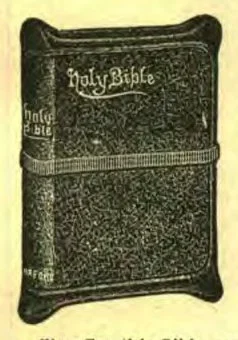
Self-Pronouncing S. S. Teachers’ Reference Bible.
CONTAINS the celebrated Teachers’ Helps, comprising nearly 400 pages. Also a complete series of fifteen new maps.
Description. — Imperial Seal Binding, Tuck Edges, known as “Divinity Circuit,” Rounded Corners, Full Red under Gilt Edges.
We offer this Bible, post-paid, for only SIX NEW YEARLY SUBSCRIPTIONS at 75 cents; or TWELVE NEW SIX MONTHS’ SUBSCRIPTIONS at 40 cents.
We will also send it, post-paid, with the INSTRUCTOR one year for $2.25. For 20 cents extra we will stamp your name in gold upon the cover.
To Reach BATTLE CREEK
FROM
CHICAGO, BUFFALO, DETROIT, OR TOLEDO,
Purchase Tickets
Reading over the MICHIGAN CENTRAL
“The Niagara Falls Route.”
A First-class Line for First-class Travel between Chicago and New York and Boston. Elegantly equipped through trains pass Battle Creek in each direction daily.
R. N. R. WHEELER,
Ticket Agent, Battle Creek.
O. W. RUGGLES,
Gen'l P. and T. Agt., Chicago, Ill.
TAKE THE Canadian Pacific Railway
for . . . CHATHAM, OTTAWA, MONTREAL, LONDON, GALT, QUEBEC, WOODSTOCK, TORONTO, BOSTON, PORTLAND, and
All points in New England, the Maritime Provinces, Great Britain, and the Continent.
Illustrated literature, time-tables, and full particulars, upon application to—
J. FRANCIS LEE, GEN. AGENT,
Passenger Dep't. 228 SOUTH CLARK ST., CHICAGO.
Branch Offices: 76 Ottawa St., Grand Rapids, Mich. Room D, Chamber of Commerce, Cincinnati, Ohio. 315 Chestnut St., St. Louis, Mo.
Grand Trunk Railway System
Time Card in Effect February 5, 1899.
C. & G. T. DIVISION.
WEST-BOUND FROM BATTLE CREEK.
LEAVE.
No. 11, Mail and Express, to Chicago 12.00 M.
No. 1, Chicago Express, to Chicago 9.00 A. M.
No. 3, Lehigh Valley Express, to Chicago 3.40 P. M.
No. 5, Pacific Express, to Chicago, with sleeper 12.55 A. M.
No. 75, Mixed, to South Bend 7.30 A. M.
Nos. 11 and 75, daily, except Sunday. Nos. 1, 3, and 5, daily.
EAST-BOUND FROM BATTLE CREEK.
LEAVE.
No. 10, Mail and Express, to Pt. Huron, East, and Detroit 3.45 P. M.
No. 4, Lehigh Express, to Pt. Huron and East 8.27 P. M.
No. 6, Atlantic Express, to Pt. Huron, East, and Detroit 2.25 A. M.
No. 8, Lehigh Exp. to Saginaw, Bay City, Pt. Huron, and East 6.50 A. M.
No. 74, Mixed, to Durand (Starts at Nichols) 7.35 A. M.
Nos. 10 and 74, daily, except Sunday. Nos. 4, 6, and 8, daily.