THE PRESERVATION OF THE BIBLE THROUGH THE MIDDLE AGES.
By Thomas E. Bartlett
(Conclusion.)
HERE is the Alexandrian manuscript. It is now the property of the British Museum. It was brought to England in the year 1628, from Constantinople, as a present to King Charles the First, arriving just seventeen years too late to be used in correcting our common version.
And here is the Ephraem manuscript; and this manuscript comes from the same period as the Alexandrian, just mentioned,—the beginning of the fifth century. This manuscript has a strange appearance. Letters in a running hand and written in black ink almost cover the pale, square letters of the ancient writing.
The sermons of Ephraem, the Syrian, are written above the partly effaced lines of the sacred oracles. Pumice-stone was used to rub upon the precious manuscript, and thus the first writing was almost destroyed. This was not done by the pious preacher himself (who lived in the fourth century), but one of his ardent admirers, who lived in the twelfth century, performed this strange act of unmeant irreverence for the word of God. But the sacred writing was not erased past all recovery. It was deciphered about fifty years ago by Tischendorf, an achievement which required such great skill and patience that it is regarded as one of the triumphs of modern scholarship.
Besides these four books, two of them coming from the fourth century and two from the fifth, there are nearly two thousand parchments known to scholars.
Very many of these contain only parts of the Bible, and all of them come from centuries later than the fifth century.
Such is a glance at the sources of our Bible. Antiquity has bequeathed to modern times nothing to be compared with these discolored and mutilated books.
If we ask scholars how they tell the age of the various manuscripts, and how the manuscripts were preserved, they would answer: Some have a date written upon them; but the oldest are without date. In another way the age of each document is computed; for undoubted specimens of the writing of the first century have been preserved.
Herculaneum, from its long burial in the ashes cast out by Vesuvius, has given us a writing of the apostolic age. As we look upon the Herculaneum papyrus, we see the form and general appearance of manuscripts which were produced when the apostles were still living.
Although the autographs which left their hands have, no doubt, long since perished,—for written, as they were, on fragile papyrus, they could not long withstand the wear of use,—still, since we have an undoubted and unquestioned writing of the first century, we possess a certain and distinct view of the appearance first assumed by the New Testament Scriptures.
We thus have a standard by which the antiquity of a document may be approximately ascertained.
The first copies, also, have shared the fate of the original writings,—are either worn out by use, or have turned to dust and ashes in the last Roman persecution, when Christian books were fiercely demanded for destruction.
Copies of copies, however, remained, written on vellum, with the self-same characters which are found upon the papyrus manuscript unearthed at Herculaneum, and written in parallel columns like those of this ancient writing.
Still, more than two hundred years separate the age of the apostles from the date of our oldest manuscript of the Gospels or the Epistles. How, then, are we confident that what has come to us from the fourth century is the production of the apostles and evangelists who lived in the first century? The answer is clear and perfectly satisfactory.
We have the Syriac Bible, a translation made while the autograph manuscripts were yet in existence, and we also have extended quotations of Scripture in the writings of the Christian Fathers who lived in those early centuries. These latter tell us, reasonably, that the lost manuscripts of the second and third centuries were practically the same as those which have come to us from the fourth and fifth and later centuries.
In a few words, the facts are as follows: The original, autograph manuscripts have perished. Our oldest copies come from the fourth century; but a translation, in the Syriac, made from those autograph manuscripts, also extended quotations made from those first copies, have reached the present age.
Every reasonable demand is met. Every serious question is as seriously answered. We know, and with a remarkable degree of probability, what writings the sacred penmen left for subsequent ages. The ancient classics,—Herodotus, Plato, Virgil, Cicero,—are not so certainly in our possession as are the writings of the apostles. The manuscripts of the classics are fewer, and most of them come from the latter part of the middle ages.—Rev. Thomas E. Bartlett, in Home Guard.
GO FORTH WITH A SONG.
By Mark Guy Pearse
THEY sang a hymn—not the Lord Jesus only, but his disciples with him. How much it meant for them! The solace of that song and the voice of their Lord blending with their voices, was the most tender and effectual way of comforting them. It was as the mother soothes her little one by singing. Could they fear, since he sang? For them, too, the words were a strength as well as a solace.
In Mr. Wesley’s whole life there was perhaps nothing that made so deep an impression on him as when, crossing the Atlantic in a great storm, the ship’s sails blown away, and the seas breaking over the ship, and everybody else screaming in terror, the simple Moravians gathered together with their women and children, and sang a hymn of praise to God. It was what Luther always did when evil tidings reached him, and things looked threatening. He rang out cheerily the words:—
“A safe stronghold our God is still,
A trusty shield and weapon.”
Let us learn to be like our Lord and Master; when we have to go forth to some sorrow or conflict, let us go forth with a song.—Mark Guy Pearse.
HOW A RAILROAD KEEPS TRACK OF ITS CARS.
By Edgar Van Etten
The destination of the car is, of course, controlled by the owning road. The matter of the distribution of cars for loading is, as a rule, managed by the superintendent of transportation through the division superintendents of the road. The question as to where a car shall be loaded is determined by the superintendent; for instance, on our road we have certain classes of cars which we do not permit to be loaded off our own line.
There are a number of freight cars in use by railroads, called “line cars.” This class of cars is formed by different roads over which they run building and putting into the line their proportion of the total number, based, as a rule, upon the mileage of the road, and sometimes on the use the road wants to make of them. Each company owns its own individual cars, but they are marked, not with the name of the company, but “White Line,” “Blue Line,” “Red Line,” or “Union Line”; and they are handled by an agent appointed by all the roads.
Such cars are restricted in their loading and operations, so far as possible, to the lines that own them. The White Line cars run into south and southwestern territory; those on the Red Line go into the west and northwest; while those on the Blue Line go largely into the east and the near-by west, as a rule this side of the Mississippi River. What are called the “common cars” of each road are those that are marked “N. Y. Central,” “N. J. Central,” etc. The line cars are distinguished by the name of the line; the others, the “common ones,” are generally permitted to be loaded almost anywhere.
On each road there are junction points where there is an agent who makes to the roads that interchange at that point what is known as a “junction report,” showing, daily, the cars that were interchanged between the roads at that point. Suppose, to illustrate, we follow a car to St. Louis. We load one of our common cars at St. John’s park, with freight for St. Louis. It arrives at Buffalo, where it is turned over to the Lake Shore. We get a junction report, showing that that car has been delivered to the Lake Shore. The car goes on to Cleveland, and is there turned over to the “Big Four,” the C. C. C. & St. Louis, and a junction report is made to both companies—the Lake Shore and the C. C. C. & St. Louis—while the Big Four takes it to St. Louis. The Lake Shore, in making a report to us, will say that the car was received on the ninth of the month, and was turned over to the Big Four on the tenth.
If, in due course of time, that car does not turn up again somewhere, we make an inquiry of the Big Four, and ask them about it. If it was reloaded at some important junction point, like St. Louis, and went west, we would get a junction report that one of our cars had been turned over to such and such a western road. So, in this way, we know pretty well where our cars are, but occasionally they get away from us on small roads from which we receive no reports.
Under the present arrangement, we depend entirely upon the honesty of the “other fellow,” as to whether we get all that we ought to from our mileage earnings, whereas, if a per diem system were in vogue, we could eventually trace out just how many days our cars had been on any road in the country.
A great many roads employ a man known as a “car-tracer.” It is his business to travel over the country where the cars of his company are supposed to be, or to points where he may be especially sent by the general superintendent of the road or the superintendent of transportation, searching for the cars of his company. The car-tracer, in his general travels, will get off at a station, go through the yards and note, according to their number, the cars he finds there. He is generally on the lookout for the cars of his line, wherever they may chance to be. He secures detailed information as to the locality of a car that may have been what we call “misused.” In this way he corrects some evils, because he notifies his company that their cars are being misused at a certain point. The misuse of a car means doing with it something contrary to the general rule or understanding between the companies. For instance, it is a rule that all cars shall be loaded toward their home. Suppose one of our freight cars to be in St. Louis. The understanding is that the road that has that car must load it toward the New York Central Railroad, in New York, to some point in the direction of New York. If, instead of so doing, the road loaded it to a point in California, that would be a decided misuse of the car. It is also an understanding between railroad companies that foreign cars shall not be used in local service; as, on our own road, in transacting the local business, we must not use a Wabash car, etc.—Edgar Van Etten, Supt. N. Y. C. & H. R. Railroad, in New York Independent.
SENTENCES THAT LIVE.
CERTAIN historic utterances, as every one knows, seem to pack into a few syllables the secret of an entire epoch in political history, living and retaining their dramatic power even when the events that gave birth to them have passed away. Some of these sayings are recalled by a writer in Chambers’s Journal:—
“One of the most famous historical mots is that attributed to Louis XIV when seventeen years of age. The president of the French parliament, speaking of the interests of the state, was interrupted by the king with, ‘L’état, c’est moi!’ Another version of the saying is that Louis interrupted a judge who used the expression, ‘The king and the state,’ by saying, ‘I am the state!’ No authentic record of the saying exists, and it is discredited by modern French historians.”
“A remarkable utterance was that of the notorious Madame de Pompadour, the mistress of Louis XV. One day, as La Tour was engaged in painting the lady’s portrait, Louis entered the room in a state of great dejection. He had just received news of the battle of Rossbach, in which Frederick the Great had inflicted a disastrous defeat on the combined forces of France and Austria. Madame de Pompadour told him he must not lose his spirits, because he would fall ill; and, besides, it was no matter—‘After us, the deluge!’”
“‘All is lost save honor!’ was the announcement, in a condensed form, of Francis I in a letter to his mother after the defeat of Pavia. Napoleon used the same expression after the battle of Waterloo. On his arrival at the Elysée, three days after the battle, Caulaincourt exclaimed: ‘All is lost!’ ‘Except honor,’ added Napoleon.
“We are indebted to Cromwell for one of the best-known sayings in English history, that connected with the dissolution of the Long Parliament. On the fateful day, at the conclusion of a long speech in which he figuratively blew up the Parliament, Cromwell called in twenty or thirty musketeers, and expelled the members. Turning to the table, his eye fell upon the symbol of the sovereignty of Parliament, the mace. Lifting it up, he said scornfully: ‘What shall we do with this bauble? Take it away!’ What became of it is one of the mysteries of English history.
“Equally well known is Cromwell’s advice to his troops as they were about to cross a river to engage the enemy. Having made a speech, as was his custom on such occasions, he finished up with, ‘Put your trust in God, but be sure to see that your powder is dry.’ There is surely something truly Cromwellian in such a happy combination of piety and practical advice.
“It was Oxenstierna, the chancellor of Gustavus Adolphus, who said to his son: ‘You know not, my son, with how little wisdom the world is governed.’
“During the war of Dutch independence, under the leadership of William, Prince of Orange, the Duke of Buckingham, who thought that the United Provinces were doomed to inevitable destruction, asked William whether he did not see that the commonwealth was ruined. ‘There is one certain means,’ answered the prince, ‘by which I can be sure never to see the ruin of my country—I will die in the last ditch!’”
HOW TO BREATHE.
An old gentleman gave good advice to a young lady who complained of sleeplessness. He said: “Learn how to breathe, and darken your room completely, and you won’t need any doctoring.”
“Learn how to breathe! I thought that was one thing we learned before coming into a world so terribly full of other things to be learned,” she said ruefully.
“On the contrary, not one in ten adults knows how to breathe. To breathe perfectly is to draw the breath in long, deep inhalations, slowly and regularly, so as to relieve the lower lungs of all noxious accumulations. Shallow breathing won’t do this.
“I have overcome nausea, headache, sleeplessness, seasickness, and even more serious threatenings, by simply going through a breathing exercise—pumping from my lower lungs, as it were, all the malarial inhalations of the day by long, slow, ample breaths. Try it before going to bed, making sure of standing where you can inhale pure air, and then darken your sleeping room completely. We live too much in an electric glare by night. If you still suffer from sleeplessness after this experiment is fairly tried, I shall be surprised.”—Selected.
DO HORSES WEEP?
THE Admiralty and Horse Guards Gazette is responsible for the story, which is said to be well-authenticated, of a horse which wept after a battle during the Crimean war.
“A solitary horse, which had apparently escaped unhurt, was observed standing with fixed gaze upon an object close beside him; this turned out to be his late master, quite dead. The poor animal, when a trooper was despatched to recover him, was found with copious tears flowing from his eyes; and it was only by main force that he could be dragged away from the spot, and his unearthly cries to get back to his master were heart-rending.”
A “FIXED-UP” CLOCK.
By Myrta B. Castle
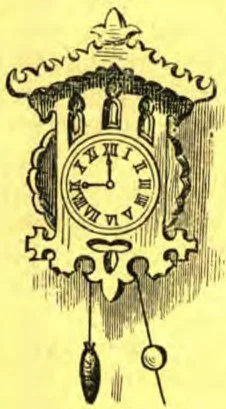
“What’s the matter with this old clock, Uncle Lee?”
The question came in muffled tones from the attic, where George was “rummaging.” “What?” said Uncle Lee—uncle by courtesy, only, to George as well as to half the other boys in town. Then Uncle Lee said “what” again. It was a way he had of hearing with one ear only till he got ready to hear with the other. Now he came to himself.
“O!” His voice changed when he saw what George had. “That stopped the night my mother died, and I never could get it to go since.”
“You don’t know how to fix clocks, I guess,” said George. “Let me fix it; I always fix my grandma’s.” George was sixteen, and he spoke with the assurance of a master-workman in a clock factory.
Uncle Lee hesitated a moment, and looked the lad over. Then he thought: “May be he can fix a clock,” and added aloud: “Try it if you like; but don’t break anything, boy.”
So George lifted the clock out of its box, and took it down stairs. He “fixed” it all the rest of the day, and then went home. The clock refused to go.
A few weeks later Herbert Blackman came in from the country, and saw the wheels lying around where George Stuttle had left them.
“Hello! What have you been doing to your clock?”
“I have not been doing anything with it. George wanted to fix it when he was here, and that’s the consequence,” said Uncle Lee.
“George Stuttle—fix a clock! You must be crazy to let that great big moose touch clock-wheels”—Herbert was small! “Let me fix it, and I’ll show you how a clock ticks.”
“Very well, Herbert; fix it,” answered Uncle Lee quietly.
So Herbert “fixed” the clock industriously till his father drove down in the evening to take him home, at which time there were almost as many wheels in his head as there were on the table.
Then the poor old clock lay undisturbed till one day Herb White dropped in to see Uncle Lee.
“Did your clock go off like the ‘one-hoss shay’?” inquired Herb.
“No; it only wouldn’t go, and so George Stuttle and Herbert Blackman each tried to fix it. Poor boys!” laughed Uncle Lee. “They did their best, but you’ll have to take my word for it that it’s a clock.”
“Is it possible, Uncle Lee, that you let either of those boys meddle with a clock?” exclaimed Herb, with unspeakable scorn. “I just wish you’d let me try. I know how to fix clocks.”
“Go ahead, by all means.” This time Uncle Lee’s eyes twinkled.
“May be you think I can’t fix it,” said Herb indignantly; “but I’ll show you, in a jiffy.”
Uncle Lee had business in the town that day, which kept him away most of the afternoon. When he came back, Herb, with flushed, nervous face, was still at the clock.
“Pretty long jiffy,” remarked Uncle.
“Blame the thing!” snarled Herb; “the witches are in it, I know. It just won’t go together,” and he shoved away from the table, giving a most ungentle creak to his chair. So the clock wasn’t “fixed” any more that day.
But a few days afterward Herb’s older brother, Manley, walked in, and Uncle Lee told him about the clock. Manley gave the wheels and cogs a comprehensive and comprehending glance,—he was nineteen, or thereabout,—and made a few wise remarks on the absurdity of letting boys fuss with such delicate things as clock machinery; but he ended with, “I’d like to try it, though, if you’ll let me.”
So Manley “fixed” the clock for several hours. He succeeded in fitting the pieces together quite ingeniously—so much so that the clock almost recognized its identity, and one part—it was an old-fashioned clock with weights—ran for three or four minutes. Then it stopped, stubbornly refusing another tick.
This time Uncle Lee stood the old clock on the mantel, where it stayed till another White boy, Fred, came one very cold day to stay all night. After awhile he said,—
“I never saw that clock before. Where have you kept it? and why doesn’t it go?”
“Go?” laughed Uncle Lee; “I should think it ought to run like chain lightning, it has had so much attention lately. First George Stuttle tried it; then Herbert Blackman knew he could fix it—you ought to have seen the pieces when he got through with it! Next your brother Herb mixed up the wheels some more, and finally Manley got it partially together. So there it stands—a victim of too much fixing.”
“If you’ve let all those fellows dive into that clock, you’ve got to let me! Manley and Herb think they’re awful smart—fix a clock, indeed! Manley couldn’t fix a door-knob, let alone a clock; much less could Herb. And as for George and Herbert, I am surprised that you should let them try.”
“Go ahead, do,” said Uncle Lee, as well as he could for laughing. “I think the clock can stand one more overhauling.”
So at it Fred went, merrily enough. “Won’t I crow over all those bungling fellows!” thought he to himself. He worked steadily all the afternoon, and till late in the evening. Still the clock refused to go. Finally he got up angrily, put on his hat and coat, and started off.
“May I inquire where you are going?” asked Uncle Lee politely. “Pray do not stop fixing the clock!”
“I’m going home.”
“What! four miles through this cold and snow, at this time of night!” exclaimed Uncle Lee, thoroughly sobered now, as he saw how seriously the boy was taking his defeat.
“Yes; I can’t stay. Good-by,” and away he hurried.
That was the last of the clock-repairing at Uncle Lee’s (though perhaps if there are any more boys who would like to “fix” the clock, they might be furnished with its address). The once-faithful timekeeper still refuses to give a tick; but as it stands on the mantel, those boys sometimes actually turn red in the face, it seems so audibly to shake its fat sides, and chuckle: “Don’t you think it’s better to know how to do a thing and not say much about it, than to say so much about it and not know how to do it?”
So perhaps the clock’s mission is a better one than just to tell what time it is.
MYRTA B. CASTLE.
MAGIC KEYS.
By Mary F. Butts
IN a rude voice screamed little Tom:
"Open the door for me!"
"Yes," was the answer from within,
"If you'll bring the proper key."
"If you please, mama," said little Tom,
Putting down his pride;
At mention of the gentle words
The door flew open wide.
Hearts, like doors, are often locked;
"Thank you" and "If you please,"
Spoken with a pleasant smile,
Are the magic keys.
— Mary F. Butts, in Outlook.
THE WAIF'S PRAYER.
By Mrs. Ballington Booth
A LITTLE five-year-old boy was found crouching in a hall-way, half-clad, and numb with exposure to the cold. The waif was warmed and fed; but it was with his new garments he was most charmed,—so much so that when the sleepy time came, he cried piteously while being undressed, begging to keep the sweet, clean clothing on.
Before putting him to bed, the slum sister knelt with him, and said, “Say these words after me: ‘Now I lay me down to sleep.’”
Peeping between his fingers, the little fellow whispered: “Now I lay me down to sleep.”
“I pray the Lord my soul to keep,” continued the sister.
“I pray the Lord my clothes to keep,” said the little one.
“No, not clothes,” said the sister,—“soul to keep.”
“Soul to keep,” whispered he, with wide-open eyes.
“Now,” urged the sister, “say it from the beginning: ‘Now I lay me down to sleep, I pray the Lord my soul to keep.’”
But the poor little fellow was too intent upon his treasures: “Now I lay me down to sleep, I pray the Lord my clothes to keep,” he said again.
“No, no,” said the patient sister, “that is not right; you pray the Lord your soul to keep, and I will take care of your clothes.”
“And won’t you pawn them,” said the little boy, “and buy whisky with them? that’s what they always did at home when I got new clothes.”
Although he finally mastered his little prayer, it was with the words, “I pray the Lord my clothes to keep,” on his lips, that he finally fell asleep.—Mrs. Ballington Booth.
Smile Even When Cross
“WHAT are you smiling at?” asked a lady one day of her niece.
“Nothing, dear auntie,” was the mild reply, “only because I’m so cross, and I’m determined not to look so!”
She had made the effort for the sake of others, but possibly the reaction of muscle on mind was her ample reward. At least the rule is a good one to follow, since no one can be harmed by failure. “Look cheerful—and see what happens!”—Selected.
Children Playing at Being Grown Up
“Why, Mary,” said Mrs. Wilson to her little girl, “you and your visitors are doing nothing but sit about and look miserable. Why don’t you play something?” “We are playing.” “Playing what?” “We’re playing that we are growed up.” — Exchange.
A WONDERFUL LIGHT.
Quite a sensation was created a week or two ago by Professor Vivian Lewes, who informed the members of the Gas Institute at Edinburgh that a French scientist, M. Denayrouse, had discovered a means of increasing the illuminating power of gas something like fifteen times. Professor Lewes had been made aware of the discovery during a visit to M. Denayrouse in Paris, and he had obtained permission to experiment with the new method of gas lighting, and to make a communication upon the subject to the Edinburgh meeting.
In the invention M. Denayrouse had first been struck with the idea of applying the principle of the blowpipe to the gas burner. He employs a lamp with a spherical-shaped metallic body and incandescent mantle. In the body of the lamp is placed a very small dynamo working a ventilator, and receiving the current from two small accumulators. The electrical energy required is exceedingly small, and is said to be only about one third volt and one tenth ampere. This is, however, quite sufficient to force a current of air through the mantle, and cause the gas to burn with remarkable brilliancy. According to M. Mellet the lamp has a density of thirty-five or forty carcels, and consumes seven litres of gas for each carcel. Professor Lewes had, however, been shown a lamp of eighty carcels (about eight hundred candle power), and he was convinced that the light was quite as brilliant as an arc lamp.—Electrical Engineer.
“AMID THE EVERLASTING HILLS.”
By Mary D. Brine
Over the distant mountains lies a soft and tender
haze;
Upon the nearer hills all day the golden sunlight
plays;
The valley lies in safety ’neath the grandeur of the
heights,
And revels in the beauty of the summer’s dear delights.
As far as eye can reach, it sees God’s pictures fair
and sweet,—
No flaw, no blot to mar his work, but all sublime,
complete.
And over all the tender skies, so fleecy, soft, and blue;
And still beyond, the watchful love, so wonderful and
true.
Again, behold! a sudden change comes sweeping o’er
the sky!
And now upon the mountains, see! cloud-shadows
darkly lie.
The valley can no longer smile, since ’neath the gloom
o’erhead
Its merry friends, the sunbeams bright, in silence all
have fled.
Now, dark and darker grow the clouds, until at last
the rain—
Sweet nature’s tears—burst forth as from a heart
o’erfull of pain,
And, till the grief be spent, the face of nature must
be sad,
And then, her heart refreshed, the clouds have passed,
and she is glad.
Now, watch the sun behind those clouds! how coyly
it peeps through
A little rift, now here, now there, till wider spreads
the blue
Of heaven’s own glorious canopy, and down the
mountain’s side
The sunlight riots once again, and scatters far and
wide.
The storm has passed! the valley smiles again in
peace serene;
And just a little sermon has been preached to us, I
ween.
The thought is only this, that whereso’e’er life’s tears
may be,
There will always be God’s smile behind the clouds
for you and me.
— Mary D. Brine.
DEATH FROM ALCOHOL.
A child was fatally injured at Salem, Ohio, August 16, in a very remarkable manner. An empty alcohol barrel, heated by the sun, caused a generation of gas, filling the barrel. The boy had just seated himself on the barrel when it exploded with terrific force, throwing him into the top of a pear tree and burning portions of his body to a blister. Note is made of this death from alcohol in the newspapers because it was so sudden and unusual; but thousands of people, young, middle-aged, and old are killed every year by alcohol in its various forms of beer, cider, wines, gin, and whisky. It was a sad fate for the boy, who doubtless was innocent of wrong; but it would be far better to be blown to pieces by an alcohol explosion than to live a rum-soaked drunkard, and die of alcoholism in the end. How many thousands of boys and men are in as dangerous a position as was that boy on the heated whisky barrel, but they do not sense their danger, and perhaps will not until it is too late to save themselves!
THE COST OF A BRITISH SHIP OF WAR.
A Parliamentary paper recently issued throws much light upon the cost of warships and their armament, machinery, etc. The prices given are mainly those to contractors, but from other sources the expense of building ships in the public dockyards can be obtained. No real comparison can be drawn between the two, of course, for the maintenance of the public yards is imperative for many sound reasons, and therefore there are items connected with the cost of vessels built in them from which those constructed in the private yards are free. However, when we remember that the private builder has to make a profit, we must not be surprised at the cost of employing them; and it has been fully demonstrated that it is as essential to the efficiency of our resources to give experience to the private contractors as it is to maintain public establishments. Messrs. Thomson, of Clydebank, for the hull and machinery of the battleship “Jupiter,” are to receive £732,683, and for the cruiser “Terrible” about £570,000. Messrs. Laird will receive for the battleship “Mars,” £733,211; and the Barrow Company as much for the cruiser “Powerful” as the Thomsons do for her sister ship. Messrs. Maudslay, who are the agents for the Belleville boilers in England, receive in royalties for the French firm, £10,600, but they will not construct the boilers in their shops. The Talbot class of cruiser, of which several are being constructed in Scotland, costs about £210,000 apiece, while the torpedo boat destroyers average about £35,000 apiece.—Scientific American.
DANGERS OF MISSIONARIES.
In China both Catholic and Protestant missionaries are in danger from the ignorant and cruel natives, who regale themselves with horrible stories of the crimes of the missionaries. It is probable that a common suffering and danger makes these missionaries of the different creeds of the Christian religion manifest toward each other some portion of Christian sympathy, but in other countries and in other conditions these friendly relations are reversed. Some of the people of Peru, South America, are greatly excited over the arrival in that country of a few families of Protestants from this country, and the religious element (Catholic) is appealing to the president of Peru to expel them from the country! This is quite on the Chinese fashion. The president, however, replies that he shall protect all who obey the laws, whether they are Catholics or Protestants. The Catholic majority will probably solve this problem by making some laws which Protestants will find it hard to observe without violating conscience. Like our Sunday laws, they will be civil(?) laws based upon the religious beliefs of the people!
GOOD WORDS NEVER DIE.
An anecdote which shows what a great and eternal influence a few words may have, is recorded as follows: —
Dr. Valpy, the author of a great many class books, wrote the following simple lines as his confession of faith: —
“In peace let me resign my breath,
And Thy salvation see;
My sins deserve eternal death,
But Jesus died for me.”
Valpy gave those lines to Dr. March, a rector, who put them over his study mantel shelf. The Earl of Roden read them.
“Will you give me a copy of these lines?” said the good earl.
“I shall be glad to do so,” said Dr. March.
Lord Roden took them home, and put them over his mantel shelf. General Taylor, a Waterloo hero, came into the room and noticed them. He read them over and over again, while staying with Lord Roden, till his lordship remarked: —
“I say, friend Taylor, I should think you knew those lines by heart.”
General Taylor handed those lines to an officer in the army, who was going out to the Crimean war. He came home to die, and when Dr. March went to see him, the poor soul in his weakness said: —
“Good sir, do you know this verse which General Taylor gave to me? It brought me to my Saviour, and I die in peace.”— Selected.