The Youth’s Instructor, Vol. 43, No. 36.

A DRY-DOCK

The Youth’s Instructor

Sep 5, 1895

S. D. A. Publishing Association · Battle Creek, Mich. · Sep 5, 1895
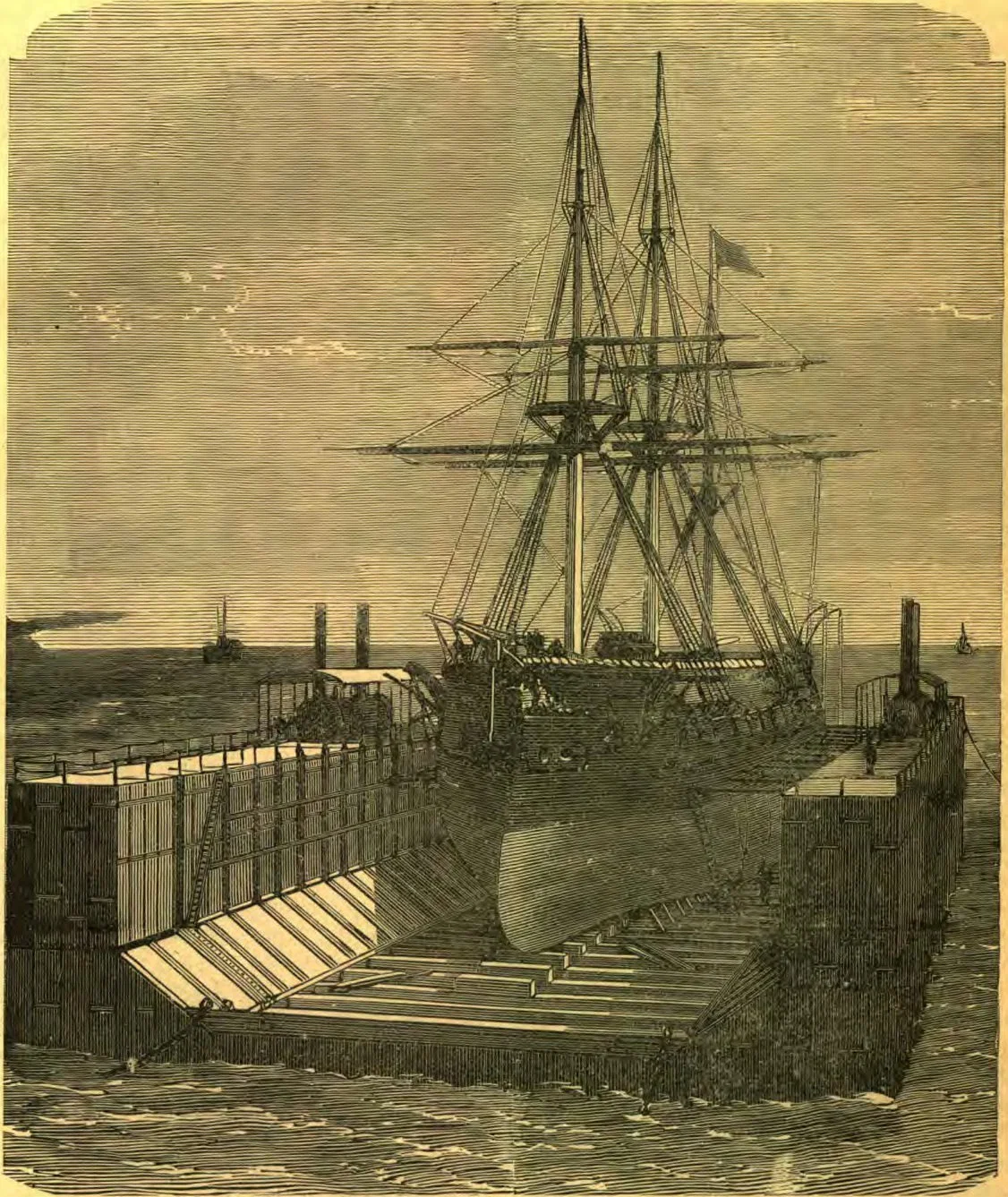
A DRY-DOCK.

Dry-docks are of various kinds and sizes; but all of them have but one purpose,—that of gaining access to the bottom of vessels. When a ship is taken in a dry-dock, the dock is first filled with water, and the ship is hauled in and placed in the exact position desired. The dock’s gate is then closed, and powerful pumps are set in motion to empty the dock. A floating dry-dock is different from others in that it is made to be sunk, and the vessel is placed inside it, and made fast. Pumps are then put to work, and the water is pumped out and air takes its place. This causes the dock to rise to the surface, thus lifting the vessel out of the water.
All vessels must have their bottoms cleaned now and then, and sometimes extensive repairs are necessary. They are often coated with tar and paint.
The largest dry-dock I have seen is on the north shore at Auckland, New Zealand. It can receive two of the largest English men-of-war at once. The United States government has just built a very fine dry-dock at Port Royal, South Carolina. J. CHRISTIANSEN.

CURIOSITIES OF ETIQUETTE.

In the Austrian court it is contrary to custom for perishable articles to appear twice on the imperial table. The result is large perquisites for the attendants. To one man fall all the uncorked bottles, to another the wine left in the glasses, to another the joints, and to another still the game or the sweets. Every morning a sort of market is held in the basement of the palace, where the Viennese come readily to purchase the remains. And there is no other means of procuring imperial Tokay than this,—buying the wine left over from the emperor’s table.
Long ago in England even the greatest men in the land were pleased to receive such perquisites. In the reign of Henry II, for instance, the Lord Chancellor was entitled to the candle-ends of one great and forty small candles a day; and the aquarius, who must be a baron in rank, received one penny for drying towels on every ordinary occasion of the king’s bathing.
The royal ceremonial which the French Revolution swept away, the first Emperor Napoleon was careful to revive in a less extreme form, and it is characteristic of the man that he made a special study of it, and went so far as to prescribe the special forms to be observed on great occasions. Before his coronation, M. Isabey, the miniature painter, gave seven rehearsals with wooden dolls appropriately dressed, of the seven ceremonies that were to be enacted. One ceremony being especially intricate, the functionaries rehearsed it in person in the gallery of Diana at the Tuileries, a plan having been carefully traced with chalk on the floor. This was the sort of thing in which Napoleon especially rejoiced, and he himself arranged beforehand all the details of the entry of Maria Louisa into France, and of his subsequent marriage with her. Among other particulars, on reaching what was then French territory, the archduchess was conducted into the eastward room of a three-roomed house near Braunau; the French commissioner entered the westward; while the third room in the middle was occupied by the rest of the party. And M. de Bausset, who gives an account of the proceedings, having bored holes with a gimlet in the door of the middle-room, had a splendid view of the unconscious princess. But, he quaintly adds, it was the ladies who took most advantage of his forethought. — London Standard.

COURAGE

We greet with quickening pulse the story That shrouds a warrior's name in glory;
We thrill to learn, from lays heroic, How patriots perished, finely stoic.
Yet loftier courage means the giving Far less to dying than to living.
It means, with truth's divine assurance, To arm the soul in stern endurance;
It means with grip no stress can sever To clutch the sword of high endeavor
And wage, in patience and persistence, This bloodless battle called existence.
— Edgar Fawcett, in Youth's Companion

ARE YOU BUYING THE TREASURE?

(Conclusion.)
Christ does not use this parable to commend the man who hides the treasure until he can buy the field; but his object in using this illustration is to convey to our mind the value of spiritual things. To obtain worldly treasure, the man would make a sacrifice of his all; and how much more should we give for the priceless, heavenly treasure! He said again: “The kingdom of heaven is like unto a merchant-man, seeking goodly pearls: who, when he had found one pearl of great price, went and sold all that he had, and bought it.” This goodly pearl represents the priceless treasure of Christ, as does the gold hid in the field. In Christ we have everything that is needful for us in this life, and that which will make up the joy of the world to come. All the money in the world will not buy the gift of peace and rest and love. These gifts are provided for us through faith in Christ. We cannot purchase these gifts from God; we have nothing with which to buy them. We are the property of God; for mind, soul, and body have been purchased by the ransom of the life of the Son of God. Then how can we buy the Son of God as our treasure? Jesus says: “I counsel thee to buy of me gold tried in the fire, that thou mayest be rich; and white raiment, that thou mayest be clothed, and that the shame of thy nakedness do not appear; and anoint thine eyes with eye-salve, that thou mayest see.” Then what is it to buy the eternal treasure?—It is simply to give back to Jesus his own, to receive him into the heart by faith. It is coöperation with God; it is bearing the yoke with Christ; it is lifting his burdens. For our sakes he became poor, that we through his poverty might be made rich. The Lord Jesus laid aside his royal crown, he left his high command, he clothed his divinity with humanity, in order that through humanity he might uplift the human race. He so appreciated the possibility of the human race that he became man’s substitute and surety. He places upon man his own merit, and thus elevates him in the scale of moral value with God. Christ is the atoning sacrifice. He left the glory of heaven, he parted with his riches, he laid aside his honor, not in order to create love and interest for man in the heart of God, but to be an exponent of the love that existed in the heart of the Father. He came into the world to make man accept the fact that although man had sinned against God, “God so loved the world, that he gave his only begotten Son, that whosoever believeth in him should not perish, but have everlasting life.” Jesus paid the price of all his riches, he assumed humanity, he condescended to a life of poverty and humiliation, in order that he might seek and save that which was lost.
Through the grace of Christ, we may be strengthened and matured, so that though now imperfect, we may become complete in him. We have mortgaged ourselves to Satan, but Christ came to ransom and redeem us. We cannot purchase anything from God. It is only by grace, the free gift of God in Christ, that we are saved.
In the parable of the treasure in the field, the man who found it went and hid it until he was enabled to purchase it; but in finding Christ, we have nothing to hide. In our great joy we desire to reveal the hidden treasure to others. We are eager to impart the possession, and put forth heartfelt, earnest effort so to represent the treasure to others that they may value it as we value it. Like the man who sold his all, we estimate nothing too dear to be sacrificed for the possession of the heavenly treasure. Those who find Christ find salvation, and they are not ashamed to have any one understand what a high estimate they place upon him who is their salvation, righteousness, sanctification, redemption, and exceeding great reward. They desire that all shall see and appreciate the treasure which they have found. They desire that every one shall open the heart so that the healing beams of the Sun of righteousness may shine into the chambers of heart and mind, and that others may have the light of life. It is impossible to hide the bright hope that comes to the soul who lays hold of Christ by faith. When Jesus went through the cities and villages of Palestine, it is written that he “could not be hid.” Let the precious Saviour come into the heart, and his presence cannot be concealed. The heart will be full of hope, comfort, and love, and a divine light will illuminate the countenance.
Christ says to you, “My son, give me thine heart.” And in exchange for your heart, he says, “A new heart also will I give thee.” Will you accept the heavenly treasure on Christ’s terms? Those who make the treasure their own by faith, are the only ones who can be benefited by it. We are to appropriate Christ by accepting the truth of his word. Are we doing it? MRS. E. G. WHITE.

“BE THOU AN EXAMPLE.”

YOUNG people seldom think of the real advantage of youth as contrasted with age. We may desire the experience, mature judgment, and wisdom of the sage, and in our hearts love, honor, and respect the aged; yet the infirmities which the passing years bring have no attraction for us. Sometimes young people think that religion is for middle-aged and elderly people. The idea prevails that it is natural for old people to be Christians, and that much should not be expected of youthful hearts; yet when we read the history of God’s people, we see that in a number of cases those who were young in years had marked evidences of the special favor of God. Samuel received divine communications, even in childhood, and does it not seem strange that the Lord passed by the men of wisdom and experience, and chose the young man Saul to be king over Israel? The case of David is similar. He was chosen, instead of men who were older and more prominent, to overcome the champion of the Philistines, Goliath. He afterward became king of Israel.
The admonition Paul gives to Timothy in 1 Tim. 4:12 shows clearly what God desires the youth to be. Read the verse very carefully. We usually think it the duty of fathers and mothers to set a proper example before children and youth; but here we see that Paul tells Timothy—a young man—that he ought to be an example. Does it say that he should be an example only to the unconverted?—No; it says: “Be thou an example of the believers.” This means much more. Notice the points in which Timothy was exhorted to be an example. What more noble ambition could inspire the heart of a young man or woman than to be an example to believers “in word, in conversation, in charity, in spirit, in faith, in purity”? What a power for good would be exerted by a young person whose word and conversation was right at all times, whose heart was pure, and whose faith was constantly taking hold of Christ! God does not ask impossibilities of any of his children. It is possible for our young people to be strong in the Lord and the power of his might. How our little companies and churches would flourish and grow in strength if the youth who are connected with them would only permit the Spirit of God to lead them in their duties! “Be thou an example of the believers.” This means you, dear reader. God has a care for the young people of our denomination. He has sent many tender entreaties to you, and he places before you a high position of honor and trust. It is time to choose whom ye will serve. MRS. L. FLORA PLUMMER.

MY FEEBLE LIFE.

I have no wit, no words, no tears; My heart within me like a stone Is numbed too much for hopes or fears; Look right, look left, I dwell alone; I lift mine eyes, but dimmed with grief No everlasting hills I see; My life is in the falling leaf; O Jesus, quicken me.
My life is like a faded leaf, My harvest dwindled to a husk; Truly, my life is void and brief, And tedious in the barren dusk; My life is like a frozen thing, No bud nor greenness can I see; Yet rise it shall—the sap of spring; O Jesus, rise in me.
My life is like a broken bowl, A broken bowl that cannot hold One drop of water for my soul, Or cordial in the searching cold. Cast in the fire the perished thing, Melt and remold it, till it be A royal cup for him, my King; O Jesus, drink of me.
— Christina G. Rossetti.

REST

CHRIST'S life outwardly was one of the most troubled lives that was ever lived,—tempest and tumult, tumult and tempest, the waves breaking over it all the time, till the worn body was laid in the grave. But the inner life was a sea of glass. The great calm was always there. At any moment you might have gone to him and found rest. Even when the bloodhounds were dogging him in the streets of Jerusalem, he turned to his disciples, and offered them, as a last legacy, “my peace.” Nothing ever for a moment broke the serenity of Christ’s life on earth. Misfortune could not reach him; he had no fortune. Food, raiment, money—fountain-heads of half the world’s weariness—he simply did not care for; they played no part in his life; he “took no thought” for them. It was impossible to affect him by lowering his reputation; he had already made himself of no reputation. He was dumb before insult. When he was reviled, he reviled not again. In fact, there was nothing that the world could do to him that could ruffle the surface of his spirit.
Such living, as mere living, is altogether unique. It is only when we see what it was in him that we can know what the word “rest” means. It lies not in emotions nor in the absence of emotions. It is not a hallowed feeling that comes over us in church. It is not something that the preacher has in his voice. It is not in nature, nor in poetry, nor in music—though in all these there is soothing. It is the mind at leisure from itself. It is the perfect poise of the soul, the absolute adjustment of the inward man to the stress of all outward things, the preparedness against every emergency, the stability of assured convictions, the eternal calm of an invulnerable faith, the repose of a heart set deep in God. It is the mood of a man who says, with Browning: “God’s in his heaven; all’s well with the world.”—Henry Drummond.

EUROPEAN AFFAIRS.

If the Sublime Porte has imagined that with the return of the Tories to power in Great Britain, the pressure upon Turkey to fulfil her unfulfilled pledges of reform would be removed, and that the Armenian question would be permitted to slumber on indefinitely, it has made a great mistake. The Armenian question is the first to which Lord Salisbury turns his attention. His language is such that the Grand Turk at Constantinople cannot fail to understand it, whether the nomadic Kurds will be able to comprehend it or not. Thus he says:—
“With respect to Armenia, we have accepted the policy which our predecessors initiated, and our efforts will be directed to obtaining an adequate guarantee for the carrying out of reform. We have received a most loyal support from both France and Russia. The permanence of the sultan’s rule is involved in the conduct he pursues. If the cries of misery continue, the sultan must realize that Europe will become weary of appeals, and the fictitious strength which the powers have given the empire will fail it. The sultan will make a calamitous mistake if he refuses to accept the advice of the European powers relative to reforms.”
Mr. Gladstone has already shown by his great speech at Chester that he is substantially in agreement upon this subject with the new administration. Evidently the Turk must get down or get out.
THE German celebrations of the victories of 1870 and 1871, which have filled Germany with enthusiasm, have not been without effect upon France. The latter country has had to pay dearly for the ill-advised war with Prussia, precipitated by Napoleon III and his priest-controlled empress, Eugenia. France was defeated and despoiled, and then, during all these years since, while the nation has been slowly recovering her strength, Germany has not failed to glorify herself in her phenomenal success. All this is exceedingly trying to a proud-spirited and warlike nation like France, which for so many years stood at the head of European affairs. She is no longer afraid of Germany, and now having the friendship of Russia, she is deeply stirred with resentment at these noisy demonstrations over German victories. Thus the fighting spirit is kept up in two of the most powerful nations of the world, whose immense armies are only a few days’ march from each other. These festivities in honor of the German victories will not end until January 18. If France shall be able to contain herself under this prolonged strain, she will show a creditable amount of courage and self-control.
THE royal house of Austria, the Hapsburgs, seems to be in a fair way of becoming extinct. A few years ago the prince imperial committed suicide, the prospect of the throne of Austro-Hungary not being thought of sufficient worth to live for. His two remaining brothers have all the vices of princes, and now one is said to have a dangerous illness. There are hundreds of impecunious princes, of blue-blood and dissolute habits, who will be ready to accept a call from Austro-Hungary to rule the country; but in the event of a lack of royal material, the people may have something to say. Hungary would undoubtedly demand a republic, for the spirit of liberty still lives in the land of Kossuth. What a pity it cannot animate all Europe, as it did in the heroic days of 1848!
UPON the Mekong and upon the Niger England and France are almost continuously at loggerheads. France has induced China to cede to her some territory which England not only claims, but of which she is in actual possession. The two nations are now growling at each other, and should the English press give way to these provoking encroachments of France, no one can tell what would happen.
Altogether, European affairs are in a very unsettled state, and no one can tell what a day may bring forth.
ENGLAND is generally credited with being far more friendly toward the Triple Alliance than toward France and Russia; but lately the free comments of the English press upon German affairs has so stirred the usually phlegmatic Teutons, that everything pertaining to England is exceedingly distasteful to them. Emperor William lately made a short visit to the north of England, but the sharp hits of the London papers so angered him that he decided not to visit the capital of his grandmother, the good Victoria.

STEAM AND ELECTRICITY.

FOR some time it has been apparent that the time would come when steam, as a motive power, would be superseded by the newer and more perfect electrical force. The advantages of electricity over steam are plain to be seen,—it has unlimited power, is easily controlled, can be transmitted long distances, and is free from smoke, fire, and dust. These qualifications proclaim electricity as the coming power for manufacturing, for railways, and for ships. At some places sufficient electrical power is generated not only to light the town and run various manufactories, but a large amount is transmitted by wire to other towns which have no electric plant of their own, for the same purposes. An electric plant at Niagara, N. Y., is using a portion of the immense power of the Niagara Falls to generate electricity for all the surrounding territory. It is claimed that by and by the whole route from Niagara to Buffalo will be lighted at night by electricity furnished by the electric plant at Niagara. An electrical railroad is now nearly completed from Niagara to Buffalo, and soon the tourist to the falls will be able to ride along that wonderful river from the falls to the lake, on the margin of the water, carried by the electric power which the great falls manufactures. No doubt other towns possessing a good water power will become centers of electrical energy which will be conveyed to other towns less favored. Of course steam power can be used anywhere as a manufacturer of electric power, but water power for such a purpose will always be the cheaper method.
The railway companies see what is coming, and are preparing for the change. It will not be accomplished at once, as the expense would be too great, and time must be allowed the train hands to get acquainted with the new power. Electricity is now used for nearly all the traffic in cities, as well as for short lines outside; and lines connecting cities which are not far apart are now being projected.
It has been thought that the great companies which are engaged in the manufacture of steam engines would stand in the way of the electric engines, and that there would be a great financial and legal battle between the representatives of the rival powers, steam and electricity, before the new power could gain a footing; but recent events show that this will not be the case. Those who are interested in both these powers, seeing the inevitable, have decided to join hands and work together. To this end two great companies, the Westinghouse Electric Company and the Pittsburgh and Baldwin Locomotive Company of New York, have joined together in one company, representing a capital of twenty million dollars. As one paper expresses it, “It is the marriage of the steam engine and the dynamo.” Henceforth they will pull together, each in its own harness, and the fittest will survive.
We have no fault to find with steam power. It was and is a great invention. It has done its work well, and has shown its activity and power in a thousand ways; but if a stronger, better, and cleaner power has come, let us welcome it. Some predict much faster time on the railroads by electricity than by steam. This is not strange; for with lightning power, why not lightning speed?

THE RUSSIAN AND ABYSSINIAN TREATY.

The secret understanding existing between Russia and France is again shown by the treaty lately made between Russia and Abyssinia. France, Italy, England, and Germany have interests in Africa, but heretofore Russia has had nothing to say in regard to African affairs. It is for the interest of France that her newfound ally, Russia, should have an interest in that country, so that her voice might be heard and her power felt in Africa. This has now been accomplished; and the ancient kingdom of Abyssinia, ruled by King Menelek, who claims to be a descendant of Solomon, the wise king of Israel, has entered into close treaty relations with Russia. The Abyssinian bishop and the orthodox Greek bishop of Odessa have embraced each other in public, and have taken part in the same religious ceremonies.
That Russia should clasp hands with Abyssinia just at the time when Italy and Abyssinia are going to war, is a very significant movement, and it has made quite a sensation at Rome. As Italy is a member of the Triple Alliance, the whole alliance will feel as if it had received an affront. The present czar does not seem to have the pacific disposition of his late father. This is shown by his course of action toward Japan, and in this apparently uncalled-for treaty with Abyssinia.

A NEW GRAIN ROUTE.

CONSIDERABLE interest is being awakened in Canada over the plan for a new grain route from the Northwest to England and Europe by the way of Hudson's Bay. Connection between Hudson's Bay and the Canadian Northwest country will be made by a railroad seven hundred miles long from Winnipeg to the west shore of the bay. The Dominion parliament has voted a subsidy for this road. It passes through a cold and barren country, where there is no demand for a road except for the carrying trade from the extreme points of the road. The route from Winnipeg to England is a thousand miles shorter than by any other way; but as Hudson's Bay is open to safe navigation but three months each year, the project seems of doubtful utility. However, it presents a good opportunity for the Canadian government to get a little farther into debt. M. E. K.

TALKS WITH BOYS AND GIRLS.—NO 1.

DEAR CHILDREN: We now begin a series of weekly talks with you, through the INSTRUCTOR, on every-day topics. The wise man has said, “Hear, ye children, the instruction of a father, and attend to know understanding.” Prov. 4:1. Every man but Adam was once a boy, and every woman but Eve was once a girl. All have passed over the same road. So in our talks we hope to help the boys and girls understand some things that will help them over many of the difficulties that we, who are older, had to pass through. In the great coal mines of Wales there are red lights kept burning at different points to warn those who are not familiar with the mines that there is danger a little farther ahead. Those who marked the spots where the signal lights are placed, learned of these dangers by unpleasant experiences, or the death of some of their fellow miners. If they should refuse to place a signal of warning for others who are unacquainted with the way, many more lives might be lost.
So it is in life. The youth are beset with dangers on every hand. The fathers and mothers who have passed over the road, and know of the pits and death-damps, should put out the signal-light, and turn the coming generation from these sloughs. The children should hear the instruction given, and by asking questions, learn more about the way to avoid these pits of misery and death. If any who read these talks wish to ask questions, we shall be glad to receive letters from them, and will do our best to answer their questions.
The subject of our first talk is—

WORK AND PLAY.

We know that many children love to play. There are some who love to play and hate to work. There are a few who love to work, and do not care to engage in play. There are still others who love both to work and to play. We do not think it is a sin to play, if the play is one that is approved of by the Creator. The Lord looks upon children in play as well as when they are in worship. The Bible says, “Even a child is known by his doings, whether his work be pure, and whether it be right.” Prov. 20:11.
Perhaps some one will notice that the text does not say “whether his play be pure,” but it is “whether his work be pure.” This leads us to consider the difference between work and play. If I were to ask some of you to tell me the difference, I expect you would say, “Work makes us perspire, and makes our backs ache.” But did you ever perspire when you were playing ball or skipping the rope? Why did you call that play? It may be that the ball game or the blind-man’s-buff caused you to perspire more freely, and your limbs to ache more painfully, than when you carried in the coal, washed the dishes, weeded the garden, or swept the floor. Yet you called one work and the other play.
The difference, many times, is in the mind rather than in the thing done. I remember a boy who was husking corn with his father and brother. After his fingers became a little sore, he thought he must be excused from work. His father tried in every way to encourage him to keep at the work until the day was over, but all to no purpose. He pleaded that his hands were sore, his boots hurt his feet, and his back ached. His father did not want to be severe on his son, so he excused him for the afternoon. In less than half an hour the boy joined some neighbor boys in husking corn across the road, laughing and playing as though he never had sore hands or sore feet or lame back. Over there he was interested in the work, and it became play to him.
Is this not the secret of the whole matter? If boys and girls would seek to cultivate a taste for the work they are to perform, they would enjoy their work as much as they do their play. Then when the work was done, and they engaged in their games with a will, it would not be a change from work to play, but simply a change of exercise.
We have already cited you to the text that says, “Even a child is known by his doings.” His doings are his fruits. “By their fruits ye shall know them,” says the Saviour. Jesus loved children, and stopped in the midst of his teachings to put his hands on them and bless them. He loved to see them enjoy their play and also their work. He spent his youthful days with his father, engaging in the carpenter work. No doubt he became tired; yet he had a purpose that gave him enjoyment in his work.
Now, children, how do you do your work? Do you do it only when commanded, fretting under the burden all the time? Do you look upon your work as a drudgery, and long to get it off your hands so you can get out to play? Do you think God is pleased with such a course? Why not seek the Lord to make your work easy by keeping your mind on him, that you may feel happy because you are doing it for him? Try it. Turn your work into play, because you enjoy it. J. H. D.

GOOD MEMORIES.

It is a good thing to have a good memory. It saves a person from making many mistakes, and is a great help in acquiring a good education. But all people do not naturally possess this ability. Some have naturally good powers to return what they hear or read, while others have to hear it again and again, or read it over and over, before they can keep it in the mind.
This distinction is especially noticeable in the school-room. Some students have only to look at a thing once, and it seems to be fastened in the mind. Others put in hours trying to commit to memory, and fail when called to recite. Pen, pencil, and note-book are used to assist the memory, and yet much is lost.
There are various causes for this deficiency, yet it has been demonstrated that all, by earnest efforts, can improve in this direction. Many times haste is the cause of this defect. The student glides over the lesson without thinking of the power of the words read. Often it comes from a lack of a knowledge of the meaning of words. Not knowing the exact meaning of the words in which the thought is expressed, but a faint impression is made upon the mind. After a short time the student wishes to reproduce the thought, but is unable. He charges his memory with a failure, when it was a failure in receiving the thought. We cannot remember what we have never known.
There have been some men of very extraordinary memories in the world. They seem to be giants in this direction. It is said that Cyrus was able to call every person in his army by his proper name. He must have been a close observer to do this.
Mithridates, who governed twenty-three nations, all of different languages, could converse with every one of the twenty-three nations in its mother tongue. To remember twenty-three languages so as to think and converse in them, was a wonderful thing.
History records that Cyneas, despatched by Pyrrhus to Rome, the day after his arrival knew, and could salute by their names, all the senate and the whole order of gentlemen in the city. Again it is said of Seneca that he could repeat two thousand verses at one sitting, in their order, and then, beginning at the end, repeat them backward, without missing one.
Maglia Bethi could quote from memory the chapter, section, and page of any book he had read, and could repeat the author's words in reference to any particular topic. A gentleman, to test his memory, lent him a large manuscript which he intended to publish, and calling on Bethi some time after he had returned it, pretended that the manuscript had been lost, and requested him to write as much of it as he could remember. The record states that he wrote it again accurately, word for word, as it was in the manuscript itself.
These examples just given show us that the mind can be trained to great achievements in retaining and reproducing matter that has once been fastened there; but it takes practise to accomplish anything in this line. Yet it is a most excellent acquisition. If every young man was as familiar with the word of God as these men were with what they learned, what a power they would have in resisting temptation! Let us seek to improve the mind in retaining what it has once received. J. H. D.

TRUST AND DISTRUST.

EVERY little while the public learns that some man of high standing, who has been for years honored, respected, and trusted as the very soul of honor, has been shown to be a knave, perhaps has been so for a long time. When we hear of these things, we feel something as did Washington when he learned of Arnold’s duplicity and traitorous designs against his country, and say, as Washington then said, “Who can we trust now?” But we should not let these examples of evil breed in us wholesale distrust of every one. It is well to manifest caution in all things, but we should never allow caution to degenerate into a cynical distrust of men and measures. It is better to believe a man to be honest until you know he is not, than it is to believe he is dishonest, until it is demonstrated to you in an unmistakable manner that your suspicions are unfounded.
When the celebrated Kitto was a boy, he recorded the following in his diary: “Gained the idea that it is better to be deceived sometimes than never to trust.” Although this was but a boy’s idea, it was worthy of a philosopher.
We once hired a ground for a camp-meeting. The owner was very suspicious, and seemed to fear, all the time, that he was likely to be made the victim of some deep-laid plot. Happily for our reputation, he felt better after the meeting was over. Another,—a frank, open-hearted business man of that same town,—speaking to us of this man, said: “Mr. —— believes that the whole world is engaged in a conspiracy to cheat him, and he shows his fear of it in his face.” There are rogues, but there are honest men; if there were not, the rogues would cease to be a novelty. M. E. K.

LESSON 12.—TITHING.

  • (September 14, 1895.)*
1. To whom did Abraham pay tithes? Gen. 14: 18–20; Heb. 7: 1, 2, 4.
2. What was Melchisedec?—“Priest of the Most High God.” Verses 1, 2.
3. What is said of his genealogy? Verse 3. (See note .)
4. What is said of his greatness? Verse 4.
5. Of whom did the Levites receive tithes? Verse 5.
6. Who received tithes of Abraham? Verse 6.
7. By whom was Abraham blessed? Verses 1, 6.
8. Who, then, was the greater, Abraham or Melchisedec? Verses 4, 6, 7.
9. Whom did Melchisedec represent? Verses 3, 15.
10. After what order was Christ a priest? Heb. 5: 6; 6: 20; 7: 17, 21.
11. Then does Christ receive tithes? Heb. 7: 8.
12. What did the Saviour teach concerning tithing? Matt. 23: 23. (See note .)
13. Then, as followers of the teachings of Christ, what ought we to do?—Pay tithes. (See note .)
14. How were the Levites supported in their work? 1 Cor. 9: 13. (See note .)
15. What has the Lord likewise ordained concerning the support of those who preach the gospel? Verse 14. (See note .)
16. Who commissions and sends out those who preach the gospel? Matt. 28: 18–20; John 20: 21.
17. Then whose servants are they? Who employs them?
18. And in accordance with what has been shown in the above, what provision has the Lord made for the support of his laborers? (See note .)
Continue reading: THE PRESERVATION OF THE BIBLE THROUGH THE MIDDLE AGES