A writer of the sixteenth century in the vigorous style of that period described Calabria as “the trembling land.” This province forms the toe of the Italian boot and there very often the shoe pinches. In fact all of Southern Italy is more or less subject to the dangerous caprices of nature. One moment the country is heaving to and fro like a ship at sea, in the iron grasp of the earthquake giant, and in another, smoke, fire, and lava are being belched forth from the bowels of the earth thru the mighty crater of Vesuvius.
Only two years ago Calabria passed thru a fearful earthquake experience which left a large part of the province devastated and desolate. But the people are courageous and the work of restoring the towns and villages destroyed by the earthquake was soon begun. From all Italy came contributions of money and provisions. The city of Milan alone helped to erect two new towns near the site of the ones that had been shaken down by the earthquake.
Just as the Minister of Finance and other governmental and provincial officials were on the point of inaugurating some of these new towns, the earthquake giant again arose in his might and shook violently that section of the province adjoining the one previously devastated.
It has been said that during the interval from the earthquake in 1905 to the present one, the earth has been in a continual tremor, as shown by the seismographic instruments, but not sensible enough to be felt by the people. The seismograph registered from the time of the earthquake of 1905 to July, 1906, the space of about a year, as many as 300 distinct shocks in this region.
This last earthquake, it is claimed, came as a culmination of the uncertain state in which Calabria has found itself ever since the previous great scourge. But be that as it may, yet we see that the old earth, as a man at advanced age, is becoming unsteady in its gait and is in a state of tremor because it also is approaching the end of its days.
The towns and villages that suffered the heaviest in this last earthquake were for the most part situated high up among the mountains, overlooking the blue waters of the Ionian, the sea of Pythagoras and Praxiteles. The well-cultivated vineyards and groves of orange and olive trees that clothe the mountainside indicate that the people are thrifty and industrious.
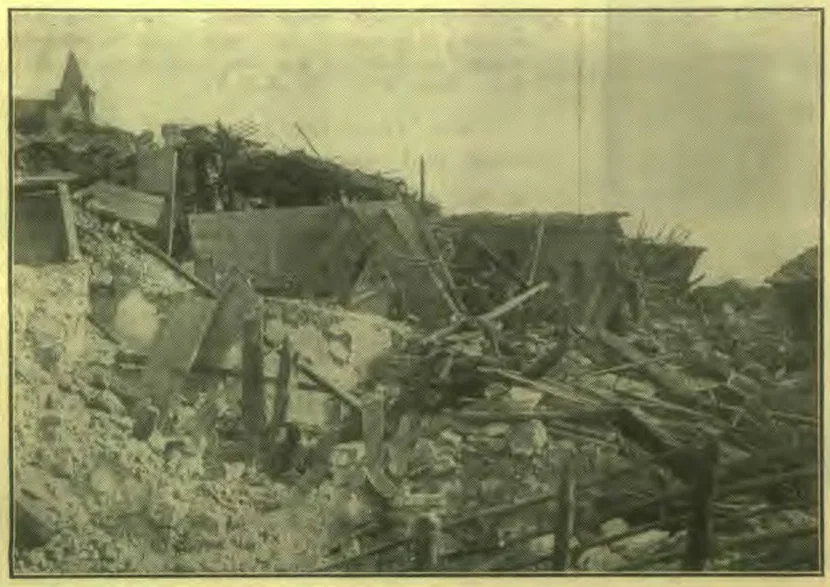
A Section of Ferrazzano as It Appeared after the Earthquake.
In the Wake of the Earthquake: Not a House Left Intact.
Calabria formed a part of the ancient Magna Grecia, which derived its name from the powerful Greek colonies that in very early times studded this part of Italy. Pythagoras here founded a school of philosophy to which even the great Plato came to cultivate his mighty genius. And also in its magnificent scenery Calabria partakes much of the nature of Greece. The oranges of Calabria are among the finest to be had anywhere.
The people of the stricken districts, living mostly among the mountains, were accustomed to retire early and were therefore wrapped in deep sleep on the evening of October 23, the fatal night that marked the death knell for many of them.
About nine o’clock that evening the earth began to rock to and fro and play havoc with its slumbering children. There was first a slight shock which was quickly followed by a very severe one. And in ten seconds the earthquake had transformed flourishing towns and villages into cemeteries and heaps of ruins.
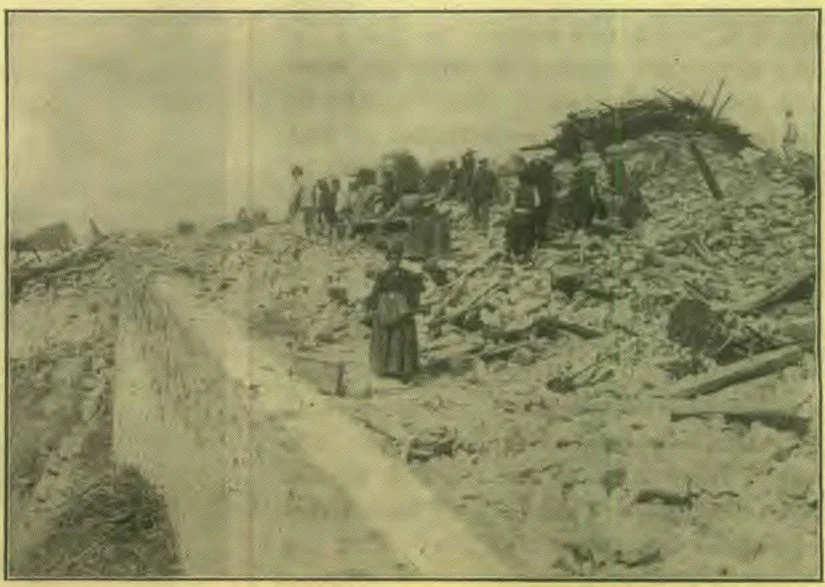
Hunting for Their Scanty Belongings after the Calabrian Earthquake.
Upon the town of Ferrazzano, with its 2,500 inhabitants, the earthquake struck in all its fury. Many of the inhabitants were buried under the roofs and walls of their own houses, while wrapped in slumber. Some, as if by miracle, escaped; others ran out into the open country, while some badly wounded perished during the night for lack of assistance.
The earthquake throwing down the homes of the people and spreading death and distress everywhere was assisted in its destructive work, as if by the cruel irony of nature, by the blackened skies that poured down their abundant stores of rain in drenching torrents. In that terrible moment those that had escaped with their lives, terrified beyond measure, sought refuge in the open fields, where the rain beat mercilessly down upon them. With the clayey constituency of the soil we can well imagine that there must have been desolation personified.
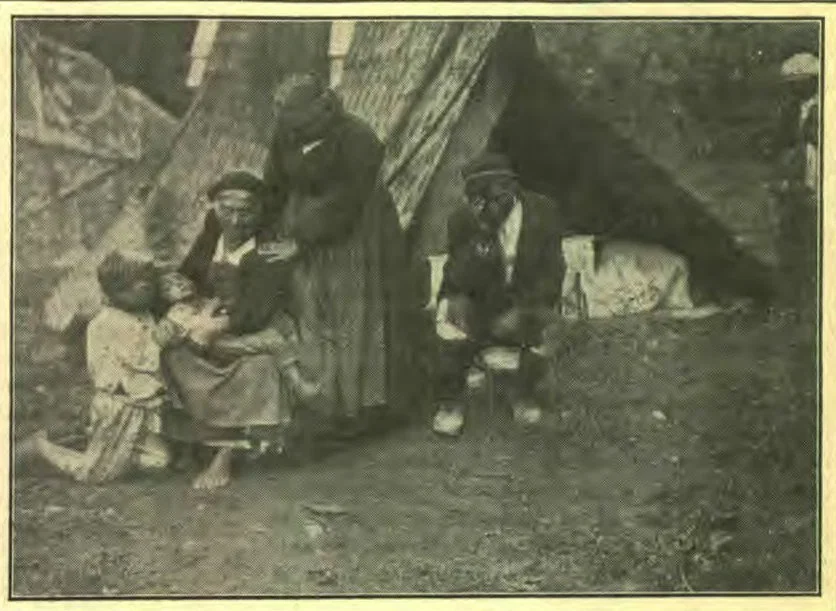
When the morning dawn shed forth its gleams upon the grewsome spectacle, crowds of pale, terrorized people could be seen thoroly drenched from the rain and trembling from the cold, as these towns are situated high up among the mountains. Almost all the houses were razed to the ground while the few that remained standing were in danger of falling at any moment. Pieces of walls and roofs were balanced in air as if by a miracle of equilibrium. The town was literally deserted. On the heaps of ruins some old women were endeavoring to gather up a few of their scanty belongings. One old lady sat on a desolate pile that once represented her home crying, “My poor boy, my poor boy!” Entire families were wiped out, and in some instances there were children left orphans or a lone father wandering about deprived of his entire family.
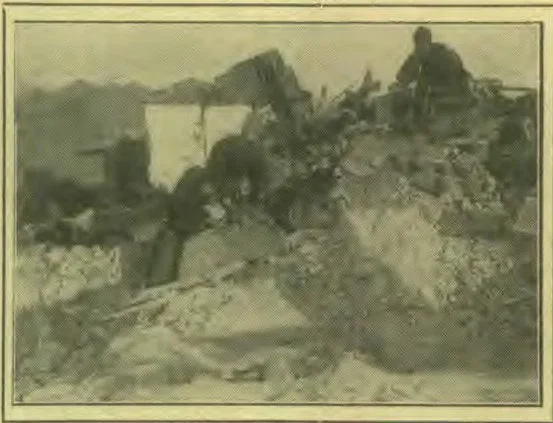
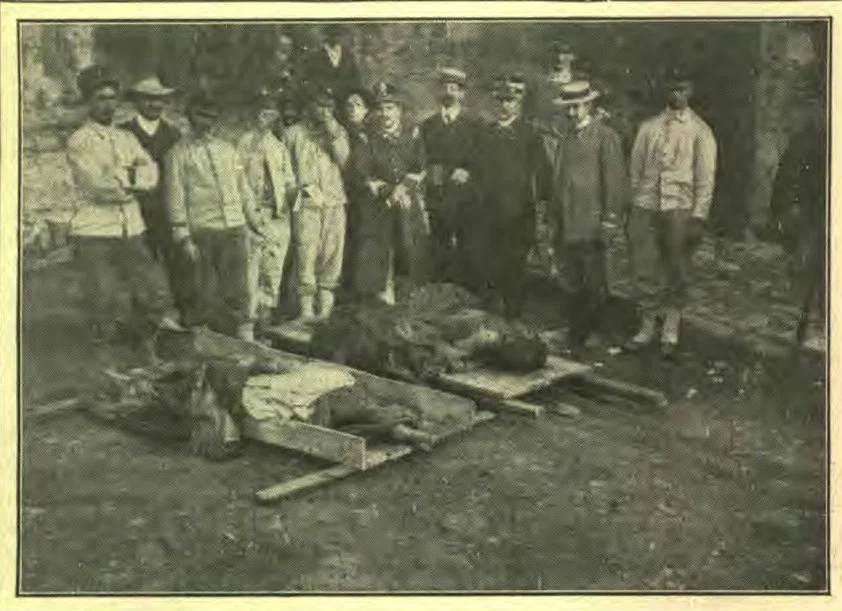
As the work of rescue began the people crowded upon the spot, each anxious to find a lost relative or friend. One man that had been for some time buried under the ruins was pulled out by the soldiers and found to be alive. He looked about him for a moment and then ran down the street crying for joy. One can hardly imagine the touching scenes that took place when some one that was thought to be lost was found safe and sound and joyfully embraced by his dear ones.
In one town called Gerace Marina four-fifths of the houses are down, while Brancaleone was almost entirely destroyed. Without11going into detail on the extent to which the different places suffered, suffice it to say that twenty-seven towns and villages suffered heavily in the earthquake while there were twenty-eight others that were less severely damaged.
At first the number of those that perished in the earthquake was reported to surpass five hundred. But an accurate and careful examination revealed that the death-list is not much over 200. However, besides these, many were wounded, hundreds of houses have been destroyed, and thousands are camping in the open air.
The government immediately despatched a war-ship and a large number of soldiers to the scene of the disaster. Thus was quickly begun the work of rescuing those buried under the ruins, and giving aid to the wounded and suffering. Lumber was also sent from northern Italy which was accorded free transportation by the railroads, to be used for building temporary huts for sheltering the homeless people from the storms.
The different cities of Italy contributed liberally to aid the inhabitants of the earthquake-stricken districts. The king of Italy immediately sent $20,000 to alleviate the suffering of his afflicted subjects. The students of the different large universities of Italy went thru the streets of their respective towns soliciting money, provisions, and clothing for the homeless of Calabria. In Milan alone they gathered about $7,000.
Victims Extracted from the Ruins.
A Forlorn Family Rendered Homeless by the Earthquake.
The Catholic Church came forward and loudly lamented the sad fate that had overtaken the poor inhabitants of Calabria. It generously offered its aid; however, in caring for the dead rather than the living. So solemn masses were proclaimed for the suffrage of the souls of those that perished in the earthquake. The emissaries of the church went around from house to house collecting money to pay for these masses. A goodly sum was thus gotten together. The masses were celebrated with much pomp and ceremony, and the money collected went to pay for the same and consequently safely found its way into the coffers of the church. Thus the church helped the victims of the earthquake by helping itself. But I might add that something was done by the Catholic Church toward collecting money also to help rebuild its churches that were destroyed or damaged by the earthquake. The church of Rome knows how to turn ever the calamities of the people to its profit.
Also in Italy the earthquake played its caprices. In one place it left the upper half of the town untouched, while in the lower half not a house was left intact.
On the morning following the earthquake a reporter met a lady carrying a nine-months’-old baby in her arms. The babe opened its bright eyes and smiled sweetly at him, happily unconscious in its innocency that it was alone in the world. On the evening of the earthquake the father, mother, two brothers, and a gardener were crushed by the house falling upon them. But the mother by the maternal instinct of her nature bent herself over her babe and in that position perished. The babe was found the next morning, alive and unhurt, lying between the right hand and body of its dead mother.
A boy was deprived of his parents and all his relatives by the earthquake. The small savings of his people were lost; the home was carried away and dashed into an abyss, 1,300 feet below, and even the ground upon which it stood was altered beyond recognition.
These momentary tremors of the earth involving but a corner of its surface can give us some slight idea of what that day will be of which it says, “And EVERY mountain and island were moved out of their places.” These are forerunners of that time, announcing in no uncertain tones that that day hasteneth greatly.
C. E. MILTON.
The Recrudescence of Evil Days
Never perhaps since the days of the Reformation was there a time of such wide-spread agitation for what will ultimately mean the union of church and state. We are living in the later American Republic the life of the Roman Republic over again. As men lost faith in God's word in the early centuries of Christendom, as the state, influenced by the wealthy and luxurious, sunk more and more deeply into iniquity and manifold crimes of every sort, the apostate church and the weakened state naturally came together,—ambitious men in the state to secure the power of the church for the furtherance of their aims, and ambitious men of the church to secure the power of the state for the enforcement of so-called Christian dogmas. We are living in principle that time over to-day.
And, saddest of all, it is manifest in what was once, at least, "the land of the free and the home of the brave," a nation that had nailed to its standard banners bearing the inscription, "Congress shall make no law respecting the establishment of religion or prohibiting the free exercise thereof." Yet there lie before us at the present writing not less than four bills at present before Congress, every one of which if enacted into law will be an advance step to the fuller union of church and state.
1. H. R. Bill No. 327, introduced by Mr. Ollie M. Jones, referred to the Committee on Coinage, Weights, and Measures, to restore the inscription, "In God We Trust," upon the coins of the United States of America. It is very brief, as follows: "Be it enacted by the Senate and House of Representatives of the United States of America in Congress assembled, that all coins of the United States of America hereafter minted or coined shall bear the inscription, 'In God We Trust.'"
2. H. R. Bill 4597, introduced by Mr. Allen, referred to the Committee on the District of Columbia, entitled "A Bill to Further Protect the First Day of the Week as a Day of Rest in the District of Columbia;" prohibiting the keeping open of any place of business or the maintaining of any stand for the sale of any article or articles of profit during Sunday, except venders of books and newspapers, and apothecaries for the dispensing of medicine, undertaking establishments and other things for the purpose of charity or necessity. Football and baseball, all other kinds of playing, sports or pastimes or diversions disturbing the peace and keeping of the day prohibited in the District of Columbia on Sunday; building operations and railway construction made unlawful. Violation of the law is subject to a penalty of not less than $5.00 nor more than $50.00; in cases of corporations a light fine for every person employed in violation of this act. Those who uniformly keep another day of the week as a day of rest are exempt from prosecution.
3. H. R. Bill 4929, introduced by Mr. Heflin, referred to the Committee on District of Columbia, entitled "A Bill Prohibiting Labor on Buildings, etc., in the District of Columbia on the Sabbath Day."
4. S. Bill 1519, introduced by Mr. Penrose, referred to the Committee on Post-offices and Post-roads, entitled "A Bill to Prevent Sunday Banking in Post-offices in the Handling of Money-orders and Registered Letters."
Of the first of these we are glad to see that some of the great journals of the United States, like the "Independent," and some of the devoted religionists of the United States, are not in anywise troubled over the irreligion of leaving off the words "In God We Trust." Of what importance are they anyway? How do they bring the nation or the individual nearer God? It was said of Israel of old the more they increased the more they sinned against God; yet they multiplied to themselves altars, increased their prayers, kept their feasts at the new moon, and made high profession. Whether our coinage shall bear the inscription or not will make or break no true character. If the dishonesty which has been revealed in almost every phase of life, and12country-wide, continues, the inscription will be a hollow mockery.
As to the bills which follow, no human law can make a Sabbath, protect a Sabbath, or make Sabbath-keepers acceptable in God's sight. Presumably the men behind these are professed Christians; they believe neither in the Jewish nor the Mohammedan religion, yet they would forbid men proper physical exercise who believe in Christ, while at the same time they would allow religious teaching and public worship of the most antichristian character. Of course the Mohammedan or any other religious person has the right so far as man is concerned to worship what he will and as he will. But the facts show how utterly inconsistent is every attempt to control worship and regulate religious institutions or dogmas by law. Why not TRUST God to care for His own Sabbath? The Religious Liberty Society will make a strong fight in the District of Columbia to enlighten the people. We earnestly hope that our readers will study the question and be found on the right side.
Annual Meeting of the California Conference Association.
By W. T. Knox
THE twelfth annual meeting of the California Conference Association of Seventh-day Adventists will be held in connection with the thirty-seventh annual session of the California Conference of Seventh-day Adventists, at Fresno, Cal., January 31 to February 5, 1908, for the purpose of electing a board of seven directors and transacting any other business that may come before the meeting.
W. T. Knox, President.
E. A. Chapman, Secretary.
Annual Meeting of the California Conference.
THE thirty-seventh annual meeting of the California Conference will convene at Fresno, Cal., Jan. 31, 1908, at 7:30 P.M., continuing until February 5.
Each church is entitled to one delegate for the church, and one additional delegate for every twenty members.
A full delegation is earnestly desired.
W. T. Knox, President.
E. A. Chapman, Secretary.
North Pacific Union Conference.
By W. B. White
NOTICE is hereby given that the first biennial session of the North Pacific Union Conference will be held at College Place, Wash., Jan. 31 to Feb. 9, 1908. The first meeting of this session will take place at 9:00 A.M. January 31. All accredited delegates are requested to be present, if possible, at the first meeting.
W. B. WHITE, President.
Wild Beasts
Wild Beasts.—A report from Calcutta declares that wild beasts killed in India in 1906, 2,081 persons, while 22,844 natives died as a result of snake bites, 1,000 more than the year previous. See Rev. 6:8.
Flesh-Eating
Flesh-Eating.—Every now and then we read in the newspapers an item like this, "November 30. Masons[*] Eat Tainted Oysters; Three Dead." Here is another, "An Inquest Held over a Citizen in Canada, Who Died from Ptomain Poison from Eating Sausages." And the whole of one page of a Sunday paper is devoted to the oyster and clam beds of New York, and how they are fattened and polluted by the half billion barrels of sewage poured over them every day. And there are many other oysters and clams, besides those gathered in New York, from the mouth of the harbors of the big cities. It is on just such things as sewage and the offal of the ocean that the "delicious bivalves" fatten. Yet men will eat them, and still continue to eat flesh, notwithstanding ptomain poisoning. We believe in a grain, fruit, and vegetable diet because it is better. Many of the ills that are sweeping thousands away do not trouble the vegetarian.
Death of Dr. George Schrady
We neglected to report the death, November 30, of Dr. George Schrady, for many years the able editor of the New York Medical Journal. He was the attending physician during the illness of Grant, and was called into consultation in the case of President Garfield; and also investigated plague conditions in San Francisco.
Our National Shame
Our National Shame.—The Constitution, of Atlanta, Ga., in its issue of December 20 calls crime our national shame, and says, "Statistics upon statistics have been quoted showing impressively an increase in criminal activity proportionally greater than the increase of population, and in all these figures crimes involving the taking of, or the attempt to take, human life predominate." The Constitution declares that three-fourths of all the prisoners in Georgia penitentiaries are there for crimes against human life, while the penitentiary records make no mention of the many murderers or would-be murderers who escape detection or arrest. The Constitution further declares: "The truth is, if such conditions are to continue, life is nowhere safe. No citizen can know at what moment he will become the victim of the pistol 'toter' or the assassin." This from a secular paper. How truly it accords with the word of God which declares that the latter days will be as the days of Noah; and in the days of Noah, we are told, the earth was filled with violence.
The Sabbath Question
By Editor
We are glad to see the widespread agitation of the Sabbath question. Let it be agitated. Let men investigate it to its fullest. Not all papers will admit both sides of the question. We are glad to see articles, however, in the N. E. Argus, of Minneapolis, and the Trenton Times, of New Jersey. The first of these shows what true Christianity was from the Bible standpoint, and how human laws exalt themselves above the law of God, written by Mr. H. F. Phelps; while the other squarely and frankly takes issue with the Sunday-Sabbath idea, and proves both by history and the Bible that Sunday is not the Sabbath. This is written by Mr. B. F. Kneeland.
Earthquake Shocks Across Continents
A despatch from Laibach, Austria-Hungary, dated December 30, states that a series of earthquake shocks of great violence were recorded at that observatory that morning, having according to the estimation of scientists their center on the mainland between Mexico and Columbia. Isle of Wight recorded the same strong convulsions. Prof. John Milne believes such a disturbance must have been destructive unless marine. The same morning a heavy earthquake was recorded at Cheltenham, Md., lasting two hours. At Laibach it lasted four.
Bubonic Plague and Rat Control
The seriousness of the bubonic plague in San Francisco is to be realized in the fact that up to the first of the month there had been 111 definite cases, with sixty-six deaths, thirty-two recoveries, and thirteen under treatment; and there are now fifty suspected cases under observation. The local health office reports that since the middle of September 25,333 rats have been taken to the bacteriological laboratory for examination. Of the 7,897 rats last examined, only sixty-four were found to be infected with the plague, and this is looked upon as a most encouraging record. It appears that the average number of cases reported weekly has decreased over seventy-five per cent since the middle of September, as the result of the campaign of sanitation conducted by the United States marine hospital corps, under the command of Dr. Rupert Blue, assisted by Dr. W. C. Rucker. In this connection the city council of Portland, Ore., recently passed an anti-rat ordinance, which requires the use of wire screens or netting in all basements, warehouses, grain elevators, docks, and packing-houses for the protection of all foodstuffs from rats. It is the purpose of the ordinance to starve these animals by shutting off their food supplies as much as possible, and at the same time prevent foodstuffs from being infected with bubonic plague germs. This is the same ordinance that was enacted by the councils of San Francisco and Seattle on the recommendation of the federal authorities as the most effective means of guarding against a possible invasion of the plague.—Springfield Republican, Dec. 14, 1907.
Georgia Begins Prohibition
The state of Georgia has begun upon its prohibition era, and we have not as yet heard that there has any great calamity occurred in the state, nor is it deserted of its inhabitants. We think it will endure it all right, as would every other state that would take the same course.
Poverty in London
Poverty in London.—A despatch of December 14 from London declares that the poverty in that city is fearful. One man was arrested for eating oats dropped from a horse's nosebag in the street. The prisoner showed a letter proving fourteen years of good character, and that his dismissal was due entirely to lack of work. He declared that he had not tasted food except oats for thirty hours.
Sunday Baseball in the Army
According to the "Springfield Republican," Sunday baseball in the army is going to continue. The War Department has taken a firm stand in the matter, in spite of the strong protest from religious circles. The government's position is that the soldiers must have some innocent amusement if there is to be any army in this country. The feeling is that there is too little to induce men to enlist, and if all the harmless amusements are thrown out it would make it still harder.
Annual Meeting of the Pacific Press Publishing Association.
THE fourth annual meeting of the members of the Pacific Press Publishing Association will be held at the office of the Pacific Press Publishing Company, in Mountain View, Cal., Monday, Jan. 27, 1908, at 11:00 o'clock A.M.
This meeting is called for the purpose of electing a board of seven directors and transacting such other business as may properly and legally come before the meeting.
M. C. Wilcox, President.
E. A. Chapman, Secretary.
Notice of the Annual Meeting of the Stockholders of the Pacific Press Publishing Company.
NOTICE is hereby given to all whom it may concern, that the annual meeting of the stockholders of the Pacific Press Publishing Company, a corporation, organized, and existing under, and by virtue of, the laws of the State of California, will be held at the office of the company, on Villa Street, in the town of Mountain View, County of Santa Clara, state of California, on Monday, the 27th day of January, A.D., 1908, at 9:30 o'clock A.M.
The election of directors for the ensuing year, the advisability of amending, repealing, or adopting new by-laws, and such other business as may be necessary or proper to be transacted will come before the meeting. By order of the directors.
H. W. Cottrell, President.H. G. Childs, Secretary.
Notice.
WILL the persons named below, or any one knowing the whereabouts of any of them, kindly write to the undersigned, and give post-office address:
A. E. Axtel, Mrs. Alice Thomas, Mrs. E. Wilson, L. B. Whitney, James Adamson, Mrs. M. J. Cullum, Miss Clara Worth, E. C. Burnham, C. M. Nichols, Mrs. E. M. Smily, Mrs. C. J. Goodman, Mr. and Mrs. Wm. Linvendell, Mrs. M. J. Wood, Mrs. J. Pearson, Abel Striplin, G. A. Brandstater, Fredric M. Rodman, and C. W. Wentworth.
H. A. ST. JOHN.
Sanitarium, Napa Co., Cal.
The United Christian Party
We are asked to make a special call for the United Christian Party, which meets in convention May 1, 1908, at Rock Island, Ill. Mr. Benkert, its leader, has for his aim the making of the Ten Commandments, the moral law of God, the foundation of his party platform. It sounds good, but never can such a regime as that obtain in this world of sin. The attempt to put such things into politics would not help politics, and it would only bring dishonor to God's law.
Berlin Schoolchildren Near Starvation
A cable despatch from Berlin, Germany, December 23, states that there are thousands of school children in that city near to starvation. In 245 out of 285 primary schools no fewer than 11,947 children attended school, in most cases without breakfast, and in all cases without the prospect of obtaining a midday meal at home.
The Building of a Home
By Mrs. L. D. Avery-Stuttle
By Mrs. L. D. Avery-Stuttle
The Part of the Wife.
(Concluded from Last Week.)
I USED to count among my most pleasant acquaintances a lady whose cup was certainly filled to the brim with the waters of affliction. She was never for an hour free from nerve-racking pain. Well, what about her voice? Surely, if peevish, whining tones are the necessary accompaniment of pain, hers would have borne testimony to the fact. But not only was her voice soft and sweet, but her face wore the calm, beautiful expression of a soul at peace with its God.
O, I thought as I looked upon her, what a victory to gain! What a conquest of the spirit over the flesh! greater indeed than "he that taketh a city."
Another thing: Cultivate a quick sense of appreciation. Don't find fault when the husband attempts to please you; then, my friend, do you be pleased. Show some sense of gratitude.
"But how can I act pleased when I'm not pleased?"
You can be tactful. You can express your pleasure at his thoughtfulness.
"Well, when Henry brought home that fright of a dress the other day, I was so exasperated that I just called him a stupid fellow before I thought. I couldn't help it. Now that I think of it, I believe he did look sort of sad, and I remember he turned away and sighed a little, and only said he was sorry it didn't please me."
Well, I dare say he'll not try it again right away. Perhaps he'd like to, but he's so afraid of that faultfinding tongue of yours that he resists many an impulse to bring home little presents occasionally, and perhaps you have cheated yourself of many a pleasant little treat.
Said one woman to another the other day: "My Jim never brings me anything. He works over at Coulter's ten-cent counter, you know, and there are so many nice little knick-knacks there; I thought sure he'd bring me something once in awhile, but Jim never seems to think of me, and yet he often makes his mother and sister presents."
Ah, my friend, you pity yourself, but I pity Jim! He remembers well enough the last present he brought you, and he doesn't forget that he went without a new overcoat that he needed badly, that he might bring that present home to you. He could hardly wait to surprise you, and pictured to himself all day how pleased and delighted you would be. But there happened to be something about it that you didn't quite like. So you pouted over it like a silly child.
Yes, I dare say you have forgotten all about it—but Jim hasn't.
Again, I say, You pity yourself, but I pity Jim.
One thing more: It is not, and ought not to be, the part of the wife to contradict her husband. Men don't like to be contradicted. But if you are certain your husband is mistaken, and has made a wrong statement, if you feel that it is really necessary that he should know it, don't, don't call his attention to the fact in the presence of company; wait till you are all alone with him, and you will be much more likely to convince him of his error. You owe this consideration not only to your husband and to yourself, but to your guests. Who has not been sadly embarrassed many times by the thoughtlessness of a hostess who stupidly insists upon carrying her point, even tho it matters not a whit either way, and tho she force her unfortunate guest to give unwilling ear to a foolish and senseless dispute over a trifle.
O, it is a great thing, it is a blessed thing to be a loved and honored wife like her of whom the inspired singer declared: "She will do him good and not evil all the days of her life."
"O dear!" sighs some meek little woman, "I'd only be too thankful if my husband brought me home anything at all. I'd never find fault, I'm sure. But I never have a cent I can call my own. It isn't that I don't work—there's seven in the family, and I do the work alone only for what help the children can give."
Ah, this is a pitiful case, indeed; I hope it isn't a typical one. The day ought to have long since gone by when a spool of thread or paper of pins is grudgingly bought by the head of the house for the meek little wife who does the work of three women.
But it seems to me that even here, genuine love and tactfulness on the part of the wife may win many a victory. The trouble is, we forget to tell our sorrows to Him who is great in counsel. We are too busy to go to the Strong for strength.
Men generally love to see women neat and trim, and are usually willing to contribute their share toward attaining this desirable result. But I am pretty sure that most of us give less care and attention to personal neatness than we should, especially while we are at work in our own homes. Are you not likely to think, if you do not say, "O, it's only John, he doesn't care, and I'm too tired to slip on a fresh dress or even a clean collar"?
But you did not say that years ago, my lady; then you used to dress on purpose for John. Why don't you now? Do you love him any less? You would resent the insinuation—at least, I hope you would. You are inclined to forget that cleanliness is next to godliness. And let me tell you, my untidy sister, John does care. You just try the effect of a bright ribbon, or a clean, becoming gown, the very next time you sit down to dinner. See if John's eyes will not sparkle. See if he doesn't show some of the admiration he used to, in the old days of which you still love to dream. Try it; and, too, let the table linen be clean and tasty. You can afford better to allow the piano to gather dust than to ask your husband to sit down to a table with soiled napkins—or none at all—and a table-cloth that has done duty a week too long.
Again: The wife should be able and willing to give good counsel to her husband. Many women give a great deal of counsel—sometimes they give too much. The wife of Job counseled him; but she might far better have kept quiet. The wife of Hamon counseled her husband; but the son of Hammedatha might better have sunk in the depth of the sea than to have listened to her. So let us be able to give good counsel, or none at all.
Some women imagine themselves much better managers than their husbands, and assume lordly airs; and talk about "my" farm, and "my" house, and "my" property. Too bad! Masculine, swaggering airs become no woman. It matters not how much better education the wife may have than her husband, she certainly lacks refinement if she makes ostentatious display of her fancied superiority. She would better heed the words of inspiration; they are needed to-day as much as they were 1900 years ago:
"And [let] the wife see that she reverence her husband."
Say to Mothers, What a Holy Charge Is Theirs
"SAY to mothers, What a holy charge is theirs!"
What One Word Did.
My neighbor met me on the street,
She dropped a word of greeting gay;
Her look so bright, her tone so sweet,
I stepped to music all that day.
The cares that tugged at heart and brain,
The work too heavy for my hand,
The ceaseless underbeat of pain,
The tasks I could not understand,
Grew lighter as I walked along,
With air and step of liberty,
Freed by the sudden lilt of song
That filled the world with cheer for me.
Yet was this all? A woman wise,
Her life enriched by many a year,
Had faced me with her brave, true eyes,
Passed on and said, "Good morning,
dear!"