"The Lord hath prepared His throne in the heavens; and His kingdom ruleth over all." Ps. 103:19.
2. What shows that His law is the same in all places of His dominion?
The prayer that Jesus taught: "Thy will be done in earth, as it is in heaven." Matt. 6:10.
3. How do we know that His will is expressed in His law?
"I delight to do Thy will, O My God; yea, thy law is within My heart." Ps. 40:8.
"And knowest His will, . . . being instructed out of the law." Rom. 2:18.
4. How much is expressed in this law?
"Let us hear the conclusion of the whole matter: Fear God, and keep His commandments; for this is the whole duty of man." Eccl. 12:13.
5. Where will we meet this law again?
"For God shall bring every work into judgment, with every secret thing, whether it be good, or whether it be evil." Verse 14.
"As many as have sinned in the law shall be judged by the law." Rom. 2:12.
6. What law is this which is the rule of human conduct and by which we must be judged?
"If ye fulfil the royal law according to the Scripture, Thou shalt love thy neighbor as thyself, ye do well: but if ye have respect to persons, ye commit sin, and are convinced of the law as transgressors. For whosoever shall keep the whole law, and yet offend in one point, he is guilty of all. For He that said [margin, "that law which said"], Do not commit adultery, said also, Do not kill. Now if thou commit no adultery, yet if thou kill, thou art become a transgressor of the law. So speak ye, and so do, as they that shall be judged by the law of liberty." James 2:8-12.
NOTE.—There can be no question as to the law here meant. (1) It is the royal law of the great King whose "kingdom ruleth over all." (2) It is not a new law, but the law according to the Scripture,—a law found in the Old Testament. (3) It is the law which contains the precepts: "Do not kill;" "Do not commit adultery." This is the Ten-Commandment law. See opposite page. (4) It is the same law to which the wise man refers by which we must be judged.
7. How does the Lord refer to this law?
"And the Lord said unto Moses, Come up to Me into the mount, and be there; and I will give thee tables of stone, and a law, and commandments which I have written." Ex. 24:12.
"And He gave unto Moses, when He had made an end of communing with him upon Mount Sinai, two tables of testimony, tables of stone, written with the finger of God." Ex. 31:18.
"And the tables were the work of God, and the writing was the writing of God, graven upon the tables." Ex. 32:16.
8. After Moses had broken these tables (Ex. 32:19), what did the Lord write upon the second tables?
"At that time the Lord said, . . . I will write on the tables the words that were in the first tables." Deut. 10:1, 2.
9. What did the Lord write upon the tables?
"And He wrote on the tables, according to the first writing, the Ten Commandments, which the Lord spake unto you in the mount out of the midst of the fire in the day of the assembly: and the Lord gave them unto me." Verse 4.
"These words the Lord spake unto all your assembly in the mount out of the midst of the fire, of the cloud, and of the thick darkness, with a great voice: and He added no more. And He wrote them in two tables of stone, and delivered them unto me." Deut. 5:22.
NOTE.—There can be no question on the part of him who with unprejudiced heart reads the record of the giving of the law of Ten Commandments. It was spoken amid unearthly grandeur by the voice of God, engraved by the finger of God upon tables of enduring stone, placed in a holy receptacle made expressly for it, and over it was placed the mercy-seat, in the most holy place of the sanctuary or house of God. Around it all the worship and service of God revolved. By every possible way God showed the holiness, the perfection, the completeness, of this great summary of all morality, the Decalogue. (Continued on Page 14.)7
"All His commandments are sure. They stand fast forever and ever." Ps. 111:7, 8.
"All Thy commandments are righteousness." Ps. 119:172.
"Thy righteousness is an everlasting righteousness, and Thy law is the truth." Ps. 119:142.
NOTE.—Surely a perfect law, a law of truth and righteousness, admits of no change. It is the reflect of God's holy character; it can not change. It hangs upon the two great principles of love to God and love to our neighbor, as declared in both Old and New Testaments. Deut. 6:4-6; Lev. 19:18; Matt. 22:36-40.
13. What does Jesus say of that law?
"Think not that I am come to destroy the law, or the prophets: I am not come to destroy, but to fulfil. For verily I say unto you, Till heaven and earth pass, one jot or one tittle shall in nowise pass from the law, till all be fulfilled." Matt. 5:17, 18.
14. What is the transgression of this law called?
"Sin is the transgression of the law." 1 John 3:4.
15. How many are condemned by it?
"All have sinned, and come short of the glory of God." Rom. 3:23.
"Now we know that what things soever the law saith, it saith to them who are under [within, subject to] the law; that every mouth may be stopped, and all the world may become guilty before God." Rom. 3:19.
16. For what did the Son of God give Himself?
"Who gave Himself for us, that He might redeem us from all iniquity [law-breaking], and purify unto Himself a peculiar people, zealous of good works." Titus 2:14.
17. What, then, will faith do for us?
"Do we then make void the law thru faith? God forbid; yea, we establish the law." Rom. 3:31.
18. Will rites or ceremonies avail us?
"For in Christ Jesus neither circumcision availeth anything, nor uncircumcision, but a new creature." Gal. 6:15.
19. What will faith in Christ lead us to do?
"For in Jesus Christ neither circumcision availeth anything, nor uncircumcision; but faith which worketh by love." Gal. 5:6.
"Circumcision is nothing, and uncircumcision is nothing, but the keeping of the commandments of God." 1 Cor. 7:19.
20. How is the love of God manifested?
"For this is the love of God, that we keep His commandments; and His commandments are not grievous." 1 John 5:3.
21. In so doing whom will we follow?
"He that saith he abideth in Him ought himself also so to walk, even as He walked." 1 John 2:6.
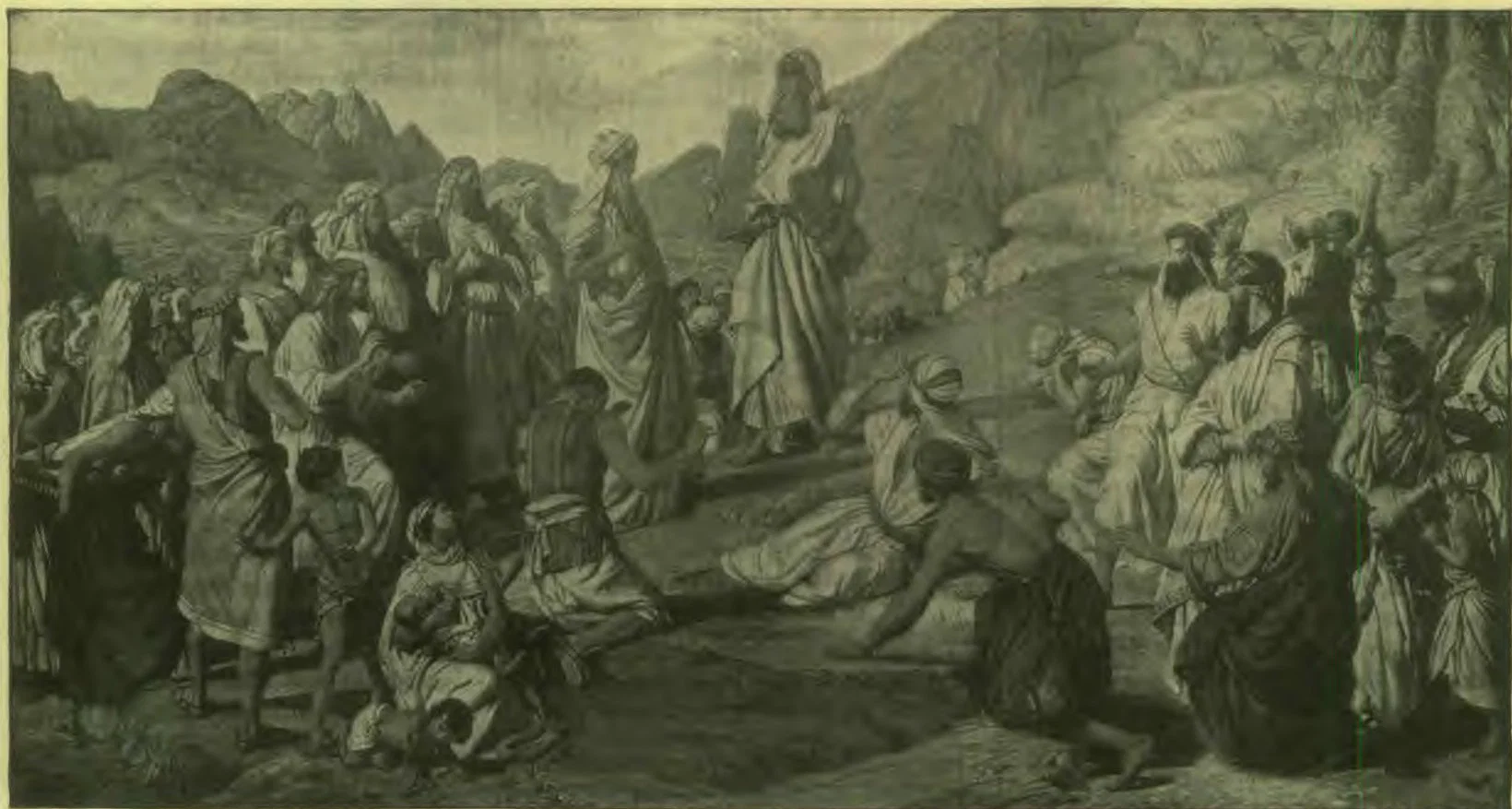
J. R. Herbert, R. A. Moses Descending from Mount Sinai.
The Law of Jehovah
And the Witness of Prophet, Apostle, and Jesus Christ
"The Law of the Lord is perfect." Ps. 19:7
"Jehovah came from Sinai; . . . from His right hand went a fiery law for them. Yea, He loved the people." Deut. 33:2, 3
"Hear, O Israel; the Lord our God is one Lord; and thou shalt love the Lord thy God with all thine heart, and with all thy soul, and with all thy might. And these words, which I command thee this day, shall be in thine heart." Deut. 6:4-6
"Thou shalt love thy neighbor as thyself." Lev. 19:18
"Master, which is the great commandment in the law? Jesus said unto him, Thou shalt love the Lord thy God with all thy heart, and with all thy soul, and with all thy mind. This is the first and great commandment. And the second is like unto it, Thou shalt love thy neighbor as thyself. On these two commandments hang all the law and the prophets." Matt. 22:36-40
"The works of His hands are verity and judgment; all His commandments are sure. They stand fast forever and ever, and are done in truth and uprightness." Ps. 111:7, 8
"Harken unto Me, ye that know righteousness, the people in whose heart is My law; fear ye not the reproach of men, neither be ye afraid of their revilings. For the moth shall eat them up like a garment, and the worm shall eat them like wool; but My righteousness shall be forever, and My salvation from generation to generation." Isa. 51:6-8
"Thy righteousness is an everlasting righteousness, and Thy law is the truth." Ps. 119:142
"Concerning Thy testimonies, I have known of old that Thou hast founded them forever." Ps. 119:152
"For the commandment is a lamp; and the law is light; and reproofs of instruction are the way of life." Prov. 6:23
"Let us hear the conclusion of the whole matter: Fear God, and keep His commandments; for this is the whole duty of man. For God shall bring every work into judgment, with every secret thing, whether it be good, or whether it be evil." Eccl. 12:13, 14
THE TEN WORDS
Exodus 20:1-17
And God spake all these words, saying:
I
I am Jehovah thy God, which have brought thee out of the land of Egypt, out of the house of bondage. Thou shalt have no other gods before Me.
II
Thou shalt not make unto thee any graven image, or any likeness of anything that is in heaven above, or that is in the earth beneath, or that is in the water under the earth: thou shalt not bow down thyself to them, nor serve them; for I Jehovah thy God am a jealous God, visiting the iniquity of the fathers upon the children unto the third and fourth generation of them that hate Me; and showing mercy unto thousands of them that love Me, and keep My commandments.
III
Thou shalt not take the name of Jehovah thy God in vain; for Jehovah will not hold him guiltless that taketh His name in vain.
IV
Remember the Sabbath day, to keep it holy. Six days shalt thou labor, and do all thy work; but the seventh day is the Sabbath of Jehovah thy God: in it thou shalt not do any work, thou, nor thy son, nor thy daughter, thy man servant, nor thy maid servant, nor thy cattle, nor thy stranger that is within thy gates; for in six days Jehovah made heaven and earth, the sea, and all that in them is, and rested the seventh day: wherefore Jehovah blessed the Sabbath day, and hallowed it.
V
Honor thy father and thy mother; that thy days may be long upon the land which Jehovah thy God giveth thee.
VI
Thou shalt not kill.
VII
Thou shalt not commit adultery.
VIII
Thou shalt not steal.
IX
Thou shalt not bear false witness against thy neighbor.
X
Thou shalt not covet thy neighbor's house, thou shalt not covet thy neighbor's wife, nor his man servant, nor his maid servant, nor his ox, nor his ass, nor anything that is thy neighbor's.
Of Christ: "I delight to do Thy will, O My God; yea, Thy law is within My heart." Ps. 40:7, 8
"Believest thou not that I am in the Father, and the Father in Me? the words that I speak unto you I speak not of Myself; but the Father that dwelleth in Me, He doeth the works." John 14:10
"And it is easier for heaven and earth to pass, than one tittle of the law to fail." Luke 16:17
"If ye keep My commandments, ye shall abide in My love; even as I have kept My Father's commandments, and abide in His love." John 15:10
"If ye love Me, keep My commandments." John 14:15
"Ye are My friends, if ye do whatsoever I command you." John 15:14
"Whosoever committeeth sin transgresseth also the law; for sin is the transgression of the law. And ye know that He was manifested to take away our sins; and in Him is no sin." 1 John 3:4, 5
"Do we then make void the law thru faith? God forbid; yea, we establish the law." Rom. 3:31
"Thou shalt call His name JESUS; for He shall save His people from their sins." Matt. 1:21
"Who gave Himself for us, that He might redeem us from all iniquity, and purify unto Himself a peculiar people, zealous of good works." Titus 2:13
"If ye fulfil the royal law according to the scripture, Thou shalt love thy neighbor as thyself, ye do well; but if ye have respect to persons, ye commit sin, and are convinced of the law as transgressors. For whosoever shall keep the whole law, and yet offend in one point, he is guilty of all. For He that said, Do not commit adultery, said also, Do not kill. Now if thou commit no adultery, yet if thou kill, thou art become a transgressor of the law. So speak ye, and so do, as they that shall be judged by the law of liberty." James 2:8-12
"Here is the patience of the saints: here are they that keep the commandments of God, and the faith of Jesus." Rev. 14:12
"Blessed are they that do His commandments, that they may have right to the tree of life, and may enter in thru the gates into the city." Rev. 22:14
"He that saith he abideth in Him [Christ] ought himself also so to walk, even as He walked." 1 John 2:6
"It is time for Thee, Lord, to work; for they have made void Thy law. Therefore I love Thy commandments above gold; yea, above fine gold." Ps. 119:126, 127
Let Him In.
IT is a striking picture that Mr. Mente has given us for our first page. In its background lies the great dark world, with its troubles, its strife, its calamities, its sins, its crimes, its perils. It is not an enticing picture. It does not invite the hunted heart to refuge nor the troubled soul to rest.
Yet how true to life is the picture. War or preparations for war is a business of the nations. Crime in a thousand Protean forms stalks boldly from the slums and dark alleys of the city to the great highways of commerce, industry, and government. Gaunt famine devours her victims in the great populous countries of earth. Manifold diseases prey upon the inhabitants of earth. Fire and tempest, flood and earthquake, calamity and disaster, help to swell the death-roll of earth’s morgue. Religion, which ought to be the stay, the hope, the power of the soul in times like these is weak and listless, or hopelessly apostate.
Yet is there hope. God lives and reigns. Jesus Christ is a risen Saviour, a pitiful, loving, merciful Redeemer, a strong, true, and helpful Friend. Therefore down into the dark world He comes, seeks out the clouded homes, the closed hearts, the gloomy lives; yea, all needy ones; and knocks at the door for entrance. Down into lukewarm, careless Laodicea He comes, and knocks for admittance. In words of infinite love He pleads: ‘Behold, I stand at the door, and knock: if any man hear My voice, and open the door, I will come in to him, and will sup with him, and he with Me.’ Rev. 3:20.
He knows before He knocks the condition within. He knows how unswept, unclean are the rooms; He knows the trash of sensuousness piled within; He knows how the selfish, pleasure-loving, avaricious heart has heaped up rubbish till the door is blocked. Yet He knocks. He would come in and give infinite help in the cleansing and renovation of the rooms. Open the door.
He knows how bare is the cupboard of all that would minister to human need; knows that there is nothing to set before Him but human weakness, and misery, and wretchedness, and sorrow, and wo. Yet would He come in. He would cleanse the heart and heal by the Balm of Heaven every bruise of sin. He would sit down with you, dear soul, at the miserable board you would spread for Him. Seeing it in all its poverty, in all its lack of every good quality, yet would He sit down with you and partake, heartily, helpfully, blessedly. Then you would sup with Him. He would open His treasures and load the table yielded to Him. Then from that board to which you had invited the King, the King would serve you. What delectable food does heaven furnish that He would not set before you in that royal feast? What life-giving viands would be displayed, potent with all the blessings of strength and gladness and rest and joy and blessedness—fruits from the tree of life; draughts from the river of life.
O, let the Royal Pilgrim into the heart and life. Let Him in, not as a wayfaring man who tarries only for a night, but as an abiding Guest, a life Companion.
“Open now to Him your heart,
Let Him in;
If you wait He will depart,
Let Him in;
Let Him in, He is your Friend,
And your soul He will defend,
He will keep you to the end,
Let Him in.”
THE study in Romans last week dealt with those scriptures that show that our heavenly Father can and does reach those who are in the darkest night of heathenism. The next verses to be considered are the following:
“But if thou bearest the name of a Jew, and restest upon the law, and gloriest in God, and knowest His will, and approvest the things that are excellent, being instructed out of the law, and art confident that thou thyself art a guide of the blind, a light of them that are in darkness, a corrector of the foolish, a teacher of babes, having in the law the form of knowledge and of the truth; thou therefore that teachest another, teachest thou not thyself? thou that preachest a man should not steal, dost thou steal? thou that sayest a man should not commit adultery, dost thou commit adultery? thou that abhorrest idols, dost thou rob temples? thou who gloriest in the law, thru thy transgression of the law dishonorest thou God? For the name of God is blasphemed among the Gentiles because of you, even as it is written. For circumcision indeed profiteth, if thou be a doer of the law; but if thou be a transgressor of the law, thy circumcision is become uncircumcision. If therefore the uncircumcision keep the ordinances of the law, shall not his uncircumcision be reckoned for circumcision? and shall not the uncircumcision which is by nature, if it fulfil the law, judge thee, who with the letter and circumcision art a transgressor of the law? For he is not a Jew who is one outwardly; neither is that circumcision which is outward in the flesh; but he is a Jew who is one inwardly; and circumcision is that of the heart, in the spirit not in the letter; whose praise is not of men, but of God.” Rom. 2: 17–29.
In the apostle Paul’s time, the Jews were the professed church of God in the earth. They made great pretensions to piety. They would not deign to mingle with the nations about them because of the superiority that they claimed.
But the apostle shows in the first part of the foregoing quotation that bearing “the name of a Jew,” and resting upon “the law,” and glorying in God, and approving excellent things, are not sufficient. Professing all these high forms of morality and righteousness, while at the same time every principle of them is being violated and trampled upon, is nothing but hypocrisy.
The Jews placed great stress upon circumcision. They had the idea that if they were only circumcised it was equivalent to a passport into heaven. Circumcision, according to their notions, made them the children of Abraham, and if they were his children they were safe. But the apostle makes it plain that they were altogether wrong. “Circumcision indeed profiteth, if thou be a doer of the law.” The doing of the law, then, is the objective point toward which we are directed. The doing of the law is righteousness. Any amount of professions, any amount of outward ceremonies, even though these ceremonies may be instituted by the Lord Himself, will not take the place of right-doing, which right-doing is the keeping of God’s law.
“If thou be a transgressor of the law, thy circumcision is become uncircumcision.” The Jew to whom these words were addressed was trusting in his circumcision to save him. And the Jew who is trusting in any such a form or ceremony represents any individual in any time of the world’s history who trusts to the formalities of service and who does not give attention to the plan that God has given whereby men may attain to righteousness and keep the law of Jehovah.
Many persons seem to think that if they only have their membership with some church they will be all right; or if they cling to some of the forms of religion that God will save them. But any one who stops to consider the matter closely will readily understand that God can not save any one who is not right. To bring that which is wrong into heaven would mean to ruin the eternal happiness of every righteous person who would enter there. Only the right can stand with God. Only the righteous can enter His eternal abode. The mere formalities of circumcision, or of any other like ceremony, must be swept aside as of no consequence apart from God’s great object of leading men to keep His law.
The apostle Paul expresses this truth in another place in this language:
“Circumcision is nothing, and uncircumcision is nothing; but the keeping of the commandments of God.” 1 Cor. 7: 19.
It is so easy for men to get their minds fixed upon some kind of formality, some kind of a ritual, some particular outward performance, and depend upon these things to the neglect of real deeds of righteousness, hence the apostles and teachers and prophets of the Bible have made it very plain that keeping God’s commandments is the object to be sought above everything else.
And in view of the importance of commandment-keeping the Lord has made abundant provision for man’s salvation from sin so that he can keep the righteous requirements of the divine Father. This point is particularly dwelt upon in the next chapter of Romans, so we will pass it for the present.
“He is not a Jew who is one outwardly; neither is that circumcision which is outward in the flesh.” The outward life does not make the real revelation of what the man actually is. To be a Jew in reality would mean to possess the faith and the righteousness of Abraham. And it takes this faith and righteousness that was so conspicuous in Abraham to truly represent the keeping of the law of God.9“He is a Jew who is one inwardly; and circumcision is that of the heart, in the spirit not in the letter; whose praise is not of men, but of God.” Inward righteousness is the only true righteousness. Men may make a fair exterior. They many appear, on a superficial acquaintance, to be all right. This outward appearance is all that men have to judge by in estimating the work and the characters of their fellows, but God looks at the man as he really is. God looks at the heart; He looks at the motives; He considers the meditations and thoughts; He goes into the citadel of the soul where none but He can enter, and measures the real man.
Thus being able to measure the man as he really is, and not looking upon him merely as he outwardly appears, when God pronounces him good he is good indeed. And thus may the lesson be impressed on our minds that even the outward observance of some of the precepts of the law of God may be as hollow a formality as the circumcision that was practised by the Jews long after they had ceased to possess the righteousness for which that ceremonial stood. The true keeping of the law of God must be a matter in which the individual meets the careful scrutiny of Him who knows every motive, every thought, and every impulse of the heart. The true keeping of the law of God begins with the innermost part of the man’s private life and shows a perfectly clean record clear to the surface.
With the knowledge of God’s actual requirements before us should we not at all times breathe the prayer, “Let the words of my mouth and the meditation of my heart be acceptable in Thy sight, O Jehovah, my Rock, and my Redeemer.” Ps. 19: 14.
Studies in the Book of Daniel
God the Revealer
Daniel Two—The Alphabet of Symbolic Prophecy. The Dream.
THERE was a troubled king in the ancient and mighty empire of Chaldea—not a strange thing. This one, however, was troubled for cause. As he had looked backward over the kaleidoscopic history of the earth to his time, as he had viewed the rise and fall of empire, the exaltation and abasement of men, his mind had turned to his own mighty, growing, world-renowned, world-governing empire. Would it fall into decay and perish as had others? Would it in turn be subjected by some mighty conqueror, even as Babylon had brought other nations under her iron yoke? Or would Babylon, glorious above all her predecessors, stand forever?
The great God is interested in the affairs of men. He has a purpose in this world which He is working out despite sin and rebellion. In the working out of this purpose He seeks to use for His own eternal glory and the everlasting good of all His creatures, every human soul, to the fullest extent of that soul's capability. He will use every soul which will respond to Him. He will enter every avenue to heart or mind which may be left open to Him, in order to seek the salvation and cooperation of that soul. God has not revealed His working in behalf of all, but He works in behalf of all; and He leaves on record typical cases for the encouragement and instruction of those who come after.
Among the kings of earth, Pharaoh was one of such who rejected God's revelation, hardened himself against God's mercy, and defied God's power. Nebuchadnezzar was another ruler who at last yielded to the Divine Goodness. Thru both of these kings God showed His power and glory; thru the one despite his hardness and rebellion; thru the other by blessed final cooperation. The one hardened under reproof and instruction; the other yielded.
The Second Lesson.
God had showed the proud king of Babylon that the educational system of Babylon at its best was not to be compared with the divine system at the worst; but Nebuchadnezzar had not heeded the first lesson. Now the king's desire to know the future was the channel by which the second time God sought to teach Nebuchadnezzar the folly of all human wisdom, and the only true source of knowledge. He therefore came to the idolatrous king in the most impressive possible way—in a strange and startling dream which roused the king from his sleep, prevented further slumber, and troubled his spirit greatly.
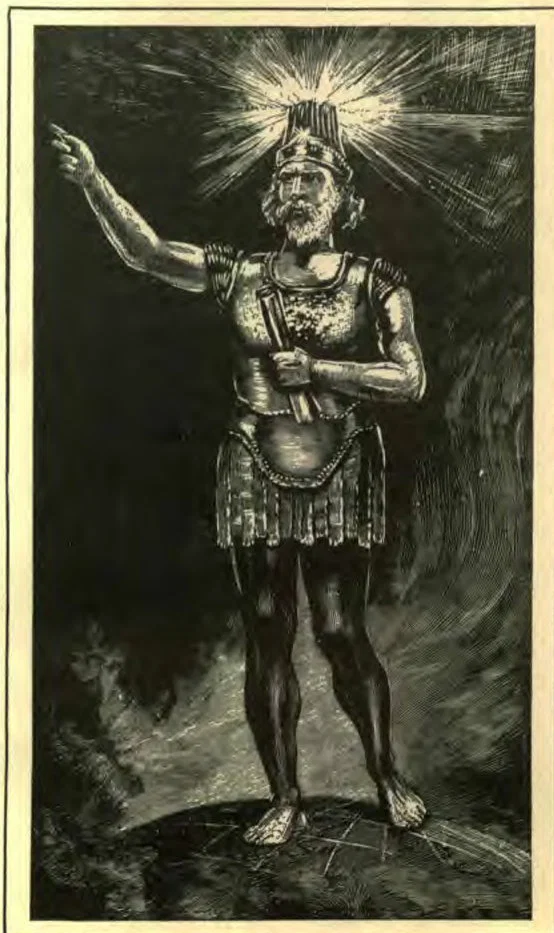
The Image of Nebuchadnezzar’s Dream.
A Vain Quest.
He sought for the meaning of the dream, so unlike any others of which he had ever heard, and naturally to the wise men of his council—the magicians, enchanters, sorcerers and Chaldeans. But that he might be assured of the true interpretation, he demanded that they should first tell his dream. The youthful Judean students had caused him to doubt the great teachers of his realm, and he thought it wise to demand more than the ambiguous replies of the scholars of mysticism, the school-men, or the priests. More than this, he demanded a satisfactory reply to his request under the penalty of destruction of property and loss of life. "If ye make not known unto me the dream and the interpretation thereof, ye shall be cut in pieces, and your houses shall be made a dunghill." Dan. 2: 5. On the other hand, if they would make known the dream and its interpretation, they should be loaded with gifts and honor. Dan. 2: 6. The king thus placed before these worldly wise men the strongest incentives to reveal their right to be regarded as counselors in his realm. They again ask that the dream be made known.
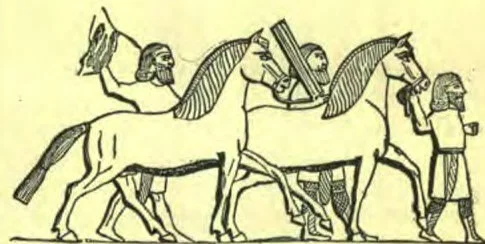
Babylonian Horses and Men, from the Monuments.
But the requirement is beyond their wisdom. No philosophy they possess, no science of which they are masters, no process of reasoning, no authority of masters or tradition, no incantation or spell, can reveal the dream or its meaning. They know this; and in the light of the king's sentence they confess the futility of their knowledge, and seek to excuse themselves and to persuade the king by precedent. The record tells us:
"The Chaldeans answered before the king, and said, There is not a man upon the earth that can show the king's matter; forasmuch as no king, lord, or ruler hath asked such a thing of any magician, or enchanter, or Chaldean. And it is a rare thing that the king requireth, and there is no other that can show it before the king, except the gods, whose dwelling is not with flesh. For this cause the king was angry and very furious, and commanded to destroy all the wise men of Babylon." Dan. 2:10-12, A.R.V.
Viewed from the ground of their great claims and pretensions, the king's decree was not unjust. Here were men who boasted10that they were keepers of the gate of heaven; that with them was the fulness of knowledge; and yet they were deceivers of men and destroyers of nations. Their lying interpretations and flattering counsel would lull a ruler to ease when he ought to be stirred to repentance and action. They were brought to a test, and were found wanting.
When the wise men were called before a king who had honors to bestow, the unpopular worshipers of Jehovah were not invited; but when the decree went forth that the wise men should be slain, "they sought Daniel and his companions." Dan. 2:13.
Prudently and wisely Daniel inquires of Arioch, the executioner, "Wherefore is the decree so urgent from the king?" Arioch tells him. Daniel goes to the king, and asks, not for the dream, not for time to escape, but for time to make known the interpretation. Then follows a prayer-meeting. Daniel tells his godly companions, and they seek God together, that He, the only Revealer of the veiled future, should make known the mystery. They make no demands on their merits, or because of their faithfulness; but desire "mercies of the God of heaven." Here is the result with Daniel's thanksgiving:
"Then was THE SECRET REVEALED unto Daniel in a vision of the night. Then Daniel . . . said, Blessed be the name of God forever and ever; for wisdom and might are His. And He changeth the times and the seasons; He removeth kings, and setteth up kings; He giveth wisdom unto the wise, and knowledge to them that have understanding; He REVEALETH THE DEEP AND SECRET THINGS; He knoweth what is in the darkness, and THE LIGHT DWELLETH WITH HIM. I thank Thee, and praise Thee, O Thou God of my fathers, who hast given me wisdom and might, and hast now made known unto me what we desired of Thee; for Thou hast made known unto us the king's matter." Dan. 2:19-23, A.R.V.
Daniel tells Arioch, Arioch tells the king, the king sends for Daniel; and here is Daniel's message to that king, and all other kings who desire to know the future:
"The secret which the king hath demanded can neither wise men, enchanters, magicians, nor soothsayers show unto the king; but THERE IS A GOD IN HEAVEN THAT REVEALETH SECRETS, and He hath made known to the king Nebuchadnezzar WHAT SHALL BE IN THE LATTER DAYS." Verses 27, 28, A.R.V.
God is the Revealer of the mysteries of the future. He "is Light, and in Him is no darkness at all." 1 John 1:5. He desires that men shall be His sons, "children of light," knowing of the evil to come, and the sure refuge—Christ Jesus. 1 Thess. 5:4-6. He would not have kings or rulers or presidents or statesmen blinded to these things; and His revelation to Nebuchadnezzar is left on record to all who live afterward. It is recorded in order that rulers now may know "what shall be in the latter days," "what shall come to pass hereafter; and He that revealeth secrets hath made known to thee [whomsoever you are] what shall come to pass." Dan. 2:29.
The Dream.
Daniel then tells the dream. It is neither guesswork nor conjecture nor mediumship nor mind-reading. It is the revelation of God, told with the conviction of truth:
"Thou, O king, sawest, and, behold, a great image. This image, which was mighty, and whose brightness was excellent, stood before thee; and the aspect thereof was terrible. As for this image, its head was of fine gold, its breast and its arms of silver, its belly and its thighs of brass, its legs of iron, its feet part of iron, and part of clay. Thou sawest till that a stone was cut out without hands, which smote the image upon its feet that were of iron and clay, and brake them in pieces. Then was the iron, the clay, the brass, the silver, and the gold broken in pieces together, and became like the chaff of the summer thrashing-floors; and the wind carried them away, so that no place was found for them; and the stone that smote the image became a great mountain [margin, "rock"], and filled the whole earth." Verses 31 to 35, A.R.V.
In these five verses of less than one hundred and fifty words is given in epitome the history of the world in time, and the outlook of eternity. It is the alphabet of all symbolic prophecy. From that kingdom of earth, most far-reaching in its influence, with its evanescent splendor, it sweeps forward to the eternally glorious kingdom of Jesus Christ.
[The second part of this article, "The Interpretation of the Dream," will be given in our next. It should be of great interest, as it is of vital importance to study these lessons which God has given us.]