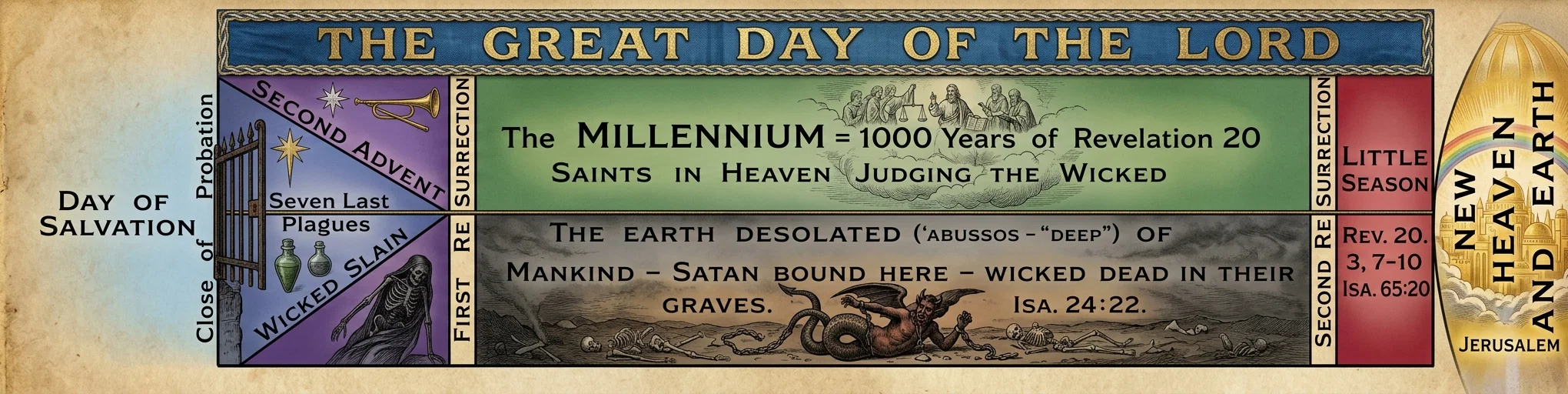
The rest of the dead lived not again until the thousand years were finished.” Rev. 20:5, first part. “And when the thousand years are expired, Satan shall be loosed out of his prison.” Verse 7. That is, the resurrection of the wicked dead and the loosing of Satan are events that occur at the close of the millennium, and are therefore coincident. When the wicked dead are raised, they come up as they went down, with the carnal mind which is enmity with God and not subject to His law. Rom. 8:7. They are fit subjects of Satan’s temptations and deceptions because of their resistance to the pleading of God’s Spirit and their rejection of His grace and mercy freely offered to them in the Gospel, before they fell under the power of death. Hence, we read in verses 8 and 9 that Satan goes out to deceive the nations, and gathers them together to battle, and leads them to attempt the capture of the beloved city and the saints of God.
The “beloved city” is the New Jerusalem which is above and is the mother of us all. Gal. 4:26. It is the city for which Abraham looked, “a city which hath foundations, whose builder and maker is God.” Heb. 11:10. It is the holy city, New Jerusalem, which John saw “coming down from God out of heaven.” Rev. 21:2. Thus at the beginning of the millennium Christ comes to this earth and gathers His saints and takes them to the holy city, New Jerusalem, and they reign with Him a thousand years. Rev. 20:4. Then at the end of that period He comes with all His saints and the holy city, raises the wicked dead, thereby loosing Satan, and then follows the last desperate effort of Satan and those he has deceived to capture the holy city and overthrow the kingdom that Christ is then setting up on the earth with the New Jerusalem as its capital.
This is the culmination of Satan’s effort against God and His government. It ends in failure and the total destruction of Satan and all his followers; for fire comes down from God out of heaven and devours them. Rev. 20:9, 10.
Satan’s character, work, and final end are described in Eze. 28:12-19, under the symbol of the king of Tyrus. First, he was a holy angel, exalted in position, the anointed cherub that covereth. Verses 12 to 14. He was perfect in his ways till iniquity was found in him. Verse 15. He became lifted up with pride, and God cast him out of heaven and decreed his destruction. Verses 16 to 18.
Satan Not Immortal.
Some have thought that the devil can not be destroyed because he is immortal. His life came from God, the Creator, and surely God can take it away when He chooses. The Father hath life in Himself, and hath given His Son the same life, so that He also hath life in Himself. John 5:26. But He has not given Satan life in himself so he can exist eternally, as a menace to God’s government and a tempter and an accuser of God’s people. It would be contrary to God’s character and attributes to create beings that, by an evil course, could perpetuate sin in His universe, and be rivals whose power and influence He could not destroy. God’s wisdom and love preclude such a view. It is a moral impossibility.
We can conceive how God can permit the existence of evil for a limited time and overrule it for His glory and the good of His universe by placing before all intelligencies an object-lesson of sin and its dire results, and of His love and mercy in redeeming from sin all who would choose life and loyal obedience to the Creator. But God’s wisdom and love make it utterly inconsistent for Him to immortalize sin by creating any being who could and would sin and could not die, and could not be destroyed. That would make Him responsible for the existence of sin throughout eternity. Such a view is contrary to God’s character as revealed in Christ, and to the plain teaching of the Scriptures.
The Lake of Fire.
Once, in the days of Noah, a flood of waters enveloped the earth and destroyed the wicked then living. Matt. 24:38, 39; 2 Peter 3:5, 6. “But the heavens and earth which are now, by the same word [the word of God] are kept in store, reserved unto fire against the day of judgment and perdition of ungodly men.” Verse 7. The Saviour speaks of this fire when He describes the judgment upon the wicked in Matt. 25:41: “Depart from Me, ye cursed, into everlasting fire, prepared for the devil and his angels.” Peter describes the scene in 2 Peter 3:10-12: “The heavens shall pass away with a great noise, and the elements shall melt with fervent heat, the earth also [will melt with fervent heat] and the works that are therein shall be burned up.” This will constitute the lake of fire which will envelop the earth as the flood of waters enveloped the earth in the days of Noah. It is called everlasting fire because it is everlasting in its results. There is no life beyond it. We have an example of what eternal fire will do in the experience of Sodom and Gomorrha. They were turned into ashes by eternal fire, and their destruction is declared to be an example of the fate of the ungodly. Jude 7; 2 Peter 2:6. They will be turned into ashes, destroyed root and branch. Mal. 4:1, 3. Satan is the root because the originator of evil; and evil angels and wicked men are the branches.
This lake of fire is formed or prepared at the end of the thousand years by the fires from within the earth uniting with the fire that comes down from heaven. Thus it was in the days of Noah. The fountains of the great deep were “broken up, and the windows of heaven were opened.” Gen. 7:11. Water from below and from above united to form a lake of water, “whereby the world that then was, being overflowed with water, perished.” 2 Peter 3:6. Hence, when the lake of fire envelops the world, the elements and the earth melt with fervent heat, “and the works that are therein [Satan and all his followers] shall be burned up.” They are consumed, devoured, destroyed in the lake of fire, and therefore it is called “the second death.” Rev. 20:14, 15.
[The concluding article in this series is upon the glorious climax of redemption, “The Earth Made New.”]
Activity in the Kingdom of God
ACTIVITY in the kingdom of God augments the power of spiritual life, and deepens the consciousness of religious realities.—William Adams.
Movements in Church History
THE history of the Church of Christ from the days of the apostles has been a history of movements.—H. P. Liddon.
For the Elect’s Sake.
By F. D. Starr
By F. D. Starr.
“I endure all things for the elect’s sakes, that they may also obtain the salvation which is in Christ Jesus with eternal glory.” 2 Tim. 2:10.
THESE words show the unswerving fidelity of the apostle Paul to the welfare of the elect.
Who are the elect?—In the first place, our blessed Redeemer Himself is reckoned as one of this class. His name heads the list: “Behold My Servant, whom I uphold; Mine Elect, in whom My soul delighteth; I have put My Spirit upon Him: He shall bring forth judgment to the Gentiles.” Isa. 42:1.
Very clearly this has reference to Christ.
In the next place, the angels of God come into this list: “I charge thee before God, and the Lord Jesus Christ, and the elect angels, that thou observe these things without preferring one before another, doing nothing by partiality.” 1 Tim. 5:21.
While all the holy angels are numbered with the elect, yet not all the elect are angels. Indeed, we shall find that some of them are so far from being angels that we probably would discover nothing angelic about them at the present time. “Even so then at this present time also there is a remnant according to the election of grace.” “The election hath obtained it, and the rest were blinded.” Rom. 11:5, 7. “For Jacob My servant’s sake, and Israel Mine elect, I have even called thee by thy name.” Isa. 45:4.
From numerous references, it will be seen that the elect as here indicated are human beings, once lost in sin, but saved by grace. For this class Paul submitted to endure all the hardships to which the Gospel laborer can be subjected. But he himself, the one of the elect, would not have appeared as such when as a chief of sinners he was haling Christian men and women to deliver them to prison. Jacob did not appear as one when supplanting his brother Esau. Prospectively these were of the number of the elect, however.
But are not the elect sure of final salvation from all eternity? Surely they are not, for Peter tells the believers to make their calling and election sure. 2 Peter 1:10. Paul endured all things for the elect’s sake that they might be saved, plainly indicating that there was a possibility of some of the elect not being saved.
To elect is to choose. Jesus said of His disciples, “Have not I chosen you twelve, and one of you is a devil?” John 6:70. Judas, one of the twelve, was promised, with the eleven other disciples, a throne in the future kingdom (Matt. 19:28), but he failed to make that election sure.
How much are we willing to endure for the elect’s sake? Love will enable us to endure all things for their sakes.
When bearing what may seem to us to be unreasonable burdens, let this consideration give us strength to bear it: “I endure all things for the elect’s sakes.” How careful we should be not to offend the elect. “Who shall lay anything to the charge of God’s elect?” Rom. 8:33. His elect are very precious in His sight. “He that toucheth you toucheth the apple of His eye.” “Whoso shall offend one of these little ones which believe in Me, it were better for him that a millstone were hanged about his neck, and that he were drowned in the depth of the sea.” “He suffered no man to do them wrong; yea, He reproved kings for their sakes, saying, Touch not Mine anointed, and do My prophets no harm.” “Can a woman forget her sucking child, that she should not have compassion on the son of her womb? Yea, they may forget, yet will I not forget thee.” What a consolation to be of this number and endure for them.
Westlake, Idaho.
Signs of His Coming—Increase of Riches.
1. “In the last days,” what will be the character of many?
“Know this, that in the last days grievous times shall come. For men shall be lovers of self, lovers of money.” 2 Tim. 3:1, 2.
2. To what will this love of money lead?
“Come now, ye rich, weep and howl for your miseries that are coming upon you. Your riches are corrupted, and your garments are moth-eaten. Your gold and your silver are rusted; and their rust shall be for a testimony against you, and shall eat your flesh as fire. Ye have laid up your treasure in the last days.” James 5:1-3.
3. Do conditions fulfil these predictions?
The following statements, gleaned from various reliable sources, show present-day conditions: In 1889 Mr. Thomas G. Shearman published an article in the “Forum” entitled, “Owners of the United States,” in which he made the statement upon evidence that seventy of the wealthiest men of the country had a combined capital of about $2,700,000,000. In 1898 many trusts were formed, combining $1,000,000,000 of the capital of the country into great organizations. But 1898 was only the beginning. Soon the steel trust was formed with a capitalization of $1,389,339,956. Other trusts soon brought the figures for the combines up to $4,318,005,646. In three years 142 of these industrial combinations were formed, and less than one hundred men were the active controllers of all this vast concentration. Fully one fourth of the wealth of the nation has passed under the sceptre of the trusts, with absolute control of it. And of the hundred owners and controllers of so many billions of wealth, the figures can be narrowed down to less than a dozen men who are the real dictators of all our nation’s industrial and business enterprises.
4. What does Habakkuk say of the greed of men of this time?
“The wicked swalloweth up the man that is more righteous than he; and makest men as the fishes of the sea, as the creeping things, that have no ruler over them. He taketh up all of them with the angle, he catcheth them in his net, and gathereth them in his drag: therefore he rejoiceth and is glad.” (See Hab. 1:13-17.)
5. What is said of his ambition?
“Who enlargeth his desire as Sheol, and he is as death, and can not be satisfied, but gathereth unto him all nations, and heapeth unto him all peoples.” Hab. 2:5.
6. How is much of this wealth accumulated?
“Behold, the hire of the laborers who mowed your fields, which is of you kept back by fraud, crieth out: and the cries of them that reaped have entered into the ears of the Lord of Sabaoth.” James 5:4.
7. How is it used?
“Ye have lived delicately on the earth, and taken your pleasure; ye have nourished your hearts in a day of slaughter. Ye have condemned, ye have killed the righteous one; he doth not resist you.” James 5:5.
8. What does Habakkuk say of the judgment which will be visited upon the oppressor by the oppressed?
“Shall not all these take up a parable against him, and a taunting proverb against him, and say, Wo to him that increaseth that which is not his: how long? and that ladeth himself with pledges! Shall they not rise up suddenly that shall bite thee, and awake that shall vex thee, and thou shalt be for booty unto them? Because thou hast plundered many nations, all the remnant of the peoples shall plunder thee, because of men’s blood, and for the violence done to the land, to the city and to all that dwell therein.” Hab. 2:6-8. (Read the entire chapter and compare verses 2 and 3 with Hebrews 10:37, 38 showing that it has special application to the last days.)
9. What will be the reward of those who oppress the poor?
“Who can abide the day of His coming? and who shall stand when He appeareth? for He is like a refiner’s fire, and like fuller’s soap. . . . And I will come near to you in judgment; and I will be a swift witness against . . . those that oppress the hireling in his wages, the widow, and the fatherless.” Mal. 3:2-5.
10. Of what value will their wealth be in that day?
“Neither their silver nor their gold shall be able to deliver them in the day of Jehovah’s wrath.” Zeph. 1:18.
Liberty’s Last Libation
By Moore
O! if there be on this earthly sphere,
A boon, an offering Heaven holds dear,
'Tis the last libation Liberty draws
From the heart that bleeds and breaks in
her cause. — Moore.
Empty-Handed.
“ALEXANDER THE GREAT,” says Archbishop Trench, “being upon his death-bed, commanded that when he was carried forth to his grave his hands should not be wrapped, as was usual, in cerecloths, but should be left outside the bier, that all men might see them, and might see that they were empty.”
This is a great Bible truth. “We brought nothing into this world, and it is certain we can carry nothing out. We come into life empty-handed. So we go out when life shall close. If we would have possessions in the life to come, we must now lay up treasure in heaven.
No Soul Finally Deserted of God
By Ellen G. White
No soul is ever finally deserted of God, and given up to his own ways, as long as there is any hope of his salvation.—Mrs. E. G. White.
In the Power of God.
ONE of the glories of the apostle Paul’s preaching was in the elimination of self. He aimed to make no display of his wisdom or education or ancestry. These he counted as loss. But his message was in “demonstration of the Spirit and of power.” 1 Cor. 2:4. The Gospel of God reached hearts, set sin’s captives free, and regenerated souls. And all this was as he tells the believers “that your faith should not stand in the wisdom of men, but in the power of God.” Verse 5.
The wisdom of men fails. It led them in the early centuries to endeavor to unite pagan philosophy with the simple yet mighty truths of the Gospel, and thereout came the great apostasy. It led men to substitute for the institutions of God’s planting, heathen institutions; for the divinely ordained rites and worship day of the Bible, the elaborate rites and festivals of paganism, and therefrom came the demand upon the civil power to sustain them. It led man to assume the titles and prerogatives of God, and to do in God’s church what He never would do. Out of this came the Papacy, the Dark Ages, and all its persecutions.
The wisdom of men has no power to keep men. It may last to-day; to-morrow it is superseded by a new hypothesis, a new philosophy, a new theology. It gives no ground for faith. He who founds his belief in it to-day, suffers shipwreck of faith to-morrow.
The power of God is the Gospel of God. And therefore Paul’s ringing cry, “I am not ashamed of the Gospel: for it is the power of God unto salvation to every one that believeth; to the Jew first, and also to the Greek. For therein is revealed a righteousness of God from faith unto faith; as it is written, But the righteous shall live by faith.” Rom. 1:16, 17. To the completeness of that righteousness, grace-given, God’s eternal law bears witness. Rom. 3:21. The soul stands by faith on the verities of God, effluent of living power. Christ Jesus is his living Head, and the soul is responsible to Him. Before that creative power, that living and yet present Head, all the wisdom and philosophies and theologies and systems of men sink into insignificance. “Because the foolishness of God is wiser than men; and the weakness of God is stronger than men.” 1 Cor. 1:25.
The President and the Constitution
By Editor
Religious Questions
Before the President-elect of the United States enters upon the execution of his office, he shall, according to Article II, Section 1, of the Constitution of the United States, take the following oath or affirmation:
“I do solemnly swear (or affirm) that I will faithfully execute the office of President of the United States, and will, to the best of my ability, preserve, protect, and defend the Constitution of the United States.”
Now it was not the purpose of the fathers of this republic to throw the strength of the government to the upholding of institutions, documents, or things, as sacred fetishes. Human rights were to be guarded, and the Constitution preserved, protected, and defended because it conserved and guarded those rights. And the only way to preserve, protect, and defend that great instrument is to preserve, protect, and conserve the rights of the people—the individual—for which the Constitution was ordained. For, as stated in the preamble of the Constitution, it was ordained among other good things to “establish justice,” and to “secure the blessings of liberty to ourselves and our posterity.”
Among the blessings of liberty which the fathers of the republic sought, and for which they bled, were the blessings of religious liberty, the freedom to worship God according to the dictates of conscience, untrammeled and unhindered by medieval exactions or church-and-state limitations.
Madison expressed it in the following words in 1785 in his memorial to the General Assembly of Virginia:
“Because it is proper to take alarm at the first experiment upon our liberties, we hold this prudent jealousy to be the first duty of citizens, and one of the noblest characteristics of the late Revolution.”
“Who does not see that the same authority which can establish Christianity, in exclusion of all other religions, may establish, with the same ease, any particular sect of Christians, in exclusion of all other sects?”
“All men are to be considered as entering into society on equal conditions; as relinquishing no more, and, therefore, retaining no less, one than another, of their natural rights. Above all, are they to be considered as retaining an ‘equal title to the free exercise of religion according to the dictates of conscience.’ Whilst we assert for ourselves a freedom to embrace, to profess, and to observe, the religion which we believe to be of divine origin, we can not deny an equal freedom to them whose minds have not yet yielded to the evidence which has convinced us.”
And Thomas Jefferson in the same year said:
“Almighty God hath created the mind free; all attempts to influence it by temporal punishments or burdens, or by civil incapacitations, tend only to beget habits of hypocrisy and meanness, and are a departure from the plan of the holy Author of our religion, who being Lord both of body and mind, yet chose not to propagate it by coercion on either, as was in His almighty power to do.”—Virginia Act for Establishing Religious Freedom, 1785.
Therefore the following principle was embodied in the Constitution:
“No religious test shall ever be required as a qualification to any office or public trust under the United States.”
But that was not sufficient. The principle must be more strongly stated, the rights of man more clearly expressed, more strongly guarded. From ten sovereign states came proposed additions, which were embodied in Article I of Amendments to the Constitution:
“Congress shall make NO LAW RESPECTING AN ESTABLISHMENT OF RELIGION, or PROHIBITING THE FREE EXERCISE THEREOF; or abridging the freedom of speech, or of the press; or the right of the people peaceably to assemble, and to petition the people for a redress of grievances.”
At a still later date, after the fearful Civil War had ravaged the land, it was feared that the citizen might suffer from state restrictions upon his liberty, and therefore in Article XIV of Amendments this prohibition was placed:
“No state shall make or enforce any law which shall abridge the privileges or immunities of citizens of the United States; nor shall any state deprive any person of life, liberty, or property without due process of law, nor deny to any person within its jurisdiction the equal protection of the laws.”
Of that Constitution, the great historian George Bancroft truly said:
“The Constitution establishes nothing that INTERFERES with EQUALITY or INDIVIDUALITY. It knows nothing of differences by descent, or opinions, of favored classes, or LEGALIZED RELIGION, or the political power of property. It leaves the individual alongside the individual. RELIGION was become avowedly the ATTRIBUTE OF MAN and not of a corporation. VINDICATING THE RIGHT OF INDIVIDUALITY EVEN IN RELIGION, and in RELIGION ABOVE ALL, the new nation dared to set the example of ACCEPTING in its RELATIONS TO GOD THE PRINCIPLE FIRST DIVINELY ORDAINED IN JUDEA.” It left the management of temporal things to the temporal power; but the American Constitution, in harmony with the people of the several states, WITHHELD from the FEDERAL GOVERNMENT THE POWER to invade the home of reason, the CITADEL OF CONSCIENCE, the SANCTUARY OF THE SOUL; and not from indifference, but that the infinite Spirit of eternal truth might move in its freedom and purity and power.”—History of the Constitution, Book V, chapter 1.
Truly the nation had the right to engrave upon the reverse side of its great seal, “Novo Ordo Seclorum”—a new order of things, or ages. The nation had turned its back upon the medieval principles, laws, methods, tyrannies, and had emblazoned upon its escutcheon, Liberty for each and all, civil and religious. And in no land has religion ever prospered as under that only true civil policy.
Yet religious zealots,—with less faith in God than in the state, have endeavored to turn back the tide of liberty to the Dark Ages. They have kept alive the old medieval and colonial laws which have disgraced the statute-books of our states. They have combined in these latter days in various forms and ways, the latest that of church federation, to embody a religious sabbath in the statute law. Efforts of this kind have been kept before Congress for years. Pressure9from religious bodies has been brought to bear upon representatives and senators. Let the pressure become strong enough, as it may under Mr. Taft’s administration, and the sabbath bills will be passed by Congress. Will Mr. Taft sign such bills, or will he weigh them all in the light of the principles of the Constitution and the rights of the individual American? From such legislation in some of the states men have languished in prison and been deprived of property without due process of law. Like legislation will become national. How will our President stand?
In a report adopted by the United States Senate in 1873 is the following:
“EXTENSIVE RELIGIOUS COMBINATIONS TO EFFECT A POLITICAL OBJECT ARE . . . always dangerous. This first effort of the kind calls for THE ESTABLISHMENT OF A PRINCIPLE which, in the opinion of the committee, would lay the foundation for DANGEROUS INNOVATIONS upon the spirit of the Constitution, and upon the RELIGIOUS RIGHTS OF THE CITIZENS. IF ADMITTED, it may be justly apprehended that THE FUTURE MEASURES OF THE GOVERNMENT will be strongly MARKED, if not EVENTUALLY CONTROLLED, by the same influence. ALL RELIGIOUS DESPOTISM commences by COMBINATION AND INFLUENCE; and when that influence begins to operate upon the political institutions of a country, the CIVIL POWER SOON BENDS UNDER IT; and the catastrophe of other nations furnishes an awful warning of the consequence.”
Will President Taft—lawyer, jurist, American, man—stand for the principles of the Constitution, for the conservation of the rights of the individual, both civil and religious?—We believe that he will. We accept his solemn oath for what it declares to the full, till overt acts shall demonstrate to the contrary. And we shall pray for his health and prosperity.
Our Old Testament lessons for the week conclude the book of Joshua and the first three chapters in Judges. After the awful lesson of Achan’s sin and its fearful consequences, the entire book of Joshua has to do with the conquering of the Canaanites and the division of the land. The last two chapters contain Joshua’s solemn charge to the people to serve God and Him alone.
The book of Judges covers a period following sometime after the death of Joshua, concluding in the first book of Samuel. The name of the book is derived from the leaders who had to do with the government of Israel. They are called “judges” in the Old Testament world as defenders of a cause, men raised up in times of crises to contend for the independence of the people. In chapter 3:9 they are called “saviours.” They also judged the people in the sense of administration of law. The chronology of the book is peculiarly difficult. For instance, in 1 Kings 6 we are told that the temple was built 480 years after the Exodus; but if we add together the numbers given in the book of Judges we get a total of 410 years. In Acts 13:20 it is said that God gave them judges for the space of about 450 years. The difficulty in trying to compute the chronology from the book itself arises from the fact that some of the judges were contemporaneous perhaps; some of them were only local; sometimes there were interregnums, or spaces between the rule of the judges, of which no account is taken. From such expressions as found in 17:6; 18:1, 31, it is supposed that Judges was written at least as late as the time of Samuel, or when Saul was king. Some place it as late as the days of Solomon; but the expression would indicate that it may have been written in the days of Saul. If so, it was probably written by Samuel. The chapters which come into our lessons to-day have to do with the failure of Israel to carry out the instructions which God gave, their consequent captivity, and the help which came to them through the judges, or saviours, whom the Lord raised up in their behalf.
Our New Testament lessons begin with the 21st verse of the first chapter of Luke and continue to the 30th verse of the fourth chapter of the same book. This includes the birth of John the Baptist and of Jesus; the angelic vision to the shepherds; their worship of the child Jesus; the presentation in the temple; the preaching of John the Baptist; the genealogy of Jesus from the standpoint of the Saviour of all nations, tracing it back to Adam; the temptation of Jesus; and His ministry in Nazareth about six months later. Note how particular is this book in giving the time of the preaching of John the Baptist. No writer of fable would have told in the particular way in which Luke has, the various rulers and governors who were in authority at the time that John began his ministry. He particularizes to the extent that it could very easily be traced out as to whether his Gospel was false or not. He dwells far more largely upon the early history of the mission of Jesus than do any of the other evangelists.
The Cause of Bank Defalcations and Failures.
By T.
Edward P. Moxey is an official of the United States department of justice, whose duties require him to seek and compile evidence against the crooked bankers of the country. It was upon his evidence largely that John R. Walsh, the bank president and bank wrecker of Chicago, was put behind the bars. His testimony will play an important part in the trials of Alfred H. Curtis and Charles W. Morse who are under indictment in New York for embezzlements and defalcations in the National Bank with which they were connected. His work of this kind has led him to be a close student of the causes underlying so many embezzlements and fraudulent transactions in the banking world.
Mr. Moxey places fast and luxuriant living at the head of the evils which are causing a wave of dishonesty to pass over the nation. To use his own words, he says the cause of it is “the gorgeous hotels and restaurants, the bars, the gambling-houses, the myriad theaters, the palatial apartment houses, the turning of night into day, the flood of money in New York upon which this life is borne along, the craving for vast incomes by which alone such a life can be lived.”
“To say that even a bare majority of the tens of thousands of men who nightly swell the crowd of amusement-crazed spenders, who live in $5,000 apartments, and whose touring-cars congest the streets, are doing this with money which is honestly theirs, is absurd. They are not earning this money; they are either juggling other people’s cash or they are gambling with their own. When you can go into a restaurant at two o’clock in the morning and behold $60,000 worth of women’s gowns at the tables and $3,000 worth of food in process of consumption, something is wrong. And when you observe half a million dollars’ worth of automobiles waiting to take this one supper crowd to their homes—or elsewhere, you may be sure there is queer bookkeeping somewhere.”
“It is not only this sort of life in New York, but in a more sinister way the sight and example of it, which is bringing about a degradation of the sense of common honesty throughout the country, that the American asset, the ‘New England conscience,’ has become an object of jest. And as I said, New York is to blame. As in all other matters, theatrical, literary, and artistic, the other cities and towns take their cue from New York. As New York lives, so they all wish to live. To-day in towns as small as 25,000 population there are springing up all-night grill rooms with Hungarian orchestras, wherein the young business men of these communities must foregather if they are to be in the social swim with their local smart set.”
“The young banker or business man in the smaller community comes to New York. He is taken in hand by his business acquaintances here and shown about the town. His hosts spend money on a scale which dazzles him. They take him to luxurious hotels and cafes where they and the head waiters know each other by name and where he is introduced to a scale of living fit only for men of millions. He wonders how his friends manage to share in this prodigality, and bit by bit he finds out. They tell him funny stories of transactions which, reduced to a proper financial analysis, are defalcations pure and simple or, at best, plain gambling. ‘Everybody does it,’ they say; ‘it’s part of the game.’ And back to his home town goes the young banker, filled with dreams of sudden wealth and all the gay life that goes with it.”
“And let me make my opinion emphatic that the laxity with which the criminal laws of our land are enforced by many of the judges of our courts has much to do with encouraging bank officers to misuse the funds in their keeping. There are many direct causes for bank defalcations, but the primal cause is the desire for luxury fostered in the great cities. Of late years the chief immediate cause is the using of the bank’s funds to promote enterprises in which the bank’s officers have interested themselves.”
It must be admitted by all well-informed persons that Mr. Moxey has stated the facts in regard to existing conditions. Most of the old men, and many of the young men, have still the old-fashioned honesty. But the new generations that are coming on are yielding more and more to the glitter and gaiety of the age, and are seeking to learn the questionable art of getting money quickly, regardless of methods, so that the fast life of extravagance and luxury may be indulged. Men should not be at a loss to understand what the inevitable outcome of such a course must be. T.
Thy Will Be Done
By Whittier
STRIKE, Thou the Master, we Thy keys,
The anthem of the destinies!
The minor of Thy loftier strain,
Our hearts shall breathe the old refrain,
Thy will be done!
—Whittier.