Your ShelfYour Projects

Review and Herald, Vol. 91, No. 33.

Questions and Answers
Earlier text: Questions and Answers

The Christian and God's Law

THE law is the foundation of God's government and the expression of his character.
The gospel is God's message of peace and reconciliation to those who have broken the law of his realm.
He who breaks God's law does, by that act, defy God's rule and put his own purpose against the purpose of God. When that is done, there is a gulf between man and his Maker. They are at cross-purposes; and as there cannot be two systems of government in one universal realm, one must give way to the other; one must go down before the other. Otherwise there would be anarchy, with every being a law unto himself—no head, no government, no protection of individual rights. The result would be absolute ruin to the entire universe. There must be law, universally applicable, and that law the fundamental principle of a government of equal universal jurisdiction.
God could thrust out of his universe, as fast as they arose, all transgressors of his law, all opponents of his government; and none could question the justice of his course. He does not do it. Therein his mercy and his love mingle with his justice; and the proclamation of that mercy and the invitation into the arms of that love constitute the gospel.
God's work is not self-destructive.
Free salvation does not give a license to sin.
The gospel does not abolish the law.
The law of God came into the world for a definite purpose,—that man might know the real character of God and the principles that underlie his government. There must be the utmost harmony between the character of God, the law of God, and those who are finally accounted worthy of eternal life. ‘We shall be like him,’ says the apostle John, ‘for we shall see him as he is.’ When the universe is freed from the disease of sin, there will be one unbroken harmony of life and character throughout all the realm of God.
The apostle says: ‘I am not ashamed of the gospel of Christ: for it is the power of God unto salvation.’ Sin made salvation necessary. ‘Sin is the transgression of the law.’ That salvation which the gospel brings to light is salvation from sin and its consequence—eternal death. The necessity of salvation proves the existence of sin; and the existence of sin proves the existence of the law, for ‘where no law is, there is no transgression.’
If, then, we assert the abolition of the law because of the existence of the gospel, we take away the very necessity for the existence of the gospel. If the law is abolished, there is no sin; for ‘sin is not imputed where there is no law.’ If there is no sin, there is no need of salvation, no need of a Saviour, no necessity for the gospel. Take the law of God out of this world, and God could not condemn any man for anything he might do. There would be no sin then; for we cannot transgress a law that does not exist. There would be no salvation then; for we cannot be saved from a condition that does not exist. There would be no gospel then; for God will never proclaim the ‘good news’ of a salvation for which there is no need.
The Word declares, ‘If we confess our sins, he is faithful and just to forgive us our sins, and to cleanse us from all unrighteousness.’ Again: ‘All have sinned, and come short of the glory of God.’ The Bible, in both the Old Testament and the New, recognizes the presence of sin in this earth. It must, therefore, recognize the existence of the law, of which sin is the transgression. As the forgiveness of our sins depends upon the confession of our sins, and as the fact of our being sinners proves the existence of the law of God, we see at once that the forgiveness of our sins depends upon our recognition of the existence of the law of God.
If that law were abrogated by the death of Christ while we still live in him, then we should be driven to the conclusion that the trouble was with the law rather than with us who had broken it. It would mean that the law was imperfect or unjust, or both, and that the only way to get rid of it and save our lives was for Christ to be slain under its condemnation that he might, in some unexplainable way, remove the faulty code from the realm of God.
But what is the word of Inspiration in reference thereto? ‘So that the law is holy, and the commandment holy, and righteous, and good.’ Rom. 7:12. James calls it ‘the perfect law, the law of liberty.’ James 1:25. Did Christ come to the world to abolish that which is holy and righteous and perfect?—Nay, verily; for those are the very qualities of his own character. Because his character was in perfect harmony with that law, he was holy and righteous and good and perfect. The law of God being the expression of his character, God could not abolish it without abolishing his own attributes.
The conflict in heaven was never between righteousness and righteousness, between perfection and perfection, but between righteousness and unrighteousness, between perfection and imperfection. So Christ says: ‘Think not that I came to destroy the law or the prophets: I came not to destroy, but to fulfill.’ Matt. 5:17.
On the other hand we read, ‘To this end was the Son of God manifested, that he might destroy the works of the devil.’ If he abolished the law, the inevitable conclusion would be that the law was of iniquitous origin, a part of the works of the devil. Thus we see what dishonor it brings upon God to claim the abolition of his law through the mediatorial work of Christ. The devil had sinned and caused many others of the angels to sin. When the angels sinned, they transgressed the law of God. ‘For if God spared not angels when they sinned, . . . the Lord knoweth how to deliver the godly out of temptation, and to keep the unrighteous under punishment unto the day of judgment.’ 2 Peter 2:4-9. For God to abolish the law which they transgressed would be to acknowledge that the law and the Giver of the law were in the wrong, and Satan and all his angels were in the right. It would palliate the sin, excuse the sinner, and declare the law imperfect and unjust. Satan would indeed have cause to exult if that were done. It would be the proof of all his accusations against God and his government.
As long as men are being adjudged righteous or unrighteous, worthy of eternal life or meriting eternal death, God cannot abolish the law; for that is his supreme and only standard of righteousness.
Jesus Christ declares of himself: ‘I have kept my Father's commandments, and abide in his love.’ John 15:10. Because he did that, the Word calls him ‘Jesus Christ the righteous.’ Again: ‘Be ye holy; for I am holy.’ What is the test of holiness?—The law; there is no other. ‘Ye therefore shall be perfect, as your Heavenly Father is perfect.’ Matt. 5:48. The standard of perfection is the law—‘Whoso looketh into the perfect law of liberty.’ Looking into that law, we see revealed the defects of our characters. If we are faulty, it reflects our faults; if righteous, it witnesses to that righteousness.
But that law, perfect as perfection itself, cannot confer perfection upon us. It can reveal it or the lack of it in us. The very test of its perfection is that it can reveal our every imperfection. The remedy for our imperfection is not in the law but in something outside the law. It is found in the gospel of Jesus Christ. We cannot be saved in our sins; but we can be saved from our sins. Jesus Christ was ‘manifested to put away sin by the sacrifice of himself.’ Heb. 9:26. ‘The blood of Jesus his Son cleanseth us from all sin.’ 1 John 1:7.
That righteousness, that perfection in the eye of the law, comes to us through Christ; and the ‘good news’ of that fact is the gospel of Jesus Christ. When there was no power in ourselves to keep us from sin, no power in ourselves to save us from the consequences of sins already committed, no power in us to achieve righteousness by the deeds we might do, then came the gospel of Christ, ‘the power of God unto salvation.’ Then came Christ, bearing ‘our sins in his own body upon the tree,’ ‘made to be sin on our behalf,’ that he might pay the penalty of the broken law in our stead, and then confer upon us an inheritance in the kingdom of righteousness.
Thus we see that there is no conflict between the law and the gospel. The one reveals sin in the individual; the other brings him the remedy. The one reveals to man the character of God; the other reveals the only arrangement whereby we can have bestowed upon us a likeness of that character. The one reveals Heaven's rule of government; the other reveals the only arrangement God has made to counteract the effect of Satan's rebellion against that government.
What, then, should be the Christian's attitude toward the law of God, which is the foundation of the government of God? The attitude of the true Christian toward that law must be the same as the attitude of Christ himself—loyalty, obedience. An attitude different from that of Christ would make one a rebel against the government of God. Christ said, ‘Thy law is within my heart;’ and he who would be a true follower of Christ must learn to say the same, and say it in glad loyalty. C. M. S.

He Fell at His Post

MAIL has just reached the Mission Board office bringing the particulars of the death of Elder E. H. Wilbur, of South China. As was inferred from the first, his death was due to heart failure. The end of our brother’s work came just as he would have desired it to come whenever his life’s work was finished.
Years ago, as a nurse in Iowa, connected with the Iowa Sanitarium, Brother Wilbur felt a burden for China. At that time we had no work in the interior of that vast field, our only representative being the aged Brother La Rue, in the British port of Hongkong. But Brother Wilbur failed to pass the medical test. His heart was affected, and the medical report showed that it was liable to fail at any time. So the Mission Board declined to consider the appointment. Brother Wilbur took it in good part, but for a year or more continually pressed his claim for China. His argument was that if his life was to be short there was all the more reason why he should spend the years that he did have where the need was greatest, where there were the most souls unwarned in the darkness. Now and then reminders would come to the Mission Board office, and to the several officers of the board,—a Chinese Scripture text, some collection of facts regarding China, always with the subscription, “Yours for China.”
Brother Wilbur’s earnest advocacy of his case for China finally won with his own associates in Iowa, and it was agreed that he should go to the field. Twelve years ago he and Mrs. Wilbur sailed for South China. Always devoted and earnest in the work, Elder Wilbur labored untiringly. Some years ago he was ordained to the gospel ministry, and more recently was appointed to superintend a work in Pakhoi, southernmost China, on the northern shore of the gulf of Tongking. There, with his hands full of service, he was called abruptly to lay down all the burdens, and to rest through the closing scenes until the Lord gives the reward unto his servants.
“With the heart trouble that he has had for years,” writes Sister Wilbur, “we expected he would die almost any time; but as he kept up and did the same usual work every day, it seemed so sudden. He was ill but two days.” Our sister was five hundred miles from fellow missionaries, but was surrounded by the sympathy of our Chinese brethren and sisters, and the kind courtesy of foreign residents. “It is my desire,” she writes, “to remain in China, and to work a while longer. The workers are few, and some are sick. The Lord has blessed me with health and the children are well. So the brethren here have decided to have me stay in Hongkong, to do Bible work among the Chinese women. My heart is in this work, and I want to do all I can to hasten the Lord’s coming.”
It is not that the worker with some constitutional weakness should ordinarily push on into the far tropical fields, where the strain upon health is severe. Every consideration dictates that the strong and the hearty should be chosen to take up work in the fields where physical vigor is put to the highest test. But our brother’s difficulty was constitutional, and from the best knowledge he could get, he could live in one place about as well as another; and as he waited upon the Lord himself the conviction came to his brethren that the burden in this case was of the Lord; and these twelve years of service have been devoted just where our brother wished them to be spent, in one of the darkest and neediest corners of the earth.
And now in response to the urgent call from the Asiatic Division Committee for the sending of further help to South China, Iowa is giving up one of its strongest young workers and his wife, to catch up the torchlight of truth and bear it still farther onward among China’s millions. W. A. S.

The Times and the Demands Upon God's People

The times in which we live are thrilling in the extreme. The unexpected so often occurs that we cease to marvel at passing events. Wars, revolutions, floods, droughts, fires, cyclones, earthquakes, accidents by land and sea and air, and crimes of every sort follow one another with such rapidity that we almost cease to be surprised; and if the dailies fail to chronicle some harrowing event, we almost feel that we have been cheated out of our usual report.
The future is dark to the most sagacious statesman; only the diligent prophetic student can truly interpret current events. To him the kaleidoscopic activities of the nations, their consuming anger, their mad rush for territory, commercial supremacy, and prestige among men, all point to the fulfillment of prophecy that shall finally bring deliverance to God's people.
One week ago there was recorded in this country no visible war cloud hanging over the nations of Europe, while at this writing the daily papers are printing great headlines announcing that Russia, France, and Servia are in a defensive war with Germany and Austria-Hungary; with England, Italy, and Japan likely to be drawn into the conflict.
How truly the present situation fulfills the declaration of Lord Salisbury, in speaking of these times:— “ These wars come upon us absolutely unannounced, and with terrible rapidity. A war cloud arises on the horizon that overthrows all calculations, and it may be a month or two months after the first warning you receive, you find you are engaged in, or in prospect of, a war upon which your very existence is staked.”
Of this present struggle, General Miles is quoted as saying, “This is to be the greatest war of the ages, and the last.”
At this time, it is not known what nations of Europe will be involved, if the war continues. Even if the incident should close, and peace be declared, it serves as an illustration of the times in which we live, and the rapidity with which events of this nature may occur.
Our people should not forget their brethren and sisters in these war-stricken zones. Many will be called upon to go to the front, and there enter into a life-and-death struggle with their fellow men, some of whom are Christians like themselves. They will be called to destroy their own brethren in Christ Jesus, and to transgress other precepts of the law of Jehovah. In these trying times our European brethren need our sympathy and prayers for wisdom and strength to do the right.
Our ministers will find it difficult to preach the message. It will be almost impossible to secure halls for preaching, and the ears and hearts of the people will be so hungry for news of the war that they will have little inclination to listen to the gospel. Our colporteurs will suffer greatly from the stringency of money, and the poor will lack even the necessities of life.
Some one said, “War is hell.” Nothing this side of the infernal pit can equal it. It has no redeeming features; it is all bad, diabolical, cruel, devilish; yet the innocent are often dragged into it by those in authority whose ambitions are beyond bounds, and whose covetousness has no limits.
Our sympathies should reach the unfortunate and those whose lives are endangered. Why should we not engage in daily prayer for our brethren and sisters across the waters, keeping their needs continually before the Lord?
The four angels of Revelation 7 have long withheld the winds of strife, that the work of God might be finished in the earth. For many long years our work has been almost undisturbed; we have gone where we would, and the Lord has blessed and prospered his work.
In Europe the signal blessing of the Lord has attended his work, and during the last few years many have been brought to the truth. As the hand of the Lord has been seen leading in the work in that country, we have all rejoiced. Now if the winds of war break loose, it is because the angels can keep them but little longer in restraint for the finishing of the work. It means that we who have the salvation of our fellows at heart must work with greater diligence than heretofore. We cannot hope for the Lord to hold the armed world forces in leash much longer. In this country, where peace prevails, we must double our diligence in giving the message to the people.
We are surely in the day of the Lord's preparation, and we must account for our stewardship. The hand of God is in it all, and what he permits is for our warning and encouragement. Let us work with a diligence never known before, and forget not our brethren in the faith whose lot must be made doubly hard by the conditions of today.
I. H. EVANS.

A Week at Honolulu

AFTER a very pleasant and restful voyage of six days from San Francisco, we steamed into the harbor of Honolulu, Hawaii, Tuesday morning, June 9. A number of the brethren and sisters met us at the boat, and gave us a real Hawaiian welcome. It was a great pleasure to meet our workers and people in these islands. We remained with them eight days, holding meetings with the church, and counseling with the workers regarding plans of labor for the coming year.
Our church in Honolulu is the only one we have in the Hawaiian Islands. The membership is forty-three. Eight or ten others are keeping the Sabbath, some of whom are to be baptized soon and unite with the church. To a stranger the congregation seems rather mixed. There are about a dozen Americans, eight or ten Chinese, six or eight Hawaiians, and about the same number of Portuguese, besides two Scandinavians and one Javanese. The most of them understand English well enough to follow the speaker, though some are not able to get the full benefit of the sermon.
These dear brethren and sisters love this message, and are endeavoring by their lives and labors to lead others to accept it. Elder and Sister F. H. Conway, who are in charge of the work in the islands, are doing all they can to help the members to be true missionaries. As it is very difficult to hold public meetings among people composed of so many nationalities, the church members are being instructed and trained in personal missionary work, such as selling magazines and pamphlets, lending tracts, and holding Bible readings. All the members, and even some of the larger children, are responding very encouragingly to these kinds of missionary effort. They meet with great encouragement in the sale of literature among the Japanese, Hawaiians, Chinese, Portuguese, and the soldiers stationed at the army barracks. They need a greater variety of literature for some of these nationalities. They also need some one of experience and ability to take charge of the work and teach them how to work systematically and to persevere against difficulties. The readiness with which the people purchase our literature in their various languages is about the most encouraging and hopeful omen for the advancement of the message in these islands.
In planning the work for the future, it was thought best for Brother and Sister McKeague to make their home in Hilo, on the island of Hawaii. Brother McKeague was born in the islands, and has a good knowledge of the Hawaiian language. He attended school in Healdsburg College, and later took the nurses' course at Loma Linda. Sister McKeague is an experienced nurse from the Glendale Sanitarium. Although they are both excellent nurses and deeply interested in medical missionary work, they feel that they must make the evangelistic work first, using their knowledge of the medical work to help the people as the way may open. Arrangements were made to provide them with a tent and a stereopticon for public meetings. They will first do personal work with our literature and in missionary nursing. Later they will use the tent to gather the people for public services. Their field is a difficult one, but they are going there trusting the Lord to give them success; and I wish to solicit in their behalf the earnest prayers of those who read this report. This request will surely appeal to their fellow students, both in the college, and in the sanitariums from which they were graduated.
Brother and Sister Conway will remain in Honolulu to build up the church and to carry forward the work in behalf of those who have not heard the message. They will be assisted by Sister Ada Robinson, who has spent several years in Japan and knows the Japanese language. She embraced the truth about a year ago in Honolulu, and is now doing Bible work and selling magazines. She is making a special effort among the Japanese, none of whom at the present time are members of our church. As soon as it can be brought about, Elder Conway will conduct a tent effort in Honolulu. He hopes to do so during the coming winter.
Besides these five workers under the direction and support of the Mission Board, Brother and Sister Bartholomew are conducting nurses' treatment rooms in the city. Brother Bartholomew was graduated from the Washington Sanitarium, and was for a long time connected with the Iowa Circle Sanitarium. He has been in Honolulu nearly two years. At first he was connected with the Y. M. C. A. building, in which he installed an excellent treatment equipment. He has recently rented rooms in the Royal Hawaiian Hotel. His place is neat and well equipped. Among his patrons are some of the best and most influential families in the city. Brother Bartholomew does most thorough and efficient work, and enjoys the confidence of those who come to his institution. His reports show that since opening the first treatment rooms in Honolulu there have been given 3,116 treatments. The value of these treatments, at the regular rates charged, would be $7,986. The amount received for them was only $3,675, showing a reduction of $4,311 having been made to those unable to pay regular rates. During the first half of June as many treatments were given as during the entire month of May. Our workers in Honolulu are very glad of the good work being carried on in these treatment rooms. They are cooperating with Brother Bartholomew in every possible way.
My association with the workers and believers in Honolulu gave me a new conception of our Hawaiian Mission field, and awakened a deeper interest for the prosperity of the work there. A week was too short a period for all that I found to do. The kindness, loyalty, and earnestness manifested by these brethren and sisters endeared them to our hearts. As they waved us a kindly good-by, I could but pray the Lord to keep them faithful to the end of the struggle. It will soon be over, and the faithful will be gathered to that blessed and eternal home where they will be forever with the Lord.
A. G. DANIELLS.

The Great Commission

“AND, Jesus came and spake unto them, saying, All power is given unto me in heaven and in earth. Go ye therefore, and teach all nations, baptizing them in the name of the Father, and of the Son, and of the Holy Ghost: teaching them to observe all things whatsoever I have commanded you: and, lo, I am with you alway, even unto the end of the world. Amen.” Matt. 28:18-20.

Cheering Words From Korea

C. L. BUTTERFIELD
HERE are a few more items gleaned from my mail. These are all from our native workers, and show that they, with us, realize that we are living in the time of the “loud cry,” and that the work will soon close:—
“January 28, in company with Brother Pae Hyon Ju,” writes Chyon Mon Cook, “I went to the Cady church and spent five days. The mornings were spent in study, while we visited the people of the village in the afternoons. Each evening during the five days we were there, a public preaching service was held. Twenty-seven new believers took a decided stand for the present truth.
“I am now going to Pyong San, where there is an urgent call for help, and no doubt quite an interest. The number who have come out of heathenism and accepted the message this year is a sure sign that we are living in the last days, and that the angel of Revelation 18 has come down with a strong voice and with great power.”
Ne Syok Kwan writes: “During the past few months I have been sending the magazine and writing letters to a man not far from Pyong Yang. He became interested in the truth and wrote several times for me to come to his home. I went a short time ago, and after studying the truth with him and his neighbors for a few days, six began to keep the Sabbath. I cannot say whether all will be faithful or not, but I hope they will.”
Brother Pae Hyon Ju reports eight new believers at Soonan, and nine at another place. So the reports come in monthly. We certainly praise God for a part in this work of saving souls.

Batavia, Java

P. TUNHEIM
Our Malay paper, Malaysian Messenger of Truth, is now on the press for the third time. We are having it printed only once in three months, as we are so short of workers. The last issue sold quite readily. One of our sisters and the writer went into some of the country towns for a few days; and in about four days we sold six hundred copies, besides selling tracts in the Dutch language and taking a number of subscriptions. The number of papers sold does not seem so large when we compare it with the sales in the homeland, where I myself often sold two hundred copies in a day, and sometimes more. But we must remember that in Java the greater part of the people cannot read Malay, so we have to go over much territory to hunt for those who can read this language. When we come to the native Mohammedans, where only a few of them can read, they will say, “We can read only the Arabian letters.” We found a number who had read the first issue of the Malay paper until they could answer questions put before them in regard to the articles it contained. The papers had been turned over so many times that the leaves had come apart. We earnestly pray that the seed that is sown in this way will spring up and bear fruit.
The Lord has also blessed us in distributing the Harvest Ingathering number of the REVIEW from America among the few English and English-speaking people. We had about one hundred and fifty papers sent us, and with these we have collected $106.44. These papers have been the means of enlightening the people concerning our work. Many of them do not know anything about it. This is how the Lord arranges for so many to know about it. The people not only receive the good papers to read, but also get a blessing themselves in giving the money to be used in placing the light before others who sit in darkness.
We have just celebrated the Lord’s ordinances. The Lord came very near to us with his Holy Spirit. There were twenty-two or more who took part. A study was given the previous Sabbath in which it was clearly shown that those who do not obey God’s great precepts do not believe them, and are not prepared to partake of that holy ordinance while willingly transgressing God’s commandments. Several who are not paying tithe did not take part; for they realized that they were not in harmony with God’s Word, and therefore felt that condemnation would rest upon them.
Brother R. T. Sisley is our elder. He gave a beautiful study on God’s care for his people. It pays to serve the God who has promised, “The mountains shall depart, and the hills be removed; but my kindness shall not depart from thee, neither shall the covenant of my peace be removed, saith the Lord that hath mercy on thee.” Isa. 54:10.
For a number of weeks we have held meetings in our mission house, in both Dutch and Malay, but the attendance has not been large. The Dutch meetings have been better attended than the Malay. Brother Van de Groep, who has recently come here, helps in the work and conducts the Dutch services, while our native evangelist and the writer conduct the Malay. We hope that some may take their stand as a result of the meetings. We are now holding two meetings a week in the mission home, one in Dutch and the other in Malay. The remaining evenings are taken up with open-air meetings for the Chinese; for it seems so difficult to get the Chinese to come to the houses. In the midst of the Chinese quarter, the government has just built a beautiful market place, and it seems to be providentially prepared as a place where the three angels’ messages can be sounded to the many thousands of Chinese people who are sitting in gross darkness. We sometimes have large congregations. While many come and go, yet a great many stand and listen with great interest throughout the service.
We have been praying for a long time that the Lord would raise up a Chinese worker; for we have been in great need of one. The Lord has heard our prayers. A year ago he put it into the heart of an honest man to come to our meetings. Since that time this man has never lost an opportunity to do good wherever he could. He studies the truth and lives every principle of the message. He is a good example to the church, can speak two or three Chinese dialects, and interprets for us from the Malay. Hearing the message in their own tongue, the people are drawn to the meetings.
We realize that money is a god which is cherished by nearly the whole world, and find that to have the believers pay tithe for many months before they are baptized is a good test as to whether they have gained the victory over their bad habits.
Our courage in the Lord is good, although many difficulties arise daily in connection with this work. Satan is working hard, but the Lord is stronger than he. Dear brethren and sisters, pray for us and our work that many souls may be won for God as a result of our labors.

A General Advance

R. C. PORTER
Since my last report there has been a general advance throughout the Asiatic field.
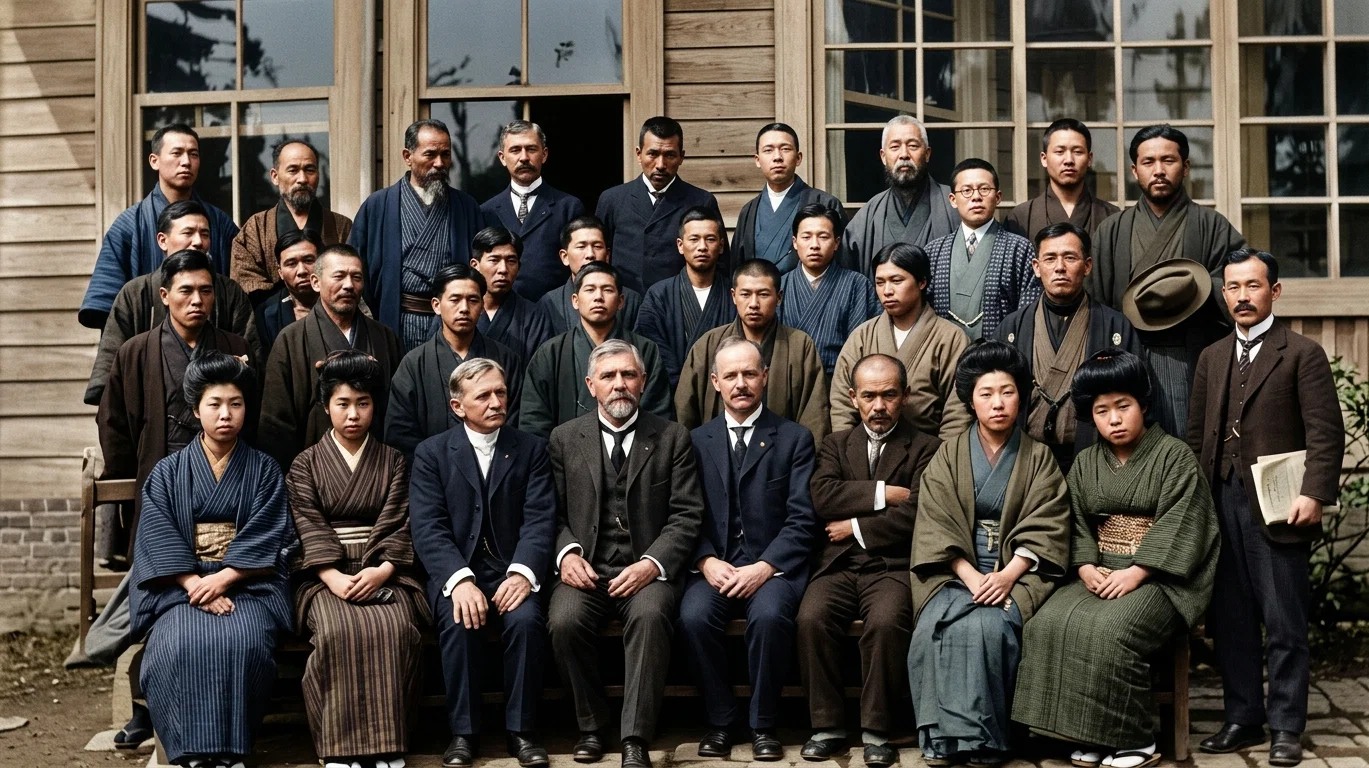
Japan has closed a very profitable three months' institute for the Japanese workers. It was my privilege to spend three weeks there near the close of the period. A practical presentation of the leading features of the message had been given by Elder F. H. De Vinney. Elders W. D. Burden and T. H. Okohira carried daily studies in Bible, music, and history. The work closed with a marked outpouring of the Holy Spirit, and the laborers returned to their fields full of faith and courage, and better equipped with an intelligent knowledge of the message for successful work. Brother C. N. Woodward and Elder C. L. Butterfield attended a part of this institute, and rendered valuable assistance.
The work throughout the Japanese field has been divided into five divisions, each division being under foreign supervision. This will be an important factor for the future success of the work. Land has been purchased near Tokio on a nine-hundred-and-ninety-nine-year lease for the location of the headquarters of the Japanese work, and building operations are now under way. The whole trend of the work in Japan is forward.
Central China has purchased a fine building in a good location in the city of Changsha as the headquarters of the work in Hunan Province. It is all paid for, and is being occupied. Much gratitude to God and the brethren in the homeland is expressed, that this much-needed station for the work in that large city, combined with headquarters for the province, has been made possible.
Photo by R. C. Porter
TEACHERS AND WORKERS ATTENDING JAPANESE INSTITUTE AT TOKIO
Photo by R. C. Porter TEACHERS AND WORKERS ATTENDING JAPANESE INSTITUTE AT TOKIO
The headquarters for the Central China field are now located at Hankow. This is the natural center from which to operate the three provinces—Honan, Hupeh, and Hunan. In the near future Elder R. F. Cottrell, the superintendent, will move to Hankow, Elder C. P. Lillie taking the supervision of the work in the Hunan Province, with Brother S. G. White as assistant. Brother White will also act as treasurer. Brother and Sister J. O. Ryd will assist Elder Cottrell in Hankow. Dr. A. G. Larson, also located at Hankow, fills the office of treasurer of the Central China Mission. On his last tour through Hunan four new churches were organized and twenty-four persons were baptized by Elder Cottrell. Sister Cottrell accompanied him and did excellent work in the Sabbath school department.
Elder J. J. Westrup, who has charge of the work in Honan Province, is returning to America on account of the illness of his wife, from whom he has now been separated for more than two and one-half years. He returned from his furlough alone, expecting that Sister Westrup would regain her health and come to him later, but she has not made the recovery that was hoped; so Elder Westrup now leaves to join her, and will labor where the conditions are more favorable for Sister Westrup. Elder Fred Lee takes the work as superintendent of the Honan Province, with Brother O. J. Gibson as assistant and treasurer.
Plans to extend the work in the East China Mission were laid during a general meeting recently held in Shanghai. Elders Stafford and Wood have charge of the work in Shanghai and its vicinity, also in the Kiangsu Province. They are now holding meetings in a mat house built for the purpose, about ten miles out of Shanghai. Their work the last few months has resulted in bringing a goodly number into the truth, several of whom are attending our training school, and give evidence of making good workers.
Brother H. J. and Sister Doolittle have charge of the work in the central part of the field. Some one to oversee the work in the northern part is greatly needed. Elder O. A. Hall, the superintendent of the East China Mission, is a teacher in our training school, and it is difficult for him to give sufficient attention to the northern part of his territory, which has no foreign supervision. But the work is moving forward, and the workers are of good courage.
South China is suffering from the loss of three workers, one by death and two by removal from the field. The work is advancing however. One new province has been opened, and there is a spirit of unity and courage throughout the field. The demand for two superintendents for missions and one for the treasury department of this field is imperative.
Elder L. V. Finster writes that the work in the Philippines was never more prosperous. The first residence on the newly purchased site for the headquarters of the Philippines, located in the city of Manila, is nearing completion. The printing plant has already been transferred to the new location. Twenty-five were recently baptized as the result of meetings held by the Filipino workers, aided by the foreign laborers from time to time. Forty-five accepted the message during the last month.
The latest word from the Malaysian field reported by the treasurer, Brother H. E. Sharp, is that the income from tithes, offerings, and book sales during the past months exceeds the expenditures throughout the field. Elder F. A. Detamore, the superintendent, passed through Shanghai with his wife and family, accompanied by two brethren and their wives as recruits for that field. They were preceded by Elder and Sister Yates and Sister Mamie Yarnell, who reached the field a few weeks ago and are already getting a good grip on their work.
A spirit of good cheer vibrates throughout the Asiatic field, and there are continual evidences of God's leading, which are an assurance of prosperity in the work, and of continual advance until the great clock of time marks the hour for its final triumph.
Continue reading: The Bolivia Mission