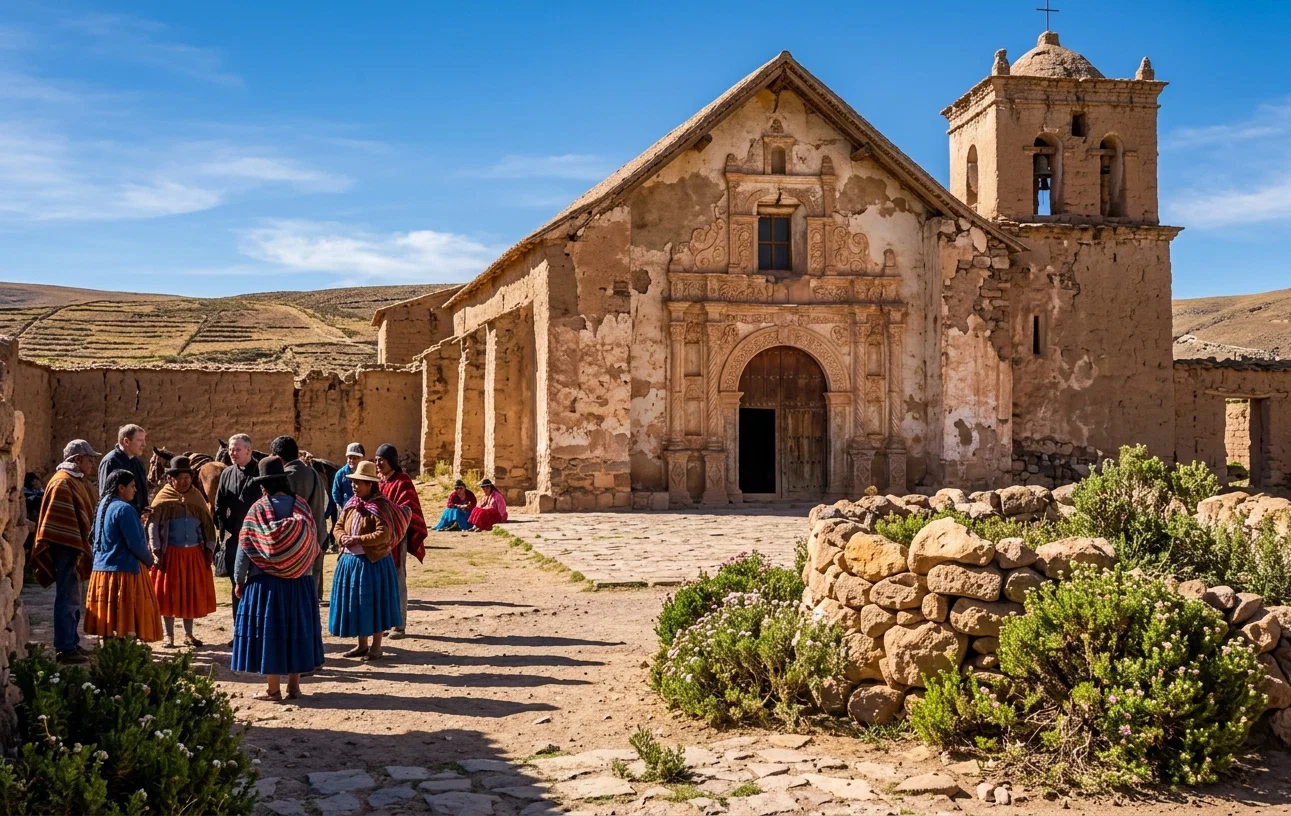
Our regular weekly trip to the alta (high above La Paz) headquarters of our Bolivia Mission, is a very interesting one. We rise at 4 A. M., saddle our horses, and start on our way before daylight.
Recently with Luciana Chambia, our Indian worker, we started as usual, reaching the top of the mountain about 7 A. M. The mountain is about one thousand feet high, with a very abrupt rise. We walked part of the way as it is a hard climb for the animals. From the top, one can see estancias (villages) jotted here and there for miles around.
We reached the first village at 8 A. M., and were informed by an Indian that there was to be a feast in the next village, and that all the people in the four estancias we intended to visit were going to attend. I felt that it was unfortunate that we should have taken that day to go; for every one who can possibly walk goes to these feasts. They are feasts of the Catholic Church, where all get intoxicated before the day is over. We found Indians selling alcohol inside the churchyard, dancing and drinking, dressed in gayly spangled clothes made for the occasion, and with long flowing false hair. When we realize that all this is done in the name of the Lord, we can understand how much effort we as a people should put forth for these poor ignorant Indians. How my heart ached for them! I could not tell them how wrong it was to connect the dear Saviour with such feastings, because I could not speak the language.
After treating several sick persons, we rode over near the church, and here we met the chief of the village, whose daughter I had treated some time before. He came up to me and shook my hand heartily. I told him through my interpreter that I wished to take a picture of his people dancing. It is very hard to get pictures of these feasts, for the Indians do not wish to be published broadcast in this manner, the picture showing them all in their drunken revelry. I feared he would refuse me, but I suppose because of the help I was giving his Indians he got those together who were dressed for the occasion, and I obtained some very interesting pictures [two of which accompany this article].
As we were about to go, an Indian came to us asking, “Señor doctor, won’t you please go to a sick woman who has been stabbed?” She was in another village two miles farther on, one we had12never visited. I told him we would go if he would guide us there, as it is very hard to find the houses by direction.
I found the woman very sick, with a gash three inches long under her arm, and one in her breast five inches long and very deep. The wounds had been inflicted three days before, so that the flesh could not be drawn together. After removing the filthy clothes and bandages, I washed and cleansed the wounds, re-bandaging them, and left her feeling more comfortable. The deep wound had started to suppurate, and if it had been left much longer there would have been considerable trouble in getting it to heal.
COSTUMES OF INDIANS ATTENDING DRUNKEN CHURCH FESTIVAL
These, dear brethren, are the conditions we find among these people. On other trips I make, I find many cases equally as bad. Many get well in a very short time. The Lord is indeed guiding in a wonderful manner; for some of the cases I have seem to me almost impossible to cure, but they get well. I am realizing more and more that my Father in heaven is with me daily, directing my hands and giving me wisdom to do that which I of myself could never accomplish. The medical work in these fields calls for consecrated men and women; and it is my prayer that God will keep me faithful so that his presence will be with me daily. For what could I do alone?
We cared for fifteen persons on this trip—not so many as the week before, but we can see the work growing. The great need now is to get the language, for through the medical work the way is opening to tell the people the great message for this time. We are using all our spare time in studying Spanish. While on these long trips, I take my New Testament in Spanish and English and study while in the saddle. This I find an excellent plan, reading God’s Word and translating it into the language of the people for whom we are laboring.
BOLIVIAN ROMAN CATHOLIC CHURCH
WHERE FESTIVAL WAS HELD
Character Building in the Home
By Helen C. Conard
HELEN C. CONARD
“The choicest garb, the sweetest grace,
Are oft to strangers shown;
The careless mien, the frowning face,
Are given to our own.
We flatter those we scarcely know,
We please the fleeting guest,
And deal full many a thoughtless blow
To those we love the best.”
“Home, with its purity, peace, and love, is the gift of Christianity.”
CHARACTER building is the alpha and omega of life’s short span. It has always been so. God himself began it when he placed the man and the woman in that garden “eastward in Eden.” Before them was placed that work of developing characters fitted to hold the dominion which God put in their hands. They were placed upon vantage ground; but they failed, and the vantage was lost, and their tainted posterity have been obliged to struggle against ever-increasing odds from that dark day to this. But still the plan has not changed. The work is before us, and there is no other way. And while the path leads us by the way of the cross, we must follow it or fail, not only for time, but for eternity.
“Man is a bundle of habits.” Usually when it is said of a young man, “He has no bad habits whatever,” it simply means that he does not drink intoxicants, he does not use tobacco, he does not swear, he does not gamble. The fact is if he has no bad habits whatever, he is perfect. At the same time that he neither drinks, chews, smokes, swears, nor gambles, he may have other habits that will as surely enslave him in the bondage of sin and compass his final destruction. The boys and girls upon whom the burden of this message is soon to rest must possess positive, sterling qualities that will pass at a premium in any market because of their recognized value.
Obedience
Christ was subject to his parents. Here is the obedience that is the example for every child. Here is the standard to which every parent should strive to bring his child. When shall this training begin? If it did not begin with the parent in his own parental home, he will have a struggle with himself before he begins with his child. He must learn what obedience is; he must have in his own mind such a clear-cut idea of what constitutes true obedience that he will be able to detect disobedience in whatever guise it may present itself. The will of the parents must be an unwavering law to the child. But here we are confronted with the problem of problems: how to teach this implicit obedience. It stands to reason that the training must begin very early—it can hardly begin too early—in the child’s life, and it must be carried on with conscientious, undeviating, patient persistence until the habit is fully established. And then what? The habit must be maintained with the same conscientious, undeviating, patient persistence so long as you are the parent and he is the child. But some may say, Is not this making provision for the parent to be tyrannical,—for the child to be a slave,—a mere whim of caprice?—No, there is no such provision in true obedience.
There are always two parties to obedience, the one commanding or requiring and the other complying with the requirement. To be obedient is to be subject in will or act to authority; and here we are brought to the first step in teaching obedience,—the training of the will. This does not mean the annihilation of the child’s will by any means. The will is God’s most precious gift to man, and it should ever be the aim of the parent to strengthen the will of his child, to train the will, to turn this precious reserve force into channels of peace and blessing. If the will of the child is brought into harmony with the will of the parent, there will be no thought in the child’s mind of tyranny on the part of the parent or of the loss of individuality on the part of himself. The parent’s way is his way; the parent’s interest, his interest. This is as it should be. But what a responsibility it throws upon the parent! His will must be the governing will; but what about his will? Has he so learned the lesson of obedience that his will has been brought into harmony with the will of the Father of all?
Respect
Respect naturally follows obedience. In fact, it seems to me that there can be no true obedience to an authority without respect for that authority. So surely as a parent forfeits the respect of his child, so surely the semblance of obedience will come to an end as soon as the pressure of physical force is removed. Here in a most emphatic way is the potency13of example over mere precept demonstrated. The example of the parents in their association with each other and in their attitude toward their children will count for much in forming this habit. If the husband shows that the wife is his queen, she will be enthroned in the actions of her children. If the wife crowns her husband king, he will have a family of loyal subjects.
Reverence
Closely allied to respect is reverence, and here as in the training of respectfulness, a single word or act of the parent may turn the scale. Reverence for God, for the name of God, for the house of God,—are we as a people lacking in this? I have sometimes thought so, and yet I know we do not mean to be guilty of anything sacrilegious. Many times the conditions under which we worship have a tendency to lower the standard in this respect. If we could always have the church edifice with its mellowed light and suggestive furnishings, we might find it as easy to maintain a degree of religious awe, even in our children, as is seen with some other sects; but with meetings held in the common schoolhouse or in the private house, it becomes a matter of study just how to preserve the proper decorum. One thing I have looked upon with fear and trembling,—the apparently growing tendency toward the separation of parents and children during the time of the service. It is a sight which it seems to me must wring groans of distress from the very angels to see pious parents on the front seats while their children are in some other part of the room, usually in the rear, with their playmates or acquaintances of the week. It is a dark picture, with more in it than is seen on the surface. I wish it were an imaginary one.
(To be concluded)
Home Life
By Mrs. C. C. Lewis
Conducted by Mrs. C. C. Lewis, Takoma Park, Washington, D. C.
Through the columns of this department, hints will be given on all matters pertaining to the home life. Short articles and letters are solicited from home makers, telling of their everyday experiences,—their joys and sorrows, their failures and successes.
The Battle Against Waste
MORE than ever before the world of today is a battle field. The battle is closer than any other ever fought. It is not for dynastic glory. It is not for a personal point of honor. The world's battle of today is against waste, the devourer of humanity.
Either, in this land of the American people, as in other lands largely peopled, waste must stop, or the growth of population must stop. And when the population of a nation ceases to go forward, the next step is that it begins to go backward. This is national decay. Step by step with national decay goes individual decay.
Where, and in what, is this devouring waste?—Everywhere and in everything. Twenty million families, the big consolidated family of the United States, each needlessly burning one single match a day, at the price of five cents a dozen boxes,—only one match wasted to a whole family,—is the equivalent of burning down every year a house worth half a million dollars.
If so little a thing as a single match a day for each family of five persons can mean so much in the aggregate of national waste, is not all the rest of the possible and the actual waste as clear as sunshine?
There is the light that is left burning when not needed. There is the fire flaming under the empty kettle. There is the good food swept neglected from the table. There are the farm implements, the artisan's tools, the household utensils, misused and damaged. In all varieties there is waste by nearly all the units; and the aggregate is immeasurable.
Worse! There is the economic waste in the production of the necessaries of life. Two pairs of hands on the job for one pair. One pair fiddling for a day over what could be done in half a day. Rent paid for more space than would suffice. Water running over the dam without turning a wheel. In your own mind go down the list—this, that, and everything. Think of what a single match a day means, and then see if your imagination can grasp it all—all the waste.
Scientific management is chiefly the stoppage of waste. In recent years the supreme efforts and the supreme triumphs of business management have been in the stoppage of waste—getting more than before out of the same material, the same physical energy, the same material activity.
And now American governing bodies, like private corporations, are alive to the need of scientific management to promote efficiency and save waste. They are employing experts in business methods. They are hunting for good business managers as a private corporation would—a city business manager, a State business manager, a federal department business manager.
This is the battle for efficiency, absorbing in our day the best brains of successful business management.
But this isn't going far enough. It does not get to the biggest field of all—the public's waste. The scientific methods of the thousands saving against the waste of the happy-go-lucky millions have been a partial check on the rising price of the nation's bread and butter. But there is a limit to the attainment of the ideal of waste—saving by the scientific methods of the thousands organized into perfect business machines. To that ideal the successful ones are near enough, and the others must perish—to sound the warning of the dead line.
Then it will be up to the individual units—the millions for the last chance! Can the millions on the farm, in the small place of business, at the workbench, in the household, learn that inexorable lesson to save waste? Well, they can, because they must. Germany has learned, or is learning; and France, and Holland.
Theirs is the lesson we Americans must learn or be devoured by our waste. We must not suck the orange dry and then study the rejoicing of the shriveled skin. We must not be the last to learn. In the economic race, the devil takes, without fail and without mercy, the hindmost.—Munsey's Magazine.
The Mother's Responsibility in Regard to the Purity of Her Children
By E. E. K.
THE engineer who would attempt to run a train filled with human beings over a road beset with danger, without a thorough knowledge of the perilous points and a full understanding of how he must guide his engine, either to avoid or to pass over them in safety, would be condemned at once by every one, not only as utterly unworthy of the trust reposed in him, but as guilty of inexcusable sin in thus jeopardizing human lives,—inexcusable, because, if he takes upon himself such a trust, he has no right to remain in ignorance of anything which it is in his power to learn respecting the precautions necessary to insure a safe journey.
If a knowledge of the dangers which surround his way is so necessary to the engineer into whose care is intrusted simply the bodily safety of human beings for only a few short hours, how much greater importance is attached to a knowledge of the pitfalls and dangers which beset life's pathway, for all mothers to whose care and guidance is intrusted not only the physical but the mental and moral welfare of children for a score of years.
The evils that influence our children for vice are everywhere prevalent. There are hundreds of different avenues by which they may reach even the most sheltered homes of our land. Mothers cannot afford to ignore these perils. It is blindness to danger that invites moral disasters.
Many mothers are apt to look upon the subject of impurity as one which in no way concerns their children of tender years, and so neglect to guard them in this particular until the weeds of impurity are firmly rooted in their young hearts. It is easy to see the weeds when they have grown and are putting forth leaves and branches; but then it is too14late; the roots are firmly grounded; and labor with what zeal we may to tear them out, there is always danger that some rootlet will remain to spring up again where least expected. The only sure way is to prevent the mischief-making seeds from germinating.
As a safeguard against vice, teach the little one, from earliest infancy, correct physical habits, especially in regard to sleeping and eating. “The handmaid of chastity is nature's great restorer, peaceful, unbroken slumber for childhood and youth.” Any source of indigestion, too much or too little exercise, cold feet, or other exciting cause of sleeplessness, should be zealously guarded against. The diet of children should be most rigidly looked after. Children allowed to eat at all hours, to partake of rich and highly seasoned foods, sweetmeats, and dainties, to use tea and coffee and strong condiments, to overeat, are thus taught self-gratification rather than self-control, and are placed under the dominion of their lower natures.
Abundant exercise is an especially important aid to purity, and the value of wholesome occupation at all times can hardly be overestimated. The mind will be occupied with something, and the old adage that “Satan finds some mischief still for idle hands to do” is a true one. Have something fresh and interesting always ready with which to satisfy the keen appetites of their unfolding intellects. Teach them about stones and flowers, about insects and birds, and read to them about great and useful men and women. Strive to interest them in whatever will create in them aspirations for that which is good and pure. If the circumstances which surround them are such that there is any likelihood of their being led into evil through the example of others, fortify them against it by warning them of its inevitable consequences.
Guard the associations of your little ones even more carefully than those of children of older growth. Never allow them in their play to wander out of your sight and hearing in company with some neighbor's child; and do not, to get rid of their noise, banish them to some room or corner by themselves, where they, unobserved, will feel at liberty to carry out any impulse for evil which may spring up in their minds. If little friends come to visit them, superintend their plays, show them new games, and help them to keep their minds so full of enjoyable thoughts that they will have no time to think of anything wrong. Let them see that you enjoy their guests, and they will soon come to feel that a visit from a friend without mamma to share it will be a great loss of pleasure.—E. E. K., in Home and School.
His Way
By Eleanor Scott Sharples
WITH a heart that was pure, and an eye
seeing clear,
She looked on a world full of woe,
And begged with a woman's passionate
might,
“Dear Father, O pray let me go!
“I will use all the strength of my earnest
soul
To teach them the way to thee;”
But the Father but drew her more close
unto him
And answered her passionate plea,—
“I have many a voice that is loud and
strong,
To speak to the world for me.
But I’ve no one to sing a lullaby song
To this wee little babe but thee.”
And the song was so sweet, and the song
was so soft,
That the babe on her bosom smiled;
And the world that was weary of noise
and of strife,
Saw God in the mother and child.
—Eleanor Scott Sharples.
New Jersey
By A. R. Sandborn
It has been a long time since we have reported to the REVIEW, but it has not been because God was not working for the people of this State.
I can speak for about three years only, but during this time the prospering hand of God has been manifested. This is distinctly a foreign field, and we have been working for the following nationalities: English, German, Swedish, Danish-Norwegian, Dutch, Slavic-Bohemian, Polish, Russian, Hungarian, and Negro. We have had ten workers laboring for the foreign-speaking people, one Negro worker, and about as many more working for the English-speaking people. At the present time we are employing twenty-four laborers.
During the year 1913 the net increase in church membership was 99, making our present membership 825. A substantial increase was made in the tithe over the previous year. Four new churches were dedicated last year, and another is now nearing completion. These buildings are substantial monuments, and will mean much for the advancement of the third angel's message in this State.
We are glad to be able to do so much for the foreigners, and we have been able to send several to spread the message in other places.
When the message came that we ought to work the cities in the East, the Lord immediately began to prepare the way; and we find that there are many waiting for the message. Our literature is accomplishing much in advancing the work here.
We have only four tent companies in the field this year, but the prospects are bright for good returns from these.
A. R. SANDBORN.
Santa Maria, Brazil
By F. W. Spies
SANTA MARIA is fifteen leagues distant from Caruaru, the nearest railroad station. The whole country between these two places (and there are many regions like it in this state of Pernambuco) bears in a special sense the marks of the curse of sin. There is a dry season of six months, and a wet season of the same length of time. At the close of the dry season, there is not a green leaf to be seen for many miles around. All is withered and dead. And, in fact, the inhabitants of this section are happy if, after a period of six months, rain sets in. Sometimes it fails, and that may mean eighteen months without rain, and very likely the starving of all live stock.
On our way from Caruaru, after riding for hours in the hot sun, we approached what seemed a clear, cool, refreshing rivulet. We were glad for the prospect of getting a good drink; but when we tasted the water we found it to be strongly saline, and not fit to drink. The inhabitants tell us that all the water found in the earth or in streams in this section is more or less salty, and cannot be used. To provide a water supply, the people dig holes of all sizes, shapes, and depths in the earth, and in the rainy season these fill up with water. This is the water supply for man and beast as long as it lasts. Although it is now the rainy season, and this water supply is at its best, it is not very enticing, even to a thirsty person, to go to one of these water holes covered with all sorts of plants and swarming with water insects and animals, for a drink. It is now almost two weeks since we have seen any fruit worth mentioning. In the dry15season, the bill of fare is very meager.
But why are we in such a place anyway? A certain inhabitant of Santa Maria heard of a sister in Caruaru who kept the Sabbath. His pastor had told him that the only way one could get along with those Adventists was not to talk with them, for if a person ventured into a conversation with them, he was lost. However, this faithful pastoral instruction, instead of having the desired effect, led the man, who had once been a Catholic and whose priest used to talk in the same way about the Protestants, to think that there must be something wrong with such advice, and he became curious to know more about these Sabbath keepers. He went the fifteen leagues to Caruaru, partly on business, partly to meet the Sabbath keepers. After a valiant struggle to defend the first-day sabbath, he was so far worsted that he went home with a copy of Portuguese “Bible Readings,” resolved to study the question; and in Santa Maria we now have about twenty persons in six different families who are keeping the Sabbath, and others are interested.
It certainly seems strange that the truth should find its way into such out-of-the-way places, and yet, as we talked to these persons of the glories of the new earth, where the difficulties of the present life and the curse now burdening this old earth will be forever past, they could certainly appreciate all the promised blessings. The writer has been accompanying Elder Ricardo Wilfart through this state, his new field of labor, introducing him to the brethren, and among other places we visited Santa Maria. May the Lord grant that the work that looks so promising here at this time may develop into a good, strong church.
F. W. SPIES.
Ontario
By J. Allen; Mrs. Allen
On Sabbath, June 20, eighteen members were added to the church in Brantford, Ontario. Thirty-two new members have been added to this church during the past ten months. In the months of July and August last year we held a tent effort there, and followed the work in a hall during the fall and winter. We met with some severe opposition, but the Lord blessed with an increase in numbers, as noted above.
We are now laboring in Toronto, with its nearly half million inhabitants. We began our tent effort last Sunday, July 12, with a good attendance, and each night since we have had a goodly number at the meetings. As this is the home of the Lord’s Day Alliance, we expect that the work will be somewhat difficult to open up. But we are of good courage and trust in the Lord to lead us.
J. AND MRS. ALLEN.
Maryland
By GUSTAVUS P. RODGERS
BALTIMORE.—We are now beginning the fifth week of our tent effort for the colored people of Baltimore. Connected with the effort, are the members of the church, who render faithful service each night in a good, strong choir. Elder Seeney, from Wilmington, Del., preaches here every other evening. The interest is the best we have ever had at any place; the tent is filled at each service, and from fifty to one hundred stand. On Sunday nights the crowd is still larger. Some already are keeping the Sabbath, although we have not yet preached on this important truth.
The same persons attend night after night, and we believe that the success we are praying for will be a reality. Our conference brethren have been good to us in furnishing us with such a nice tent, and in return we are making the tent entirely self-supporting; for our collections will pay every expense. We solicit the prayers of the readers of this paper for many souls, and for wisdom in the presentation of the message.
GUSTAVUS P. RODGERS.
Training the Young by Example
PLATO says that “the best way of training the young is to train yourself at the same time; not to admonish them, but to be always carrying out your own principles in practice.”
South Dakota Camp Meeting
By I. G. Ortner
THE camp meeting at Huron, S. Dak., held June 12-21 on the State fairgrounds, was a successful one, notwithstanding that the meeting opened amid stormy weather and heavy winds.
Besides the conference laborers, there were present Elders Chas. Thompson, C. L. Emmerson, J. H. Schilling, M. L. Andreasen, Valentine Leer, S. Mortenson, A. R. Ogden, and E. T. Russell; Profs. Frederick Griggs, E. C. Witzke, H. A. Morrison, and W. W. Ruble; Brethren F. E. Painter and W. H. Edwards.
The attendance from the city was good, and the preaching was of an inspiring nature, touching the heart, the burden being, One soul brought to Christ by each one in the conference in 1914. The conference president, who had served faithfully for four years, wished to be relieved of official duties, that he might give himself more fully to the work of the ministry; so this important work, after careful consideration, was laid upon Elder E. T. Russell, formerly of the Central Union Conference. The other conference officers remained the same as for the past year. During the meeting two baptismal services were conducted, and about thirty-five candidates were buried with their Master in the watery grave.
Reports of the various departments showed progress in every line of work. Fifteen cents a week per member for the first six months of 1913 and twenty cents a week for the last six months of the year were fully met by the conference. Tithe receipts showed an increase of about $2,000 over the previous year. The per cent of tithe to missions was sent to the General Conference as recommended; thus it can be said of the South Dakota Conference that it met all expectations of the General Conference for the year.
A successful cafeteria was conducted, which allowed the sisters more time to attend the meeting.
In view of the prospects of a good crop in this State, a movement was begun which is hoped will reduce the financial obligations of the conference very materially this year. The conference starts upon its year with hope and courage to continue the proclamation of the last message of mercy to a dying world.
I. G. ORTNER.
Western Canadian Meetings
By O. A. OLSEN
The Saskatchewan Camp Meeting
This meeting was held at Regina, June 25 to July 5. Seventy-five tents composed the camp, and nearly four hundred of our people were in attendance. While this is the youngest of the Western Canadian Union conferences, it is very rapidly coming to the front. The past year was a prosperous one in every department of the work. The blessing of the Lord attended the laborers, and a goodly number were added to the truth.
During 1913 three new churches were received, increasing the membership by 123, and the total number of believers by 204. The tithe had a gain of $2,958.23, and the offerings of $2,072.18. The total tithes and offerings per capita were $49.08. All this gives evidence of a prosperous and growing work.
This conference is taking a very active interest in the home missionary work; and experience has shown that every church and conference doing that will experience encouraging growth and development in all branches of its work.
The business proceedings of the conference were most harmonious. Elder A. C. Gilbert was reelected president for the coming year, and few changes were made in other officers.
The laborers present were the same as at the Alberta meeting, with the exception that Elder C. Leer came to take the place of Elder Riffel in the German work. Daily services were held in English, German, Servian, Roumanian, and Russian. Scandinavian meetings were also held frequently. By this the reader gets an idea that several nationalities are represented in this field; but these are by no means all. Canada, like the United States, has a very mixed population, representing nearly all nations in the world.
The question of a conference school was given much consideration at this time. One year ago the conference instructed its executive committee to be on the lookout for a favorable location for such a school, and report its findings to the conference this year. This instruction the committee followed, and presented to the conference assembled quite a number of sites and propositions. These were all most carefully considered by a large representative committee chosen by the conference, and North Battleford was selected as the location offering the largest number of advantages for the school. Five thousand two hundred and twenty-nine dollars was subscribed in cash and pledges. This, with $1,296 on hand, gives them $6,525 to start the school enterprise. Their decided purpose is to proceed only as they have cash on hand to meet the outlays. They will do well to hold strictly to this plan.
We were glad to find this conference ahead on the Twenty-cent-a-week Fund, and their purpose is to keep their lead. Why should not more conferences do the same?
The spiritual interest in the meetings was very good. The preaching was close and searching, and heartily received. On the last Sabbath of the meeting we had a special refreshing. Some took their stand for the Lord, and nearly all present renewed their covenant with God. It was a most impressive occasion, and will long be remembered by many.
A special feature of the meeting was the children's missionary program given on Sunday morning. It was very interesting and instructive, and had an excellent effect on the congregation. There were parents present who confessed their faults in not giving their children more encouragement in missionary effort. Much credit is due their conference Sabbath-school secretary for her excellent work for the children.
The Manitoba Camp Meeting
In company with Elder H. S. Shaw and others, we left Regina on Sunday afternoon for the Manitoba meeting at Morden, where we arrived Monday noon. We found the camp very pleasantly located in a shady park on the outskirts of the town. The meeting, having begun the week before, was under full headway, in charge of Elder E. M. Chapman, the president, and his coworkers. While the Manitoba Conference is the oldest in the Western Canadian Union, it is still the smallest in number of believers. Various internal conditions have hindered the progress of the message. We hope that unity and hearty cooperation may prevail, that the work may advance more rapidly, to the joy and encouragement of all. This camp was composed of thirty-eight tents, and about one hundred and fifty of our people attended the meeting.
Morden is located almost in the extreme south of the province, in a German community where we have a large German church; hence the Germans formed fully two thirds of our people assembled. The blessing of the Lord attended our meetings, and our people seemed much encouraged, and heartily responded in renewal of consecration to God and his service.
Elder Chapman was reelected president of the conference. May the Lord greatly bless the work in that great province during the coming year. Eight candidates were baptized at the meeting, and some others will be baptized at their home churches.
The conference voted to raise $1,500 to be divided between mission and home work. Of this amount $800 was given in cash and pledges at the meeting. This was good, considering the small number present, and showed a readiness on the part of the people to support the work. This conference has been somewhat backward in the home missionary work. We hope there will be a decided change in this respect, as this would prove a great blessing, and give a new impetus16to the progress of the work in both the churches and the conference.
With this meeting ends the series of five camp meetings in the Western Canadian Union. In company with Elder Shaw I have attended them all. The blessing of the Lord has been with us, giving us much freedom in preaching and in giving Bible studies, which have been of a heart-searching nature.
In every place the message has met a most hearty response. Personally I have greatly enjoyed the tour, and my associations with Elder Shaw and other laborers have been most pleasant and profitable.
The Western Canadian field is a most promising one, with a devoted and consecrated corps of workers and a faithful church membership. Great results are in store. There is also a large foreign element of many nationalities to whom the truth must be taken, both by literature and by the living preacher. May the good work be hastened on its march.
O. A. OLSEN.