NEW YORK CITY is pre-eminently the home of the enormously rich; it is also the abode of the desperately poor. Both classes, the two extremes of human life as measured by money, here meet and mingle together. The contrast is already a marked sign of the times, and it seems destined in the near future to be a still more serious menace to society.
Facts bearing on this matter are so openly manifested, and so generally recognized, that arguments to prove the proposition are superfluous.
Wise, conservative men in every department of our complexed modern, civic, and economic structure are crying out in alarm against the conditions which perpetuate and also augment the danger; but notwithstanding this, the chasm which separates the very rich and the very poor is daily becoming wider and deeper.
From statements and statistics frequently appearing in current periodicals and confirmed by general, personal observation, it is evident that almost fabulous wealth in the possession of a few persons, and corresponding poverty among the masses of our population, are increasing at a tremendously-swift pace and reaching gigantic proportions. Of all the nations of the world, the United States leads in the list of colossal wealth, and of all the cities of the world, New York is far in the lead for magnitude and number of individual fortunes; therefore the reading public of New York City are especially invited to consider this matter.
A well-known English writer, Mr. James Bryce, observes that sixty years ago there were no great fortunes, and no general poverty in the United States; twenty years ago there were relatively many persons of enormous wealth, and also a large increase of those absolutely destitute. Now it can be said that marvelous riches in the hands of comparatively few is beyond any comparison with former days, while official figures place the number of national paupers at three million persons, and one-tenth of all who die in New York City fill paupers' graves. Who dares to think what is sure to transpire in the next score of years if the present tide continues its onward sweep and rush!
Fifty years ago, New York City boasted of twenty-eight millionaires; now it is the home of over two thousand. But "millionaire" no longer expresses the riches gathered in single fortunes; "multimillionaire" is a word coined in recent years to describe the possessors of such vast amounts, and "billionaire" is the term already applied to one or more who now surpass all others in the race for money.
The mind is staggered by such stupendous figures, and when it is observed that approximately a dozen men by their united capital can control the entire business of the country, the outlook for the future is truly appalling. When a few persons obtain the power to still tax the masses, the burdens of the poor will become unbearable. No song of "prosperity" can then drown the cry of distress already sounding throughout the land.
In this connection it is certainly important that we note some predictions of the Bible pertaining to the matter.
Here we get history in advance, a glimpse of the future as revealed to the apostles and prophets of the Lord. He who "knoweth the end from the beginning," and who "declares from ancient times the things not yet done," as proof of His own sovereign wisdom, has told us of a time when men will have literally "heaped treasure together."
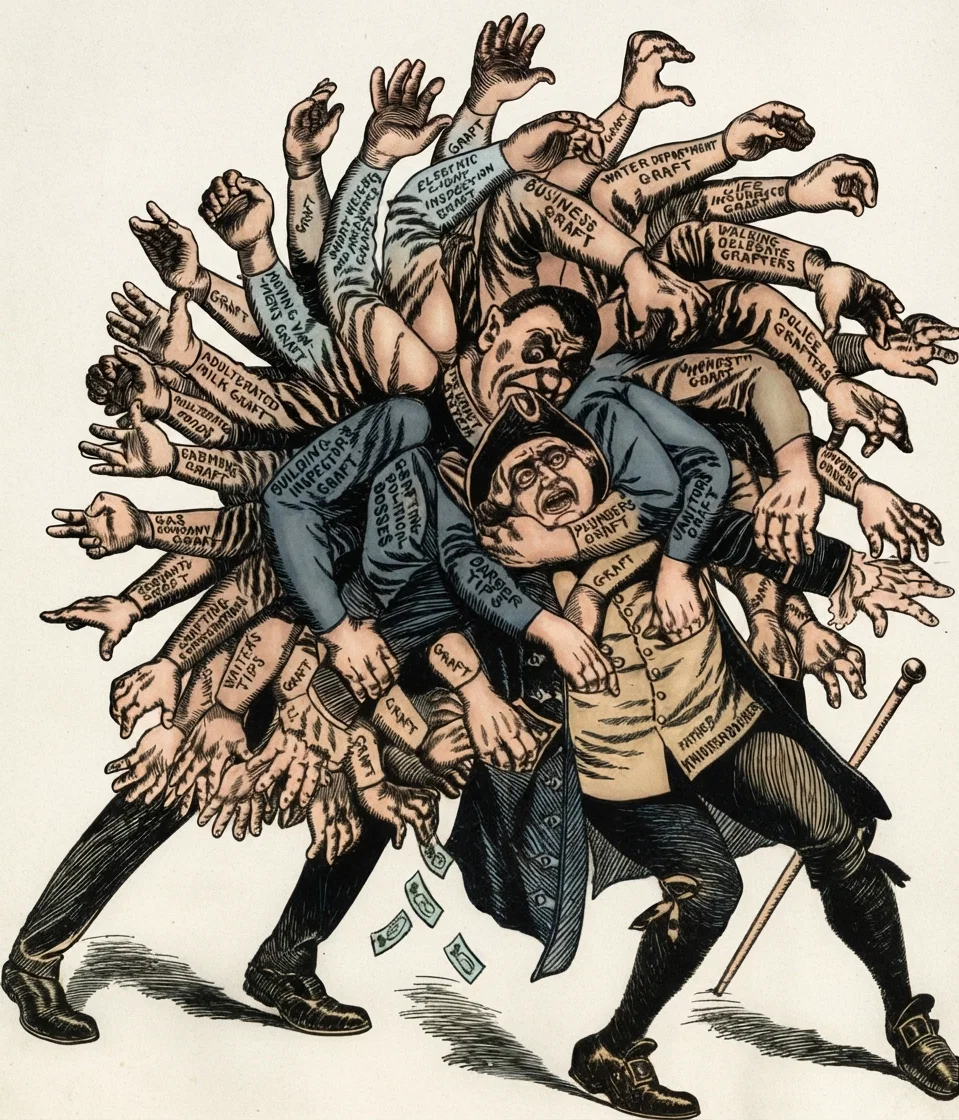
IN THE HANDS OF THE MONSTER "GRAFT."
Notice the expression quoted—"heaped treasure together"—heaps of money, piles of gold, such an abundance of riches that it is actually "heaped" together. Surely this is a true picture of present-day fortunes; no scattering coins, no moderately-filled purses, but treasure "heaped" up, and "heaped together" in mounds fast growing into hills and mountains.
Such a startling description in Bible language of what is going on to-day, leads one to inquire further of the same inspired oracle as to the source of this abnormal wealth. "Behold, the hire [wages] of the laborers who have reaped down your fields, which is of you kept back by fraud, crieth." How familiar some of these words sound in our ears!
The Bible is really telling how "laborers" have been deprived of their just "hire" or wages, by "fraud" on the part of those who have "heaped treasure together." One can almost imagine he is hearing the bitter complaints of the workingmen as they recite the reasons for their discontent. Fraud in the matter of hire of laborers is the Lord's prophecy; every labor organization in the country bears witness that the charge is true.
Current articles and comments in the public press emphasize the fact that "frenzied finance" is responsible for much of this trouble, and that at least part of this enormous treasure is "tainted money," or money gathered by tainted men. In view of recent disclosures, in this city especially, there is no need to say again that our extremely rich men have not hesitated to plunder the public.
Lavish extravagance is the usual result of such heaped-up treasure obtained by fraud; therefore the apostle adds, "Ye have lived in pleasure on the earth, and been wanton; ye have nourished your hearts as in a day of slaughter." Think of the costly banquets spread by these lords of finance, or their sons and daughters; think of the ostentatious display in dress, equipage, and amusements daily flaunted in the pinched face of Poverty. Every dweller in New York, and every visitor in our midst, must be impressed with the "wanton," reckless, useless, foolish, wicked ways in which the ill-gotten wealth is consumed. A terrible harvest must surely be reaped from this sowing.
Bitterness is filling the hearts of the poor, while pride spurs on the rich. A violent clash must inevitably come, or else all previous human history is written in vain, and even the Word of God will be proved untrue, which in the same connection says, "Go to now, ye rich men, weep and howl for your miseries that shall come upon you. Your riches are corrupted, and your garments are moth-eaten. Your gold and silver is cankered; and the rust of them shall be a witness against you, and shall eat your flesh as it were fire." If "like causes produce like effects," then we are not far from a repetition of the French Revolution a century ago. Matters as now progressing can not go on forever. Indeed, the scripture under consideration declares that these conditions mark the "last days." The very end of the world is foretold in these rapidly-moving events. Men are hastily heaping together treasure for the "last days;" the piteous moan of the depressed laborer tells that the "last days" are now passing; the wanton pleasure-seeker proclaims the "day of slaughter" near at hand, while the Lord's own Word declares "the coming of the Lord draweth nigh," and exhorts those who know the meaning of these things to "be patient therefore, brethren, unto the coming of the Lord."
Rich and poor alike are pointed to the only way of escape; character alone is the test in that day. Millionaires or billionaires will then stand on exact9equality with laborers and paupers. And that time is near.
Who is ready for the issue? Let rich and poor heed the signs of the times, and escape the perils set forth in the scripture examined, James 5:1-7.
H. E. ROBINSON.
IS THE WORLD GROWING BETTER?
No one reading the daily papers can fail to see the alarming increase of all kinds of crime. Every day brings its account of this or that murder, and so numerous have these become that only the most atrocious are mentioned at all. A lynching, that a few years ago would have occupied most of the front page, is now found among the minor news, and even the burning at the stake of two or three persons is given but a few lines. The public mind has become so callous to ordinary crimes, that the fact that last year about 10,000 murders were committed in the United States—with only 123 legal executions—has elicited no widespread comment. There were 175,871 persons arrested in New York City last year on different charges—2,000 for murderous assault, and yet “there is no special cause for any alarm,” as some would have us believe; 24,426 young persons under twenty years and 32,681 women are included in this number—figures that ought to cause serious reflection in the heart of every lover of righteousness.
And yet this great number of arrests—as many arrests in one year as there are people in Denver, Colo., or Minneapolis, Minn.—does not include the great number of criminals that escape, or who through money influence are able to do business contrary to the law. And their number is legion. As one contemplates the disclosures brought to light through different investigations, one is led to wonder if there are any honest men left, or if any more dependence can be placed on humanity. The view that some take of the situation is aptly illustrated in a cartoon that appeared in a prominent daily some time ago. Diogenes, the man that went on a daylight hunt with a lighted lantern in search of an honest man, is seen, disgusted, crawling back into his barrel again after an unsuccessful trip, and underneath are these words: “Aw, what’s the use.”
M. L. ANDREASEN
By M. L. Andreasen
"Has every man his price?" is a theme that has been discussed by many New York pulpits. While this question has been answered in the negative, the very fact that it has been raised is indeed a sign of the times. It is true, far more now than in Lincoln’s time, that "the times are out of joint." Lawlessness seems to pervade society, from the mischievous boy on the street to the most honored and trusted of legislators and public servants. And there is a meaning to all this.
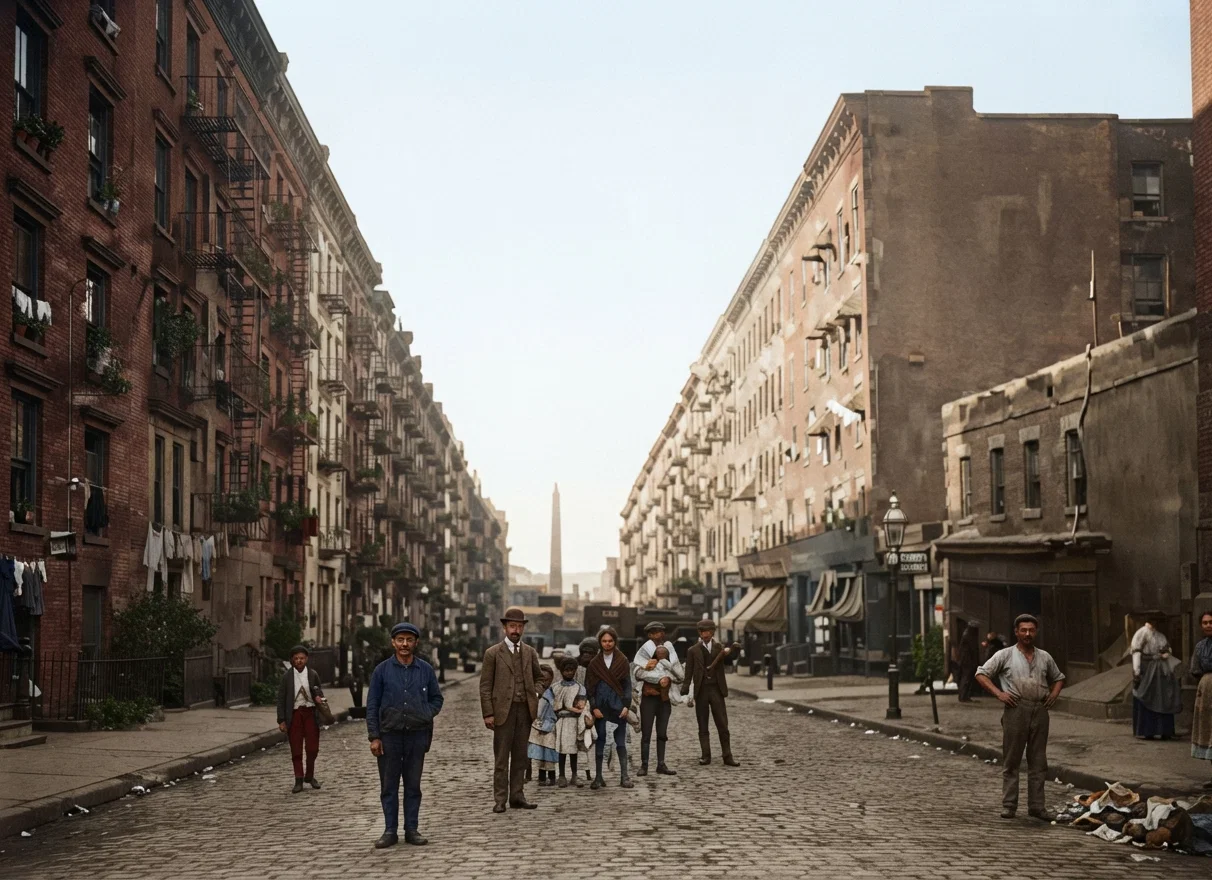
“Little Italy,” New York City. In these few tenement houses more than 4,000 people hive and swelter, exist and die.
Two thousand years ago the Bible foretold the condition as it is to-day. Instead of teaching that the world should be getting better, it distinctly stated that "evil men and seducers shall wax worse and worse." The careful Bible student and observer of the times sees in the situation of to-day the "perilous times" that should come "in the last days," when men should be "lovers of their own selves, covetous, . . . incontinent, fierce, despisers of those that are good, traitors, heady, highminded, lovers of pleasures more than lovers of God." Instead of waiting for the kingdom of God to be set up on earth, he is waiting for the "blessed hope, and the glorious appearing of the great God and our Saviour Jesus Christ;" he is "looking for and hastening unto the coming of the day of God, wherein the heavens being on fire shall be dissolved, and the elements shall melt with fervent heat."
And that, reader, is the meaning of these things. The end of all things is at hand. Soon the Master shall appear. Deceit, falsehood, crooked dealing, all sin, misery, and sickness shall then have an end. Blessed time! May it soon come!
M. L. ANDREASEN
OUR METROPOLIS.
By Max Hill
A MIGHTY city, broad its streets and long,
Where surges to and fro the mighty throng,
A human tide four thousand thousand strong;
An army from the earth's remotest bounds
Unite to swell the whirl of sights and sounds;
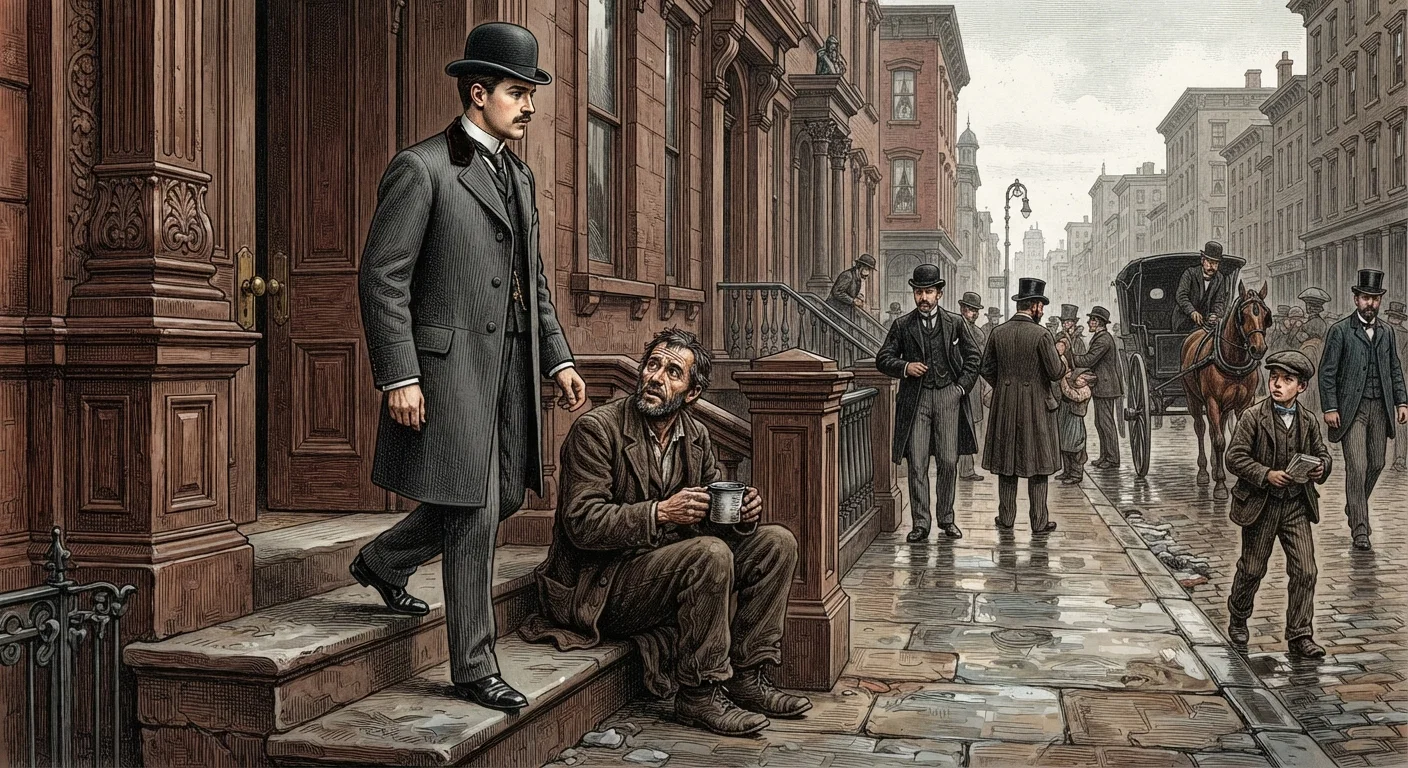
There wealth and poverty walk side by side,
The man of wealth, no selfish whim denied,
The poor with scarce a daily seed supplied;
His wants unnoted, rudely pushed aside.
The lame are there, the halt, the weak, the blind,
Who strive for life, but fall beneath the grind
Of ceaseless toil. Unwept are they, unsung
Their life of pain; their tale of wo, tho wrung
From hearts that longed to speak, is never told.
The world cares not to hear, and deaf and cold
She turns their pleading hands away unfilled,
And conscience in the giddy maze is stifled.
Black sin is there, dark-visaged, cruel, bold,
With pitfalls to deceive, with wiles untold;
Men sold to sin, with brains befogged with drink,
Sunk lower than the lowest beast would sink;
Unknown to virtue, lost to love or pride,
Dead to ambition, knowing naught beside
The low desire of beast from man to hide.
There graft and greed, with groping, grasping power
Like ancient orgies, strong within the tower
Of law (which serves their wills alone), lay hold
On strong and weak alike, for all are sold;
The "ring," the "boss," hold undisputed sway,
With them is power, and none their will gainsay.
The stranger walks those crowded streets alone,
Where thousands pass him by, and he unknown.
Few hands are there to welcome him, to reach
To help the one whose halting foreign speech
Can not reveal the longing heart's desire
For friendship; can not tell the hopes that fire
His soul in this new land to will and do,
To mount the heights that rise before his view.
There on those streets, away from friends and home,
The outcasts of the world, forsaken, roam;
Lost in the toils of sin, a mother's son
Goes stumbling by, the drunkard's course to run;
But O, the shame, the sorrow, when that one
That hurries by with haunted, careworn face
Is mother's girl, who found the old home place
Too slow, perhaps, and leaving all behind
Turned to the world a living death to find.
But look again, the saddest scene of all
That on the sight in this great throng will fall
Is childhood suffering. Pale, thin, and wan,
The hungry, pinched, and grimy face, whereon
God's pure, sweet sunshine never, never shone,
Where godly cleanliness was never known;
The stooping form with toil already bowed,
The helpless little ones within the crowd,
Some tiny faces marked for sin and crime,
Some yet revealing beauty through the grime;
So vile in body, dwarfed in soul and mind,
Who ne'er received a loving word nor kind.
Let fall the curtain on such scenes as these.
Are there no views that satisfy and please?
Is there no love, no joy, no song, no prayer,
No face of calm content, brow free from care?
Yes, yes, in spite of sin, and pain, and crime,
In spite of grim disease, revolting grime,
In spite of these that sicken and destroy,
The city harbors love and peace and joy.
Their happy homes are found, where pure and sweet
The inmates live apart from crowd and street,
Shut in is love, and banished pain and care,
Where God is known, and oft is named in prayer.
But these are safe, these need no saving arm,
Their guarded lives are free from outward harm.
But O, the souls that know no home like this,
The childish faces never touched with kiss,
The aching heart that never knew the bliss
Of mother-love, or felt the fond embrace
Of mother-arms, or looked into the face
Of innocence and purity to trace
Responsive smiles of love. And look again,
Where in a crowded hovel of a den
(Call this not home, tho these be forms of men),
In filth and heat, a dozen, aye, a score,
Of human souls exist, they live no more.
The stranger in the crowd, bowed down with grief,
Is still alone, for him is no relief;
The man of crime, the outcast, shunning light,
Like beasts of prey go forth to slay at night.
These live their lives of sin and shame and wo,
A hunted life, where blow demands a blow.
These, these, are they who need the outstretched hand,
These homeless strangers in a foreign land,
These men and women, dead to purity,
These children, steeped in criminality,
These souls that never breathed God's name in prayer,
These need the Saviour's tender love and care.
Shall they go down to death in pauper graves
And never know the only power that saves?
Shall Christians idly gaze upon the lost
Whose ransomed souls the blood of Jesus cost,
And reach no hand to save? The Master stands
And pleads before their hearts, His piercéd hands
Outstretched to call them home. Their eyes see not,
Their darkened minds so seared with blight and blot
No comprehension know. Arouse, awake!
And teach these dying souls their bonds to break!
Teach them of Him whose life and all beside
He gave for such as they, tho crimson dyed;
Show them the cross whereon their Saviour died,
Their Saviour who for them was crucified.
SIGNS OF THE TIMES IN THE UNITED STATES.
Awful Drink Bill.
[Rene Bache, in Pearson’s Magazine, Jan. 1906.]
"But as the days of Noah were, so shall also the coming of the Son of Man be. For as in the days that were before the Flood they were EATING and DRINKING, marrying and giving in marriage, until the day that Noah entered into the ark, and knew not until the Flood came, and took them all away; so shall also the coming of the Son of Man be." Matt. 24:37-39.
"But evil men and seducers shall wax worse and worse, deceiving, and being deceived." 2 Tim. 3:13.
In the year 1850, there were in this country four hundred and thirteen concerns engaged in brewing beer and ale, the total amount of capital employed being $4,072,380. The enormous growth of the business since then may be judged from the figures of the census for 1900, which gave the number of breweries as fifteen hundred and nine, and the total capital as $451,284,468. In the same length of time the number of distilleries in the United States has not grown at all—indeed, it has diminished by one, from nine hundred and sixty-eight to nine hundred and sixty-seven—but the capital used in the production of fire-water has increased from $5,409,334 to $32,551,604, while the value of the output has gone up from $15,770,240 to $96,798,443. This value represents the cost to consumers, at wholesale. Inasmuch as the cost of materials used has advanced
(Continued on page 15.)
FEDERATION OF THE CHURCHES.
THE FUNDAMENTAL ERROR.
How the Papacy Was Formed.
WE have seen what a great error it is for people to expect the conversion of the world, and that the nations of this world shall be transformed into the kingdom of God.
We have seen what an immensely greater error it is to form a federation of churches or of any other kind to accomplish the conversion of the world, and to make the nations of the world the kingdoms of God.
But of this whole subject, and in this whole connection, the very chiefest of all errors,—the fundamental error—is the idea of federation itself. We have stated that it was by federation—by just such a principle, just such a form, and just such working of church-federation—that the Papacy was made, in all that it has ever been. And of all the evil things that have oppressed and afflicted this world the Bible presents the Papacy as the supreme.
That this error of federation may be seen, in fairest and truest way, to be the fundamental error that it is, we shall here present the plain, unmodified story of it, as it is set down in the unquestionable history. That story is as follows:
The Original Christian Plan.
"Altho all the churches were, in the first age of Christianity, united together in one common bond of faith and love, and were in every respect ready to promote the interests and welfare of each other by a reciprocal interchange of good offices; yet with regard to government and internal economy, every individual church considered itself as an independent community, none of them ever looking in these respects beyond the circle of its own members for assistance, or recognizing any sort of external influence or authority.
"Neither in the New Testament, nor in any ancient document whatever, do we find anything recorded, from whence it might be inferred that any of the minor churches were at all dependent on, or looked up for direction to, those of greater magnitude or consequence; on the contrary, several things occurred therein which put it out of all doubt that every one of them enjoyed the same rights, and was considered as being on a footing of the most perfect equality with the rest.
"Indeed it can not,—I will not say be proved, but even be made to appear probable, from any testimony, divine or human, that in this age it was the practise for several churches to enter into, and maintain among themselves, that sort of association which afterward came to subsist among the churches of almost every province,—I allude to their assembling by their bishops, at stated periods, for the purpose of enacting general laws, and determining any questions or controversies that might arise respecting divine matters.
"It is not until the second century that any traces of that sort of association from whence councils took their origin, are to be perceived;* when we find them occurring here and there, some of them tolerably clear and distinct, others again but slight and faint; which seems plainly to prove that the practise arose subsequently to the times of the apostles, and that all that is urged concerning the councils of the first century, and the divine authority of councils, is sustained merely by the most uncertain kind of support, namely, the practise and opinion of more recent times."—Mosheim, "Commentaries," Cent. I. Sec. XLVIII.
Beginnings of Early Federation.
Of this matter in the second century, the record is as follows:
"Altho, therefore, all the churches had, at the commencement of this century, various laws and institutions in common, which had been received from the apostles themselves, and were particularly careful in maintaining with each other a certain community of tenets, morals, and charity; yet each individual church which had a bishop and presbyters of its own, assumed to itself the form and rights of a little distinct republic or commonwealth; and with regard to its internal concerns was wholly regulated by a code of laws, that, if they did not originate with, had, at least, received the sanction of the people constituting such a church.
"During a great part of this century, all the churches continued to be, as at first, independent of each other, or were connected by no consociations or confederations. Each church was a kind of little state, governed by its own laws, which were enacted, or at least sanctioned, by the people. But by degrees all the Christian churches within the same province united and formed a sort of larger society, or commonwealth, which, as is usual with confederated republics, held its conventions at stated seasons, and in them deliberated for the common advantage of the whole confederation. This custom first arose among the Greeks, with whom such confederation of several cities, and the consequent conventions of their delegates, had long been in use. In process of time, when experience had shown its utility, this practise found its way over all the Christian church.
"In process of time, however, the very great advantages attending on a federation of this sort becoming apparent, other provisions were induced to follow the example of Greece, and by degrees this form of government became general throughout the whole church; so that the Christian community may be said, thenceforward, to have resembled one large commonwealth made up, like those of Holland and Switzerland, of many minor republics. These conventions or assemblies, in which the delegates from various churches consulted on what was requisite to be done for the common welfare of the whole, were termed synods by the Greeks, and by the Latins councils. To the laws enacted by the deputies under the powers with which they were invested by their respected churches, the Greeks gave the name of canons or general rules, and by this title it also became usual for them to be distinguished by the Latins.
"The associations, however, thus introduced amongst the churches, and the councils to which they gave rise, altho not attended with certain benefits and advantages, were, nevertheless, productive of so great an alteration in the general state of the church, as nearly to effect the entire subversion of its ancient constitution.
"For, in the first place, the primitive rights of the people, in consequence of this new arrangement of things, experienced a considerable diminution, inasmuch as, thenceforward, none but affairs of comparatively very trifling consequence were ever made the subject of popular deliberation and adjustment; the councils of the associated churches assuming to themselves the right of discussing and regulating everything of moment or importance, as well as of determining all questions to which any sort of weight was attached. Whence arose two sorts of ecclesiastical law, the one public or general, and thenceforward termed 'Canonical,' from the canons; the other private or peculiar, consisting merely of such regulations as each individual church deemed it expedient, after the ancient manner, to enact for itself.
"In the next place, the dignity and authority of the bishops were very materially augmented and enlarged. In the infancy, indeed, of councils, the bishops did not scruple to acknowledge that they appeared there merely as the ministers or legates of their respective churches, and that they were, in fact, nothing more than representatives acting from instruction; but it was not long before this humble language began by little and little to be exchanged for a loftier tone; and they at length took upon them to assert that they were the legitimate successors of the apostles themselves, and might consequently, of their own proper authority, dictate laws to the Christian flock. To what an extent the inconveniences and evils arising out of these preposterous pretensions reached in after time is too well known to require any particular notice in this place.
Destruction of Equality.
"Another effect which these councils had, was to break in upon and gradually destroy that absolute and perfect equality which had reigned amongst the bishops in the primitive times. For as it was necessary that some certain place should be fixed on for the seat of council, and that the right of convening the assembly and presiding therein as moderator, as well as of collecting the suffrages and preserving the records of its acts, should be vested in some one or other of its members, it for the most part became customary to give a preference in these respects to the chief city of the province and its bishop, and hence in process of time, sprung up the dignity and authority of 'metropolitans,' a title conferred by way of distinction on the bishops of principal cities. These associations of churches, situated within one and the same province, soon gave rise to the practise of many different provinces associating together; and hence a still greater disparity, by degrees, introduced itself amongst the bishops.
"In fine, this custom of holding councils becoming at length universally prevalent, the major part of the church assumed the form of a large civil commonwealth, made up of numerous inferior republics; to the preservation of which order of things it being found expedient that a chief or superintending prelate should be appointed for each of the three grand divisions of the earth; and that, in addition to this, a supreme power should be lodged in the hands of some one individual bishop; it was tacitly assented to that a certain degree of ecclesiastical preeminence should be recognized as belonging to the bishops of Antioch, Rome, and Alexandria, the principal cities in Asia, Europe, and Africa, and that the bishop of Rome, the noblest and most opulent city in the world, should, moreover, take the precedence amongst these principal bishops, or, as they were afterward styled, patriarchs, and also assume the primacy of the whole Christian Church throughout the world."—Id. Cent. II., Sec. XXII., XXIII., with Mosheim, "Eccl. Hist." Book I., Cent. II., Part II., Chap. II., Par. 11.
[This important article is continued in our next.]
CHRIST OUR LIFE.
By Roderick S. Owen
ALL men desire life; all shrink from death; and yet how few there are who are walking in the way of life! The words of Jesus to the Jews are equally applicable to-day: "And ye will not come to Me, that ye might have life." John 5:40. Christ is the One through whom all life comes; "for as the Father hath life in Himself; so hath He given to the Son to have life in Himself;" "for the bread of God is He which cometh down from heaven, and giveth life unto the world." John 5:26; 6:33. Sin and death are inseparably connected. The presence of the one proves the existence of the other. So that all who sin are under sentence of death. Since "all have sinned, and come short of the glory of God," death reigns over all the human family. "For as by one man sin entered into the world, and death by sin; and so death passed upon all men, for that all have sinned."
Just at the point of the first transgression is the time where Jesus, who is the Author of life, becomes life to the sinner, in the sense of saving the transgressor from immediate death, and extending his existence through a probationary period, in spite of his repeated offenses; so that we are indebted to Christ for our every breath. How sad to think that so many spend the breath thus given in mercy, in profaning and abusing Him who has Himself suffered, to become the Giver of life—thus cursing the hand extended in blessing!
But Christ "is the Saviour of all men," and "specially of those that believe." Yes, there is a life beyond a mere physical existence, and this is found in Christ Jesus. "He that believeth on the Son hath everlasting life; and he that believeth not the Son shall not see life; but the wrath of God abideth on him." John 3:36. He who finds this, finds the power of that endless life, which is manifest in Jesus, to destroy the works of the devil. He "shall not come into condemnation; but is passed from death unto life." "For the law of the spirit of life in Christ Jesus hath made me free from the law of sin and death. For what the law could not do, in that it was weak through the flesh, God sending His own Son in the likeness of sinful flesh, and for sin, condemned sin in the flesh; that the righteousness of the law might be fulfilled in us, who walk not after the flesh, but after the Spirit." Such an one can say: "I am crucified with Christ; nevertheless I live; yet not I, but Christ liveth in me; and the life which I now live in the flesh I live by the faith of the Son of God, who loved me, and gave Himself for me."
Such an one having been born from above, and being risen with Christ, walks in newness of life, his life is not set on things of the earth, but on things above. He being dead with Christ, his life is hid with Christ in God; and when Christ, who is his life, shall appear, then shall he also appear with him in glory. Col. 3:1-4. For Jesus said, "I am come that they might have life, and that they might have it more abundantly." John 10:10.
But this life in the flesh, or mortal state, is not all, even tho in it we do find a victory over the power of temptation. "For our conversation is in heaven; from whence also we look for the Saviour, the Lord Jesus Christ; who shall change our vile body, that it may be fashioned like unto His glorious body, according to the working whereby he is able even to subdue all things unto Himself." Phil. 3:20, 21. For we who have received the first-fruits of the Spirit, "even we ourselves groan within ourselves, waiting for the adoption, to wit, the redemption of our body." Rom. 8:23. For "we shall not all sleep, but we shall all be changed, in a moment, in the twinkling of an eye, at the last trump; for the trumpet shall sound, and the dead [in Christ] shall be raised incorruptible, and we shall be changed. For this corruptible must put on incorruption, and this mortal must put on immortality." 1 Cor. 15:51-53. Immortality! O, what an existence, measuring with that of God! Free from corruption! not subject even to a liability to die! And all this comes to us through the Saviour, which God has provided for us, in giving His only-begotten Son to die, that we might have everlasting life.
Thus we see that Christ is our life:
Because He is the Author of our existence.
Because He saves us, as sinners, from immediate death, giving us a probationary life.
Because He imparts to us eternal life now, which lifts us above the power of sin, and which enables us, tho in the flesh, to walk in newness of life.
Because, at His glorious appearing, He will clothe with immortality all who trust in Him.
God grant that we may all know Him whom God hath sent, whom to know is life everlasting. John 17:3.