Not far off would I follow Thee, O Lord,
And mingle with the curious, idle throng,
To arbitrate the strife 'twixt life and death —
The controversy weary hours prolong.
I would not dare to loiter by the way,
Afar off from my blessed Christ who died,
Lest, losing all the sense of loss, I might
Be found among the rabble who deride.
So closely let me press that I may touch
Thy garment as I tread life's crowded way,
That healing virtue may its grace impart
To nobly live Thy life through all the day.
Not far away, though many voices call,
And beck'ning fingers lure where foes beguile;
But urgently I press to closely step
Beside my Master through earth's little while.
And soon, ah, soon, my Shepherd-King shall lead
To fields Elysian in the home above,
Where all His chosen flock shall follow still,
To hear His gracious voice and love His love.
WORTHIE HARRIS HOLDEN.
Gethsemane
By Mabel Corinne Craker
By Mabel Corinne Craker
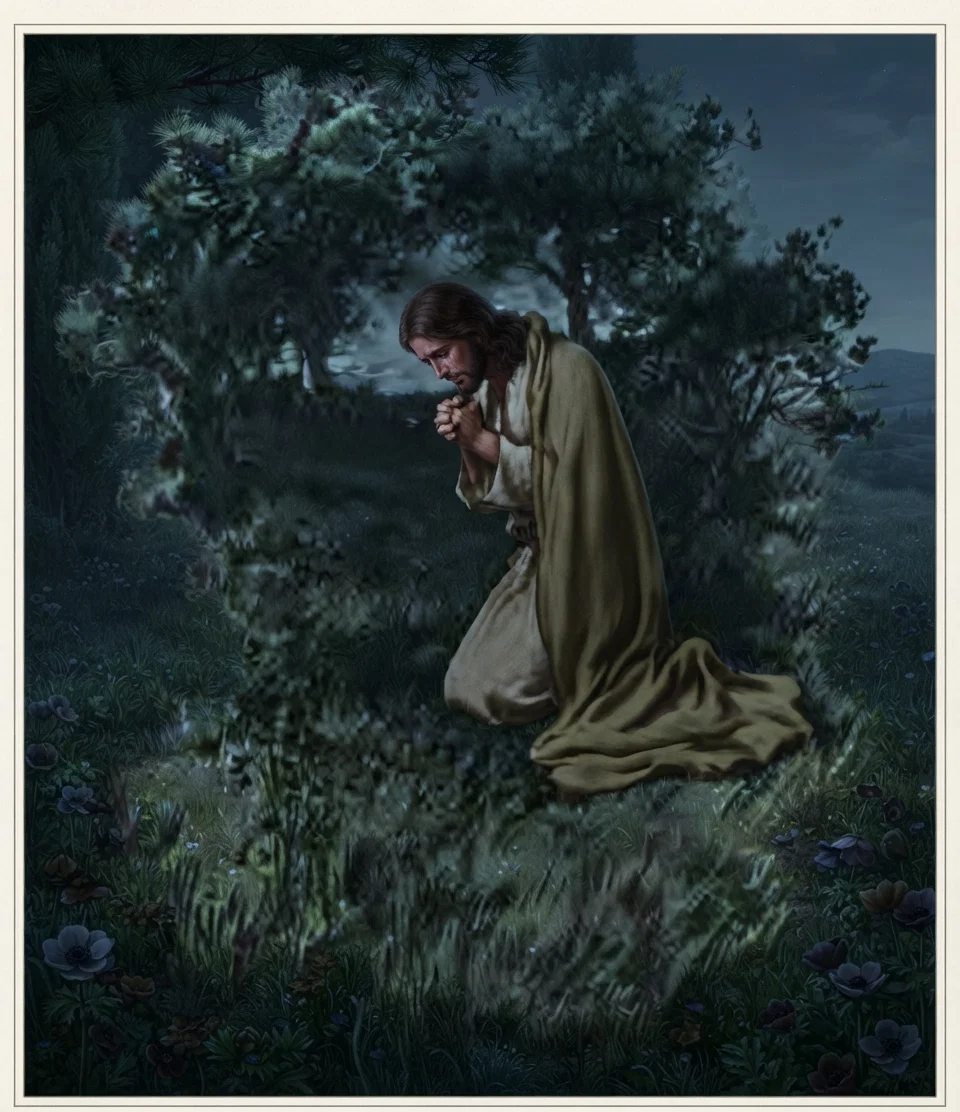
BRIGHT rose the paschal moon o'er the dark garden,
Tinting with silver sheen cypress and palm-trees.
Cloudless the heav'nly dome circled above it.
Hushed were the songs of birds, quiet the night breeze.
Thus lay Gethsemane, placid and tranquil.
Stillness of death enwrapped all her recesses.
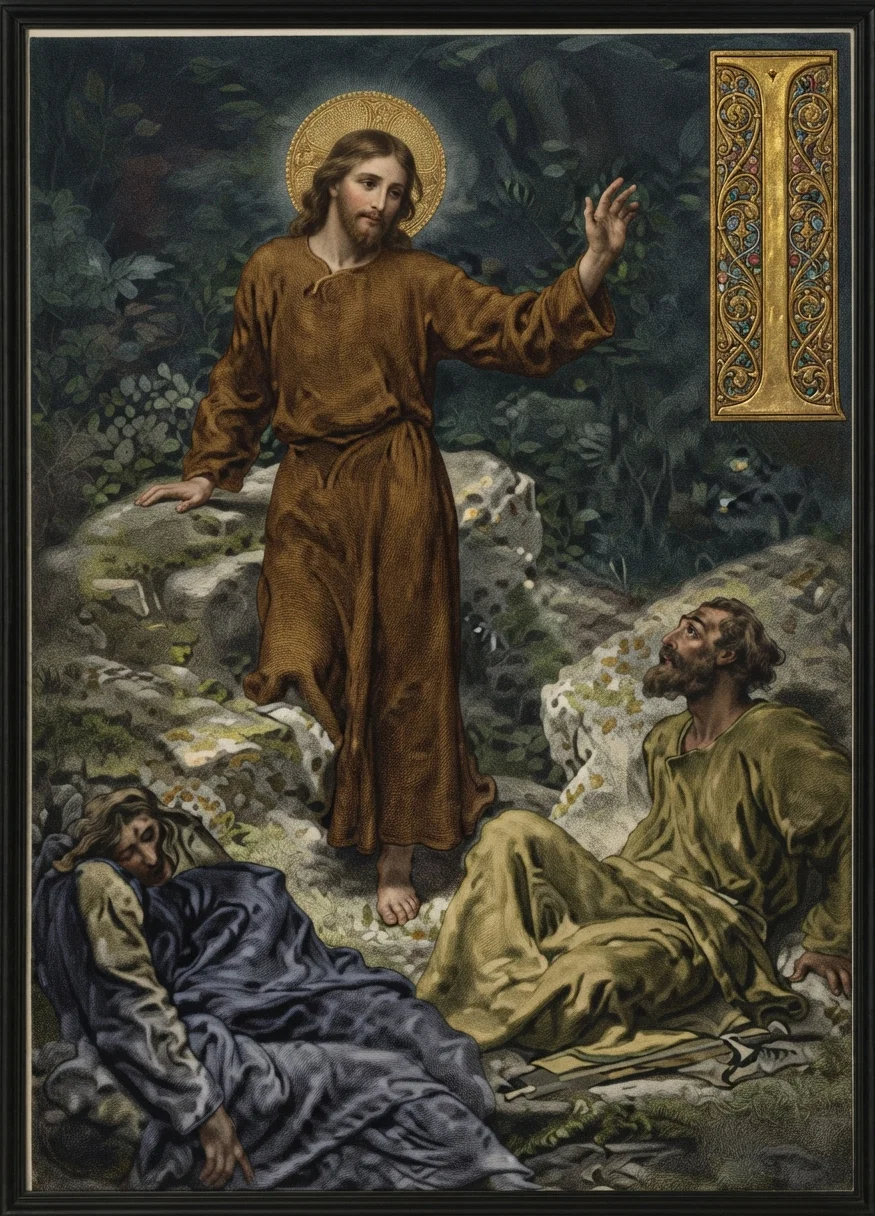
Entered this calm retreat Jesus our Saviour,
Bowed with His load of grief, weak with distresses;
Guiltless, yet bearing the shame of the guilty;
Far from His Father's side—sin's greatest torture.
Dew from the leafy boughs bathed His form stricken.
Nature, with tearful eyes, wept for its Author.
Heaven so deeply mourned, harp-strings were silent.
God was withholding His love and His power.
Christ, the Commander of angels in glory,
Grieved as the hopeless in their dying hour.
Drained was that bitter cup—drained for each mortal—
With trembling hand. Soon an angel from heaven
Steadied His form while His lips, parched with anguish,
Emptied the dregs from the cup which was given.
Fain would I linger within the damp garden,
Hear the deep groanings—that prayer twice repeated,
Down His worn face see the drops of blood trickle,
Realize fully my sins were there meted.
Ne'er should I deem that my burden's too heavy,
Though He should beckon where grief with toil blendeth,
Ask me to sip from a cup that is briny.
Heaven's balm falls on the head that low bendeth.
CALEB, THE HERO OF FAITH
By George I. Butler
He and Joshua Were Not Afraid—Would Have Been Stoned to Death but for Divine Interposition—Afterward Conquered the Very Giants That Spread the Terror
By GEORGE I. BUTLER
CALEB, the hero of faith, is first brought into view at a great crisis in the history of the exodus from Egypt to the promised land. We can hardly realize that it was less than two years from the call of Moses to lead out the children of Israel, at the burning bush, till the spies were sent out to search the land of Canaan and bring back to Moses their report. Yet "Usher's Chronology" so declares.
FORCED BY PRESSURE OF MIRACLES
Wonderful events were packed into that brief space of time. The pressure of God's miracles at last forced Pharaoh to let the people go. The journey through the Sinaitic desert, the sojourn at Mount Sinai, the march to the border of Canaan, and all the changes wrought in the host to transform it from a promiscuous multitude to a disciplined army, each tribe under its appointed leader, was a great work, made very difficult by their murmurings, lack of faith, stubbornness, fault-finding, and incipient rebellion. At last they reached Kadesh, in the wilderness of Paran, not so very far from the border of the promised land.
SENT TO SPY OUT THE LAND
"And the Lord spake unto Moses, saying, Send thou men, that they may search the land of Canaan, which I give unto the children of Israel." Num. 13: 1, 2. One from each tribe was selected. Caleb was here first mentioned. He represented the tribe of Judah, while Joshua represented the tribe of Ephraim. So they searched the land. It was a rich country, with many strong cities, and well populated. Giants were there of great height,—powerful men. The soil was very fruitful. At the brook of Eshcol they cut off a cluster of grapes so large that it required two men to carry it between them on a staff. The land flowed with milk and honey.
At last the spies returned. Ten of the men brought back a discouraging report. While they admitted that the land was very rich and good, they said they were not able to conquer it. These ten spies greatly discouraged the people by their evil report. But Caleb and Joshua were full of faith. "And Caleb stilled the people before Moses, and said, Let us go up at once, and possess it; for we are well able to overcome it." But the ten spies denied that, and said, "We are not able"; "and they brought up an evil report" that was false.
ENRAGED, THEY WANTED TO STONE THEM
A great crisis was now reached. It was a very serious matter. They had come a long distance through the desert. God had wrought mightily for them. His power was revealed as it never was seen before by mortal men; and now as they were almost ready to enter the promised land, there was an actual rebellion. When Caleb insisted that with God's help they could easily possess the land, the people were so enraged that they were about to stone the two witnesses.
Then the glory of the Lord appeared in the tabernacle, and the Lord said: "Because all those men which have seen My glory, and My miracles, which I did in Egypt and in the wilderness, and have tempted Me now these ten times, and have not harkened to My voice; surely they shall not see the land which I swore unto their fathers, neither shall any of them that provoked Me see it: but My servant Caleb, because he had another spirit with him, and hath followed Me fully, him will I bring into the land whereinto he went; and his seed shall possess it. . . . As truly as I live, saith the Lord, as ye have spoken in Mine ears, so will I do to you: your carcasses shall fall in this wilderness; and all that were numbered of you, according to your whole number, from twenty years old and upward, which have murmured against Me, doubtless ye shall not come into the land, concerning which I swore to make you dwell therein, save Caleb the son of Jephunneh, and Joshua the son of Nun: But your little ones, which ye said should be a prey, them will I bring in, and they shall know the land which ye have despised."
WAS INDEED A GREAT CRISIS
This was indeed a great crisis. Caleb, first mentioned in this connection, here appeared conspicuous. He "wholly followed the Lord." Precious promises were made to him and Joshua. All the others of the children of Israel above twenty years of age passed away and miserably perished during the succeeding thirty-eight years of wandering in the wilderness of Paran. Not one of them even entered the promised land. So much for their unbelief.
EIGHTY-FIVE, BUT READY FOR THE CONFLICT
From this time, Caleb's name is not mentioned for over forty years, until Joshua led victorious Israel into the promised land. As the people were conquering the land, Caleb again appeared on the stage of action, valiant and true to the last. When he went as one of the spies, he was forty years of age. Now he was eighty-five, but strong and vigorous as he ever was, fighting the battles of the Lord. One of the great terrors of the ten spies was the Anakims, a race of giants who inhabited the country about the city of Hebron, one of the most ancient cities of the world. Goliath, slain by David with his sling, was of this race. He was over nine feet high, and powerful in proportion.
Caleb did not fear them, though they terrified the whole nation. He called the attention of Joshua to the promises God made him because of his faith in God. He claimed the very territory where the giants lived as the gift of God to him and his seed. And Joshua granted his petition.
CONQUERED THAT WHICH HAD TERRIFIED THE WHOLE NATION
The valiant man of faith then proceeded to demonstrate the truthfulness of his statements forty-five years previous, when the cowardly ten spies terrified all the people by describing the gigantic sons of Anak, and the inability of the Israelites to conquer them. Caleb had said they were abundantly able to conquer them and the whole promised land. And now, when over fourscore years old, he and a few others entered the very land of these giants, and their fortified cities, and victoriously drove them all out of that portion of the country. Such is the power of faith when men "wholly follow the Lord."
What an evidence of God's power Caleb and Joshua must have furnished to the children of Israel! After all the race of unbelievers was purged out of the host, their children, led by Caleb and Joshua, conquered the land. How easily could they have conquered it thirty-eight years before had the leaders and the people been possessed of Caleb's faith!
We have now reached the greatest crisis this world has ever seen or ever will see. We are seeking the antitypical Canaan and the New Jerusalem. The same living faith that Caleb possessed is greatly needed now. Many are proving their lack of faith. But there are many Calebs who believe we are abundantly able to go up and possess the true promised land—the new earth and the New Jerusalem. May God greatly increase the Calebs of this host!
Nothing Can Separate Us from God’s Love
"I AM persuaded, that neither death, nor life, nor angels, nor principalities, nor powers, nor things present, nor things to come, nor height, nor depth, nor any other creature, shall be able to separate us from the love of God, which is in Christ Jesus our Lord."
Interpretation of Prophecy
By Eliza H. Morton
The "Perspective" of the Prophets — Significance of the Preface to the Ten Commandments
By ELIZA H. MORTON
A WOMAN who had been reading some of the articles in the SIGNS OF THE TIMES, recently made this remark: "I do not understand why certain writers for this paper apply some of the prophecies of the Old Testament to conditions near the end of time, or immediately after the coming of Christ, when the connections seem to show that these prophecies had their fulfilment in the judgments which God sent upon ancient kingdoms."
The Laws of Prophetic Interpretation
Great laws underlie the interpretation of prophecy, which, when understood, throw much light upon future events.
Horne, in his "Compendium to the Study of the Bible," says concerning the prophets: "They were like watchmen upon an elevated station, who looked into the distance and proclaimed what they saw. The foreground would be distinct, but objects afar would be dimmer and blended in a degree together. This is called the 'perspective' character of prophecy; and it was scarcely possible, in consequence, to distinguish, before the accomplishment, which of the events predicted was near and which more remote."
A Double and Even Threefold Meaning
Thus some prophecies have a double and even a threefold meaning. For example, in Hosea 11:1 is the following prophecy: "When Israel was a child, then I loved him, and called My son out of Egypt." This prophecy states a historical fact recorded in Ex. 4:22, 23, as well as an event which was then in the future, even the flight into Egypt of Joseph and Mary with Jesus. "And was there until the death of Herod: that it might be fulfilled which was spoken of the Lord by the prophet, saying, Out of Egypt have I called My son." Matt. 2:15.
It also refers to other conditions. Christians are the Israel of God in this dispensation. "Know ye therefore that they which are of faith, the same are the children of Abraham." Gal. 3:7. God is now calling Israel out of this wicked world of which Egypt was a type. Jude 4, 5; Rev. 11:8. "Wherefore come out from among them, and be ye separate, saith the Lord, and touch not the unclean thing; and I will receive you." 2 Cor. 6:17.
The preface to the Ten Commandments, "I am the Lord thy God, which have brought thee out of the land of Egypt, out of the house of bondage" (Ex. 20:2), has more than a local application to the Jews, and gives the reason why Christians should keep those commandments.
Ancient and Modern Connected
The prophets, in describing the judgments which were to come upon ancient Israel, Babylon, and other nations, because of their transgressions, and which came according to the word of the Lord, interwove with those descriptions allusions to remote events connected with the close of earth's drama, even the great day of the Lord.
This is very apparent in Zephaniah 1, where God's severe judgments against Judah are closely associated with the time when all living things will be utterly consumed from the earth (verses 2, 3) in the day of God's wrath (verse 15), the time when the earth shall be returned to its original chaotic state (Jer. 4:23, 24), and remain thus for a thousand years (Rev. 20:3).
The Lord's great prophecy in Matthew 24 associates the destruction of Jerusalem with the end of the world. Verses 15-19, 31. This "double sense" in which many prophecies must be taken is a beautiful pledge that God will fulfil future events just as minutely as He has fulfilled those in the past, and is an evidence of the divine inspiration of the Scriptures.
Choose, Believe, Do
By E. W. Farnsworth
"And why call ye Me, Lord, Lord, and do not the things which I say?" Luke 6:46.
GOD deals with no man as with an infant or an idiot. He did not make us in a hurry. He was not trifling with us when He gave us the power of choice. He made us in His own image physically, mentally, morally. He endowed the man He made with intellect. He commands the man He made to choose the path in which he will walk, the master whom he will obey.
"See, I have set before thee this day life and good, and death and evil;" and He calls heaven and earth to record, and entreats His people to choose life, that both they and their seed may live. Deut. 30:15, 19.
Man can choose. He can do. He can obey God. It is inconsistent, it is folly, to call Him "Lord, Lord," and refuse to obey Him. Our Father never asked any man to do anything He would not give him the power to do.
Grace makes no compromise with sin. "Shall we sin, because we are not under the law, but under grace? God forbid." Rom. 6:15. Grace is the enablings of the law, that every jot and tittle of "the righteousness of the law might be fulfilled in us, who walk not after the flesh, but after the Spirit." Rom. 8:4. Nothing is conceded, no license to sin is granted, by grace. "He that hath My commandments, and keepeth them, he it is that loveth Me." "If a man love Me, he will keep My words." Love means obedience. Disobedience is rebellion. "To obey is better than sacrifice."
"Believe," "Do," "Keep," "Perform," "Fulfil"—these are the commands of revelation. Our "resolutions," "covenants," "promises," "pledges," are interesting as symptoms, but it is only conduct that counts. No man is saved by works; but in describing the Judgment, inspiration states, "They were judged every man according to their works." Rev. 20:13.
To be, to do, to suffer, to bear the cross, are the vital lessons that should be emphasized in these days of a popular, easy-going religion. E. W. Farnsworth.
"The Waters Which Thou Sawest"
By B. E. Beddoe
IN vision Daniel saw strife "upon the great sea." As a result, "four great beasts came up from the sea." The prophet John "saw a beast coming up out of the sea." At another time, there was shown him a "great harlot that sitteth upon many waters."
To Daniel it was made clear that the beasts represented kingdoms. The beast seen by John had a like significance. The fallen woman symbolized a fallen church. In each instance, the very birth and existence seemed dependent upon waters.
Speaking to John, the angel said, "The waters which thou sawest, where the harlot sitteth, are peoples, and multitudes, and nations, and tongues."
Recently the writer stood on a prominence overlooking a section of one of our modern cities, just far enough away to be unable to distinguish individual sounds, just near enough to hear street-car, automobile, truck, hammer, and voice in one confused noise. I closed my eyes and listened. It was the sound of many waters — the roar of the sea.
To friends who stood with me I said: "The prophecy has it right, 'The waters which thou sawest . . . are peoples,' and the people we see sound as waters."
B. E. BEDDOE.
Giants in the Earth in Those Days
By G. C. Hoskin
"There were giants in the earth in those days."Gen. 6:4.
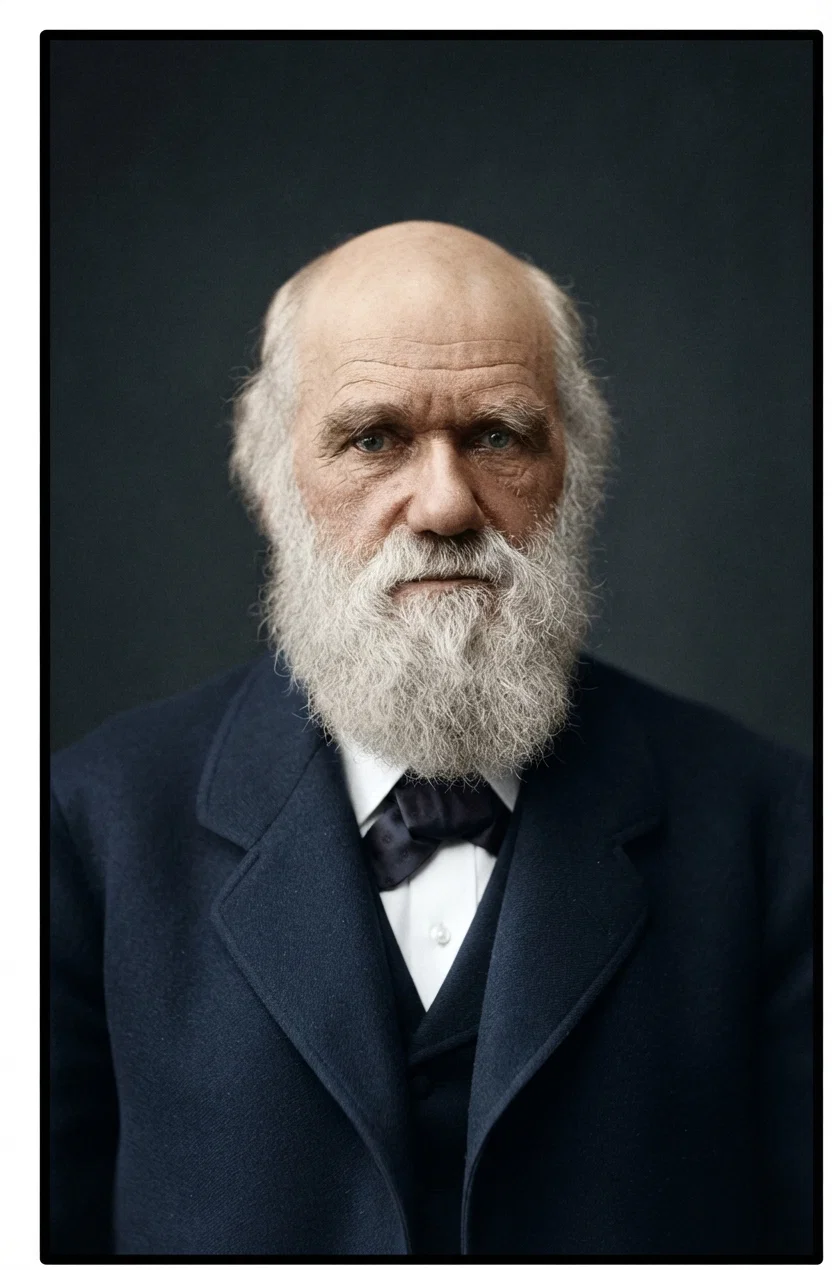
THERE are very few of us who have not smiled more than once over fairy tales of giants, that were told us when we were boys and girls. Little did we think it probable that such men and women really did exist on our earth. But when we read of it as a fact and matter of record in Holy Writ, the story changes, and somehow we want to learn more of this great people. So we read on for a few chapters, and there we find their history. The preceding chapter gives their complete genealogy. It is a brief bit of history. But there is enough of it to show that the forefathers of the human race were men of giant stature and intellect. The record says they "became mighty men," "men of renown." Then we go back to the first chapter and the twenty-seventh verse of the same book, and there it is written that "God created man in His own image, in the image of God created He him; male and female created He them," and that it was done about six thousand years ago. In further study, we see the reason for the present deterioration in the human race, clear, logical, conclusive, and supported by facts. And still, some people, some who have dug deep into the great storehouse of science, claim as their parents, monkeys and frogs and tadpoles, and try to make everybody else acknowledge relationship. They call it evolution. In reality it is "devilation." But that shows the extent to which the mind can become befogged when God and His records are left out of the reasoning. Away with such vagaries! Our fore-parents were giants in physique and intellect, and we will attain to the same if our characters are such as will stand before the Lord Jesus, our Saviour, at His soon coming.
G. C. HOSKIN.
Christians as Workers in the Vineyard
"ALL who are Christians should be workers in the vineyard of the Lord. They should be wide-awake, zealously laboring for the salvation of their fellow men, and should follow the example that the Saviour has given them in His life of self-denial, sacrifice, and earnest effort."
A VICARIOUS SACRIFICE WAS NECESSARY
By R. C. P.
Christ Volunteered to Pay the Death Penalty for Man—The Majesty of the Law Must Be Upheld—The Father Suffered with the Son
In the transgression of Adam, the race of mankind had fallen. He could transmit to his offspring only the heredity of his sinful nature. Hence by the natural law of transmission, the iniquity of Adam must be visited upon the race. "By the offense of one judgment came upon all men to condemnation." Rom. 5:18. Judgment had been rendered, the verdict announced; and the world ruined by rebellion, having seceded from the moral government of God by the act of disobedience, was hopelessly lost. "Wherefore, as by one man sin entered into the world, and death by sin; and so death passed upon all men, for that all have sinned." Verse 12.
HE HAD NO EXCUSE
Man could offer no acceptable excuse for sin. God's proclamation was plain: "Of the tree of the knowledge of good and evil, thou shalt not eat of it: for in the day that thou eatest thereof thou shalt surely die." Gen. 2:17. Eve informed Satan that God had made this definite prohibition. Gen. 3:3. Hence she could not plead ignorance of the law. But even ignorance of law does not excuse the transgressor.
DUE THE DAY HE SINNED
The death penalty was therefore due the day man sinned. If it had been executed that day, the race of mankind would have perished in Adam. Why was not the death penalty executed upon Adam that day?—Jesus offered to take man's place and bear the penalty in man's stead. So it is said: "For we must needs die, and are as water spilt on the ground, which can not be gathered up again; neither doth God respect any person: yet doth He devise means, that His banished be not expelled from Him." 2 Sam. 14:14. Or, as the margin reads, "Because God hath not taken away his life, He hath also devised means."
Adam's life must have been taken away that day if God had not devised means to spare it, by another volunteering to act as man's substitute under the death sentence. By that means His banished was not expelled from Him. "Then He is gracious unto him, and saith, Deliver him from going down to the pit: I have found a ransom." Job 33:24.
The means devised had therefore provided a ransom for man that saved him from execution the day that he sinned.
CHRIST MAN'S VOLUNTARY SUBSTITUTE
The very day that Adam sinned, God sought him in the garden, and offered him a ransom in the promise that the seed of the woman should bruise the serpent's head. Gen. 3:15. This promise was renewed to Abraham. Gen. 17:19. The promised seed was Christ. "Now to Abraham and his seed were the promises made. He saith not, And to seeds, as of many; but as of one, And to thy seed, which is Christ." "And if ye be Christ's, then are ye Abraham's seed, and heirs according to the promise." Gal. 3:16, 29.
Why did not God pardon the sinner without the sacrifice of Christ? It was not because He did not love the sinner sufficiently. "For God so loved the world, that He gave His only-begotten Son, that whosoever believeth in Him should not perish, but have ever-
lasting life." John 3:16. To offer pardon indiscriminately for all violation of law, without inflicting its penalty upon a voluntary substitute, would remove all restraint of law.
FUNDAMENTALS IN SCIENCE AND MORALS
As in science there are certain fundamental rules that lie at the foundation and enter into the solution of all scientific problems, so in morals there are ten fundamental rules that lie at the foundation of God's moral government and enter into the solution of all moral questions. Sin is secession from the government of God. Sinners are those who have joined Satan in secession. To provide a plan of pardon that would restore to such the rights of citizenship while in open rebellion against the government, would be to enthrone anarchy and overthrow the kingdom of God.
In providing a plan of pardon, the dignity of the law must be recognized. God could not wipe the slate and call the account of sin balanced. The Lawgiver must either inflict punishment or take it upon Himself. He chose to take His own judgment of sin upon Himself, that He might save the guilty without dishonoring the law.
MUST ACKNOWLEDGE JUSTICE
Any plan of pardon that does not require an acknowledgment, on the part of the sinner, that God is holy and just, is imperfect. Holiness must in love set judgment in the earth, while restoring the sinner. No amount of sacrifice or suffering which does not by a life of obedience recognize the justice of God's demand for holiness, can atone for sin.
Sin is not merely to be punished. It must be removed from the universe. God and sin can never dwell together. He can never look upon sin but to hate it. The measure of His love for the sinner is the measure of His hatred of sin. The ruin that sin has wrought with the subjects of His kingdom makes impossible His reconciliation to its remaining in the universe. God must remove sin from the universe or abdicate His throne.
The vicarious sacrifice of Christ begins the work of atonement with a life of such perfect obedience as does justice to God's holiness and to the righteous requirements of His holy law. He thus began the work of atonement at the very point where man had failed. In taking man's place, He must be just before the law, or He can never justify the transgressor. He must sense the sinfulness of sin as God feels it, as well as to accept its judgment for men. He must justify God's dealing with sin, while suffering its penalty.
DID IT AS A VOLUNTARY SUBSTITUTE
This Christ did as man's voluntary substitute. "For if by one man's offense death reigned by one; much more they which receive abundance of grace and of the gift of righteousness shall reign in life by one, Jesus Christ. Therefore as by the offense of one judgment came upon all men to condemnation; even so by the righteousness of one the free gift came upon all men unto justification of life. For as by one man's disobedience many were made sinners, so by the obedience of one shall many be made righteous." "That as sin hath reigned unto death, even so might grace reign through righteousness unto eternal life by Jesus Christ our Lord." Rom. 5:17-19, 21.
Though tempted in all points as we are, Christ lived His entire life for man as man, yet without sin. Heb. 4:15. He vindicated the justice of God in requiring obedience to the law, not only by showing that man could have lived it perfectly in Paradise, but as man He lived it inviolate in a world of rebellion. Having lived righteously for man, He had righteousness to offer to man.
But His obedience could not be accepted for transgression, until justification had been made complete by the acceptance of the penalty of transgression as just. When He took man's place, the217Lord laid on Him the iniquity of us all. Isa. 53:6. In accepting the death penalty for all, Christ acknowledged that the death sentence pronounced upon all was just. Here His obedience reached its climax, and His vindication of God's justice was complete.
IT WAS NOT DONE ARBITRARILY
God did not arbitrarily lay the sins of the world upon Christ. The counsel of peace was between Them both. Zech. 6:13. Christ, though equal with God, voluntarily "made Himself of no reputation, and took upon Him the form of a servant, and was made in the likeness of men: and being found in fashion as a man, He humbled Himself, and became obedient unto death, even the death of the cross." Phil. 2:7, 8.
In dealing with the problem of atonement, Christ must exercise the same freedom of choice, at every step of His voluntary substitution for man, that man had been permitted to exercise in relation to sin. It was this right of freedom to choose at every step whether He would proceed farther with the plan to save man at the tremendous sacrifice it involved, that caused the bitter cup of man's sin meeting God's displeasure in Gethsemane and at the cross, to tremble in His hand. It was not until He had voluntarily said, "Nevertheless not My will, but Thine, be done," that the Father inflicted upon Him the extreme penalty of sin at the cross.
HE COULD NOT EXCUSE SIN
The conquest of Calvary had been won in Gethsemane. Christ's death was the manifestation of God's displeasure against sin. It shows that sin must be punished. Its judgment must be executed the same when it is voluntarily taken by His own innocent and beloved Son, for man, as when it falls upon the most hardened impenitent sinner. This shows unquestionably that all sinners must be freed from sin through Christ's voluntary substitution, or meet the death penalty. God would not inflict the death penalty upon His own Son when sin was laid upon Him, and excuse another with unsurrendered sins of his own upon him. Christ's voluntary substitution for man is therefore an incontrovertible demonstration of the fact that every man must accept Christ's work of atonement for sin, or himself be executed as a sinner.
NOT TO APPEASE GOD'S WRATH
Christ's execution upon Calvary was not to appease the wrath of an offended God against the sinner. Neither was it the death of a martyred hero. It was the climax of the love of God for the sinner. "But God commendeth His love toward us, in that, while we were yet sinners, Christ died for us. Much more then, being now justified by His blood, we shall be saved from wrath through Him. For if, when we were enemies, we were reconciled to God by the death of His Son, much more, being reconciled, we shall be saved by His life. And not only so, but we also joy in God through our Lord Jesus Christ, by whom we have now received the atonement." Rom. 5:8-11. The marginal reading for "atonement" is "reconciliation."
Reconciliation is bringing man to see and acknowledge that he is wrong and God is right. Atonement is at-one-ment. It is restoring the sinner to a position where he is at one with God, and, through the love of God, with his fellow men. It must restore the sinner from rebellion, and reinstate him in the kingdom of God.
RECONCILING THE SINNER
God was not in wrath merely looking upon Christ and condemning the sinner. God was in Christ reconciling the sinner to Himself, not by removing His law, but by removing the sinner's transgression of it. The atonement is not an effort at compromise between the sinner and God. It is not an effort to get God to love the sinner. God in love gave His Son on Calvary to save the sinner who in fiendish rebellion mocked and derided Him upon the cross. God commended His love in that while men were yet sinners Christ died for them.
But God can never be reconciled to a sinner's leading an unholy life. God was in Christ offering to man a holy life on condition of the surrender and removal of sin from the universe. Man in Christ accepted the offering. Christ through the work of atonement has undertaken to remove sin, and through His atonement God and man are reconciled. That the atonement is completed by the removal of sin from the universe is seen in the cleansing of the sanctuary.
VICARIOUS SUFFERING
The vicarious sacrifice of Christ is not mere sentiment. It is the central fact of both the Old and the New Testament Scriptures. "Without shedding of blood is no remission." Heb. 9:22. "For the
love of Christ constraineth us; because we thus judge, that if one died for all, then were all dead: and that He died for all, that they which live should not henceforth live unto themselves, but unto Him which died for them, and rose again." 2 Cor. 5:14, 15. Christ's life must be sacrificed in the sinner's stead if He would restore the sinner. "Surely He hath borne our griefs, and carried our sorrows: yet we did esteem Him stricken, smitten of God, and afflicted." Isa. 53:4.
THE ERRONEOUS PAGAN CONCEPTION
The pagan conception of suffering was, to appease God's wrath against the sinner. Those who have become affected by paganized conceptions of Christianity have viewed the sufferings of Christ in that way. This would make of an infinitely loving God, a demon of hatred.
It has been the plan of Satan ever since his fall to make God appear as an exacting judge, standing over the sinner with the sword of justice, only awaiting an opportunity to wreak upon him vengeance in the enforcement of an arbitrary law. He has ever sought to attribute all the suffering that sin has occasioned to the vengeance of an unjust God. Christ's death upon Calvary, by revealing the love of God, unmasked Satan's malicious scheme to undermine thus the character of God. At the cross it was seen that "He was wounded for our transgressions, He was bruised for our iniquities: the chastisement of our peace was upon Him; and with His stripes we are healed." Isa. 53:5.
The cross was not the manifestation of the Father's wrath against the sinner, but the infliction of the penalty of transgression of His law upon sin.
GOD SUFFERED WITH CHRIST
The cross was the climax of Christ's life of love. He had submitted to be made sin for us, that He might make us sinless. "He hath made Him to be sin for us, who knew no sin; that we might be made the righteousness of God in Him." 2 Cor. 5:21. "Behold, what manner of love the Father hath bestowed upon us, that we should be called the sons of God." 1 John 3:1.
It wrung the heart of God to its infinite depths to withdraw His face from His Son in the hour of His darkest trial. God suffered equally with Christ in permitting His Son to be made sin for us. Accompany Abraham and Isaac to Mount Moriah if you would know the suffering of the Father in offering His Son for us. Hear the suffering Son cry out, "My God, My God, why hast Thou forsaken Me?"
But the Father can not spare His Son the agony of Gethsemane and save the lost. Christ must feel the depths of the separation of sin from a holy God. And as God turned His face from His only Son, He felt to its depths the awful darkness that sin had brought. God was in Christ suffering that He might reconcile sinners by His love.
THE SACRIFICE WAS DIVINE
"It was Christ that died." His death was not the death of humanity. It was the death of God for humanity. A human sacrifice could not atone for sin. He came as "Immanuel," "God with us." He was Divinity clothed in humanity, Son of God and Son of man. As man He lived a sinless life, "in all things . . . made like unto His brethren, that He might be a merciful and faithful High Priest in things pertaining to God, to make reconciliation for the sins of the people." Heb. 2:17.
As God He died a divine sacrifice for sin. His very soul was poured out unto death, and made an offering for sin. Isa. 53:10-12. Our redemption is sure, because our Redeemer is Creator. He is not only to place us under new environment, but to make us new creatures. After His resurrection it was said, "See the place where the Lord lay." And standing forth triumphant over death He said: "I am He that liveth, and was dead; and, behold, I am alive forevermore, amen; and have the keys of hell and of death." Rev. 1:18.
GOD IS FOR US—WHO CAN BE AGAINST US?
O, sin-burdened soul, in view of Christ's suffering and death for us, "what shall we then say to these things? If God be for us, who can be against us? He that spared not His own Son, but delivered Him up for us all, how shall He not with Him also freely give us all things? Who shall lay anything to the charge of God's elect? It is God that justifieth. Who is he that condemneth? It is Christ that died, yea rather, that is risen again, who is even at the right hand of God, who also maketh intercession for us. Who shall separate us from the love of Christ? shall tribulation, or distress,218or persecution, or famine, or nakedness, or peril, or sword? As it is written, For Thy sake we are killed all the day long; we are accounted as sheep for the slaughter. Nay, in all these things we are more than conquerors through Him that loved us. For I am persuaded, that neither death, nor life, nor angels, nor principalities, nor powers, nor things present, nor things to come, nor height, nor depth, nor any other creature, shall be able to separate us from the love of God, which is in Christ Jesus our Lord." Rom. 8:31-39.
R. C. P.
SUBSCRIPTION RATES
By Editor
Three months ............................... $0.50
Six months ................................... .90
One year (50 numbers) ........................ 1.75
With "Questions and Answers" ................. 2.00
With Bible Atlas (maps only) ................. 2.25
With Bible Atlas (maps and text) ............. 2.50
With Bible Dictionary ........................ 2.50
One new yearly subscription and one renewal, or two new, sent at one time, $3.00.
Two new yearly subscriptions and one renewal, or three new, sent at one time, $4.00.
Three new yearly subscriptions and one renewal, or four new, sent at one time, $5.00.
Five or more copies to one person, six months, each $0.60.
Five or more copies to separate addresses, six months, each $0.65.
Weekly and Monthly SIGNS one year, $2.25.