Signs of the Times, Vol. 41, No. 14.

THE MAD RUSH OF WAR PREPARATIONS
Earlier text: A WORD TO OUR READERS

TEA-DRUNKENNESS AND HEADACHES, ETC

THE British Medical Journal some time ago stated that a parliamentary debate on the bill for Sunday closing of saloons called forth from some of the members remarkable statements concerning tea, which they affirmed to be quite as injurious as beer. Sir James Ferguson, an old Scotch member, went so far as to say that he believed "far more deterioration was caused to the race by the excessive use of tea than by the excessive use of beer." He enlarged upon the evils resulting in Scotland from the substitution of tea and white bread for the old-time breakfast of porridge and milk. Another member referred to tea as a cause of insanity, and Sir William Tomlinson also asserted that tea was doing more harm to the health of the nation than beer.

TEA-DRUNKENNESS AND HEADACHES, ETC.

Dr. James Wood, visiting physician of the Brooklyn Dispensary, New York, several years ago published in the Quarterly Journal of Inebriety an article on the baneful effects of tea-drinking, a subject which he has carefully studied for years. Dr. Wood states that out of one thousand persons who applied for treatment at the Brooklyn Central Dispensary, one hundred gave symptoms pointing directly to tea-drunkenness, while many others were suffering more or less from the same causes.
According to Dr. Wood, tea-drinking is responsible for half the headaches and a large portion of all cases of despondency, anemia, insomnia, and insanity. He says: "Some people are profoundly intoxicated by indulging in two cups of strong tea per day. . . . An ounce of tea-leaves used daily will soon produce poisonous symptoms." Of the one hundred cases mentioned by Dr. Wood, sixty-nine were women and thirty-one were men. Fifty-four drank two pints or less; thirty-seven, four pints or less; and nine, ten pints or less."

NERVOUSLY DISABLED

Dr. Morton, of Brooklyn, told of a disease known as "tea-drinker's disorder." His attention was called to this disease by a tea-taster whose nervous system disabled him for business. The patient confessed that he was afraid of people and of places, was haunted by hallucinations continually, and had no appetite. He gave up his business as a tea-taster, and recovered.
The case of a coffee-taster came under my observation some years ago. He had developed hallucinations and convulsions of an epileptiform character, all of which disappeared after he gave up his work as coffee-taster.
Dr. Bock, of Leipsic, investigated the diseases of the higher classes of German society, and attributed their irritability to the free use of coffee.
The habitual daily indulgence in coffee, even in moderate quantity, leads in time to functional disorders of the nervous system, and ultimately to destructive organic changes of brain and nerve cells.
The after-symptoms of coffee-drinking are characterized by depression of spirits and aversion for labor, with headaches frequently of a periodic nature, and insomnia.

COCOA AND INDIGESTION

Dr. James Fraser, of Scotland, made a series of experiments for the purpose of determining the influence of tea, coffee, and cocoa upon stomach digestion. He found that cocoa, instead of being the least harmful, is the most productive of indigestion of all the common beverages.
DANGERS IN TEA, COFFEE, and COCOA. THEY ARE AS HARMFUL AS SOME ALCOHOLIC BEVERAGES—A PROLIFIC SOURCE OF INSOMNIA, HEADACHE, AND EVEN IMBECILITY. By Daniel H. Kress, M. D.
The principal alkaloid contained in cocoa is theobromin. This is similar in its action to thein and caffein. In addition to theobromin, cocoa contains an astringent similar to the tannin in tea, and also from six to eight per cent of undefined products resulting from the fermentative action to which the cocoa has been subjected. The exact composition of these, or their effect upon the system, is not yet known.

TWO GREAT METHODISTS ON TEA AND COFFEE
John Wesley and Dr. Adam Clarke both labored faithfully to discourage the use of tea. In the "Autobiography of Dr. Adam Clarke" it is stated that "in the year 1782, Dr. A. Clarke read Mr. John Wesley's 'Letter on Tea.' When he had finished it, he said, 'There are arguments here which I can not answer; and till I can answer them to my own satisfaction, I will drink neither tea nor coffee.' He broke off the habit from that hour, and never afterward sought for arguments to overturn those of Mr. Wesley, and from that day to the present never once tasted tea or coffee."
It is not necessary to make a decoction of tea-leaves and use it as a beverage, in order to obtain the exhilaration. The same results may be obtained by smoking tea-leaves. Tea cigarettes are even now used in England, and the habit is said to be spreading.
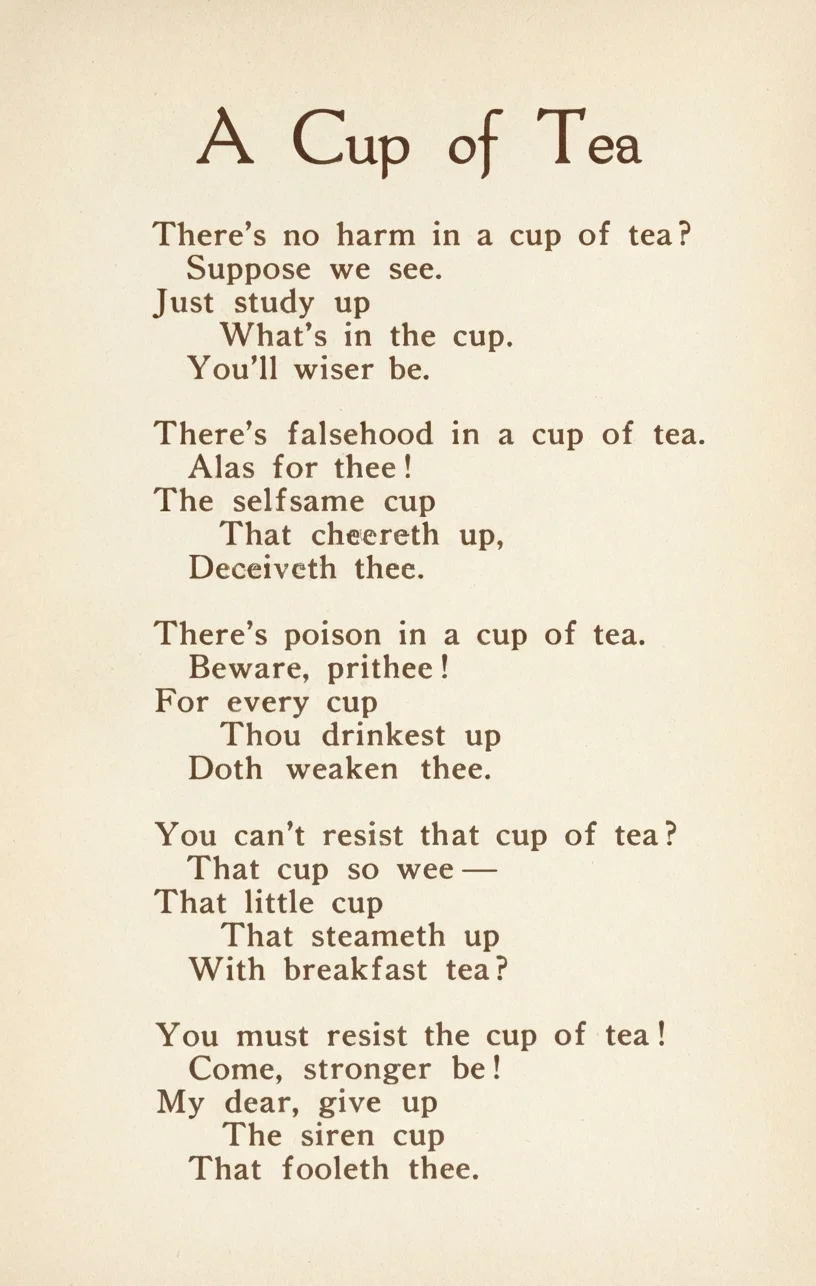
A Cup of Tea

There's no harm in a cup of tea?
Suppose we see.
Just study up
What's in the cup.
You'll wiser be.

There's falsehood in a cup of tea.
Alas for thee!
The selfsame cup
That cheereth up,
Deceiveth thee.

There's poison in a cup of tea.
Beware, prithee!
For every cup
Thou drinkest up
Doth weaken thee.

You can't resist that cup of tea?
That cup so wee —
That little cup
That steameth up
With breakfast tea?

You must resist the cup of tea!
Come, stronger be!
My dear, give up
The siren cup
That fooleth thee.
— Mary Henry Rossiter.
A Cup of Tea There's no harm in a cup of tea? Suppose we see. Just study up What's in the cup. You'll wiser be. There's falsehood in a cup of tea. Alas for thee! The selfsame cup That cheereth up, Deceiveth thee. There's poison in a cup of tea. Beware, prithee! For every cup Thou drinkest up Doth weaken thee. You can't resist that cup of tea? That cup so wee — That little cup That steameth up With breakfast tea? You must resist the cup of tea! Come, stronger be! My dear, give up The siren cup That fooleth thee. — Mary Henry Rossiter.

COFFEE STRONGER THAN WINE

Prof. Brillat Savarin, of Paris, in his work "Physiology of the Senses of Taste," published a few years ago, and translated into German, says: "Coffee is a much stronger drink than people usually believe. A strong man can live long, and drink two bottles of wine a day. The same man could not stand the same quantity of coffee for a great while. He would become imbecile or die of consumption."
Professor Virchow says: "We have at last arrived at the truth that caffein, the quintessence of coffee, is nothing more nor less than a strong stimulant, and when taken in large quantities, a poison like brandy."
The one who takes into his system any kind of stimulant, be it tea, coffee, tobacco, opium, arsenic, or alcohol, is intoxicated just in proportion to the dose taken, and all his actions will be more or less unnatural.
Frequently nervous patients who have been advised by me to give up the use of tea or coffee have said: "O, I can easily do that! I take it very weak, you know." But no matter how weak the tea or coffee may previously have been taken, there was experienced a severe headache and other nervous symptoms. The best evidence that these beverages, even in small doses, are harmful, is the fact that such disagreeable symptoms are produced in the attempt to abandon their use.

SUGGESTIONS IN GIVING THEM UP

In giving up the use of these beverages, take a period of rest for two or three days. Hot milk should be drunk for a few days. Well-beaten, fresh, raw eggs may be stirred into fruit juice or milk and used. By the end of the second day, the headache has probably ceased. Periodic headaches usually disappear, never to return; and chronic constipation of years' standing is sometimes entirely relieved by merely discontinuing the use of these beverages.

The Greatest Disaster

WHEN some great cataclysm of nature startles us with its suddenness and awfulness, we stand aghast at the wreckage wrought.
A Galveston gale, a San Francisco earthquake, a sinking Titanic, a cyclone, a fire, a flood, a famine, will serve to fill the human heart with fear. But not one nor all of these can begin to compare with that which is the supreme terror, and before which all these sink into trivial insignificance.
A wasted life is the acme of dreadful, distressing disaster. Slyly, steadily, steals the enemy upon his prey, and before he is aware, the consciousness of a misspent life strikes terror to the victim.
O dreamer, awake!
"Count that day lost, whose low descending sun Finds naught achieved, and duty's task undone." T. H. JEYS.

Heart-Keeping and House-Keeping

HEART-KEEPING is much like house-keeping. There must be continual sweeping out of dirt and cleaning out of rubbish, a daily washing of dishes, and a perpetual battle with all sorts of vermin. If the heart-cleaning could be done once for all, then the Christian might discharge all his graces and have an easy time of it. And just because the assaults of subtle temptations are so constant, and the uprisings of sinful passions are so frequent, and the task of keeping the inward man what it ought to be is so difficult, many a one who begins a religious life gets discouraged and makes a wretched failure. The question with every Christian is:
Shall the accursed Amalekites of temptation burn up all my spiritual possessions and overrun my soul? Shall outward assaults or inward weakness drive me to discouragement, and disgrace me before my Master and before the world? Or shall they drive me to Jesus Christ, who will give me the victory?—Theodore L. Cuyler.

Cutting Wholesale Bookkeeping Costs

THIS is the subject of the new Burroughs bulletin for wholesalers and jobbers.
This bulletin is filled with short-cut bookkeeping ideas gathered by the Burroughs Information and Research Department from thousands of progressive houses in all lines of business.
"Cutting Wholesale Bookkeeping Costs" shows how wholesalers are getting records and cost figures by simple, short-cut methods and how you can get business-building information in the same way.
Among the short-cut ideas in this bulletin are boiled-down suggestions for getting out monthly statements on the money-collecting dates; for error-proof invoice checking; for a daily sales recapitulation: by actual bookkeeping and statement forms; and other valuable suggestions.
Our purpose in offering you this service bulletin is, that the business man who saves money by using short-cut methods is usually ready to look into the still greater saving he can make by handling these same methods on a machine.
Send the coupon or ask our System Service Department for specific information on your bookkeeping problems.
Send me a copy of your new bulletin, "Cutting Wholesale Bookkeeping Costs." There must be no cost and no obligation to me.
Name.................................................................................................... Firm..................................................................................................... Street.................................................................................................... City and State......................................................................................
Next time your representative is in this vicinity I will also be glad to have him call and explain how a Burroughs Bookkeeping Machine could be profitably applied to my business. O. K...................................................................
Burroughs Adding Machine Company 154 Burroughs Block, Detroit, Michigan. European Office: 76 Cannon St. London, E.C., England.
Makers of adding and adding-subtracting bookkeeping machines, listing and non-listing adding and calculating machines, visible-printing adding and calculating machines — 86 different models in 492 combinations of features — $150 to $950 in U. S. Easy payments if desired.

Christ Our Advocate—The Sanctuary

There is no one thing in the Scripture more illuminating, more comprehensive of all the teachings of the Word, than the subject of the sanctuary, revealing as it does the object and purpose of sacrifice, and the priesthood and work of our Lord Jesus Christ. This little pamphlet on this great subject is 10 cents.
Pacific Press Publishing Assn., Mountain View, Cal.

Cooking Oil for Sale

"Gold Medal" is the highest grade of all cooking oils. It always pleases. Costs a little more, but worth much more. Keeps sweet and pure for years. 5-gallon can, $4.35; 2 cans, $8.50; barrel, $36.00. Freight is low on oil, and two cans cost no more than one. Sanitarium Food Company, 558 Anthony Avenue, St. Paul, Minnesota.

"Melchizedek

OR THE EXALTATION OF THE SON OF MAN"

THE most complete and interesting work ever published on this theme. Endorsed by many Bible students as the only satisfactory explanation of the oath of Jehovah by which Christ is made a priest after the order of Melchizedek. Beautifully bound. Price, prepaid, $1.25. Address Arizona Tract Society, 615 N. Tenth Street, Phoenix, Arizona.

For Sale or Exchange

One hundred and sixty acres of unimproved real estate, adjoining Thatuna Academy farm, a flourishing school, at Viola, Idaho. Can be made a good home. Well-watered and timbered, in addition to tillable land. Will consider exchange for a good house and lot in California town, or country tract. Address J. H. Forney, Moscow, Idaho.

FAST TIME

To and From DENVER, OMAHA, KANSAS CITY, CHICAGO, AND THE EAST
PACIFIC LIMITED From San Francisco 10:20 a.m.
SAN FRANCISCO LIMITED From San Francisco 5:00 p.m.
OVERLAND LIMITED DE LUXE From San Francisco 4:00 p.m.
TO CHICAGO IN LESS THAN THREE DAYS
Protected Throughout with Automatic Electric Block Signals
RAIL AND STEAMSHIP TICKETS SOLD TO ALL POINTS
For information write Mr. C. S. Fee, Passenger Traffic Manager S. P. Co., San Francisco, or any agent.
SOUTHERN PACIFIC

Smoking on Street-Cars

The Journal of the American Medical Association suggests that "when the question, 'Shall smoking be abolished on street-cars?' comes up for settlement with any city, there can be only one answer. From the point of view of hygiene and common cleanliness, to say nothing of the comfort of the majority, smoking on street-cars is an indefensible nuisance." We hope that the Journal, through its medical associates, will make a strong fight against tobacco-smoking in public places. The man who smokes in these days seems to have the feeling that he has the right of way, and that the individual who does not smoke is the nuisance, rather than himself. As rude as the most barbarous savagery, is the man who insists on puffing his vile tobacco smoke in the face of his fellows, and particularly in the faces of women.

The Czar of Russia and the Use of Vodka in His Dominions

REFORMERS in Russia have been seeking for a number of years to suppress the manufacture and the use of vodka, realizing that it was menacing the morality and the prosperity of the nation. But the ministry of finance was invariably opposed to every such reform, because it tended to diminish one of its most lucrative sources of revenue. The czar has been making extensive personal observations, and he expresses "his deep regret at the melancholy spectacle of the people's helplessness and the family wretchedness, the inevitable results of inebriate life." And he further-
more laid down the principle that "the prosperity of the state exchequer ought not to be made dependent upon the moral and material ruin of so many of my subjects."
The government monopoly of spirits was introduced some twenty years ago by M. Witte; and so long as Count Witte remained at the head of the ministry of finance, the revenue from the monopoly never exceeded $250,000,000 a year. But during the last ten years, under the administration of M. Kokovtseff, the revenue from the vodka monopoly has nearly doubled. In 1912 it was $380,000,000, and in 1913 it was $415,000,000, and it is expected to reach $455,000,000 this year.
Count Witte, who introduced the government monopoly of spirits, is one of the strongest advocates in favor of abolishing the evil. The national exchequer has been in a very flourishing condition during the last ten years, but Count Witte asks the question, "Is it merely that our successful budgets of the last decade should be based on the energetic and rapid fostering of the drink revenue?"
Government officials have been very active in the villages, as well as the cities, in cultivating the drink habit, and all in order that they might derive a great revenue from the sale of intoxicants. This is one of the great characteristics of the drink evil. For the mere gain that there is in it, the purveyors of strong drink are willing to destroy human beings, both soul and body. We throw up our hands in horror at the cruelties and the barbarities of war, but what is there that brings greater suffering than this curse of the liquor traffic? It is to be hoped that the czar will be successful in the reforms he is seeking to bring about in his empire.

Is This a Christian Nation?

THERE are some who are emphatically saying that this is a Christian nation. They are continually pointing to many things that they regard as positive evidences that it is such.
There can be no mistaking the fact that the civilization of America, as well as that of the greater part of Europe and much of Asia, has been deeply molded by Christianity. There is a wonderful power in the gospel of Christ to uplift and to help men, even in this life, and that, too, regardless of whether all men will accept Christ.
There can be no question that there are living to-day, not only in this nation, but in many other civilized nations of the world, some of the most stalwart Christians. They are men who stand for the great principles of the gospel of Christ, and the world is feeling the uplifting impulses of these characters. Some of these men are in the churches; some of them are in legislative assemblies; and they may be found in the various walks of life. But we must not make the mistake of regarding the influence of individual men and women who are devoted and true Christians for the characterization of a whole nation.
Christ specifically said, "My kingdom is not of this world," and it is contrary to the whole tenor of His life and teaching to insist upon any of the nations of this world, as such, being styled as Christian. One of the greatest evils of the early and middle centuries of the Christian era was the mistaken notion that nations as such could wield the scepter of Christ. And the climax of the apostasies of the last days will be reached when the nations again will fulfil the prophecies of the Apocalypse by attempting to direct the civil affairs of this world in the name of Christ. Let us beware of the warnings of history, and thereby our minds will be quickened to regard the warnings of the word of God.

Should Not Surely Die

A MAN in Boston who claims that he used to be a minister in one of the evangelical churches, has recently been relating some of his visits, in spiritistic séancés, to other spheres.
On one of these visits, he said, he had the privilege of hearing Plato address an audience. He said that Plato talked in quite an ordinary way, but he expressed most extraordinary thought. Of all the mythological delusions, there is no other so absurd and foolish as the belief that we may converse with the dead.
God said in the beginning, that if man partook of the forbidden fruit, he should surely die, and men from that day to this have been dying in spite of themselves. But there was a master deceiver who contradicted God by saying that man should not surely die, and in order to make good his deceptive offers in the Garden of Eden, he has had to invent the myth that there is consciousness in death. But God's word consistently teaches that "the living know that they shall die: but the dead know not anything." Eccl. 9: 5. One of the greatest delusions of the time is the teaching of those doctrines that are based upon the conscious state of the dead. God's word should be our guide in this doctrine as in everything else.

Thinks Peace to Be Centuries Away

IN a recent address before four hundred students in Harvard University, Dr. Charles W. Eliot, president emeritus of the institution, said:
"During my two years of travel in the far East, in the employ of the Carnegie Institute, I found conditions very discouraging to an advocate of peace. During that time Italy was at war merely for purposes of obtaining territory. Russia was invading Persia, while England looked on without taking any steps for effective interference. Also the Chinese revolution was at its height, and this revolution showed the terrible limits to which war can go."
Following these statements, Dr. Eliot suggests a universal education to develop the masses to the place where they will have peace instead of war, and then adds:
"I myself think that this will take centuries. My report to the Carnegie Institute has not been acceptable to many of the so-called promoters of peace, because they can not wait long enough. They want universal peace within a century. Moreover they fail to see that under present conditions of society, strong armed forces are necessary."
When we regard the facts as shown in the world, we must recognize that the nations are rapidly preparing for the Armageddon war predicted in the book of Revelation. But the divine Book also tells of a class who will be saying, "Peace, peace, when there is no peace," and who will finally reach the point where they will in unison say, "Peace and safety," when they are standing under the forbidding shadows of sudden destruction. The facts concerning the conditions in the world are strangely out of harmony with the sentiments expressed by many people, and it is a marvelous thing that this strange contradiction between fact and theory could have been so clearly outlined by the inspired men of the sacred Book.

Current Events

THE enactment of the enlarged homestead law has opened 211,000,000 acres of lands for entry and occupation under its provisions. These lands are principally in the states of Colorado, Montana, and Oregon. Lands that had been withdrawn in Wyoming and Idaho, to the extent of some 90,000 acres, have also been thrown open to homesteaders. By addressing the Department of the Interior, Washington, D. C., full information can be received concerning these lands.
THE New York World offers the suggestion that a "state constabulary" should be organized to supplement the sheriffs and their deputies in dealing with the "now quite ordinary emergencies growing out of labor strikes and their disorders." The World thinks that a state constabulary would not be so obnoxious to the strikers, and that it would aid in preserving order without putting communities so frequently under martial law.
THE Japanese cabinet resigned March 24. The government issued a statement to the effect that the cabinet had resigned because their congress failed to agree on the budget, and that the pending naval scandal had nothing to do with it; while those opposing the government insist that the corruption among naval officers was the real reason.
A GERMAN aviator has established a new record for height, having reached an altitude of 20,564 feet. And on the same day, an aviator in France carried nine passengers, with an aggregate weight of practically a ton, in one of Belmont's self-balancing aeroplanes. With this load, the Belmont machine reached a height of 5,000 feet.
THE strike in the plant of the Gould Coupler Works at Buffalo, New York, reached such an acute stage on the evening of March 24 that martial law was proclaimed, and five hundred National Guardsmen, who had been on patrol duty, threw a line of pickets around the city.

Ulster and the Situation Confronting England

PRECIPITATED by the home rule incident at Ulster, a very grave issue is confronting the government of England. When leading army officers took sides and threw down the challenge that they would not serve unless the government coincided with their ideas, they made the first advance toward a military despotism; and whenever conditions in a government assume the place where military dictators step in to direct the affairs of state, a very acute stage of danger has been reached.
Leading papers in England recognize the gravity of the situation. The London Daily Chronicle asks, "Are the army officers to dictate to Parliament what bills shall pass?" The London Daily News raises the question as to "whether we are to be governed by Parliament or by the army," while the Manchester Guardian says, "Not only is there one law for the rich man in the army and one for the poor, but there is one standard for the Tory officers' loyalty and another for the private soldier with sympathies for the laboring man."
England is without question one of the strongest and best governments in the world, but she has been maintaining a desperate struggle with her vast army of discontented and poverty-stricken men and women; and while this home rule affair has interjected some new elements, yet the very clamorings of the discontented are undermining the solid structure of government and preparing the way for the reign of anarchy and lawlessness.
If England were the only country in the world where these conditions prevailed, the situation would not be alarming. But the individual is blind to ordinary fact who does not see that every nation on this earth is struggling with the same difficulties that confront England. To-day the situation may be acute in England, and we think it is worse there than anywhere else. But to-morrow the scene may shift to France, to Germany, to Russia, to Japan, to the United States, or to any other nation in the world, and everywhere is revealed the fact that a revolution is smoldering. These conditions are becoming so common that there is great danger of our developing an indifference that ends in ruin and destruction.

You have reached the end of this edition.

Signs of the Times · Apr 14, 1914