“The day of the Lord” is frequently mentioned in the Bible. The expression is often in the very midst of the sublimest and perhaps it would be proper to say most awe-inspiring passages of the Word of God. Joel fairly thrills us with the words, “Blow ye the trumpet in Zion, and sound an alarm in My holy mountain; let all the inhabitants of the land tremble; for the day of the Lord cometh, for it is nigh at hand.” Joel 2:1. Zephaniah fills the mind with emotions of solemn import by his wonderful statement that “the great day of the Lord is near, it is near, and hasteth greatly, even the voice of the day of the Lord; the mighty man shall cry there bitterly. That day is a day of wrath, a day of trouble and distress, a day of wasteness and desolation, a day of darkness and gloominess, a day of clouds and thick darkness, a day of the trumpet and alarm against the fenced cities, and against the high towers. And I will bring distress upon men, that they shall walk like blind men, because they have sinned against the Lord; and their blood shall be poured out as dust, and their flesh as the dung. Neither their silver nor their gold shall be able to deliver them in the day of the Lord’s wrath; but the whole land shall be devoured by the fire of His jealousy; for He shall make even a speedy riddance of all them that dwell in the land.” Zeph. 1:14–18.
Sin is now having its day. Crime is allowed to go apparently unpunished. The wealthy man with his gold can blind the eyes of justice. But there is a Judge whose eyes are too pure to behold iniquity, and His day, even the “great day of the Lord, is near.” And in that day “neither their silver nor their gold shall be able to deliver them.”
One of the crying sins of this time is the corrupting of courts and legislatures by the using of bribes. He who embezzles the savings of widows, and despoils orphans, yes, and that even dares to take the life of his fellow-man, hopes by the use of his “silver” and “gold” to escape the justice that he knows he deserves. This is truly the time when sin and crime, cruel, bold, and wanton, is having its day. It is allowed to pursue its course of blood-curdling criminality for a little while, so that all the universe may see what a hideous monster it is. And surely, when crime is seen in all the phases of its cruelty and injustice, none but the most abandoned and absolutely incorrigible will want to have its day prolonged.
Then there is great hope in the thought of “the day of the Lord,” and also there is joy in knowing that “it is near, and hasteth greatly.” The “mighty man” who “shall cry there bitterly” is he who has resisted every offer of mercy and of the pardon of sin that is now so entreatingly urged upon all. Our Father in heaven loves us, and is seeking in every way that infinite goodness can devise to draw us away from our sins. He knows that there is no happiness in such a life, and so he calls us away from sin because He wants to see us happy. And He is calling all the more urgently now because the day of sin is about ended, and we have only a little time left in which to escape.
While the “day of the Lord” will be filled with solemn import, yet it is a most consoling thought that then the days of injustice will be forever past. The days of crime and the blinding of justice by “silver” and “gold” are gone never to return. Let all who are lovers of justice rejoice. T.
THE POPE’S POLICY CONCERNING SCHOOLS.
The policy of the pope on the school question is quite well set forth in his recent encyclical concerning the Manitoba school controversy that has been waged for so many months. What Leo has to say on the subject is summed up in a paragraph of the Christian Advocate of January 20:—
“An encyclical letter issued by the pope concerning the Manitoba school question regrets the laws that were passed seven years ago repealing the concessions enjoyed by Roman Catholics; condemns undenominational education based on religious neutrality; commends the zeal of the bishops on the subject, but regrets that the laity are divided by party passion; recognizes the attempt of the Canadian authorities ‘to minimize the prejudice to Catholics by the education laws of the province,’ but says that this is inadequate; exhorts the faithful to continue their demand for their rights, but advises them not to reject partial concessions which ‘are likely to lessen the perils attaching to a purely secular education.’ If, finally, they are not able to obtain ‘justice,’ they must themselves furnish the means of founding Catholic schools, and, under the guidance of the bishops, frame a code of instruction reconciling revealed religion with modern progress in science and letters.”
THE SOCIAL QUESTION.
THERE is indeed a social question to-day. And those who have even a smattering of knowledge concerning the events that led up to the French Revolution, are impressed with the fact that the same lawless and revolutionary principles of that period are increasing very rapidly in this country to-day. And under a somewhat different form these same social difficulties present themselves in the other countries as well. Men are fondly hoping that the universal revolution may never come, or some of the more selfish are saying, as did Louis XV. of France, It will not come in my day. The Word tells that there is coming “a time of trouble, such as never was since there was a nation even to that same time; and at that time Thy people shall be delivered, every one that shall be found written in the book.” Dan. 12:1.
It is very evident that this prophecy has its application at the close of time, for the resurrection is most clearly brought to view in the text. Then right in the last days there shall be “a time of trouble, such as never was since there was a nation even to that same time.” The prophet had been permitted to view the rise and fall of nations clear down to the very end. Yes, even the French Revolution, with its Reign of Terror, had passed before his vision. But with all this scene in full prophetic view, he pronounces the “time of trouble” of the last days the greatest of all “since there was a nation.”
Let all who are so anxiously and earnestly asking what the social and political difficulties of to-day portend, turn to the blessed Book and they will find on its pages a clear answer. They will learn that this rising storm of crime, of difficulty between colossal wealth and abject destitution, of shameless and bold licentiousness, of the mutterings of war among all the nations, together with all the other evils of our day, are but the marshaling of Satan’s forces against that “time of trouble, such as never was since there was a nation.”
Are you sheltered from this coming storm? To-day is the day of salvation, but very soon it must be eternally too late.
Ever Increasing
The Scientific American Supplement says that “thirty years ago no gun exceeding five tons in weight was worked on the deck of a ship, or was considered capable of being so worked. To-day guns weighing 110 tons are loaded and manipulated on ship-board, through hydraulic agencies, with the greatest ease. Muzzle-loaders have been superseded by breech-loaders, and power and range are ever increasing.” Thus the power and efficiency of the cannon has been increased twenty-two fold in the last thirty years. Certainly there is a good foundation from more standpoints than one for the statements from General Miles found in another paragraph.
Maine and Smokeless Powder Preparations
The U. S. battle-ship Maine is reported to have sailed for Cuban waters. The report also comes that the Secretary of the Navy has placed an order with one firm for 10,000,000 pounds of smokeless powder. Extra men have been set to work in the big powder mill, and it is said that the prodigious order can be all filled within a few weeks.
IF WE BUT KNEW.
By Eron Alpha Gregory
If we but knew the troubled thoughts arising,
Behind the brows that look so calm and smooth,
We’d leave unsaid the words all light and thoughtless
That sometime rob life of its fairest bloom;
If we but knew.
If we but knew how many weary vigils
The bright eyes gazing in our own had kept,
We would not shadow their brief hour of gladness,
That soon enough will give place to some new
regret;
If we but knew.
If we but knew how heavy were the burdens
Pressing upon weak shoulders everywhere,
We’d come with willing hands and words of kindness
To ease them of the grievous loads they bear.
If we but knew.
If we but knew the erring feet that wander
Far out where rage the dark and ceaseless storms,
Were longing to come back to peace and shelter,
How gladly would we go and guide them home;
If we but knew!
If we but knew how soon the
dear, sweet faces
We love so well, might pass
from earth fore’er,
We would caress them in this
world more often,
With gentlest touch would
wipe away their tears;
If we but knew.
—Eron Alpha Gregory.
THEODORE LANCASTER.
By Priscilla Ann Baker
I was just settin' sponge one evenin' when I heard a deep solemn “whoa!” out to the front gate, an' steppin' to the bay winder I see a top carriage a-standin' out there with a nice-lookin', tired-appearin' old lady an' a young man that looked tireder than her. They didn't git out but looked inquirin' like toward the house, so I went out onto the porch and told 'em good-evenin'. They said so 'twas an' wanted to know if Felix Baker lived here. I was agreeable to that an' invited 'em right in, goin' out to open the gate myself, fur if there's one thing I do like when I go anywheres it's to have folks make me welcome, so I always meet 'em if I sees 'em an' kin. If you'll believe me I went that time no more knowin' who I was to fetch in than you do, but when I see her clost it just flashed acrost me that the lady was old Mis Lancaster from Walnut Hills that I had knowed a long time an' used to visit with when we wus a passel of girls together, but now only onct in a while. She's one of the kindest bodies you ever see, with a plump, neat form, in a plain black grosgrain silk (they own a section), an' wavy, nearly white hair a-crownin' as handsome, wholesome a face as you ever looked into.
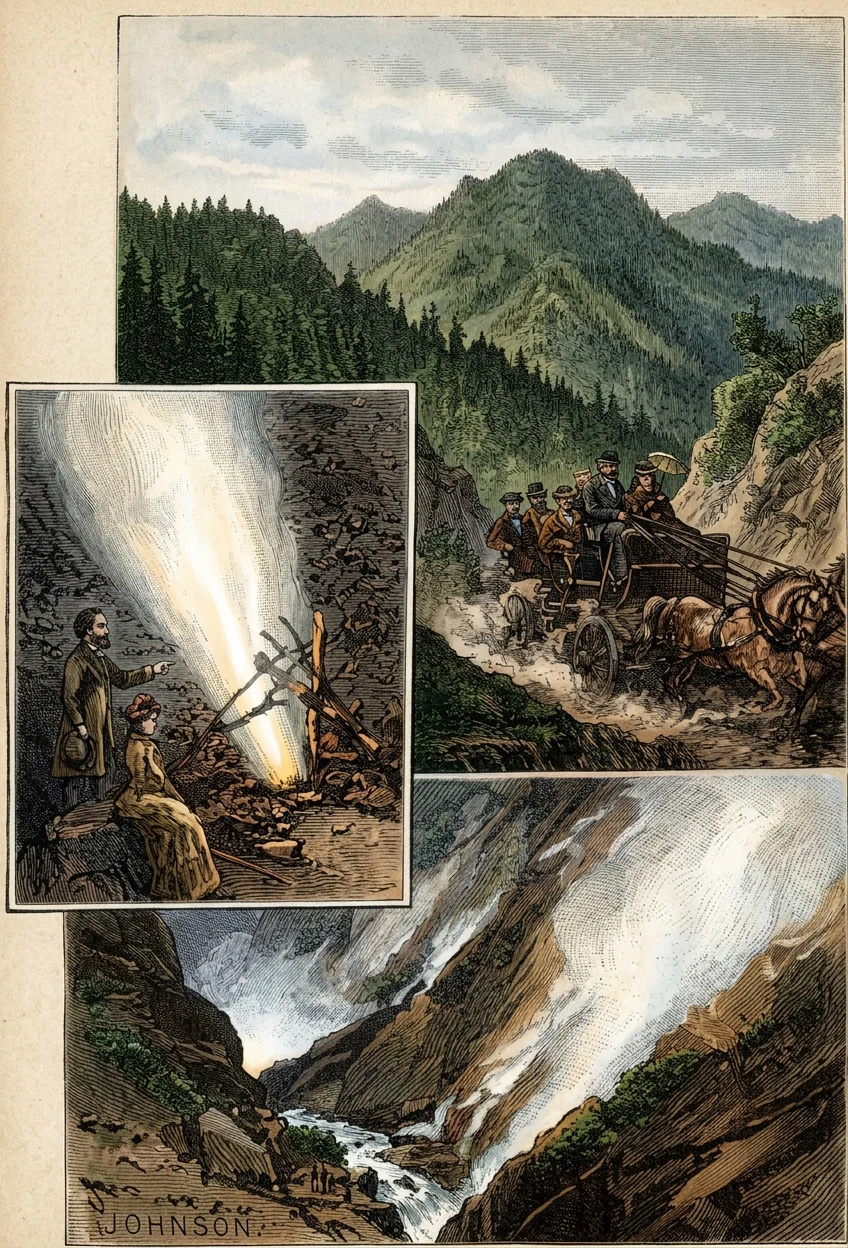
CALIFORNIA SCENERY. NO. 5.—
The Geysers, in Sonoma County, are about one hundred miles north of San Francisco, in the Mayacamas Mountains, 1,700 feet above sea level. One writer says: “Imagine a clear,
The young man was her son; an' after we had had a hearty hand-shakin' I tole him to drive on around to the barn where Baker was, an' brought her into the house. She belongs to the Seventh-day Baptist Church up in the other township, a-keepin' of Saturday for Sabbath, but that never hurt her none, fur she lived up to that an' all the graces besides right along, an' all her neighbors will tell you so as well's me, I ventur'.
I set her into Baker's big rockin'-cheer, an' between her askin' me this an' me askin' her that an' answerin' backwards and forwards I found time to git up a decent supper, fur the fire wusn't out yit an' only needed a few poplar chips, an' I had jell an' blackberries an' blue-monge, besides my warm victuals an' bread, good enough fur inybody. So when the men got in (they'd washed first) an' Baker an' her had spoke conjual, I told 'em to set up an' partake, fur I knowed they wus powerful hungry. Ridin' fifteen miles will make inybody hungry unless they're worryin' about somethin'. But I see to onct that that wus the case with that young man. He's as handsome as his mother only his hair is shinin' black, an' he's slim like, an's got the saddest great black eyes. He took some off every dish I handed him, but my! he didn't know how to 'preciate my cookin', poor feller! an' no wonder, no wonder.
When his mother tol' me, to one side, about his trouble an' all he'd been through, I come nigher feelin' like I did when our little boys both died than I ever hev any other time in my life, only it wus all grief then an' no shame about it. Why, my heart wus melted fur him, an' at the same time shrunk up with shame an' bilin' over with indignation.
Now I'll begin at the beginnin' or you'll never get head or tail of it. As I said before, the Lancasters own a section up beyant Walnut Hills, good yieldin' soil an' medders with some nice open woods pastur'. They had five boys, their only girl dyin' at eight. Two of the oldest ones married, and they built 'em homes on the old place, an' another one lives near, the baby bein' still to home with 'em. But this one, Theodore, he's next the youngest an' the pick of the flock if you could tell which one to pick, he wus that good to the old folks. He got it into his head three or four years ago to go to Arkansas an' git him a big farm where land wus cheap an' the climate mild an' growin'. There wus a senator from there up to Walnut Hills on a visit to his folks, an' he bein' a great han' to talk an' tell all about Arkansas got Theodore, as I said, into a notion of emigratin' right down there.
Well, he wus engaged to a sweet, rosy, intelligent young woman named Abbie Willis, an' so they married to onct. We wus to the weddin', Baker an' me, an' I told him a-comin' home an' he 'lowed it wus so, that a promisin'er-lookin' pair we'd never see jined. The ceremony come off at five o'clock in the evenin', an' all the young people went with 'em in carriages seven miles to the Ohio River, where they got onto a steamboat. That young woman wus as happy as a bird, fur her folks wus to move down in two or three year an' live by 'em if they liked it.
When they got down there, they found the land an' climate right smart like that senator had told 'em an' bragged it wus, an' hevin' ready money furnished 'em, by the time a couple of years had rolled by, they had a pretty little home built with bay an' dormer winders, an' veranders, an' climbin' roses, an' a good barn an' grannery Mis Lancaster said. An' what they thought the most of, a dimpled, bright-eyed little son had been give to 'em. Mis Lancaster told how they'd write about all its little cunnin' ways, an' 'peared 'zif 'twas a perfect delight to 'em. She got a letter from him an' her about that time that she showed me where he says: “Mother, I don't know why God is so good to me. You an' father wus always more than kind to us at home, an' now I have Abbie, the dear, true wife I thought she'd be, an' I know mine's the sweetest baby alive. When I go out to work in the fields, an' hear the birds singin', I look up to the sky and praise God with my whole heart. I haven't a wish except to have you folks an' hers come an' live by us.”
Now, I'll tell you the next word they got from that son, fur you'd never guess it, never. That wus that he wus in jail! Yes, sir, in the county jail among all sorts of burglars, horse-thieves, an' two murderers. “What fur?”—Fur nothin' but tendin' to his own business. As I remarked before, him an' his folks wus Seventh-day Baptists, an' kep' Saturday fur Sabbath, workin' on a Sunday; an' 'twas jist on account of his religion; because some little narrer-minded neighbor happened to see him plowin' corn back on his own farm on a Sunday as he went by to meetin', he felt called on to haul him up before the law. The man as prosecuted him wus a church-member, but he'd never read his Bible much, I'm sure, or he'd thought of Paul askin' us if we have a matter agin' a brother if we dast “to take it to the law before the unbelievers,” an' the Lord sayin', “Not by might nor power, but by My Spirit, saith the Lord.”
It 'peared that a good while ago they had made a Sunday law in Arkansas an' put a claus into it that wus meant to 'low Jews and Seventh-day folks like Lancaster to work Sundays if they didn't disturb nobody else, but a few years ago some of the folks took it into their heads to make Sunday-keepers outen' 'em, an' they ups an' gits the Legislatur' to take that “other day” part out. Some of the big senators wus anxious fur it, but most of 'em jist voted fur it without thinkin' but little of it, an' some thought they'd git “the favor of their constituents,” she said, so the thing went through; an' then 'twas that that overbearin' ole10feller that never hed sensed the first letter of the alphabet the Golden Rule's writ with, up 'an tore a God-fearin' man from his young wife an' tender, helpless baby, an' throwed him into jail fur nothin' under the broad heavens except that he didn't understand the Bible like him on this pint.
Don't you try to tell me it wus because of work bein' done on Sunday, fur there wus all the railroad cars an' steamboats a-runnin' an' a-tootin', the rest'rants an' hotels open, the street-cars an' busses a-goin', besides factories an' lots of people that wus fishin', harvestin', berryin', swappin', an' pleasurin'. No, sir, it wus fur nothin' more'n spite because he kep' Saturday; an' I'll prove it by tellin' how only this man an' others that kep' that day like him ever wus tuck up fur Sunday work.
Well, sir, he wus tried, found guilty, fur he didn't deny it, an' fined som'ers about twenty-five dollars, but he refused to pay it because he hadn't done anything wrong. He claimed that he had a right to worship God as he thought best, or not at all if he didn't want to, as fur as the government was concerned; that this is, or should be, a free country, where a man may serve the Lord, or Allah, or Confucius, an' keep Friday, Sunday, Saturday, or no day at all; an' if you'd read what Thomas Jefferson an' James Madison an' Washington hisself said about sich things in some books that father left to me, you'd see he wus right, that is, if you kin see straight. Well, so because he didn't pay what they'd fined him they kep' him in jail right along.
The weather wus powerful hot, an' while he lay there, his crop goin' to waste, an' his stock runnin' hither an' yan, a friend come one day an' tole him his baby wus sick. O, how he wanted to go to him an' hold the little feller in his arms, fur they had told him how that before he wus tuck sick, he'd look up kinder pleadin' like to his mother, and ask, “Where's papa?” An' now his active little feet, an' chubby, lovin' arms were so still, as he lay not knowin' what wus goin' on about him, his little face so white an' pinchin', an' a little wail creepin' out of his pale baby lips now an' agin. But he couldn't go to him; an' the next day the little feller died—an' his father in jail! His wife wus brought right to him, an' the jailer let her in an' shet the door.
PRISCILLA ANN BAKER.
(Concluded next week.)
NEVER REFUSES A BEGGAR.
“No,” SAYS a well-known member of Congress, in the St. Paul Globe, “I never refuse a beggar now, and I’ll tell you why.”
“Once upon a time I was in St. Louis on business. It was winter, and you know how cold that town can be when it tries hard. I was out on the street at 11 o’clock one bitter night, when a chap struck me for a dime. He was poorly clad, looked hungry and sick, and I ought to have handed out the money at once. I was just brute enough not to do it. He followed me a hundred feet, begging and pleading, and I finally threatened to have him arrested. He turned away with a sob in his throat, and I went on to the hotel.
“There was a big snowstorm that night, and next morning they found him in a drift, frozen stark and stiff. I saw the body and recognized it. The pale face was pinched and drawn with hunger and suffering, and the eyes were as wide open as yours—great big blue eyes, sunken back in their sockets, and staring at me in an awful way. They seemed to be fastened on me alone, and to follow me as I moved. When I heard car-drivers, draymen, bootblacks, and newsboys saying how gladly they would have given the poor wretch a quarter to buy lodgings and food, I sneaked away, feeling that I was a murderer. It hurt me more than I can tell you. I don’t wait now to be asked for alms. I give to some who are, no doubt, undeserving, but I take my chances on that. That thing rests like a murder on my conscience, and nothing like it shall happen again.”
THE BAPTIST CHAPEL CARS.
Of the four chapel cars now in the service of the American Baptist Publication Society, one is engaged under the care of the Rev. J. S. Thomas, one is in use in California and Nevada, one is traveling in Minnesota, North Dakota, and Montana, and the fourth, loaded with Spanish Bibles and tracts, is the instrument of the Rev. A. J. Diaz in his missionary journey to the Mexicans. Money is being collected on pledges for the fifth car, to be known as the Ladies’ Chapel Car, and a sixth, to be built by the young men and their friends, is on the way. The cars have traveled 75,000 miles in the five years since they were instituted, and with them 6,000 meetings have been held, 7,000 sermons preached, 4,000 families visited, 4,000 copies11of Scripture given away, and books, papers, and tracts distributed almost without number. About sixty Baptist Churches have been started, fifty meeting-houses secured, and as many pastors settled over newly organized churches, 100 Baptist Sunday-schools begun, 500 persons baptized, and 5,000 persons converted.—Christian Advocate.
ROSE FROM THE RANKS.
MR. CHAUNCEY M. DEPEW lately visited the Mechanical Department of Cornell University. He found at the head of it Professor Morris. The latter claimed him as an old acquaintance.
“How’s that?” said Mr. Depew.
“I used to work for the New York Central Railroad,” was the professor’s answer.
“Indeed! In what department?”
“O, just in the ranks!”
“How did you get on there?” asked Depew.
“I was first a fireman on an engine. That was a tough job, but it led up to the position of engineer. I made up my mind to get an education. I studied at night and fitted myself for Union College, running all the time with my locomotive. I procured books and attended as far as possible the lectures and recitations. I kept up with my class, and on the day of graduation I left my locomotive, washed up, put on the gown and cap, delivered my thesis, and received my diploma, put the gown and cap in the closet, put on my working shirt, got on my engine, and made my usual run that day.”
“Then,” said Depew, “I knew how he became Professor Morris.”
That spirit will cause a man to rise in any calling. It is ambition, but it is ambition wisely directed, seeking to make one’s self fitted for higher work. When this is accomplished, the opportunity for higher work is sure to come.—Scientific American.
THE DEVIL'S BEANS.
By H. L. Hastings
The Rev. Rowland Hill began his sermon one morning by saying: “My friends, the other day I was going down the street, and I saw a drove of pigs following a man. This excited my curiosity so that I determined to follow. I did so, and to my great surprise I saw them follow him to the slaughter-house. I was very anxious to know how this was brought about, and I said to the man, ‘My friend, how did you manage to induce these pigs to follow you here?’”
“‘O, did you not see?’ said the man, ‘I had a basket of beans under my arm, and I dropped a few as I came along, and so they followed me.’”
“‘Yes,’ said the preacher, ‘and I thought, so it is, the devil has a basket of beans under his arm, and he drops them as he goes along, and what multitudes he induces to follow him to an everlasting slaughter-house! Yes, friends, and all your broad and crowded thoroughfares are strewn with the beans of the devil.’”—The Family Circle, by H. L. Hastings.
ALL THE VOWELS IN ONE WORD.
The following six words are said to be all in the English language which contain all the vowels in regular order: Abstemious, affectious, arsenious, anemious, facetious, and tragedious. “Duoliteral” is said to be the only word which contains them all in reverse order. And there are said to be 149 words which contain all the vowels in irregular order.
SONG OF HOPE.
By Mary A. Lathbury
CHILDREN of yesterday,
Heirs of to-morrow,
What are you weaving?
Labor and sorrow?
Look to your looms again;
Faster and faster
Fly the great shuttles
Prepared by the Master;
Life’s in the loom,
Room for it—room!
Children of yesterday,
Heirs of to-morrow,
Lighten the labor
And sweeten the sorrow,
Now, while the shuttles fly
Faster and faster.
Up and be at it—
At work with the Master.
He stands at your loom,
Room for Him—room!
Children of yesterday,
Heirs of to-morrow,
Look at your fabric
Of labor and sorrow.
Seamy and dark
With despair and disaster,
Turn it—and lo,
The design of the Master!
The Lord’s at the loom,
Room for Him—room!
—Mary A. Lathbury, in Christian Advocate.
O How Little!
It is said that the missionary societies of the United States, Canada, Great Britain, Continental Europe, Asia, Africa, and Australia, number 249, with 4,694 stations, and 15,200 out-stations. The missionaries number 11,659, the native laborers 64,290, and the communicants 1,121,699. There are 913,478 persons receiving instruction. The income in all these countries is $12,988,687. For all this we are glad, but, O, how little it is compared with the demand for missionary labor! There are not a few professed Christians who could, with blessing to themselves, duplicate this sum of money severally. The members of the professed church of Christ spend twelve millions many times told for the filthy and ruinous indulgence of tobacco. How little we believe the Gospel! How little we realize that we are debtors to the souls for whom Christ died! Brother, what shall our accounting be in that last great day?
JOTTINGS FROM THE ORIENT.
By H. P. H.
From the historical standpoint, the bay of Nicomedia is an interesting place. At its entrance from the Sea of Marmora and the Bosporus are several fine islands, where many of the better classes of Constantinople reside. From these islands the bay extends almost directly east, and is about forty miles long and from five to ten miles wide. The country on both sides is quite mountainous, and contains numerous villages, some Greek, some Armenian, some Turkish, and some Tscherkess. As a rule, these various nationalities rarely intermarry, and live each by themselves, so that, altho living in the same district for centuries, their nationality is kept distinct.
At the head of the bay, on the south side, was one of Constantine’s treasure-houses, and a few miles to the east is Sabandje, known as the village of the mother of Constantine. On the north side of the bay, at the head, on slopes rising at an angle of 45°, is Nicomedia, once the capital of the eastern division of the Roman Empire. Under Diocletian, Nicomedia soon reached great splendor, and in population was the fourth city of the world. It was in this city that in 303, at the instigation of Galerius and consent of Diocletian, the last and one of the most bitter persecutions of Christians by pagans broke out, and continued nearly ten years.
Fifteen centuries have left no traces of the former beauty of Nicomedia; a few sections of the old wall are still standing, and a hedge of scrubby shrubs and thorns marks the outline of the entire wall. The present city occupies less than half the space of the ancient city, and contains about ten thousand inhabitants, composed of Turks, Greeks, and Armenians.
TYPICAL TURKISH WOMEN OF THE WORKING CLASS.
Asheres, or “Groves,” an image, probably set up in groves, to represent the goddess Astarte, the female divinity of sun-worship. Its worship “was simply licentiousness under the guise of religion.” —Schaff.
In traveling from village to village in these regions, we were surprised to find that each village has its “high place,” usually the most prominent point about the village, to which the people resort, to burn incense, to pay vows, and, in some cases, on saints’ days to feast. Some of these places are covered with trees; thus they answer to the “high places” and “groves” of the ancient heathen, which were so often a snare to Israel; and, together with the day of the sun, bear witness to the fact that heathen forms and customs still live in the Christian church.
But as in the days of Josiah, so now all heathen elements must be eliminated, all relics of sun-worship put down, and the true worship established. And in these villages, as the Word of God is held forth as the only standard, some accept it, and at once drop all else. The sign by which these are known is the Sabbath. And it has become generally known among unbelievers and nominal Christians that to accept the Sabbath means a marked reform. As soon as one decides in his own mind to keep the Sabbath, he ceases the use of wine and tobacco, as he understands that the Sabbath is a sign that God sanctifies.
The deep-seated dishonesty which reigned in these fields in Paul’s day, and which led a certain poet to exclaim, “The Cretians are always liars,” has not materially decreased. But it is generally understood that when one keeps the Sabbath, he is honest and can be trusted.
In some regions this fact has already become proverbial. While waiting for our horses in one village, Brother Baharian stepped into a store where he was unknown to make a purchase. While waiting his turn, the dealer was weighing out nails and the purchaser took the liberty to throw in a few extra nails to make heavy down weight. Upon this the dealer retorted, “If you were a Sabbath-keeper, you would not do that.”
In another village, so much given to wine that few old people are found, as nearly all die young, one of the worst drunkards embraced the truth. But his relatives were opposed and persecuted him so much that he turned back to his old ways, but he grew worse and became a terror to the village, and so unendurable to his relatives that they cried out, “Let the Sabbath-keepers have him if they will only reform him!” After much labor he was reclaimed, and today is still a faithful witness to the saving power of the truth.
In the province of Nicomedia, there are Sabbath-keepers in seven villages, including Nicomedia. In one of them, Bardizag, situated just across the bay from Nicomedia, is a high school of the American Board. As a result of this school’s work, quite a number in these regions know some English, and some of them are readers of the SIGNS OF THE TIMES.
At present, the truth is making encouraging advancement in this vicinity, and a number of young people are devoting themselves to the work; on account of political conditions, it is not easy for Armenians to move about, but the truth is not bound. Indeed, where there are so many obstacles and sin is so deep-rooted, the victories of the Gospel shine the brighter.
H. P. H.
OUR WORK AND WORKERS.
A CANVASSERS’ institute is appointed for February 17 to March 7, at London, Ontario.
THE addition of six to the church at Chippewa, Mich., is reported by Brother A. R. Sandborn.
A REPORT from the church at Mecosta, Mich., says, “Nearly all the children in our Sabbath-school have made a start to serve the Lord.”
A CHURCH of fifteen members was organized at Watsonville, Cal., January 9. Brethren H. F. Courter, Osborne, and H. H. Dexter officiated.
THE church at Kalamazoo, Mich., recently did a good work by giving a supper to the poor children of the city. Brother Stureman says: “I know this has effected a new experience in our work. The public as well as our church took a lively interest in it.”
BROTHER W. A. SWEANY reports the baptism of four candidates at Albert Lea, Minn., and others awaiting an opportunity. The Scandinavian work there was also prospering under the ministry of Brother E. G. Olsen. The company there will build a new house of worship in the spring.
THE church at St. Charles, Mich., seems to have caught the true spirit of work. A report of the clerk says, “There are calls among the people for readings and prayer-meetings, but we feel that our ministers should be left free to enter new and more extensive fields, and we must do what we can to fill these calls.”
THE Reaper of January 12 says: “We are glad to announce that the work is well under way in Walla Walla, to feed and care for the wants of the suffering. Rooms have been rented and are being fitted up for that work.” We suppose that before this time the good work is under full headway, and enjoying the blessing of God.
BROTHER W. G. BUCKNER, who is laboring in Birmingham, Ala., writes: “I am at present working hard every day in the erection of a house for mission work and for headquarters of the work at this place, where both colored and white people can have an opportunity of finding the truth. It is designed to be operated strictly on the principles laid down in Isaiah 58.”
BROTHER H. F. PHELPS reports to the Worker instances of rescue effort on the part of the church in St. Paul, Minn., which has been doing Good Samaritan work for the past four years. In one family, where the husband could not get work, and the wife had made every effort to secure employment, she had quietly gone without meals in order that husband and son might have what little there was.
BROTHER FRANK R. SHAEFFER rode into Petrolia, Cal., some weeks ago, on a bicycle, arriving on Sunday evening. He did not know any one in the place, but went into the only church in the place. A Methodist minister was to speak, but during the Christian Endeavor meeting which preceded, Brother Shaeffer made a few remarks, after which he was invited by the minister to preach. He did so, and by invitation was asked to continue meetings, which he did for a week, when he was obliged to return to his former field, leaving the Lord to take care of the seed sown.
SISTER VESTA J. FARNSWORTH, on returning to New Zealand from the Australian camp-meetings, writes of a sister at Dunedin, N. Z., “who has been working faithfully in selling the Bible Echo for two or three years. She began with two dozen copies, and has increased to sixty dozen, so she is now selling 720 copies every week. . . . Besides this she has sold, in the past year, 300 copies of our small works, such as ‘His Glorious Appearing,’ ‘Christ our Saviour,’ etc. She also loans tracts to interested12individuals. In addition to this, she is going to take six dozen copies of the Australian Sentinel, and six dozen of the new health journal [which was announced to appear in January]. This sister had not seen one of our ministers for three years, nor did she need to see one, for it was refreshing to the minister to meet such a worker; there was no dearth in her soul.” And so it will be everywhere; where there is faithfulness in distributing the Gospel message, there is the Saviour’s promise, “Lo, I am with you alway, even unto the end of the world.” This letter also notes the addition of twelve members to the church at Christchurch, N. Z.
AN important factor in our work is the use we make of the means in our hands. Pertinent to this subject is the following comment by Elder J. H. Durland in Field Echoes: “How much owest thou unto my Lord?” The apostle Paul answers the above question: ‘A stewardship of the Gospel is committed unto me.’ A steward is one put in charge of property belonging to another person, to administer it in accordance with the wishes and commands of the owner. It is not his property, and yet he has everything to do with it. But in so doing he is under the directions, and subject to the wishes, of the proprietor. He is accountable to his lord, and required to make an explicit return of the way in which he has discharged his stewardship.”