Your ShelfYour Projects

Signs of the Times, Vol. 24, No. 5.

Knowing Christ, No. 2
Earlier text: THE DAY OF THE LORD

THE GOSPEL AT CORINTH

Lesson VIII.—Sabbath, February 19, 1898.

THE GOSPEL AT CORINTH.

Lesson Scripture, Acts 18:1-23, R. V.

1 “After these things he departed from Athens, and came to 2 Corinth. And he found a certain Jew named Aquila, a man of Pontus by race, lately come from Italy, with his wife Priscilla, because Claudius had commanded all the Jews to depart from 3 Rome; and he came unto them; and because he was of the same trade, he abode with them, and they wrought; for by 4 their trade they were tent-makers. And he reasoned in the synagogue every Sabbath, and persuaded Jews and Greeks. 5 “But when Silas and Timothy came down from Macedonia, Paul was constrained by the Word, testifying to the Jews that 6 Jesus was the Christ. And when they opposed themselves, and blasphemed, he shook out his raiment, and said unto them, Your blood be upon your own heads; I am clean; from henceforth I will go unto the Gentiles. 7 And he departed thence, and went into the house of a certain man named Titus Justus, one that worshiped God, whose house joined hard to the synagogue. 8 And Crispus, the ruler of the synagogue, believed in the Lord with all his house; and many of the Corinthians hearing believed, and were baptized. 9 And the Lord said unto Paul in the night by a vision, Be not afraid, but speak, and hold not 10 thy peace; for I am with thee, and no man shall set on thee to harm thee; for I have much people in this city. And he dwelt there a year and six months, teaching the Word of God among them. 12 “But when Gallio was proconsul of Achaia, the Jews with one accord rose up against Paul, and brought him before the judgment-seat, saying, This man persuadeth men to worship 14 God contrary to the law. But when Paul was about to open his mouth, Gallio said unto the Jews, If indeed it were a matter of wrong or of wicked villainy, O ye Jews, reason would that I 15 should bear with you; but if they are questions about words and names and your own law, look to it yourselves; I am not minded to be a judge of these matters. 16 And he drave them from the judgment-seat. And they all laid hold on Sosthenes, the ruler of the synagogue, and beat him before the judgment-seat. And Gallio cared for none of these things. 18 “And Paul, having tarried after this yet many days, took his leave of the brethren, and sailed thence for Syria, and with him Priscilla and Aquila; having shorn his head in Cenchreae; for 19 he had a vow. And they came to Ephesus, and he left them there; but he himself entered into the synagogue, and reasoned 20 with the Jews. And when they asked him to abide a longer 21 time, he consented not; but taking his leave of them, and saying, I will return again unto you, if God will, he set sail from 22 Ephesus. And when he had landed at Caesarea, he went up 23 and saluted the church, and went down to Antioch. And having spent some time there, he departed, and went through the region of Galatia and Phrygia in order, establishing all the disciples.”

QUESTIONS.

1. Tell what led to Paul’s preaching at Athens.
2. Give the substance of his discourse.
3. When he left Athens, to what place did he come? Verse 1.
4. Whom did he find there? Verse 2.
5. What connection did he form with this family? What was their occupation? Verse 3.
6. What did he do every Sabbath day? Verse 4.
7. When Silas and Timothy had come to him (compare chapter 17:15), how was Paul affected? Verse 5.
8. What did the Jews do as Paul preached thus? What was Paul’s reply to their blasphemous opposition? What did he say that he should thenceforth do? Verse 6.
9. In what place did he then begin to teach? Verse 7.
10. What results of his labors were soon seen? Verse 8.
11. What comforting assurance and encouragement in the work did Paul receive at this time? Give the exact words. Verses 9, 10.
12. How long did he therefore continue there teaching the Word of God? Verse 11.
13. What took place while Paul was laboring there? Who was the governor before whom Paul was brought? Verse 12.
14. What was the charge against Paul? Verse 13.
15. What made it necessary for Paul to reply to this charge? What did the governor say about the case? Verse 14.
16. What shows that he knew that Paul was not guilty of any misconduct? Verse 15.
17. How did he treat Paul’s accusers? Verse 16.
18. How was Ps. 7:15, 16 fulfilled in this case? How did the governor regard this conduct? V. 17.
19. What did Paul do? When he finally took leave of the brethren, where did he go? Who accompanied him? Verse 18.
20. Where did he first land? What did he do while there? Verse 19.
21. What encouragement did Paul receive to continue laboring in that place? Verse 20.
22. Why would he not remain? What promise did he make to the friends there? Verse 21.
23. To what place did he then sail? Where did he immediately go on reaching the land of Palestine? After saluting the church, where did he go? V. 22.
24. After spending a time in Antioch, where did Paul go? What did he do in this journey? V. 23.

NOTES AND QUESTIONS.

1. “And when they opposed themselves.” The student must not make the mistake of playing upon the words “opposed themselves,” as is sometimes done in the case of 2 Tim. 2:25, and saying that the writer means to teach that those who oppose the truth oppose themselves. The single Greek word from which the words “oppose themselves” are rendered, will by no means bear such a construction as is often put upon these words. It means simply, “set themselves in opposition.” A reference to Rom. 13:2; James 4:6; 5:6, and 1 Peter 5:5, where the same Greek word is rendered “resist,” “resisteth,” will show that it could not possibly be used in the sense of making opposition to one’s self.
2. Gallio, deputy of Achaia, was brother of the philosopher Seneca, the tutor of the emperor Nero.
3. Verse 22. Paul landed at Caesarea, and “went up and saluted the church.” Altho Jerusalem is not mentioned, it is generally accepted that the “going up” was to that city. The expression is literally correct, as applied to a journey from Caesarea to Jerusalem.
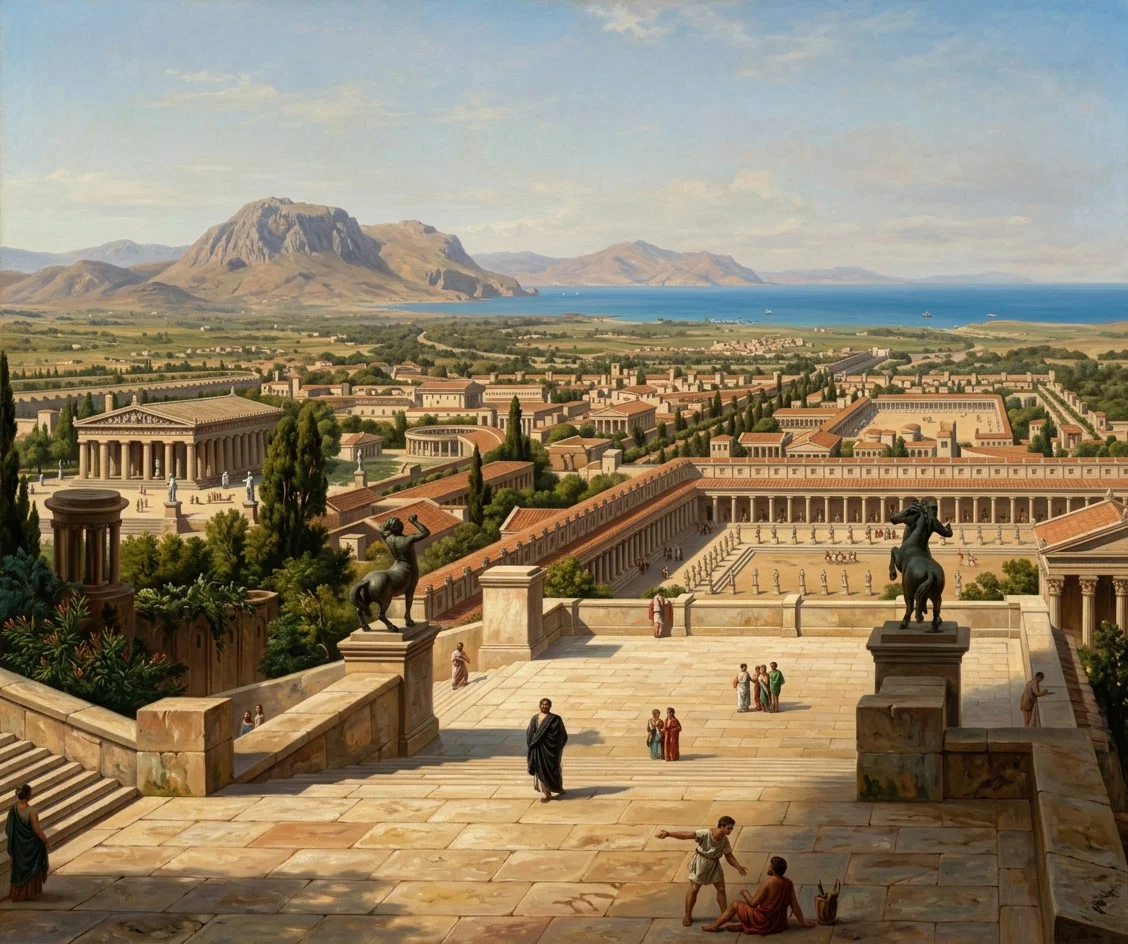
Corinth was the ancient capital of Achaia, a voluptuous city of Greece, about forty miles west of Athens. It was five miles in circuit. On the south was a rocky mountain, rising abruptly to the height of 2,000 feet, on the summit of which was a temple of Venus. Corinth had an extensive commerce, and was celebrated for its wealth, magnificence, and learning. Here the Isthmian games, referred to by Paul (1 Cor. 9:24, 25), were celebrated every four years.

HELPING HAND MISSION.

A most hearty response has already been made to the call for contributions for the Helping Hand Mission in San Francisco. Cash donations are coming in from all over the coast, and some even from the far East. The total amount of cash received up to Jan. 26, 1898, is $318.15.
In addition to the cash, a large amount of clothing, dried fruit, bedding, dishes, table ware, cereal coffee, etc., etc., is promised and will come in as soon as we are ready to receive it.
All contributions of food, clothing, etc., should be addressed, B. F. Richards, Helping Hand Mission, 641 Commercial Street, San Francisco.
Send all cash remittances to Helping Hand Mission, care Pacific Press, Oakland, Cal.
S. N. CURTISS, Secretary and Treasurer Helping Hand Mission.

PERIODICALS WANTED.

GEORGE W. BALDWIN, St. Williams, Ont., requests copies of the SIGNS, Sentinel, and Review, for missionary work. Please send post-paid until the request is withdrawn.

OUR GENERAL AGENTS.

General Eastern Agency.—Pacific Press Pub. Co., 39 Bond St., N. Y. City, N. Y.
General Central Agency.—Pacific Press Pub. Co., 14-18 W. 5th St., Kansas City, Mo.
Argentine—Señor N. Z. Town, Casilla del Correa, 481 Buenos Ayres, Argentine Republic, S. A.
Arkansas Tract Society—Fayetteville, Ark.
Atlantic Tract Society—39 Bond St., New York City, N. Y.
Australia—Echo Publishing House, North Fitzroy, Victoria.
Australian Tract Society—251 St. George’s Road, North Fitzroy, Australia.
California Tract Society—1059 Castro St., Oakland, Cal.
Canada—Int. Tract Society, 268 Crawford St., Toronto, Ontario.
China—A. La Rue, 22 Queen’s Road, East Hongkong, China.
Colorado Tract Society—1112 S. 11th St., Denver, Colo.
Dakota Tract Society—Vilas, S. Dakota.
England—International Tract Society, 59 Paternoster Row and 451 Holloway Road, London.
Florida Tract Society—Box 508, Orlando, Florida.
Foreign Mission Board, S. D. A., 1730 N. 15th St. Phila., Pa.
Germany—International Tract Soc., Grindelburg, 15a, Hamburg.
Illinois Tract Society—324 Dearborn St., Chicago, Illinois.
Indiana Tract Society—1311 Central Ave., Indianapolis, Ind.
International Tract Soc.—271 W. Main St., Battle Creek, Mich.
Iowa Tract Society—603 East 12th St., Des Moines, Iowa.
Kansas Tract Society—821 West 5th St., Topeka, Kan.
Maine Tract Society—North Deering, Me.
Manitoba—W. H. Falconer, 287 Burrows Ave., Winnipeg, Manit.
Maritime Provinces Tract Society—Box 85, Moncton, N. B.
Michigan Tract Society—271 W. Main St., Battle Creek, Mich.
Minnesota Tract Society—Box 989, Minneapolis, Minn.
Missouri Tract Society—14 West Fifth St., Kansas City, Mo.
Montana Tract Society—Box 1192, Helena, Mont.
Nebraska Tract Society—1505 E St., Lincoln, Neb.
Nevada—Cal. Tract Society, 1059 Castro St., Oakland, Cal.
New England Tract Society—South Lancaster, Mass.
New York Tract Society—317 West Bloomfield St., Rome, N. Y.
New Zealand Tract Society—57 Tory St., Wellington, N. Z.
North Pacific Tract Society—508 E. Everett St., Portland, Or.
Ohio Tract Society—Marion, Ohio.
Oklahoma Tract Society—318 4th St., Oklahoma City.
Ontario Tract Society—43 Argyle St., Toronto, Ontario.
Pennsylvania Tract Society—Box 644, Williamsport, Penn.
Quebec Tract Society—S. Stukely, P. Q., Canada.
Scandinavian Tract Society—Ackersgaden 74, Christiania, Nor.
South Africa Int. Tract Soc.—28 a Roeland St., Cape Town.
Southern Tract Society—243 South Boulevard, Atlanta, Ga.
Switzerland—Imprimerie Polyglotte, 48 Weiherweg, Basel.
Tennessee River—324 Cleveland Ave., Nashville, Tenn.
Texas Tract Society—626 and 628 Elm St., Dallas, Tex.
Upper Columbia Tract Society—College Place, Wash.
Utah Tract Society—Box 1058, Salt Lake City, Utah.
Vancouver Island—B. Robb, 231 Pandora St., Victoria, B. C.
Vermont Tract Society—190 N. Winooski Ave., Burlington, Vt.
Virginia Tract Society—2504 E. Clay St., Richmond, Va.
West Virginia Tract Society—Newburg, W. Va.
Wisconsin Tract Society—Milton Junction, Wis.

Angels of God

“Angels of God.” (Spanish.) A collection of five Bible readings on the following subjects: 1. The Angels of God. 2. Satan and His Work. 3. Christ the Resurrection and the Life. 4. The Second Chapter of Daniel. 5. Signs of the Coming of Christ. Two illustrations; paper; price, 6 cents. Address, PACIFIC PRESS PUBLISHING CO., Oakland, Cal.

BIBLE STUDENTS’ LIBRARY.

Reduced Net Price List.

Revised Aug. 12, 1897.
No. Cents.
1 Bible Sanctification. 10
2 Abiding Sabbath. 20
10 Scripture References. 2
14 The Sufferings of Christ. 2
16 Christ in the Old Testament. 1
24 Is Sunday the Sabbath? ½
25 The Sanctuary and the Judgment 1
26 The Sabbath and the New Testament 1
27 The Bible.—Its Inspiration and Importance 1
31 The Second Advent 2
34 God’s Memorial 1
36 The Signs of the Times 1
42 Elihu on the Sabbath 1
43 The Ten Commandments Not Revised 1
46 Without Excuse ½
47 Thoughts for the Candid ½
48 Which Day Do You Keep and Why? ½
49 Can We Know? ½
50 Is the End Near? ½
51 Is Man Immortal? ½
52 Why Not Found Out Before? ½
53 The Sabbath and the Law 20
54 Nature and Obligation of the Sabbath of the Fourth Commandment. 10
55 Order of Events in the Judgment. 15
57 Tent-meeting Lessons on “The Life of Christ”. 1
58 Matthew 24; or the Second Coming of Christ. 10
60 Tent-meeting Lessons on “Prophecy” 1
61 Tent-meeting Lessons on “Sin and Righteousness” ½
63 The Sure Foundation and the Keys of the Kingdom. 1
64 The Full Assurance of Faith 1
65 The Great Day of the Lord 2½
67 Bible Election 1½
68 The Old Testament in the New Dispensation 1½
69 “Jewish.” Christians Are Israelites Indeed. ½
70 Immortality of the Soul 2
71 Righteousness, Where It Is, and How Obtained. Also in Spanish and Portuguese. ½
72 Christ and His Righteousness 15
73 Can We Keep the Sabbath? 1
74 The Counterfeit and the Genuine. 1
75 Living by Faith. Also in Spanish. 1
76 Bible Questions and Answers Concerning Man 1
77 The Talents 1
79 Baptism—Its Significance 1
80 Sunday—Origin of Its Observance in the Christian Church. 15
81 God’s Message for To-day ½
83 Angels: Their Nature and Ministry 20
85 Twofold Evidence of Acceptance with God ½
86 Justification, Regeneration, Sanctification, by M. C. Wilcox. 1
90 The Bible Doctrine of the Trinity. 1
93 Christian Science. Is It Science? Is It Christian? 15
95 From Sabbath to Sunday ½
97 The Sun of Righteousness 10
99 Prediction, Interpretation, Fulfilment. 1
101 The Rest That Remains for the People of God ½
103 Should Christians be Members of Secret Societies? By Mrs. White. 1½
104 Justified by Faith. By Mrs. E. G. White 1
105 The Way to Christ. By Mrs. E. G. White 1
107 Who Changed the Sabbath? (new) 1½
108 Life: Its Source and Purpose 10
110 Appeal to Methodists ½
111 Tormented Forever and Ever 1
112 Spiritualism: Its Source and Character 1
113 “The Christian Sabbath.” (Those Catholic Mirror Articles) 2
114 The Identical Seventh Day 1
115 Waymarks to the Holy City 1
117 Prophetic Lights, Illustrated, 180 pp. 50
118 Christ Tempted as We Are 1
119 The Kingdom of Christ: Its Nature and Subjects 1
121 The Temporal Millennium 1½
122 Perfection of the Law of God 1½
124 Manner of Christ’s Coming 1
125 The Privilege of Prayer. 1
127 Christ as Prophet, Priest, and King 1
128 Christ, Our Advocate, Illustrated 10
130 The Seal of God and the Mark of the Beast, Illustrated 2
131 The Sure Word of Prophecy, Illustrated 10
133 Righteousness 1
134 The Lord’s Day the Test of the Ages, Illustrated 15
135 Honor Due to God 10
136 The Millennial Age 1
137 New Testament Sabbath, Illustrated 1
138 America’s Crisis, Illustrated 2
140 The Saints’ Inheritance. 10
142 Is Sunday Called the Sabbath in the New Testament? ½
143 Truth for the Times 1
144 The Eastern Question. What Its Solution Means to All the World? 1
145 Will a Man Rob God? 10
146 Rich Man and Lazarus 1
147 Home Missionary Work 2
148 The Sabbath in Prophecy 2
149 From Glory to Glory, Illustrated. 1½
150 Rome’s Arraignment of Sabbath-breakers 1
The Bible Students’ Library is published quarterly. Price, 25 cents per year. Address your State tract society.
A STANDING ORDER for a certain number of each new issue insures your getting new numbers as soon as printed. Would it not be well for you to give us such an order?
Pacific Press Pub. Co., Oakland, Cal.
39 Bond St., New York City. Kansas City, Mo.

PILGRIM'S PROGRESS

BY JOHN BUNYAN
A new, clear-type edition of convenient size. Neatly bound in cloth, cover design in colors, 240 pages, size 5x7½ inches.
Price, 50 Cents
Address . .
PACIFIC PRESS PUB. CO., Oakland, Cal.
43 Bond St., New York. 18 W. 5th St., Kansas City, Mo.

News and Notes

FOREIGN.

—It is reported that Russia has decided to send a portion of her Black Sea fleet to Chinese waters.
—The British troops have occupied Okute, in Borgu territory, West Africa, the possession of which has long been in dispute between England and France.
—Considerable excitement has been occasioned at Berlin by the announcement that Russia has formed two new army corps on the German and Austrian frontiers.
—Late advices from Bombay state that during the week the number of deaths from the bubonic plague is 851. The exodus is increasing and business is stagnated.
—An anti-Jewish riot occurred at Algiers on January 24, the mob attacking and looting the stores of the Hebrews. Three hundred arrests were made by the police.
—A private cablegram received at New York on January 20 states that the Government of Chile has decided to undertake the construction of a railway across the Andes.
—The Japanese steamer Nara-maru was wrecked off the Pescadores on December 27, and went down with eighty of her passengers and crew and ten Japanese military officers.
—The Government of Siam has made amends to the United States by degrading and depriving of pay those officers and soldiers who assaulted U. S. Vice-Consul E. V. Kellett on Nov. 19, 1896.
—A company of French marines from a war ship in the harbor of Haipong, China, routed a band of Chinese pirates which had attacked the European residence portion of the city, and routed them, killing thirty.
—During a heated discussion in the French chamber of deputies over the existing relations between the Church and the State, a motion was made for their separation. The motion was defeated by a vote of 319 to 192.
—The black plague has broken out in Yun-nan province, China, and in the city of Chan-I-Cheo deaths are so numerous that coffins can not be procured in sufficient quantities for ordinary burial, and the people are said to be throwing the dead bodies to the dogs.
—The British gunboat Lapwing has seized the steamer Baluchistan, which was carrying a cargo of arms and ammunition for the Baluchistan revolutionists. It is believed that this is one of the vessels which has been supplying the Afridis with arms to withstand the British.
—General Blanco has left Havana, and it is reported that he is on a mission of peace to General Gomez. During the week there have been rumors of plans for a demonstration against the Americans in Havana and other places, but no outbreak has occurred. Two German ships and one British have anchored in the harbor of Havana since the arrival of the U. S. Maine, and French war ships are expected. The Spanish press of both Havana and Madrid are outspoken in their animosity toward the recent act of the American administration in sending the Maine to Cuba, and in consequence the powerful Spanish cruiser Vizcaya is to be sent to New York.
—The Canadian Government has let a contract for a railway from Telegraph Creek, at the head waters of the Stickeen River, to Teslin Lake, so as to connect with navigation to Dawson. The length of the road will be 130 miles, and it is to be completed by next September.
—A speaker at a recent missionary convention held in Exeter Hall, London, stated that less than one-seventh part of her majesty’s 350,000,000 subjects are Christians; 240,000,000 are in the darkness of heathenism; and 60,000,000 in the partially lighted darkness of Mohammedanism.
—The members of the French chamber of deputies in Paris, indulged in a riot on January 22 similar to those which recently took place in the Austria-Hungary chamber of deputies. The cause for the disturbance was certain references made concerning the connection of M. Zola with the Dreyfus affair.
—A riot was precipitated by the Socialists in the Belgium chamber of deputies, at Brussels, on January 25. A mob seeking to mingle in the melee was held in check by the soldiers, while a hand-to-hand fight was in progress between the Socialists and anti-Socialists. A strong body of police was required to quiet the disorder.
—The republic of Ecuador is now seriously threatened with a revolution against President Alfaro. A large armed body headed by exiled chiefs of the clerical and conservative parties now in Peru has gathered at the border with the intention of crossing into Ecuador. Both governments are trying to prevent the invasion.
—Recent reports from the Philippine Islands tend to show that the Spanish official reports of the close of the rebellion there were not founded on fact. The Japanese Daily Advertiser asserts that the rebellion is still in full force in seven of the Philippine provinces, and publishes an edict of the captain-general which rivals Weyler’s in cruelty.
—The emperor of Corea has asked the United States minister at Seoul for protection from revolutionists. The emperor fears that a revolution might be taken advantage of by an interested power, and thus Corea lose her independence. The captain of the cruiser Boston, now at that place, has refused to land a naval force, though strongly urged to do so by the emperor.

DOMESTIC.

—A disastrous fire occurred in East St. Louis on January 25, destroying property to the value of $1,000,000.
—The House Committee on Territories has rejected the bills providing for the statehood of Arizona, New Mexico, and Oklahoma.
—Joseph McKenna, of California, took the oath of office as associate justice of the Supreme Court of the United States on January 26.
—The “Great Eastern” block in Spokane, Washington, was burned on January 25, and eight persons perished in the flames. The building was valued at $120,000.
—The city of Helena, Arkansas, and several nearby towns were startled by a severe earthquake shock on the evening of January 26, tho no serious damage is reported.
—Late advices from the Alaska gold fields state that Capt. Philip H. Ray, of the United States Army, has declared martial law at Fort Yukon to protect the caches of provisions belonging to the two companies who have stores at that place.
—It is reported that a “sweeping revival” is taking place at Sandwich, Illinois; that every evening about one thousand men march in double file to the tabernacle; that people who have been at enmity are settling their differences, and debtors are paying their debts.
—The suspected filibustering steamer Tillie was wrecked off Barnegat on January 23. She carried forty tons of dynamite, three dynamite guns, and a considerable quantity of ammunition for the Cuban insurgents. Four of the crew went down with the vessel.
—President S. B. Dole, of Hawaii, reached Washington on January 26, and with his company was received by the Secretary of State, was afterward waited upon by President McKinley at his hotel, and later in the day the distinguished guest was received at the White House by the President.
—The Church Extension Society of the Methodist Churches of San Francisco has decided to assume all the indebtedness of the various Methodist Churches in that city, intending to clear them all of debt before the year 1901. The debt is to be divided into shares of $10 each, and the members encouraged to take as many shares as possible.
—The State of California celebrated its Golden Jubilee on January 24 with a grand parade in San Francisco, accompanied with military and literary exercises. The parade was a truly cosmopolitan one, including organizations of Germans, Irish, Spanish, Portuguese, Chinese, and Indians, numerous civic societies, several different military organizations, and many parlors of Native Sons and Daughters, making in all a procession about five miles long. The parade was the ushering in of California’s golden jubilee week, it being just fifty years since Marshall’s discovery of gold at Sutter’s Mill.
—A committee of the Illinois Senate is investigating the charge that a regular system of police blackmail is being practised in Chicago upon the keepers of opium joints, both white and Chinese. It is charged that some keepers of opium joints pay as high as $10 per week to certain individuals for protection from police molestation.
—Two new cruisers for the Japanese navy were launched in the United States during the past week, one at the Cramps ship-yards in Philadelphia and the other at the ship-yards of the Union Iron Works in San Francisco. These are both protected cruisers of the latest pattern, and are to have a speed of twenty-two and one-half knots.
—A remarkable illustration of the influence of heredity is shown in the case of a Philadelphia boy murderer who hacked his playmate to pieces and threw his body into the river. In speaking of his crime he said: “My grandfather killed his man, my father killed his man, and now I have killed my man, so we are all alike.” The boy shows no remorse for his deed, but rather glories in his notoriety.
—It is reported that thirteen different syndicates are represented in the company of engineers now with the Nicaragua Canal commission, each syndicate being desirous of digging the great waterway. The commission has reported that the canal can be constructed for less than three-quarters of the original estimate. In view of this report it is conceded that Congress can not further avoid authorizing its construction.
—The United States battle-ship Maine sailed into the harbor of Havana on January 25, and received from the forts and vessels in the harbor the usual courtesies extended to such a visitor. While officials state that this visit has no particular significance, almost the entire Atlantic squadron is within a few hours’ sail of Havana, and other vessels of the squadron have been ordered to join the fleet at its present rendezvous.
—Within the last three weeks fourteen murdered babies have been found in the vicinity of West Hoboken, N. J. In most cases the babies had been strangled before they were two days old. The police state that many an unwilling mother is willing to pay $25 or more to have her child “adopted” by some one who she thinks will be kind to it, and these adopters find it more profitable to dispose of the children in this shocking manner.
—The Baptist Publication Society in summarizing the work done by its five chapel cars, presents the following interesting figures: “During the five years since they were instituted, the cars have traveled 75,000 miles, 6,000 meetings have been held, 7,000 sermons preached, 4,000 families visited, 4,000 copies of the Scriptures have been given away, and books, papers, tracts, etc., distributed without number. About 50 Baptist Churches have been started, 50 meeting-houses secured, 100 Sunday-schools started, and 5,000 persons converted.”
Continue reading: THE TWELVE SENT FORTH